Why Your Store Needs Ecommerce Website SEO to Survive
Why Most Online Stores Struggle to Survive Without SEO
Ecommerce website SEO is the practice of optimizing your online store so that product pages, category pages, and content appear in Google search results — without paying for ads.
Here’s a quick breakdown of what it involves:
| What It Is | What It Does |
|---|---|
| Keyword optimization | Connects your products to what buyers are searching for |
| Technical SEO | Helps Google crawl and index your store efficiently |
| On-page content | Convinces both search engines and shoppers to choose you |
| Schema markup | Displays prices, ratings, and stock info directly in results |
| Link building | Builds authority so Google ranks you over competitors |
The stakes are high. 75% of people never scroll past page one of search results. If your store isn’t there, you’re essentially invisible.
And visibility matters more than most store owners realize. Organic search drives an average of 43% of ecommerce revenue — yet most small stores invest nothing in it. Every day without SEO is a day your competitors are capturing customers you could have had.
The good news? SEO compounds. Traffic earned today keeps paying off for months and years — unlike paid ads, which stop the moment your budget runs out.
I’m Nic Canobbio, founder of Canatos Media, and with over two decades of experience in media strategy and content production — including building digital-first brands with millions of views — I’ve seen how ecommerce website SEO separates stores that scale from ones that stall. Let’s walk through exactly how to build that foundation.
Defining Ecommerce Website SEO and Its Strategic Value
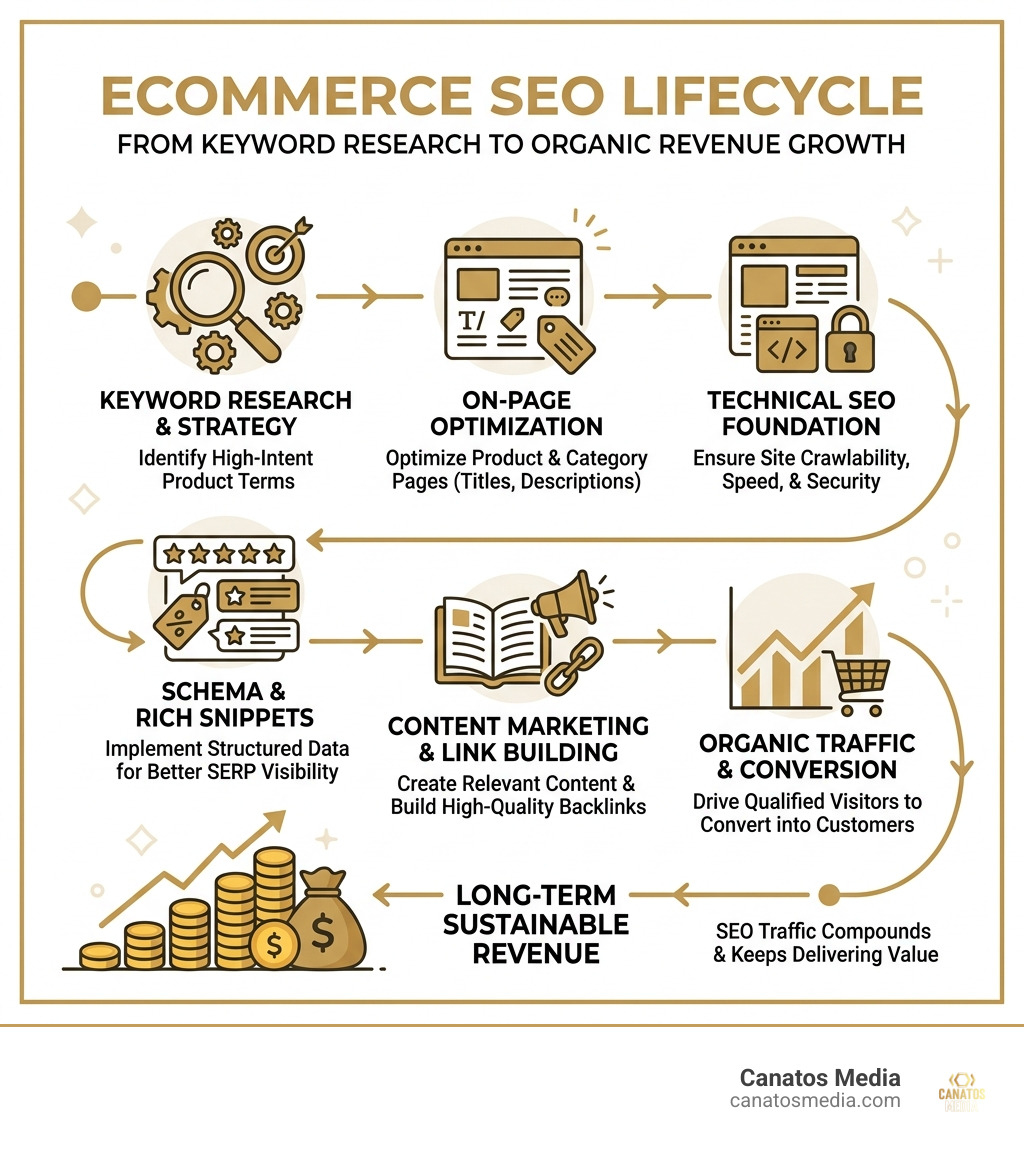
When we talk about ecommerce website seo, we are describing a specialized branch of search engine optimization. Unlike a blog or a standard business site, an online store has “transactional intent.” This means the people searching aren’t just looking for information; they are looking to pull out their credit cards and buy something.
In 2026, the search engine results pages (SERPs) have evolved. Google doesn’t just show blue links anymore. For ecommerce queries, you’ll see product carousels, rich images, and price comparisons. If you aren’t optimized, you won’t appear in these high-converting visual sections.
The strategic value of SEO lies in its ability to drive organic revenue. While paid ads are great for a quick spike, they are a variable cost that eats into your margins. SEO, on the other hand, is an investment in an asset you own. According to research, organic traffic for ecommerce can have a 15x ROI compared to paid ads over a 24-month period.
Beyond just sales, ecommerce website seo builds brand authority. When you consistently rank for “best dog halloween costumes” (a keyword that gets 1.3K searches monthly) or specific product names, shoppers begin to trust you as a leader in your niche. This trust makes customer acquisition significantly cheaper over time.
For those looking to stay ahead of the curve, we also focus on AI Search Optimization, ensuring your products are the ones recommended by AI assistants and LLMs. For a deeper dive into the mechanics of ranking, check out this Ecommerce SEO Guide: Boost Rankings & Sales in 2026.
Building a Scalable Site Architecture and Category Framework
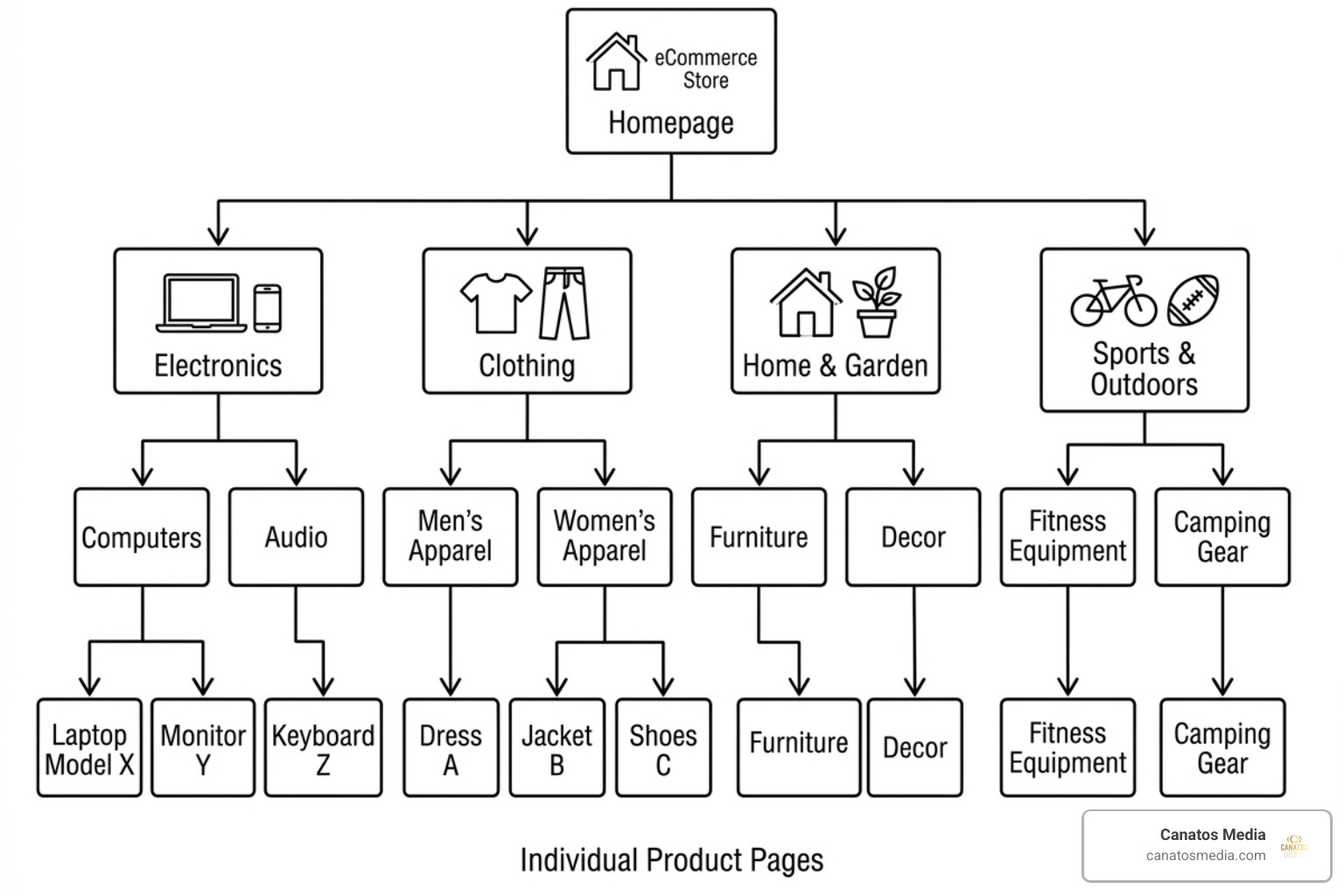
One of the biggest mistakes we see in Long Island ecommerce shops is a messy site structure. If Google’s “crawlers” get lost in your site, they won’t index your products. We advocate for a “flat” site architecture.
The 3-Click Rule
A golden rule for ecommerce website seo is that a user (and a search engine) should be able to reach any product on your site within three clicks from the homepage. The structure usually looks like this:
- Homepage -> Category Page -> Subcategory Page -> Product Page
Category Hierarchy and Faceted Navigation
Your category pages are your “landing pages” for broad search terms. If you sell shoes, your “Men’s Running Shoes” category page is a vital SEO asset. However, large stores often use “faceted navigation” (filters for size, color, price). If not managed correctly, these filters can create thousands of duplicate URLs, wasting your “crawl budget.” We use canonical tags to tell Google which version of the page is the “master” copy.
URL Structure and Breadcrumbs
Clean URLs are essential. Instead of a URL like mystore.com/p?id=12345, we want mystore.com/shoes/mens/nike-air-max. This tells both the user and Google exactly what is on the page. We also implement breadcrumb navigation, which provides a clear path back to the homepage and helps Google understand the relationship between pages.
At Canatos Media, our services include auditing these structural elements to ensure your site is built for growth. Proper internal linking—connecting your blog posts to your products—further distributes “link equity” across your site, boosting the rankings of your most important pages.
On-Page Excellence: Product Pages and Content Strategy
Your product pages are where the “magic” happens—it’s where browsers become buyers. To rank well, you cannot simply copy and paste the manufacturer’s description. Google views that as “duplicate content” and will often hide your page in favor of the original source.
The 300-Word Rule
We recommend at least 300 words of unique content for every product page. This content should cover:
- Features and Benefits: What does it do, and why does the customer need it?
- Specifications: Size, weight, material, etc.
- Use Cases: How and where should the product be used?
Product Page Essentials
To maximize ecommerce website seo, every product page must include:
- Unique Title Tags: Include the Brand + Product Name + Key Attribute (e.g., “Sony WH-1000XM5 Wireless Headphones – Black”). Keep these under 60 characters.
- Compelling Meta Descriptions: These are your “ad copy” in the search results. Include perks like “Free Shipping” or “30-Day Returns” to boost your click-through rate.
- Image Alt Text: Google can’t “see” images, so we use alt text to describe them (e.g.,
alt="mens-black-nike-running-shoe-side-view"). - User Reviews: Reviews provide fresh, unique content that Google loves. They also act as social proof for Conversion Rate Optimization (CRO).
For small businesses in the Tri-State area, understanding SEO for Small Businesses UK: What Actually Works (2026) provides great parallel insights into how localized competition works, even if the geography is different.
Buying Guides and Content Marketing
Don’t just sell; educate. Creating buying guides (e.g., “The Ultimate Guide to Choosing a Hiking Tent”) allows you to rank for “informational” keywords. You can then link these guides directly to your product pages, moving customers through the sales funnel.
The Role of Structured Data in Ecommerce Website SEO
Structured data, or “Schema markup,” is a piece of code you add to your site to help search engines understand your content. For ecommerce, this is non-negotiable.
When you implement Product Schema, Google can display “Rich Snippets” in the search results. This means a shopper can see your product’s price, whether it’s in stock, and its star rating without even clicking on your site.
- AggregateRating: Shows the average star rating and number of reviews.
- Offer Schema: Displays the price and currency.
- Availability: Shows “In Stock” or “Out of Stock” status.
Rich snippets can increase your organic click-through rate by up to 30%. It provides price transparency and availability signals that build immediate trust with the shopper.
Technical Foundations and Performance Benchmarks
Technical SEO is the “engine” of your website. If the engine is broken, the car won’t move, no matter how pretty the paint job (content) is.
Page Speed and Core Web Vitals
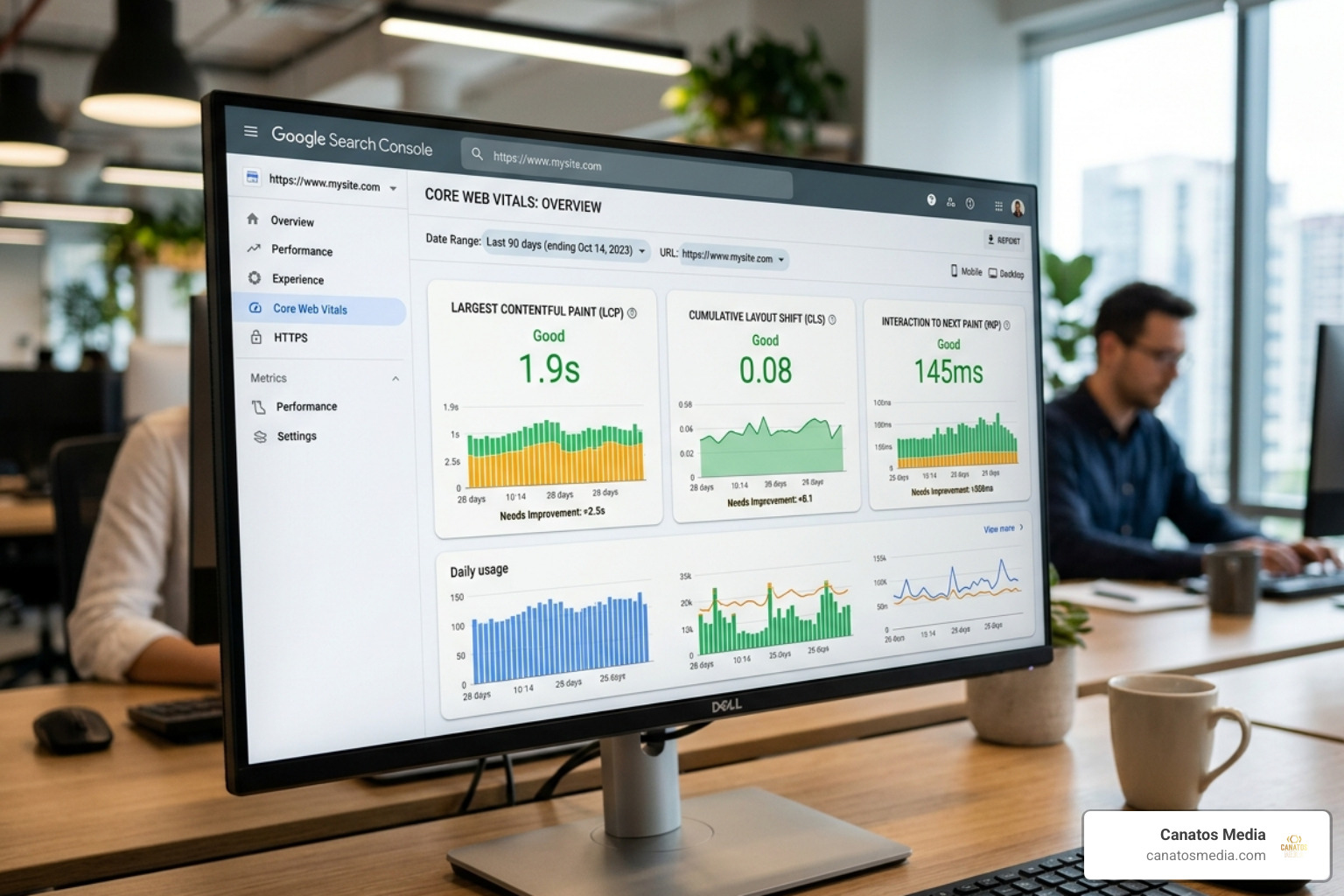
In 2026, page speed is a confirmed ranking factor. Google uses “Core Web Vitals” to measure user experience:
- LCP (Largest Contentful Paint): How fast the main content loads. Target: Under 2.5 seconds.
- CLS (Cumulative Layout Shift): Does the page jump around as it loads? Target: Under 0.1.
- INP (Interaction to Next Paint): How responsive is the site when a user clicks something? Target: Under 200ms.
Slow sites lose money. Every 1-second delay in page load can result in a 7% drop in conversions. We help clients optimize these metrics through image compression, minifying code, and using Content Delivery Networks (CDNs). You can learn more about how we package these technical fixes in our pricing section.
Mobile-First Indexing
Google primarily uses the mobile version of your site for ranking and indexing. If your store looks great on a desktop but is hard to use on a phone, your rankings will suffer. Ensure your buttons are easy to click and your text is readable on small screens.
Essential Technical Files
- HTTPS: An SSL certificate is mandatory for security and ranking.
- XML Sitemaps: A map of your site that you submit to Google Search Console to ensure every product is found.
- Robots.txt: A file that tells Google which pages not to crawl (like your checkout page or admin login).
- Canonical Tags: These prevent duplicate content issues by pointing Google to the “main” version of a page.
Prioritizing Keywords for Ecommerce Website SEO Success
Keyword research for ecommerce is different from blogging. We aren’t just looking for high volume; we are looking for commercial intent.
We categorize keywords into two main buckets:
- Informational: “How to clean leather boots” (Good for blogs).
- Transactional: “Buy men’s timberland leather boots size 10” (Good for product pages).
Using Transactional Modifiers
To capture buyers, we target keywords with “modifiers” like:
- Buy
- Price
- Sale
- Best
- Discount
- Free Shipping
The Power of Long-Tail Keywords
While “shoes” is a high-volume keyword, it is nearly impossible to rank for. However, “waterproof trail running shoes for wide feet” is a long-tail keyword. It has lower search volume but much higher conversion rates because the user knows exactly what they want.
| Query Type | Example Query | Intent | Difficulty |
|---|---|---|---|
| Informational | “What are the best running shoes?” | Researching | High |
| Commercial | “Nike vs Adidas running shoes” | Comparing | Medium |
| Transactional | “Buy Nike Air Max 270 size 11” | Ready to Buy | Low/Specific |
We often use Amazon’s autocomplete and Google’s “People Also Ask” sections to find these specific phrases that shoppers are actually typing.
Frequently Asked Questions about Ecommerce SEO
How long does it take to see results from ecommerce SEO?
SEO is a marathon, not a sprint. Typically, you will start to see initial ranking movements within 3 to 6 months. However, the real “compounding growth” usually kicks in around the 12-month mark. This is when the ROI becomes significantly more attractive than paid advertising.
Can I build a successful store using only SEO?
While it is possible—especially in “restricted industries” (like vape or CBD) where you can’t run traditional ads—we generally recommend a multi-channel approach. SEO provides the sustainable, long-term foundation, while paid ads (SEM) can provide immediate traction while you wait for your organic rankings to climb.
How do I handle out-of-stock products for SEO?
Never just delete a page! If a product is temporarily out of stock, keep the page live, update the schema to “OutOfStock,” and add a “Notify me when back” button. If a product is permanently discontinued, use a 301 redirect to send users (and search equity) to the most relevant current product or the parent category page.
Conclusion
In the competitive landscape of 2026, ecommerce website seo is no longer an optional “extra”—it is a survival requirement. Without a clear strategy for site architecture, technical health, and high-intent keyword targeting, your store is leaving money on the table for competitors to grab.
At Canatos Media, we specialize in an integrated strategy that connects cinematic content, precise targeting, and technical SEO to drive measurable growth for businesses in the Tri-State area and Long Island. We don’t just want you to rank; we want you to sell.
Ready to stop being invisible and start scaling your organic revenue? Contact Us to scale your ecommerce store and let’s build a storefront that works as hard as you do.