Why Multi-Location Businesses Struggle with Video Content Costs
Running video production across multiple locations feels like solving a math problem with no solution. You need fresh, professional content at each branch, but shooting, editing, and distributing separate videos for each location multiplies both your timeline and budget. A single cinematic shoot might cost $5,000 to $15,000. Multiply that by three, five, or ten locations, and you’re looking at a six-figure spend before you’ve even measured results.
The real expense isn’t just the cameras and crew. It’s the coordination overhead. Scheduling shoots across different time zones, managing multiple editing projects, maintaining brand consistency when different vendors handle different locations, and then distributing content through fragmented channels. Each layer adds cost and complexity.
Many multi-location businesses respond by either stopping video production entirely or settling for low-quality internal content that doesn’t match their brand standards. Neither approach serves your growth.
The Real Problem: Fragmented Marketing Across Multiple Locations
Video content isn’t expensive because cameras are expensive. It’s expensive because most production workflows treat each location as a separate project.
Consider a typical scenario: Your Denver office needs promotional content, so you hire a local production team. Your Austin location has different needs, so you hire another vendor. Your Chicago team does their own thing with a smartphone. Within months, you have inconsistent messaging, different visual styles, and no cohesive brand story. Your customer sees three different versions of your company depending on which location they interact with.
This fragmentation kills your lead generation. When someone researches your multi-location business, they expect consistency. A professional video from one location followed by a low-quality clip from another signals that you’re either disorganized or that quality varies by location. Neither impression builds trust.
The cost problem and the brand consistency problem are actually the same problem: siloed production workflows.
How Efficient Production Scales Without Scaling Expenses
Scaling production doesn’t require scaling your budget linearly. The breakthrough comes from building a repeatable system where one shoot produces content for multiple locations and channels.
Here’s how it works: Instead of treating each location as a separate project, we structure shoots to capture content that serves your entire portfolio. A single production day might film testimonials, process demonstrations, team introductions, and facility tours that get customized and repurposed for each branch. One shoot yields 15 to 20 short-form videos instead of one.
The production cost stays roughly the same. The output multiplies.
You also reduce coordination overhead by batching shoots. Instead of scheduling separate production days across multiple locations, you plan quarterly or bi-annual production cycles where you visit 2 to 3 locations in one trip. This concentrates travel costs and maximizes crew efficiency.
Your next step: Audit which content types work across all your locations (testimonials, behind-the-scenes, process videos, team introductions) and which need location-specific treatment. This audit immediately shows you where you can batch content and where efficiency gains are highest.
Our Streamlined Video Production Process for Growing Brands
We’ve built our production workflow specifically for multi-location businesses. The process eliminates waste without cutting corners on quality.
Here’s our approach:
Planning phase: We identify core content themes that apply across all locations, then customize them by location. A “day in the life” video works everywhere, but each location’s version highlights local team members and specific facilities.
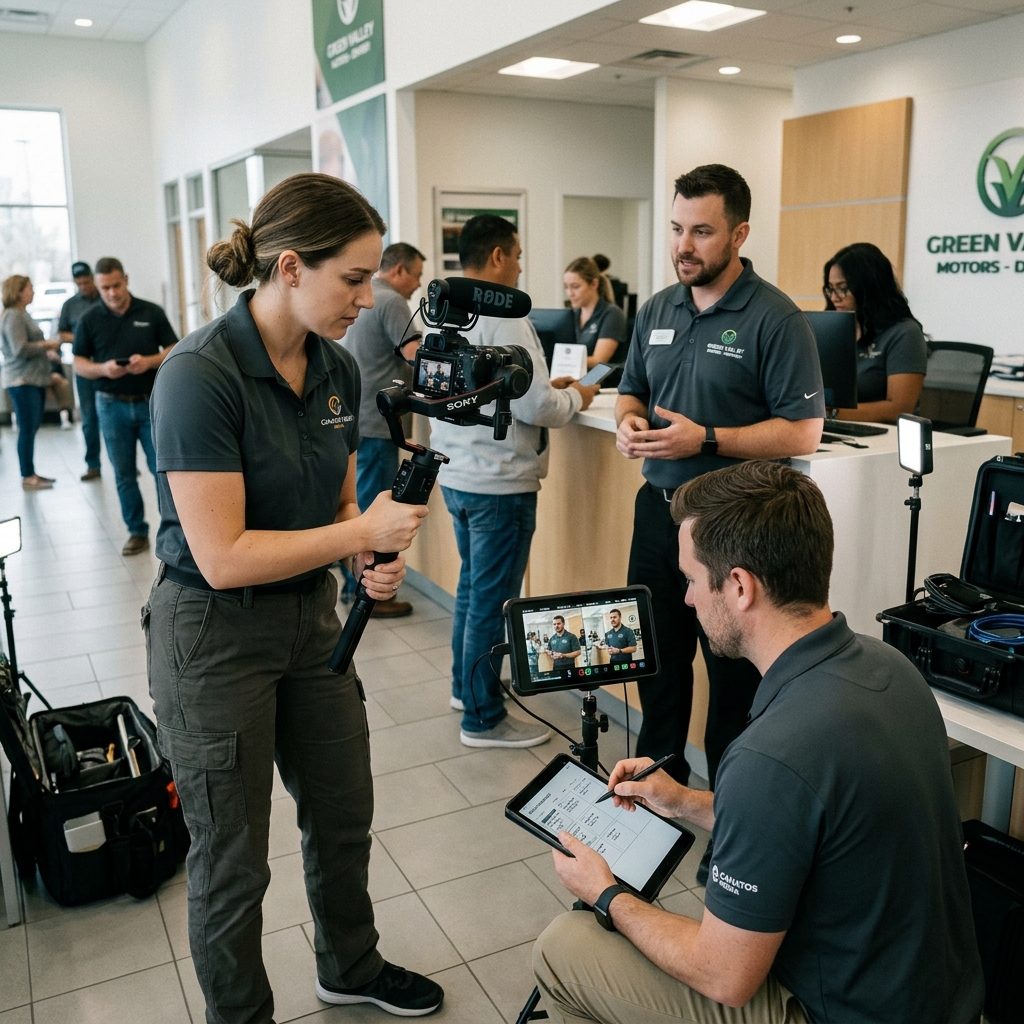
Batched production: We consolidate shoots to visit multiple locations in a single cycle. This means coordinating with your teams once rather than multiple times, and maximizing our crew’s efficiency.
Modular filming: We capture footage that adapts to different formats and channels. A single interview becomes a 60-second social clip, a 15-second reel, a testimonial tile, and a long-form case study. One shoot, multiple assets.
Centralized editing and quality control: All content flows through one team, ensuring consistent color grading, sound design, and messaging.
This structure cuts typical production costs by 30 to 40 percent compared to location-by-location shoots while improving consistency. You can see our flexible production pricing to understand how this scales with your business.
Creating Consistent Brand Storytelling Across All Locations
Consistency doesn’t mean every video is identical. It means every video tells a recognizable version of your brand story.
Multi-location businesses often struggle because each location develops its own culture and approach. That’s healthy. But when it extends to completely different visual styles and messaging, it fragments your brand. A customer in Denver shouldn’t see a fundamentally different brand experience than a customer in Austin.
We solve this with a brand framework that works across locations. This includes:
- A shared visual language (color palette, typography, motion style, music choices)
- Core brand values articulated in a way each location can apply locally
- Recurring video formats that feel familiar to your audience
- Messaging pillars that every location reinforces
So your Denver team might feature a different team member in a “expert tips” video than your Austin location, but both videos look and feel like they came from the same company. The messaging about reliability, expertise, or customer care stays consistent even as the specific examples change.
This approach also makes content production faster. Once the framework is set, each location’s team can brief the production crew in 20 minutes instead of 2 hours, because the vision is already clear.
Integrating Video Content with Social Media Management
Video is expensive to produce but cheap to distribute. Most multi-location businesses under-leverage their video by treating each piece as a standalone asset instead of the centerpiece of a distribution strategy.
We integrate video production with social media management so that each video drives results across channels. A single production deliverable becomes:
- 3 to 5 short-form reels optimized for Instagram, TikTok, and Facebook
- Carousel posts with video clips and captions for LinkedIn
- Email campaign assets with embedded video
- Website homepage video and location-specific pages
- Paid advertising creative
This multi-channel approach means your production investment works harder. The $3,000 you spend on video production generates 15 to 20 content pieces that get distributed over 8 to 12 weeks across platforms.
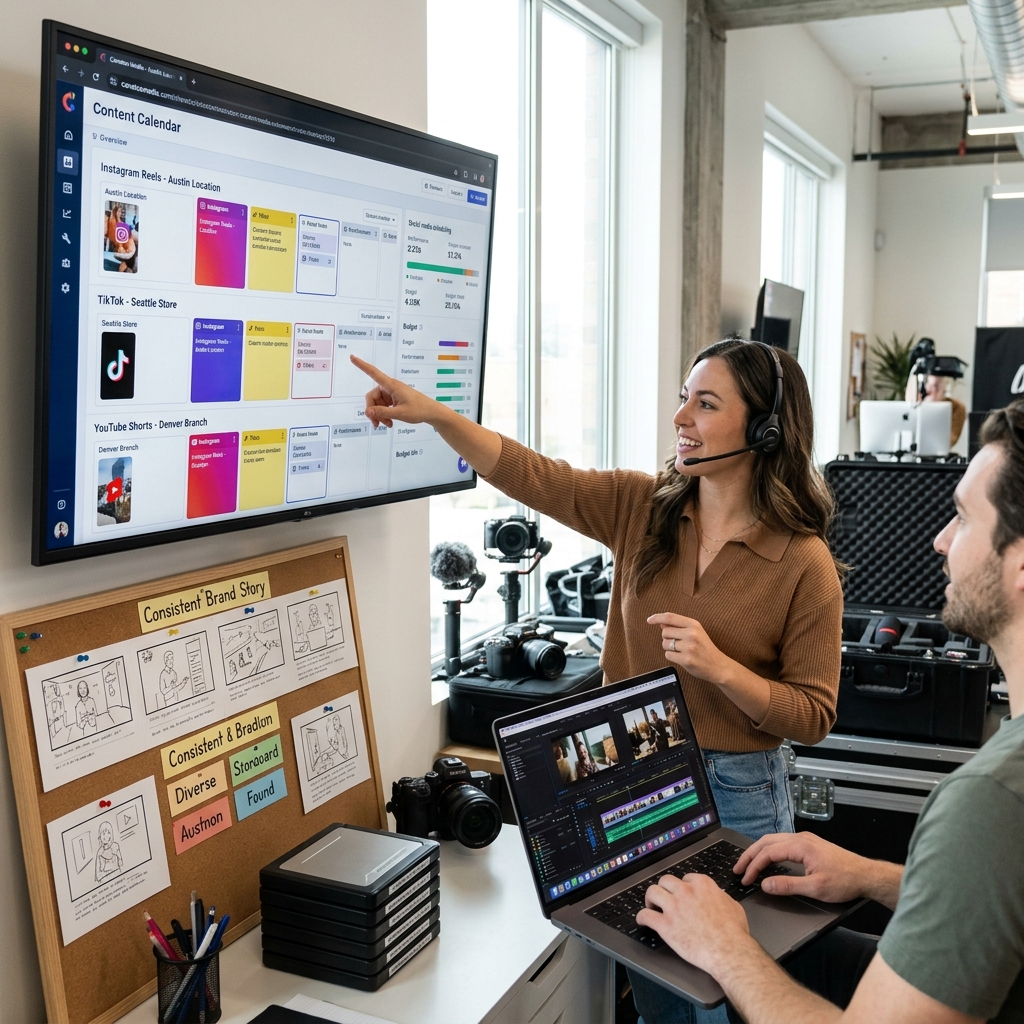
Social media management also informs what you shoot. We track which content types, lengths, and messaging generate engagement at each location, then adjust future production briefs. So each shoot gets more targeted and productive than the last.
Maximizing ROI Through Strategic Video and Paid Advertising
Video content performs well organically, but the real ROI multiplier is combining video with paid advertising. Organic reach on social platforms continues to decline, and paid amplification is now essential for driving measurable results.
We treat video production and paid advertising as one system. After production, we immediately test the highest-performing clips in paid campaigns across Meta (Facebook and Instagram) and Google platforms. This means:
- Using A/B testing to identify which video angles, messaging, and formats drive the lowest cost-per-lead
- Scaling proven assets with paid spend instead of constantly producing new content
- Attributing lead and sales results back to specific videos and locations
- Adjusting production strategy based on what paid testing reveals
For a typical multi-location business, a $5,000 production investment combined with a $2,000 to $3,000 monthly paid advertising budget generates 15 to 40 qualified leads per month, depending on your industry and service type. The video production cost amortizes across multiple months of paid campaigns.
This integrated approach is why we track ROI rather than just video metrics. Views and engagement matter, but leads and sales matter more.
Why Short-Form Video Drives Better Results Than Traditional Production
Many business owners still think “professional video” means longer formats: 3 to 5 minute brand films, testimonial videos, or educational content. Those have a place, but short-form video consistently outperforms traditional production for lead generation.
Short-form videos (15 to 60 seconds) work better for multi-location businesses because they:
- Generate higher completion rates (people watch more of a 30-second video than a 3-minute one)
- Perform better in paid advertising (lower cost-per-view)
- Adapt easily across channels and devices
- Require less viewer context (you don’t need background to understand a 30-second tip)
- Compress time-to-value (your message lands in seconds, not minutes)
This doesn’t mean you should only produce short-form content. But if your budget is limited, short-form drives better results. A single production day yielding 15 short-form videos outperforms one polished 4-minute brand film from a lead generation perspective.
We structure our shoots around short-form as the primary format, with longer pieces emerging as compositions of short-form assets rather than the reverse.
Turning Video Content into Measurable Leads and Sales
Production quality doesn’t matter if the content doesn’t convert to leads. We’ve seen beautiful videos that generated zero pipeline and simple testimonials that drove consistent leads.
The difference is conversion architecture. Every video we produce includes:
- A clear next step (book a demo, request a consultation, download a guide)
- A reason to take that step (solve a specific pain point, answer a common question)
- Minimal friction (one-click links, simple forms, clear CTAs)
- Lead capture mechanisms (landing pages, scheduling tools, email capture)

For multi-location businesses, we track which locations’ content converts best, then double down on what works. Maybe Austin’s team generates leads more effectively through “day in the life” videos, while Denver performs better with educational content. We’ll adjust both production and paid strategy based on location-level performance.
We also measure the full customer journey. A video might not drive immediate leads, but it builds awareness that converts later. Our ROI case studies show how brands track this impact across the full sales funnel, from awareness to close.
Getting Started with Scalable Video Production Today
If you’re managing multiple locations and feeling squeezed by video production costs, here’s what we recommend:
Start with a content audit: Identify which content works across all locations and which is location-specific. This takes 2 to 3 hours and immediately shows where you can batch shoots and reduce costs.
Plan a pilot production cycle: Rather than overcommitting, produce content for 2 to 3 locations in one cycle. This gives you a baseline for cost, timeline, and results without large upfront spend.
Integrate with social and paid: The moment you have video assets, start testing them in paid advertising. Even a modest $500 to $1,000 monthly test reveals which content drives leads.
Build a quarterly rhythm: Most multi-location businesses thrive with production every quarter. This keeps content fresh, distributes investment across the year, and gives you time to learn from results between cycles.
The goal is sustainable growth, not a one-time video project. Budget-friendly video production means building a system where you produce professional content consistently without straining your budget or your team.
We work with multi-location service and product businesses to design exactly this system. If you’re ready to explore how this works for your business, we’d like to help.
Contact us today for a free consultation to see how we can help you grow your business.
Frequently Asked Questions (FAQ)
How do we keep video production costs down for businesses with multiple locations?
We streamline our production process by shooting multiple location videos in concentrated timeframes and repurposing content across platforms, which eliminates the inefficiency of scheduling separate shoots for each branch. Our team develops a unified brand strategy upfront so we can create modular content that works for all your locations while maintaining consistent visual storytelling. This approach lets us produce high-quality cinematic videos without the inflated costs typical agencies charge for location-by-location campaigns.
Can we produce video content that works across different locations without it looking generic?
Yes. We create a customized brand framework for your business, then adapt the core narrative and visual style to reflect each location’s unique characteristics while keeping everything cohesive. Our process includes location-specific messaging layered over consistent cinematic production quality, so customers see your brand identity everywhere while feeling the local relevance. We’ve found this balance between consistency and personalization actually drives higher engagement than truly generic content.
How does video production connect to generating actual leads and sales for our business?
We integrate every video we produce directly into our paid advertising and social media management strategies, which means your content goes beyond views and gets positioned in front of people actively interested in your services. We track performance through conversion metrics tied to lead capture and sales pipeline activity, not just vanity metrics like views. This integrated approach ensures that your investment in quality video translates into measurable business results.