Why Most Brands Fail When They Separate Website Design from Video
Your website and your video content serve different purposes on the surface, but they’re actually part of one customer journey. When we see brands struggle, it’s usually because they treat these two channels as separate projects managed by different teams with different goals.
A video creator focuses on engagement and views. A web designer focuses on aesthetics and user flow. Neither is wrong, but when these worlds don’t talk to each other, you end up with a beautiful website that doesn’t leverage your best content, or viral videos that send traffic to a site that doesn’t convert.
The real cost shows up in your metrics: high video engagement with flat website traffic, or steady site visitors who never take action because there’s no compelling visual narrative guiding them forward. Your audience sees fragments instead of a cohesive brand story.
The Disconnect Costing You Leads and Sales
Here’s the specific breakdown of what happens when design and video operate independently:
Videos exist in isolation. A well-produced video might live on YouTube or social media, but your website doesn’t know how to use it. Visitors land on your homepage and see static copy and generic stock images instead of the cinematic storytelling you’ve already invested in.
Website design ignores your video assets. Your web designer picks stock footage or relies on text-heavy sections when you already have premium content sitting in your library. This duplication wastes budget and confuses your messaging.
Traffic sources don’t align. Video drives visitors to your site, but those visitors encounter pages that don’t reflect the tone, energy, or offer they just saw in the video. The friction kills conversions.
Lead capture drops. When visitors aren’t emotionally invested by visual storytelling before they see your CTA, they’re less likely to fill out forms or request demos. Video primes the psychological pump; a disconnected website deflates it.
For a multi-location service business or growth-focused brand, this gap translates to 20-40% lower conversion rates than an integrated approach typically delivers.
How Unified Design and Video Strategy Works Together
Integrated web design and video strategy means building your website architecture around your video content from the start, and creating videos with your website user journey in mind.
It looks like this:
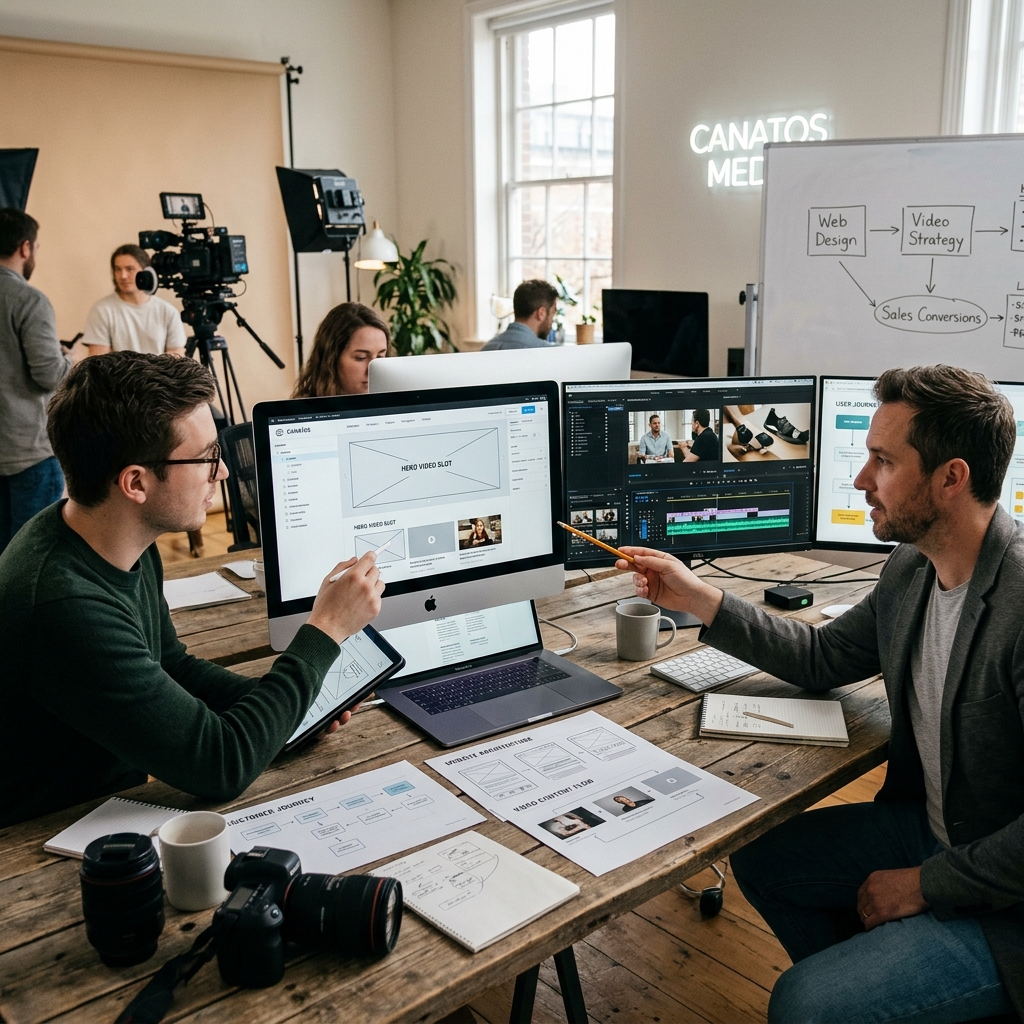
- Your homepage features a hero video that establishes brand voice and captures attention in the first three seconds.
- Service or product pages use short-form videos to demonstrate value before someone reads a single paragraph.
- Landing pages pair video testimonials with trust signals in the design layout so both work together.
- Your call-to-action appears after video content has warmed the visitor, not before.
The result is a website that feels cinematic and moves visitors toward conversion through narrative momentum, not just button placement.
Our Integrated Approach to Web and Video
At Canatos Media, we don’t treat website design and video production as separate deliverables. We start with your customer journey and work backward.
First, we map where video adds the most value: above the fold, in explainer sections, during objection-handling, and at conversion moments. Next, we design your website architecture to make room for these assets. Finally, we produce video content that matches both your visual brand and the specific function it needs to serve on that page.
Our team includes cinematographers, web designers, and conversion specialists who collaborate throughout the entire project. A video isn’t approved until we’ve tested how it performs within the actual page layout. A design element isn’t finalized until we know what video will sit beside it.
We also integrate your video assets with your broader digital ecosystem: social media, paid advertising, and email marketing all pull from the same narrative foundation. When someone sees your Facebook video, lands on your site, and receives a follow-up email, they experience one coherent brand story across three channels.
Building Websites That Showcase Your Video Content
Your website design should create frames and focal points for your cinematic website videos rather than compete with them.
This means:
- Homepage hero sections with video autoplay, minimal text overlay, and clear directional flow.
- Full-width video players on core service or product pages, positioned before lengthy copy.
- Testimonial pages that lead with client success videos rather than quotes.
- About pages that use brand story videos to create emotional connection before diving into company history.
- Landing pages with video thumbnails that change dynamically based on visitor source or behavior.
The design itself should support video viewing: adequate white space around players, fast page load times optimized for video assets, mobile-responsive layouts that don’t shrink videos down to unwatchable dimensions, and clear next steps positioned after the video ends.
We typically recommend placing video content in the top 60% of pages where scrolling isn’t required for initial viewing. This respects user behavior while maximizing the impact of your cinematic content.
Creating Videos That Drive Website Traffic and Conversions

Video content created in isolation often performs well on social platforms but doesn’t convert when it lands on your website. The gap exists because social videos are built for stopping the scroll; website videos are built for closing deals.
We create videos with your website’s conversion goals baked in from the scripting phase. An explainer video on your homepage needs a clear transition into the next section. A demo video on a pricing page needs to address the specific objection that prevents purchase at that moment. A testimonial video needs to include outcome metrics, not just enthusiasm.
Video length matters too. A 60-second hero video supports fast homepage scanning. A 90-second explainer video holds attention without causing tab abandonment. Anything longer than two minutes should be segmented into chapters with interactive navigation so visitors can jump to relevant sections.
We also design visual consistency between your video style and website design language. When your video uses the same color palette, typography treatment, and visual effects as your website, viewers experience seamlessness. The transition from watching to reading to acting feels natural rather than disjointed.
Lead Generation Through Seamless Design and Video Integration
The magic of integration shows up in lead capture. When video and design work together, visitors move through your site with psychological momentum building toward your offer.
Here’s the actual sequence:
- Video establishes credibility and emotional connection in the first 10 seconds.
- Design narrative guides the visitor’s eye toward supporting information.
- Objection-handling content (often video-based) removes friction.
- Social proof (testimonials, case studies, metrics) confirms the decision.
- Clear CTA appears when the visitor is warmest.
This flow works because you’re not asking for a lead from a cold visitor. You’re asking for a lead from someone who’s experienced your brand story visually and felt its relevance to their situation.
Form completion rates increase when video precedes the form. Conversion time decreases when visitors understand their path forward before they commit. And qualified lead volume grows because you’re filtering for engaged visitors who’ve already seen what you offer.
Real Results: How Our Clients Accelerated Growth
Our case studies document the specific outcomes of integrated design and video strategy. What we consistently observe:
- Service-based brands see 35-50% improvement in contact form submission rates after redesigning their website around video content.
- Multi-location businesses reduce sales cycle length by 2-3 weeks when their website guides prospects through video-supported discovery.
- Product brands increase average order value by 20-30% when website design and video testimonials combine to build confidence before checkout.
These aren’t marginal improvements. They’re the difference between a marketing budget producing steady activity and a marketing budget driving measurable revenue growth.

The common thread in every successful integration: the team that designed the website worked directly with the team that produced the video.
Getting Started With Your Integrated Strategy
Start by auditing your current website against a simple question: if a visitor mutes their audio and watches only your video content, do they understand your core value proposition?
If the answer is no, your integration work needs to begin. Map where video would change the visitor experience most significantly: usually your homepage, primary service pages, and main landing pages.
Next, evaluate your existing video content. What do you have that’s already performing well? That’s your foundation. What gaps exist between your video storytelling and your website copy? Those are your production priorities.
Finally, involve both your designer and video creator in the same planning session. Walk through your website page by page. Discuss where each video lives, how it’s positioned, what text supports it, and what action follows it.
The best integration starts with alignment, not with production. When your team shares a vision for how website design and video work together, the execution follows naturally. We’re here to guide that process and handle the cinematic production side.
Contact us today for a free consultation to see how we can help you grow your business.
Frequently Asked Questions (FAQ)
How do we integrate website design with video production to maximize conversions?
We build your website as the anchor for your video content, ensuring every page layout, navigation flow, and call-to-action aligns with your video assets. Our team creates custom video placements that guide visitors toward lead capture forms and sales pages, while designing your site structure to drive traffic back to your most effective video content. This two-way integration means your website doesn’t just display videos—it uses them strategically to move prospects from awareness to decision.
What’s the difference between how we approach web and video versus handling them separately?
When websites and videos operate independently, you lose the opportunity to amplify each other’s impact. We treat them as one system where your site architecture supports your video distribution strategy, and your video content is optimized to convert the traffic your site generates. This unified approach eliminates the gaps that typically cause leads to drop off between discovering your brand and taking action.
Can you help us if we already have a website and video content that aren’t working together?
Absolutely. We audit your existing website and video assets to identify missed opportunities, then restructure your site to leverage the content you have while filling gaps with new productions that support your conversion goals. Many of our clients start this way, and integrating their separate efforts typically doubles their lead generation within the first quarter.