Why Misaligned Landing Pages Kill Your Video Ad Performance
A prospect watches your 15-second video ad on Instagram. The hook lands. The product looks compelling. They tap through to… a generic homepage that doesn’t match anything they just saw.
That disconnect costs you conversions. We see it happen constantly with multi-location and service-based brands: strong creative that captures attention, followed by a landing experience that fails to reinforce the message. The result is wasted ad spend and frustrated prospects who bounce before converting.
The solution isn’t complicated, but it requires intentionality. Aligning your short-form video creative with location-specific landing pages creates a cohesive journey that moves people from awareness to action. We’ll walk you through exactly how to build this system.
Your short-form video has one job: stop the scroll and spark curiosity. It works best when the visual story, value proposition, and emotional hook are crystal clear in 6-15 seconds. But that clarity only matters if the landing page that follows tells the same story.
When someone clicks your video ad and lands on a page that looks different, uses different language, or promotes a different offer, their brain experiences friction. They came because of one promise; now they’re evaluating a different one. That moment of confusion is where most bounces happen.
We’ve tracked campaigns where tightening this alignment alone improved conversion rates by 25-40%. The video and landing page don’t need to be identical, but they need to feel intentional. Same visual style. Same core message. Same next step.
For multi-location businesses, this complexity multiplies. A video promoting your downtown Denver location should land on the Denver location page, not a generic service overview. A seasonal offer teased in your creative needs to be the hero of the landing experience too.
Action step: Audit your current video ads and their destination landing pages. Write down the main claim each video makes, then note what the prospect sees first on the landing page. Are they aligned?
The Hidden Cost of Disconnected Creative and Landing Experiences
Beyond bounce rates, disconnected experiences damage your attribution data. When your analytics can’t clearly connect which video creative led to which conversions on which landing page, optimization becomes guesswork. You can’t confidently scale what works because you don’t actually know what’s working.
There’s also a brand consistency problem. If your video tells a cinematic brand story but the landing page feels templated and generic, you signal inconsistency. Prospects subconsciously register that disconnect, and trust erodes.
For service-based brands running location-specific campaigns, this fragmentation is especially costly. You might be spending $5,000 to generate awareness for a specific location, but then funneling people to a landing experience that doesn’t feature that location prominently. The specificity you paid for in targeting gets lost in the experience.
We worked with a home services company running beautiful short-form video ads for their three regional markets. Each video showcased local client transformations and testimonials specific to that area. But they were all pointing to the same generic service page. Once we created location-specific landing pages that echoed the visual style and messaging of each regional video campaign, their cost per lead dropped by 35% and conversion time accelerated by three days.
The cost of misalignment isn’t just the leads you lose. It’s the inefficiency baked into your entire funnel.
Action step: Pull your last 90 days of ad spend data. Calculate your cost per conversion by channel. If video has a noticeably higher cost per conversion than other channels, misalignment is likely part of the problem.
How We Align Your Short-Form Creative with Local Landing Page Strategy
Our approach starts with treating video and landing pages as a single conversion system, not separate components.
First, we audit your current messaging architecture. What’s the core promise in your video? What’s the emotional hook? What’s the specific offer or next step? We document this for each video variant or location you’re targeting.
Then, we build landing pages that mirror this structure. The headline echoes the video’s main claim. The visuals use the same color palette, typography, and cinematic style. The social proof (testimonials, case studies) reflects the same narrative the video established.
For location-based campaigns, we create dedicated landing page templates that pull in location-specific data: local images, location-based testimonials, address, hours, and even localized value propositions. Your Denver video leads to a Denver landing page that feels built specifically for that market.
We also implement clear conversion pathways that match the video’s promise. If your 15-second ad is about speed, your landing page’s primary call-to-action should make claiming that benefit frictionless. If your video emphasizes expertise, the landing page should showcase credentials and client results right away.
This synchronization also extends to our paid advertising strategy. We test variations of your short-form content alongside variations of landing page messaging, tracking which combinations convert best. A video about cost savings might convert better on a landing page emphasizing ROI than one emphasizing speed.
Mapping Your Customer Journey From Video View to Conversion
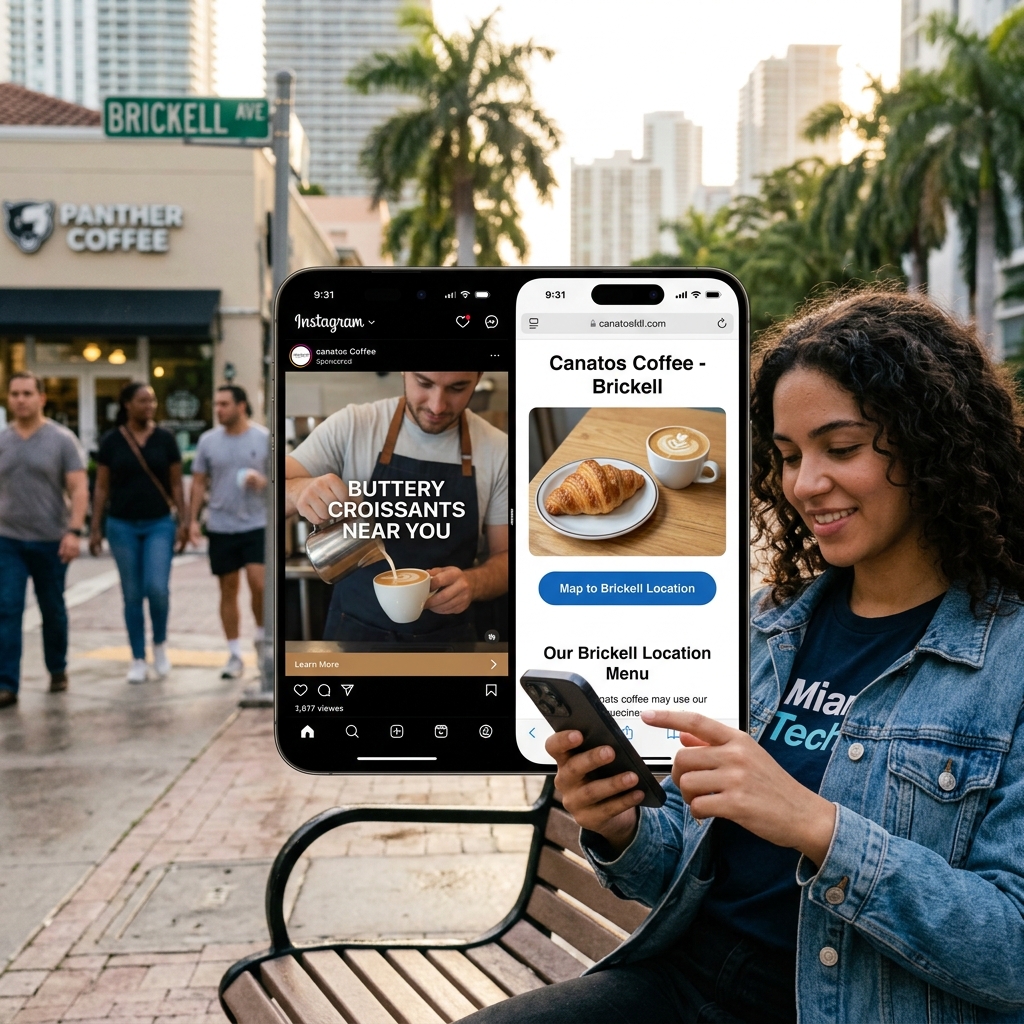
Understanding the path someone takes from video impression to conversion is foundational to optimization.
We map this journey in stages:
Awareness: They see your short-form video in their feed. The opening two seconds determine whether they keep watching. Your creative needs to be visually distinctive and immediately relevant to them.
Interest: They watch the full video. Your narrative hooks them into your specific value. By the end, they know what problem you solve and why they should care.
Consideration: They click through to the landing page. This is where they evaluate whether you’re trustworthy and whether your offer solves their specific situation.
Decision: They complete the conversion action: filling out a form, calling a number, booking a consultation. The friction here directly impacts your conversion rate.
The alignment happens across all four stages. A video that creates high interest but lands on a page with unclear next steps fails at the decision stage. A generic landing page that doesn’t reinforce the specific promise made in the video creates drop-off during consideration.
For location-specific campaigns, we also track how geography influences this journey. Prospects in one market might respond faster to a video about local expertise, while another market responds to social proof. We use this insight to customize both creative and landing page messaging by location.
We implement tracking that captures which video variant someone watched, when they watched it, and what action they took on the landing page. This closed-loop attribution lets us see exactly which creative-to-landing-page combinations are driving conversions.
Action step: Map your current customer journey for one video campaign. Identify the biggest drop-off point. Is it happening at the video level (low click-through rate) or the landing page level (high bounce rate)? This tells you where to focus first.
Building Location-Specific Landing Pages That Match Your Ad Message
Location pages need to do double duty: they’re both standalone resources for organic search and conversion destinations for paid video ads.
Here’s our framework for building them:
Start with a headline that speaks to the specific location and the specific offer your video teased. Not “Our Service” but “Fast HVAC Repair in Denver” or “Bookkeeping for Healthcare Practices in Portland.” This headline should feel like the natural continuation of your video’s opening hook.
Next, include location-specific content: photos of your team in that location, case studies of projects in that area, testimonials from local clients, local business partnerships, and details like address, hours, and service radius. This specificity confirms that the video wasn’t generic and that you actually serve their neighborhood.
The core value proposition should be the same across all location pages, but the supporting details change. If your main offer is “30% faster installation,” that stays consistent. But the testimonials, case studies, and visual imagery should reflect that specific location’s market.
We also optimize each location page for local search. This means location-specific keyword targeting (not just “our service” but “our service in [city]”), schema markup that highlights location data, and local link building. This way, people searching for your service in that geography find both your video ads and your organic presence.
The layout should be conversion-focused. Call-to-action buttons appear above the fold and again mid-page. Form fields are minimal on the first step (name and email are often enough) with additional questions happening after submission. Video elements should be prominent, so the visual consistency with your ad creative is immediately apparent.
We’ve found that location pages with client testimonials and case studies specific to that area convert 40% higher than generic versions. The local specificity creates credibility and relevance that generic pages simply can’t match.
Action step: Pick your lowest-performing location. Create a new landing page variant that includes five location-specific elements (local testimonials, local case studies, location imagery, specific local value propositions, or local partnerships). Test it against your current page.
Creating Consistent Brand Storytelling Across All Touchpoints
Cohesion builds trust. When your video, landing page, email follow-up, and even your website’s navigation all tell the same story using the same visual language and tone, people relax. They’re not constantly re-evaluating whether this is the right place or the right offer.
We start by documenting your brand story: not a tagline, but the actual narrative of who you are, what you believe, and why you do what you do. This story then gets expressed in different formats for different mediums.
Your short-form video might tell this story through a client transformation in 15 seconds. Your landing page tells it through case studies and social proof. Your email sequence reinforces it through educational content. The coherence across these channels compounds trust and conversion.
For service-based and multi-location brands, consistency becomes more challenging but more valuable. A prospect might first encounter your brand through a video ad, then see a follow-up email, then visit your website, then speak with someone at a local branch. Each touchpoint should feel like it’s part of the same organization telling the same story.
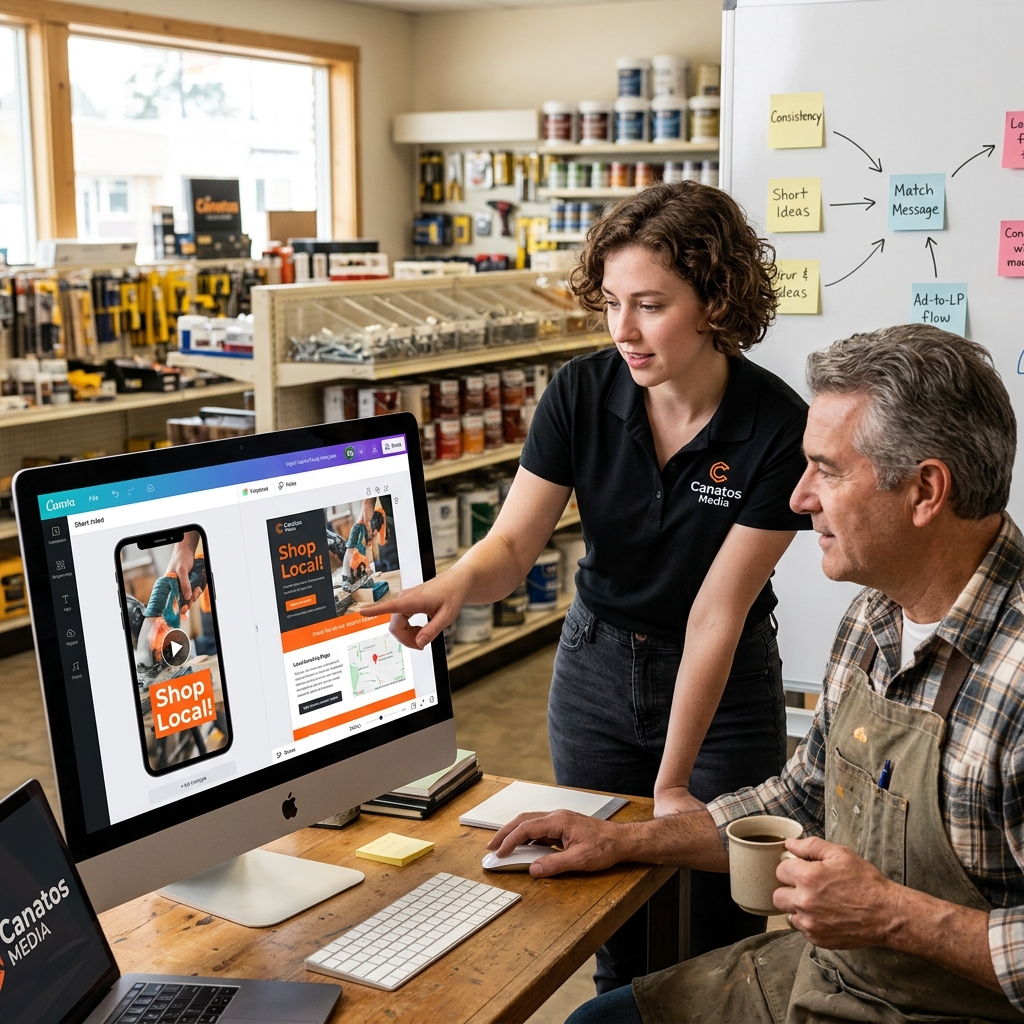
We build this consistency by establishing clear visual guidelines (color, typography, imagery style), messaging frameworks (how you describe your service, your benefits, your differentiators), and tone principles (how formal or casual, how technical or conversational). Then every piece of creative we produce follows these guidelines.
This doesn’t mean repetition. It means intentional variation within a coherent system. A video about speed and a landing page about expertise can both be part of your story if they’re exploring different angles of the same core promise.
Your all-in-one marketing funnel needs this coherence. Every component should feel like it belongs in the same system.
Technical Integration: Tracking and Attribution for Multi-Location Campaigns
Here’s where most businesses fall apart: they can’t actually measure whether their video-to-landing-page alignment is working.
We implement UTM parameter strategies that tag every video ad with the source (which video variant), medium (paid social), and content (which location or offer). When someone clicks through to the landing page, we capture this data. Then, when they convert, we can trace that conversion back to the specific creative and landing page combination that led them there.
For platforms like Meta and Google, we set up conversion tracking pixels on your landing pages so the platform itself can attribute conversions back to the specific ad. This gives you real-time performance data and lets the algorithm optimize toward high-converting combinations automatically.
We also implement event tracking on the landing page itself. We can see not just whether someone filled out a form, but whether they watched your embedded video, scrolled past your testimonials, or spent time on your pricing section. This micro-data helps us understand what landing page elements are actually moving the conversion needle.
For multi-location campaigns, we use custom dimensions in analytics to segment performance by location. This way, you know which locations are converting highest from which video variants, letting you double down on what’s working in each market.
We set up custom dashboards that show you at a glance: cost per conversion by video variant, conversion rate by landing page, average time to conversion, and cost per conversion by location. You’re not guessing about what’s working; you’re seeing it in real time.
Many businesses never set up this infrastructure, so they’re essentially blind to which campaigns deserve more budget. You’d be throwing money at underperforming combinations indefinitely.
Action step: Audit your current tracking setup. If you can’t answer “What’s my cost per conversion for video ads pointing to landing pages versus video ads pointing to my homepage?” you have a tracking gap to fix.
Optimizing Conversion Rates Through Cohesive Visual Messaging
Once you have the alignment infrastructure in place, optimization becomes systematic instead of guesswork.
We start with A/B testing. One video variant pointing to one landing page version against a different video/landing page combination. We measure not just conversion rate, but cost per conversion. A 10% higher conversion rate doesn’t matter if the click-through rate dropped 30%.
The visual messaging is where most optimization happens. We test whether opening with a specific visual hook (client before/after, product in use, founder story, social proof stat) performs better than others. We test whether cinematic shots or direct-to-camera explanations convert better for your specific audience.
On the landing page side, we optimize layout, copy length, CTA button placement and color, form field quantity, and the prominence of different proof elements. A landing page that moves testimonials above the fold might convert 15% higher. A shorter form might reduce friction by 20%.
We also test landing page messaging variations. Same location, same offer, different framing. “Join 2,000 happy clients” versus “Get started in 30 minutes” versus “We handle the complexity so you don’t have to.” For your specific audience, one frame typically outperforms others by 20-40%.
For multi-location businesses, we find that location-specific messaging often outperforms benefit-specific messaging. “Trusted HVAC repair in Denver” might convert higher than “We specialize in fast repairs” when someone is actively looking for a local service. The location signal confirms relevance.
Video length is another variable we test. Some audiences engage with 6-second videos, others prefer 15-30 seconds. Some markets respond to testimonial-heavy creative, others to quick-cuts and transitions. We let the data guide creative direction.
Optimization is ongoing because your audience and market evolve. What worked in Q1 might need refinement by Q4. But with proper alignment and tracking infrastructure, refinement is rapid and evidence-based.
Case Study: How Our Integrated Approach Drives Measurable Lead Growth
We worked with a three-location home services company that was spending $8,000 monthly on short-form video ads. Their click-through rate was solid (2.2%), but their conversion rate was just 3.1%, putting their cost per lead at $118. They were frustrated because their ads looked great but weren’t translating to calls or form submissions.
We audited their setup and found the disconnect immediately. Beautiful cinematic videos showcasing their team and finished projects were pointing to a generic service page. No location specificity, no reflection of the video’s narrative, no clear local proof points.
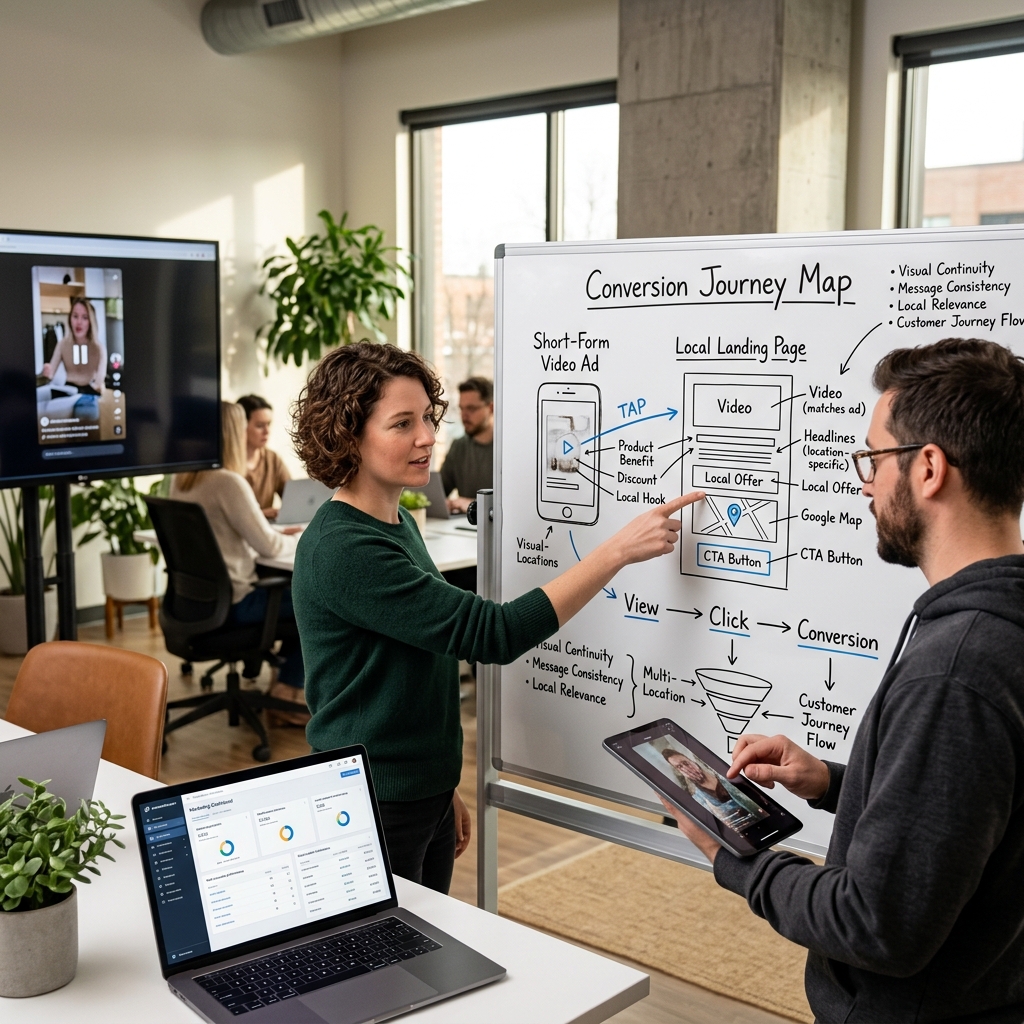
We rebuilt their strategy:
First, we created location-specific landing pages for each of their three service areas. Each page featured local testimonials, photos of the team at that location, case studies of completed projects in that neighborhood, and location-specific CTAs (like “Schedule your Denver inspection”).
Second, we produced video variants for each location, keeping the same cinematic style but featuring the team and clients specific to that market. The messaging stayed consistent (speed, reliability, local expertise), but the execution reflected each location’s community.
Third, we implemented proper tracking so every video variant was tagged and every landing page conversion was attributed back to the specific video and location that drove it.
Results after 90 days:
- Cost per lead dropped from $118 to $71 (40% improvement)
- Conversion rate improved from 3.1% to 5.2%
- Time from click to conversion accelerated from 4.2 days to 2.1 days
- Location-specific video variants consistently outperformed generic versions
The monthly ad spend was the same, but they were generating 65% more qualified leads. More importantly, they could now confidently allocate budget based on which location/video/landing page combinations worked best.
Getting Started With Synchronized Creative and Landing Page Strategy
Start small and systematic. Pick one video campaign and one location (or one core offer). Map the current experience: what does your video promise, and what does the landing page deliver?
Identify the gap. Is it visual consistency, messaging clarity, location specificity, or something else?
Build a better landing page experience that directly reinforces your video’s promise. Keep it simple: cohesive visuals, clear headline, obvious next step.
Implement basic tracking so you can measure cost per conversion before and after the alignment change.
Run this iteration for two weeks with consistent ad spend. Compare your metrics to the previous period.
Once you see the impact, expand the approach to your other video campaigns and locations.
This isn’t a one-time fix. It’s a system that compounds over time. Each quarter, you refine based on what the data tells you. The brands that dominate in their categories are the ones that’ve spent months optimizing this alignment while their competitors are still wondering why their ads aren’t converting.
We help growth-focused business owners build this system at scale, handling everything from short-form video production to landing page optimization to multi-location campaign management. The time you save and the leads you generate are worth far more than the investment.
Let’s talk about what your aligned video-to-landing-page strategy could look like. Reach out today to explore your specific situation.
Contact us today for a free consultation to see how we can help you grow your business.
Frequently Asked Questions (FAQ)
How do we ensure our short-form video ads actually convert visitors into leads?
We align every frame of your video creative with the specific landing page experience visitors encounter after clicking. When your ad messaging, visuals, and call-to-action match exactly what appears on the landing page, we eliminate confusion and friction that typically kills conversions. We also implement conversion tracking across your entire campaign so we can measure what’s actually working and optimize accordingly.
Why does it matter that our landing pages match our ad content for multi-location businesses?
When you have multiple locations, consistency becomes even more critical because visitors expect the same quality and messaging regardless of which location page they land on. We build location-specific landing pages that reflect the unique details customers care about (local phone numbers, address, hours) while maintaining your brand story from the video. This synchronized approach prevents the common mistake of sending customers to generic pages that don’t address their specific location, which tanks conversion rates.
What’s included in our process for syncing creative and landing page strategy?
We handle the full integration: we create your short-form video content, build or optimize your location-specific landing pages, set up conversion tracking, and continuously test different messaging combinations to improve performance. Our team manages the technical setup so every ad variant connects to the right landing page variation, giving us clear data on which combinations drive the most qualified leads for your business.