Why Most Businesses Fail to Connect Video Views to Actual Revenue
A business owner launches a short-form video campaign on Instagram and TikTok. The videos rack up 50,000 views in two weeks. The team celebrates the engagement, reports success to leadership, and continues the same strategy. Three months later, they realize those views didn’t translate into a single new client or sale.
This scenario plays out constantly because there’s a massive disconnect between what gets measured and what actually matters to the business. Views feel like progress. They’re visible, quantifiable, and shareable. But they rarely correlate with revenue unless you’ve built the right tracking infrastructure in place first.
We’ve worked with dozens of service-based brands who discovered this the hard way. They had amazing video content and solid viewership, yet couldn’t explain why their bottom line hadn’t moved. The problem wasn’t the video quality or the audience size. It was the absence of a measurement system that connected viewer behavior to actual business outcomes.
Without proper tracking, you’re essentially running your video marketing in the dark. You might be reaching the right people, but you won’t know if they’re becoming leads, customers, or repeat buyers. That’s where most campaigns lose their credibility and funding.
The Gap Between Vanity Metrics and Real Business Results
Vanity metrics feel good but rarely drive decisions. Likes, shares, comments, and view counts are easy to track and present, but they don’t answer the questions that matter: “Did this video bring in a qualified lead? Did it move someone closer to booking an appointment or making a purchase?”
The gap exists because social platforms prioritize engagement over conversion. A video with high engagement may simply be entertaining without persuading anyone to take action. You need metrics that bridge the gap between attention and action.
Here’s what typically gets ignored:
- Click-through rates from video to landing pages
- Landing page conversion rates for video-driven traffic
- Time spent on pages by video referrers
- Lead form submissions from video viewers
- Appointment bookings attributed to video content
- Customer lifetime value of video-generated leads
The real ROI story emerges when you track these downstream behaviors. A video with modest view counts but high click-through rates to qualified lead forms might deliver far better returns than a viral video that drives traffic with no commercial intent.
Start by identifying which metrics align with your actual business goals. If you’re a service-based brand, appointments matter more than vanity metrics. If you sell products online, conversion rate and average order value matter most. Build your measurement system around those endpoints first.
Setting Up Proper Tracking Infrastructure Before Launching Video Campaigns
Infrastructure comes before content. We recommend establishing your tracking setup before your next campaign launches, not after.
The foundation requires four components:
Pixel Installation and Event Tracking. Install conversion pixels on your website and configure them to track specific actions: page visits from video sources, form submissions, email signups, and purchases or appointment bookings. Facebook Pixel, Google Analytics 4, and your CRM integration should all capture these events.
UTM Parameters for All Video Links. Every link in a video description, video card, or bio should include UTM parameters that identify the campaign, content type, and platform. This tells you exactly which video drove which action. For example: `?utm_source=instagram&utm_medium=video&utm_campaign=servicepromo_jan2026`
CRM Integration. Your video traffic should flow into your customer relationship management system so you can track leads through the entire sales cycle. Without this, you won’t know if video-sourced leads convert better or worse than other channels, or how much revenue they eventually generate.
Landing Page Stability. Video campaigns drive spikes of traffic quickly. Make sure your landing pages load fast and are optimized for mobile conversion. A beautifully made video is wasted if the destination page can’t handle the traffic or doesn’t convert viewers into leads.
We recommend spending a week setting this up before launching any paid video campaign. It’s foundational work that protects your investment and ensures you have accurate data from day one.
Key Performance Indicators That Matter for Service-Based Brands

Service businesses operate differently from e-commerce. Your KPIs should reflect the sales cycle and decision process unique to your industry.
These metrics earn the most attention in our campaigns:
Cost Per Lead (CPL). How much are you spending in media and production to generate a single qualified lead? Divide total campaign spend by number of leads generated. This number tells you if your video strategy is cost-efficient relative to other channels.
Cost Per Booked Appointment. If your goal is appointment bookings, this metric cuts straight to the point. Some leads convert faster than others. Knowing the cost per actual booked appointment is more actionable than knowing cost per click.
Lead Quality Score. Not all leads are equal. A lead that comes from a video viewed all the way through typically has higher intent than one from a brief interaction. Track which video content sources produce leads that actually show up to appointments.
Conversion Rate from Lead to Customer. What percentage of video-generated leads become paying customers? This reveals whether your video is attracting the right audience or just pulling in tire-kickers.
Customer Acquisition Cost (CAC). Once a lead converts to a customer, what was the total cost to acquire them across all marketing touchpoints? This is the metric that connects to profitability.
Video Completion Rate. Short-form video platforms measure how far people watch. A 60% completion rate on a 30-second video is excellent. Completion rate often predicts engagement quality better than raw view count.
Start by tracking the three metrics most connected to your business model, then expand as your data grows. Too many KPIs creates confusion; too few leaves blind spots.
How We Link Short-Form Video Performance to Appointment Bookings
Linking views to appointments requires treating your video as the first stage of a conversion funnel, not the entire funnel itself.
When we build campaigns, we layer multiple touchpoints. A video viewer who doesn’t convert immediately might convert after seeing a second video, reading a blog post, or receiving an email. Video rarely closes the deal on its own. Instead, it should qualify interest, build trust, and move prospects into your lead nurturing sequence.
Here’s how we structure this flow: Short-form video introduces a specific problem and positions your solution. The video ends with a clear call-to-action directing viewers to a landing page or link in bio. The landing page captures contact information in exchange for something valuable (a consultation, guide, or discount). Once someone becomes a lead, they enter your email sequence or sales process. Your CRM tracks when that lead books an appointment.
Each stage of this funnel should have tracking enabled. You’ll quickly see where drop-off happens. Maybe video views are strong but click-through is weak, meaning your call-to-action needs clarity. Or maybe landing page traffic is high but form submission is low, pointing to a conversion optimization issue on the page itself.
The video isn’t responsible for 100% of the conversion. But it is responsible for initiating the chain of events. That’s how you measure its true ROI.
Building Attribution Models That Account for Multi-Touch Customer Journeys
Most customers see multiple pieces of content before deciding to book an appointment or make a purchase. Video might be the first interaction, but email marketing, retargeting ads, or referrals could seal the deal.
Multi-touch attribution models divide credit among all the touchpoints in the customer journey. There are several approaches:
First-Touch Attribution gives all credit to the first interaction (often the video). Useful for understanding top-of-funnel performance but doesn’t reflect the full picture.
Last-Touch Attribution credits only the final interaction before conversion. This can overvalue remarketing ads and undervalue awareness-building content like video.
Linear Attribution splits credit equally across all touchpoints. Fair but less precise about which stages matter most.
Time-Decay Attribution gives more credit to recent interactions while still acknowledging earlier ones. This often reflects reality better, as recent actions are fresher in the customer’s mind.
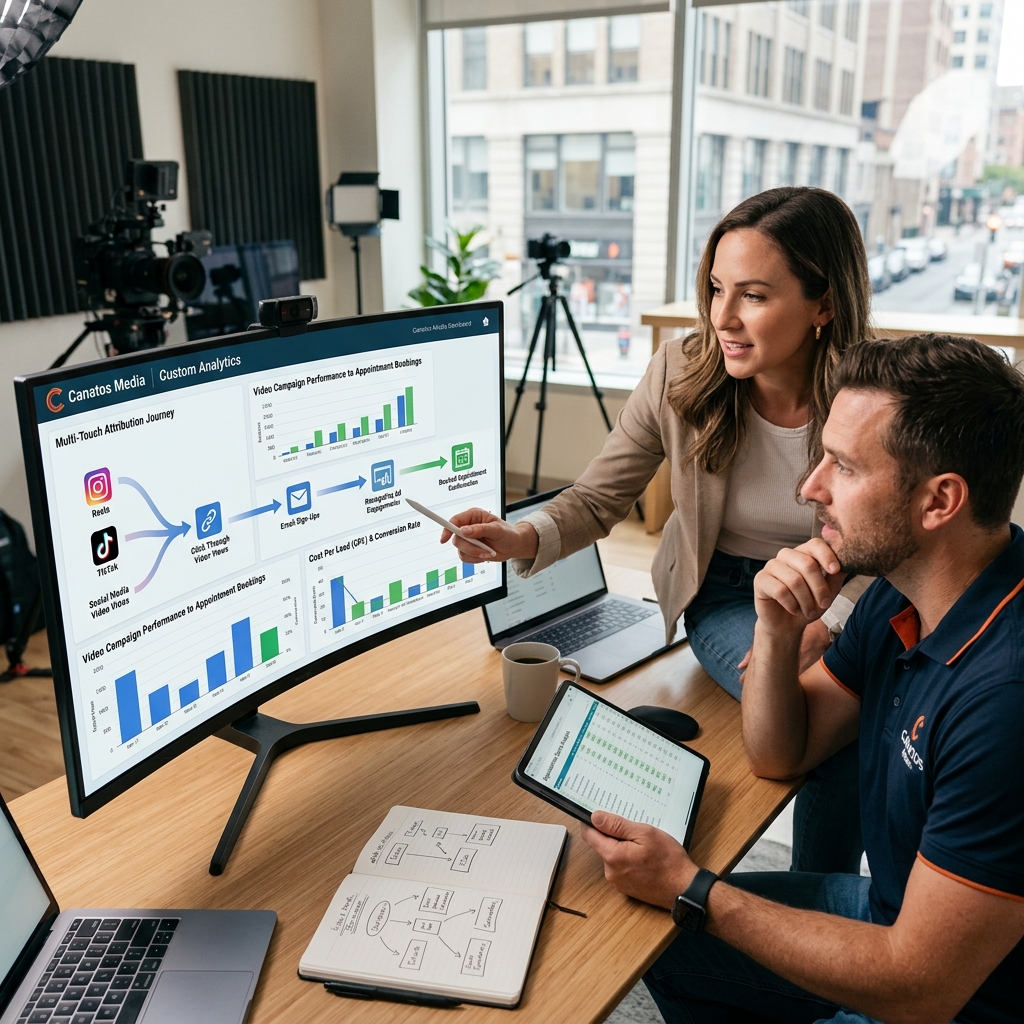
We recommend starting with first-touch and last-touch models to see the range, then moving to linear attribution as your data volume grows. Your analytics platform should let you compare models side by side.
The key insight is this: if video is showing strong first-touch performance but weak last-touch performance, it’s doing its job as an awareness tool. You shouldn’t expect it to close deals alone. Conversely, if video appears rarely in the customer journey, it’s not pulling its weight anywhere.
Analyzing Cost Per Lead and Cost Per Booked Appointment
These two metrics directly tell you whether your investment is paying off.
Cost per lead is straightforward: Total campaign spend divided by leads generated. If you spend $5,000 on a video campaign and generate 50 leads, your CPL is $100. The question then becomes: is $100 acceptable for your business model? If your average customer is worth $5,000 in lifetime revenue and you close 20% of leads, the $100 CPL is excellent. If your average customer is worth $500, it’s too high.
Cost per booked appointment is more refined. Some leads never convert to appointments. If that same $5,000 campaign generates 50 leads but only 25 people actually book appointments, your cost per appointment is $200. This metric more accurately reflects your acquisition cost because not every lead becomes an opportunity.
To calculate these precisely, you need clean data. Your CRM must mark which leads came from video campaigns, and your appointment calendar must sync with your analytics platform. Many service businesses skip this integration, which means they can’t answer the question at all.
Track these metrics weekly during active campaigns. If cost per appointment starts rising, it usually means audience fatigue, ad frequency is too high, or the video is reaching less qualified viewers. That’s your signal to pause, adjust targeting, or refresh creative.
Optimizing Video Content Based on ROI Data
Data tells you what worked. Acting on that data is what separates winners from average performers.
Once your campaign is running, pull performance reports at the one-week mark. Look for these patterns:
Completion Rate and CPL Correlation. If a video has 75% completion but high CPL, your audience finds the content engaging but it’s not convincing enough to act. Consider a stronger call-to-action or more specific value proposition.
Geographic Performance. One region might convert at twice the rate of another. Double down on winners and pause underperformers.
Audience Segment Performance. If you’re running on Meta platforms, segment your audience (age, interests, behaviors) and see which cohorts deliver the best ROI. Reallocate budget toward the winners.
Thumbnail and Hook Performance. For platform algorithms and organic reach, test different video openings and thumbnails. The first three seconds determine completion rate.
Call-to-Action Clarity. If click-through is low but watch time is high, people like the content but don’t understand what to do next. Simplify and strengthen your CTA.
Create a test-and-iterate rhythm. Establish a baseline, then test one variable (thumbnail, copy, audience, or creative angle) every week. Document what wins and bake it into your next batch of content. This approach compounds improvement over months.
Creating Dashboards That Show the Full Picture of Campaign Impact
Numbers scattered across different platforms create confusion. A unified dashboard shows the real story.
Your dashboard should display:
- Video views and completion rates by platform
- Click-through rate from video to landing page
- Landing page traffic and conversion rate
- Total leads generated (with source attribution)
- Leads that became booked appointments
- Cost metrics (CPL, cost per appointment, cost per customer acquired)
- Trending data (week-over-week changes)

Most analytics platforms offer dashboard builders. Google Data Studio integrates with Google Analytics and Meta Ads for free. Supermetrics connects multiple data sources. Or your CRM vendor might offer native dashboard capabilities.
The dashboard should be updated automatically so you’re always seeing current data, and it should be accessible to everyone making decisions about the campaign. When leadership can see that video drove 30% of this month’s appointments at 40% lower cost than other channels, the conversation about budget shifts immediately.
Make your dashboard tell a story. Present it with context: “This video generated $50,000 in revenue, cost $8,000 to produce and promote, and reached 200,000 people.” That narrative matters as much as the individual numbers.
Scaling Winning Video Campaigns Through Data-Driven Decisions
Once you’ve identified a video or video strategy that delivers strong ROI, scaling becomes the priority.
Scaling doesn’t mean doubling spend overnight. It means systematically increasing investment in what works while maintaining profitability. Here’s the process:
Increase Ad Spend Incrementally. Raise budget by 25-50% and monitor metrics for one week. If CPL stays flat or improves, increase again. If it climbs, you’ve hit the ceiling for that audience or creative. Pause and test new audiences instead.
Expand to New Audiences. Once you’ve saturated a demographic, test adjacent audiences. If 25-34 year-old homeowners perform well, test 35-44 or expand geographically.
Repurpose High-Performing Content. A video that converts well on Instagram Reels might work on TikTok or YouTube Shorts with minimal adaptation. Reuse the creative rather than starting from scratch.
Build Retargeting Sequences. Video viewers who didn’t convert immediately are warm prospects. Retarget them with follow-up videos or static ads. These audiences typically convert at lower cost because awareness is already established.
Layer Multiple Campaigns. Once you’re confident in one video’s performance, add new videos addressing different pain points or featuring different services. A diverse video mix reaches broader audiences than relying on a single piece of content.
At Canatos Media, we combine short-form video production with integrated digital strategies including social media management, paid advertising, and AEO optimization to ensure your scaling efforts hit target and drive real business growth. Our approach treats video as the opening act in a multi-channel system, not the entire show.
Document every change you make and its impact. This knowledge becomes your playbook for future campaigns. The business that learns what works for itself faster than competitors will always outpace the market.
For further reading: Video-first marketing.
Contact us today for a free consultation to see how we can help you grow your business.
Frequently Asked Questions (FAQ)
How do we help you connect video views to actual bookings instead of just vanity metrics?
We build comprehensive tracking infrastructure that connects your short-form video performance directly to appointment bookings through proper UTM parameters, landing page analytics, and CRM integration. Our approach focuses on measuring cost per booked appointment rather than surface-level metrics like views or likes, which means you’ll see exactly how much revenue each video campaign generates. We set this up before launching so every piece of data flows into a unified dashboard that shows the complete customer journey from video click to booked appointment.
What’s the difference between how we measure video ROI versus standard social media reporting?
We track multi-touch attribution to account for the fact that most customers interact with your content multiple times before booking. Instead of crediting a single video view for a conversion, we analyze the entire sequence of touchpoints across your paid ads, organic content, and website to understand true campaign impact. This gives you an honest picture of which video content and ad placements actually drive qualified leads and appointments, not just inflated metrics that don’t connect to revenue.
How do we use ROI data to optimize your video campaigns?
We analyze performance data to identify which video types, messaging angles, audience segments, and ad placements generate the lowest cost per booked appointment. We then scale the winning combinations while eliminating underperformers, continuously refining your video content based on what actually converts in your specific market. This data-driven cycle means your video budget shifts toward the strategies that move the needle for your business growth.