Day: May 19, 2026

  • How to Not Go Broke Using LinkedIn Paid Advertising

    How to Not Go Broke Using LinkedIn Paid Advertising

    Why LinkedIn Paid Advertising Cost Catches So Many Businesses Off Guard

    LinkedIn paid advertising cost is one of the most Googled questions by B2B marketers — and for good reason. The numbers can feel steep at first glance.

    Here’s a quick snapshot of what you can expect to pay in 2026:

    Metric Typical Range
    Cost Per Click (CPC) $2 – $6
    Cost Per 1,000 Impressions (CPM) $6 – $20
    Cost Per Send (Sponsored Messaging) $0.26 – $0.50
    Cost Per Lead (CPL) $50 – $200
    Minimum Daily Budget $10
    Minimum Lifetime Budget $100
    Average Monthly Spend (most businesses) $0 – $500

    LinkedIn is significantly more expensive than Facebook or Google Ads on a per-click basis. But that higher price tag comes with something those platforms can’t fully match — access to verified professional audiences: decision-makers, executives, and buyers defined by job title, seniority, and industry.

    The result? B2B advertisers are seeing a 121% return on ad spend (ROAS) on LinkedIn in 2026, meaning every $1 spent returns an average of $2.21 in attributed revenue.

    Still, without a clear understanding of how LinkedIn’s pricing works, it’s easy to burn through your budget fast and have little to show for it.

    I’m Nic Canobbio, founder of Canatos Media, and my experience negotiating high-stakes media deals and managing paid ad strategies across multiple platforms has given me a front-row seat to the real-world impact of LinkedIn paid advertising cost on business growth. This guide breaks down exactly what drives those costs — and how to make every dollar work harder.
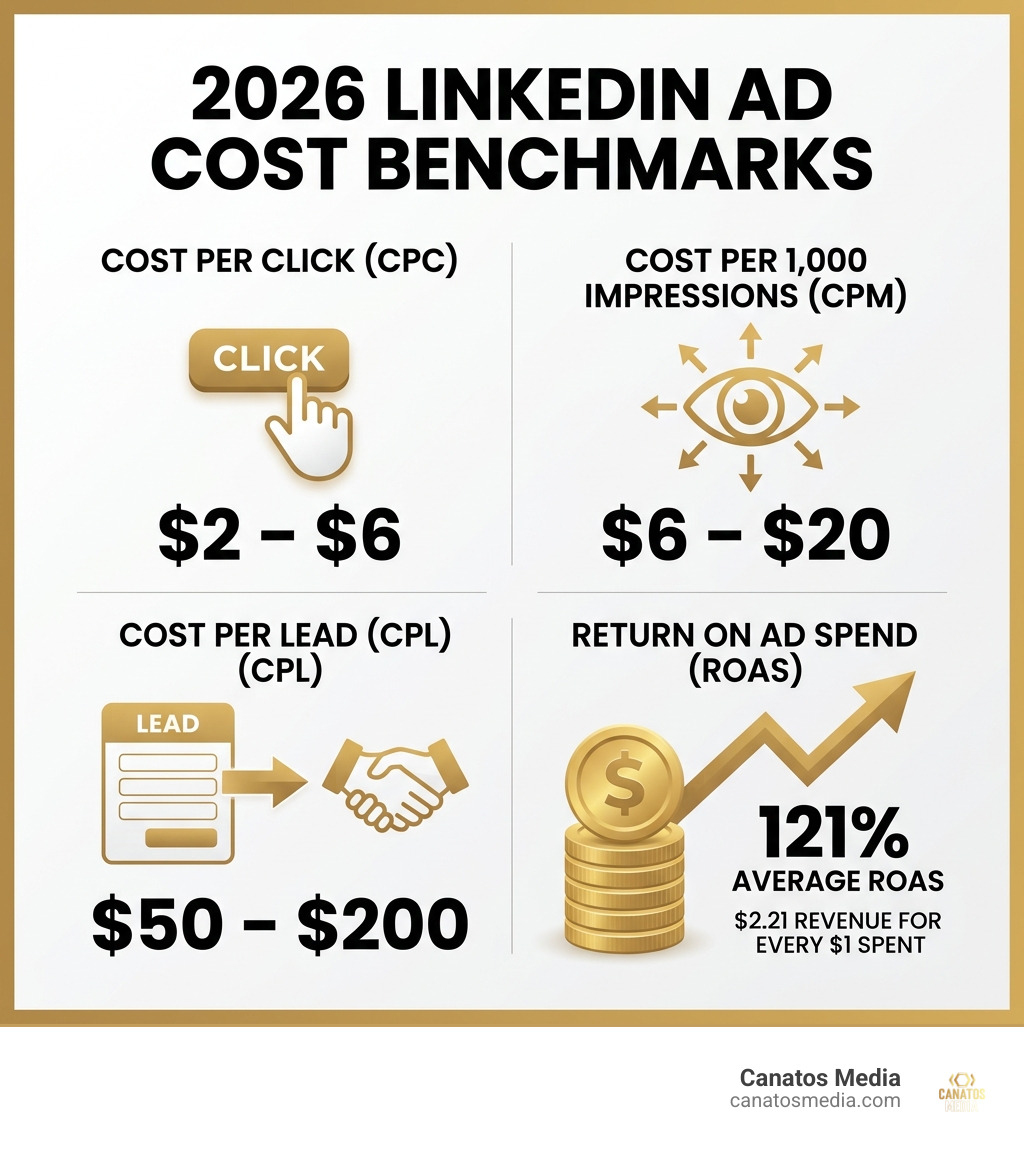
    2026 LinkedIn ad cost benchmarks infographic with CPC, CPM, CPL, and ROAS data - linkedin paid advertising cost infographic

    Understanding the LinkedIn Paid Advertising Cost in 2026

    When we talk about linkedin paid advertising cost, the first thing we have to address is the “sticker shock.” If you’re used to paying $0.50 for a click on Meta, seeing a $6.00 CPC on LinkedIn can feel like someone just tried to sell you a $20 cup of coffee. But on LinkedIn, you aren’t just buying a click; you’re buying a seat at the table with a professional identity.

    How the Auction and Pricing Models Work

    LinkedIn operates on an online auction system. You aren’t just paying a flat fee; you are competing against other advertisers who want to reach the same “New York-based CTO” or “Long Island marketing director.”

    Your actual cost is determined by three main things:

    1. Your Bid: What you are willing to pay.
    2. Target Audience Desirability: How many other people are trying to reach that same person?
    3. Ad Relevance Score: LinkedIn rewards ads that people actually like. If your ad has high engagement, LinkedIn might actually charge you less than a competitor with a boring ad.

    LinkedIn uses objective-based pricing, which means you only pay for “billable events” tied to your goal. If your objective is “Website Visits,” you only pay when someone clicks. If it’s “Brand Awareness,” you pay for impressions (CPM).

    LinkedIn vs. The World

    To put things in perspective, let’s look at how LinkedIn stacks up against other platforms in May 2026:

    Platform Average CPC Average CPM
    LinkedIn $2.00 – $6.00 $6.00 – $20.00
    Meta (Facebook/IG) $0.40 – $1.30 $3.00 – $6.00
    Google Ads (Search) $1.00 – $4.00 $10.00 – $15.00

    While LinkedIn is the “premium” option, it is currently the only major platform delivering a consistent 121% aggregate ROAS for B2B. For every $1.00 we see our clients invest, they are averaging $2.21 in attributed revenue. That’s because the lead quality is often much higher—you’re getting fewer “tire kickers” and more genuine decision-makers.

    Minimum Budgets and Bidding Strategies

    One of the most common questions we get at Canatos Media is: “What’s the bare minimum I need to spend?”

    LinkedIn has some hard floors you need to know about:

    • Minimum Daily Budget: $10.00 per campaign.
    • Minimum Lifetime Budget: $100.00 (for new campaigns).
    • Minimum Bid: Generally $2.00 for CPC or CPM.

    However, just because you can spend $10 a day doesn’t mean you should. We usually recommend a daily spend of at least $25 to $50 to actually give the algorithm enough data to learn. If you’re serious about seeing results, check out our guide on Paid Social Media Advertising from Zero to Hero in One Hour to see how to structure these budgets effectively.

    Choosing Your Bidding Strategy

    How you bid significantly impacts your linkedin paid advertising cost. You have three main choices:

    1. Maximum Delivery (Automated): This is the “set it and forget it” option. LinkedIn’s AI tries to get you the most results for your full budget. It’s great for beginners, but it can sometimes be the most expensive way to buy.
    2. Cost Cap: You tell LinkedIn, “I don’t want to pay more than $50 per lead.” The system will try to keep your average cost below that. It’s great for controlling costs, but if your cap is too low, your ads might stop showing entirely.
    3. Manual Bidding: This gives you total control. You specify exactly what a click or 1,000 impressions are worth to you. We generally recommend this only for experienced advertisers who are monitoring their campaigns daily.

    Benchmarking Costs by Industry and Seniority

    Not all LinkedIn users are priced equally. Targeting a junior graphic designer in the Midwest is going to be significantly cheaper than targeting a C-suite executive at a Fortune 500 company in the Tri-state area.

    According to 2026 benchmarks, your linkedin paid advertising cost is heavily influenced by “professional identity.” You are paying for the privilege of skipping the gatekeeper and landing directly in the feed of a decision-maker.

    Average LinkedIn Paid Advertising Cost by Sector

    Different industries face different levels of competition. Here is what the Cost Per Lead (CPL) looks like across various sectors in 2026:

    • Technology/SaaS: $75 – $200 (High competition, high reward).
    • Financial Services: $80 – $180 (Strict regulations and high-value clients).
    • Professional Services: $50 – $130 (Consulting, legal, accounting).
    • Manufacturing/Industrial: $60 – $150 (Niche audiences, often lower CPC).
    • Healthcare/Pharma B2B: $70 – $160.

    How Seniority and Region Impact Your LinkedIn Paid Advertising Cost

    If you are targeting “C-Suite” titles, expect to pay 2x to 3x more than you would for mid-level managers. These individuals have the most “desirable” profiles, meaning more advertisers are bidding for their attention.

    Geography also plays a massive role. In the Americas (especially the Tri-state area and Long Island), CPCs average around $1.70 to $6.00. In contrast, the EMEA region can see CPCs as high as $5.00 to $8.00 depending on the specific country.

    Seasonality Tip: We’ve noticed a unique trend in late Q4. While many B2C advertisers go crazy on Meta for Black Friday, some B2B players pause their LinkedIn ads in December. This can lead to lower CPCs for those who stay in the game, as executives are often using that downtime to research tools for the upcoming year.
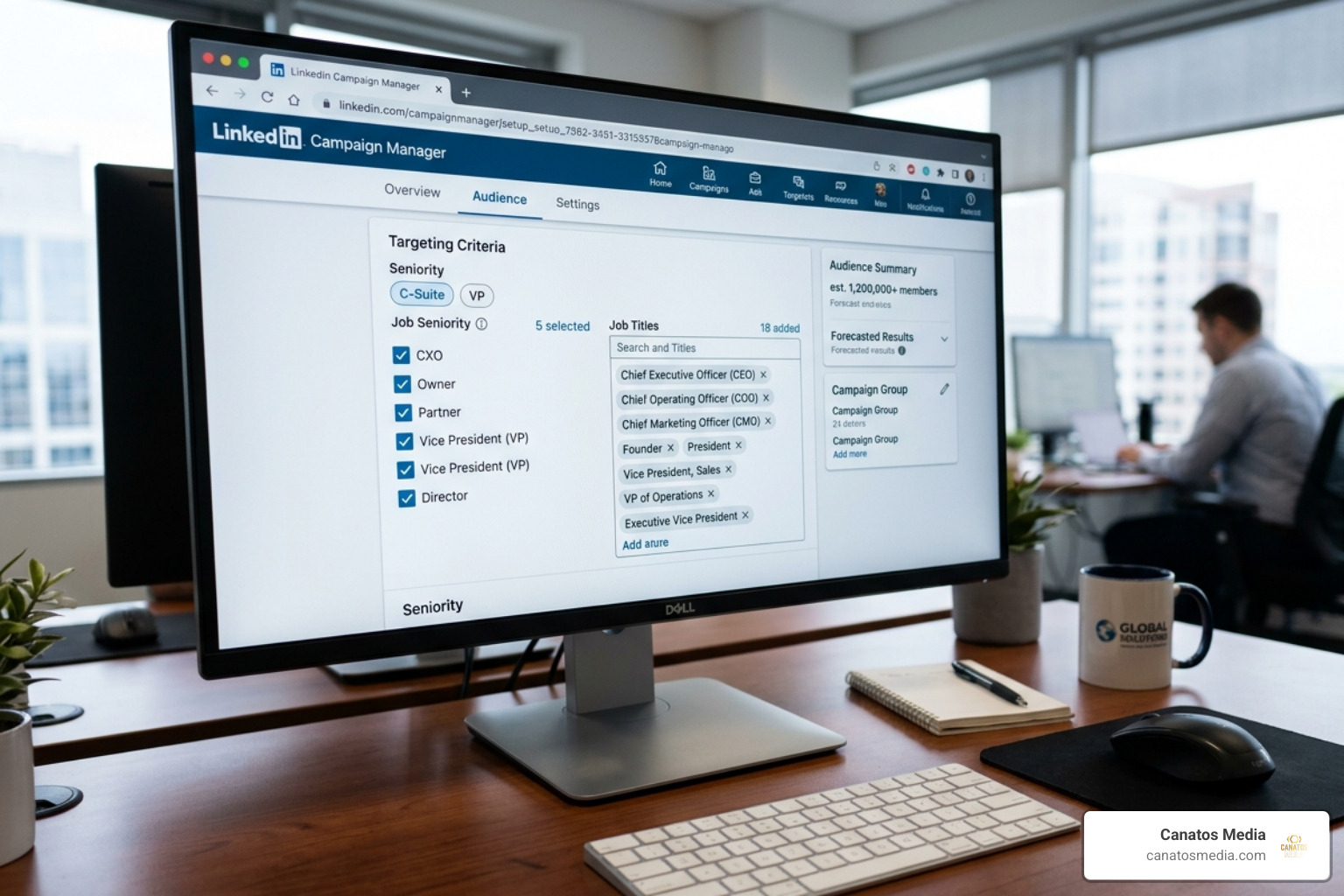
    High-level executive targeting settings in LinkedIn Campaign Manager - linkedin paid advertising cost

    Strategies to Lower Costs and Improve ROAS

    You don’t always need a bigger budget; sometimes you just need a better strategy. At Canatos Media, we focus on an Integrated strategy that connects content to conversions to ensure you aren’t wasting money.

    1. Boost Your Ad Relevance Score

    This is the single biggest lever you have. LinkedIn assigns every ad a score from 1 to 10 based on click-through rate (CTR), comments, likes, and shares. A high score (7–10) tells LinkedIn your ad is valuable, and they will reward you with lower costs and better placement.

    2. Use Lead Gen Forms

    Instead of sending people to a slow-loading landing page on your website, use LinkedIn’s native Lead Gen Forms. These forms auto-fill with the user’s profile data. Because they reduce friction, they often result in a 2x to 5x higher completion rate than standard website forms, significantly lowering your CPL.

    3. Combat Ad Fatigue

    If your audience sees the same ad eight times in three weeks, they’ll stop seeing it—literally. This is called ad fatigue, and it causes your CTR to plumment and your costs to skyrocket. We recommend refreshing your creatives every 2 to 3 weeks and using frequency caps to ensure you aren’t over-saturating a small audience.

    4. Leverage Thought Leader Ads

    In 2026, people trust people more than they trust brands. Thought Leader Ads—where you “boost” a post from a real person’s profile (like a CEO or founder)—consistently outperform company page ads. They feel more authentic and often see much higher engagement for a lower linkedin paid advertising cost.

    5. Try Predictive Audiences

    Think of these as LinkedIn’s version of “lookalike” audiences. By using machine learning, LinkedIn can find users who share similar professional traits with your existing customers. This allows you to expand your reach without having to manually guess every single job title or skill.

    Frequently Asked Questions about LinkedIn Ad Pricing

    How long does it take to see results from LinkedIn campaigns?

    LinkedIn is a demand generation channel, not a “quick fix” like Google Search. B2B buyer journeys are long and complex—often requiring 80+ touchpoints before a deal closes. You should commit to a 3-month testing phase. The first month is for the algorithm to learn; the second is for optimization; and the third is where you start to see the real pipeline impact.

    What are the typical cost per applicant and cost per hire benchmarks?

    If you’re using LinkedIn for recruiting, the costs are slightly different. Promoted job posts generally see a cost of $1 to $8 per applicant, with the U.S. average sitting around $2.83. However, for high-demand roles like cybersecurity or data science, the total “cost per hire” (including all advertising and software) can range from $4,700 to $12,000.

    What is a realistic monthly budget for a small business?

    While 48% of businesses spend under $500 a month, we find that this often leads to “data starvation.” To give the LinkedIn algorithm enough information to actually optimize your ads, we recommend a minimum of $3,000 to $5,000 per month. If you are a larger enterprise, you might spend $10,000+ to truly dominate a specific niche.

    Conclusion

    The linkedin paid advertising cost in 2026 is undeniably a premium, but it’s a premium that pays off when handled with precision. By understanding the auction system, leveraging Lead Gen Forms, and focusing on ad relevance, you can reach the exact decision-makers who move the needle for your business without going broke in the process.

    At Canatos Media, we specialize in an integrated strategy that connects cinematic short-form video with high-intent targeting. We don’t just want you to get clicks; we want you to see measurable growth in your revenue. Whether you are in the Tri-state area or Long Island, we can help you navigate the complexities of paid social to ensure your brand stands out in a crowded professional feed.

    Ready to stop guessing and start growing? Explore our Services today and let’s build a strategy that actually converts.
  • End-to-End Video Production and Ads Management for Multi-Location Brands

    End-to-End Video Production and Ads Management for Multi-Location Brands

    The Challenge of Managing Video Content Across Multiple Locations

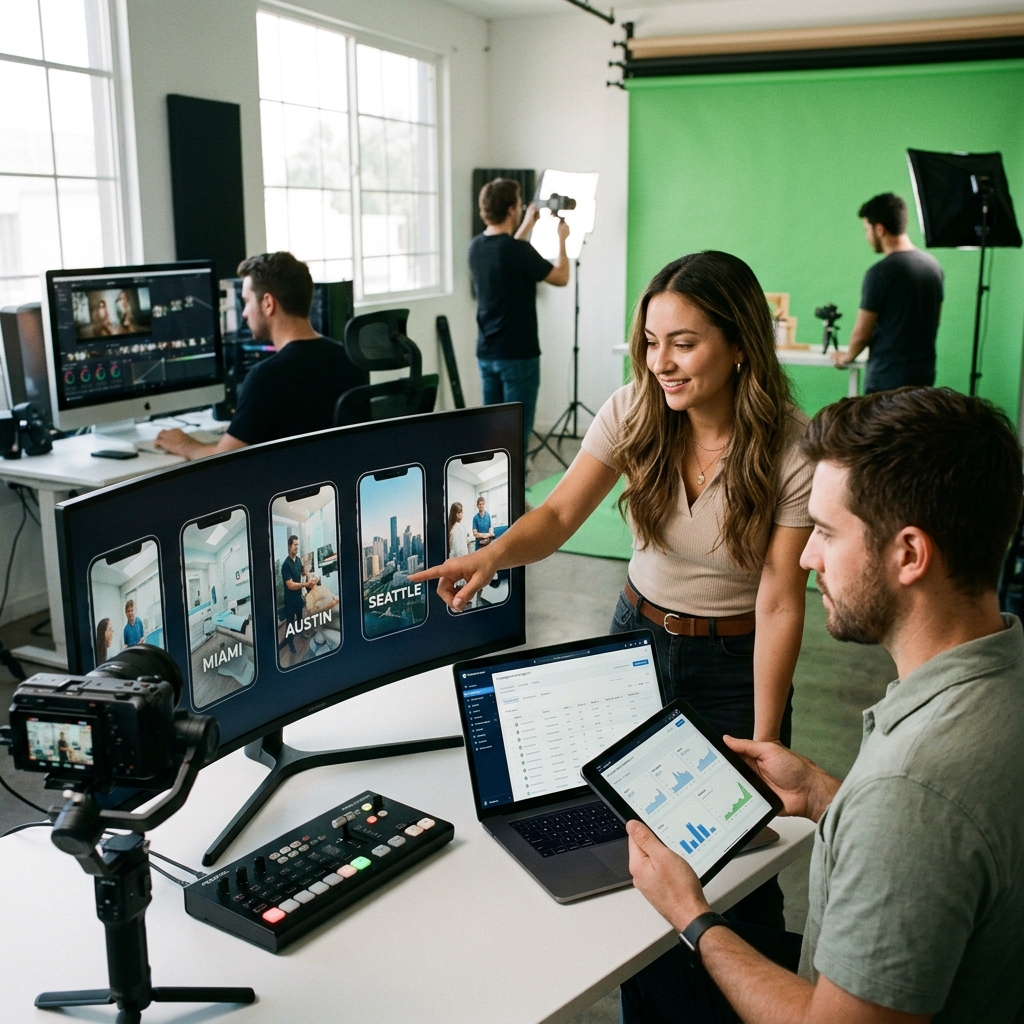
    Running a multi-location or franchise business means balancing brand consistency with local relevance. Each location needs to feel like part of the same brand while resonating with its specific community. When it comes to video content, this tension becomes acute.

    Most multi-location brands face a familiar problem: corporate headquarters creates one generic video, sends it out to all locations, and expects it to work everywhere. It doesn’t. A dental practice in Denver needs different messaging than one in Miami. A plumbing franchise in suburban markets operates differently than one in urban centers. Generic content gets ignored because it doesn’t speak to local audiences.

    At the same time, producing custom videos for every single location becomes prohibitively expensive and logistically complex. You’d need separate crews, different shoots, competing timelines, and budget overruns. There’s no scalable system, no quality control, and no clear way to measure whether the investment is actually generating leads.

    The real challenge isn’t just creating content. It’s creating content that maintains brand integrity while being locally adaptable, all while staying within production budgets and integrating seamlessly with paid advertising strategies. Without a unified system, you end up with scattered efforts that drain resources without delivering results.

    Why Generic Video Agencies Miss the Mark for Multi-Location Businesses

    Most video production agencies operate on a project basis. They shoot, edit, deliver, and hand you a finished file. For a single-location brand, this works fine. For multi-location businesses, it’s a fundamental mismatch.

    Here’s why: generic agencies don’t understand the operational demands of franchises and multi-unit service businesses. They don’t account for the fact that you need content that’s modular, flexible, and integrated with advertising systems. They produce beautiful videos that sit in your library untouched because there’s no clear process for getting them deployed across locations or tied to paid campaigns.

    Additionally, most agencies separate video production from advertising strategy. Your video gets made in one silo while your paid ads run in another, with no coordination between them. This creates waste: you’re paying for ad spend without optimized creative, and you’re investing in production without a clear performance framework tied to lead generation.

    The agencies that understand single-client, single-location needs haven’t built systems for scale. They can’t produce monthly content across multiple locations. They don’t have workflows that allow local customization without redoing the entire production. They’re not equipped to manage how video content performs in paid channels and adjust accordingly.

    What multi-location brands actually need is an end-to-end partner who produces video, runs advertising, tracks performance, and builds systems that get stronger with volume, not weaker.

    How Cinematic Short-Form Content Drives Lead Generation at Scale

    Short-form video is where attention lives now. Whether it’s Instagram Reels, TikTok, or YouTube Shorts, audiences are scrolling through dozens of videos per session. What stops them scrolling is cinematic quality combined with emotional relevance.

    We’ve found that cinematic short-form content outperforms generic talking-head videos by a significant margin on paid platforms. When you invest in production quality, higher frame rates, intentional color grading, and professional sound design, the content stands out in ad feeds. People don’t just watch it; they engage with it.

    For multi-location brands, this becomes a lead generation engine. A 15-second cinematic video of a service being delivered, a before-and-after transformation, or a customer testimonial shot with professional production values gets clicked, watched, and acted upon. That same content repeated across locations with local variations amplifies reach while controlling costs.

    The key is structural: you produce core cinematic elements that work across all locations, then customize the messaging or talent for each market. One production shoot in one location can yield content for dozens of markets. You’re not recreating the wheel for each franchise; you’re templating it intelligently.

    Paired with proper audience targeting in Meta and Google ads, this approach generates qualified leads consistently. The cinematic quality removes skepticism, and the local relevance drives conversions.

    Our Integrated Approach to Video Production and Paid Advertising

    We combine video production, social media management, and paid advertising into a single integrated system. Rather than handling these as separate services, we build them together from the ground up.

    Here’s how it works: when we plan your video content, we’re simultaneously planning how it will perform in paid channels. We know which videos will work best as 15-second ads on Instagram, which ones suit YouTube’s longer-form placements, and which benefit from Google’s visual search features. We build variations into the production itself, not as an afterthought.

    Once content is produced, we manage deployment across your locations’ social channels while running paid campaigns at the platform level. We handle everything: account setup, audience segmentation, bid management, and creative rotation. You get monthly reporting that ties video performance directly to lead volume and cost-per-lead.

    This integration eliminates waste. You’re not overspending on ads because you have weak creative. You’re not producing expensive videos that never see daylight because there’s no advertising strategy behind them. Every piece of content has a purpose, a placement, and a performance expectation.

    Building a Cohesive Brand Story Across All Your Locations

    Multi-location brands often struggle with a core question: how do we feel like one brand when we operate in different markets?

    Video answers that at a visceral level that text and static images can’t. Through consistent production style, color grading, music, and messaging, your brand becomes recognizable instantly, whether someone sees your content in Boston or Boise.

    We develop a visual language specific to your brand that scales across locations. This includes production templates, approved music and sound design, color palettes, and messaging frameworks. Every location can create content that feels distinctly theirs while maintaining unmistakable brand identity.

    For a multi-unit service business, this might mean all locations use the same opening shot style, the same customer testimonial format, and the same call-to-action, but with locally sourced talent and location-specific details. The formula is consistent; the execution is local.

    This approach also builds trust faster. When customers see your brand consistently presented across locations, they perceive stability and professionalism. That perception converts to leads.

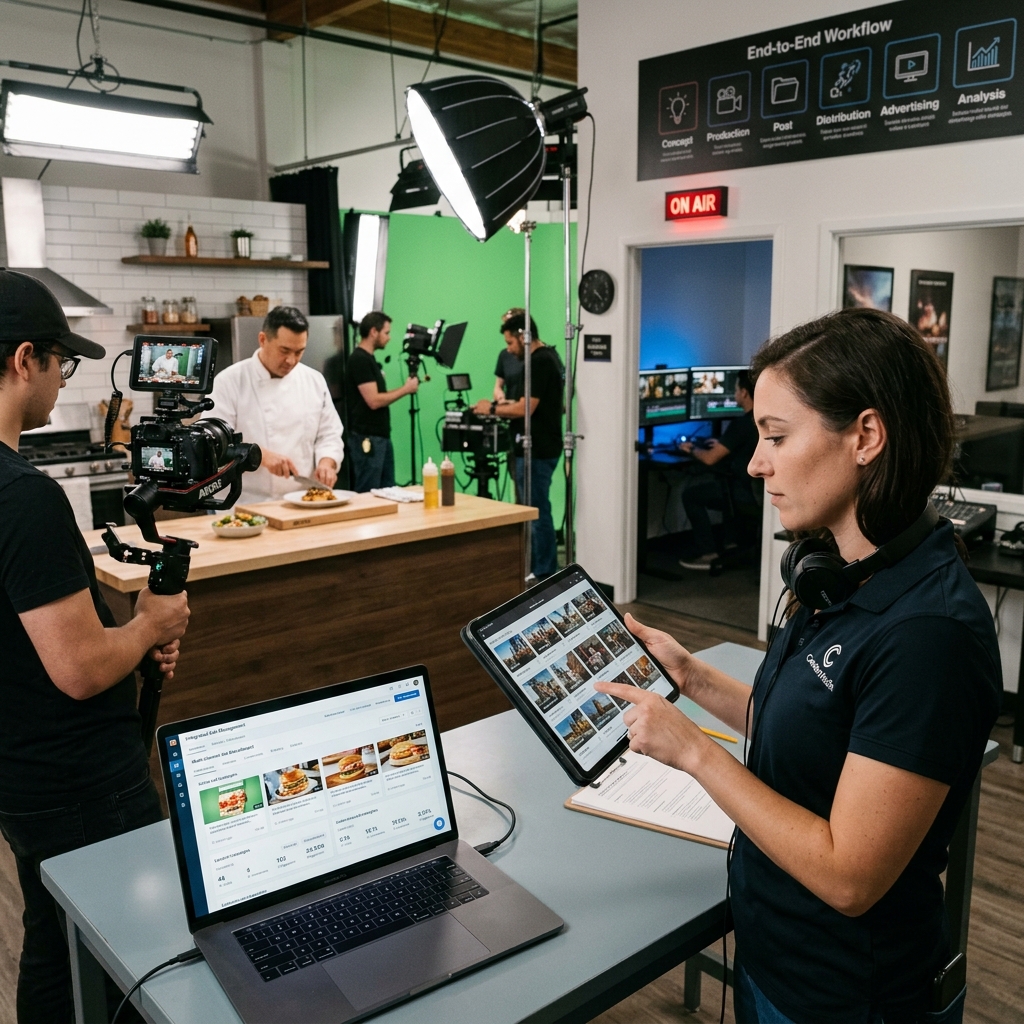
    Streamlining Your Entire Video Workflow From Concept to Campaign

    Without a defined workflow, video projects bog down: unclear timelines, miscommunication between teams, revisions that spiral, and delays before anything goes live.

    We build workflows that move fast without sacrificing quality. This starts with concept development aligned to your lead generation goals, moves through production and editing with clear approval checkpoints, and ends with deployment across social and paid channels on a predictable schedule.

    For multi-location brands, we establish a content calendar that accounts for production capacity and each location’s promotional needs. Rather than everything being reactive and firefighting, you have a system: X new pieces of content every month, produced at scale, deployed consistently, and measured rigorously.

    The workflow also includes feedback loops. When a video performs well in paid channels, we know immediately and can produce variations. When something underperforms, we diagnose why and adjust the next piece. You’re not waiting months to see if an investment paid off.

    Measuring ROI: From Video Production to Qualified Leads

    Video production feels expensive on the front end. Without clear measurement, it’s easy to question whether the investment made sense. We tie everything to performance.

    Our reporting connects video completion rates, click-through rates, and view costs directly to lead volume. You see not just that a video got 50,000 views, but that those views generated 15 qualified leads at a $50 cost-per-lead. Over time, you understand which types of video, which messaging angles, and which locations are most efficient at converting attention into actual business opportunity.

    This data drives optimization. If one location’s testimonial video generates leads at half the cost of another location’s, we understand why and replicate that approach. If short-form reels outperform longer YouTube content for your audience, we adjust the content mix accordingly.

    You’re also able to forecast. With three months of data, you can predict fairly accurately what video investment will generate at a specific cost-per-lead, allowing you to plan marketing budgets with confidence rather than guesswork.

    Getting Started With Your Complete Video Marketing System

    The best time to implement an end-to-end video and advertising system is before you’re desperate. The worst time is when you’re scrambling to generate leads and have no content infrastructure.

    If you run a multi-location brand and video feels like a missing piece of your marketing, we can help you build a system that scales. We’ll start by understanding your business, your locations, and your lead generation targets. From there, we’ll outline a production roadmap, establish workflows, set up advertising accounts, and create a measurement framework tied to your actual business goals.

    You won’t be thinking about video production and advertising as separate challenges anymore. You’ll have one unified system designed specifically for how multi-location brands actually operate. That clarity, combined with professional execution, is what drives both lead volume and profitability in competitive service markets.

    Ready to talk through what an integrated video system looks like for your business? Let’s start there.

    For further reading: Live video production.

    Contact us today for a free consultation to see how we can help you grow your business.

    Frequently Asked Questions (FAQ)

    How do we handle video production and advertising for businesses with multiple locations?

    We create a cohesive brand template that works across all your locations while allowing for local customization. Our team produces cinematic short-form content that maintains your brand identity, then we manage paid advertising campaigns on Meta and Google to ensure each location gets the qualified leads it needs. This approach lets you scale your video marketing without losing the consistency that builds brand recognition.

    What’s included in your end-to-end video marketing system?

    We handle everything from initial concept development and filming through final campaign optimization. Our services include short-form video production, social media management, Meta and Google paid advertising setup, SEO optimization, website design support, and lead generation systems. We also provide ongoing performance tracking so you can see exactly how your video content converts into leads and sales.

    How do we measure whether our video campaigns are actually generating leads?

    We set up tracking systems that connect your video ads directly to lead capture and sales data. We monitor metrics like cost per lead, lead quality, and conversion rates across all your locations so you understand the true ROI of your video marketing investment. Our reporting shows you not just views and engagement, but the actual business results you’re paying for.