
Day: May 20, 2026

  • The Ultimate Roundup of WordPress Site Management Services

    The Ultimate Roundup of WordPress Site Management Services

    Introduction

    [IMAGE] of a digital dashboard monitoring multiple website metrics; WordPress ecosystem; proactive maintenance; technical debt; site longevity; [INFOGRAPHIC] explaining the WordPress management lifecycle; Services

    wordpress management services

    Why WordPress Management Services Are Worth Every Penny

    WordPress management services are professional plans that handle the ongoing technical upkeep of your WordPress site — so you don’t have to.

    Here’s a quick look at what they typically include:

    What’s Covered Why It Matters
    Security scans & malware removal Keeps hackers out and your reputation intact
    Plugin, theme & core updates Prevents compatibility issues and vulnerabilities
    Daily cloud backups Lets you restore your site in minutes if something breaks
    Uptime monitoring Catch downtime before your customers do
    Performance optimization Faster sites rank higher and convert better
    Expert support Real help when things go wrong — fast

    Plans typically start around $49–$99/month for essentials, and go up from there based on the level of hands-on support, hosting, and add-ons included.

    Running a WordPress site sounds simple — until it isn’t. A single plugin update can break your checkout. A missed security patch can let malware in. And if your site goes down on a Friday night, you’re losing customers in real time.

    For local business owners trying to grow online, every hour spent wrestling with website problems is an hour not spent on customers, content, or sales.

    That’s exactly why more businesses are handing off their WordPress sites to professional management teams.

    I’m Nic Canobbio, and through my work at Canatos Media overseeing digital content strategies and web-driven growth for brands, I’ve seen how the right WordPress management services can free up a business owner’s time and directly impact their bottom line. In this roundup, I’ll break down the best options available in 2026 so you can find the right fit for your needs.
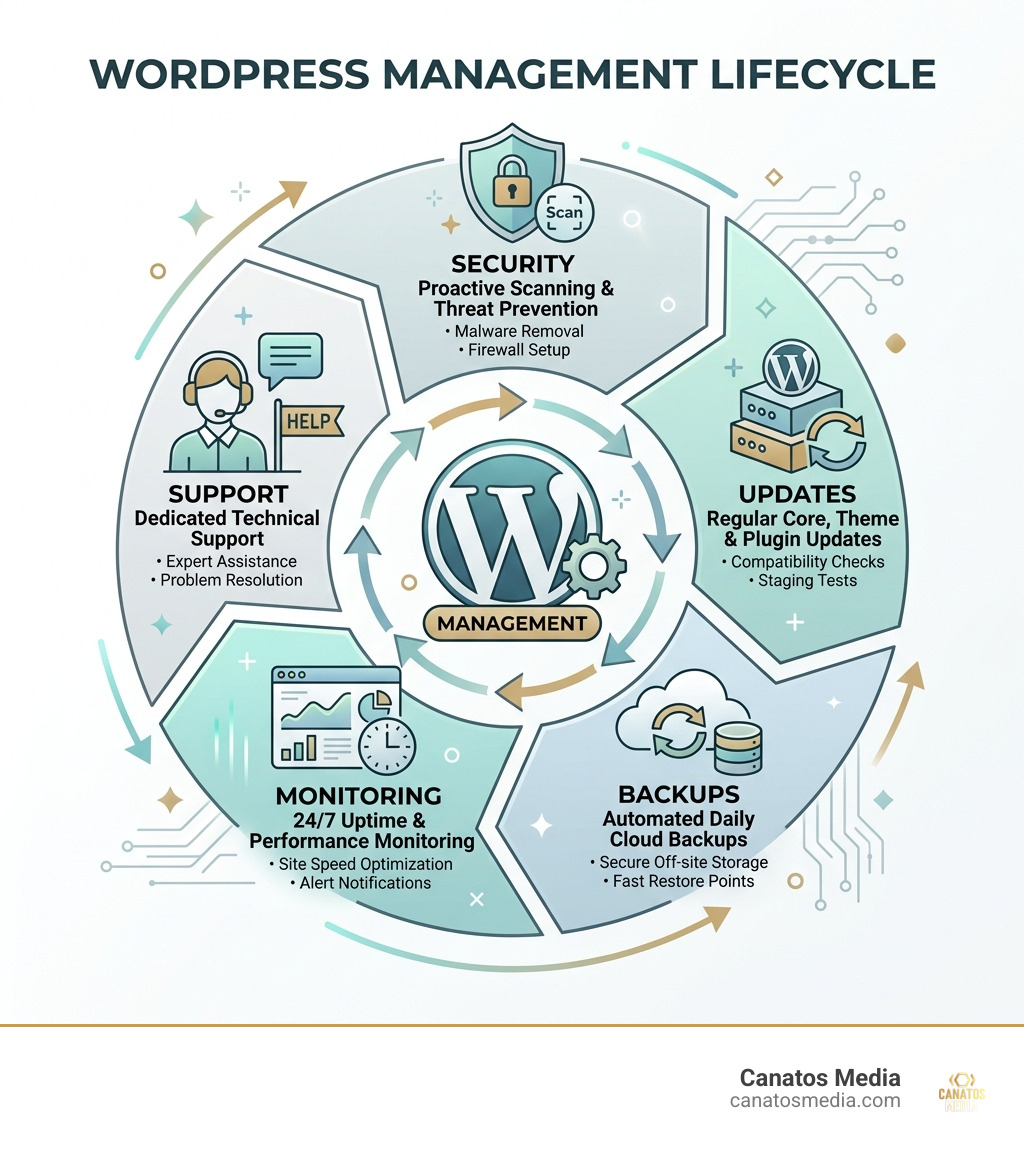
    WordPress management lifecycle infographic showing security, updates, backups, monitoring, and support cycle - wordpress

    What are WordPress Management Services and Why Do You Need Them?

    At its heart, a wordpress management services plan acts as a specialized insurance policy and a dedicated IT department rolled into one. While WordPress is the world’s most popular CMS, its open-source nature means it requires constant vigilance.

    Website owners need these services because technical debt accumulates quickly. Every time a new version of WordPress Core is released, or a plugin developer pushes a security patch, your site needs attention. If you ignore these, you aren’t just missing out on features; you’re leaving the door unlocked for hackers. Statistics show that updated websites rank significantly better in search engines and are far more resilient against automated bot attacks.

    Our Services focus on the heavy lifting: managing plugin compatibility, ensuring your theme doesn’t “break” after an update, and providing disaster recovery. If your site is compromised, a management service doesn’t just tell you there is a problem; they fix it, often before you even realize it happened. For businesses in the tri-state area and Long Island, where competition is fierce, having a site that stays online 24/7 is non-negotiable.

    Secure server lock representing WordPress security and maintenance - wordpress management services

    Canatos Media Website Maintenance & Security

    The Difference Between Hosting and WordPress Management Services

    A common misconception is that “Managed Hosting” is the same as wordpress management services. It isn’t. Think of hosting like the land your house is built on. Managed hosting provides a high-quality “plot” with good utilities (server-side speed, uptime, and basic security).

    Management services, however, are like the property manager who lives in the house. While the host looks at the server, management services look at the application. This includes:

    • Database Optimization: Cleaning up “overhead” in your database to keep things snappy.
    • Theme Troubleshooting: Fixing layout shifts or CSS bugs.
    • Plugin Management: Vetting which plugins are safe to use and which are slowing you down.

    While some of our Pricing tiers include high-performance hosting, the core value lies in the human expertise applied to your specific site configuration.

    Why Proactive Management Beats Reactive Maintenance

    Maintenance is waiting for something to break and then scrambling to fix it. Management is preventing the break in the first place. Proactive management involves 24/7 uptime monitoring (sometimes checking every 45 seconds) and 404 error monitoring to ensure customers never hit a dead end.

    By identifying performance bottlenecks—like a bloated image or a slow-loading script—before they impact your Core Web Vitals, we keep your SEO healthy. Reactive maintenance often leads to “3 AM panic calls.” Proactive management lets you sleep. If you’re tired of being a “slave to the computer,” a Consultation Booking can help you transition to a hands-off model.

    Essential Features of Premium WordPress Management Services

    When evaluating wordpress management services, you should look for features that go beyond the basics. A premium provider doesn’t just “click update.” They test updates in a staging environment (a clone of your site) first. This ensures that a buggy plugin won’t take down your live store.

    Website speed test result showing high performance and optimization - wordpress management services

    Key premium features include:

    • Cloud Backups: Storing your data off-site (e.g., on Amazon S3 or Google Cloud) so that even if the server fails, your data is safe.
    • Malware Removal: If a site is hacked, premium services offer “hack-clean” guarantees.
    • Performance Optimization: This isn’t just a one-time thing. It involves ongoing image compression, database cleanup, and script minification.

    At Canatos Media, we view 24/7 WordPress website management as a partnership. Our Case Studies show that businesses focusing on these technical details see a measurable reduction in churn and an increase in user retention.

    Advanced Security and Emergency Support

    Security in 2026 requires more than a simple plugin. It requires a “defense-in-depth” strategy. This includes:

    • Intelligent Firewalls (WAF): These analyze traffic patterns to block sophisticated SQL injection and cross-site scripting attacks.
    • Brute Force Protection: Stopping bots from guessing your passwords.
    • Isolated Applications: Ensuring that if one part of your server is compromised, your site remains an island of safety.

    If an emergency does occur, response time is the only metric that matters. Many top-tier providers resolve 50% of requests within an hour and 90% within two hours. If you need that level of certainty, Contact Us to discuss our emergency protocols.

    The landscape of search is changing. In 2026, we aren’t just optimizing for Google; we are optimizing for AI discovery. This is known as GEO (Generative Engine Optimization).

    To stay visible in AI-driven search results (like ChatGPT or Claude), your WordPress site needs:

    1. llms.txt Integration: An emerging standard that helps AI crawlers understand your site’s content hierarchy.
    2. Schema.org Structured Data: Giving machines clear signals about your products and services.
    3. Content Citability: Rewriting passages to be statistically dense and “quotable” by AI models.

    Research shows that sites using these GEO techniques can see an increase in AI-driven visibility of 30% to 115%. Our WordPress Management, Maintenance & GEO Optimization plans are designed to future-proof your brand against these shifts.

    Comparing Management Tiers: From Basic to Enterprise

    Choosing the right plan depends on your business size and the complexity of your site.

    Feature Essentials Plan Managed Plan Fully-Managed/Enterprise
    Price Range $49 – $99/mo $199 – $349/mo $500+/mo
    Best For Blogs, Small Portfolios Growing Businesses E-commerce, High-Traffic
    Updates Weekly Weekly (tested) Real-time / Staging-first
    Backups Daily Daily + Offsite Hourly
    Support Email (24h) Priority Email/Chat 24/7 Phone & Dedicated Manager
    Hosting Use your own Included Scalable Cloud Hosting

    Specialized Support for E-commerce and High-Traffic Sites

    E-commerce sites, particularly those running WooCommerce, have specialized needs. A broken checkout for even ten minutes can result in thousands of dollars in lost revenue. These sites require:

    • Checkout Stability Monitoring: Ensuring the payment gateway is always functional.
    • Scalable Infrastructure: Handling traffic spikes during sales or holiday seasons.
    • API Integrations: Managing the connections between your site and your CRM, shipping providers, or inventory tools.

    Our Monthly WordPress Maintenance Services for e-commerce prioritize “zero-downtime” migrations and constant performance tuning to keep conversion rates high.

    White-Label Solutions for Agencies and Freelancers

    If you are a creative agency in New York or New Jersey, you might want to offer maintenance to your clients without hiring a full-time developer. This is where white-label services come in.

    Through All in One Social Content and Management, agencies can resell our technical expertise under their own brand. We handle the updates, security, and reporting, while you maintain the client relationship. This has been shown to increase agency profit margins by over 20% by eliminating the overhead of a dedicated technical team.

    Calculating the ROI of WordPress Management Services

    Is it worth the investment? If your time is worth more than $50/hour, doing your own maintenance is actually costing you money.
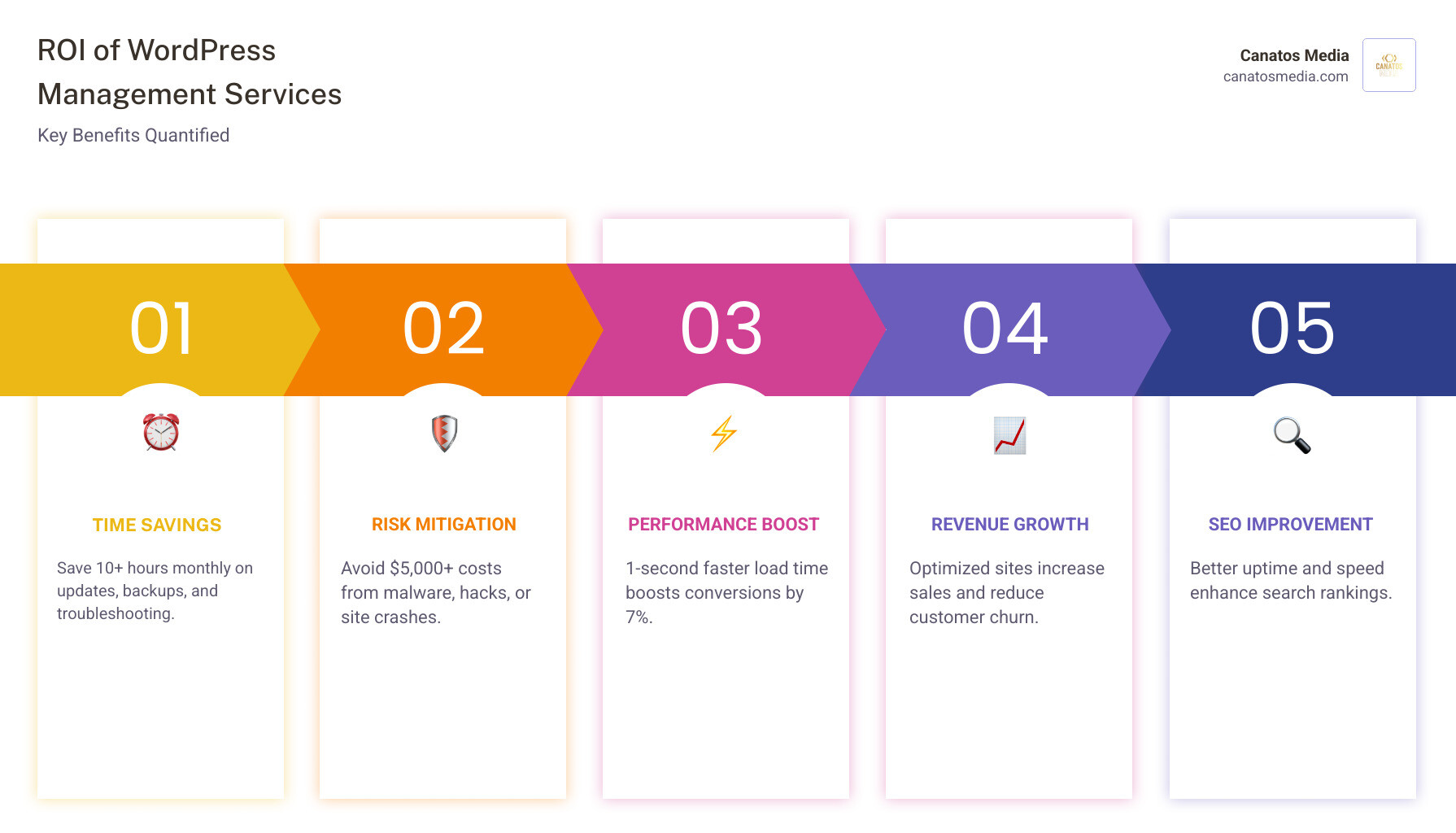
    Growth chart showing increased revenue from optimized website management - wordpress management services infographic

    The ROI of wordpress management services comes from three areas:

    1. Time Savings: Saving 10+ hours a month on manual tinkering.
    2. Risk Mitigation: Avoiding the massive costs of malware removal or rebuilding a crashed site.
    3. Improved Performance: Faster sites lead to better user experiences. Case studies show that even a one-second improvement in load time can boost conversions significantly.

    By partnering with a team that offers 24/7 WordPress website management, you’re investing in your business’s ability to scale without technical friction.

    Avoiding Common Pitfalls in Service Selection

    When shopping for a provider, watch out for these “red flags”:

    • Hidden Hourly Fees: Some “cheap” plans charge extra for every small fix. Look for plans that include “Fast Tasks” or unlimited small edits.
    • Slow Response Times: If they don’t guarantee a response within a few hours, your site could be down for a whole weekend.
    • No Staging Environment: Never let a provider update your live site without testing it elsewhere first.

    A quick Consultation Booking can help clarify what’s included in a plan before you sign a contract.

    How Professional Management Impacts SEO Rankings

    Google’s algorithm prioritizes speed, security, and uptime.

    • Uptime: If Google’s crawler hits your site and it’s down, your rankings can slip.
    • Mobile Responsiveness: Ongoing management ensures that new content or plugins don’t break your mobile layout.
    • Core Web Vitals: Professional optimization focuses on “Largest Contentful Paint” and “Cumulative Layout Shift”—metrics that directly influence where you sit on the search results page.

    Our Services ensure that your technical SEO is always “green,” allowing your content strategy to shine.

    Frequently Asked Questions about WordPress Management

    How much do WordPress management services typically cost in 2026?

    In 2026, basic maintenance typically costs between $49 and $99 per month. For comprehensive management that includes hosting, security, and proactive support, prices range from $199 to $599 per month. Enterprise-level support for high-traffic or multisite networks can range into the thousands.

    What is the difference between a “Fast Task” and custom development?

    A “Fast Task” is generally any update or fix that can be completed in 30 minutes or less—such as changing a phone number, swapping an image, or adjusting a CSS color. Custom development involves building new features, creating custom plugins, or major site redesigns, which are usually billed hourly or by project.

    Do these services include managed hosting or just software updates?

    It depends on the plan. “Essentials” plans often allow you to keep your current host while the provider manages the software. “Managed” and “Premium” plans almost always include high-performance cloud hosting as part of the package for better synergy between the server and the site.

    Conclusion

    Your website is the digital storefront of your business. In a market like the tri-state area, you can’t afford a slow, insecure, or outdated site. WordPress management services provide the peace of mind you need to focus on what you do best: running your business.

    At Canatos Media, we don’t just “maintain” websites; we integrate them into a total digital strategy. From cinematic short-form video and social media management to advanced GEO optimization and SEO, we connect your content to measurable growth.

    Ready to stop worrying about your website and start growing? Explore our Services today and let us handle the technical details while you handle the success.
  • Local Lead Generation for Service Businesses: Why We Built Canatos Media Differently

    Local Lead Generation for Service Businesses: Why We Built Canatos Media Differently

    Why Service-Based Brands Struggle With Lead Generation at Scale

    Service-based businesses face a unique marketing challenge. Unlike e-commerce companies that can rely on product listings and straightforward conversions, service brands must build trust and demonstrate capability before a prospect becomes a customer. This gap between awareness and trust is where most service businesses lose leads. We built Canatos Media specifically to close that gap through integrated systems that turn social media attention into qualified leads and measurable growth.

    Most service businesses operate with a flawed assumption: more visibility equals more leads. A plumbing company, HVAC contractor, or consulting firm invests in social media posts, gets decent impressions, and then wonders why the phone doesn’t ring more.

    The real issue is that service businesses sell solutions to problems that develop over time. A homeowner doesn’t wake up wanting HVAC service; they wake up when their system fails. A business owner doesn’t search for marketing help until they hit a growth ceiling. This means your audience isn’t always “warm” when they encounter your content.

    Additionally, service businesses often juggle multiple locations, varying service types, and complex decision-making processes involving multiple stakeholders. A single Facebook post won’t cut through that complexity. You need proof of quality, evidence of reliability, and trust signals that overcome the risk perception.

    Most agencies respond by throwing volume at the problem: more posts, more ads, more content. What you actually need is fewer, higher-quality touchpoints that demonstrate expertise and build credibility across the entire customer journey.

    The Problem With Traditional Agency Approaches to Local Marketing

    Traditional marketing agencies separate disciplines into silos: social media teams, advertising teams, SEO teams, video teams. Each department optimizes for their own metrics. The social team wants engagement. The ad team wants cost-per-click efficiency. The SEO team wants rankings. These competing priorities rarely align around what actually matters: generating leads that convert to paying customers.

    This compartmentalization creates three critical problems for service businesses:

    Your message becomes inconsistent. One team designs Facebook ads focused on price. Another creates website content emphasizing quality. A third runs Google ads with different value propositions. Prospects encounter conflicting messaging and lose confidence in your brand.

    Handoffs between teams create friction and slow response times. A prospect clicks an ad, lands on a mismatched landing page, and the sales team doesn’t have context about which ad they clicked or what promised outcome they were expecting.

    Measurement becomes convoluted. Did the lead come from the ad campaign, the organic social post, the Google search, or the website? Traditional agencies struggle to show how their individual services actually work together to generate revenue.

    Service businesses need better integration. Your marketing should operate like a coordinated system, not a collection of separate vendors.

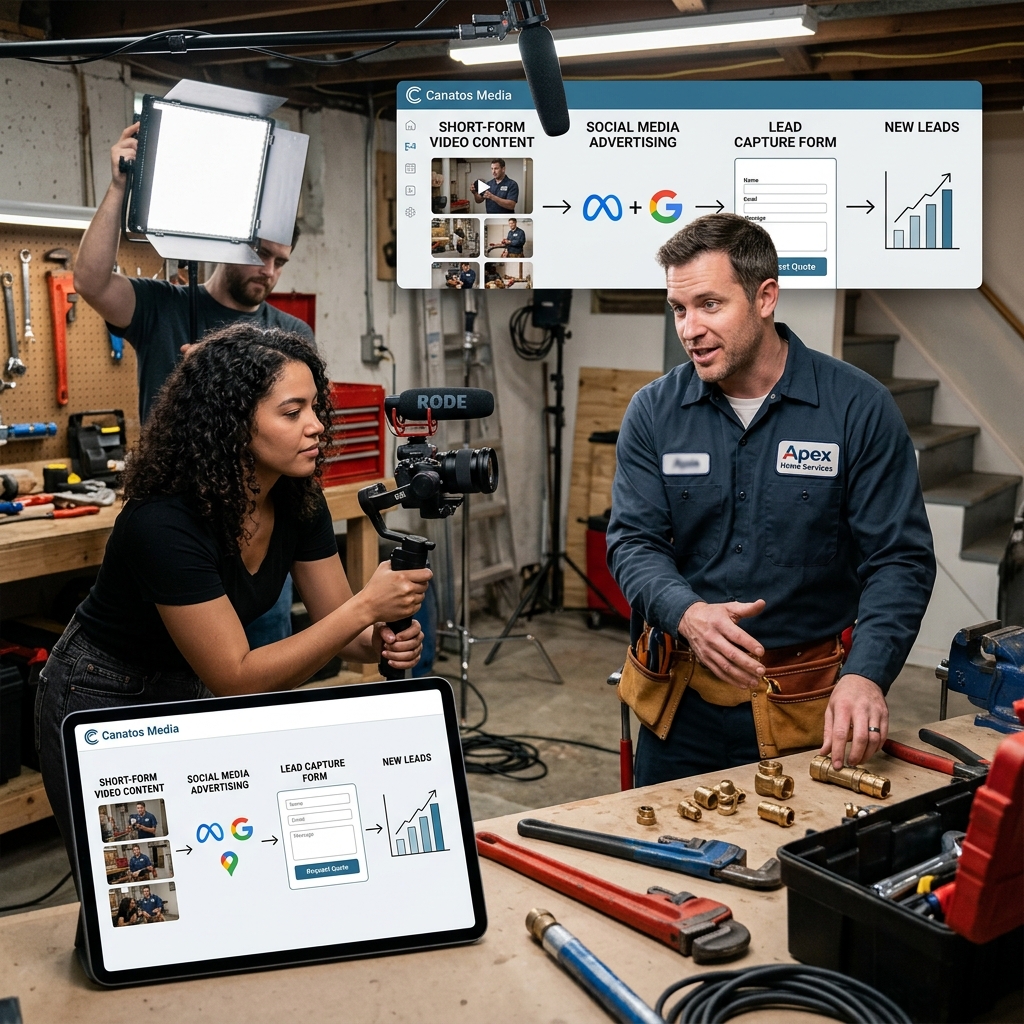
    How We Combine Short-Form Video With Lead Generation Systems

    We built our approach around a central insight: short-form video is the highest-trust format available right now, and it integrates seamlessly into every channel that generates leads for service businesses.

    Here’s how it works in practice. A plumbing company creates a 30-second video showing a common problem (low water pressure) and the solution their team delivers. That video appears on their Instagram Reels, TikTok, Facebook feed, and paid campaigns. It tells a clear story with a specific outcome, which is infinitely more convincing than a carousel ad or static image.

    The same video also flows into their paid advertising strategy. We use these short-form pieces as conversion assets in Meta and Google campaigns, where they significantly outperform traditional ad creative. Video generates higher click-through rates, lower cost-per-click, and most importantly, better lead quality because prospects see your work before they fill out a form.

    We also use short-form content to populate your website and lead capture pages. When someone lands on your site, they immediately see video proof of your expertise. This dramatically improves form completion rates and reduces friction in your conversion funnel.

    This isn’t just about production quality. We’re intentional about how each video supports your lead generation system. Every script, every shot, every call-to-action serves a purpose within the larger marketing flow.

    Our Approach to Cinematic Storytelling That Actually Converts

    Many agencies think cinematic video means high production values. We think it means clear, compelling storytelling that connects emotionally with your ideal customer and creates urgency around solving their problem.

    Cinematic storytelling for service businesses follows a specific structure:

    Problem recognition: The video opens by showing a real situation your customer encounters. A roofing company might show a homeowner discovering a leak. A staffing agency might show a business owner struggling to fill roles quickly.

    Consequence clarity: We explain what happens if the problem persists. Ignored roof leaks lead to structural damage and mold. Unfilled roles slow growth and overload existing staff.

    Your solution: We demonstrate how your service specifically addresses the problem, often showing before-and-after results or customer testimonials.

    Trust signals: We build credibility through credentials, years in business, specific case results, or customer reviews woven naturally into the story.

    Clear action: We close with a specific, low-friction next step (call now, book a consultation, visit your website).

    This structure works because it acknowledges how service customers actually make decisions. They don’t buy based on features; they buy because you’ve convinced them that you understand their problem and can reliably solve it. Cinematic website videos that follow this approach convert significantly better than generic corporate videos or testimonial compilations.

    Social Media Management Built for Lead Capture, Not Just Engagement

    Most social media managers optimize for engagement metrics: likes, comments, shares. This creates a perverse incentive structure where the goal becomes entertainment rather than business results.

    We approach social media differently. Our posting strategy, content calendar, and audience engagement all funnel toward lead capture and customer conversion. This means:

    Strategic content mix: We balance awareness content (showing your expertise and building your brand) with conversion content (direct lead-generation posts with forms, booking links, or CTAs that move prospects toward sales conversations).

    Profile optimization: Your social profiles include clear service offerings, response times, booking links, and lead-capture mechanisms. A prospect shouldn’t have to search for how to contact you.

    Community engagement: We engage with prospects and customers in ways that build relationships and encourage direct messages or form submissions, not just comment threads.

    Performance tracking: We measure social media success by leads generated and customer acquisition cost, not vanity metrics.

    For multi-location service businesses, this approach becomes critical. Each location can have unique offerings, service areas, and customer testimonials. We organize your social strategy to highlight location-specific content that resonates locally while maintaining brand consistency.

    Meta and Google Advertising Strategies for Service-Based Brands

    Paid advertising is where most service businesses waste money. They run broad campaigns aimed at anyone who might need their service, accept high cost-per-click, and wonder why conversion rates are terrible.

    Our approach focuses on audience precision and offer clarity. On Meta (Facebook and Instagram), we build custom audiences based on past customer data, website visitors, and behavioral signals that indicate someone has a real need for your service. We run separate campaigns for different service lines, different geographic areas, and different stages of the customer journey (awareness, consideration, decision).

    Google advertising for service businesses works best when targeting high-intent keywords. Someone searching “emergency plumber near me” is significantly more ready to convert than someone searching “how to fix low water pressure.” We build campaigns around these intent levels and structure our landing pages to match exactly what the search query promised.

    We also leverage Google Local Services Ads for service businesses, which show your reviews, response rates, and service areas directly in search results. These convert exceptionally well because they appear at the moment someone is actively seeking your service.

    The key is integration. Your Google ads send traffic to relevant landing pages. Your Meta ads build awareness for service lines that take longer to decide. Your website content aligns with what your ads promised. This coherence dramatically improves conversion rates across all paid channels.

    Building Trust Through AEO Optimization and Website Excellence

    Author Experience Optimization (AEO) is how search engines now evaluate whether you’re a trustworthy authority in your industry. For service businesses, this means clearly demonstrating your credentials, experience, and track record.

    On your website and across your digital presence, we make sure to highlight:

    Business credentials: Licenses, certifications, insurance, years in business, and professional affiliations.

    Customer results: Specific case studies, before-and-after galleries, measurable outcomes from past projects.

    Customer voice: Detailed reviews, testimonials with photos, and user-generated content that prospective customers find credible.

    Consistent messaging: Your service expertise comes through clearly in every page, blog post, and video on your site.

    Your website itself becomes a lead generation tool, not just an informational asset. We design conversion paths that guide prospects toward clear next steps: booking consultations, requesting quotes, or scheduling free evaluations. Load speed, mobile responsiveness, and intuitive navigation all affect whether someone stays on your site or bounces to a competitor.

    For multi-location brands, we build systems that serve both the main website (showing your company’s full scope) and location-specific landing pages that address local market needs and competition.

    How We Integrate Video, Social Media, and Paid Advertising

    The real competitive advantage emerges when these elements work together. Here’s a concrete example: A home services company produces a 45-second video showing a kitchen renovation from start to finish. We repurpose that video into:

    • Five 15-second clips for Instagram and TikTok feeds
    • A complete version for their website homepage
    • A lead-magnet video for email campaigns
    • Multiple versions optimized for Meta and Google ads with different CTAs
    • Clips with captions for accessibility and better performance

    Meanwhile, that same video supports the paid advertising strategy. We run different video ads to different audience segments, tracking which versions drive the lowest cost-per-lead. We use the complete video on the website to build credibility for prospects who arrive from paid search. We reference the video in social media posts to increase video watch time and build social proof.

    This integrated approach means your content investment compounds. One video production session creates assets for six different channels and marketing functions, all supporting the same conversion goal.

    Real-World Systems We Use for Multi-Location Brands

    Multi-location service businesses need scaled systems. A plumbing company with five locations can’t manage each location separately without burning out staff.

    We build standardized workflows where each location has:

    Local content production: Monthly video content featuring local team members, local projects, and local testimonials. This builds community relevance and appears more authentic than one corporate account sharing generic content.

    Location landing pages: Each location has its own service area map, local reviews, location-specific hours, and team photos. This improves local search visibility and conversion rates.

    Localized paid campaigns: We run location-specific ads with local phone numbers, local team photos, and location-specific service offerings. A prospect in one service area sees ads from their local team, not a corporate brand.

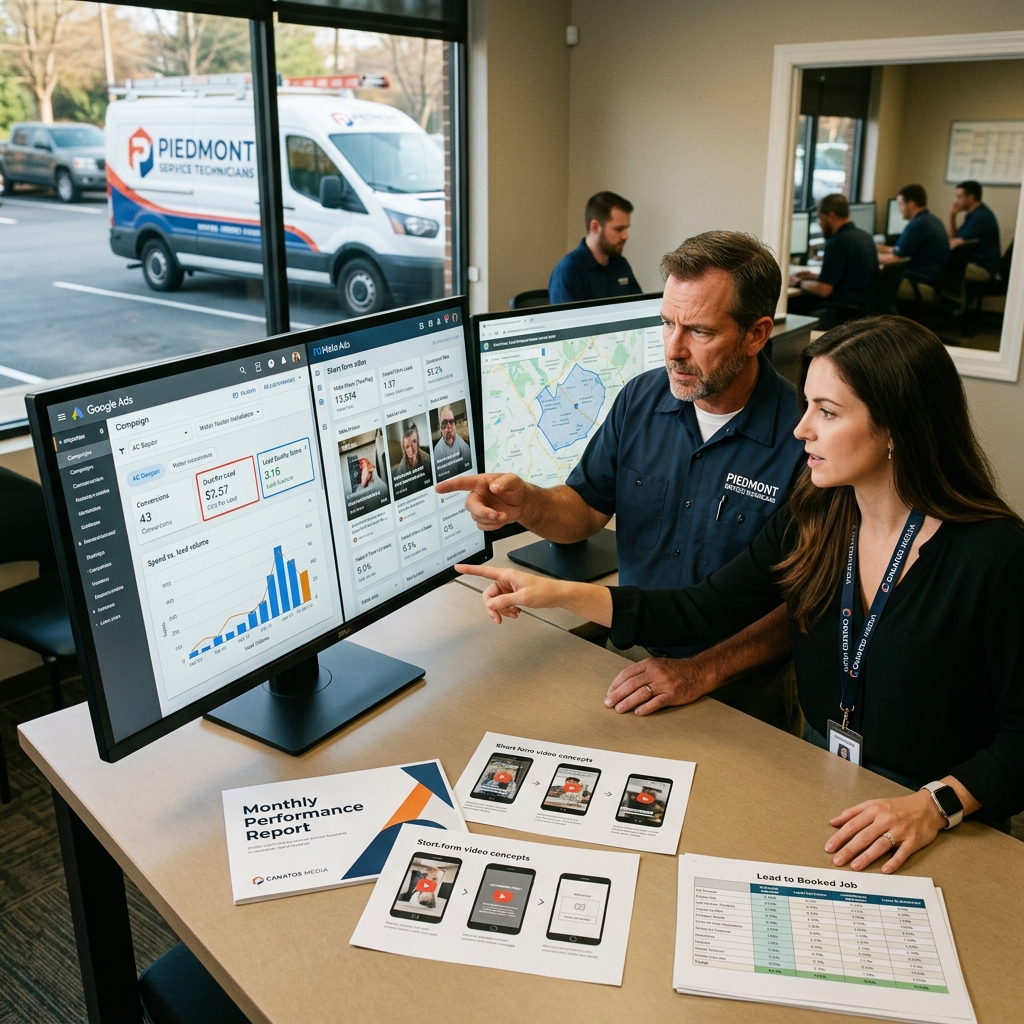
    Centralized measurement: Despite running local campaigns, we track everything through a unified dashboard showing which locations are generating leads, at what cost, and with what conversion rates.

    Shared content library: Each location doesn’t need to reinvent the wheel. We create core video templates, social media templates, and ad templates that local teams can customize with their information and local examples.

    This system scales efficiently without requiring each location to have its own marketing person. A central team manages strategy and production while local teams provide the customer testimonials, project photos, and local context that make campaigns resonate.

    Why Our Video-First Model Works Better Than Traditional Agencies

    Video dominates because it compresses the trust-building timeline. When someone watches a 60-second video of your team completing a project, they see your work quality, your professionalism, and your attention to detail. This would take paragraphs of written description to communicate equally.

    Video also performs better across every platform. Facebook’s algorithm favors video content. TikTok requires it. Instagram increasingly rewards Reels over static posts. Google shows video results prominently. By making video your content foundation, you’re creating assets optimized for how digital platforms actually work in 2026.

    Video also reduces friction in your conversion process. A prospect watches a video, sees your work, and reaches out. They’ve already made a mental commitment to at least exploring your service. Compare this to someone who reads a description or sees a photo and might scroll past. Video creates stronger buyer intent.

    Our video-first marketing approach means every strategic decision filters through one question: How does this serve video production and distribution? Social media strategy supports video creation. Paid advertising amplifies video content. Website design showcases video. This coherent focus creates efficiency across your entire marketing system.

    Getting Started With Our Integrated Digital Marketing System

    The first step is diagnosing what’s currently broken in your marketing. Most service businesses we meet are running separate channels that don’t communicate. Social media posts don’t align with paid ads. Website content doesn’t match what your ads promise. Video exists in isolation rather than fueling every channel.

    Start by auditing your current assets and channels. What video content do you have? How is it being used? Are your social media profiles optimized for lead capture or just brand awareness? What’s your current cost-per-lead across paid channels, and how does it compare to your customer lifetime value?

    Next, identify your highest-intent audience segments. Not all prospects are created equal. A homeowner actively searching for a service this week is worth far more than someone who “might need this someday.” Build your strategy around reaching the ready-to-buy segment first.

    Then, align your content production around lead generation goals. Every piece of content, every social post, every ad should support your core business objective: generating qualified leads that your sales team can convert.

    The businesses that grow fastest combine high-quality storytelling with systems thinking. They create content that builds trust, distribute it across every relevant channel, and measure everything against actual business results. We help service-based brands do exactly that, turning social media attention into sustainable revenue growth.

    Contact us today for a free consultation to see how we can help you grow your business.

    Frequently Asked Questions (FAQ)

    How does our video-first approach actually generate more leads than traditional digital marketing?

    We’ve found that short-form cinematic video stops the scroll and builds emotional connection in ways static content simply can’t match. Once we capture attention with compelling visuals, we layer in our lead capture systems across social platforms and paid channels, turning that engagement into qualified leads for your business. Our integrated approach means the video content feeds into Meta and Google advertising, social media funnels, and website conversions all at once, rather than existing as standalone content.

    What makes our service for multi-location brands different from working with a general marketing agency?

    We built our systems specifically for the operational realities of multi-location and service-based brands. We understand that one location’s lead quality differs from another’s, that your customer journey is longer than most, and that trust signals matter enormously in service industries. Our AEO optimization and website excellence strategies directly address these challenges, while our video production captures the local, personalized storytelling that converts service-based customers.

    How do we ensure our advertising spend actually produces leads, not just clicks?

    We connect our Meta and Google advertising directly to lead capture systems on your website and social channels, then track which campaigns and content types deliver qualified leads specific to your business model. Rather than optimize for vanity metrics, we structure everything from video production through paid spend around your actual conversion goals and cost per lead targets.