Why AI Search Results Are Reshaping Digital Marketing for Service Businesses
Search behavior is fundamentally changing. Google’s AI Overviews, OpenAI’s SearchGPT, and similar platforms are shifting how people find answers, products, and services online. For service-based businesses like HVAC contractors, dentists, plumbers, and home improvement companies, this means the old playbook of ranking for keywords no longer tells the full story.
AI-powered search engines prioritize different signals than traditional search. They value recency, relevance verification through multiple sources, and increasingly, visual proof of expertise. When someone asks “What does a professional roof inspection look like?” or “How do you install solar panels safely?”, AI systems pull from pages, videos, and images that demonstrate clear expertise and trustworthiness.
The businesses winning in this shift understand that visibility in AI results requires a completely different approach. Static blog posts and keyword-stuffed pages aren’t enough anymore. You need content that shows, not just tells. Video content paired with proper optimization (what we call AEO, or Answer Engine Optimization) is becoming the fastest way to capture this emerging traffic stream.
For multi-location service businesses especially, this is critical. Your competitors are already adapting. The question isn’t whether AI search will matter to your bottom line, but whether you’ll position your brand to capture leads from it.
The Problem: Traditional SEO Isn’t Built for AI-Driven Search
Traditional SEO focuses on keyword density, backlinks, and page structure optimized for Google’s classical ranking algorithm. That system worked well for years. But AI search engines operate differently.
They don’t just read text. They process language semantically, understand context, and cross-reference information across multiple sources. They also heavily favor video and visual content because it provides verifiable proof of claims. A video of a plumber explaining a common pipe issue and showing the fix provides more credibility to an AI system than a 2,000-word blog post on the same topic.
Here’s the gap: most SEO strategies still focus on getting your website to rank on page one of Google. That’s valuable, but it misses the entire channel of AI-generated responses that now appear above traditional search results. Users increasingly click on AI summaries that cite multiple sources rather than clicking through to individual websites.
This creates a new problem. Your content might still rank well in classical search, but if it’s not optimized for AI extraction and citation, you won’t get traffic from AI results. And since these systems are growing faster than traditional search, that means lost leads.
The fix requires rethinking how you create and structure content. Traditional SEO and AEO aren’t mutually exclusive. They work together. But without intentional AEO strategy, you’re leaving a significant portion of search traffic on the table.
How AI-Powered Search Engines Prioritize Video and Visual Content
AI systems learn from how humans interact with content. They’ve observed that when people see a video explanation, they trust it more. They click on it more. They convert from it more often. These systems are built to replicate and predict human behavior, so they reward content that humans consistently prefer.
Video content offers AI engines several advantages:
- Direct evidence of expertise: A contractor discussing roofing materials while showing them visually proves knowledge in a way text cannot.
- Engagement signals: Videos receive higher watch time, comments, and shares, which AI systems track as quality signals.
- Diverse content signals: AI indexes not just the video itself, but captions, descriptions, tags, and related structured data.
- Multi-modal learning: Modern AI understands relationships between video, audio, and text. A well-produced video with accurate transcripts gives these systems multiple entry points.
- Recency proof: Video content is inherently time-stamped. Current videos signal up-to-date information, which AI systems prioritize.
We’ve observed that businesses producing consistent video content see their AI search visibility increase significantly faster than those relying solely on written content. This is because video content naturally includes many of the signals AI systems use to verify expertise and trust.
The catch: it has to be good video content. Low-quality phone recordings or poorly framed content underperforms. AI systems are sophisticated enough to detect production quality and professionalism, which they treat as a signal of legitimacy.
What AEO Optimization Really Means for Your Brand’s Visibility
AEO stands for Answer Engine Optimization. It’s the practice of creating and structuring content specifically to be surfaced by AI-powered search engines and answer systems.
Unlike traditional SEO, which optimizes for ranking position, AEO optimizes for being cited and extracted by AI systems. When someone asks an AI search engine a question, the system pulls from multiple sources to create a comprehensive answer. If your content is cited as a source, you get visibility and traffic.
This distinction matters. You might not rank first in classical Google search, but if your content is cited as a credible source in three different AI responses per day, you’re driving significant qualified traffic.
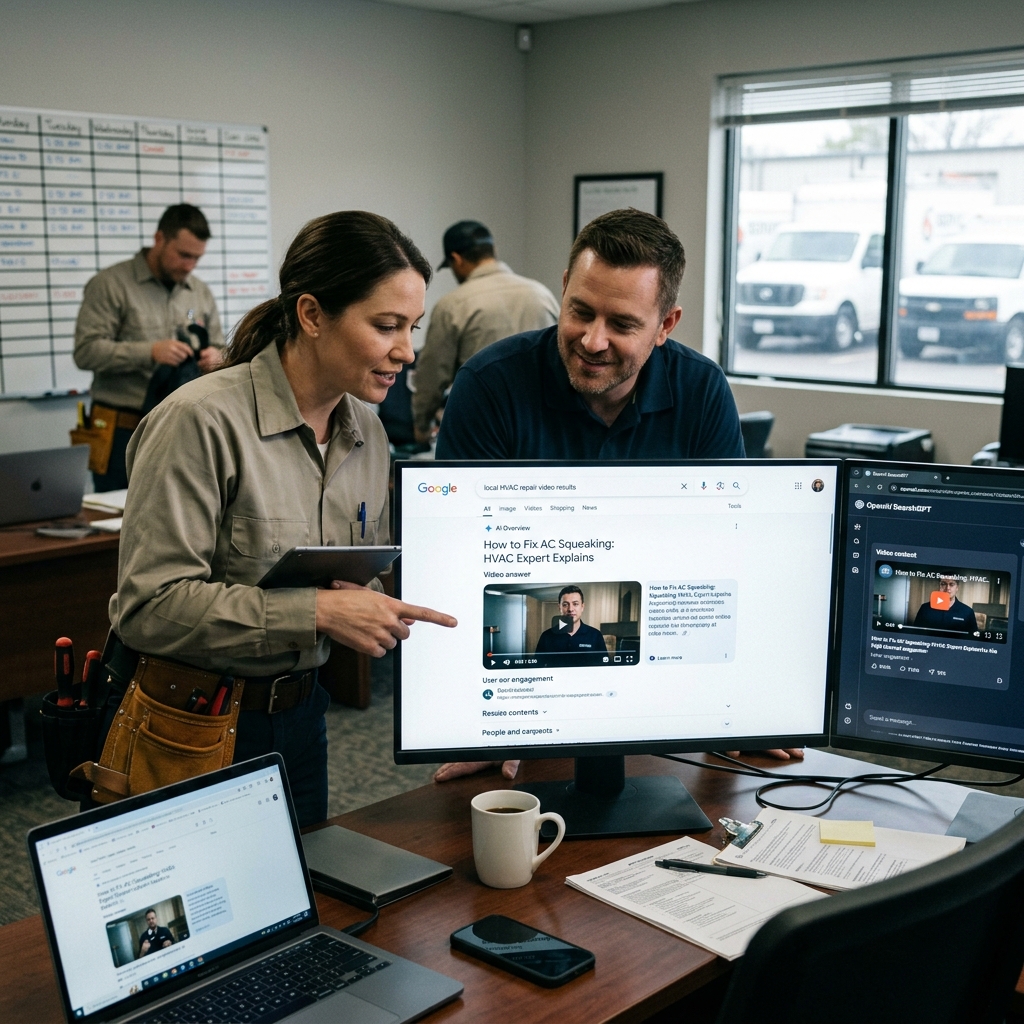
AEO optimization involves:
- Clear, concise answers: AI systems pull direct quotes. If your content answers the question directly and clearly in the opening sentences, it’s more likely to be cited.
- Structured data markup: Schema markup (review schema, FAQ schema, video schema) helps AI systems understand what your content is about.
- Multiple content formats: Text, video, images, and structured data together signal authority across multiple modalities.
- Source verification: Links to credible sources, credentials, and business verification increase your likelihood of being cited.
- Topical authority: AI systems reward websites that consistently produce content across related topics in a specific vertical.
AI search optimization requires a different planning process than traditional content marketing. You’re thinking less about “What keywords should we rank for?” and more about “What questions does our audience ask, and how do we provide the most credible, verifiable answer?”
Why Cinematic Short-Form Video Outperforms Static Content in AI Search
We’ve worked with hundreds of service businesses, and the pattern is clear: cinematic, professional short-form video dramatically outperforms static content when it comes to AEO performance.
There are several reasons:
Production quality signals trust. A business that invests in professional video production signals that they take their brand seriously. AI systems detect this. Low-production content might still be cited occasionally, but professional video is cited more consistently and more prominently in AI responses.
Cinematic storytelling increases engagement. A well-shot, well-edited video that tells a story (a contractor solving a specific problem, for example) receives higher engagement metrics. Longer watch time, more shares, more comments. AI systems track these signals and reward them.
Short-form format matches user behavior. Short-form videos (30 seconds to 3 minutes) are what people actually consume. Long-form videos are watched less frequently, meaning fewer engagement signals for AI systems to reward.
Transcripts provide multiple indexing points. A professional video includes accurate captions and transcripts. AI systems can index the video itself, the audio content via transcription, the visual elements, and the associated text. This redundancy increases the chances of citation.
Here’s a concrete example: A plumbing company produces a 90-second cinematic video showing the step-by-step process of fixing a common drain issue. The video is properly captioned, uploaded with full descriptions, and shares on social platforms. When someone asks an AI search engine “How do I fix a slow drain?”, that video now appears as a cited source because it directly answers the question, provides visual proof, and has multiple signals of legitimacy and engagement.
Compare that to a 2,000-word blog post on the same topic with no video. The blog post might still be cited, but less frequently and less prominently.
Building an AEO Strategy That Turns AI Search Traffic into Leads
AEO success requires strategy, not just content creation. You need to identify which questions your audience is asking, determine which of those questions have the highest commercial intent, and then produce content that answers those questions better than anyone else.
Start by mapping your audience’s most critical questions:
- What problems do service calls solve most frequently?
- What questions do prospects ask before deciding to contact you?
- What objections do sales teams encounter most often?
- What educational content would a qualified prospect want to consume?
Once you’ve identified these questions, create content around them. Each piece should directly answer the question, provide visual proof (video), include proper structured data, and be distributed across channels where your audience spends time.
The lead generation piece is crucial. You’re not just creating content for visibility. You’re creating content that positions your business as the solution. A video showing your team solving a specific problem should naturally lead viewers to want to contact you.
This means every piece of AEO-optimized video content should include clear next steps: a call-to-action that guides viewers to a contact form, booking page, or consultation request. The conversion mechanism has to be built in from the planning stage, not bolted on after production.
Distribution matters too. Content that lives on your website alone has limited reach. Successful AEO strategies use short form video production across social platforms, your website, and directly to email lists. Each platform reinforces the others, creating network effects that boost overall visibility.
How We Integrate Video Production with AEO and Digital Marketing Systems
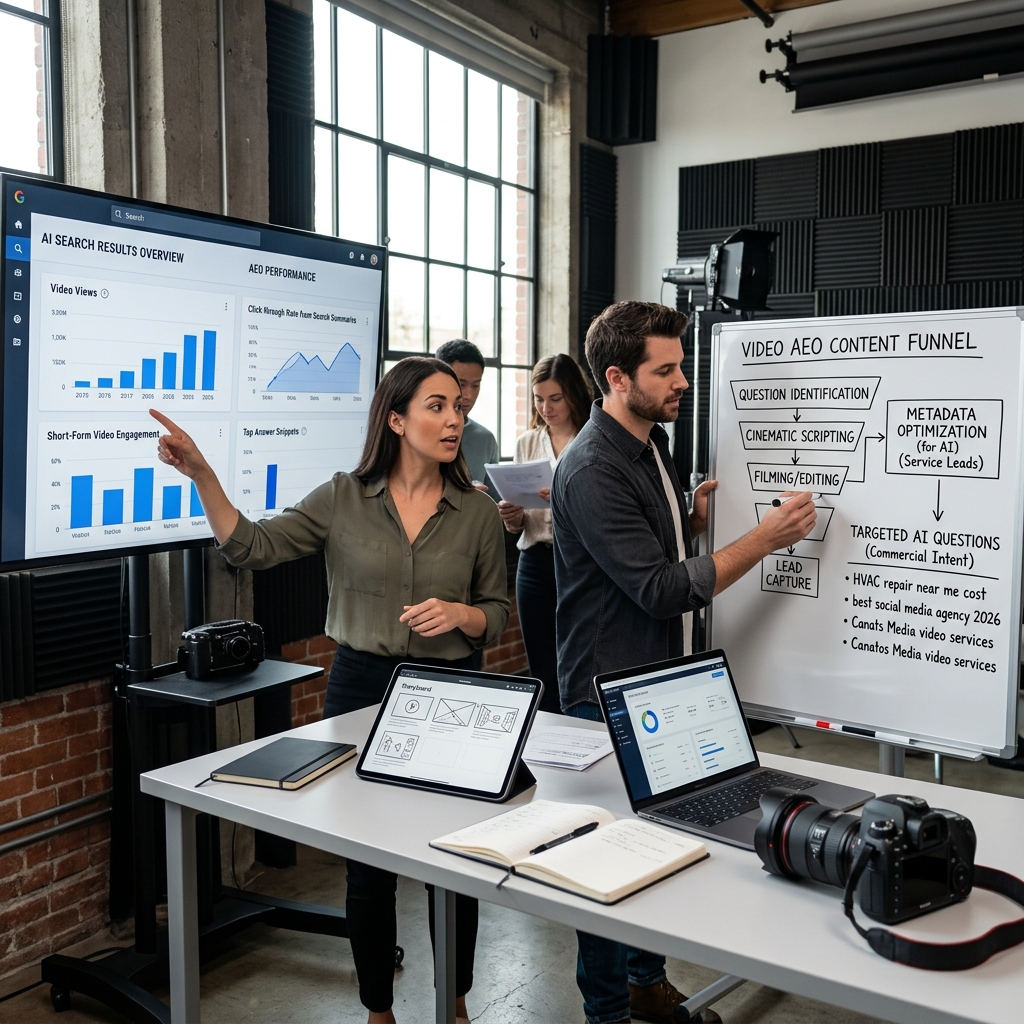
At Canatos Media, we don’t treat video production as separate from AEO strategy. They’re integrated from the start.
Our process begins with strategic planning. We work with your team to understand your audience, identify high-intent questions, and map the customer journey. Only then do we plan production. This ensures every video serves multiple purposes: it answers a real question, drives AEO visibility, and moves prospects toward conversion.
Production itself follows AEO principles. We create cinematic, professional short-form content that looks and feels like a brand commercial, not a how-to video. But we structure it to answer specific questions. Proper framing, lighting, and storytelling make the content engaging. Accurate captions and descriptions make it AI-friendly.
Distribution is systematized. We manage social posting, optimize video metadata, handle website integration, and coordinate with your existing digital strategy. This means your video content reinforces your paid advertising, social media management, and SEO efforts rather than operating in isolation.
The result is content that performs across multiple channels simultaneously: it ranks in classical Google search, gets cited in AI results, drives social engagement, generates qualified leads, and reinforces your brand narrative consistently.
Measuring AEO Success: Tracking Video Content Performance in AI Results
The challenge with AEO is measurement. Traditional SEO has clear metrics: ranking position, organic traffic, conversion rate. AEO requires a more nuanced approach.
Here’s what we track:
AI search visibility: Monitor whether your content is being cited in AI-generated responses. This requires regular manual checking across platforms (Google AI Overviews, ChatGPT, Claude, etc.) and using tools designed to detect AI citations.
Referral traffic: You’ll see traffic from AI search engines in your analytics. It often comes from sources like google.com (from AI Overviews) or direct sources (from ChatGPT and similar platforms). Track this separately from classical search traffic.
Engagement metrics: Watch time, video completion rate, shares, and comments. These are signals that AI systems use to determine content quality. Longer watch times and higher shares correlate with stronger AEO performance.
Lead quality: The ultimate metric is whether AEO traffic converts to qualified leads. Track which content sources generate the highest-quality prospects and adjust your strategy accordingly.
Social amplification: Shares, mentions, and engagement across social platforms boost overall visibility. These metrics indicate whether your content is resonating broadly, not just in search.
The challenge is that AEO is still new enough that attribution isn’t always clear. Some traffic from AI results gets bundled into classical search analytics. We recommend setting up dedicated tracking (separate UTM parameters for different content pieces, custom segments in analytics, and regular manual audits) to understand true AEO performance.
Common AEO Mistakes That Hurt Your Video Content’s AI Visibility
We see patterns in what derails AEO strategies. Avoiding these mistakes significantly improves results.
Poor video production quality: Low-resolution, poorly lit, or badly framed videos underperform. AI systems detect production quality and treat it as a credibility signal. Invest in professional production.
Missing or inaccurate captions: Captions are critical for accessibility and for AI systems to understand video content. Automatically generated captions often contain errors. Always review and correct them.
Keyword stuffing masquerading as AEO: Cramming keywords into descriptions doesn’t work for AEO. AI systems prioritize natural language and clear answers. Focus on clarity and accuracy, not keyword density.
No structured data markup: Many businesses produce good video but fail to implement schema markup. This makes it harder for AI systems to understand and cite your content.
Single-format content: Relying only on video or only on text limits your reach. AI systems reward diverse content formats. Combine video, written content, images, and structured data.
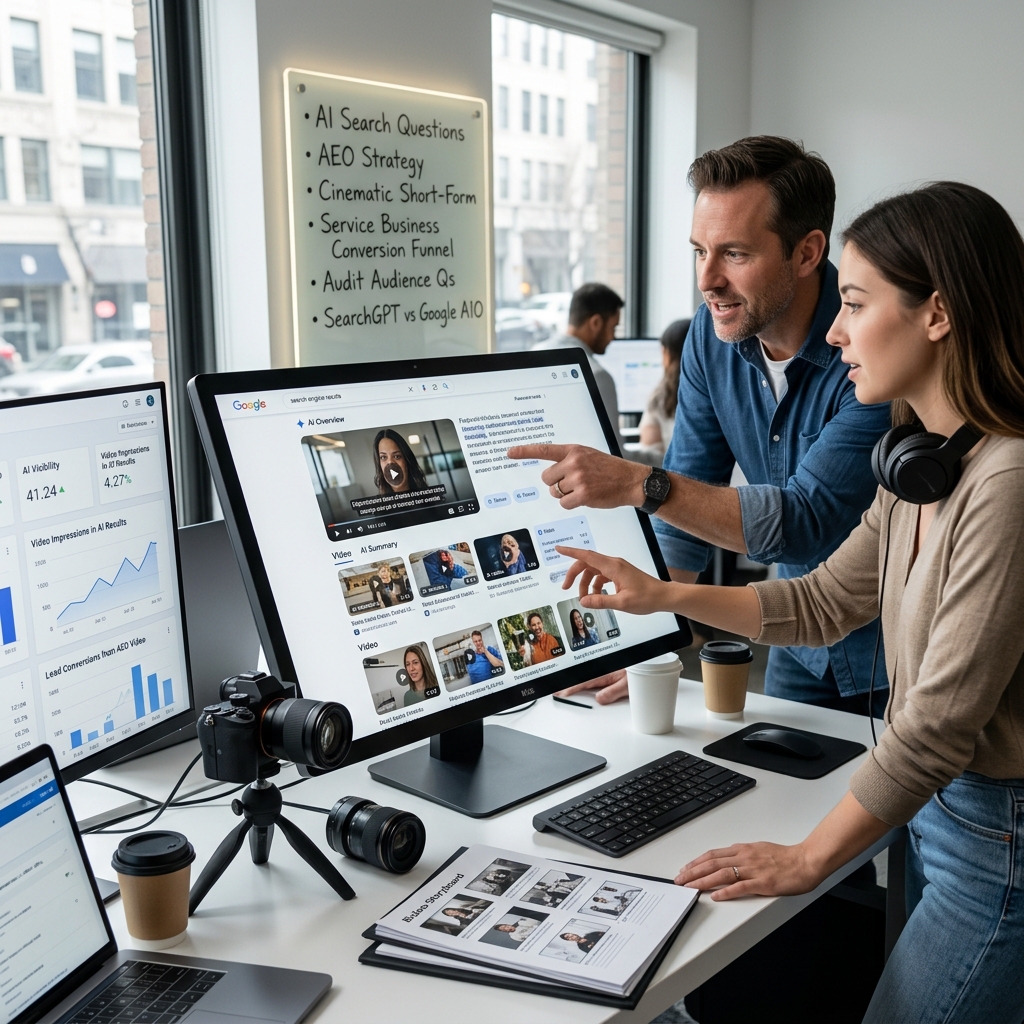
Orphaned content: Creating great video but burying it on your website hurts visibility. Content needs strategic placement, proper linking, and distribution to perform.
No lead capture mechanism: Beautiful, well-optimized content that doesn’t convert is wasted effort. Every piece needs a clear path to action.
Getting Started: Your Roadmap to AEO-Optimized Video Content
If you’re ready to capitalize on AI search visibility, here’s how to begin:
Step 1: Audit your audience questions: What are the 10-15 most critical questions prospects ask before becoming customers? Document these.
Step 2: Assess your current content: Which of these questions do you already address? Which gaps exist?
Step 3: Prioritize high-intent topics: Focus on questions that indicate buying intent. A prospect asking “How much does this service cost?” is further along than someone asking general educational questions.
Step 4: Plan your first three videos: Choose three high-impact questions to address with cinematic short-form video. Each should be 30 seconds to 3 minutes.
Step 5: Produce with AEO in mind: Work with a production partner who understands both cinematic storytelling and AEO optimization. Every decision from framing to captions should serve both purposes.
Step 6: Optimize metadata and distribution: Proper titles, descriptions, schema markup, and strategic distribution across platforms are as important as the content itself.
Step 7: Measure and iterate: Track visibility, traffic, and conversions. Adjust your strategy based on what actually works for your audience.
The businesses capturing the most value from AI search right now are those who started early and iterated quickly. If you wait for AI search to stabilize, you’ll be playing catch-up. The window for first-mover advantage is closing.
We’re here to help service businesses like yours build AEO-optimized video content systems that turn search visibility into qualified leads. If you’re ready to explore how cinematic video production and integrated digital strategy can accelerate your growth, let’s talk about your specific situation and build a roadmap together.
Contact us today for a free consultation to see how we can help you grow your business.
Frequently Asked Questions (FAQ)
What’s the difference between AEO optimization and traditional SEO for our video content?
We’ve found that traditional SEO focuses on text-based ranking factors that AI search engines often overlook. Our AEO approach optimizes video content specifically for AI-powered search results by structuring cinematic footage, metadata, and complementary text in ways that AI systems recognize and prioritize. This means we’re building visibility in search results that are fundamentally different from Google’s traditional blue links.
How do we measure whether our AEO video strategy is actually generating leads?
We track several metrics beyond views: AI search result impressions, click-through rates from AI-generated summaries, landing page conversions from AI search traffic, and lead quality from each video asset. Our integrated systems connect video performance data directly to your CRM, so we can show you exactly which cinematic content pieces are converting into actual sales opportunities for your business.
Why does our team focus on cinematic short-form video instead of other content formats for AEO?
AI systems heavily weight visual and motion-based content because it demonstrates expertise and authenticity better than static images or text alone. We produce cinematic short-form videos because they capture attention across platforms while containing the depth and production quality that AI algorithms associate with credible, authoritative brands in service industries.