Why Ad Creative Fails for Local Service Businesses
Ad creative performance determines whether your marketing budget generates real leads or disappears into the noise. For local service businesses, the stakes are even higher: a plumbing company, HVAC contractor, or home cleaning service doesn’t have the luxury of building brand awareness over months. You need phone calls and booked appointments this week.
The gap between mediocre creative and high-performing creative has widened in 2026. Algorithm changes, audience fatigue, and the sheer volume of content competing for attention mean that generic ads no longer convert. The businesses winning right now are those who understand that ad creative isn’t a afterthought—it’s the foundation of every paid advertising strategy.
We’ve worked with dozens of multi-location service businesses, and we’ve seen exactly where creative breaks down and exactly how to fix it. Here’s what we know about improving ad creative performance for your market.
Local service businesses typically face three distinct creative problems that larger enterprises simply don’t encounter.
First, there’s the “borrowed footage” trap. Many service businesses grab stock videos or rely on phone-quality clips from job sites. This signals low professionalism before the viewer even reads your headline. A plumber’s before-and-after video shot on a smartphone creates doubt. Potential customers assume: if they cut corners on marketing, what corners do they cut on the job?
Second, generic messaging doesn’t address local pain points. A pressure washing ad that says “We clean anything” performs worse than one showing a specific transformation (dark, moldy deck to pristine wood) with a local neighborhood visible in the background. People trust specificity over generality.
Third, service businesses often create one ad and run it for months. Creative fatigue is real. After 4-6 weeks, the same ad reaches the same audience repeatedly, which tanks your frequency cap and blows up your cost per lead. Without a testing system in place, you keep paying more to reach fewer people.
The fix requires both better production quality and strategic discipline. You can’t solve this with cheaper creative or more budget alone.
The Connection Between Creative Quality and Lead Generation
Quality creative directly impacts your lead volume and cost per acquisition. Here’s the mechanism: better creative generates higher click-through rates, which improves your ad relevance score in Meta and Google’s systems. Higher relevance scores lower your cost per click. Lower cost per click means more leads at the same budget.
But there’s a second, less obvious benefit. High-quality creative attracts higher-intent prospects. A cinematic 15-second video showing a kitchen renovation completion builds emotional investment in your brand. The person watching is already imagining their own kitchen. They click not out of idle curiosity, but because they see themselves as your customer. This reduces your cost per qualified lead dramatically.
We’ve tracked this across our portfolio: service businesses that invest in professional short-form video see 25-40% lower cost per lead compared to their static or low-quality video efforts. That’s not brand building—that’s immediate ROI.
The other component is trust transfer. Potential customers spend 3-5 seconds deciding whether to engage with your ad. Professional creative communicates competence instantly. Someone considering a $5,000 roof repair wants to hire someone who looks like they know what they’re doing. Great creative does that job.
How We Approach Ad Creative Strategy Differently
We start by mapping your customer’s decision journey before we produce a single frame. For a home service business, that journey looks different than it does for a SaaS company or e-commerce brand.
Your customer typically:
- Recognizes a problem (leaky faucet, missing shingles, landscaping overgrowth)
- Searches for local solutions or asks for referrals
- Compares options based on price, reputation, and perceived professionalism
- Books a consultation or calls for an estimate
Our creative strategy targets each stage of this journey differently. Early-stage awareness creative shows problems your audience experiences. Mid-stage creative highlights transformations and social proof. Late-stage creative removes friction (easy booking, clear pricing, testimonials).
This approach means we’re not creating one ad campaign. We’re creating an interconnected creative system where different assets serve different purposes and audiences.
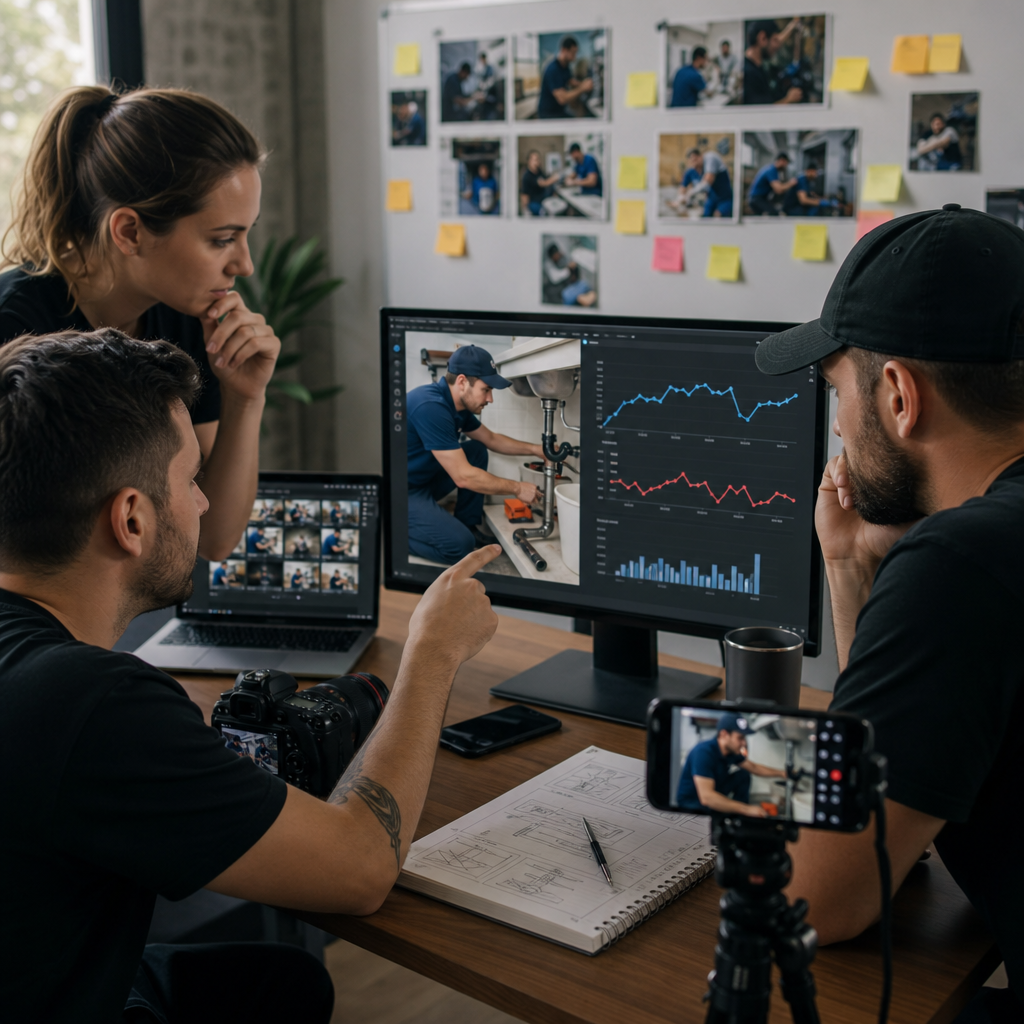
We also build creative briefs that include competitor benchmarks, audience segments, and platform-specific requirements. A 15-second Instagram Reels ad performs differently than a 6-second Meta feed video. A Google Search ad needs different messaging than a YouTube bumper ad. We account for these differences in production and messaging before we even start filming.
Short-Form Video as Your Competitive Advantage
Short-form video is no longer optional for service businesses competing for attention in 2026. It’s the format that moves the needle.
The data backs this up: video ads generate 10-15x higher engagement rates compared to static image ads across Meta platforms. For YouTube and Google, video ads outperform text-only and image-only ads on conversion metrics. But the advantage extends beyond raw numbers.
Video allows you to show transformation. A contractor’s before-and-after carousel ad shows change, but a 30-second video showcasing the entire process—the problem discovery, the craftsmanship, the finished result—creates narrative. Narrative builds trust.
We approach short-form video production by combining cinematic quality with platform-specific optimization. That means we film at higher quality standards (4K, professional color, clean audio) but then adapt the content to each platform’s requirements and audience expectations. The same shoot produces Instagram Reels, TikTok ads, YouTube bumpers, and Meta feed videos, each with its own pacing, captions, and call-to-action.
For service businesses specifically, we focus on:
- Real customer transformations (not staged or fake testimonials)
- Clear before-and-after moments
- Local context that resonates with your service area
- Credibility markers (licenses, certifications, equipment, process)
This approach works because it’s authentic and specific. Your competitor’s generic “call us today” ad doesn’t compete.
Building a Testing Framework for Consistent Results
Consistent ad creative performance comes from systematic testing, not luck or creative intuition alone.
We implement a testing framework that treats creative elements like variables in an experiment. You can’t improve what you don’t measure. This means we establish baseline performance metrics (cost per lead, lead quality, conversion rate to booked jobs) before we launch optimized creative. Then we test methodically.
The structure looks like this:
Test one variable at a time. If you change the hook, the visual style, and the call-to-action simultaneously, you won’t know which element drove improvement. We typically test one element per week: different opening hooks, different visual treatments, different audience segments, different call-to-action copy.
Track performance at the creative asset level, not just the campaign level. Meta and Google allow granular reporting. We analyze not just which ads performed best overall, but which creative assets drove the highest-quality leads for specific locations or service types.
Establish a creative rotation schedule. High performers don’t stay high forever. We rotate winning creative off after 4-6 weeks of heavy spend, then reintroduce it 2-3 weeks later. This prevents audience fatigue while maintaining the benefit of proven creative.
Set clear guardrails. If a creative asset underperforms for two consecutive weeks (or hits an established cost-per-lead threshold), we pause it and redeploy that budget to stronger performers.
This framework requires discipline and documentation, but it’s how you move beyond one-off wins to consistent, predictable results.
Integrating Creative Performance with Paid Advertising
Creative quality and paid advertising strategy must function as a single system, not separate functions.

Too often, creative teams and media buyers work in silos. Creative produces ads. Media buyers deploy them. If performance is weak, they blame each other. That structure guarantees mediocre results.
We operate differently. Our production team and advertising team share performance data in real time. When we see that a particular creative angle (e.g., customer testimonials) outperforms another (e.g., product demonstrations), that insight informs our next production brief. When media buying reveals that a specific audience segment is more responsive, that changes our creative targeting.
This integration also means we optimize ad creative for platform algorithms, not just aesthetic preference. Meta and Google reward certain creative patterns: fast cuts, pattern interrupts, text overlays that stop the scroll, clear value propositions in the first 3 seconds. We build these optimization principles into production without sacrificing quality or authenticity.
The practical result: your ad budget works harder because you’re not running beautiful creative to the wrong audience or strategic targeting with weak creative. Both components reinforce each other.
Scaling What Works Across Multiple Locations
Multi-location service businesses face a unique challenge: what works in one market may not work in another. Demographics, competition, and local preferences vary.
Our approach balances consistency with localization. We develop core creative templates and messaging that represent your brand universally. This maintains brand cohesion and maximizes production efficiency. Then we produce location-specific variations that reflect local differences: different team members, local landmarks, regional accent, and market-specific pain points.
For example, a home service company with five locations gets a core 15-second transformation video shot in their best, most photogenic job site. Then we produce four additional location-specific 15-second videos at the same quality level, each showing a local team member or a recognizable local neighborhood feature. This creates consistency while respecting that a customer in the northern suburb might respond differently to local context than a customer downtown.
We also test which creative angles perform best in each market. If customer testimonials outperform process videos in one location but underperform in another, we adjust the media spend allocation to favor the stronger creative. This requires tracking performance by location, which demands proper UTM setup and reporting infrastructure, but it’s how you maximize return across multiple service territories.
How Our Production and Advertising Teams Collaborate
Our team structure directly enables the integrated approach we’ve described. We’re not separate departments. We’re collaborative teams with overlapping expertise.
On the production side, we have videographers, editors, and post-production specialists who understand advertising requirements and platform specifications. They’re not just making beautiful content; they’re making beautiful content that performs.
On the advertising side, our media buyers and strategists are involved in the creative brief and often attend shoots. They understand the production process, the assets we’re capturing, and how those assets can be deployed tactically. This prevents the “production team created the wrong assets” problem.
We also maintain shared documentation: a creative performance tracker that shows which video styles, messaging angles, and audience segments are working, week by week. This becomes the feedback loop. Last week’s performance informs this week’s brief.
This collaboration model produces faster iteration cycles and more relevant creative recommendations than traditional agency structures.
Measuring Creative Impact on Your Bottom Line
Ultimately, ad creative performance has one measure: business impact.
For a service business, that means tracking the full conversion path from ad impression to booked job to completed work. We measure:
- Cost per click and click-through rate (top-of-funnel efficiency)
- Cost per lead and lead quality score (mid-funnel efficiency)
- Cost per booked appointment and show-up rate (lower-funnel efficiency)
- Cost per completed job and customer lifetime value (true business impact)

Most service businesses stop tracking at the lead stage. That’s a mistake. A low-cost lead that never converts to a booked appointment is worthless. A high-cost lead that consistently converts and drives repeat business is gold.
We tie creative performance directly to these downstream metrics. If a particular creative asset drives cheaper leads but lower-quality leads, we know that’s a short-term win, not a strategy. We optimize instead for creative that drives fewer leads at a higher conversion rate, because that directly improves your bottom line.
This requires proper tracking infrastructure: UTM parameters, CRM integration, and lead quality scoring. But once that’s in place, you can see exactly which creative is driving actual business results.
Getting Started with High-Performance Ad Creative
If your current ad creative isn’t performing, here’s what to do next.
First, audit your existing creative. Screenshot every ad you’re currently running. Note the age of each asset, the cost per result, and the engagement metrics. You’ll likely find that 20% of your creative is driving 80% of your performance. Identify which creative elements (hooks, visuals, messaging, calls-to-action) show up in your top performers. That’s your creative benchmark.
Second, establish your baseline metrics. If you’re currently running ads without proper tracking, set up UTM parameters and CRM integration so you can actually measure what’s working. Without baseline data, you can’t identify improvement.
Third, develop a creative brief for your next batch of assets. Include your customer’s decision journey, your top-performing creative elements, your competitive positioning, and your platform requirements. Don’t wing it.
Fourth, produce your next set of creative with these specifications in mind. Quality matters. Professional production doesn’t need to be expensive, but it needs to be intentional.
Finally, implement a testing framework. Run each new creative asset for two weeks. Track performance. Keep what works. Rotate it strategically. Pause what underperforms. Repeat.
We work with service businesses through this entire process. We audit existing performance, develop strategy, produce high-quality short-form video, manage paid advertising, and report on impact. Check out our case studies to see how we’ve helped similar businesses improve their ad creative performance and drive measurable business growth.
The businesses winning right now aren’t trying to do this alone. They’ve integrated production, strategy, and advertising into a single, coordinated system. That’s the competitive advantage you need in 2026.
Contact us today for a free consultation to see how we can help you grow your business.
Frequently Asked Questions (FAQ)
Why does our approach to ad creative differ from what other agencies do?
We focus on cinematic short-form content paired with integrated digital strategy rather than treating video production and paid advertising as separate services. Our production and advertising teams collaborate from the start, so we’re building creative assets specifically designed to perform on the platforms where your customers spend time. This integration means we’re constantly testing and optimizing based on real ad performance data, not just creating content we hope will work.
How do we measure whether our ad creative is actually driving leads for your business?
We track creative performance against your specific business goals, not just vanity metrics like views or clicks. We measure how many qualified leads each creative asset generates, what it costs per lead, and how those leads convert into customers. This data feeds directly back into our production process, so we know exactly which creative approaches are working for your business and can replicate or refine them for your other locations.
Can we scale successful ad creative across multiple locations?
Yes, we build a testing framework early on that identifies what resonates with your target audience, then we adapt those winning creative concepts for each location while maintaining consistency in your brand voice. Once we’ve proven what works in one market, we apply those learnings to scale across your other service areas, adjusting local details as needed while keeping the core creative strategy intact.