Day: June 25, 2026

  • Multi-Location Social Content Strategy: Driving Local Growth with Global Brand Consistency

    Multi-Location Social Content Strategy: Driving Local Growth with Global Brand Consistency

    Why Multi-Location Brands Struggle With Social Content Consistency

    When you operate across multiple locations, your social media presence becomes exponentially more complex. Each branch needs to feel authentically local while reinforcing a cohesive brand identity. The challenge isn’t just creating good content—it’s creating the right content, at the right time, for each market while staying aligned with your company’s core message.

    We work with multi-location service businesses and franchise owners who face this exact tension daily. The gap between corporate guidelines and local relevance is where most strategies fall apart. This guide walks you through building a system that works.

    The root problem is structural. Corporate sends down brand guidelines. Local teams send up requests for location-specific content. Marketing departments lose visibility into what’s actually being posted. Six months later, your brand looks fragmented across platforms.

    Most multi-location brands attempt one of three flawed approaches:

    Complete corporate control. Headquarters creates all content, posts the same thing everywhere. Result: Nothing resonates locally, engagement flatlines, and local teams feel ignored.

    Total local autonomy. Each location manages its own social accounts. Result: Brand messaging splinters, quality varies wildly, and you lose the amplification power of a unified voice.

    Hybrid chaos. Some content is centralized, some is local, but there’s no clear framework. Result: Inconsistent posting schedules, duplicate efforts, and wasted budget on ads that don’t align with location strategy.

    The real issue is that these approaches treat consistency and local relevance as opposing forces. They’re not. The solution requires a system, not just guidelines.

    The Cost of Disconnected Social Strategies Across Locations

    When social strategies aren’t coordinated across locations, the financial impact compounds quickly.

    Each disconnected location is essentially running its own small marketing operation. That means duplicated tool subscriptions, wasted ad spend on untested creative, and content teams reinventing wheels instead of building on proven concepts. A 10-location business running independent social strategies often spends 3-4x what a centralized system would cost.

    More critically, you lose audience velocity. If location A builds a 5,000-follower audience and location B independently builds another 5,000, those audiences never interact. In a unified system, that’s 10,000 people who see your message multiple times, creating network effects that multiply engagement and referrals.

    Inconsistent messaging also erodes trust. When customers see your brand messaging shift between locations—different tone, different visual style, different value proposition—they question which version is the “real” brand. This hesitation kills conversions.

    Ad spend inefficiency is another silent killer. Without a centralized content library and performance data, each location wastes budget testing basics that another location already solved. One location discovers that customer testimonials convert 3x better than promotional offers, but that insight never reaches the other nine locations. Every location reruns the same expensive experiments.

    Actionable takeaway: Audit your current social spend across all locations for the past three months. Calculate what percentage goes to successfully converting content versus learning-phase content that underperforms. That gap is your disconnection cost.

    How Cinematic Short-Form Video Creates Unified Brand Identity

    Video is the most efficient tool for encoding your brand identity into content. A 15-second professionally produced video tells your story faster and more reliably than paragraphs of text or static images.

    We’ve found that cinematic short-form content—video with professional production values, intentional pacing, and clear narrative structure—works as a universal translator between corporate brand standards and local relevance. Here’s why:

    A cinematic brand story is recognizable instantly. Your color grade, music, pacing, and narrator voice become signatures. When someone sees your content in their feed, they know it’s you before they process the message. This builds brand recall across markets far faster than inconsistent local content can.

    Short-form video also solves the local-versus-corporate tension elegantly. You can film 50 individual location testimonials using the same crew, equipment, and post-production style. Each testimonial is authentic and local. But they’re all visually and sonically identical, so they reinforce the same brand identity. Post them across different locations and they create a unified brand presence that feels both local and established.

    This approach works because viewers process visual consistency differently than they process message variation. People expect local differences in what you’re saying—different local teams, different customer stories. They expect visual consistency in how you’re saying it.

    Our short-form video production approach is built specifically to solve this. We create templates and workflows that let you produce dozens of location-specific videos while maintaining a unified brand aesthetic.

    Our Integrated Approach to Location-Based Content Production

    The system we’ve built starts with centralized creative direction and decentralized content creation.

    Here’s the framework:

    Content Planning Layer. Corporate defines quarterly themes, key messages, and campaign timelines. This gives every location direction without micromanaging. One quarter might focus on “customer success stories.” Another focuses on “seasonal promotions.” This prevents chaos while leaving room for local interpretation.

    Production Template System. Rather than building each video from scratch, we create reusable templates. A “customer testimonial” template specifies shot sequences, music, color grade, and pacing. Your location teams (or your crew) then film locally using that template. The output is identical in style but locally relevant in content.

    Distributed Asset Library. All produced content lives in a central, searchable library organized by location, content type, and performance metrics. This prevents duplication and lets faster-moving locations borrow winning concepts from slower ones.

    Approval Workflow. Before posting, all content routes through a quick approval layer that checks brand alignment without creating bottlenecks. This takes hours, not weeks.

    The result is content that gets posted consistently, on schedule, with local relevance and global brand coherence.

    Social Media Management That Scales Across Multiple Locations

    Scaling social media management across multiple locations requires removing three failure points: scheduling inconsistency, message fragmentation, and audience abandonment.

    Our all-in-one content engine handles this through centralized management with location-specific customization. Here’s what that looks like in practice:

    One central calendar shows all posting across all platforms and all locations. Managers see exactly what’s going live where and when. This prevents the common scenario where location A posts the same campaign content on Tuesday that location B posted on Friday, creating duplicate visibility instead of amplified reach.

    Content can be posted identically across locations or customized per location with a single template. That testimonial video? Post it everywhere. That seasonal promotion? Customize the location details but keep the creative identical.

    Engagement and community management happens locally but with centralized tracking. Your location teams respond to comments in real time, which builds genuine local relationships. But corporate sees aggregate engagement metrics and can identify which locations are winning and why.

    This structure requires the right tools and clear processes. Without them, you get inconsistency. With them, you get a unified social presence that feels both local and professional.

    Paid social advertising is where most multi-location strategies collapse. You’ve either got locations running ads independently (wasteful) or you’ve got corporate running ads for all locations (ineffective).

    The solution is a hybrid approach with centralized creative testing and location-level campaign management.

    Here’s the structure: Corporate (or your agency partner) identifies the top 5-7 highest-performing creative concepts. These get tested at scale against broad audience targets. Winning creative is documented.

    Then each location manager or regional operator runs location-specific campaigns using those proven creative concepts. Location A targets Denver metro customers. Location B targets Denver suburbs. Both use the same creative because it’s proven, but they segment audiences based on local geography and intent.

    This approach reduces ad testing waste while preserving local campaign control. You’re not testing 10 different creative directions per location. You’re testing 5-7 concepts once and deploying 10 times. The math is dramatically different.

    Budget allocation across locations should be performance-based, not equal. If location A consistently converts at 30% lower cost than location B, location A gets a bigger budget share. This creates natural incentives for locations to improve their conversion mechanics, and you’re not funding underperformance indefinitely.

    Building Local Authority While Maintaining Global Brand Voice

    Local authority comes from being present and relevant in your specific market. Global brand voice comes from consistency in how you communicate. These reinforce each other when done right.

    The key is separating voice from vocabulary. Your global brand voice is the underlying tone, values, and perspective. Your vocabulary is the specific words, references, and local details you use.

    For a multi-location fitness brand, the global voice might be “motivational but realistic about the work required.” The vocabulary changes per location: Denver location references high-altitude training. Phoenix location references desert heat resilience. Same voice, different dialect.

    This distinction lets you build genuine local authority without creating brand fragmentation. You sound like yourself in every market while speaking to each market’s specific context.

    Social content that anchors local authority includes location-specific staff spotlights, community partnership announcements, and location-relevant current events. These feel local because they are. They reinforce your brand voice because they’re created with centralized direction.

    Lead Generation Systems That Connect Content to Revenue

    Content without a lead generation system is just entertainment. We bridge this gap by treating content as the top of a lead funnel, not as a standalone asset.

    Every social content piece has a purpose in the funnel. Some content is pure awareness (brand story videos). Some is consideration (process explainers, customer results). Some is decision-stage (testimonials, pricing breakdowns). Mapping your content to funnel stage ensures your social strategy generates actual leads.

    The mechanics work like this: Awareness-stage content drives followers and early-stage engagement. Consideration content (which should link to your website) moves interested people toward a decision. Decision-stage content lives behind a lead form or drives direct contact.

    Without this structure, you get viral engagement that doesn’t convert to leads. With it, every piece of content serves a measurable business goal.

    The specific mechanics depend on your business. A service business might use location-specific landing pages paired with local testimonial videos. An e-commerce brand might use short-form how-to content that drives traffic to specific product pages. The framework adapts, but the principle stays: content connects to revenue through intentional conversion mechanics.

    Measuring Results Across All Your Locations

    You can’t manage what you don’t measure. For multi-location brands, this means tracking both brand-level metrics and location-level performance.

    Brand-level metrics show health: overall reach growth, engagement rates, audience quality. These indicate whether your unified content strategy is working. If brand engagement is flat while follower count grows, something’s wrong with content relevance.

    Location-level metrics show where to invest: conversion rates per location, cost per lead per location, local audience growth. These reveal where your strategy is working and where it needs adjustment.

    The critical metrics depend on your business model, but typically include:

    • Followers per location as a percentage of local market size
    • Engagement rate (total engagement divided by total followers)
    • Click-through rate to website per location
    • Cost per lead by location
    • Lead-to-customer conversion rate by location
    • Revenue attributed to each location’s social activities

    Dashboard reporting that shows all locations simultaneously, plus drill-down capabilities per location, gives you visibility. Without this, you’re flying blind.

    Getting Started With Your Multi-Location Social Strategy

    Start with an honest audit of your current state. Document what content exists, who’s creating it, where it lives, how it’s being shared, and what’s actually converting to business results. Most multi-location brands discover their social strategy is more fragmented than they realized.

    Next, define your brand voice and creative direction. What should your brand sound like? What visual style defines you? This becomes your template framework that all locations build within.

    Then build your content calendar for the next quarter with three tiers:

    • Tier 1: Corporate/brand content that posts identically everywhere (brand stories, company announcements)
    • Tier 2: Template-based content that each location customizes (customer testimonials, seasonal campaigns)
    • Tier 3: Pure-local content (community events, local staff spotlights)

    Allocate roughly 40% to tier 1, 40% to tier 2, and 20% to tier 3. Adjust based on what your audience responds to.

    Finally, invest in the right tools and processes. You need a central content library, approval workflow, and analytics dashboard. You need clear responsibilities for who creates what and who approves it.

    This is where we help. We manage the full operation: from content production and asset organization to social posting and performance reporting. If you’d rather build this internally, the framework above gives you the blueprint. If you want a partner to handle it, we’ve built systems specifically designed for multi-location brands.

    The difference between a fragmented social presence and a unified, lead-generating machine is structure. The good news is structure is learnable and implementable. Start with your audit, build your framework, and scale from there.

    Contact us today for a free consultation to see how we can help you grow your business.

    Frequently Asked Questions (FAQ)

    How do we maintain brand consistency across multiple locations while allowing for local customization?

    We create a centralized content framework with your core brand elements, then produce location-specific variations that keep your global identity intact. Our team builds templated short-form video content that highlights local teams, services, or promotions while maintaining consistent messaging, visual style, and cinematic quality across every location.

    Can we manage social media and advertising for all our locations from one dashboard?

    Yes. We’ve built our systems to scale across multiple locations with centralized oversight and location-specific reporting. You get a single point of contact managing your social accounts, ad campaigns, and content distribution, while we provide detailed analytics for each location so you can see exactly which strategies drive leads and revenue in specific markets.

    What’s the timeline for seeing results from a multi-location social content strategy?

    Most of our clients see initial engagement improvements within 4-6 weeks, but meaningful lead generation typically accelerates after 12 weeks as we optimize based on performance data across your locations. We focus on building systems that compound over time rather than chasing short-term wins, so your content strategy becomes more efficient and profitable the longer we work together.

  • Mastering Google Search Engine Optimisation Without Losing Your Mind

    Mastering Google Search Engine Optimisation Without Losing Your Mind

    What Is Google Search Engine Optimisation — and Why Does It Matter for Your Business?

    Google search engine optimisation is the practice of improving your website so it appears higher in Google’s unpaid (organic) search results — and gets found by the right people at the right time.

    Here’s a quick-reference summary of what it involves:

    SEO Element What It Means
    Crawling Google’s bots discover and read your pages
    Indexing Google stores your pages in its search database
    Ranking Google decides where your pages appear in results
    On-Page SEO Content, keywords, titles, and images on your site
    Technical SEO Site speed, mobile-friendliness, and structure
    Authority Links and trust signals from other sites

    Google processes over 8.5 billion searches every single day. The businesses that show up in those results don’t get there by accident — they earn it through consistent, smart SEO.

    But here’s the honest truth: most guides make this harder than it needs to be.

    There are no secret tricks. Google’s own documentation puts it plainly — “Sorry, there are no secrets here that’ll automatically rank your site first in Google.” What works is understanding how Google actually thinks, then building your site around that.

    This guide breaks it all down in plain language, starting from the ground up.

    I’m Nic Canobbio, founder of Canatos Media, and over the past two decades I’ve applied Google search engine optimisation as a core part of building content strategies that have driven over 60 million views across social and digital platforms. Whether you’re running one location or several, the principles I’ll walk you through are the same ones that move the needle.

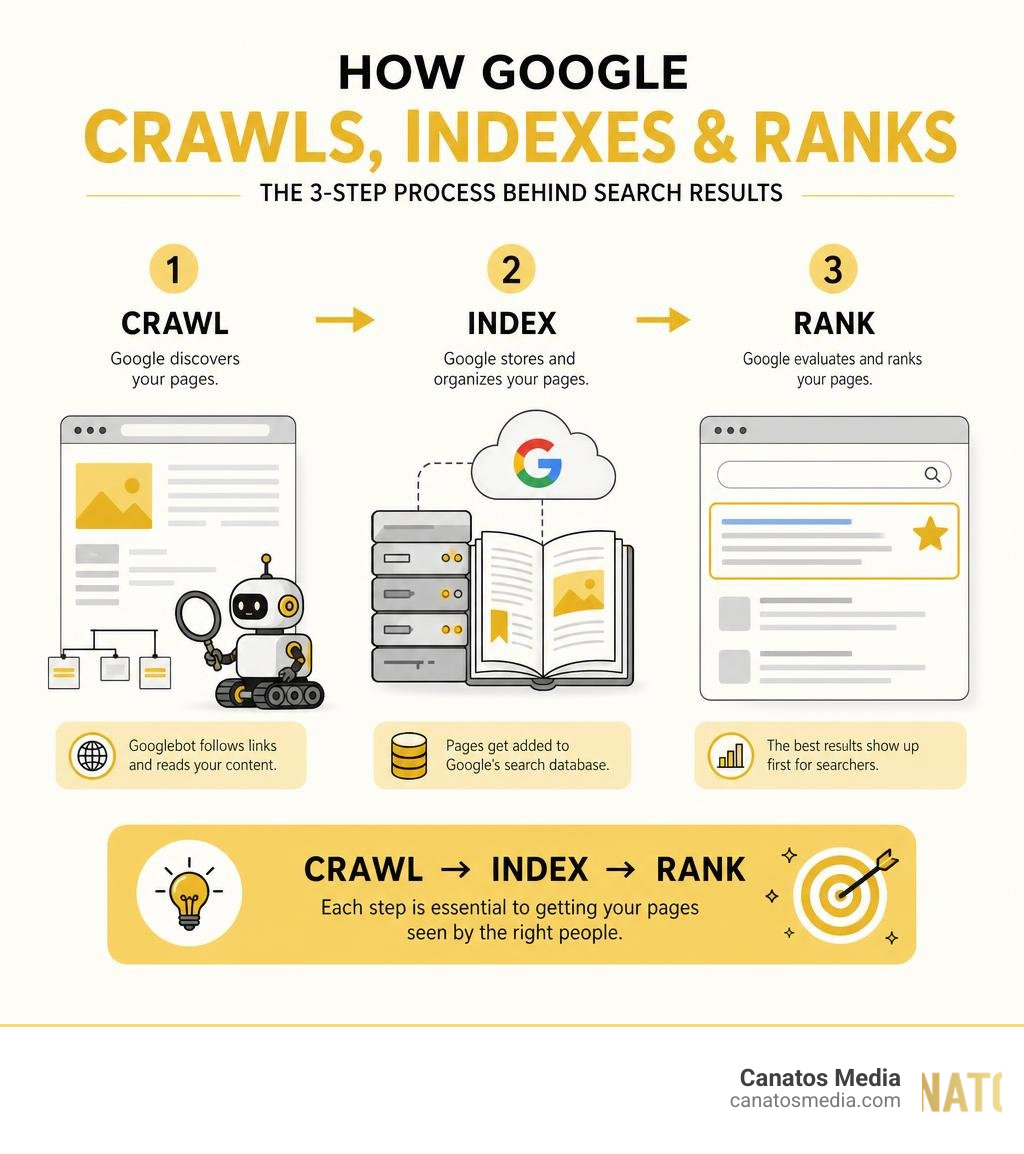
    Infographic showing how Google crawling, indexing, and ranking work step by step in SEO infographic

    Similar topics to google search engine optimisation:

    Demystifying Google Search Engine Optimisation: The Core Fundamentals

    To understand google search engine optimisation, you must first understand how Google itself functions. Google is not a human editor flipping through a directory; it is a massive, automated system running constantly to map the web.

    When you optimize your site, you are essentially helping three main processes run smoothly: crawling, indexing, and ranking.

    • Crawling: Google uses automated programs called “crawlers” (or spiders) to explore the web. They find pages primarily by following links from pages they have already visited.
    • Indexing: Once a page is crawled, Google analyzes its content, images, and structure to understand what the page is about. It then stores this information in a giant database known as the search index.
    • Ranking: When a user types a query into Google, algorithms sift through billions of indexed pages to serve the most helpful, relevant, and high-quality results in a fraction of a second.

    To get started with these basics, we always recommend reviewing Google’s SEO Starter Guide, which outlines the technical and structural baselines of search visibility. Navigating these rules successfully is the first step toward a broader SEO Search Engine Optimization strategy that reliably places your brand in front of active buyers.

    How Google Search Works and Why It Matters

    Google’s crawlers are relentless. They discover the vast majority of web pages automatically. However, they do not have infinite resources. Google allocates a “crawl budget” to every website, which dictates how often and how deeply its bots will explore your pages.

    Once crawled, pages must be parsed. Historically, Google relied heavily on PageRank—an algorithm that evaluates the quantity and quality of links pointing to a page to determine its relative importance. While PageRank remains an active part of the ranking ecosystem, modern Google Search uses hundreds of complex, machine-learning-driven signals to assess quality, context, and user intent.

    These algorithms are not static. Google is constantly adjusting how it evaluates content. For perspective, Google made over 500 algorithm changes in 2010 alone—averaging nearly 1.5 updates per day. Today, in June 2026, those updates occur even faster, fueled by real-time AI refinements. If your site does not follow clean, standardized guidelines, a sudden algorithm core update can quickly drop your visibility.

    How Long Do Changes in Google Search Engine Optimisation Take to Show Results?

    A common source of frustration for business owners is the time lag in SEO. When you update a title tag, publish a new blog post, or fix a broken link, the impact is rarely instantaneous.

    Every change you make requires time to be processed on Google’s end. The timeline generally depends on:

    1. Crawl Frequency: How often Google crawls your site. Popular, high-authority sites with frequently updated content are crawled multiple times a day. Smaller, newer sites might only see crawlers once every few weeks.
    2. Indexation: The time it takes for Google to process the crawled data and update its index.
    3. Ranking Latency: The period during which Google’s core ranking systems reassess your page against competing pages.

    Some minor adjustments might take effect in a few hours, while larger structural site migrations or comprehensive content updates can take several weeks or even months to fully reflect in search results. Patience and consistent monitoring are vital.

    Setting Up Your Command Center with Google Search Console

    If you want to master google search engine optimisation without guessing, you need a direct line of communication with Google. That is exactly what Google Search Console (GSC) provides. It is a free tool that tells you how Google views your site, alerts you to technical issues, and displays your actual search performance.

    Google Search Console dashboard showing search performance and index coverage

    Setting up GSC involves verifying your site ownership (usually by adding a small TXT record to your DNS configuration or uploading an HTML file). Once verified, you gain access to diagnostic tools that remove the guesswork from SEO.

    Measuring Search Traffic and Performance

    Within Search Console, the Performance Report is your primary tool for tracking progress. It breaks down your organic traffic into four essential metrics:

    • Clicks: The number of times users clicked through to your website from Google search results.
    • Impressions: How many times a link to your site was seen by a user in search results (even if they didn’t click).
    • Average CTR (Click-Through Rate): The percentage of impressions that resulted in a click.
    • Average Position: Your site’s average ranking spot for selected queries.

    By analyzing the specific search queries that bring users to your site, you can identify which pages are performing well and which ones need optimization. If you notice a page has high impressions but low clicks, it’s a clear sign that your title link or meta description needs to be more compelling.

    Submitting Sitemaps and Inspecting URLs

    To ensure Google has the freshest view of your site, you should submit an XML sitemap directly through Search Console. A sitemap is a simple file that lists all the important pages on your website, making it easy for crawlers to find them. This is especially critical for large sites, e-commerce stores, or sites with complex directory structures.

    If you have recently updated a specific page and want Google to index it immediately, you can use the URL Inspection Tool.

    This tool provides direct crawl, index, and serving data from the Google index. It will tell you if the page is mobile-friendly, if structured data is properly configured, and if there are any crawl errors preventing index coverage.

    Technical SEO: Building a Fast, Mobile-First Foundation

    Technical SEO is the practice of optimizing your website’s infrastructure so search engine crawlers can access, crawl, and index your content without friction. If your technical foundation is weak, even the most brilliant content will struggle to rank.

    A major pillar of technical SEO is mobile-first indexing. Google shifted to a mobile-first indexing approach in 2016, meaning it primarily uses the mobile version of a website’s content for indexing and ranking. Because mobile devices account for the majority of Google searches globally, your mobile user experience is your actual search experience. For a deep dive into this topic, refer to The Definitive Rules for Mobile SEO Success in 2026.

    Additionally, security is a non-negotiable ranking signal. Your site must use HTTPS encryption to protect user data. Google also expects clean code rendering; if your site relies heavily on complex JavaScript, ensure it is fully crawlable and not blocked by local scripts. For official developer standards, consult the guide on Technical SEO Techniques and Strategies.

    Monitoring Core Web Vitals and Page Experience

    Google’s Core Web Vitals are a set of real-world, user-centered metrics that measure key aspects of web performance. You can monitor these directly within Search Console’s Page Experience report.

    • Largest Contentful Paint (LCP): Measures loading performance. To provide a good user experience, LCP should occur within 2.5 seconds of when the page first starts loading.
    • Interaction to Next Paint (INP): Measures page responsiveness to user inputs (like clicks or taps). A good INP score is 200 milliseconds or less.
    • Cumulative Layout Shift (CLS): Measures visual stability. Pages should maintain a CLS score of 0.1 or less to prevent annoying layout jumps while loading.

    Improving these metrics requires latency reduction. We achieve this by compressing heavy images, leveraging browser caching, minimizing render-blocking CSS/JavaScript, and utilizing a reliable Content Delivery Network (CDN).

    Site Structure, Descriptive URLs, and Canonicalization

    A clean site structure helps both users and search engines navigate your content. Your directory structure should group topically similar pages together, allowing Google to understand page relationships and crawl frequencies more easily.

    Keep your URLs descriptive and simple. Avoid long strings of random numbers or parameters.

    • Bad URL: https://canatosmedia.com/folder1/pub?id=93821&sort=true
    • Good URL: https://canatosmedia.com/blog/google-seo-guide

    When you have multiple URLs with identical or highly similar content (such as product variations in an e-commerce store), you risk duplicate content issues. Google resolves this by selecting a “canonical” URL—the primary version of the page it will index and rank. You can influence this decision by implementing explicit canonical tags (rel="canonical") in your page headers.

    Finally, manage crawling permissions using your robots.txt file. Use it to block crawlers from private or state-changing URLs (like checkout pages), but remember: never use robots.txt to prevent indexing. If a page is linked elsewhere on the web, Google can still index it without crawling it. To block indexing, use a noindex meta tag instead.

    Content Strategy: Creating Helpful, People-First Content

    In google search engine optimisation, quality content remains the single most important factor. Google’s algorithms are trained to identify and reward “people-first” content—material written genuinely to help, educate, or entertain human readers, rather than to manipulate search engines.

    Google evaluates content quality using the E-E-A-T framework:

    • Experience: First-hand, practical exposure to the topic.
    • Expertise: Professional knowledge, credentials, or deep understanding.
    • Authoritativeness: Recognition as a go-to source in your industry.
    • Trustworthiness: Honest, transparent, and accurate information (the most critical component).

    To stand out, your content must offer a unique perspective. Avoid summarizing what ten other websites have already said. Instead, share proprietary data, case studies, or expert insights that provide real “information gain.”

    Helpful, People-First Content Keyword-Stuffed, Search-Engine-First Content
    Written naturally, addressing user questions directly. Forced repetition of exact-match keyword phrases.
    Organized with clear, logical heading structures (H2, H3). Fragmented structure designed only to host links.
    Includes original insights, expert quotes, or unique data. Recycled, low-effort summaries of existing search results.
    Prioritizes readability, clear formatting, and visual aids. Cluttered with distracting advertisements and pop-ups.

    Writing for Humans First in Google Search Engine Optimisation

    When writing content, expect your readers’ search terms and write naturally. You don’t need to repeat a keyword phrase fifty times to rank for it. Google’s semantic search systems understand context, synonyms, and related concepts perfectly.

    Start by targeting a specific keyword phrase for each page, but focus on the search intent behind that phrase. Are users looking to buy, to learn, or to find a specific website? Map your content to that intent. If you are working with limited marketing budgets, check out our guide on Affordable SEO Services That Won’t Make Your Wallet Cry to see how to build a high-ROI content map without overspending.

    Keep your paragraphs short, use bullet points, and front-load your pages. Putting a concise summary or a “TL;DR” section in the first 30% of your document makes it highly readable for users and easily parsable for modern search engines.

    Optimizing Images, Alt Text, and Video Content

    Visual media makes your content more engaging, but search engines require help to understand it.

    Always add descriptive alt text to your images. Alt text serves a dual purpose: it assists visually impaired users reading your site via screen readers, and it tells Google exactly what the image depicts, helping you rank in Google Images.

    • Bad Alt Text: alt="image123.jpg"
    • Good Alt Text: alt="digital marketer reviewing Google Search Console performance reports"

    Compress all images before uploading them to prevent slow page load times. For video content, host videos with clear titles, descriptions, and schema markup. Videos are increasingly prominent in search results, and integrating them properly is a vital part of modern search visibility. To understand how video assets fit into the bigger picture, explore How Video Content Drives Success in AI Search Results and AEO Optimization.

    The New Era: Optimizing for AI Overviews, GEO, and AEO

    Search is undergoing its most significant evolution in decades. With the launch of Google’s conversational search features and Gemini-powered systems, the landscape has expanded from standard blue links to direct, synthesized answers.

    User interface of Google AI search results showing generative summaries

    According to Pew Research, 60% of Americans read AI summaries in search results. However, this presents a unique challenge for brands: research shows that Google AI Overviews recommend competitors 69% of the time, even when citing a brand’s own listicles.

    To navigate this shift, marketers are focusing on Generative Engine Optimization (GEO) and Answer Engine Optimization (AEO). The goal is no longer just ranking first; it is securing a citation inside the AI’s synthesized response.

    This new paradigm is built on core ranking systems. As officially documented in Google’s Guide to Optimizing for Generative AI Features, Google uses Retrieval-Augmented Generation (RAG) to ground its AI outputs in standard web index data. This means that traditional, foundational SEO remains the absolute prerequisite for AI visibility. For a broader look at this evolution, read our guide on Maximizing Visibility with Answer Engine Optimization Services in 2026.

    Structured Data and Rich Results in the AI Era

    Structured data (using JSON-LD schema markup) acts as a translator for search engines. It organizes your content into an explicit, machine-readable format, helping Google understand the entities, relationships, and facts on your page.

    By adding schema markup (such as Product, Article, FAQ, LocalBusiness, or Event schema), you make your site eligible for rich results—enhanced listings in search results that feature ratings, prices, images, or dropdown questions. In the AI era, structured data is even more critical. AI crawlers rely heavily on clean entity relationships to verify facts and attribute citations, making schema markup an essential tool for establishing brand authority.

    Ethical Promotion: White Hat vs. Black Hat Tactics

    As search engines become smarter, the distinction between ethical and manipulative SEO tactics grows sharper.

    • White Hat SEO: Focuses on human audiences, follows search engine guidelines, and builds long-term value. This includes writing high-quality content, improving site speed, and earning natural backlinks from reputable sites.
    • Black Hat SEO: Attempts to exploit algorithm loopholes to rank higher. Examples include keyword stuffing, sneaky redirects, cloaking (showing different content to users than to search engines), and buying spammy backlinks.

    While black hat tactics can sometimes yield short-term gains, they carry severe risks. Google continuously updates its spam detection systems. If your site is caught violating Google’s spam policies, it can be penalized, resulting in a dramatic loss of traffic or complete removal from the search index. Focus on ethical, sustainable white hat practices to protect your business.

    Frequently Asked Questions about Google SEO

    What is the difference between AI Overviews and AI Mode?

    AI Overviews are the inline, AI-generated summaries that appear at the top of standard Google search results for complex queries. They provide a quick answer alongside citations pointing to the source websites.

    AI Mode (introduced in May 2026) is a dedicated conversational tab within Google Search powered by Gemini 3.5 Flash. It allows users to engage in multi-turn, conversational follow-ups, attach files, and explore topics deeply without leaving the conversational interface. It uses a “query fan-out” technique to analyze a user’s prompt, generate multiple sub-queries, gather information from various index sources, and synthesize a unified response.

    No. While some webmasters have begun deploying llms.txt or llms-full.txt files at their site root as insurance for third-party AI platforms, Google Search does not require or use them. Google’s generative AI features rely entirely on its standard search crawler. If you want to control how Google’s AI crawlers access your site for training purposes while remaining visible in search, you can manage permissions using standard robots.txt directives and user-agents like Google-Extended.

    How can I improve my local SEO visibility?

    For businesses operating in specific geographic areas like Long Island or the broader Tri-State area, local SEO is essential. Start by claiming and fully optimizing your Google Business Profile. Ensure your Name, Address, and Phone Number (NAP) are completely consistent across the web.

    Additionally, leverage localized schema markup, gather genuine customer reviews, and build local backlinks. If you are running an online storefront alongside a physical location, make sure your product inventory is synced with Google Merchant Center.

    For e-commerce operators, local and organic visibility must work hand-in-hand. To avoid common pricing pitfalls, check out Stop Overpaying for Your Ecommerce SEO Packages and learn why organic positioning is critical in Why Your Store Needs Ecommerce Website SEO to Survive. For official guidelines on optimizing your local presence, refer to Google’s Guide to Improving Local Ranking.

    Conclusion

    Mastering google search engine optimisation isn’t about chasing every minor algorithmic shift or trying to trick a multi-billion-dollar system. It is about laying down a rock-solid technical foundation, understanding what your audience is searching for, and delivering incredibly helpful, unique content that answers those needs.

    Whether you are optimizing for traditional blue links or positioning your brand to be cited in Gemini’s AI Overviews, the core principles remain the same: build for humans first, keep your site fast and accessible, and let data guide your decisions.

    At Canatos Media, we don’t believe in isolated marketing tactics. We design integrated digital strategies that connect high-production visual content, social media management, paid campaigns, and technical SEO to drive measurable growth for businesses across Long Island and the Tri-State area.

    If you are ready to stop guessing and start growing your organic search presence with an experienced partner, explore our Canatos Media Services today. Let’s build a strategy that gets your business found.