Day: July 8, 2026

  • How to Choose the Right Video Marketing Partner for Your Local Service Business

    How to Choose the Right Video Marketing Partner for Your Local Service Business

    Why Local Service Brands Struggle With Video Content

    Local service businesses face a unique content challenge. Unlike product companies that can showcase items in isolation, you need to demonstrate expertise, build trust, and show real results. A plumber, HVAC contractor, dental practice, or home remodeler can’t just post a product photo and expect leads.

    The friction starts early. Most business owners know video performs better than static content, but creating it consistently requires skill, equipment, and time you don’t have. You’re already managing operations, staff, and customer relationships. Adding video production to that workload feels impossible.

    Then there’s the authenticity problem. Generic, over-produced videos don’t resonate with local audiences. People want to see real people, real projects, and real transformations. But creating that kind of content requires both creative vision and technical execution working together seamlessly.

    The result? Many service businesses either skip video entirely or produce low-quality content themselves that undermines their professional reputation.

    The Cost and Complexity of Traditional Video Agencies

    Traditional video production agencies operate on a project basis, not a partnership basis. You hire them for a one-off shoot, they deliver files, and the relationship ends. When you need more content next quarter, you start from scratch negotiating rates and timelines again.

    The financial model is built for big budgets. These agencies typically require retainers of $5,000 to $20,000+ per month minimum, with individual project costs running $3,000 to $15,000 or more. That investment makes sense for Fortune 500 brands with massive marketing budgets, but it’s a barrier for growth-focused business owners managing tighter margins.

    There’s also the execution gap. Traditional production houses excel at one-time cinematic projects but struggle with the ongoing content machine local businesses actually need. You end up with beautiful footage that doesn’t feed into a broader marketing strategy, so views don’t convert to leads.

    Finally, the timeline problem compounds the issue. From concept to final delivery, traditional agencies often take 4 to 8 weeks. In that time, market conditions shift, your marketing priorities change, and the content arrives when it’s no longer timely.

    What Sets Our Approach Apart From Standard Production Houses

    We built Canatos Media specifically for growth-focused service business owners who need consistent, high-quality content without the overhead of traditional agencies or the DIY struggle of doing it yourself.

    Our model flips the traditional approach on its head. Instead of project-based work with long gaps between content, we operate as an extension of your team. We handle short-form video production, social media management, paid advertising, and SEO optimization as an integrated system. Content isn’t an isolated asset; it’s fuel for a complete marketing engine.

    We maintain cinematic quality standards while working at speeds traditional agencies can’t match. Our in-house production team and streamlined workflows mean you get professional-grade videos in weeks, not months. We’re also transparent about pricing and built our services to fit growth-stage budgets, not just enterprise clients.

    The biggest difference is accountability. We don’t just hand off videos. We track how content performs, which pieces drive leads, and what messaging resonates with your audience. Then we optimize and iterate based on actual results.
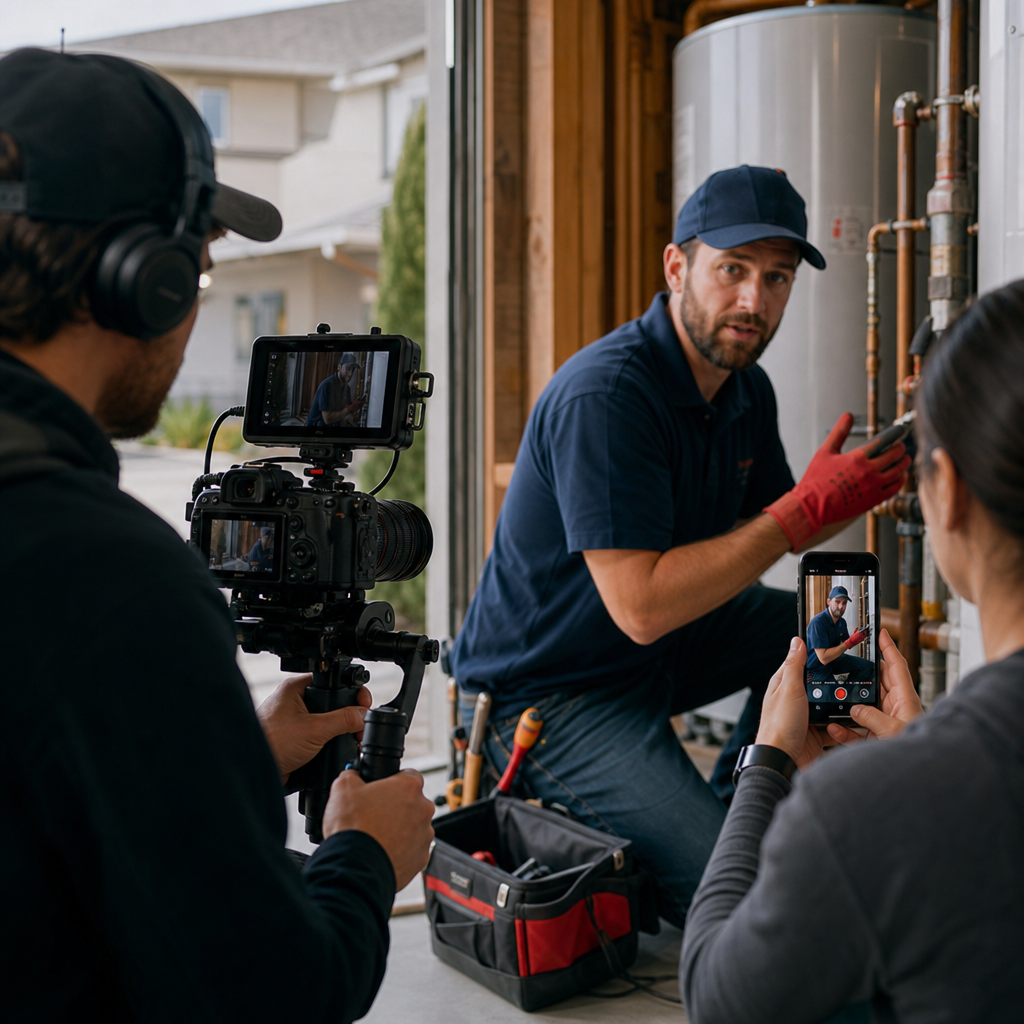
    How We Integrate Video With Your Full Marketing System

    Video is most powerful when it’s part of a larger strategy, not a standalone tactic. We approach every project with the full funnel in mind.

    Short-form videos fuel social media growth and engagement. But they also need to connect to paid advertising, website presence, and lead capture systems. Here’s how we structure it:

    • Social content builds brand awareness and audience trust
    • Paid campaigns amplify that content to target audiences actively searching for your services
    • Landing pages and website content convert viewers into leads
    • SEO optimization ensures your brand appears when people search for solutions
    • Lead management systems track and nurture those inquiries into customers

    We manage all of these pieces, so messaging is consistent and each component reinforces the others. A video showcasing a transformed kitchen doesn’t just live on Instagram. We use it in ads, feature it on your website, optimize it for search, and structure your backend to capture and follow up with interested prospects.

    This integrated approach is why service businesses see 3-5x better results with us than they would investing in video alone.

    Short-Form Content That Actually Converts Leads

    Not all short-form content is created equal. The difference between a video that gets likes and a video that generates qualified leads often comes down to strategy and execution details.

    We focus on four content pillars for service businesses:

    Before and After Transformations: Show the problem state, walk through the process, and reveal the result. These establish credibility and demonstrate exactly what you deliver.

    Client Testimonials and Case Studies: Real customers talking about their experience build trust more effectively than any marketing message you could write. We film these professionally but keep them authentic.

    Educational Process Videos: Answer the questions prospects have. What goes into a proper foundation inspection? How does your remodeling timeline work? What should homeowners know about HVAC maintenance? Educational content positions you as an expert and keeps your brand top-of-mind.

    Behind-the-Scenes and Team Content: Local audiences connect with people. Show your team at work, introduce key staff, share company culture. This builds the personal relationships that drive referrals and repeat business.

    Each format serves a specific purpose in your marketing system. We create a content calendar that balances these types and ties them to your paid advertising and SEO strategy. The result is content that doesn’t just entertain; it qualifies and converts.

    Our Process For Building Your Video Content Engine

    We start with a strategy session where we understand your business, your customer journey, and your growth goals. Not every service business is the same, and we don’t use templates.

    From there, we build your content calendar and production roadmap. We identify which types of videos will serve your business best, how often you should publish, and how to integrate video into your paid and organic marketing efforts. We also establish baseline metrics so we can measure impact from day one.

    Production happens efficiently. Our team handles scripting, filming, editing, and optimization. We manage shoots on your timeline, minimize disruption to your operations, and deliver final content on schedule.

    Once content is live, we monitor performance continuously. We track metrics like views, engagement, click-through rates, and lead attribution. This data feeds back into optimization: we double down on what works, adjust what doesn’t, and refine the strategy quarterly based on real results.

    You’re never in the dark. We provide regular reports showing what’s working, how many leads are coming from video content, and recommendations for what’s next.

    Real Results: How We Drive Measurable Business Growth

    Results vary by industry and starting point, but we consistently see measurable business impact for our service business clients.

    One HVAC contractor client increased qualified leads by 67% over six months by combining cinematic before-and-after videos with targeted paid campaigns and improved website conversion. A home remodeler used testimonial video content to increase average project size by 18% because prospects entered conversations more confident in their vision. A dental practice cut new patient acquisition costs in half by building a video-based trust system that reduced decision friction.

    These results happen because video content is tied to actual business metrics, not vanity metrics. We’re optimizing for lead volume and quality, not just views or likes. That alignment between content strategy and business goals is what separates real growth from activity that feels productive but doesn’t move the needle.

    Why Cinematic Quality Matters for Service Brands

    High production value isn’t about ego or unnecessary expense. It’s about perception and trust.

    When someone is considering hiring you for a major purchase, they’re evaluating whether you’re professional, detail-oriented, and capable of delivering quality. Grainy, poorly lit, or amateurish video sends the wrong signal. It suggests those same qualities might be reflected in your actual work.

    Cinematic quality communicates craftsmanship. It tells prospects that you take pride in what you do and that you’re confident enough in your brand to invest in showing it well. For service businesses competing in mature markets with established competitors, that quality difference can be the deciding factor.

    We maintain cinematic standards across all content, from high-end project showcases to simpler social clips. Professional lighting, color grading, audio, and pacing are baseline, not premium add-ons.

    Ongoing Management and Optimization of Your Video Assets

    Video content doesn’t have a shelf life the way traditional advertising campaigns do. A well-produced video can drive leads for months or years if it’s properly distributed, repurposed, and optimized.

    We manage your video assets as an ongoing resource. That means:
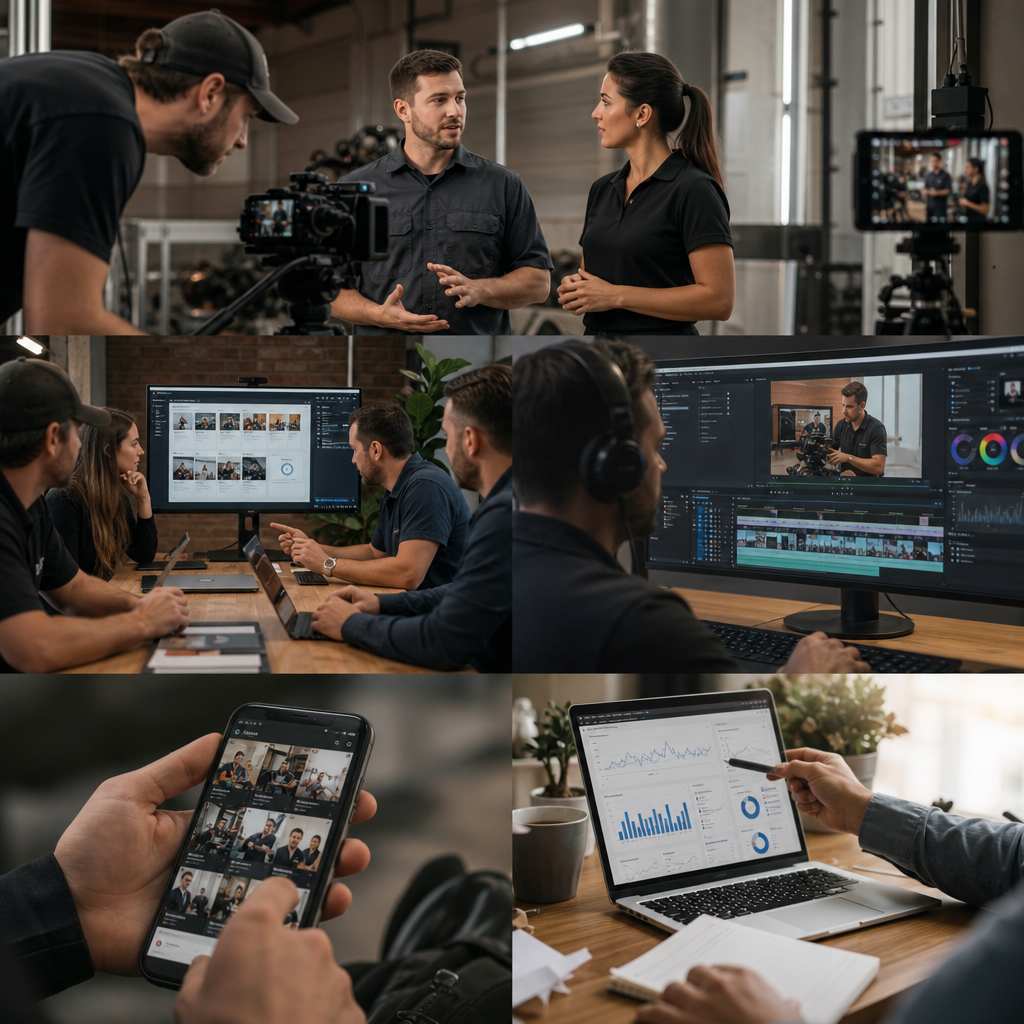
    • Repurposing longer-form content into shorter clips for different platforms
    • Updating metadata and descriptions as search trends shift
    • Testing variations in paid campaigns to optimize performance
    • Retiring underperforming content and doubling down on winners
    • Building evergreen libraries so you always have relevant material to deploy

    This ongoing management is why we operate as a partnership, not a vendor. Your business evolves, markets shift, and seasons affect service demand. Your video strategy should evolve with those changes rather than remaining static.

    Getting Started With Your Video Strategy Today

    If you’re ready to move beyond generic content and build a video marketing system that actually drives leads, the first step is understanding where you are and where you want to be.

    We recommend scheduling a brief strategy call where we’ll discuss your business, your growth goals, and what’s holding you back right now. No hard sell, no obligation. We’ll give you honest feedback on your current approach and what we’d recommend.

    From there, we can outline a plan tailored to your budget and timeline. Most clients start with a pilot project to test the approach and see results before scaling up. That might be three months of content production and management, or it might be a larger engagement. The point is to start seeing measurable impact, then build from there.

    Visit https://canatosmedia.com to learn more about our services, or reach out directly to discuss your video strategy. We work with service businesses across industries, and we’ve built our process specifically to drive the kind of growth you’re looking for.

    For further reading: End-to-end video marketing partner.

    Contact us today for a free consultation to see how we can help you grow your business.

    Frequently Asked Questions (FAQ)

    What makes short-form video content different from traditional long-form production for local service businesses?

    We create videos designed for social media consumption where your customers actually spend time, rather than lengthy corporate videos that sit on websites. Our short-form approach combines cinematic quality with platform-specific optimization, so each 15-60 second piece drives engagement and captures attention in crowded feeds. This format directly converts into leads because we build clear calls-to-action and messaging that matches how service-based prospects actually discover and evaluate businesses online.

    How do you ensure video content actually generates leads rather than just views?

    We integrate every video we produce into your complete marketing system, connecting it with your paid advertising strategy, landing pages, and lead capture processes. Our team doesn’t just shoot and upload content; we analyze performance data, optimize based on what’s converting, and continuously refine your video strategy to align with your sales pipeline. This means every piece of content we create has a specific role in turning attention into qualified leads for your business.

    What’s included in your ongoing support after our initial video production is complete?

    We handle continuous management of your video assets through social media posting schedules, performance monitoring, paid media optimization, and regular strategy adjustments based on what’s working. Our team stays actively involved in your content’s performance rather than handing off a finished product, which means we’re constantly identifying new opportunities to improve your results and scale what’s successful.
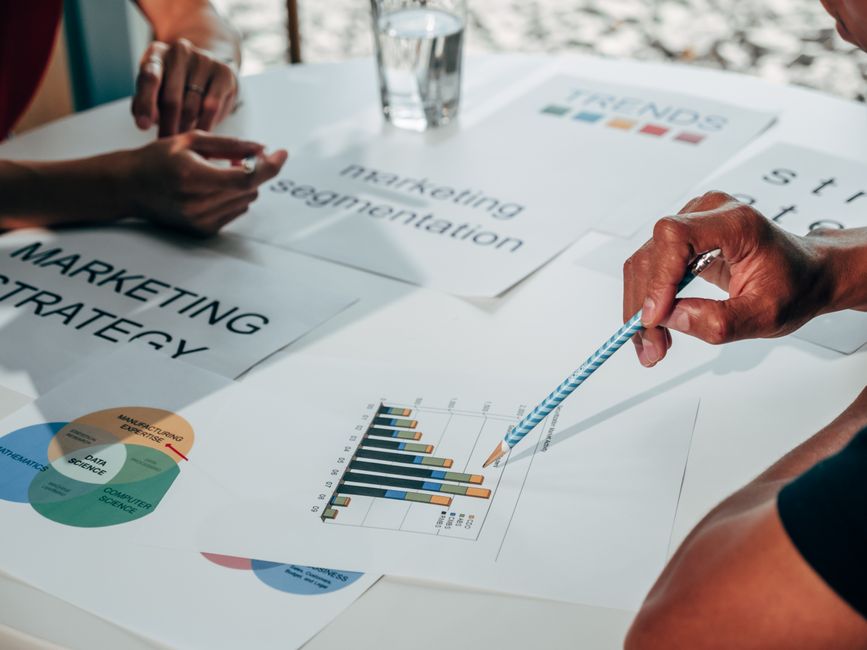
  • The Long Island Growth Guide: Customer Acquisition Strategies That Actually Work

    The Long Island Growth Guide: Customer Acquisition Strategies That Actually Work

    Why Your Customer Acquisition Strategy for Long Island Determines Whether Your Business Grows or Stalls

    The fastest way to build a customer acquisition strategy on Long Island:

    1. Optimize your Google Business Profile for local search and Maps
    2. Run geo-targeted ads on Google and Meta aimed at specific Nassau or Suffolk zip codes
    3. Create short-form video content on Instagram and Facebook to build local brand awareness
    4. Leverage local SEO with town-specific keywords and consistent NAP data across directories
    5. Build a referral and review system to turn happy customers into your best salespeople
    6. Use email marketing to nurture leads — it delivers 122% ROI, higher than any other digital channel
    7. Tap into the Hispanic community — over 594,000 Long Islanders (20.49%) represent a major underserved opportunity

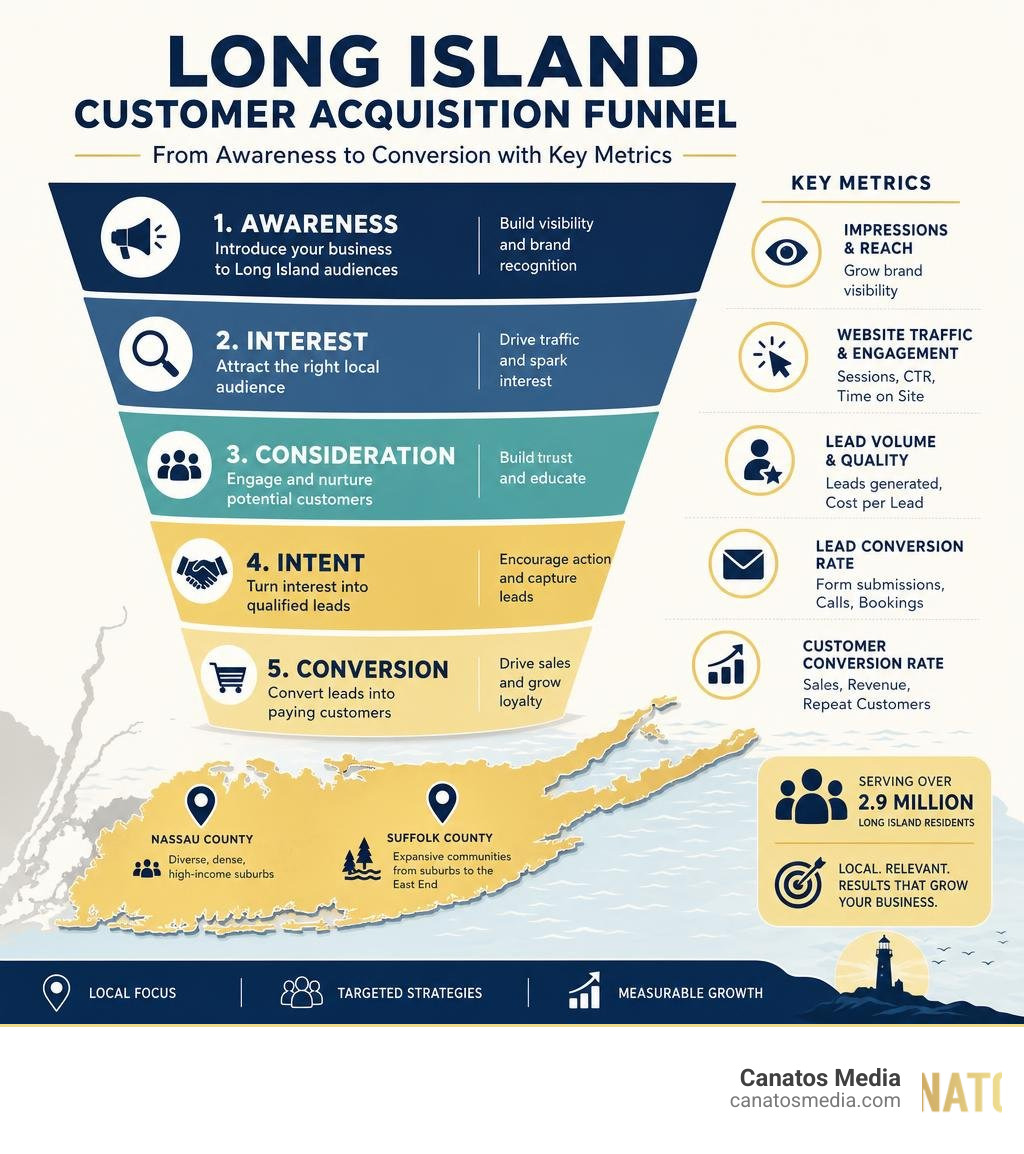
    Long Island is one of the most competitive local markets in the country. With over 2.9 million residents spread across Nassau and Suffolk Counties, and a dense concentration of small businesses all competing for the same customers, standing out is genuinely hard.

    Most business owners here know they need more customers. What they’re less sure about is how to get them — and which channels are actually worth the time and money.

    The challenges are real: local search is crowded, paid ads cost money, and generic national marketing strategies don’t translate well to a suburban market with distinct town-by-town culture and consumer behavior.

    But the opportunity is just as real. Long Island shoppers begin nearly every purchasing journey online. Local search intent is extremely high. And businesses that get their digital presence right — with the right targeting, the right content, and the right follow-up systems — consistently win.

    This guide breaks down exactly what works here, with no fluff.

    I’m Nic Canobbio, founder of Canatos Media, and I’ve spent over two decades working at the intersection of media production, business strategy, and audience growth — including building content systems that have driven over 60 million social media views. My hands-on experience developing a customer acquisition strategy for Long Island and beyond, from negotiating high-stakes media deals to integrating AI into growth systems, is what shapes everything you’ll read in this guide. Let’s get into it.

    Long Island customer acquisition funnel from awareness to conversion with key metrics infographic

    Understanding the Unique Long Island Market Dynamics

    Long Island is not a single, homogeneous market. It is a complex tapestry of diverse communities, each with its own micro-trends, purchasing behaviors, and cultural identity. Stretching from the border of Queens all the way to Montauk, our region demands a localized approach that respects these internal boundaries.

    Nassau County and Suffolk County present distinct demographic profiles. Nassau is characterized by dense, high-income suburban neighborhoods with short commute times to New York City. Suffolk, on the other hand, spans a much larger geographic area, transitioning from bustling suburban hubs to agricultural land and the luxury seasonal markets of the East End.

    Long Island demographic map highlighting Nassau and Suffolk counties

    To acquire customers here, we must understand the consumer psyche. Long Islanders are fiercely loyal to their local communities but highly demanding of convenience and quality. They have high purchasing power, but they are also heavily targeted by national brands. This means local businesses must leverage their community roots as a competitive advantage.

    Seasonality also plays a massive role in our local economy. The summer months bring an influx of tourism and spending to coastal towns and the East End, while inland areas might experience shifting consumer patterns. A successful acquisition framework must be flexible enough to pivot with these seasonal tides—transitioning, for example, from spring preparation campaigns to autumn maintenance messaging.

    Why a Tailored Customer Acquisition Strategy Long Island Approach is Critical

    If you try to run a generic, national marketing campaign on Long Island, you will waste your budget. B2C businesses, from home services to medical practices, cannot rely on broad targeting. A homeowner in Garden City has different pain points and aesthetic expectations than a renter in Patchogue.

    Furthermore, our B2B landscape is highly concentrated in specialized sectors like healthcare, finance, and defense tech. Reaching decision-makers in these fields requires hyper-targeted, relationship-driven strategies rather than cookie-cutter digital funnels.

    On Long Island, town-specific character is everything. Local pride runs deep. When a resident searches for a service, they aren’t just looking for a provider in “New York”—they want someone who knows their specific neighborhood, understands their local school district dynamics, and has a physical footprint nearby. By tailoring your approach to these hyper-local nuances, you build instant trust that national competitors simply cannot match. To master the foundational stages of this process, you can learn more about customer acquisition fundamentals to see how prospects move from initial awareness to final conversion.

    High-Impact Digital Channels for Long Island Customer Acquisition

    To build a sustainable pipeline of new business, we must diversify our digital touchpoints. Relying on a single channel leaves your business vulnerable to algorithm shifts or rising ad costs. A robust multichannel approach combines organic search, paid advertising, email marketing, and content marketing into a unified system.

    In 2026, the consumer journey is non-linear. A prospect might see one of our cinematic short-form videos on Instagram, search for our business on Google a week later, read our local reviews, and finally convert after receiving a personalized email offer. Every channel must work in harmony to guide the prospect toward a purchasing decision.

    At the center of this ecosystem is your digital storefront. Your website and mobile presence must be optimized for immediate action. Because a vast majority of local searches now happen on smartphones—often while users are commuting on the LIRR or running errands—a slow, clunky mobile site is a revenue killer.

    Clean mobile website user experience optimized for local conversions

    Dominating Local SEO and Google Maps

    When a Long Islander needs an emergency plumber, a local accountant, or a pediatric dentist, they don’t scroll through social media—they go to Google. If your business doesn’t appear in the “Local Pack” (the top map listings), you are invisible to high-intent buyers.

    Dominating local SEO requires three main pillars:

    1. Google Business Profile Optimization: Your profile must be completely filled out, categorized correctly, and updated regularly with fresh photos, posts, and offers.
    2. NAP Consistency: Your Name, Address, and Phone number must be identical across every online directory, from Yelp to local chamber of commerce sites.
    3. Local Citations and Keywords: Your website content should naturally integrate local landmarks, town names, and zip codes. Instead of targeting generic terms like “roofing services,” target “roof repair in Huntington NY” or “Syosset roofing contractor.”

    By focusing on these localized search signals, you position your business exactly where your customers are looking. To see how we build these high-converting organic engines, read about how we build local lead generation systems designed specifically for service brands.

    Social Media and Video-First Customer Acquisition Strategy Long Island

    While search captures existing demand, social media creates it. Platforms like Instagram and Facebook are perfect for building brand awareness and emotional connection with Long Island families. However, static images and text-heavy posts no longer cut through the noise.

    In 2026, short-form video is the undisputed king of social media engagement. Audiences want to see the faces behind the business, watch real-time transformations (like a home remodeling project in Manhasset), and hear authentic customer stories.

    At Canatos Media, we specialize in creating cinematic short-form videos that capture attention in the first three seconds. But we don’t just post videos for “likes.” We build integrated systems that capture that social attention and channel it directly into a conversion funnel. If you want to stop chasing vanity metrics and start driving real revenue, discover our blueprint on how to convert social traffic into sales.

    Executing Targeted Advertising and Hyperlocal Campaigns

    Paid advertising allows us to bypass organic waiting periods and put our offers in front of our ideal audience instantly. On Long Island, this is incredibly cost-effective because our Google Ads cost-per-click (CPC) is often significantly lower than in Manhattan, allowing your ad budget to go much further.

    To maximize your return on ad spend (ROAS), we must use surgical geo-targeting. Instead of targeting all of Nassau and Suffolk, we can target specific zip codes, high-income neighborhoods, or a tight radius around your physical location. This ensures you aren’t paying for ad impressions from users who live too far away to visit your business or utilize your services.

    To understand which paid channel fits your current growth goals, consider this comparison:

    Feature / Metric Google Ads (Search) Meta Ads (Facebook & Instagram)
    Primary User Intent Active Search (High commercial intent) Passive Browsing (Discovery & Interest)
    Targeting Methods Keywords, search queries, location Demographics, interests, behaviors, zip codes
    Best Used For Direct lead generation, immediate service needs Brand awareness, visual storytelling, retargeting
    Ad Formats Text ads, Local Services Ads, Shopping Short-form video, carousels, lead forms
    Long Island Advantage Captures “near me” searches instantly Builds deep community trust via video content

    Personalization and Multicultural Marketing

    One of the biggest missed opportunities in any customer acquisition strategy for Long Island is failing to engage our diverse cultural communities. Specifically, Long Island is home to a vibrant, rapidly growing Hispanic community of over 594,300 residents—representing more than 20.49% of our total population.

    Multicultural marketing is not about simply translating your existing English ad copy into Spanish. It requires cultural relevance, understanding unique family dynamics, and presenting tailored offers that resonate with the community’s values.

    By segmenting your audience and mapping out personalized customer journeys, you can speak directly to different demographics. Whether you are tailoring campaigns for young professional commuters in Rockville Centre or multi-generational households in Brentwood, personalization dramatically increases your acquisition rates.

    Leveraging AI, Automation, and Data-Driven Systems

    The modern sales cycle moves incredibly fast. If a prospect fills out a contact form on your website and doesn’t receive a response within five minutes, the odds of converting them drop by over 80%. This is where AI and automation tools become essential.

    We can implement AI-driven chatbots on your website to answer common questions, qualify leads, and even book appointments 24/7 without human intervention. Behind the scenes, robust Customer Relationship Management (CRM) tools can automate your follow-up workflows, ensuring no lead slips through the cracks.

    When your sales and marketing teams are tightly aligned through shared data and automated CRM systems, the results are clear: companies see an average of 36% higher customer retention and 38% higher sales win rates.

    Balancing Acquisition with Customer Retention

    While this guide focuses on acquiring new customers, we must remember that keeping an existing customer is significantly cheaper than winning a new one. A healthy business balances both by focusing heavily on the Customer Lifetime Value (CLV) to Customer Acquisition Cost (CAC) ratio.

    An ideal CLV:CAC ratio is 3:1—meaning the lifetime value of a customer should be three times what you spent to acquire them. To protect this ratio, you must invest in the customer experience.

    Data shows that 62% of B2B and 42% of B2C customers purchased more after a good customer service experience, while 66% of B2B and 52% of B2C customers stopped buying after a single bad interaction. By pairing your acquisition campaigns with exceptional service and structured loyalty rewards, you turn one-time buyers into lifetime advocates. To build a system that supports this long-term balance, you can discover how to build scalable acquisition systems that align marketing, sales, and customer success.

    Key Metrics and ROI Tracking

    You cannot improve what you do not measure. To ensure your marketing budget is actually driving business growth, we must track key performance indicators (KPIs) with absolute precision.

    This goes beyond tracking “clicks” or “impressions.” We focus on bottom-line metrics:

    • Cost Per Lead (CPL): How much it costs to get a prospect’s contact information.
    • Customer Acquisition Cost (CAC): The total sales and marketing spend divided by the number of new customers acquired.
    • Conversion Rate: The percentage of website visitors who take a desired action (e.g., booking a consultation).
    • Attribution Modeling: Understanding exactly which ad, video, or search term led to a booked appointment.

    Using call tracking and advanced analytics, we can trace a customer’s journey from their very first social media view to their final invoice. To see this level of measurement in action, read our guide on how to measure video campaign ROI from initial views to booked appointments.

    Cost-Effective Customer Acquisition Strategy Long Island for Small Businesses

    If you are a small business owner on Long Island with a limited marketing budget, you might feel overwhelmed by the thought of competing with massive national ad spends. But local businesses have a secret weapon: agility and authentic community connection.

    You don’t need a million-dollar budget to acquire customers if you focus on high-yield, low-cost tactics:

    • Incentivize Referral Schemes: Word-of-mouth is incredibly powerful in tight-knit Long Island school districts and neighborhoods. Give your current customers a compelling reason to refer their friends and neighbors.
    • Prioritize Verified Reviews: Make it a frictionless part of your service delivery to ask for Google reviews. A high volume of 5-star reviews builds instant trust and boosts your search rankings for free.
    • Increase Content Velocity: Consistently publishing helpful, local-centric content (like blogs, FAQs, and quick social videos) signals to both search engines and local users that you are the active authority in your space.
    • Leverage Local Networking: Attend community events, join your local Chamber of Commerce, and build cross-promotional partnerships with non-competing businesses that serve the same target audience.

    Frequently Asked Questions about Long Island Customer Acquisition

    How is marketing on Long Island different from New York City?

    Marketing on Long Island differs significantly from NYC due to lower Google Ads cost-per-click (CPC), exceptionally high local search intent, and suburban commute patterns. While NYC marketing often targets transient foot traffic or broad metro audiences, Long Island requires a highly localized, neighborhood-specific approach that respects local town identities and commuter lifestyles.

    How long does it take to see results from local SEO on Long Island?

    While paid ads can drive leads instantly, local SEO is a long-term investment. Most businesses on Long Island begin to see measurable increases in organic search traffic, Google Maps visibility, and search rankings within 3 to 6 months of consistent optimization and review generation.

    What is a good customer acquisition cost (CAC) ratio for local businesses?

    A healthy local business should aim for a CLV:CAC ratio of 3:1. This means the total revenue a customer generates for your business over their lifetime should be three times the amount you spent on marketing and sales to acquire them. If your ratio is 1:1, you are spending too much to win each customer; if it is 5:1, you are likely underinvesting in your growth.

    Conclusion

    Building a successful customer acquisition strategy for Long Island in 2026 requires more than just running a few ads or posting occasionally on social media. It demands an integrated, data-driven approach that respects our unique suburban market, leverages hyper-local search signals, and captures attention through high-quality, cinematic storytelling.

    At Canatos Media, we don’t believe in disjointed marketing tactics. We build integrated lead generation systems that connect beautiful video content, precise local targeting, and automated conversion workflows to drive measurable business growth.

    If you are ready to stop guessing where your next customer is coming from and start building a predictable, scalable acquisition engine, we are here to help. Partner with Canatos Media for your growth strategy and let’s take your Long Island business to the next level.