Why Service Businesses Struggle to Convert Social Attention into Leads
Service businesses often nail the attention part. A plumber, HVAC contractor, or cleaning service posts a before-and-after transformation video and watches engagement climb. Comments roll in. Shares happen. But then the phone doesn’t ring, and the inbox stays quiet.
The gap exists because attention and trust are different currencies. A viral post proves people are watching, but it doesn’t prove they’re ready to buy or that they believe your business will solve their problem better than the next option. Service customers need to see the quality of your work, understand your process, and feel confident in your team before they commit. A 15-second scroll doesn’t do that.
Most service businesses also lack a clear path from “saw your video” to “becoming a customer.” They post content on social media, hope someone clicks a link, and assume the website will close the deal. There’s no system. No nurture. No strategy connecting the initial impression to the actual conversion.
The result is wasted content. You invest in production and publishing but miss the infrastructure that turns lookers into leads.
The Problem with Disconnected Marketing Channels
When your video content lives only on Instagram, your paid ads run independently on Google, and your website operates as a separate island, customers experience friction at every touchpoint. They see a compelling video about your service, click through to an ad on Google that looks like it’s from a different business, and land on a homepage that doesn’t reinforce what they just watched.
This misalignment erodes trust faster than you think. Consistency across channels builds credibility. Inconsistency signals that you’re not serious or organized, which matters enormously for service businesses where people are inviting you into their homes or businesses.
Another common mistake: running paid ads without a clear landing page experience. You drive traffic to a generic homepage or, worse, a Facebook link that doesn’t convert. The ad spend generates clicks, but the conversion rate stays flat because there’s no continuity between the promise in the ad and the experience on the landing page.
We’ve seen service businesses spend thousands on ads only to abandon the leads because they don’t have a system to follow up. Without nurture sequences, lead qualification workflows, or a CRM connecting everything, leads evaporate. A potential customer fills out a form and hears nothing, so they call your competitor instead.
How Cinematic Video Changes Customer Perception and Trust
Cinematic video doesn’t mean expensive Hollywood production. It means intentional framing, purposeful pacing, and storytelling that shows your service in motion. When a customer watches a well-shot video of your team installing a system, solving a problem, or transforming a space, they’re watching a promise being kept in real-time.
This visual proof carries weight that testimonials alone don’t achieve. Reading that you’re “professional and thorough” is one thing. Watching a five-minute cinematic breakdown of exactly how you approach a job is another. The viewer develops familiarity with your team, understands your process, and begins to imagine what working with you actually feels like.
Short-form video content amplifies this effect. A 30-second clip showing a dramatic before-and-after with clean transitions and purposeful music communicates competence and attention to detail. It travels faster across social platforms, gets shared more often, and sits in someone’s consciousness longer than a static image or text description.
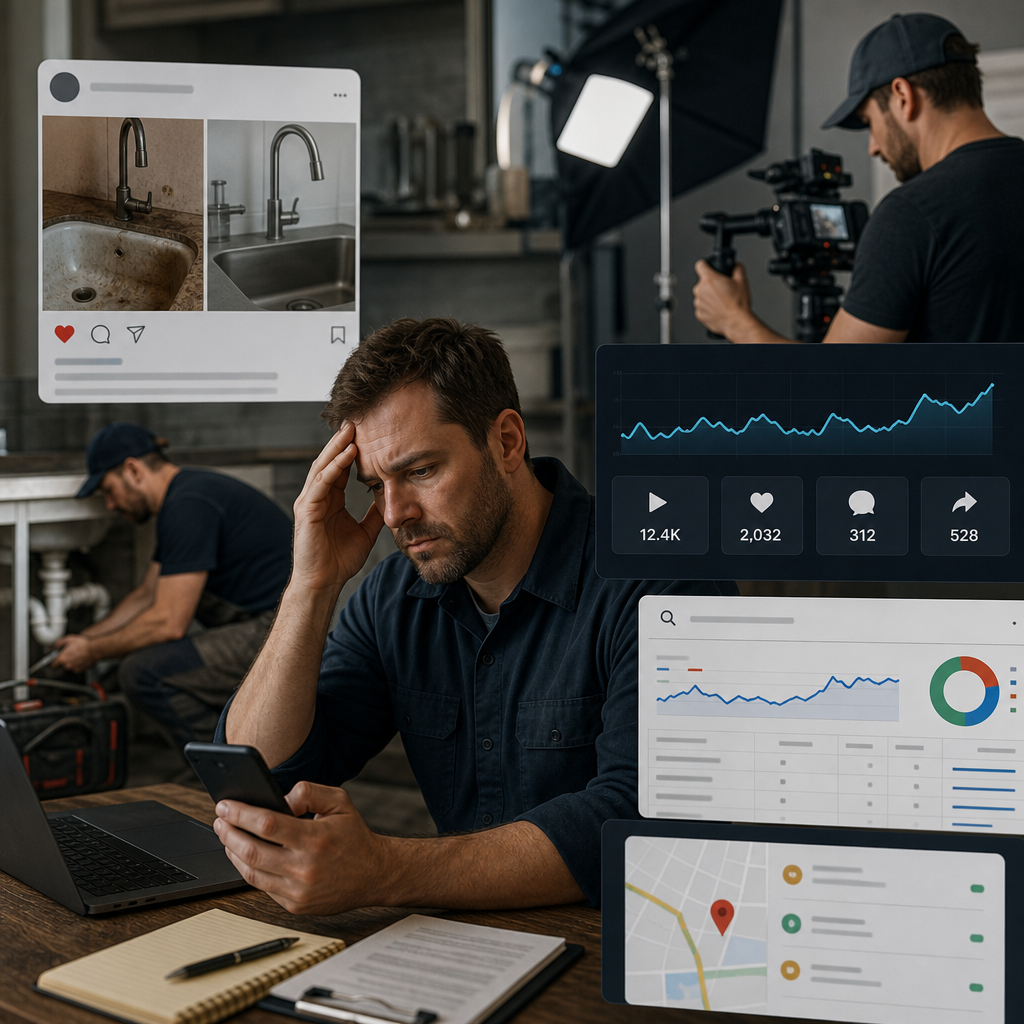
Cinematic storytelling also gives you a competitive advantage in markets where most competitors are still using phone camera footage or generic stock videos. Quality stands out. Potential customers notice and interpret premium video production as a signal of a premium service.
Our Integrated Approach: Video Plus Paid Advertising
We treat video production and paid advertising as one system, not separate initiatives. Here’s how it works: you create cinematic short-form content that showcases your service in a way that builds trust and demonstrates expertise. Simultaneously, we run paid campaigns on Meta and Google that put that video content in front of people actively searching for or interested in your service type. The landing pages and follow-up sequences are designed to feel like a natural continuation of the video experience.
This integration matters because it multiplies the effect of each channel. Your video content becomes raw material for paid ads, which means every production dollar works harder. A single piece of cinematic footage can be repurposed into six to eight different ad variations, each optimized for different audience segments and platforms.
Your paid advertising budget then ensures your best content reaches the right people at the right time, rather than relying on organic reach alone. Meta ads put your video in front of homeowners who’ve shown interest in similar services. Google ads capture people actively typing “plumber near me” or “commercial cleaning services.” Video ads on both platforms consistently outperform static creative, which means your cost per lead drops when video is in the mix.
Building Lead Generation Systems That Actually Work
A lead generation system ties together video content, paid advertising, landing page design, and follow-up automation. Without this structure, you’re just hoping leads come in and randomly trying to close them.
Start by identifying the specific transformation or problem you solve best. A home services business might focus on “transforming outdated HVAC systems into modern, efficient ones.” A cleaning service might zero in on “restoring commercial spaces to pristine condition.” This clarity lets you create focused video content and write ads that speak directly to that outcome.
Next, design a landing page that echoes the video message. If your ad features a dramatic before-and-after transformation, the landing page should reinforce that same narrative with social proof, process explanation, and a clear call-to-action. For most service businesses, that CTA is a form requesting a free estimate, phone consultation, or inspection.
The final layer is automation. When someone fills out a form, they should immediately receive a confirmation email with next steps, a video showing what to expect during a consultation, and a calendar link to book an appointment. For multi-location businesses, this routing should send the lead to the closest location automatically. The goal is to eliminate the gap between interest and follow-up, because most leads who don’t hear back within a few hours will call someone else.
Meta Ads Strategy for Video-First Brands
Meta (Facebook and Instagram) is where most service customers spend their daily time, which makes it ideal for building awareness and capturing intent-ready prospects. We structure Meta campaigns in layers. The top layer reaches broad audiences with awareness content, often 30-60 second videos showing your service in action. These establish familiarity and begin building the mental association between your brand and the solution.
The middle layer targets people who’ve engaged with your awareness content, showing them more detailed videos that address specific concerns or showcase testimonials. These people have signaled interest, so your messaging can get more specific.
The bottom layer targets people who’ve visited your website or landed on your lead form, reminding them to complete the process or offering a special incentive to book a consultation. Retargeting video ads consistently outperform static ads because movement and storytelling keep attention longer.
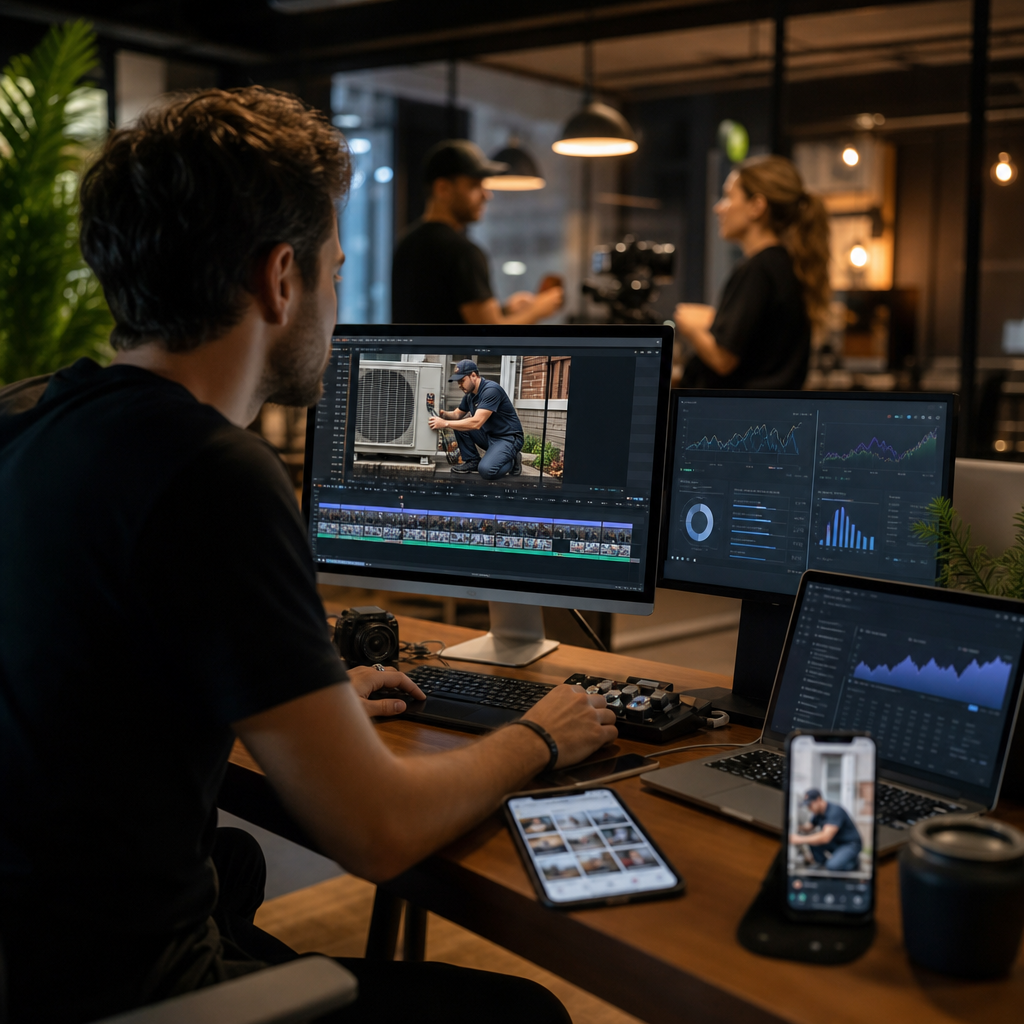
For service businesses, we typically focus on conversion-oriented campaigns rather than pure brand awareness, because the audience is smaller and more qualified. The goal is to drive phone calls, form submissions, and consultations, not just likes and shares. This requires testing different video messaging, audience segments, and creative variations to find what drives the lowest cost per qualified lead.
Google Advertising Optimization for Service Businesses
Google Ads capture high-intent customers actively searching for your service type. A homeowner typing “emergency plumber” or a business manager searching “office cleaning services near me” is already past the awareness phase and looking for a solution today.
For service businesses, we use a mix of search ads (text-based ads that appear in search results) and video ads (which appear on YouTube and across the Google Display Network). Search ads handle the immediate intent: someone searching “HVAC repair near me” sees your ad with clear pricing, availability, and a link to book. Video ads on YouTube and partner sites reach people earlier in their research, building familiarity before they start searching.
The critical optimization lever is landing page alignment. A Google search ad must lead to a landing page that matches the search query and the ad copy. If someone searches “emergency plumbing service,” they should land on a page that prominently addresses emergencies and available appointment times, not a generic homepage. This match between intent, ad, and landing experience is what Google’s algorithm rewards with higher ad rankings and lower costs.
For service businesses with seasonal demand, we adjust ad spend and messaging throughout the year. HVAC companies scale up heating ads in fall and cooling ads in summer. Landscaping businesses pause ads during winter and focus on spring projects when intent spikes. This seasonal approach prevents wasted ad spend and improves overall ROAS.
How We Structure Campaigns for Multi-Location Brands
Multi-location service businesses face a unique challenge: one campaign approach doesn’t work across all locations because demand, competition, and customer profiles vary geographically. We customize the strategy while maintaining brand consistency.
At the core is a unified video library that showcases your service in a consistent style, but with location-specific variations. Imagine a cleaning company with 12 locations. We produce cinematic short-form content showing the cleaning process and results, then create location-specific versions where we feature local team members or local customer testimonials. The production quality and storytelling remain consistent, but each location’s audience sees themselves represented.
Advertising then mirrors this approach. Each location gets its own Meta and Google campaign with geo-targeted budgets and messaging. A location in a competitive market might allocate more budget to paid ads, while a less competitive area focuses on organic social and organic search optimization. Lead routing automatically sends inquiries to the correct location, and each branch gets reporting showing which campaigns drive the most qualified leads.
This structure also allows us to scale short-form video ads across Meta and Google Ads efficiently. One piece of cinematic content becomes dozens of variations, each optimized for a different location, audience, and platform. Multi-location brands see significantly higher ROAS because the same production investment drives leads across all branches.
Measuring and Scaling What Works
Data drives everything. We track which videos, ad variations, audience segments, and landing page layouts generate the lowest cost per qualified lead and the highest conversion rate from lead to customer. This measurement framework prevents waste and focuses budget on what’s working.
For service businesses, the metrics that matter most are cost per lead, lead quality (how many leads become actual customers), and customer lifetime value. A lead that costs $15 but converts to a $3,000 project is far more valuable than a lead that costs $5 but never converts. We build dashboards showing these metrics in real-time so you can see which campaigns and channels are driving profitable growth.
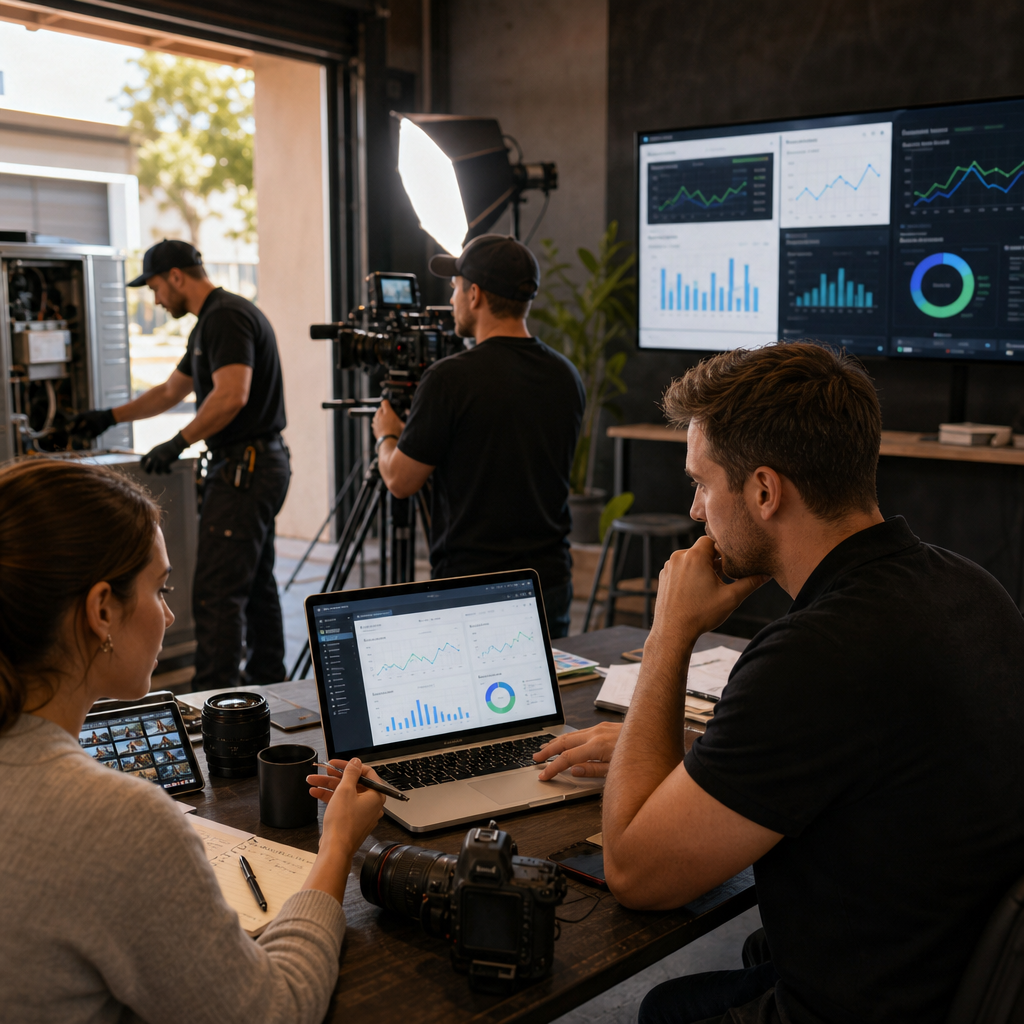
Scaling follows naturally once you’ve identified what works. If a particular video format, audience segment, or platform is delivering leads at a profitable cost, we increase budget to that channel. If another approach isn’t hitting targets, we either optimize it (different landing page, different audience, different creative) or pause it entirely. This disciplined approach prevents vanity metrics from distracting you and keeps focus on actual business results.
Why Your Next Marketing Investment Should Include Video
Video drives the conversion metrics that matter. Campaigns that include video content consistently achieve lower cost per acquisition, higher engagement rates, and better brand recall than text or static image campaigns. For service businesses specifically, video solves the trust gap by showing actual work and actual teams in motion.
The investment in cinematic short-form video production pays dividends across multiple marketing channels. One production session generates assets for paid ads, organic social content, website hero sections, email marketing, and lead nurture sequences. This leverage means your content investment compounds over time.
The combination of cinematic video and integrated paid advertising removes friction from the customer journey. Potential clients see a compelling video, click an ad that reinforces the same message, land on a page designed to convert, and move into a follow-up sequence that nurtures them toward a decision. Each touchpoint builds on the previous one, creating a coherent experience that builds trust and drives results.
Your next marketing investment should allocate budget to video production, paid advertising integration, landing page optimization, and lead automation systems. This foundation turns social attention into qualified leads and leads into customers. If you’re ready to implement this approach and want a strategy tailored to your service business, we’re here to help you build a system that actually converts.
Contact us today for a free consultation to see how we can help you grow your business.
Frequently Asked Questions (FAQ)
What makes cinematic video content more effective than standard social media clips for generating leads?
We’ve found that cinematic video builds trust and perception in ways standard content simply can’t match. When potential customers see high-quality production value and authentic storytelling, they perceive your business as more professional and established. Our approach combines this elevated production with strategic placement across Meta and Google ads, so the visual impact reaches the right audience at the right moment in their buying journey.
How do we connect video production with paid advertising to actually convert social attention into leads?
We treat video and paid ads as a unified system rather than separate tactics. We produce cinematic short-form content specifically designed for your target audience, then run that content through Meta and Google advertising platforms with lead capture systems built into the funnel. This means every piece of visual content we create has a clear path from awareness to lead generation, with tracking and optimization at each stage.
Why do multi-location service businesses see better results when they work with us compared to managing marketing in-house or through disconnected agencies?
We handle the entire chain: content creation, social media strategy, paid ad management, SEO, and lead system design all work together under one approach. With multi-location brands, we customize campaigns for local relevance while maintaining brand consistency, and we measure performance across all channels so you know exactly which locations and strategies are driving real revenue.