Day: July 20, 2026

  • Master Your LinkedIn Paid Campaign Strategy Without the Headache

    Master Your LinkedIn Paid Campaign Strategy Without the Headache

    Why Your LinkedIn Paid Campaign Strategy Is Make or Break for B2B Growth

    A strong linkedin paid campaign strategy is the difference between burning budget on bot leads and actually filling your pipeline with decision-makers who can sign contracts.

    Here is a quick-start framework to get your LinkedIn ads working:

    1. Pick the right objective first — Awareness, Consideration, or Conversion — based on where your buyer is in their journey
    2. Target precisely — Use job title, seniority, company size, and company lists to reach real decision-makers
    3. Keep audiences under 100,000 — Smaller, tighter audiences reduce junk traffic and bot leads
    4. Turn off Audience Expansion and LinkedIn Audience Network — These defaults drain budget on irrelevant impressions
    5. Match your offer to the funnel stage — Cold audiences need value-first content (checklists, webinars), not demo requests
    6. Use Manual or Cost Cap bidding — Avoid letting LinkedIn’s Maximum Delivery inflate your CPMs unchecked
    7. Budget at least $5,000/month — LinkedIn reps advise against Lead Gen or Conversion campaigns below this threshold
    8. Measure pipeline quality, not just clicks — Track qualified lead rate, sales acceptance, and cost per opportunity

    LinkedIn has over 1 billion users, and four out of five of them drive business decisions. That is an enormous professional audience. But the platform’s defaults, its auction system, and its ad formats can work against you if you do not know what to watch for.

    Many advertisers have spent thousands of dollars — sometimes over $3,000 in a single campaign — and walked away with zero qualified leads. Not because LinkedIn does not work, but because the setup was wrong from the start.

    I am Nic Canobbio, founder of Canatos Media, and over two decades of building media strategies and high-stakes partnerships has shown me exactly where a linkedin paid campaign strategy succeeds or stalls. In this guide, I will walk you through the exact steps to run campaigns that actually convert.
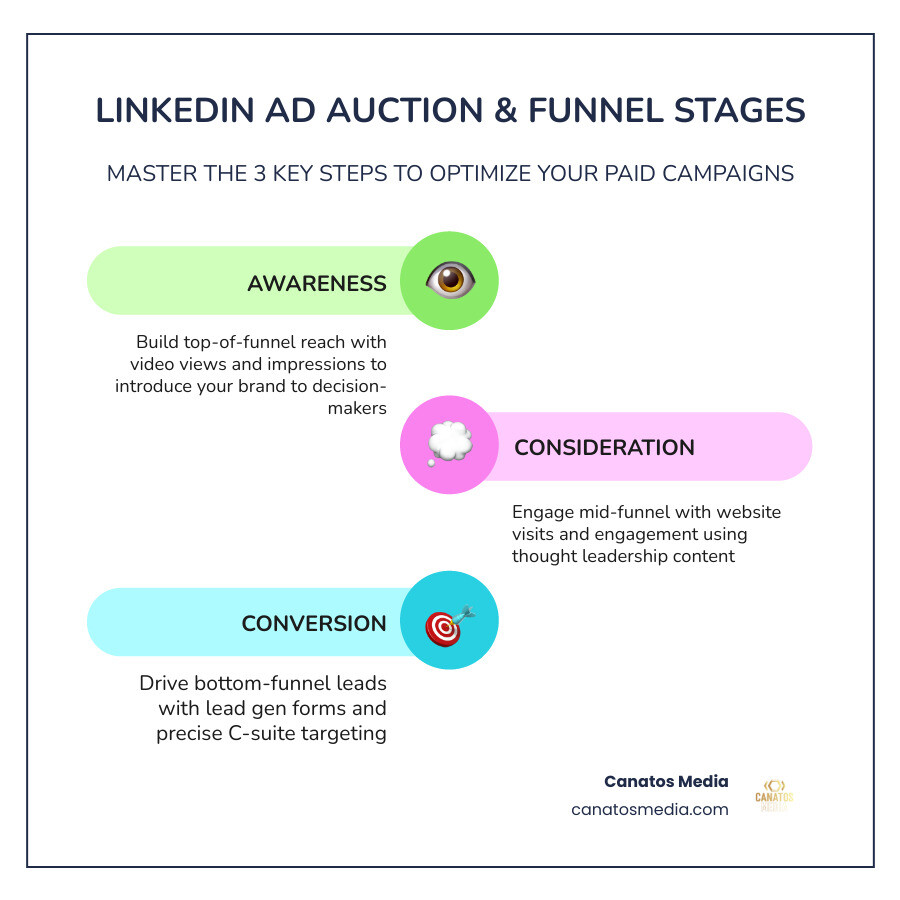
    LinkedIn paid campaign strategy funnel stages and ad auction overview infographic - linkedin paid campaign strategy

    Building a Full-Funnel linkedin paid campaign strategy

    To succeed on LinkedIn in May 2026, you cannot simply “set and forget” a single ad. B2B buyers are more sophisticated than ever. They require multiple touchpoints before they trust a brand enough to share their contact information. A full-funnel approach ensures you are not just asking for a “marriage” on the first date.

    Full-funnel B2B marketing diagram showing Awareness, Consideration, and Conversion stages - linkedin paid campaign strategy

    A successful funnel moves a prospect through three distinct stages:

    • Awareness: You are introducing your brand to a cold audience. The goal here is reach and “brand recall.” You want them to recognize your name when they see it again.
    • Consideration: You are providing value. This is where you drive traffic to your website or encourage engagement with a video. You are proving you understand their pain points.
    • Conversion: This is the “ask.” Whether it is a Lead Gen Form for a whitepaper or a website conversion for a demo, you are collecting data to hand off to sales.

    For a deeper dive into how social ads work across platforms, check out our guide on Paid Social Media Advertising from Zero to Hero in One Hour.

    Comparing LinkedIn Ad Objectives

    Funnel Stage Recommended Objective Best Ad Formats Key Metric
    Awareness Brand Awareness Video Ads, Single Image Impressions / Reach
    Consideration Website Visits / Engagement Thought Leader Ads, Document Ads CTR / Video View Rate
    Conversion Lead Generation / Conversions Lead Gen Forms, Conversation Ads CPL / Conversion Rate

    Aligning Objectives with High-Ticket B2B Services

    When you are selling high-ticket services—like podcast marketing for executives or enterprise software—the “Conversion” objective can be a trap if used too early. High-consideration purchases require high-trust relationships.

    According to Ad set setup best practices | LinkedIn Help, selecting the right objective is the foundation of your ad set performance. If you target a Fortune 1000 CEO with a “Book a Demo” ad immediately, you will likely see high costs and low engagement. Instead, align your objective with the “temperature” of the audience. Use Awareness to highlight a common industry problem, then use Consideration to offer a solution-oriented case study.

    Selecting Ad Formats for Every Funnel Stage

    Choosing the right format is as important as the message itself. In 2026, LinkedIn offers a variety of “media-rich” options:

    • Sponsored Content (Single Image & Carousel): The bread and butter of the feed. Carousels are excellent for step-by-step walkthroughs or product comparisons.
    • Video Ads: One of LinkedIn’s fastest-growing formats. Keep them under 30 seconds for the best results, and always include captions, as many executives browse on mute.
    • Document Ads: A powerhouse for lead gen. Users can read your whitepaper or checklist directly in the feed.
    • Thought Leader Ads: These allow you to sponsor a post from a real person’s profile (like a CEO or subject matter expert). They feel more authentic and less like a “corporate” ad.
    • Connected TV (CTV): 84% of B2B marketers using CTV ads find them helpful for ROI. These are perfect for high-level brand storytelling at the top of the funnel.
    • Sponsored Messaging (Message & Conversation Ads): These land directly in the inbox. LinkedIn has a frequency cap: members usually only receive these once every 45 days.

    Precision Targeting for C-Suite and Fortune 1000 Executives

    The most powerful feature of LinkedIn is the data. You can target by job title, company size, and even specific company names. However, “with great power comes great responsibility”—or in this case, the risk of over-targeting.

    Executive-level targeting settings in LinkedIn Campaign Manager - linkedin paid campaign strategy

    To reach the C-suite in the tri-state area or Long Island, you need a balanced linkedin paid campaign strategy. Start with your Ideal Customer Profile (ICP). If you are looking for Fortune 1000 leaders, do not just rely on job titles. Many executives have “unique” titles that might not fit standard categories.

    Instead, use Matched Audiences. This allows you to upload a specific list of target companies (Account-Based Marketing) and then layer on seniority filters like “VP” or “C-level.” You can also leverage Predictive Audiences, which uses LinkedIn’s AI to find users similar to your existing high-value customers.

    As noted in Paid Advertising on LinkedIn: A Practitioner’s Guide (2026), the goal is not to make the audience as small as possible, but to make it as coherent as possible.

    Avoiding Bot Leads and Audience Expansion Pitfalls

    One of the most common ways beginners blow their budget is by leaving default settings toggled “on.”

    • Audience Expansion: This allows LinkedIn to show your ads to people “similar” to your target. In theory, it sounds great. In reality, it often pulls in low-quality leads and bots. Turn it off for niche B2B campaigns.
    • LinkedIn Audience Network (LAN): This sends your ads to third-party apps and websites. Unless you are running a massive brand awareness play, uncheck this box to keep your ads strictly on the LinkedIn platform.

    If you have ever seen “leads” with zero connections and weird job titles, you have likely fallen victim to these settings. Use Exclusion Lists to filter out competitors, current employees, and job seekers to ensure every dollar is spent on potential buyers.

    Lead Gen Forms vs. Website Conversions

    This is the age-old LinkedIn debate.

    Lead Gen Forms are incredibly low-friction. They auto-fill with the user’s LinkedIn data, making it easy for them to convert. However, because they are too easy, you might get lower-intent leads. Website Conversions require the user to leave LinkedIn and fill out a form on your site. This creates more “friction,” but the leads who finish the process are usually much higher quality.

    When should you use which?

    • Use Lead Gen Forms for “low-threat” offers like checklists, industry reports, or webinar sign-ups.
    • Use Website Conversions for high-intent actions like “Request a Quote” or “Schedule a Consultation.”

    For help setting up these complex tracking systems, take a look at our digital marketing services.

    Optimizing Performance and Scaling Results

    Once your campaign is live, the real work begins. LinkedIn’s “learning phase” typically lasts 10 to 14 days. During this time, the machine learning algorithm is figuring out who is most likely to engage with your ad. Avoid making major changes during this window, or you will reset the clock.

    Bidding and Budgeting Strategies

    To control costs, you need to move away from “Maximum Delivery” once you have baseline data.

    • Manual CPC (Cost Per Click): This gives you the most control. Start at about 1/3 of LinkedIn’s suggested bid. If you aren’t spending your daily budget, increase the bid by 15-20%.
    • Cost Cap: You set a target price per result, and LinkedIn tries to keep your average near that number.
    • Budgeting: Realistically, you need at least $5,000 per month for conversion-focused campaigns. While the daily minimum is $10, that won’t provide enough data to optimize a high-ticket B2B service.

    Scaling Your linkedin paid campaign strategy with Accelerate

    LinkedIn recently introduced Accelerate campaigns. These are AI-assisted setups that automate targeting and creative placement.

    • When to use Accelerate: If you have a small team or are new to the platform, Accelerate can get you live fast.
    • When to use Classic: If you are doing strict ABM, targeting a very narrow list of companies, or need granular control over exclusions, stick with “Classic” campaigns.

    Refining Your linkedin paid campaign strategy through A/B Testing

    Never run just one ad. We recommend rotating at least 3-4 creative variations.

    • Test your Hook: Try one headline that calls out a pain point and another that promises a specific result.
    • Test your Visuals: Compare a professional stock photo against a “Thought Leader” style image of your founder.
    • User-Generated Content (UGC): Screenshots of reviews or video testimonials often outperform polished corporate videos because they provide social proof.

    Frequently Asked Questions about LinkedIn Ads

    How much budget is realistically needed for LinkedIn ads?

    While you can start with a $10 daily minimum, a linkedin paid campaign strategy aimed at high-ticket lead generation usually requires $5,000+ per month. This allows the algorithm enough “signal” to find your buyers. LinkedIn clicks are expensive—often $5 to $15+—so a small budget will result in very few clicks and zero statistical significance.

    What are the most common mistakes beginners make?

    The “Big Three” mistakes are:

    1. Hyper-targeting: Making an audience so small (under 10,000) that the ad auction ignores you.
    2. Leaving “Audience Expansion” on: This dilutes your targeting with irrelevant users.
    3. Weak Offers: Asking for a demo from someone who has never heard of you. Offer a “valuable asset” first.

    How do you reach Fortune 1000 decision-makers without junk leads?

    The secret is a combination of Company Lists and Manual Bidding. By uploading the specific list of Fortune 1000 companies and using manual CPC, you ensure you aren’t overpaying for “junk” traffic from the Audience Network. Also, ensure you are excluding “Junior” and “Entry Level” seniorities.

    Conclusion

    Mastering a linkedin paid campaign strategy is not about having the biggest budget; it is about having the most precise strategy. By moving away from “set and forget” defaults and focusing on a full-funnel approach, you can turn LinkedIn into a predictable revenue generator for your B2B business.

    At Canatos Media, we specialize in an integrated strategy that connects cinematic video content with surgical targeting. Whether you are in the tri-state area or right here on Long Island, we help you bridge the gap between “clicks” and “contracts.”

    Ready to stop guessing and start growing? Elevate your business with our professional marketing services and let’s build a campaign that actually works for you.


  • How to Allocate Your Marketing Budget Between Video Production and Paid Advertising

    How to Allocate Your Marketing Budget Between Video Production and Paid Advertising

    The Challenge of Splitting Marketing Dollars Across Channels

    Every growth-focused business owner faces the same difficult question: How much should we spend on creating content versus promoting it? This tension sits at the heart of modern marketing. You have a finite budget, competing priorities, and no shortage of vendors telling you their channel deserves the lion’s share.

    The problem isn’t that you lack options. It’s that most budget frameworks treat video production and paid advertising as separate decisions rather than interconnected parts of a single system. When we work with multi-location or service-based brands, we almost always discover they’re either investing heavily in content that never reaches their audience, or spending aggressively on ads without quality assets to drive conversions.

    The businesses that grow fastest recognize something fundamental: these two investments amplify each other. Your budget allocation isn’t really about choosing between them. It’s about finding the right ratio that turns your content into a lead-generation engine.

    Why Most Businesses Struggle With Budget Distribution

    The struggle typically comes from one of three places. First, many business owners lack historical data. If you’re new to integrated video and paid media, you don’t yet know what your audience responds to or what your conversion costs actually are. You’re making educated guesses.

    Second, budget allocation gets politicized inside organizations. Your sales team wants more leads now, so they push for immediate paid ads. Your brand team wants better content to stand out from competitors. Both are right, and neither perspective fully captures the picture. This internal tension often leads to compromise budgets that satisfy no one and optimize nothing.

    Third, most agencies and consultants specialize in one channel. They naturally recommend their expertise. A video production company will emphasize content creation. A paid media manager will stress the importance of ad spend. Neither has incentive to show you the true trade-off.

    The result is scattered spending with no clear ROI model to guide future decisions.

    The Strategic Advantage of Combining Video Content With Paid Promotion

    Here’s what we’ve learned from working with dozens of brands: video content and paid media aren’t alternatives. They’re a system. Video gives paid advertising something worth promoting. Paid media ensures your content reaches people who can actually become customers.

    Consider a concrete example. A service-based brand might create a 30-second cinematic video showing their process and results. That video is compelling, but only to people who see it. Without paid promotion on Meta or Google, it sits on social platforms accumulating a few organic views. With strategic paid media pushing that content to your target audience, the same video generates qualified leads at a predictable cost.

    The reverse is equally true. Paid traffic without quality creative wastes money. A poorly produced or generic video gets low engagement, high cost-per-click, and few conversions, no matter how much you spend.

    When we structure this combination correctly, each dollar spent on production increases the efficiency of your paid media spend. Better creative means lower cost-per-acquisition. Better cost-per-acquisition means your paid budget goes further. Your content investment becomes an asset that compounds in value over time.

    How We Structure Budget Allocation for Maximum Lead Generation

    Our approach begins with understanding your baseline conversion metrics. Before recommending a split, we identify what it currently costs you to acquire a customer through existing channels, what your average customer value is, and how many leads you need monthly to hit revenue targets.

    From there, we work backward to determine necessary paid media spend. If you need 100 qualified leads monthly and your current cost-per-lead is $75 through paid ads, you need $7,500 in monthly ad spend. That’s your baseline amplification budget.

    Video production budget comes next. We typically recommend allocating 30-50% of your monthly paid media budget toward consistent content creation. If you’re spending $7,500 on ads, invest $2,250-$3,750 monthly in short-form video production, social content, and website assets. This ratio ensures you have fresh, high-quality creative feeding your paid campaigns rather than recycling tired assets.

    This isn’t a fixed formula for every business. A brand with an existing content library might skew spending heavier toward paid media initially. A startup building brand awareness from scratch might invest 60-70% in content upfront, then shift toward paid as assets accumulate.

    Video Production as Your Core Asset Investment

    Think of video production as infrastructure. You’re building assets that work continuously across multiple channels. A single well-produced short-form video can run on Instagram, TikTok, Facebook, Google, and your website. It can be repurposed into email content, testimonial videos, or product explainers. One production investment creates multiple working assets.

    We focus on cinematic short-form content because it performs. 15-60 second videos capture attention faster than longer formats and maintain engagement across platforms. More importantly, high production quality signals credibility. Audiences unconsciously trust polished, professional creative more than generic or amateurish content.

    Budget breakdown for video production typically looks like this: talent or spokesperson time (if needed), location or studio rental, equipment and crew, editing and color grading, and revisions. For service-based brands, we often recommend producing 2-4 new pieces of short-form content monthly. This keeps your social feeds fresh, gives paid media new assets to test, and signals active, current business to potential customers.

    The key is consistency. Sporadic, high-budget productions create occasional assets. Monthly investment in production creates a reliable content system that compounds over time.

    Paid advertising extends your reach beyond organic social followers and search visibility. Where organic reach has declined sharply across most platforms, paid media ensures your content reaches your target audience at scale.

    We structure paid media spending across two primary channels: Meta (Facebook and Instagram) for audience targeting and awareness building, and Google (Search and YouTube) for high-intent customers actively searching for solutions you provide. The split between these typically depends on your business model.

    Service-based brands often benefit from a 40/60 split toward Google (capturing demand that already exists) with Meta handling awareness and retargeting. Product companies might reverse this, using Meta heavily for discovery and Google for intent-driven traffic.

    Your monthly paid budget should reflect lead goals and proven cost-per-acquisition. Test campaigns reveal real performance data. Once you know it costs $85 to acquire a customer in your market, you can confidently scale spend knowing the financial outcome. This transforms paid media from expense to predictable investment.

    The Financial Reality: What ROI Looks Like Across Channels

    Video production ROI isn’t immediate. You invest upfront and realize returns over months as those assets work across channels. A $3,000 video production might take 4-6 months to justify itself through improved paid media performance. But by month 12, that single asset has often generated 10-30x its production cost in customer value.

    Paid media ROI is measurable immediately. You can turn on a campaign, track conversions within days, calculate cost-per-acquisition, and know whether you’re profitable. This creates a psychological preference for paid spend over production investment. But this short-term visibility masks a critical risk: without quality creative, your paid ROI deteriorates over time as audiences fatigue on generic ads.

    The combined model delivers both horizons. Your paid media generates immediate, measurable revenue. Your video investments build long-term asset value and improve paid media efficiency continuously. Together, they create a sustainable, scalable lead generation engine.

    For a business targeting $10,000 monthly revenue from marketing channels, we typically see:

    • $5,000-$7,000 allocated to paid media
    • $2,000-$3,000 allocated to production and content
    • $500-$1,000 reserved for testing and optimization

    This ratio generates 15-25 qualified leads monthly for most service-based brands, with cost-per-acquisition stabilizing around $300-$450 by month three.

    Benchmarking Your Spend Against Industry Standards

    Industry benchmarks provide helpful reference points, though your actual allocation depends on your specific situation. Across professional services, e-commerce, and local service industries, we see successful brands spending 5-15% of revenue on marketing. Within that envelope, the split between production and paid varies considerably.

    High-growth companies (40%+ annual growth) typically allocate 45-55% of marketing budget to paid media, with 35-45% toward content creation and production. Mature companies with strong brand recognition often skew heavier toward paid promotion with 60-70% allocation.

    Your conversion metrics matter more than industry averages. If your cost-per-acquisition is rising month-over-month, you need better creative (production investment). If you’re satisfied with creative but not reaching enough prospects, you need more paid spend. Let your own performance guide allocation more than external benchmarks.

    Building a Scalable Budget Framework That Grows With Your Business

    A scalable framework connects growth to budget increases. As your business scales, your marketing budget should grow proportionally. The key is establishing clear rules for that growth.

    We recommend this progression: Start with baseline spend ($3,000-$5,000 monthly) allocated 40/60 between production and paid. Track performance metrics for 90 days. Once you have solid conversion data, allocate all new budget increases using the same 40/60 ratio until you hit diminishing returns in a channel.

    If you grow to $10,000 monthly budget, keep $4,000 toward production and $6,000 toward paid. At $20,000 monthly, $8,000 production and $12,000 paid. This maintains the system’s integrity while allowing scale.

    As you mature, adjust ratios based on performance. Perhaps paid media ROI flattens at certain scale. Shift surplus into new content formats or expanded production. The framework flexes without losing structure.

    Common Allocation Mistakes and How to Avoid Them

    The most common mistake is underinvesting in production. Businesses allocate 80-90% to paid media with minimal production budget, then wonder why cost-per-acquisition keeps rising. Generic creative fatigues audiences. Fresh, quality creative maintains efficiency.

    Second mistake: unbalanced timing. Production and paid need to work together. Starting a paid campaign before you have video assets to promote is like building an engine without fuel. Conversely, producing quality content without promotion means no one sees it.

    Third mistake: not measuring creative performance. Which videos drive conversions? Which platforms generate your best leads? Without tracking, you can’t improve allocation. We recommend tagging all paid campaigns by video asset and reviewing performance weekly. After 4 weeks, pause underperforming creatives and increase spend on winners.

    Fourth mistake: treating budget allocation as one-time decision. Markets shift, audience preferences evolve, and your business grows. Your allocation needs regular review and adjustment.

    Measuring and Adjusting Your Budget Split for Continuous Improvement

    Establish clear KPIs for both production and paid channels. For production, track engagement rates, click-through rates, and which videos drive lowest cost-per-lead. For paid media, track cost-per-click, cost-per-lead, and cost-per-acquisition by campaign and creative asset.

    Review performance monthly. If paid media ROI is declining while creative fatigue is evident, increase production budget. If you’re acquiring leads efficiently but can’t scale further in current channels, test new paid platforms and audiences, requiring some budget reallocation.

    Most importantly, remain willing to test. Set aside 10-15% of your budget as experimental spend. Test new video formats, new audience segments, new platforms. Quarterly, review what worked and what didn’t. Let winning tests influence your allocation framework.

    We help our clients structure this measurement through integrated dashboards tracking production assets, paid performance, and customer acquisition cost across all channels. When data is visible and organized, allocation becomes strategic rather than reactive.

    Start by auditing your current spend. Where is your budget actually going? What’s it producing? If you’re not seeing clear connections between investment and results, your allocation framework needs rebuilding. The businesses that dominate their markets use production and paid media as an integrated system, not competing channels. That integration starts with thoughtful allocation and continuous measurement.

    For further reading: Paid ads guide.

    Contact us today for a free consultation to see how we can help you grow your business.

    Frequently Asked Questions (FAQ)

    How do we recommend splitting budget between video production and paid advertising?

    We typically advise our clients to allocate 40-50% toward video production as your core content asset and 50-60% toward paid media to amplify that content across Meta, Google, and other platforms. The exact split depends on your current content library and lead generation goals, but we’ve found this balance maximizes ROI by ensuring you have quality creative assets worth promoting. If you’re starting from scratch, we may recommend a heavier production investment upfront to build your content foundation.

    What kind of ROI can we expect from this budget allocation approach?

    Our clients generally see 3-5x return on their combined video and paid media spend within the first 90 days, though this varies based on your industry, competition level, and existing brand awareness. We track performance through lead volume, cost-per-lead, and conversion metrics rather than vanity numbers. The key is that cinematic video content consistently outperforms standard social media posts by 200-400% in engagement, which directly reduces your cost-per-lead on paid campaigns.

    How does our approach differ if we’re a service-based business versus e-commerce?

    For service-based brands like yours, we weight video production slightly higher because buyer trust and credibility matter more in the decision process, so we invest in storytelling that positions your expertise. With e-commerce, paid media budgets can be more aggressive since the conversion path is shorter and product-focused content is faster to produce. Either way, we build a scalable framework that adjusts as your business grows and your data tells us what’s working.