What Is an Employer Branding Video (and Why It Changes Everything)
An employer branding video is a short, engaging video that shows candidates what it’s really like to work at your company — not just what the job pays, but who your people are, what your culture feels like, and why someone would choose you over a competitor.
Quick answer: Here’s what you need to know at a glance:
| Question | Answer |
|---|---|
| What is it? | A video showcasing your company culture, values, and team — not a specific job opening |
| Who is it for? | Future candidates who want to feel your workplace before applying |
| Why does it work? | Viewers retain 95% of a video message vs. just 10% from text |
| How long should it be? | Under 90 seconds for social media; up to 2 minutes for YouTube or careers pages |
| What performs best? | Employee testimonials, day-in-the-life clips, behind-the-scenes footage |
| Where should you post it? | LinkedIn, TikTok, YouTube, Instagram, and your careers page |
Job seekers aren’t just scanning salaries anymore. Research shows that 77% of adults consider a company’s culture before applying — and a well-crafted video is the fastest way to show them yours.
Think about it this way: a job posting tells candidates what the role is. An employer branding video shows them who you are. That difference is everything when you’re competing for top talent.
The numbers back this up. Job postings with embedded video receive 800% more engagement than those without, and application rates jump by 34% when video is part of the listing. Static posts and text descriptions simply can’t compete with the emotional pull of a real person talking about why they love where they work.
I’m Nic Canobbio, founder of Canatos Media, and with over two decades in media production — including scaling social content to more than 60 million views — I’ve seen how a strong employer branding video can transform how a company attracts talent. In this guide, I’ll walk you through exactly how to build one that works.
Why Every Modern Recruitment Strategy Needs an Employer Branding Video
In the hiring market of June 2026, talent acquisition is no longer a one-way street. Candidates are interviewing you just as much as you are interviewing them. An astounding 84% of job seekers say the reputation of a company as an employer is a key part of their decision-making process when applying for a job.
If your digital presence consists entirely of dry, black-and-white text descriptions on job boards, you are missing out on the industry’s top tier of talent. To build an enduring, highly attractive employer reputation, you need to bring your company’s daily reality to life. For a deeper dive into how video fits into your broader marketing ecosystem, check out The Complete Guide to Video Marketing.

The Difference Between a Recruitment Video and an Employer Branding Video
It is common to hear HR professionals use “recruitment video” and “employer branding video” interchangeably, but they serve two distinct purposes in your talent acquisition funnel.
A traditional recruitment video is tactical and short-term. It is typically tied to a specific job opening, listing the required skills, daily responsibilities, and immediate perks of a particular role. Its goal is transactional: Apply for this specific job right now.
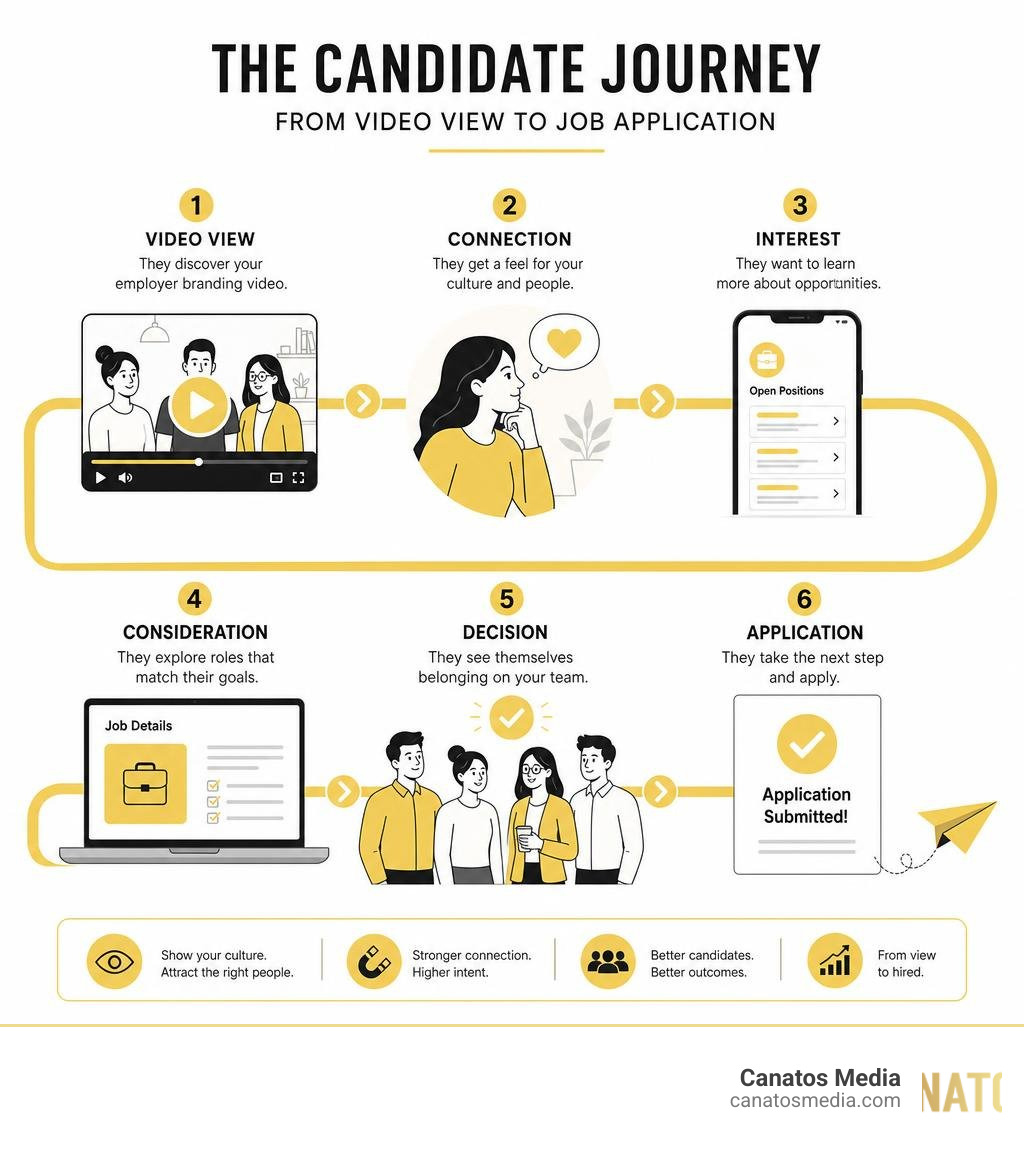
An employer branding video, on the other hand, is strategic and long-term. Instead of pitching a single role, it showcases your company’s overarching values, mission, work environment, and collective personality. It is designed to build a pipeline of passive candidates who think, “I don’t know what roles they have open right now, but I know I want to work there eventually.” For strategies on setting up this foundational narrative, read more about How to Create an Employer Branding Video That Attracts Top Talent.
The Power of Video vs. Static Job Postings
Let’s look at the hard facts. Humans are visual creatures. While reading a wall of text takes cognitive effort, watching a video is passive, engaging, and emotionally resonant. Viewers retain 95% of a message when delivered through video, compared to a meager 10% when reading it in text.
Furthermore, search engines and social algorithms heavily favor video. Video content is 50 times more likely to rank on the first page of Google than traditional text-based content. If you are operating a business in the Tri-State area or right here on Long Island, local SEO visibility is paramount. Integrating high-quality video into your career pages and local listings ensures you stand out where candidates are actively looking.
When you pair video with your job postings, the engagement metrics skyrocket. Job postings with video icons are viewed 12% more and receive a 34% greater application rate than postings without video. By showing real faces and authentic office dynamics, you also pre-screen candidates for culture fit, saving your HR team dozens of hours spent interviewing people who look great on paper but don’t align with your team’s energy. To understand why video is so effective at driving these actions, see Why Video Production is the Key to Modern Lead Generation for Service Businesses.
Key Benefits and High-Performing Content Formats
Implementing a video-first approach to your employer brand does more than just fill open seats; it drastically lowers your cost-per-hire and boosts overall brand awareness. When potential clients see how happy, engaged, and professional your employees are, their trust in your service increases as well. It’s a double-sided win. For a comprehensive look at how video elevates your entire brand presence, read How to Use Video to Boost Your Employer Brand.

Top Video Formats: Testimonials, Day-in-the-Life, and Behind-the-Scenes
Not all videos are created equal. To capture attention in 2026, you should utilize a mix of these high-performing formats:
- Employee Testimonials: These are the backbone of any employer brand. Instead of having your CEO read a scripted corporate speech, let your team speak from the heart. Highlight diverse roles and backgrounds to show that everyone has a voice. To see how top-tier brands structure these narratives, check out 10 Great Examples of Employer Branding Videos.
- Day-in-the-Life (DITL) Segments: Candidates want to see what their actual Tuesday morning will look like. A DITL video walks through an employee’s routine, from their morning coffee and team huddles to their actual workspace and collaboration sessions.
- Behind-the-Scenes (BTS) and Office Tours: Use humor or casual storytelling to showcase your physical workspace. If you have an open office layout, dynamic collaborative spaces, or beautiful local surroundings in the Tri-State area, show them off! You can find excellent inspiration on creative pacing and structure by studying how top-tier organizations structure their video campaigns.
Leveraging Employee-Generated Content for Maximum Trust
There is a major shift happening in how candidates consume media. Audiences have developed an incredibly sensitive “radar” for corporate insincerity. Overly polished, heavily scripted videos where employees look like they are reading under duress will actually push talent away.
This is where employee-generated content (EGC) comes in. EGC can be categorized into two main types:
- Low-Production EGC: Raw, authentic smartphone videos recorded directly by your employees. These work wonderfully for TikTok, Instagram Reels, and internal onboarding.
- High-Production EGC: Professional videos shot by content specialists using high-end equipment, but structured around unscripted, genuine employee stories.
By letting your team act as brand ambassadors, you build immense trust. A fantastic real-world example of this is seen in healthcare campaigns where authentic employee-led storytelling drove an average engagement rate of 9%—nearly triple the industry standard of 3.3%.
For larger enterprises looking to scale this interactivity, tools like conversational widgets can make a huge impact by allowing candidates to engage directly with video content.
How to Plan and Execute Your Video Strategy
A great video doesn’t happen by accident. It requires careful planning, a clear understanding of your company’s core values, and a distribution strategy that meets candidates where they already spend their time. Whether you are a single-location business on Long Island or scaling across the Tri-State area, consistency is key. Learn how to maintain this standard at scale in Video-First Marketing for Franchises: How to Scale Brand Growth Across Locations.
Best Practices for Producing Your First Employer Branding Video
Before you hit record, keep these foundational best practices in mind:
- Define Your Core Message First: What is the one thing you want candidates to feel? Is it your relentless drive for innovation, your warm and supportive family atmosphere, or your commitment to work-life balance? Start there.
- Keep It Short: In the modern attention economy, less is more. Keep your primary brand videos under 90 seconds. You can always create shorter 15- to 30-second cutdowns for social media.
- Design for Sound-Off Viewing: Up to 85% of social media videos are watched on mute. Always include clear, readable subtitles and dynamic on-screen text.
- Focus on Truth Over Perfection: Let your employees speak naturally. Avoid scripts; instead, use open-ended prompts like, “Tell me about a time your team had your back when a project got tough.”
- Leverage Local Expertise: If you are filming on Long Island or around New York, partnering with local production experts who understand the regional culture is invaluable. Working with a team that knows the local landscape ensures your regional storytelling feels authentic and right at home.
For a deeper dive into structuring your production process, read How to Build a Video-First Employer Brand Strategy.
Multi-Platform Distribution: LinkedIn, TikTok, and YouTube
A masterpiece of a video is useless if no one sees it. You must tailor your distribution strategy to the unique culture of each platform:
- LinkedIn: The gold standard for professional recruitment. Pair your video with a thoughtful, written post from your leadership team or the employees featured in the video. Keep the tone inspiring, professional, and value-driven.
- TikTok & Instagram: This is where you showcase your raw personality. Focus on short-form, vertical videos, trending audio, and day-in-the-life challenges. Keep it fun, lighthearted, and highly visual.
- YouTube: The perfect home for your longer-form, evergreen content. Optimize your video titles, descriptions, and tags for search so that candidates searching for your company name immediately find a high-quality window into your culture.
To learn how to maximize your reach across all these channels, explore The Ultimate Guide to Video Marketing for Service Businesses in 2026.
Measuring Success and Real-World Inspiration
Like any marketing initiative, your employer branding campaigns must be backed by data. Tracking the right metrics allows you to refine your messaging, optimize your spend, and prove the direct return on investment (ROI) of your production efforts to company stakeholders. To see how we analyze and translate video views into tangible business growth, read How We Turn Video Views into Real Revenue for Service Businesses.
Key Metrics to Track Video ROI
To accurately measure the impact of your employer branding video, look beyond simple “view counts” and monitor these deep-funnel metrics:
| Metric | What It Measures | Why It Matters |
|---|---|---|
| Retention / Watch Time | How long viewers stay tuned in | Tells you if your hook is working and if the content is engaging |
| Click-Through Rate (CTR) | The % of viewers who click your “Apply” or “Careers” link | Measures immediate interest and the strength of your call-to-action |
| Application Completion Rate | The % of started applications that are actually submitted | High video engagement should correlate with higher completion rates |
| Cost-Per-Hire | Total recruitment spend divided by number of hires | Video-led strategies typically lower this by driving organic inbound talent |
For a comprehensive framework on analyzing your recruitment marketing data, see 5 Employer Branding Metrics You Should Be Tracking.
Standout Examples: Google, Chipotle, and HubSpot
When looking for creative inspiration, it helps to study the global brands that have mastered this medium:
- Google: Google’s famous intern-focused videos successfully humanize a massive tech giant. By focusing on the nervous excitement of real, diverse interns on their first week, they show that even entry-level team members can make an impact.
- Chipotle: Their popular “How I Chipotle” series focuses heavily on employee growth and personal journeys. By showcasing real crew members sharing their favorite custom food orders alongside their career advancement stories, they elevate fast-casual roles into highly attractive career paths.
- HubSpot: Known for their incredibly transparent culture, HubSpot uses upbeat, employee-led office tours and candid discussions about flexible work arrangements to show exactly how they live their company values.
To explore more award-winning creative strategies, check out The Best Employer Brand Videos to Inspire Your Strategy.
Frequently Asked Questions
How long should an employer brand video be?
For social media platforms like LinkedIn, Instagram, and TikTok, aim for 30 to 90 seconds. For your dedicated careers page or YouTube channel, you can extend this to 2 minutes to allow for a deeper dive into employee stories. Always front-load your most exciting footage in the first 5 seconds to hook viewers before they scroll away.
How do we ensure our videos feel authentic and not overly polished?
The secret lies in unscripted storytelling. Avoid giving your employees pre-written scripts to memorize. Instead, conduct casual, conversational interviews using open-ended prompts. Film in your actual work environments with your real team, embracing natural laughs, spontaneous interactions, and minor imperfections.
Should we produce our employer brand videos in-house or hire a professional agency?
While basic, low-production employee-generated content is fantastic for daily social media updates, your primary brand video—the one that sits on your homepage and careers page—should be produced professionally. A professional agency ensures consistent brand guidelines, cinematic visual quality, crisp and clear audio, and a polished narrative structure that represents your business at its absolute best.
Conclusion
At the end of the day, attracting top talent isn’t about writing a flashier job description or listing more office perks. It’s about building a genuine connection. Candidates want to know that they will belong, grow, and do meaningful work with people they truly respect.
At Canatos Media, we specialize in bringing these human stories to light. Based in the Tri-State area and serving businesses across Long Island, we create cinematic, short-form videos and execute integrated digital marketing strategies that connect your brand with the exact people you need to grow. We don’t just help you tell your story—we help you show it.
Ready to transform your recruitment strategy and build a talent pipeline that drives real business growth? Why Video Production is the Key to Modern Lead Generation for Service Businesses is the perfect place to start. Let’s build something remarkable together.