Day: July 23, 2026

  • Bring Them Back: The Ultimate Salon Abandoned Cart Recovery Playbook

    Bring Them Back: The Ultimate Salon Abandoned Cart Recovery Playbook

    Why Salon Website Abandoned Cart Recovery Is Costing You More Than You Think

    Salon website abandoned cart recovery is the process of automatically reaching out to clients who started booking an appointment online but left before confirming — and it’s one of the fastest ways to reclaim lost revenue without spending more on ads.

    Quick answer — the best salon abandoned cart recovery tools in 2026:

    Tool Best For Key Feature
    Zenoti Multi-location salons AI-triggered reminders, 2-hour send window
    Tilavon Independent salons Visual workflow builder, A/B testing
    Bella Booking Solo operators GDPR-safe capture, one-tap recovery
    GoHighLevel Full automation CRM + SMS + email in one platform
    DINGG AI (Echo) Dormant client win-back Multi-touch personalized sequences

    Here’s the reality: over 70% of online shopping carts are abandoned before checkout. In the beauty and personal care space, that number climbs above 83%. For salons, every one of those drop-offs is a real client — one who already picked a service, chose a time, and got close to confirming — walking away without booking.

    And most salon software never even records that it happened.

    That’s a significant revenue leak. The good news? It’s one of the most fixable ones.

    I’m Nic Canobbio, founder of Canatos Media, and my background in building automated content and data-driven marketing systems — from national podcasts to sports betting platforms — gives me a unique lens on how salon website abandoned cart recovery can be turned into a reliable, automated revenue engine. In this guide, I’ll break down exactly how to set that up.
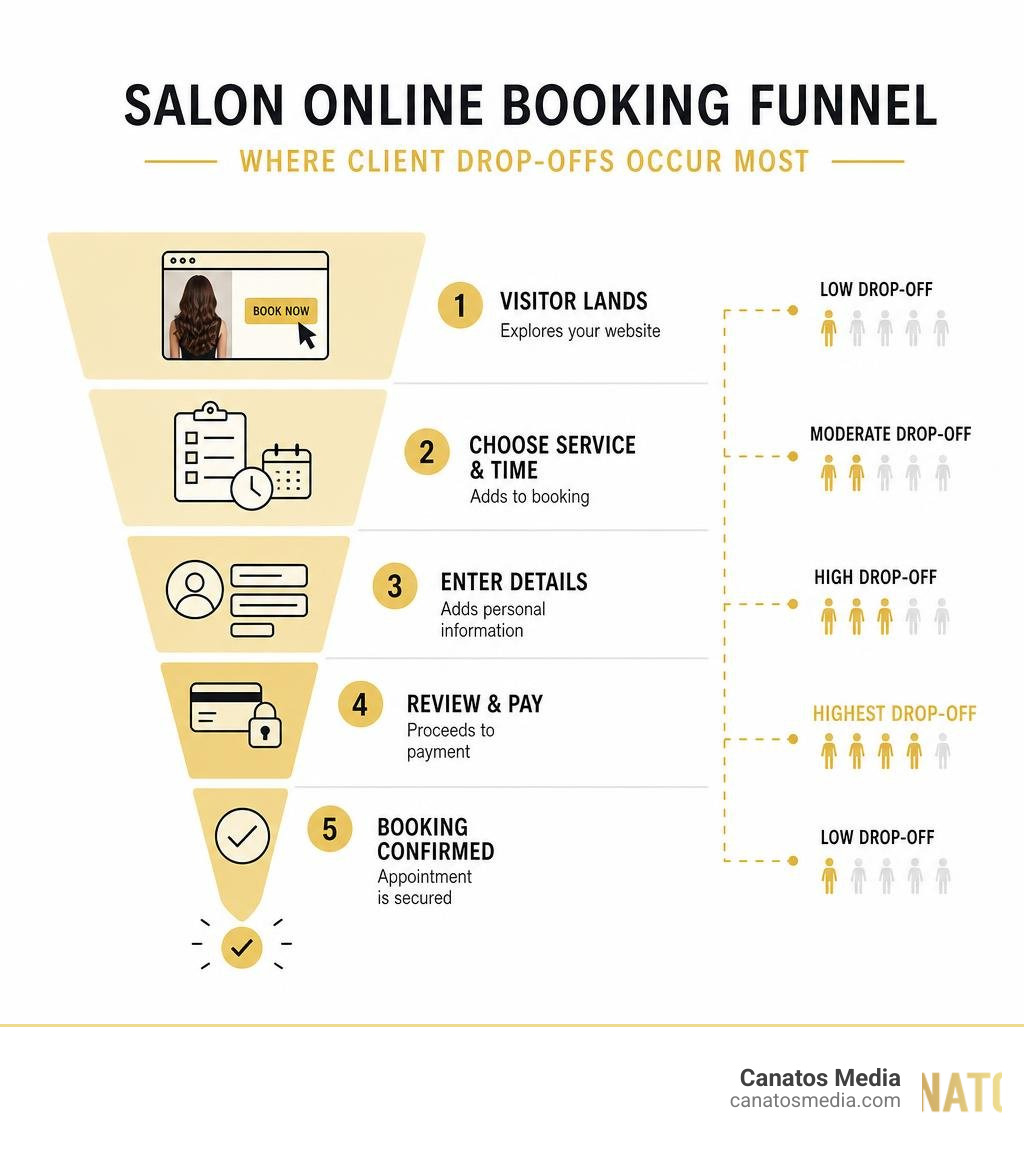
    Infographic showing the salon online booking funnel and where client drop-offs occur most infographic

    Implementing Salon Website Abandoned Cart Recovery: Why It Matters

    When we think about growing a salon in the tri-state area or right here on Long Island, our minds usually jump straight to getting new eyes on our brand. We think about social media, paid ads, or investing in Why Your Store Needs Ecommerce Website SEO to Survive to bring in fresh traffic. But what happens when that traffic actually arrives, clicks “Book Now,” and then… disappears?

    If you don’t have an automated recovery system in place, you are essentially pouring water into a leaky bucket.

    Implementing a robust recovery system is about plugging those leaks. It directly impacts your bottom line by converting high-intent users who are already on the verge of booking. Instead of spending five times more money to acquire a brand-new client via cold ads, you are simply nudging someone who already knows your name, likes your work, and wanted to visit your chair.

    Understanding the Mid-Funnel Booking Drop-Off

    In the digital marketing world, we talk a lot about “funnels.” For a beauty business, the mid-funnel is where the magic—and the tragedy—happens. A user lands on your site, looks at your gorgeous gallery, and decides they want to book a balayage or a fresh set of lash extensions. They click your booking link, select their stylist, and choose a time slot.

    Then, right at the finish line—the “Review” or “Confirm” step—they close the tab.

    This mid-funnel drop-off happens to 20% to 40% of visitors who make it to the final step of booking. These aren’t casual browsers; they are high-intent shoppers. They didn’t leave because they hate your salon; they got distracted. Maybe their coffee boiled over, their boss walked by, or they realized their credit card was in the other room.

    Without tools like Zenoti’s Abandoned Cart Recovery, these near-bookings vanish without a trace. You have no record of their intent, no way to follow up, and that prime Friday afternoon appointment slot remains empty.

    How Salon Website Abandoned Cart Recovery Differs from Traditional E-Commerce

    While traditional retail e-commerce focuses on physical inventory, salon booking recovery is entirely about time. If a shopper abandons a pair of shoes in an online shopping cart, those shoes sit in a warehouse. The retailer can email them three days later, and the shoes are still there.

    For service-based businesses, your inventory is your calendar. Time is a highly perishable commodity. If a client abandons a booking for a Saturday at 10:00 AM and you don’t recover them quickly, that time slot passes, and that potential revenue is gone forever.

    Furthermore, many modern beauty businesses run a hybrid model. You aren’t just booking hair, nail, or spa appointments; you are also selling professional retail products online. Platforms like SalonInteractive’s Online Platform allow beauty pros to run online stores and earn a 25% commission on product sales without stocking physical inventory.

    This means your recovery strategy must be dual-faceted:

    1. Service Booking Recovery: Fast, time-sensitive, and highly personalized around stylist availability and calendar slots.
    2. Product Cart Recovery: Focused on product benefits, reviews, and standard e-commerce incentives like free shipping or small discounts.

    Why Clients Abandon Salon Bookings (And How to Stop It)

    Understanding why clients walk away is the first step to building a system that brings them back. To analyze this, we have to look closely at our digital user experience.
    Frustrated salon client looking at a complex online checkout screen on their phone

    When we audit websites for local businesses, we often find that simple technical glitches or poor design choices are driving clients straight into the arms of nearby competitors. This is why having a clean, optimized site backed by solid SEO Search Engine Optimization is so critical. If your site is slow or confusing, users will bounce before they even see your booking form.

    Common Friction Points in the Checkout Process

    There are several major roadblocks that cause clients to abandon their carts or booking screens:

    • Forced Account Creation: A quarter of all online shoppers will abandon their cart immediately if they are forced to create a username and password just to complete a basic transaction.
    • Hidden Fees and Pricing Surprises: If a client thinks a service is $150, but at the final review step they see mandatory booking fees, environmental fees, or unexpected taxes that aren’t clearly explained, they will back out.
    • Poor Mobile Optimization: With up to 84% of shopping carts abandoned on mobile devices (compared to 72% on desktop computers), a clunky mobile booking interface is a death sentence for your conversion rates.
    • Complex Navigation: If booking a simple haircut requires clicking through five different screens, selecting three add-ons, and reading a massive wall of policy text, clients will get overwhelmed and leave.

    To visualize how these friction points differ between products and services, look at this comparison:

    Metric / Feature Product Cart Abandonment Service Booking Abandonment
    Primary Cause High shipping costs, price comparison Distraction, complex calendar, forced login
    Inventory Impact Low (item remains in stock) High (perishable calendar time slot)
    Mobile Abandonment Rate ~84% ~80%
    Recovery Window 4 to 24 hours 30 minutes to 2 hours
    Primary Channel Email-heavy SMS and Email hybrid

    Local businesses like Brushd, a high-end extensions and color salon, or mobile providers like Mobility Salon, which caters to seniors and disabled clients across Long Island, know that their clients expect a smooth, accessible booking process. Any friction on their websites directly translates to empty spots on their schedules.

    Best Practices for Salon Website Abandoned Cart Recovery Sequences

    To successfully rescue these lost appointments, you need a structured, multi-channel approach. You can’t just send a single, generic email and hope for the best.

    When setting up automated workflows, we recommend utilizing tools like Bella Booking’s Recovery Software. These systems automatically capture client details at the “Review” step. Even if the client doesn’t hit “Confirm,” their draft booking is saved, allowing you to trigger a highly targeted recovery sequence.

    Here are the baseline rules for any successful recovery sequence:

    • Keep it on-brand: The design, tone, and language of your emails and texts should match your salon’s personality. If you run a high-end, relaxing spa, your messages should feel calm and welcoming, not frantic or pushy.
    • Focus on helpfulness, not sales: Frame your first message as a customer service check-in. “Did your internet cut out?” or “Can we help you find the perfect time?” works much better than “Buy now!”
    • Limit the frequency: Don’t spam your clients. A standard sequence should consist of no more than 2 to 3 touchpoints over a 48-hour period.

    Crafting the Perfect Multi-Channel Recovery Playbook

    To get the highest conversion rates, your recovery playbook should combine the reach of email marketing with the immediacy of SMS text messages.

    Automated salon booking recovery workflow diagram showing SMS and email triggers

    At Canatos Media, we believe that digital marketing should be an integrated system. By combining high-quality content, targeted social media, and Affordable SEO Services That Won’t Make Your Wallet Cry, we build a steady flow of traffic to your site. But once they arrive, this multi-channel playbook is what ensures those visitors turn into paying clients.

    Timing and Frequency: The Golden Window

    When it comes to service bookings, timing is everything. If you wait too long to reach out, your client will have already booked with another salon down the street or decided they don’t need that haircut after all.

    Based on industry data and performance metrics, here is the optimal timing sequence for recovering abandoned salon bookings:

    1. The 30-Minute to 2-Hour Mark (The First Nudge): This is your golden window. Send an automated text message or email reminding them of their draft booking. Keep it friendly and include a direct link to resume their booking without making them start over.
    2. The 24-Hour Mark (The Follow-Up): If they haven’t responded, send a second message. This is a great time to answer common questions, highlight your salon’s stellar reviews, or mention your cancellation policy to build trust.
    3. The 48-Hour Mark (The Final Effort): If the appointment slot they originally wanted is still open, let them know. You can also offer a small, value-add incentive here to sweeten the deal, but don’t lead with discounts right away.

    Incentives and Personalization Strategies

    Personalization is your secret weapon. Generic emails that say “You left something in your cart” get ignored. Emails that say “Hey Sarah, we saved your Saturday 10:00 AM Balayage appointment with Jessica!” get opened. Personalization can boost your email open rates by up to 50%.

    To make your recovery messages incredibly effective:

    • Dynamic Content: Use software that pulls the client’s name, their selected stylist, the specific service, and the date/time they chose directly into the message.
    • Save the Discounts for Last: Offering a discount immediately trains your clients to abandon their carts on purpose just to get a coupon. Instead, start with a simple reminder. If you do offer an incentive in your final message, make it a value-add—like a complimentary deep-conditioning treatment or a free travel-sized product from your retail shelf.
    • Leverage Client History: If you are using advanced automation systems like Tilavon’s Marketing Automation or DINGG AI’s Client Win-Back Campaigns, you can segment your messages based on whether the user is a brand-new lead or a loyal, regular client who simply got distracted.

    Setting up a beautiful email sequence doesn’t mean much if your software systems aren’t talking to each other. Your recovery tools must integrate seamlessly with your daily booking software to prevent double-bookings and maintain clean client records.

    Syncing with Salon CRMs and Booking Software

    To make this work without pulling your hair out, your recovery tool needs a native or API-based integration with your primary salon management software (like Phorest, Meevo, or Vagaro).

    For example, systems like Fully Booked AI’s Salon Marketing Automation sync client data and appointment history in real time. When a client starts a booking on your website, the system checks their profile. If they abandon, the automation triggers. The moment they complete the booking—either through your recovery link or by calling your front desk—the system immediately stops the recovery sequence so you don’t send them annoying, redundant reminders.

    Before you start blasting text messages and emails to everyone who clicks your booking link, you must understand the legal landscape. Non-compliance can lead to massive fines—up to $500 per non-compliant text message under TCPA regulations.

    • TCPA (Telephone Consumer Protection Act): To send recovery text messages, you must have explicit opt-in consent from the user. You cannot send marketing texts to a phone number just because someone typed it into a form. Your booking screen must include a clear, unchecked checkbox where users agree to receive automated booking reminders and marketing updates.
    • CAN-SPAM Act: Every recovery email you send must include a clear, functional “Unsubscribe” link, your physical business address, and an honest subject line that isn’t misleading.
    • GDPR (General Data Protection Regulation): If you cater to clients with European citizenship (or if you want to follow the gold standard of data privacy), your system should only track authenticated users who have verified their details, and you must store their draft bookings safely, expiring them automatically after 24 hours.

    Frequently Asked Questions

    How soon should the first recovery message be sent?

    For service bookings, the first recovery message should be sent within 30 minutes to 2 hours of abandonment. This keeps your salon fresh in the client’s mind while their purchase intent is still incredibly high.

    Do anonymous website visitors get captured?

    No. To maintain privacy compliance and avoid spamming, recovery systems only capture details from authenticated or logged-in users, or users who have explicitly typed their contact information into your booking form before exiting. Anonymous traffic cannot (and should not) be tracked for direct outreach.

    What is a typical recovery rate for salon bookings?

    With a well-designed, automated multi-channel sequence, salons typically see a 15% to 30% recovery rate on abandoned bookings. Reclaiming even a fraction of these lost appointments can easily add thousands of dollars in monthly revenue to your salon.

    Conclusion

    At the end of the day, every abandoned cart or incomplete booking on your website is a client who wanted to experience your services but got tripped up at the finish line. By implementing a smart, automated salon website abandoned cart recovery system, you aren’t being pushy—you are providing an exceptional, high-touch customer service experience that makes booking with you effortless.

    At Canatos Media, we specialize in helping local businesses across the tri-state area and Long Island connect the dots between their content, their search engine visibility, and their final conversions. We build integrated digital marketing systems that drive real, measurable growth for your business while you focus on what you do best—making your clients look and feel beautiful.

    Ready to close your revenue leaks and fill your stylists’ chairs? Let’s build an automated system that keeps your salon booked solid. Reach out to us today to get started!


  • Why Combined Content and Advertising Agencies Outperform Single-Service Providers

    Why Combined Content and Advertising Agencies Outperform Single-Service Providers

    The Fragmented Agency Problem: Why Most Businesses Fail With Multiple Vendors

    Most growth-focused business owners start with a reasonable assumption: hire the best content creators, then hire the best advertisers. It makes sense on paper. In practice, it creates friction that drains budgets and slows results.

    When your video production team works separately from your advertising team, misalignment happens at every stage. The production house doesn’t know your advertising budget limits. The ad team doesn’t understand the production timeline. Neither group has skin in the lead-generation outcome. You’re managing two vendors with different priorities, different reporting systems, and different definitions of success.

    Consider a typical scenario: your production agency delivers four polished 30-second videos. Three weeks later. Your ad team reviews them and requests edits because the messaging doesn’t match the audience segments they planned to target. The videos get pushed back. Budget sits idle. Months slip by before anything runs.

    This isn’t about incompetence. It’s about structural misalignment. When content creation and paid advertising operate as separate functions, neither team bears responsibility for the full funnel. The content team optimizes for beauty. The ad team optimizes for clicks. Nobody optimizes for conversions that matter to your business.

    The cost of this fragmentation compounds over time. You’re paying premium rates to two agencies, managing twice the stakeholders, troubleshooting integration problems that shouldn’t exist, and watching campaign momentum die in handoff delays.

    How Disconnected Content and Advertising Teams Cost You Money

    The financial bleeding from fragmented teams happens in ways that don’t always show up in spreadsheets.

    Direct waste through rework. When advertising teams test underperforming videos, they often request changes that should have been built into the content from the start. Those revisions take weeks and cost thousands. A unified team would have anticipated these needs during production.

    Inefficient ad spend. Separated teams struggle to optimize the relationship between creative format and audience targeting. Your ad team might be reaching the right audience but with video formats that don’t match their platform preferences or viewing behavior. Your content team might have produced excellent material in the wrong dimensions or pacing for your primary ad channels.

    Slower iteration cycles. Testing and learning requires fast feedback loops. When you’re coordinating across two agencies, approvals take longer, updates move slower, and data insights from advertising performance rarely make it back to the content production team before the next project cycle begins.

    Platform misalignment. Meta’s algorithm favors certain video formats. Google Ads performs differently with different visual styles. TikTok engagement depends on specific editing techniques. A production team working without direct advertising input often creates content optimized for general appeal rather than platform-specific performance signals.

    Duplicate tools and overhead. You might be paying for project management tools, analytics platforms, and communication systems at both agencies. You’re also managing separate onboarding processes, brand guideline reviews, and approval workflows.

    A typical business with two agencies might spend 15-25% of their marketing budget on coordination overhead and rework. Consolidating that function often frees up budget to spend directly on performance.

    The Unified Approach: What Makes Integrated Agencies Different

    An integrated content and advertising agency operates with one core principle: content creation serves advertising performance, and advertising feedback shapes content strategy.

    This means the same team that produces your video also plans how it will be distributed, who it will reach, and what actions you want them to take afterward. They’re not handing off work at production completion. They’re handing off validated, platform-optimized creative that’s ready to perform.

    The alignment creates measurable advantages:

    Content built for conversion, not just views. Video is designed with your target audience, platform algorithms, and advertising objectives built into the creative strategy from day one.

    Faster testing and iteration. When your content and advertising teams are the same entity, feedback from ad performance gets built into the next production cycle immediately. Video that underperforms gets reshoots scheduled within days, not weeks.

    Consolidated reporting and accountability. One agency owns both the creative quality and the advertising performance. You get one set of metrics, one point of contact, and clear accountability for results.

    Consistent messaging across channels. Your brand story remains coherent whether someone encounters you on Instagram, TikTok, Google Ads, or Meta. Unified teams naturally maintain consistency because they’re working from one strategic brief.

    Optimized workflows. You’re not managing two separate processes; you’re moving through one integrated system from strategy through production through paid promotion.

    Our Cinematic Content Strategy Designed for Paid Advertising Success

    We approach every video project with advertising performance as a guiding constraint, not an afterthought.

    Our process starts with understanding your advertising objectives: which audience segments matter most, what actions you want them to take, and what budget you’re allocating to paid promotion. We map this information into the creative strategy before a single frame gets shot.

    This means our videos are built with:

    Multiple format options from a single shoot. We produce 30-second cuts, 15-second cuts, square formats, vertical formats, and native platform variations all in one production day. Rather than editing a single version and hoping it works everywhere, we’re creating platform-specific assets that perform better algorithmically.

    Platform-native editing and pacing. TikTok audiences favor quick cuts and pattern interrupts. YouTube audiences tolerate longer narratives. Meta audiences engage differently on Reels versus feed placements. We apply format-specific editing techniques to the same raw footage so each platform gets content optimized for its specific consumption patterns.

    Audience-specific storytelling. Different audience segments care about different benefits. A video targeting business owners might emphasize efficiency and ROI. The same product shown to new customers might emphasize ease of use. We structure narratives so advertising segmentation naturally corresponds to content variation.

    Performance-ready dimensions and specifications. Every video meets technical requirements for your primary advertising platforms before it ever gets exported. No surprises during upload. No reformatting delays.

    Seamless Workflow: From Production to Campaign Optimization

    The path from initial brief to live advertising happens through a coordinated system where each phase informs the next.

    Week 1-2: Strategy and planning. We define your advertising objectives, audience segments, platform strategy, and performance benchmarks. Content concepts get developed with these parameters as guardrails.

    Week 3-4: Production. Creative gets shot with multi-format output in mind. Raw footage gets organized by theme and message so editing can happen flexibly across multiple final versions.

    Week 5-6: Editing and optimization. Multiple cuts and formats come together. We’re testing variations that advertising data suggests will perform best: different hooks, different pacing, different closing frames.

    Week 7: Campaign setup and launch. Your videos upload directly into advertising accounts with proper audience segmentation and bid strategies already planned. We’re not starting fresh; we’re executing a strategy that was built into the creative.

    Ongoing: Performance monitoring and creative iteration. Ad performance data gets analyzed weekly. Underperforming videos get flagged for reshoots or repositioning. Strong performers get additional budget. This feedback loops directly back to the content team, not to a separate vendor.

    Lead Generation Through Coordinated Content and Promotion

    Lead generation happens when your content reaches the right person at the right moment with the right message. Fragmented teams struggle here because they’re not coordinating across all three variables.

    We build lead-generation systems by creating content that demonstrates value before the ask. A service-based business doesn’t need flashy video; they need video that shows how your process works and what results look like for real customers.

    Awareness content introduces your brand and demonstrates expertise through cinematic storytelling that stops the scroll.

    Consideration content shows your process, explains your differentiation, and builds confidence in your approach through case studies and customer testimonials.

    Decision content addresses objections, shows pricing transparency, and makes the next step obvious through clear calls-to-action.

    All three content types get promoted through coordinated advertising: awareness campaigns reach broad audiences with lower targeting, consideration campaigns retarget people who engaged with awareness content, and decision campaigns target warm audiences who’ve already shown interest. The content strategy and the advertising strategy are one unified system.

    For a multi-location service business, this might look like producing regional variations of core narrative content so each location can run locally-targeted campaigns with brand-consistent messaging. One production; multiple markets; coordinated ad spend. A fragmented approach would require separate production for each location or generic national content that doesn’t resonate locally.

    Measuring Results: How Integration Delivers Better ROI

    Integration changes what you can measure and how quickly you can improve based on data.

    With fragmented teams, you get siloed metrics: production agencies report on delivery speed and asset quality; advertising agencies report on clicks, impressions, and cost-per-click. Neither metric tells you what actually matters: leads, customers, and revenue generated from your video marketing investment.

    Integrated measurement connects the full funnel. We track which video variations, audience segments, platforms, and messaging approaches drive your highest-quality leads and lowest customer acquisition cost. Then we immediately feed that learning back into the next content production cycle.

    This creates a compounding advantage: every month your content gets slightly better at driving action because it’s optimized based on real performance data from the previous month.

    A typical integrated approach shows ROI improvement of 25-40% in the first three months as initial creative variations reveal which narratives and formats resonate with your specific audience. Fragmented approaches often plateau because feedback loops take too long and involve too many handoffs to act on insights quickly.

    Why Service-Based and Multi-Location Brands Need This Model

    Service-based businesses live or die on lead quality and conversion efficiency. You need video that builds confidence and demonstrates expertise, not entertainment content that generates vanity metrics.

    Our approach works particularly well for service businesses because we’re coordinating every video around your actual sales process. If your sales cycle involves consultation calls, we create content that qualifies prospects before they book. If your conversion depends on showing results, we prioritize case study and testimonial content that proves your capability.

    Multi-location brands face a different challenge: maintaining brand consistency while localizing for each market. Fragmented agencies force a choice between generic national content and expensive per-location production. We solve this through template-based production where core brand narrative gets localized through targeted advertising, voiceover variations, or location-specific footage additions, all coordinated around one unified strategy.

    For a plumbing company with five locations, this means one hero video about your process and values that introduces your brand, plus location-specific ads that show local service areas and customer testimonials. One core message; multiple market expressions; coordinated spend allocation.

    The Real Cost of Switching Between Agencies and Tools

    Consolidating from multiple agencies to one integrated partner involves real switching costs that deserve consideration. You’ll invest time in onboarding, rebuilding relationships, and potentially reworking some existing systems.

    But the cost of staying fragmented is higher. Every quarter you operate with separated teams, you’re absorbing inefficiency, managing duplicate processes, waiting for handoff delays, and missing opportunities to optimize based on performance data.

    The switching cost typically pays for itself within 60-90 days through eliminated rework, faster iteration cycles, and more efficient ad spend. Most of our clients report positive ROI on the consolidation decision within their first campaign cycle.

    How We Build Your Growth System From Content to Conversion

    We view your video marketing not as individual projects, but as a system that gets smarter and more efficient over time.

    Initial strategy work maps your specific audience segments, sales process, advertising objectives, and performance benchmarks. Content production happens with full visibility to all these constraints. Advertising strategy gets built during creative development, not after production completes. From your perspective, you’re managing one partner with one unified vision for your growth.

    As campaigns run, performance data gets analyzed and immediately informs the next production cycle. You’re not waiting for quarterly reviews or separate reporting. You’re seeing how creative variations perform within days and adjusting strategy accordingly.

    We measure success by your lead quality, customer acquisition cost, and revenue impact, not by vanity metrics like video views. Your growth becomes our accountability.

    The most effective approach is starting with one comprehensive campaign that moves through the full cycle: planning, production, advertising, optimization, and measurement. This proves the integrated model and establishes the feedback loops that compound over time.

    If you’re currently working with separated content and advertising vendors, it’s worth evaluating whether the coordination costs and delays are worth the price you’re paying. Most growth-focused businesses find that integration delivers better results, faster iteration, and clearer accountability for the same total investment.

    For further reading: End-to-end video marketing.

    Contact us today for a free consultation to see how we can help you grow your business.

    Frequently Asked Questions (FAQ)

    How does combining content production with advertising strategy actually save us money compared to hiring separate agencies?

    When we handle both content creation and paid advertising in-house, we eliminate the costly back-and-forth between disconnected teams and reduce revision cycles that waste your budget. Our content is built with advertising performance in mind from day one, meaning we’re not creating videos that look great but perform poorly on Meta or Google. You also avoid paying setup fees, onboarding costs, and the inevitable miscommunication that happens when different vendors don’t share the same metrics or goals.

    What’s the difference between how we approach video production versus traditional content agencies?

    We design every video specifically for paid advertising platforms and lead generation, not just for aesthetics or social virality. Our cinematic short-form content is structured to convert viewers into leads, which means we’re thinking about your landing pages, audience targeting, and sales funnel before we ever pick up a camera. Most traditional content agencies focus on creative storytelling without considering how the content will actually perform when promoted through paid channels.

    How do we measure whether our integrated approach is actually working for your business?

    We track the full journey from initial video view through lead capture and sales, so you see exactly which content pieces, ad placements, and audience segments generate your best results. Since we control both the creative and the advertising spend, we can test and optimize at every stage rather than guessing where the breakdown occurs between teams. Our reporting focuses on metrics that matter to your bottom line: cost per lead, conversion rates, and ROI on your total marketing investment.