
Conversion Optimization Best Practices That Actually Move the Needle in 2026
Applying conversion optimization best practices is the fastest way to grow revenue without spending more on ads. Here are the core practices that work in 2026:
- Simplify checkout – Remove forced account creation and reduce form fields
- Optimize for mobile – 60%+ of traffic is mobile, but mobile converts at half the rate of desktop
- Use trust signals – Reviews, secure badges, and transparent shipping reduce hesitation
- Run A/B tests continuously – Data beats guesswork, every time
- Speed up your pages – Every second of delay costs you conversions
- Personalize the experience – Personalized experiments drive 41% more impact
- Write CTAs that click – First-person copy (e.g., “Get My Free Report”) outperforms generic alternatives
- Fix your navigation – Clutter kills conversions
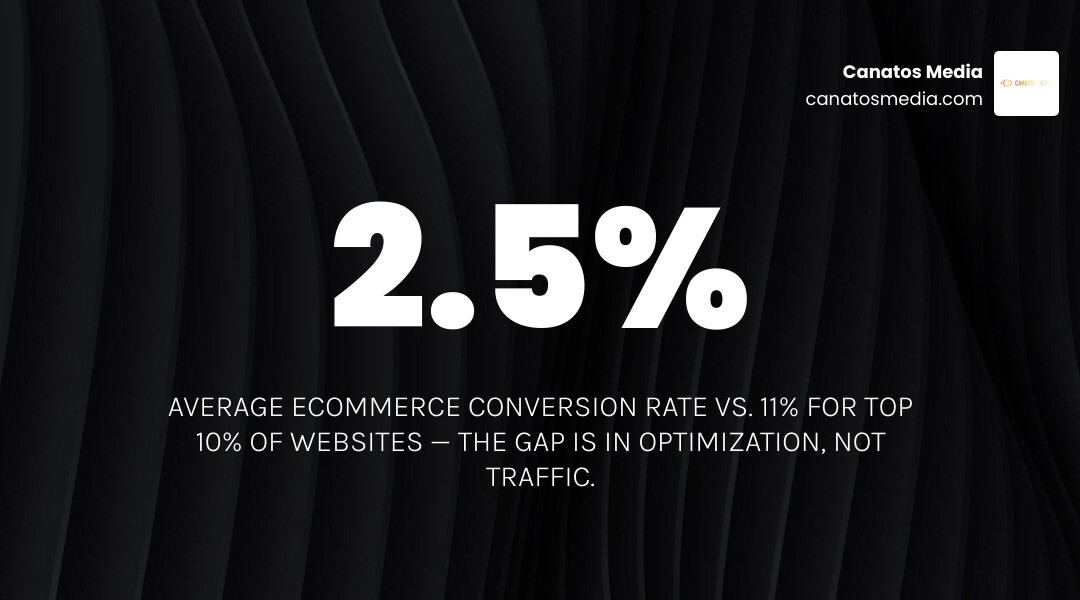
Most businesses are leaving money on the table. The average ecommerce site converts just 2.5% of visitors. The top 10% of websites convert at over 11%. That gap isn’t about traffic volume — it’s about what happens after someone lands on your page.
Paid ads cost more every year. Organic reach is harder to earn. Yet most businesses keep pouring budget into acquisition while ignoring the leaks in their conversion funnel. That’s the problem this guide is here to fix.
I’m Nic Canobbio, and through my work at Canatos Media producing content that has reached over 60 million views and building data-driven media strategies across industries, I’ve seen how applying conversion optimization best practices separates businesses that scale from those that stall. In this guide, I’ll walk you through exactly what works — no guesswork, no fluff.
What is CRO and Why It Matters in 2026
Conversion Rate Optimization (CRO) is the systematic process of increasing the percentage of website visitors who take a desired action—whether that’s purchasing a product, filling out a lead form, or booking an appointment. In 2026, CRO is no longer an optional “growth hack.” It is a fundamental pillar of business survival.
The digital landscape has shifted dramatically. Customer acquisition costs (CAC) on major search and social channels have reached record highs. At the same time, privacy regulations and the deprecation of third-party cookies mean you can no longer rely solely on ad platforms to target your perfect buyer. Your website must do the heavy lifting. By optimizing your existing traffic, you reduce your reliance on expensive ad networks and build a highly profitable, self-sustaining sales engine.
The Shift in Modern Conversion Optimization Best Practices
In 2026, the playbook has evolved. We are seeing massive mobile commerce growth, but with it comes mobile commerce friction. Consumers expect instant, frictionless, and highly personalized web experiences. If your site feels like a relic from 2018, visitors will leave in seconds.
Modern conversion optimization best practices require a shift from static, one-size-fits-all websites to adaptive digital experiences. Relying on gut feelings or copying a competitor’s layout without data is a recipe for failure. To stay ahead, businesses must adopt structured frameworks and rely on proven, data-backed methodologies to systematically improve their user experience.
How to Calculate and Benchmark Your Conversion Rate
Before you can improve your conversion rate, you need to know where you stand. The basic conversion rate formula is simple:
$$\text{Conversion Rate (CVR)} = \left( \frac{\text{Total Conversions}}{\text{Total Sessions}} \right) \times 100$$
We typically use sessions (or visits) rather than unique users to calculate this. Shoppers often visit a site multiple times before making a final decision, making sessions a more accurate reflection of ongoing intent.
So, what is a “good” conversion rate? It depends heavily on your industry:
- Average Ecommerce CVR: Roughly 2.5% across all sectors.
- Beauty and Skincare: Near the top of the spectrum at approximately 3.3%.
- Home Furniture: Rounding out the bottom at 0.6% (due to high price points and longer decision cycles).
Comparing your brand to universal benchmarks can be misleading. A high-ticket B2B company or a subscription-based model naturally has lower conversion rates than a low-cost impulse-buy brand. The goal is to establish your own baseline and focus on driving incremental, data-backed improvements.
Core Pillars of Website UX and Mobile Optimization
User experience (UX) is the foundation of conversion. If your site is difficult to navigate, slow to load, or confusing on a smartphone, no amount of persuasive copywriting will save your sales.
Streamlining Navigation and Reducing Friction
When users land on your website, they should know exactly what to do next. Cluttered menus, vague navigation labels, and intrusive pop-ups create cognitive friction.
To streamline your user journey:
- Simplify navigation labels: Use clear, descriptive terms (e.g., “Shop All,” “Services,” “Book Consultation”) instead of creative jargon.
- Embrace white space: Give your elements room to breathe. A clean design naturally guides the user’s eye to your primary call-to-action (CTA).
- Implement search autocomplete: For ecommerce sites, helping users find products instantly via smart search autocomplete is a massive conversion driver.
- Prioritize accessibility compliance: Shockingly, 94% of the largest e-commerce sites are not accessibility compliant. Failing basic standards in links, images, and form fields alienates a massive portion of your audience.
If you are a local service brand in the Tri-State area or Long Island, check out our guide on Optimizing Local Landing Pages for High-Conversion Lead Capture in 2026 to see how streamlined layouts drive local leads.
Mobile Commerce and Checkout Optimization
Mobile devices account for over 60% of global web traffic, yet mobile conversion rates average just 2.1% compared to 4.3% on desktop. This gap is caused entirely by mobile commerce friction.
To capture those mobile conversions, your checkout flow must be flawless.
- Make guest checkout prominent: 47% of sites don’t make guest checkout the most prominent option. Forcing users to create an account before buying is a major conversion killer—37% of shoppers abandon checkouts for this exact reason.
- Reduce form fields: Cut your form fields to the absolute minimum. Moving from 11 fields to 4 can increase conversions by 120%. 18% of users abandon purchases due to checkout complexity.
- Ditch case-sensitive CAPTCHAs: CAPTCHAs have an 8% failure rate, which skyrockets to 29% if they are case-sensitive. Use invisible spam protection instead.
- Use accordion checkouts: Collapse completed steps into summaries rather than just headers. This keeps the user oriented without overwhelming them with a massive multi-column form.
For businesses running paid traffic, aligning your mobile layouts with your ads is critical. Learn more in our article on Syncing Local Landing Pages with Short-Form Video Ads for Maximum Conversions.
Designing High-Impact Trust Signals, Personalization, and CTAs
Once your site usability is solid, you must address the psychological side of conversion: trust and relevance.
Implementing Personalization and Clear CTAs
Static websites are a thing of the past. In 2026, delivering adaptive web experiences via real-time 1:1 personalization is a massive competitive advantage. Personalized experiments drive 41% more impact compared to generic campaigns. This can mean dynamically displaying product recommendations based on past browsing history or adjusting landing page headlines to match the exact ad copy a visitor clicked.
Your Call-to-Action (CTA) buttons must also be highly optimized:
- Visual contrast: Your CTA button color should pop against your website’s background. Use high-contrast, brand-aligned colors.
- Strategic placement: Place your primary CTA above the fold and repeat it logically as the user scrolls.
- First-person copy: Phrasing your buttons in the first person (e.g., “Get My Free Strategy Session” instead of “Submit”) can increase clicks by up to 90%).
We dive deep into how we align high-impact visual assets and website design in our guide on How We Integrate Website Design and Video to Drive Sales.
Leveraging Trust Signals to Overcome Friction
Trust is the ultimate currency online. When visitors hesitate at the point of purchase, they are asking themselves: Is this business legitimate? Will my data be safe? Will I actually like this product?
To overcome this friction, embed high-impact trust signals directly into your design:
- Strategic social proof: Place customer ratings, reviews, and testimonials near your CTAs. Over 98% of consumers consider reviews an essential resource when making purchase decisions.
- Secure checkout badges: Displaying trusted payment badges (such as secure SSL indicators or recognized payment processors) can boost conversions.
- Transparent shipping and returns: Unexpected shipping fees are absolute kryptonite to conversions. Display shipping costs and clear return policies early in the user journey.
For more on structured trust integration, check out Baymard Institute’s research on cart abandonment and trust.
The Power of Experimentation and A/B Testing
You should never guess what will improve your conversion rate. You must test it.
Validating Ideas with Conversion Optimization Best Practices
A/B testing (or split testing) is the process of comparing two versions of a webpage to see which one performs better. To run successful tests, you need a structured framework:
- Gather Quantitative and Qualitative Data: Use analytics to find where users drop off, and heatmaps to see how they behave.
- Formulate a Strong Hypothesis: A good hypothesis follows a clear structure: “If we change [Element] to [Variation], we will see an increase in [Metric] because of [User Behavior Insight].”
- Prioritize Using the EPIC Framework: Rate your test ideas on a scale of 1-5 based on Experiment value (what you will learn), Priority, Impact, and Cost.
- Determine Sample Size and Duration: Run tests for at least 14 days to account for weekly traffic cycles, and ensure you have at least 200 conversions per variant to achieve 95% statistical significance.
The Value of Inconclusive and Failed Tests
Many marketers view an inconclusive or failed A/B test as a waste of time. This is a massive mistake.
Inconclusive tests (where neither variant wins) are highly valuable. They mitigate risk by preventing you from rolling out expensive site changes that customers don’t actually care about. They also provide valuable insights into user behavior, helping you refine your future hypotheses. As the saying goes: One test is a guess; a hundred tests is a systematic competitive advantage.
For additional frameworks on validating your CRO ideas, read the insights in Hotjar’s guide to conversion rate optimization.
Implementing Conversion Optimization Best Practices Through Technical CRO
Technical performance is the unsung hero of conversion optimization. If your site is technically flawed, your marketing efforts are dead on arrival.
Diagnosing Bottlenecks with Heatmaps and Form Analytics
Quantitative data (like Google Analytics) tells you where users are leaving your site. Qualitative tools (like heatmaps, session recordings, and form analytics) tell you why.
- Heatmaps: Visual representations of where users click, scroll, and move their cursors. If users are repeatedly clicking on non-clickable elements, or ignoring your primary CTA because it’s too low on the page, heatmaps will reveal it.
- Form analytics: These tools track form fields individually to show you where users hesitate or abandon your forms. If 40% of your visitors abandon your form when asked for their phone number, you know exactly what field to remove.
Technical Performance and Speed Optimization
Site speed is a massive conversion multiplier. 39% of shoppers expect pages to load in 2 to 3 seconds at most.
Every second of delay has a compounding negative impact:
- A one-second delay in page load time can reduce conversions by 7%.
- Every second of load delay increases bounce probability by 32%.
To optimize your site speed:
- Compress images: Convert all images to WebP format.
- Minify code: Reduce bloated CSS, HTML, and JavaScript files.
- Enable browser caching: Allow returning visitors to load your site instantly.
Common CRO Mistakes to Avoid
To build a high-converting website, you must actively avoid these common pitfalls:
| High-Converting Pages | Low-Converting Pages |
|---|---|
| Decisions based on quantitative and qualitative data | Decisions based on gut feelings or executive opinions |
| Single, highly focused CTA with zero distractions | Multiple competing CTAs and cluttered navigation |
| Fast load speeds (under 2 seconds) | Slow, uncompressed images and heavy scripts |
| Continuous, structured A/B testing program | One-and-done redesigns without post-launch testing |
| Highly optimized mobile-first checkout flows | Forced account creation and complex multi-step forms |
One of the worst mistakes you can make is copying your competitors blindly. Just because a competitor has a specific layout doesn’t mean it’s converting well for them—they might be losing money on that design, too!
Frequently Asked Questions About Conversion Optimization
What is a good conversion rate for an ecommerce website in 2026?
A good conversion rate is generally between 2% and 5% for most ecommerce sectors, though the top 10% of brands achieve rates above 11%. However, “good” is relative. Your conversion rate is highly dependent on your traffic sources, price points, and business model.
How long should an A/B test run to achieve statistical significance?
An A/B test should run for a minimum of 14 days to account for weekly traffic cycles (as user behavior on a Monday often differs from a Saturday). You should also aim for at least 200 conversions per variant and a 95% statistical confidence level before calling a winner.
Why do 70% of online shoppers abandon their carts?
The primary reasons for checkout abandonment are unexpected costs (such as shipping fees or taxes), checkout complexity (such as too many form fields), forced account creation, and slow delivery times. Removing these friction points is the easiest way to recover lost sales.
Conclusion
Building a conversion optimization strategy that actually works requires shifting from guesswork to a continuous, data-driven culture of experimentation. By prioritizing mobile UX, streamlining checkout flows, leveraging trust signals, and testing your hypotheses, you can turn your website into a highly efficient conversion engine.
At Canatos Media, we build integrated marketing strategies for businesses in the Tri-State area and Long Island. We connect cinematic short-form video production, targeted paid ads (Meta and Google), SEO, and high-performance website support to ensure that every click we drive has the highest possible chance of converting into a customer.
Ready to stop wasting ad spend and start squeezing more revenue out of your existing traffic? Let’s build an integrated system that converts.