Why Service Businesses Struggle to Convert Instagram Attention Into Leads
Instagram Reels have become essential for service businesses, but most operators face a frustrating reality: high view counts don’t translate to qualified leads. We’ve worked with hundreds of service-based brands, and the pattern is clear. They post consistently, hit decent engagement, and still wonder why their phone doesn’t ring more often.
The problem isn’t the content quality or the platform. It’s the missing bridge between viral moments and actual business outcomes. This guide walks you through building a structured Instagram Reels funnel that actually converts viewers into prospects.
Service businesses (think contractors, consultants, agencies, healthcare providers, salons) operate differently than product companies. Your customer doesn’t impulse-buy. They research, compare, build trust, and often take weeks or months to decide. Meanwhile, Instagram Reels are designed for fast-paced entertainment and rapid scrolling.
That mismatch creates a conversion desert. Your roofing company posts a satisfying before-and-after video that gets 50,000 views. But those viewers aren’t ready to call a contractor today. They’re scrolling between watching a recipe and a pet video. Your content entertained them, but didn’t capture intent or contact information when they were actually watching.
The core issue is that most service businesses treat Reels as a broadcast channel instead of a funnel. Each video sits alone, disconnected from lead capture mechanisms, nurture sequences, or any system designed to move someone from casual viewer to qualified prospect. You’re filling a bucket with a hole in the bottom.
The Gap Between Views and Qualified Prospects
Views and engagement create a false sense of progress. A Reel with 10,000 views feels successful until you realize only two people filled out a contact form. That’s a 0.02% conversion rate.
The gap exists because viewers encounter your content in three different mindsets:
Passive consumption: They’re scrolling, not shopping. They might find your video interesting or educational, but they’re not problem-aware.
Problem-aware but uninformed: They know they need a service but don’t know who to call or how to evaluate options. They’re watching but not clicking.
Ready to decide: They’re comparing vendors and making a choice. This audience is tiny compared to the first two groups, yet most service businesses focus their entire strategy here.
Instagram’s algorithm rewards entertainment and engagement, not conversion. A funny, surprising, or emotionally resonant Reel gets boosted regardless of whether it moves the needle on lead generation. That’s why you can hit your best engagement numbers while lead volume stays flat. The platform optimizes for watch time, not for your business goals.
How a Structured Reels Funnel Closes the Conversion Gap
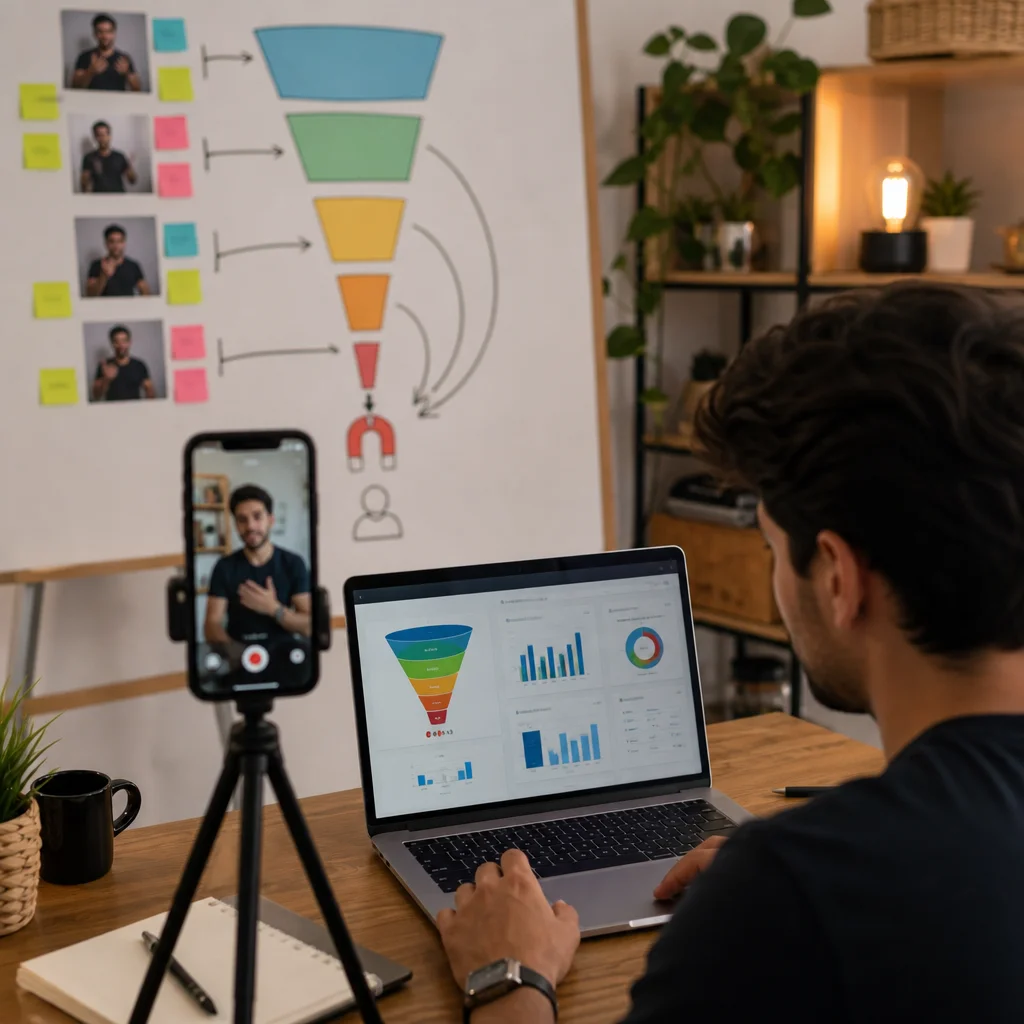
A repeatable Reels funnel maps your content to where your audience actually is in their buying journey. Instead of hoping each video converts, you build a system where different content types work together to move prospects forward.
Here’s the basic structure:
Awareness stage: Reels that attract attention and introduce your brand. These prioritize entertainment, education, or inspiration over direct sales messaging.
Consideration stage: Content that builds credibility, showcases expertise, and gives viewers a reason to stay engaged with your account. These Reels typically address specific pain points or questions your audience is asking.
Decision stage: Reels that make your offer clear, remove objections, and include direct calls-to-action. These convert curious viewers into leads.
Nurture and retention: Reels that keep former prospects or customers engaged, reducing the friction if they need your service again.

The funnel only works if each stage feeds into the next. Awareness content drives traffic to your profile. Consideration content keeps engaged viewers subscribed. Decision content includes lead capture mechanisms. Without this structure, you’re just posting individual videos that compete for attention without working together.
Designing Your Content Architecture for Lead Capture
Your content architecture is the skeleton of your funnel. It’s the framework that determines which Reel types you create, in what order, and how they connect.
Start by listing the questions your prospects ask before hiring you. A dental practice might focus on: “Does this dentist work with anxious patients?” “Do they offer cosmetic services?” “What’s the process for a first visit?” A commercial cleaning company might focus on: “Can they handle my size facility?” “Are they insured?” “How responsive are they?”
These questions become your content pillars. Each pillar gets multiple Reels across your funnel stages. A pillar about anxiety-friendly dentistry could include:
- Awareness Reel: “4 signs you’re a good candidate for sedation dentistry”
- Consideration Reel: “Here’s how we prep anxious patients for their first visit”
- Decision Reel: “Book your anxiety-free consultation in the link in bio”
When you repeat this process across 4-6 core pillars, you build a library of interconnected content that serves multiple purposes. Viewers see your brand address their specific concerns repeatedly, building trust and authority without hard-selling.
Mapping Awareness, Consideration, and Decision-Stage Reels
Each funnel stage requires different storytelling techniques.
Awareness Reels should feel effortless. They might be tips, quick how-tos, surprising facts, behind-the-scenes moments, or even light humor related to your industry. The goal is views and profile visits, not immediate leads. A fitness trainer might post “3 deadlift mistakes that are destroying your lower back.” A financial advisor might post “The one number on your credit card statement you should never ignore.” These don’t mention services; they provide value.
Consideration Reels build specificity and trust. They address objections, show your process, feature client testimonials, or showcase your team. The content is more direct but still educational. The fitness trainer now posts “Here’s exactly how I program deadlifts for clients with lower back pain.” The financial advisor posts “Why I always recommend THIS move before investing.” These signal expertise and relevance to people actively thinking about hiring.
Decision Reels are conversion-focused. They include clear CTAs like “Link in bio to book,” “DM us to get started,” or “Click the link to claim your free audit.” The format might be a direct offer, a client success story with results, or a FAQ addressing final objections. These convert engaged viewers into leads.
The ratio matters. We recommend roughly 60% awareness, 30% consideration, and 10% decision content. Most service businesses flip this upside down, leading to high friction and low conversion.
Building the Lead Magnet Into Your Reel Strategy
A lead magnet is a small, valuable offer that viewers exchange for contact information. For Reels, it needs to be simple enough to claim in 30 seconds.
Effective lead magnets for service businesses include:
- Free assessment or audit (real estate agents offer property evaluations, marketers offer marketing audits)
- Checklist or downloadable guide (contractors offer home inspection checklists, consultants offer strategic planning templates)
- Video tutorial or case study (accessible via email)
- Discount or limited-time offer (first appointment 20% off, first month 50% off)
- Consultation call (free strategy session, free discovery call)
The Reel itself hints at the lead magnet without fully explaining it. A Reel might show three common mistakes in your industry, then say: “Grab our free checklist to see which ones you’re making. Link in bio.” The checklist becomes the incentive to click.
Your lead magnet should solve a micro-problem or answer a specific question. It shouldn’t require a long form or survey. Email capture, yes. Lengthy questionnaire, no. Friction kills conversion.
When someone claims your lead magnet, they enter your CRM where nurture sequences can begin. This is where the real funnel work happens, but Reels are the traffic driver.
Integrating Your Website and CRM Into the Funnel
Reels drive traffic, but your website and CRM close the loop. Without integration, you lose 80% of the opportunity.
Every Reel link should go somewhere specific:
- Awareness Reels direct to a blog post or resource page relevant to the video topic
- Consideration Reels direct to a service page or case study page
- Decision Reels direct to a lead capture page or booking calendar
- Lead magnet Reels direct to a dedicated landing page with a simple form
Your CRM should automatically trigger responses. When someone fills out a lead form, they receive an immediate email confirmation plus your lead magnet. Within hours, a nurture sequence begins. If they fill out a consultation booking form, your team gets a notification to confirm the appointment.
The website and CRM are where viewers become leads, and leads become customers. Reels are the attention layer. Without solid conversion infrastructure on the back end, Reels become a vanity metric engine.
We often find that service businesses have strong social media but weak website conversion funnels. The two must work together. A Reel that drives 500 clicks to a confusing website wastes that effort.
Optimizing Reels for Algorithm Performance and Engagement
Instagram’s algorithm prioritizes watch time, completion rate, engagement, and shares. A Reel that gets watched fully, saves, and comments performs better than one that gets views but doesn’t hold attention.
Structure matters. Hook viewers in the first second. A freeze frame of a surprising moment, a provocative question, or an unexpected visual shift makes people stop scrolling. Service businesses often waste the first 2-3 seconds on logos or introductions. Stop. Your hook should make viewers lean in.
Pacing affects completion. Faster-paced Reels (with scene changes, text overlays, and dynamic cuts) perform better than static videos. Even if your content is inherently slow (like a consultation), add visual variation to maintain attention.
Text overlays should match your voice without overselling. Instead of “You NEED This!!!” try “Most people get this wrong.” Curiosity works better than urgency for awareness and consideration content.
Call out your audience specifically. “If you’re a service business owner…” or “For anyone who’s dealt with this problem…” makes viewers feel seen. Generic content underperforms.
Respond to comments quickly. The algorithm tracks engagement velocity in the first hours after posting. Meaningful responses increase interaction and boost distribution.
Measuring What Actually Matters: Conversions Over Vanity Metrics
Stop measuring Reels by likes and views alone. These numbers feel good but don’t indicate business impact.
Track these instead:
- Click-through rate: How many viewers actually clicked your link? (Aim for 1-3% for awareness content, 3-8% for decision content)
- Lead volume from Reels: How many qualified prospects came through your lead capture from Instagram?
- Cost per lead: Divide your content production cost by leads generated to understand efficiency
- Lead-to-customer conversion rate: What percentage of Reel-sourced leads become paying customers?
- Customer lifetime value from Reel leads: Are these leads as valuable as leads from other channels?
These metrics connect Reels to revenue. A Reel with 100,000 views but zero leads is a content failure, regardless of how good it feels. A Reel with 5,000 views that generates 50 qualified leads is performing well.
We recommend tracking these metrics in a simple spreadsheet or dashboard. Over time, you’ll identify which content pillars generate the best leads and which Reel formats resonate most with your audience. This data guides your content strategy.
How We Build and Scale Repeatable Reels Funnels

At Canatos Media, we start by mapping out your customer’s complete buying journey. We interview your sales team, review past client conversations, and identify the exact questions and objections your prospects encounter.
From there, we design a content architecture with specific pillars and a mix of awareness, consideration, and decision-stage Reels. We then film and edit a library of content designed to work together, not as individual viral moments.
The key to scaling is having systems in place before you post. We integrate your Reels strategy with your website, landing pages, and CRM so that traffic immediately converts into trackable leads. We also set up performance tracking from day one so you know exactly which content is working.
We recommend posting consistently (3-5 times weekly for most service businesses) and testing different formats, hooks, and CTAs. Over 8-12 weeks, patterns emerge. You discover which topics generate the most leads, which Reel lengths perform best, and which audience segments are most valuable. Then you double down on what works.
The best part: once a repeatable system is in place, you can scale without reinventing the wheel. New Reels follow proven templates, lead capture works automatically, and your team focuses on converting warm prospects instead of chasing engagement metrics.
Getting Started With Your First High-Converting Reel Campaign
Pick one content pillar (one core question your prospects ask) and create three Reels: one awareness, one consideration, one decision. Make them intentionally connected so that viewers progress through the funnel as they engage.
Set up a simple landing page with a lead magnet related to that pillar. Connect your Reels to this page. Make sure your CRM is ready to capture and nurture leads.
Post the Reels over a week, spacing them out so awareness content runs first, consideration runs midweek, and decision content runs toward the end of the week. Track what happens: clicks, leads, and conversions.
This single campaign teaches you more about your audience than months of guessing. You’ll see which hooks work, which CTAs resonate, and which lead magnets actually attract qualified prospects.
From there, add a second pillar, then a third. Each pillar becomes a repeatable funnel that drives consistent leads. Within 2-3 months of focused effort, you’ll have a library of content that works for your business, not against it.
If you’re ready to accelerate this process with professional strategy, filming, and CRM integration, we’re here to help. We specialize in building video-first lead generation systems for service businesses. Contact us to discuss your specific goals.
For further reading: Measure video campaign ROI.
Contact us today for a free consultation to see how we can help you grow your business.
Frequently Asked Questions (FAQ)
How do we help service businesses turn Instagram Reels views into actual leads?
We build structured funnels that connect your Reels content directly to lead capture systems. Our approach maps awareness-stage Reels that grab attention, consideration-stage content that builds trust, and decision-stage videos that drive action, then we integrate landing pages and CRM systems so every viewer has a clear path to becoming a qualified prospect.
What’s the difference between the Reels funnels we create versus just posting content regularly?
Most service businesses post Reels without a conversion strategy, which is why they get views but few leads. We design your content architecture around specific business goals, optimize each Reel for algorithm performance while directing viewers to lead magnets or booking pages, and measure actual conversions instead of vanity metrics like follower count.
How do we integrate Reels into your existing website and sales process?
We connect your Reels funnel to your website, landing pages, and CRM so leads move seamlessly from video to your sales team. This means we’re not just creating content in isolation; we’re building a complete system where social media attention converts into qualified prospects you can actually close.