Day: May 15, 2026

  • How to Master Social Content Management Like a Pro

    How to Master Social Content Management Like a Pro

    Why Social Content Management Is the Backbone of Business Growth in 2026

    Social content management is the process of planning, creating, scheduling, publishing, and analyzing content across your social media platforms — all from a centralized workflow.

    Here’s a quick breakdown of what it involves:

    1. Plan – Map out content topics, formats, and posting schedules
    2. Create – Produce platform-specific posts, videos, and visuals
    3. Schedule – Automate publishing at optimal times across channels
    4. Engage – Monitor comments, DMs, and mentions in one place
    5. Analyze – Track performance and tie results to real business outcomes

    If you’re running a local business, you already know the problem. You’re posting on Instagram, LinkedIn, maybe TikTok — but it feels scattered. Hours disappear into copying captions, reformatting images, and pulling numbers into spreadsheets. Meanwhile, you’re not sure what’s actually driving new customers through the door.

    You’re not alone. Many marketing teams describe being “buried in tabs” — manually stitching together data from five different platforms every week, with no clear picture of what’s working.

    The good news? The right social content management workflow changes all of that. The best platforms in 2026 combine AI-powered content creation, automated scheduling, unified engagement tools, and ROI reporting — so you can stop guessing and start growing.

    I’m Nic Canobbio, founder of Canatos Media, and my team has produced social content that’s reached over 60 million views — built on the same structured social content management systems we’ll break down in this guide. Let’s get into what actually works.
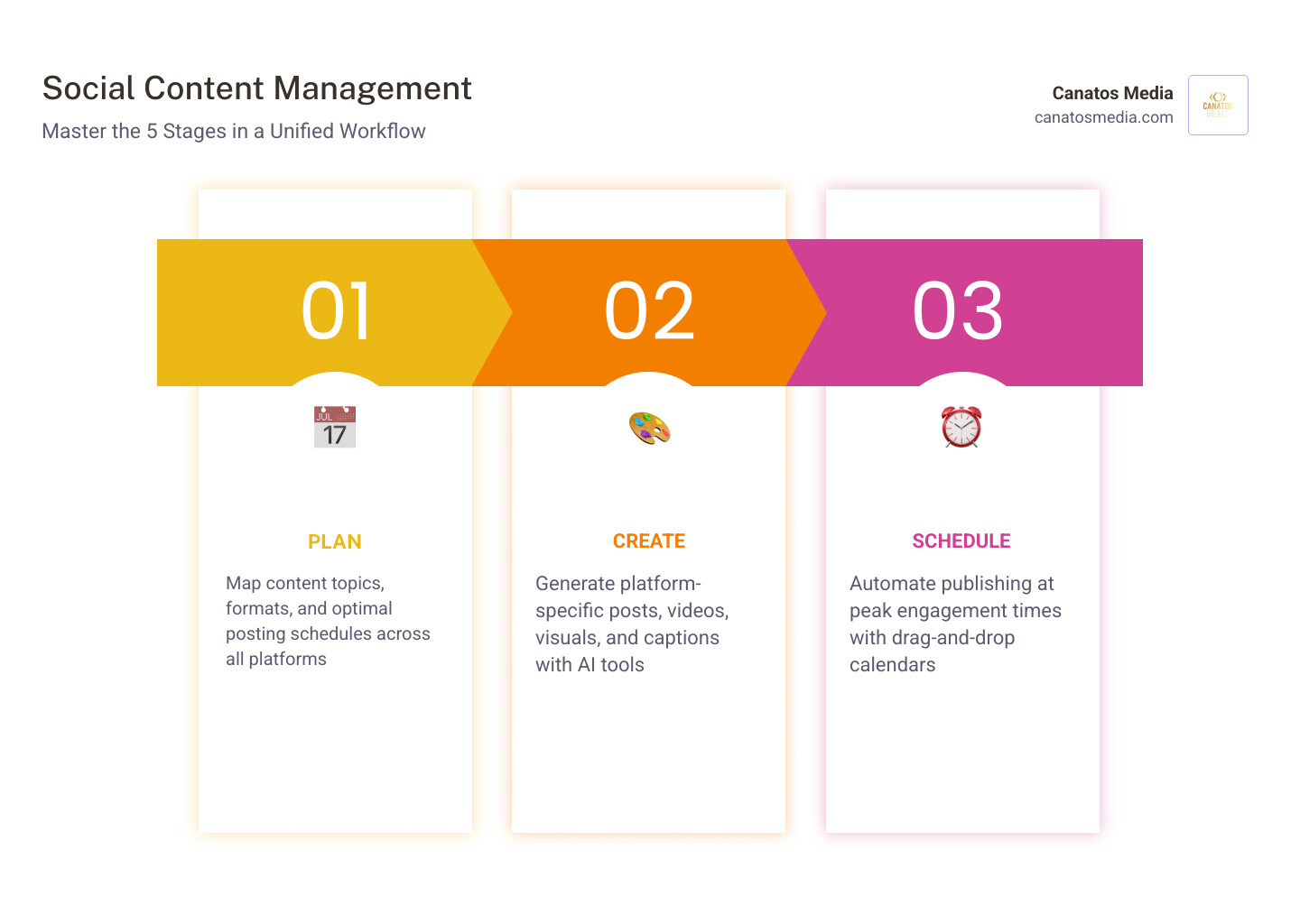
    5 stages of social content management: Plan, Create, Schedule, Engage, Analyze with key actions at each stage - social

    The Pillars of Effective Social Content Management in 2026

    As we navigate the landscape of 2026, the complexity of social media has only increased. With the rise of niche platforms like Threads, Bluesky, and Mastodon alongside heavyweights like TikTok and LinkedIn, a “post and pray” approach is a recipe for burnout. Modern social content management requires a centralized command center that does more than just schedule posts; it must provide brand intelligence.
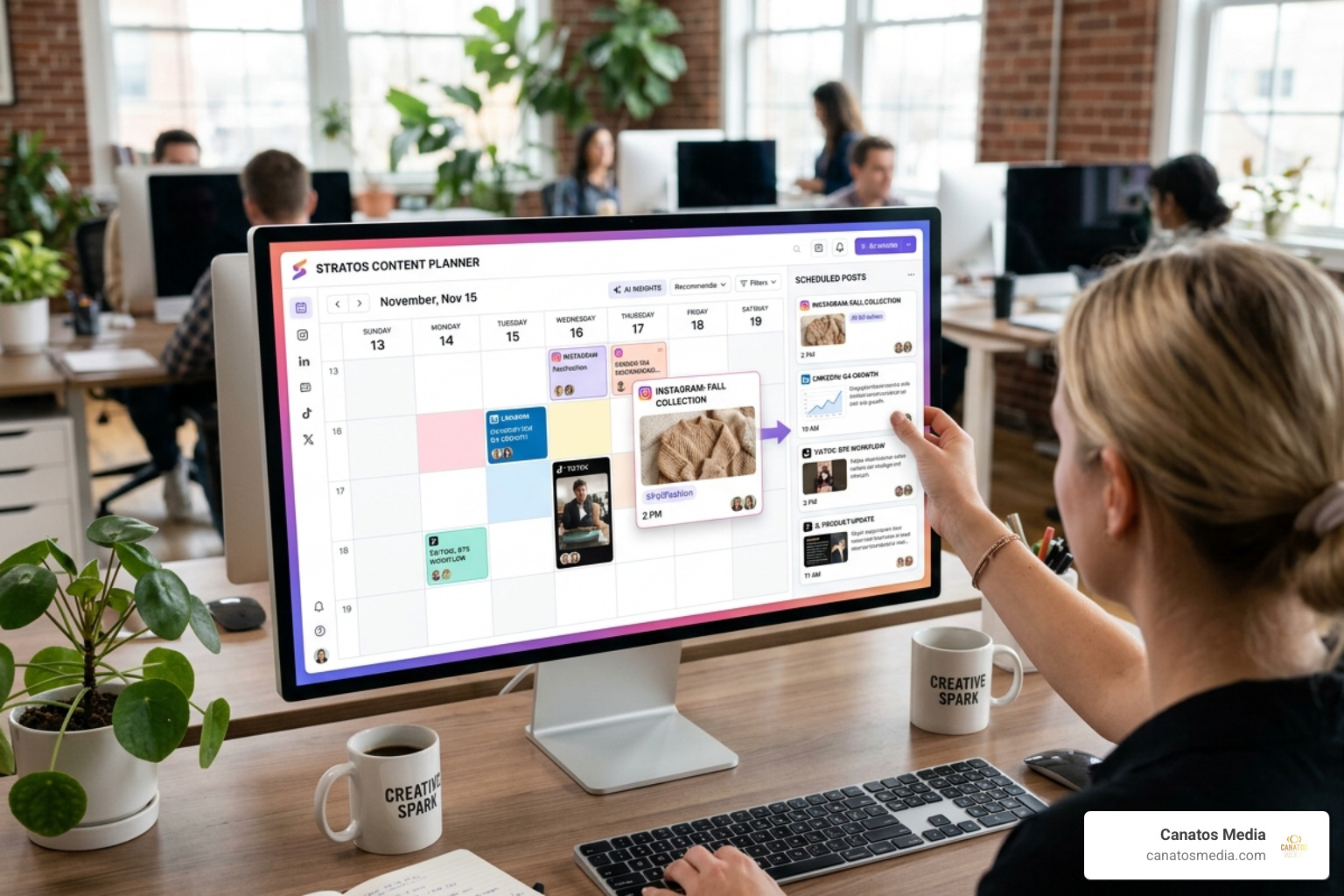
    AI-powered content calendar showing multi-channel scheduling and drag-and-drop functionality - social content management

    The core features we look for in a high-performing management platform today include:

    • Unified Content Calendar: A single source of truth where you can see your entire strategy across all networks. The best tools offer list, feed, and grid views to visualize how your brand looks on every platform.
    • Automated Scheduling & Optimal Timing: Gone are the days of guessing when to post. 2026 tools use historical data to identify exactly when your specific audience is most active.
    • Unified Inbox: Managing DMs, comments, and mentions across five platforms is a full-time job. A unified inbox triages these conversations into one stream, ensuring no customer inquiry falls through the cracks.
    • Sentiment Tracking: Understanding the “vibe” of the conversation around your brand. Are people happy, frustrated, or indifferent? Sentiment analysis helps you stay ahead of potential PR crises.
    • Competitor Benchmarking: You can’t outperform the competition if you don’t know what they’re doing. Modern platforms allow you to track competitor engagement and growth rates directly alongside your own.

    To truly master this, you need a Social Content Management Strategy that connects these tools to your broader business goals.

    Essential AI Integrations for Content Creation

    AI has moved past the “gimmick” phase and is now the engine driving efficient content production. In 2026, the best social content management tools integrate AI directly into the drafting process.

    • Generative AI for Captions: AI assistants can now take a single prompt and generate platform-specific captions. It knows that a LinkedIn post needs a professional tone with clear line breaks, while a TikTok caption needs to be punchy and hashtag-heavy.
    • Image Resizing and Previews: One of the biggest time-wasters is reformatting visuals. Modern tools automatically resize your images for every platform and provide a live preview so you know exactly how that Reel or Carousel will look before it goes live.
    • Brand Voice Adaptation: Advanced AI now “learns” your brand voice. By analyzing your past successful posts, it can suggest edits to ensure every new piece of content sounds like you, not a robot.

    Real-Time Engagement and Community Building

    Engagement is the currency of social media. If you aren’t replying to your audience, the algorithm will eventually stop showing them your content. We utilize unified dashboards to handle “comment triage.” This allows us to flag high-priority messages—like a customer asking about pricing—while using 24/7 AI replies to handle common questions (like “What are your hours?”).

    Crisis monitoring is another vital component. With real-time mention alerts across millions of websites and social networks, you can spot a negative trend before it spirals. In the tri-state area, where word-of-mouth travels fast, being the first to respond to a customer concern is a competitive advantage.

    Overcoming API Hurdles and Streamlining Team Collaboration

    Even with the best tools, we are still at the mercy of platform APIs (Application Programming Interfaces). Instagram, TikTok, and YouTube want users to stay inside their apps to see ads, so they often limit what third-party tools can do.

    Marketing team collaborating on a tablet to approve social media content - social content management

    For example, while you can schedule most things, certain features—like selecting a specific trending audio on TikTok or adding a custom thumbnail to a YouTube Short—often still require a “manual touch” via the native app. Understanding these All-in-One Social Content and Management limitations is key to avoiding frustration.

    Effective Approval Workflows for Modern Teams

    If you’re an agency in New Jersey or a marketing team on Long Island, collaboration is where the wheels usually fall off. Email threads with “finalv2REALLY_FINAL.mp4″ are a nightmare.

    Modern social content management platforms solve this with:

    • Role-Based Permissions: Ensure only the right people can hit “publish.”
    • Kanban Boards: Visualize content moving from “Idea” to “In Production” to “Approved.”
    • Internal Commenting: Tag team members directly on a post draft to request a caption change or a color correction.
    • Version Control: Track every change made to a post so you can revert back if needed.

    Leveraging Employee Advocacy for Organic Growth

    One of the most underutilized growth levers in 2026 is employee advocacy. Research shows that content shared by employees gets significantly higher engagement than content shared by brand accounts.

    By using a Full-Service Social Media Management approach, you can provide your team with a library of pre-approved content. Your “ambassadors” can then share these posts to their personal LinkedIn or X profiles with one click. This decentralizes your brand strategy and can lead to engagement rate spikes—sometimes doubling the industry average.

    Data-Driven Growth and ROI Reporting

    If you can’t prove that social media is making you money, it’s just a hobby. For businesses in the tri-state area, every marketing dollar needs to work hard. We focus on moving beyond “vanity metrics” (likes and follows) and toward “business metrics” (conversions and revenue).

    Vanity Metric Business ROI Metric Why It Matters
    Likes Saves / Shares Indicates high-value content that people want to revisit.
    Total Followers Action Rate Shows what percentage of your audience is actually engaged.
    Impressions Click-Through Rate (CTR) Measures how effective your “call to action” really is.
    Reach Cost Per Acquisition (CPA) Ties social spend directly to the cost of getting a new customer.

    Leveraging AI for Social Content Management Analytics

    You shouldn’t need a PhD in data science to understand your reports. AI-driven analytics now provide “Predictive Insights.” Instead of just telling you what happened last month, these tools can tell you what will happen if you keep posting the same type of content.

    Automated PDF reports can be scheduled to hit your inbox every Monday morning, highlighting engagement spikes and sentiment analysis. This allows you to see the “why” behind the numbers without spending hours in a spreadsheet. Check out our guide on Advanced Social Analytics and Reporting for more on this.

    Proving Impact Without a Dedicated Data Team

    For smaller teams, the goal is revenue attribution. By using UTM parameters on every link you post, you can track a user from a LinkedIn post all the way to a demo request or a purchase on your website.

    When you connect your social management tool to your CRM, you can see that a specific customer was acquired through social media. This kind of clarity is exactly what we teach in our Paid Social Media Advertising: From Zero to Hero in One Hour training—it’s about connecting the dots between content and cash flow.

    Choosing the Right Workflow for Your Business Scale

    The “best” tool depends entirely on your size and goals. A solo creator on Long Island has different needs than a global insurance provider with thousands of employees.

    Optimizing Social Content Management for High-Growth Teams

    Agile teams need speed. Features like bulk scheduling (uploading 100 posts at once via CSV) and RSS auto-feeds (automatically drafting a social post every time you publish a blog) are essential.

    We also recommend “Evergreen Campaigns.” This is a feature that takes your best-performing content and automatically recycles it into your queue every few months. This ensures your new followers see your greatest hits without you having to lift a finger. This is a core part of an All-in-One Marketing Funnel strategy.

    Affordable Solutions for Small Businesses and Creators

    If you’re just starting, don’t feel pressured to buy the $500/month enterprise plan. Many platforms offer excellent free tiers that allow you to manage 3-5 profiles. Look for “per-channel pricing,” which allows you to pay only for what you use.

    For beginners, a user-friendly mobile app is often more important than deep API integrations. Being able to snap a photo at a local event in New Jersey and schedule it immediately from your phone is a huge win for consistency.

    Frequently Asked Questions about Social Content Management

    What are the key limitations of social media management tools in 2026?

    API restrictions remain the biggest hurdle. Most tools cannot post directly to personal Instagram profiles (they require a Business or Creator account). Additionally, platforms often limit video file sizes for third-party uploads, and features like “Product Tagging” or “Collab Posts” sometimes require you to finalize the post manually within the native app.

    How can AI help grow social media followers?

    AI helps by removing the guesswork. It analyzes millions of data points to suggest optimal timing for your specific industry and region. It also performs trend analysis, flagging topics that are about to go viral so you can create content while the “wave” is still building. Finally, AI engagement tools ensure you’re replying to followers 24/7, which signals to the algorithm that your account is active and valuable.

    Which features are most important for proving social media ROI?

    The “Big Three” are UTM integration, Conversion Tracking, and Automated Reporting. You need to be able to see exactly which posts led to website clicks, and which of those clicks turned into sales. Without these, you’re just measuring “noise,” not “impact.”

    Conclusion

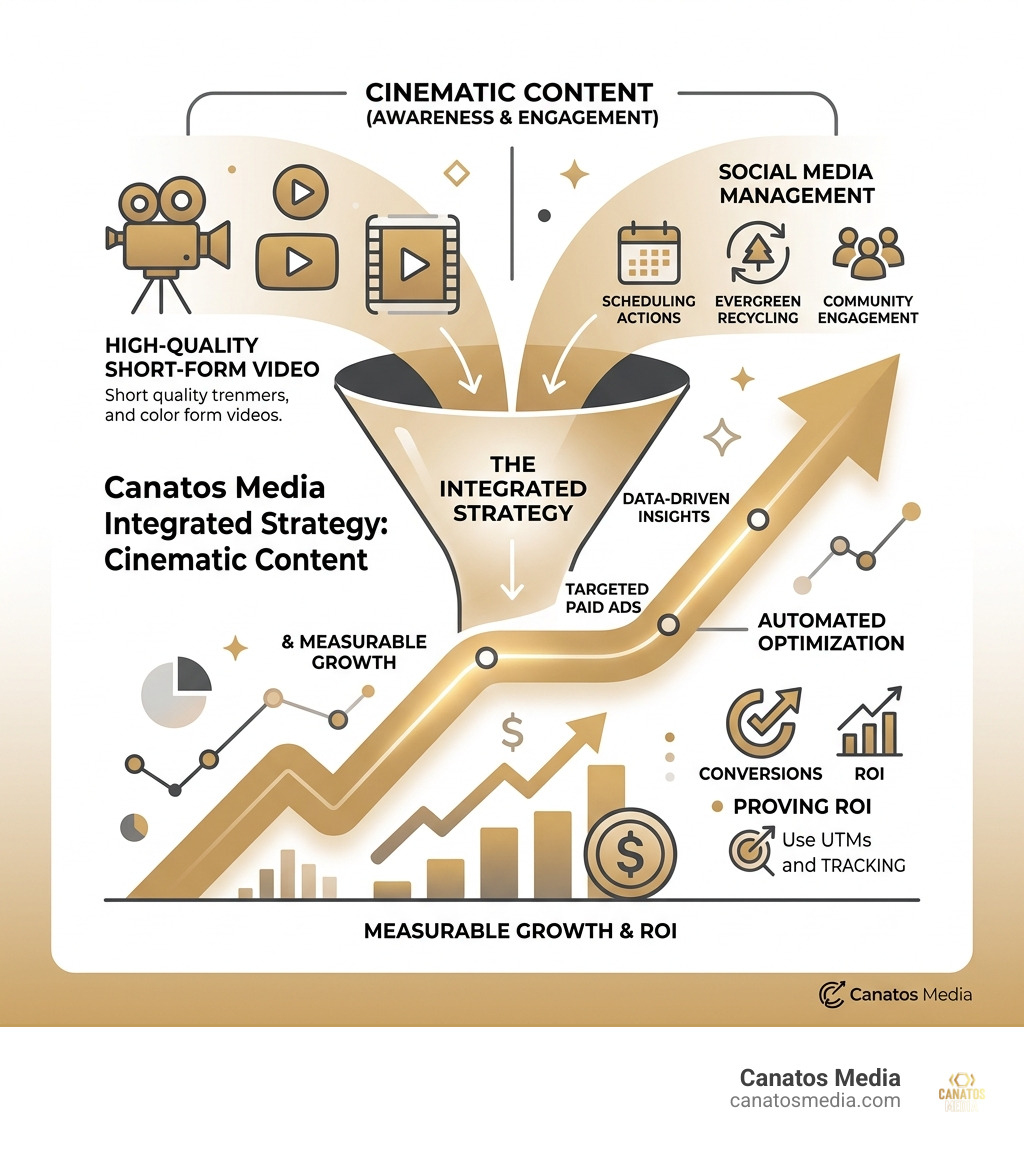
    Mastering social content management in 2026 isn’t about working harder; it’s about working smarter with a centralized system. Whether you’re a local business in the tri-state area or a growing brand on Long Island, the goal is the same: move from “scattered posting” to an integrated strategy that connects content, targeting, and conversions.

    At Canatos Media, we specialize in this exact intersection. We don’t just manage your social media; we create cinematic short-form videos that grab attention and run paid ads that turn that attention into measurable growth.

    Ready to stop the manual grind and start seeing real results? Explore our All-in-One Social Content and Management solutions today and let’s build something that scales.

    Canatos Media integrated strategy for cinematic content and measurable growth - social content management infographic

  • How We Scale Cinematic Short-Form Content Without Sacrificing Quality

    How We Scale Cinematic Short-Form Content Without Sacrificing Quality

    The Problem: Brands Need Volume and Quality Simultaneously

    Growth-focused business owners face a real tension. Social platforms reward consistency and frequency, yet producing cinematic content that reflects your brand takes time and resources. You need 20 videos a month to stay visible on Instagram Reels and TikTok, but you also need each one to look like it came from a premium production house, not a quick phone recording.

    This isn’t a new problem, but it’s become urgent. Algorithmic feeds prioritize fresh content, and audiences scroll past anything that looks amateurish in the first second. The math is brutal: three mediocre videos per week beats one polished video per month, but most brands can’t afford to produce either at the quality level their brand demands.

    The gap between volume and quality is where many otherwise excellent companies get stuck. They either compromise on production values to keep up with posting schedules, or they fall silent because producing quality content feels impossible at scale.

    Why Traditional Video Agencies Struggle With Scale

    Typical video production workflows aren’t built for volume. A traditional agency produces one video, then moves to the next project. Each project gets custom treatment: new creative direction, new shot lists, new crew scheduling. This approach makes sense for a luxury brand that needs two hero videos per year. It breaks down when you need sustainable, repeatable output.

    Most agencies also operate with extended timelines. A production might take six weeks from concept to delivery. When you multiply that across 20+ videos monthly, the math simply doesn’t work. You’d need multiple parallel teams, which most agencies can’t justify or staff consistently.

    There’s also the asset reusability problem. Traditional agencies shoot once and deliver final videos. They don’t think about how footage can feed multiple pieces of content, different platforms, or future campaigns. This means they’re starting from scratch on every project, wasting production capacity.

    The other constraint is creative bottlenecking. One creative director becomes the gatekeeper for every decision, turning what should be a scalable system into a bottleneck that slows everything down.

    Our Approach to Maintaining Cinematic Quality in High-Volume Production

    We’ve rebuilt how short-form video gets produced. Instead of custom workflows per video, we use templated production systems that maintain cinematic quality while enabling speed.

    Here’s the core idea: cinematic quality comes from lighting, composition, and color grading, not from bespoke creative work on every single piece. A well-lit product shot with professional color grading looks premium whether it’s your first video or your hundredth. A poorly lit phone video looks cheap either way.

    We design each production around a content “template”—specific shot types, lighting setups, and color grades that work for your brand and can be repeated efficiently. This isn’t cookie-cutter; it’s systematic. You might have templates for:

    • Product demonstrations
    • Customer testimonials
    • Behind-the-scenes brand footage
    • Educational or “how-to” content
    • Promotional announcements

    Within each template, we vary the specific subject, messaging, and talent, but the production framework stays consistent. This means our crew knows exactly what equipment to set up, how to light the space, and what color grade to apply. No surprises, no extended setup time.

    The result is videos that look cinematic and consistent with your brand identity, produced in a fraction of the time traditional agencies require.

    The Studio Systems That Enable Fast Turnaround Times

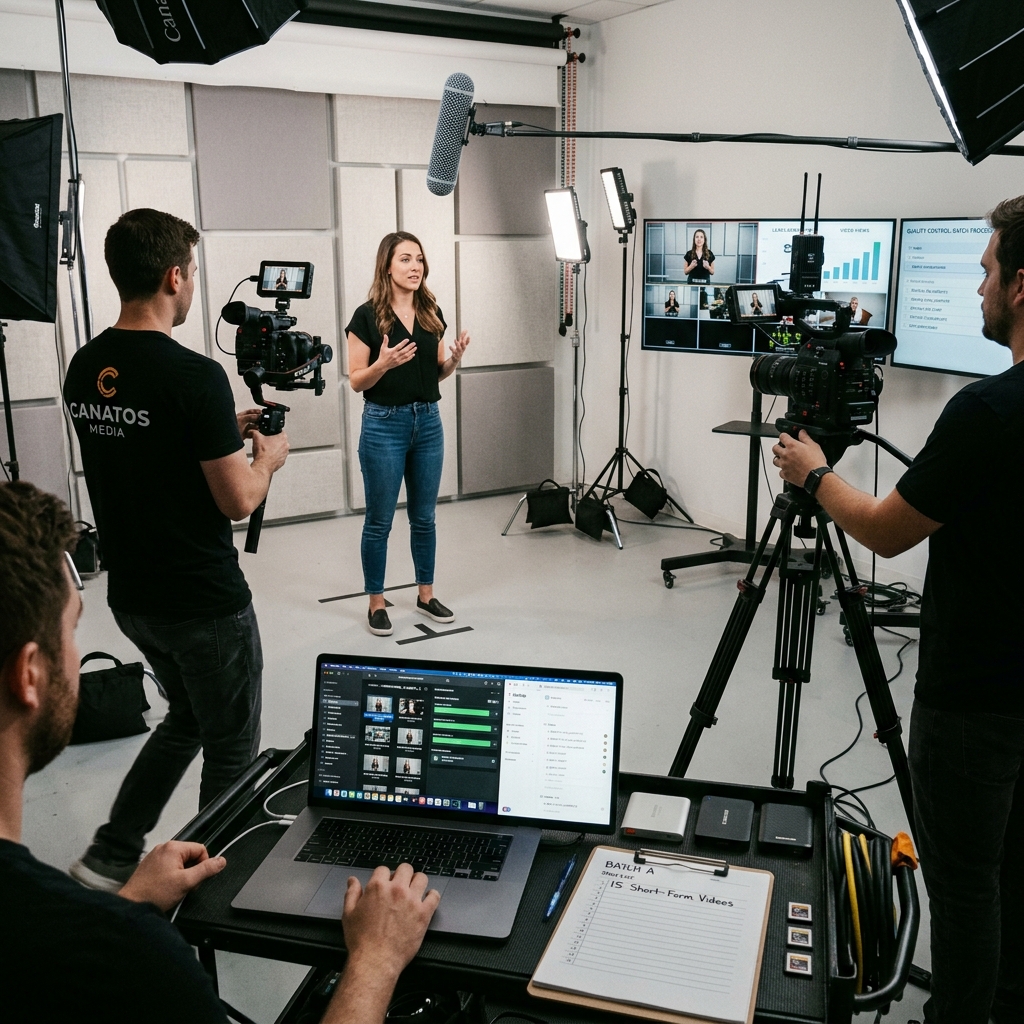
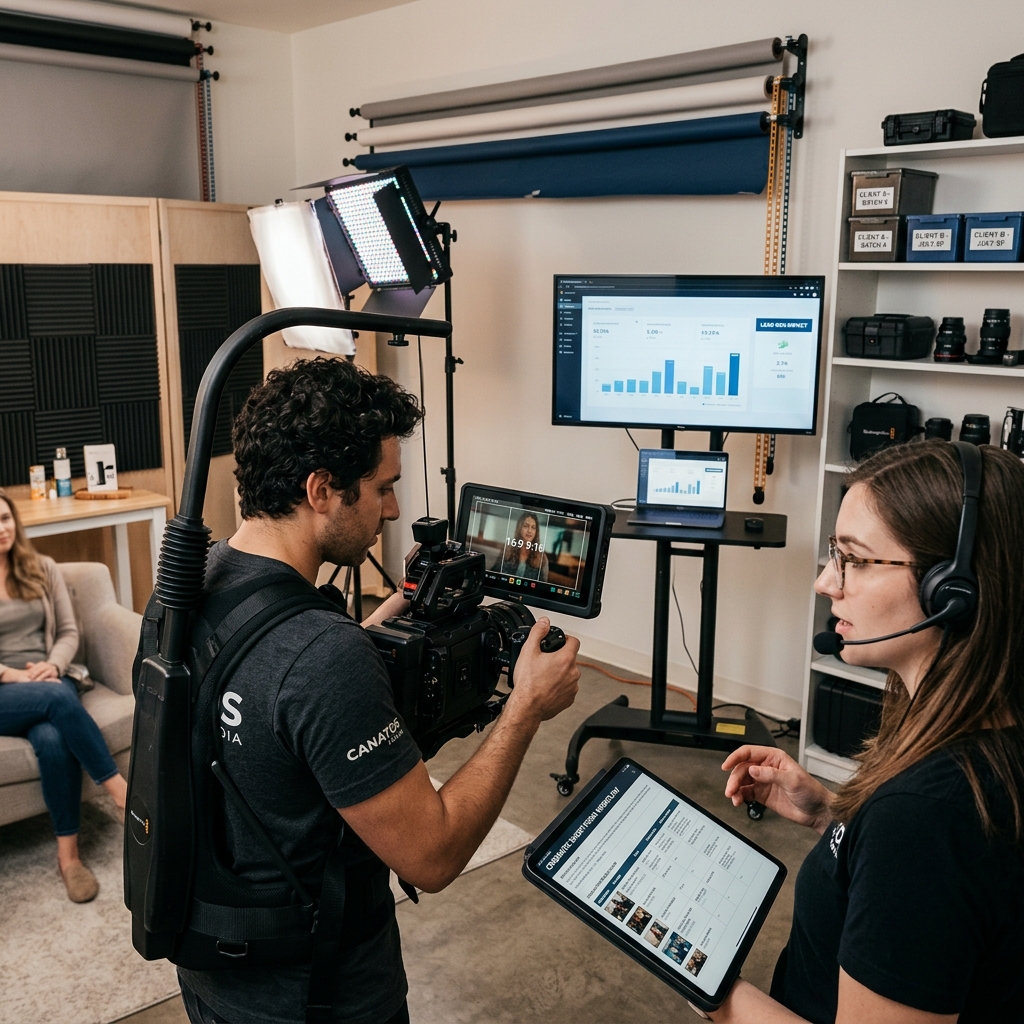
    Our production facility is designed around efficiency without cutting corners. We have dedicated spaces for different content types: a main studio with professional lighting rigs, a testimonial setup with modular backgrounds, and a color grading suite equipped for fast batch processing.

    Batch production is key. Instead of shooting one video, breaking down equipment, and setting up for the next project, we shoot multiple videos while the lighting rig is already configured. We might film 8-12 short videos in a single day because we’re not repeatedly setting up and tearing down. Crew familiarity with templates means faster positioning, fewer takes, and smoother execution.

    We also standardize post-production. Our editors and colorists work with preset color grades, motion graphics templates, and pacing standards that maintain consistency while eliminating decision fatigue. A video that would normally take two weeks to edit and color-correct moves through in three to four days.

    Next step: Assess your current content calendar. Where are the biggest bottlenecks? Is it shoot day logistics, editing timeline, or creative decisions? Knowing this helps identify where a template-based system would have the most impact.

    Integrating Short-Form Content Into Your Broader Digital Strategy

    Scaling video production only matters if that content drives business results. The videos need to feed into a broader digital strategy that turns views into leads and customers.

    We treat short-form video as the centerpiece of your social presence, but one piece of a larger system. Your short-form video production needs to connect with paid advertising (running those videos as ads on Meta and Google), SEO optimization (ensuring your website ranks for customer search queries), and social media management (posting consistently, engaging with comments, nurturing followers).

    Without this integration, you’re creating great content in isolation. With it, a single video becomes multiple touchpoints: organic social reach, paid amplification, website traffic, and lead capture.

    For example, a service-based business might film a customer success story. That video serves as organic content on Instagram, becomes a lead magnet on the website, gets repurposed into paid ads, and shows up in email nurture sequences. One production effort fuels multiple revenue channels.

    How Our Video Content Drives Measurable Lead Generation

    Volume and quality only matter if you’re tracking whether content actually converts. We build measurement into the content strategy from the start.

    Each video has a specific objective: awareness, consideration, or conversion. Awareness videos emphasize your brand story and reach broad audiences. Consideration videos dive into product features or social proof. Conversion videos are direct calls to action, often featuring customer testimonials or limited-time offers.

    We tag videos with UTM parameters, track views and engagement, and report on which content types drive the most leads and sales. This data feeds back into production planning. If testimonial videos convert at 3x the rate of educational content, we adjust the production calendar accordingly.

    The other layer is lead capture mechanics. Video alone doesn’t generate leads; you need a landing page, form, or direct message integration that captures interested viewers. We set these up alongside content production, ensuring the system actually moves people from “watched a video” to “submitted contact information.”

    The Technology Behind Our Production Workflow

    The infrastructure behind scaled production is less glamorous than the final videos, but just as important. We use production management software to coordinate shoot days, track asset versions, and manage handoffs between crew members. This eliminates scheduling conflicts and lost files.

    Our editing workflows use cloud-based collaboration tools, allowing multiple editors to work on different videos simultaneously without version control nightmares. Colorists can grade footage while editors are still cutting, compressing the overall timeline.

    We also maintain a digital asset library with every shot we’ve ever produced for your brand. This means future videos can reference or repurpose previous footage, further accelerating production. A testimonial shoot from three months ago might provide B-roll for a new promotional video.

    Scaling Without Compromising Your Brand Story

    Here’s the counterintuitive part: systematized production actually strengthens your brand story, it doesn’t weaken it. Brand consistency comes from having clear visual language and production standards, applied reliably across all content.

    When you rely on ad-hoc production, your brand looks different every week. One video is shot on natural light, the next is overly bright, another has bad audio. Audiences subconsciously feel that inconsistency, and it undermines trust.

    With templated systems, your brand develops a recognizable visual signature. People see a 15-second Reel and instantly know it’s from you because the lighting, color grade, and pacing are unmistakable. That recognition is a form of brand equity.

    The other benefit: systematic production means your brand voice becomes clearer. When you’re producing 20+ videos monthly, you develop stronger narrative consistency. You’re not scrambling to find something to say; you’re deepening the story you’ve already committed to telling.

    Real Results From Brands We’ve Scaled With Video

    Our case studies show the impact of scaling cinematic content. Multi-location service businesses have increased lead volume by 40-60% after shifting to consistent, high-quality short-form video production. E-commerce brands have seen 25-35% improvements in conversion rate when video content is integrated with paid advertising.

    One pattern we’ve noticed: results accelerate after month three or four. The first month is about building momentum and testing what resonates. By month four, you have enough data to optimize, and enough content to appear consistently in people’s feeds. That’s when the compounding effect kicks in.

    The brands that see the strongest results are those that commit to the system. They don’t pull back on content frequency or quality. They trust the process and give it time to work.

    Getting Started With Our Production Process

    If you’re ready to scale short-form video without quality compromise, the first step is a production audit. We assess your current content needs, existing brand assets, and business objectives. From there, we design templates specific to your industry and audience.

    The onboarding typically takes two weeks. We develop shot lists, lighting diagrams, and color grades for each template. We also establish reporting standards so you see measurable results from day one.

    Most brands start with a two-month pilot, producing 8-12 videos monthly. This gives us time to test what performs best and refine the templates. After the pilot, we scale to full production based on what’s working.

    If you’re ready to turn consistent, premium content into predictable business growth, let’s talk about your production roadmap.

    For further reading: Short-form video production.

    Contact us today for a free consultation to see how we can help you grow your business.

    Frequently Asked Questions (FAQ)

    How do we produce high-volume short-form content without losing the cinematic quality that makes your brand stand out?

    We’ve built our production workflow around standardized studio systems that let us shoot multiple videos in single sessions while maintaining our signature cinematic look. Our team uses preset lighting setups, color grading templates, and editorial guidelines that keep every piece of content visually consistent with your brand story. This means we can deliver 20+ videos per month without cutting corners on the creative elements that actually convert viewers into leads.

    Can we integrate short-form videos into our existing digital marketing strategy, or do we need to overhaul everything?

    We layer short-form video production directly into your current marketing ecosystem. Our team connects video content to your social media management, paid advertising campaigns, and SEO efforts so each piece serves a specific purpose in your lead generation funnel. You don’t replace what’s working—we amplify it with visual content that moves people from awareness to action.

    What’s the typical timeline for seeing measurable results from a video production campaign?

    We typically see engagement metrics shift within the first 2-3 weeks of consistent posting, but lead quality and conversion data take 60-90 days to fully show up in your pipeline. We track performance across all our platforms and adjust distribution strategy based on what’s actually driving qualified leads for your business, so you’re not just chasing vanity metrics.