Day: July 7, 2026

  • Why Canatos Media Delivers Better Results Than Large Agencies for Local Businesses

    Why Canatos Media Delivers Better Results Than Large Agencies for Local Businesses

    The Problem With One-Size-Fits-All Creative Agencies

    Large creative agencies operate on a model that works best when they’re handling dozens of clients at scale. This structure creates an inherent conflict: the more clients they serve, the more they need to standardize their processes, templates, and creative approaches. A pizza chain, a dental practice, and an HVAC service company end up getting similar strategic frameworks because the agency’s profitability depends on efficiency, not differentiation.

    The result is predictable. Your brand gets beautiful content that could work for almost anyone. It lacks the specific insight into why your customers choose you, what problem you genuinely solve better than competitors, and how your team’s unique story creates trust. Generic content performs generically, which means your investment doesn’t compound over time.

    What we’ve learned working with growth-focused business owners is that the best marketing comes from understanding exactly how your business operates. A multi-location service brand has different customer acquisition challenges than a local specialty business. One-size-fits-all doesn’t account for these realities.

    Why Large Agencies Fall Short for Growing Businesses

    Scaling a business requires speed, flexibility, and strategic alignment. Large agencies often move slowly because they have approval hierarchies, account management layers, and creative teams stretched across multiple clients. When you need a campaign adjusted based on real performance data, you’re waiting for the next quarterly review or fighting for production slots.

    Growing businesses also face budget realities that enterprise-level agencies don’t accommodate well. They’re built to serve Fortune 500 budgets, not the smart mid-market owner who needs high-quality content production married to paid advertising spend that actually drives leads. The infrastructure overhead gets passed to clients in the form of higher rates and inflexible service packages.

    There’s another constraint: most large agencies separate video production from digital strategy. You get a beautiful cinematic piece, but the distribution, paid media amplification, and conversion optimization live in a different department or aren’t integrated at all. This fragmentation means your content doesn’t get the amplification it needs to generate leads consistently.

    We built our entire process around the opposite approach: tight collaboration between production, strategy, and performance marketing so every piece of content is built to convert.

    Our Approach to Cinematic Brand Storytelling

    Cinematic doesn’t mean expensive or slow. It means intentional. We start by understanding your customer’s actual decision journey. What information do they need before they trust you enough to call or fill out a form? Where are they most likely to encounter you online?

    From there, we build brand stories that show rather than tell. Instead of listing your qualifications, we show your team solving a real customer problem. Instead of explaining your service quality, we show it through production value, attention to detail, and authentic customer testimonials woven into compelling narrative.

    The cinematic approach we use serves a specific business purpose: it builds emotional connection and credibility faster than standard content. When a service-based business owner sees themselves in your brand story, they’re more likely to reach out. When customers feel like they understand your process and values, they become advocates.

    Each story we produce is tailored to your brand’s actual differentiation. We spend time understanding what makes your multi-location operation or specialized service genuinely different, then craft content that highlights that distinction.

    Next step: Schedule a brief call to map out the core stories worth telling for your brand.

    Integrated Digital Strategy Beyond Video Production

    Video is the centerpiece, but it’s not the whole strategy. We manage social media channels where your content lives, ensuring consistent posting schedules, community engagement, and audience growth. We handle Meta and Google advertising to amplify your best-performing content directly to people actively looking for what you offer.

    SEO optimization and AEO work (Answer Engine Optimization for AI platforms) ensure your brand content gets discovered when prospects search. Website design and support work keeps your digital foundation strong and conversion-focused. All of these functions operate as one system, not isolated services.

    This integration matters because growth compounds when every channel reinforces the others. A well-produced video about your service becomes a social asset, a paid media asset, a website hero piece, and a lead generation tool simultaneously. Instead of creating separate content for each channel, we maximize the return on every production by distributing it strategically across your entire digital presence.

    The alternative is fragment your budget across different vendors, each optimizing for their own metrics without visibility into overall business impact.

    How We Drive Measurable Lead Generation

    Content production without lead generation measurement is expensive content consumption. We build every strategy around your actual business goal: qualified leads and customer acquisition at a sustainable cost.

    Our approach starts with understanding your sales process. How long is your typical decision cycle? Do you sell primarily to existing customers, referrals, or cold prospects? Are you building brand awareness for future revenue or driving immediate appointments?

    From there, we design content and distribution to move people through your funnel. Top-of-funnel content builds awareness and trust. Mid-funnel content addresses common objections and comparison questions. Bottom-of-funnel content removes the final barriers to action. Video works particularly well here because people trust video credibility more than text alone.

    We track attribution across paid media, organic social, SEO, and direct channels so you see exactly which content and distribution methods generate your best-quality leads. This data-driven approach means we optimize continuously based on what’s actually working for your business, not what we think should work.

    The Advantage of Local, Personalized Service

    Working with a local partner means easier communication, faster turnarounds, and someone who understands your market’s specific dynamics. We’re not operating from a distant headquarters with limited insight into your industry or region.

    This matters most when strategy needs to adapt quickly. If a competitor launches a campaign or your market shifts, we adjust immediately. If you need a rush production for a seasonal opportunity, you’re not competing for priority across a hundred other clients. Your success is our success because we’re invested in your community and your long-term growth.

    We also maintain ongoing relationships rather than treating each project as transactional. We learn your business deeply over time, which means our recommendations improve and our execution becomes faster the longer we work together.

    Our Video-First Content Systems

    We’ve developed production and distribution systems that make high-quality video output consistent and sustainable at mid-market pricing. Instead of treating each video as a unique, expensive project, we’ve standardized our production workflow so we can deliver premium cinematic content without enterprise price tags.

    Our systems cover everything from pre-production strategy and scripting through post-production optimization and performance tracking. We batch-produce content when efficient, scale production up when opportunities grow, and always maintain the quality standard that differentiates your brand.

    The video-first framework also means everything we produce is optimized for short-form distribution first. Whether it’s YouTube Shorts, Instagram Reels, TikTok, or LinkedIn, your content gets produced and edited for the platforms where your audience actually spends time.

    Proven Results for Multi-Location and Service-Based Brands

    Multi-location businesses face a specific challenge: maintaining brand consistency while allowing local relevance. National chains solve this with templates. We solve it with a strategic framework that scales. Each location tells the core brand story while highlighting local team members, local customer testimonials, and location-specific service details.

    Service-based brands benefit from showing expertise in action. Dental practices, HVAC companies, construction firms, and professional services all see significantly higher lead quality when prospects watch video of the actual service being performed or the actual team member who will serve them.

    We’ve worked with brands that doubled their lead volume within six months by switching from generic content to a strategic video-first approach. Others have reduced customer acquisition cost by 40% by improving lead quality and conversion rates through better brand storytelling and landing page optimization.

    Why We Skip Generic Content for Authentic Brand Stories

    Authentic stories convert better because they’re specific. When your content acknowledges real customer challenges and shows your actual process for solving them, people see themselves in that story. Generic inspirational content about your industry gets scrolled past. Specific stories about how you solve a particular customer problem get saved and shared.

    This is why we spend significant time in the discovery phase understanding your business from the inside. We talk to your team, your customers, and your prospects. We identify the patterns in why people choose you. Then we translate those insights into content that feels earned rather than manufactured.

    Authenticity also builds trust faster with high-value prospects. When someone considering a significant purchase sees real customers and real processes, not actors and stock footage, their confidence in your brand increases measurably.

    How Our Clients Scale Without Massive Agency Budgets

    We’ve designed our service model specifically for growth-focused business owners who need high-quality marketing without enterprise-level costs. This means we’re strategic about where every dollar goes, prioritizing the channels and content formats that drive your specific business outcomes.

    We also build strategies that leverage your existing assets. Your team members become content stars. Your satisfied customers become case studies and testimonials. Your process becomes your competitive advantage communicated through video. This approach reduces dependency on expensive external talent or complex production logistics.

    Many of our clients start with a core video production and digital management package, then add paid advertising, SEO, or website optimization as revenue grows. This flexibility lets you scale investments as results prove themselves, rather than committing to large upfront agency retainers.

    Getting Started With Strategic Video Marketing

    The first step is understanding your specific situation. We recommend scheduling a brief strategic call to discuss your business model, current marketing efforts, and growth goals. From there, we outline a specific approach and investment level that matches your budget and timeline.

    Most growth-focused businesses benefit from starting with a core video production and social media strategy package, then adding paid media amplification once we’ve identified which content resonates most with your audience. This phased approach reduces risk and lets you see results before scaling investment.

    Our goal is to become your long-term video marketing and digital strategy partner. We invest time in understanding your business because sustainable growth comes from strategic alignment, not transactional service delivery.

    Ready to explore how cinematic brand storytelling and integrated digital strategy can drive measurable growth for your business? Get in touch with our team to discuss your specific situation.

    For further reading: Local digital agency comparison.

    Contact us today for a free consultation to see how we can help you grow your business.

    Frequently Asked Questions (FAQ)

    What makes our video production approach different from traditional marketing agencies?

    We combine cinematic storytelling with performance-driven strategy, meaning every video we create isn’t just visually compelling—it’s designed to convert viewers into leads. Rather than treating video as a standalone deliverable, we integrate it directly into your social media, paid advertising, and SEO efforts so your content works harder across all channels.

    How do we ensure our work drives actual business results for multi-location or service-based brands?

    We build lead generation systems tailored to your specific business model, tracking everything from video engagement to actual conversions. Our team manages your Meta and Google advertising campaigns alongside content creation, so we optimize based on real performance data instead of vanity metrics like views or likes.

    Can we support an existing website, or do we need to rebuild from scratch?

    We work with your current website setup and enhance it through SEO optimization and design improvements that complement your video content strategy. If upgrades make sense for your goals, we’ll recommend specific changes, but we never push unnecessary rebuilds—we focus on what actually moves your business forward.
  • Stop Hiding from Customers with These Local SEO Services and Tips

    Stop Hiding from Customers with These Local SEO Services and Tips

    Why Most Local Customers Can’t Find You Online (And How to Fix It)

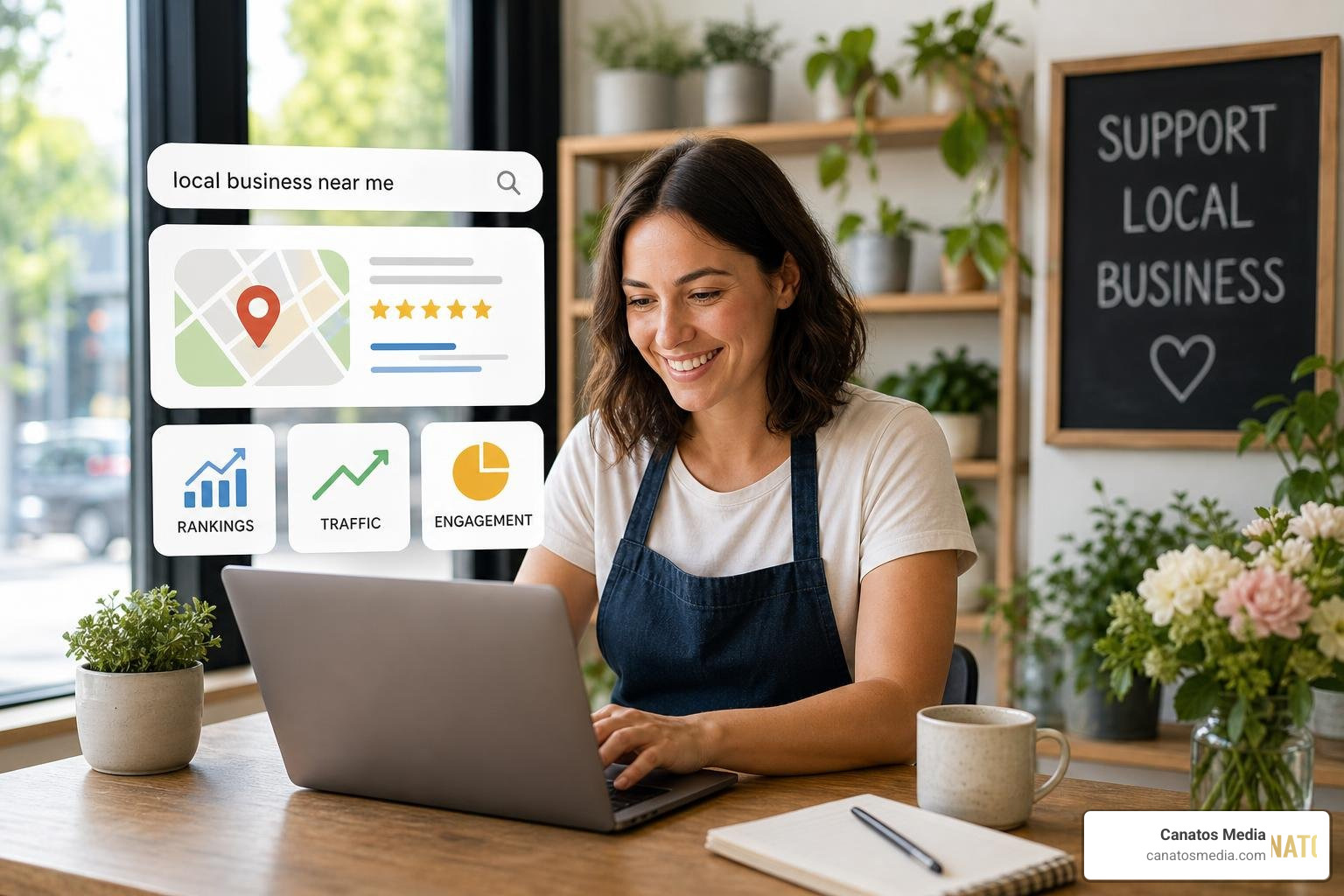
    Local small business SEO is the process of optimizing your online presence so nearby customers can find you when they search on Google — and it’s one of the fastest ways to drive real foot traffic, phone calls, and sales without paying for ads.

    Here’s a quick breakdown of what it involves and why it works:

    What It Is What It Does
    Google Business Profile optimization Gets you visible in Google Maps and the Local Pack
    NAP consistency (Name, Address, Phone) Builds trust with Google across all directories
    Local keyword targeting Connects you with customers searching in your area
    Review generation and management Boosts rankings and converts searchers into buyers
    Local citations and directory listings Confirms your legitimacy to search engines
    Location-specific content Attracts high-intent local traffic to your website

    The numbers behind local search are hard to ignore. 46% of all Google searches have local intent. And 72% of consumers who do a local search visit a store within five miles. That means people aren’t just browsing — they’re ready to buy, and they’re looking for businesses like yours right now.

    The problem? Most small businesses are practically invisible when those searches happen.

    Forty-six percent of all Google searches have local intent — yet the majority of small business owners have no idea how to show up for them. A potential customer searches “plumber near me” or “best coffee shop open now” and the businesses that appear aren’t necessarily the best — they’re the ones that showed up online in the right way.

    That gap between a great local business and one that actually gets found is exactly what local SEO closes.

    I’m Nic Canobbio, and through my work building media strategies and content systems at Canatos Media — including campaigns that have driven over 60 million views across social platforms — I’ve seen how local small business SEO can transform a business’s visibility and lead flow when done right. Let’s walk through exactly how it works.

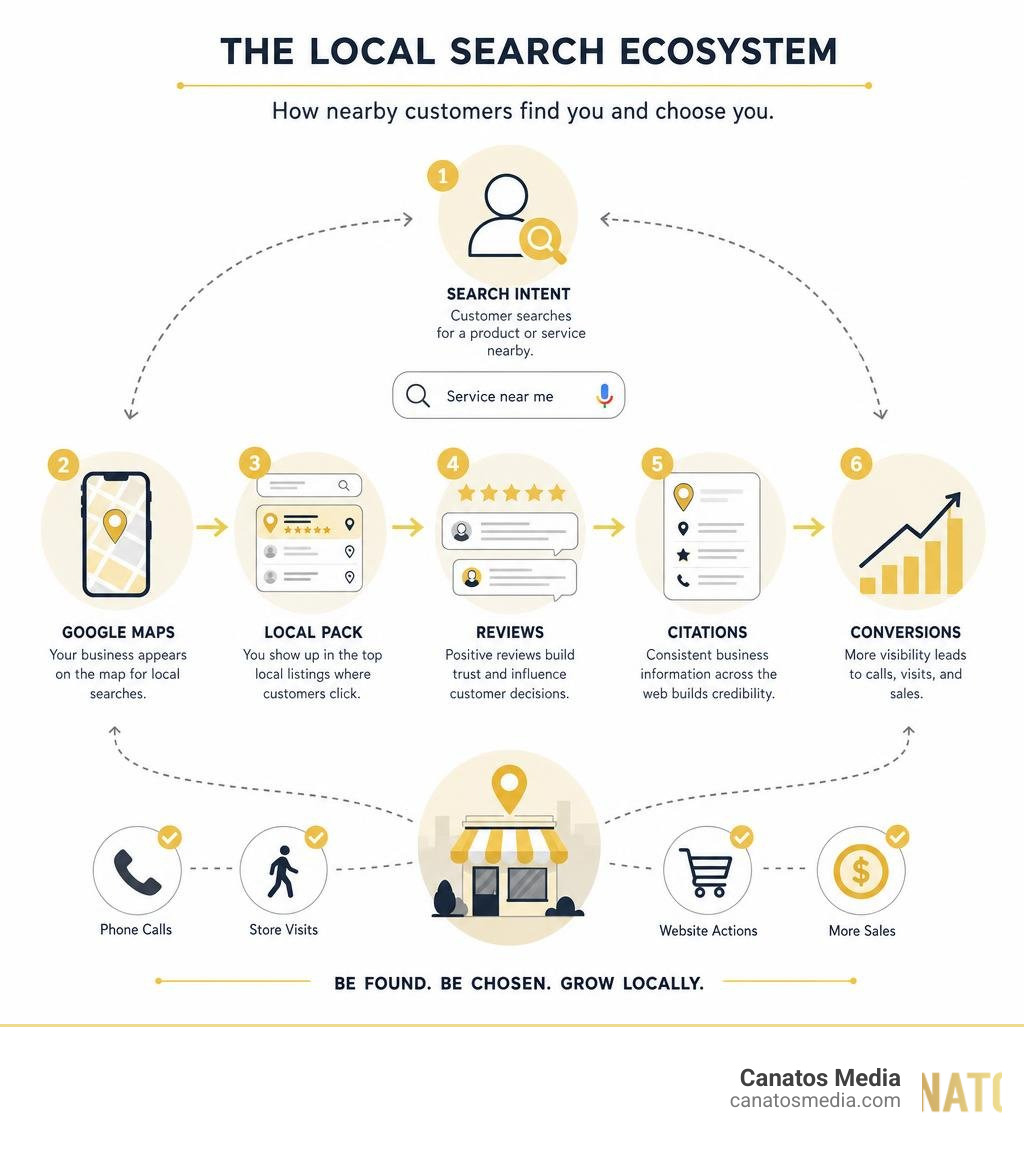
    infographic showing the local search ecosystem: search intent, Google Maps, Local Pack, reviews, citations, and conversions

    Local small business seo terms made easy:

    What is Local Small Business SEO and Why It Matters in 2026

    If you run a business in the Tri-State area or out on Long Island, your playing field is highly competitive but incredibly rewarding. Whether you are a boutique in Montauk, a family dentist in Nassau County, or an accountant in Hoboken, you aren’t trying to capture the attention of the entire world. You just need the people driving past your storefront or sitting on their couches three blocks away to find you.

    This is where local small business SEO differs fundamentally from traditional, national SEO. Traditional SEO focuses on ranking for broad, non-geographical keywords. For instance, a national flour brand wants to rank for “how to bake sourdough bread.” That is a massive, highly competitive keyword.

    In contrast, local SEO is all about local search intent and the proximity factor. If you own a bakery in Suffolk County, you want to rank for “fresh sourdough bread near me” or “bakery in Huntington.” The search engine uses the user’s real-time geographic location (via GPS, IP address, or cell towers) to serve up results that are physically close to them.

    comparing local and national search results

    To help you visualize this, we have broken down the core differences in the table below:

    Feature Traditional SEO Local SEO
    Target Audience National or global searchers Local, geographically defined searchers
    Primary Goal Drive website traffic and global brand awareness Drive foot traffic, phone calls, and local physical visits
    Key Ranking Factors Backlink profile, domain authority, broad content Proximity, Google Business Profile, local reviews, citations
    Primary Search Element Standard organic blue links Google Maps, the “Local 3-Pack,” localized organic results
    Competition Level Extremely high (competing with global giants) Moderate (competing only with businesses in your immediate area)

    If you want to dive deeper into how search engines evaluate websites on a broader scale, you can learn more about the fundamentals of local search to build a solid foundation.

    The Core Benefits of Local Small Business SEO

    Many small business owners we talk to on Long Island and across the Tri-State area feel overwhelmed by the thought of digital marketing. They worry they will have to spend thousands of dollars a month on paid ads just to stay relevant. But local SEO is actually the ultimate equalizer. Here is why:

    • Explosive Local Brand Awareness: When you rank in the top three map spots, every neighbor searching for your service sees your name first. It turns your business into a household name in your community.
    • Highly Cost-Effective Marketing: Unlike paid digital ads where the leads stop the second you turn off your budget, organic local search positions are long-lasting. Once you claim those top spots, they continue to drive free leads month after month.
    • Instant Trust and Credibility: When Google places your business in the coveted Map Pack, it acts as a stamp of approval. Combined with a steady stream of positive customer reviews, potential clients will trust you before they even pick up the phone.
    • Incredible Conversion Rates: People searching with local intent are highly motivated. They aren’t just researching; they are looking to buy today. In fact, 28% of local searches result in a purchase within 24 hours.
    • Drives Direct Foot Traffic: If you run a brick-and-mortar storefront, ranking highly on mobile map searches is the single best way to guide physical customers directly to your front door.

    If you are operating on a tight budget, you don’t have to break the bank to get started. You can discover affordable SEO services that won’t make your wallet cry and begin building your local authority step-by-step.

    Core Pillars of Local Search Dominance

    To win at local small business SEO, you have to understand how Google decides who gets the spotlight. When a user types in a query with local intent, Google deploys its local ranking algorithm. This algorithm is built upon three core pillars: Relevance, Distance, and Prominence.

    1. Relevance: How well does your business match what the user is searching for? If someone searches for “organic dry cleaners,” Google won’t show a standard laundromat unless its profile and website clearly state they offer organic services.
    2. Distance (Proximity): How far is your business from the searcher or the search location specified? While you cannot control where a searcher is standing, you can control how clearly you define your service areas.
    3. Prominence: How well-known or trusted is your business? Google measures this by looking at your reviews, your backlink profile, your local directory presence, and how active you are online.

    When these three pillars align, Google rewards your business by placing you in the Local Pack (also known as the Map Pack or the Local 3-Pack). This is the box of three featured local business listings that appears at the very top of Google’s search results, right beneath the map.

    Google Map Pack interface showcasing local business listings

    Because the Local Pack occupies the most valuable real estate on mobile and desktop screens, it captures roughly 75% of all local search clicks and calls. If you aren’t in those top three spots, you are essentially handing your local customers directly to your competitors.

    How Google Ranks Local Small Business SEO

    While we can’t control the physical distance between your shop and the searcher, we can absolutely maximize your Relevance and Prominence. Google’s local ranking algorithm relies heavily on specific off-page and on-page signals to determine your worthiness.

    First, your proximity signals must be crystal clear. This means your physical address must be verified, and your website must clearly outline the specific cities and neighborhoods you serve.

    Second, review velocity plays a massive role. It is not enough to have 100 great reviews from three years ago. Google wants to see a steady, natural influx of fresh, positive reviews. A business with 40 reviews—with five of them submitted in the last two weeks—will often outrank an older competitor with 150 stagnant reviews.

    Third, citation consistency is vital. If your business is listed as “Canatos Media” on Google, “Canatos Media LLC” on Yelp, and “Canatos Marketing” on the YellowPages, Google’s algorithm gets confused. That confusion dilutes your prominence score. Keeping your Name, Address, and Phone number (NAP) identical across the entire web is a non-negotiable rule.

    To make sure your technical and local foundations are built correctly, you can find reliable providers with our SEO services 101 guide to help navigate the complex landscape of search algorithms.

    Google Business Profile and Reputation Management

    Your Google Business Profile (GBP) is the single most important digital asset for local search. It is the control center for how your business appears on Google Maps and search results. If you haven’t claimed, verified, and fully optimized your GBP, you are invisible.

    To optimize your Google Business Profile for maximum impact:

    • Fill Out Every Single Field: Don’t skip anything. Enter your exact business name (no keyword stuffing!), category, business hours, holiday hours, local phone number, and a detailed, keyword-rich business description.
    • Select Accurate Categories: Your primary category is a massive ranking signal. Choose the most precise primary category possible (e.g., “Italian Restaurant” instead of just “Restaurant”), and use secondary categories to capture related services.
    • Upload High-Quality, Real Photos: Avoid stock photography. Upload real, high-resolution photos of your storefront, your team, your work, and your products. Keep adding new photos weekly to signal to Google that your business is active.
    • Leverage Google Posts: Think of Google Posts as free social media space directly on your search listing. Use them to share weekly updates, promotions, events, and helpful tips.
    • Build an Automated Review System: Don’t just hope customers leave reviews. Implement a system—using post-service SMS text messages, email follow-ups, or physical QR codes at your counter—to ask for reviews when customer satisfaction is highest.
    • Respond to Every Single Review: Always reply to reviews within 24 hours. Thank your positive reviewers, and address negative feedback professionally and constructively. Google notices your engagement, and so do prospective customers.

    For a deeper dive into managing your digital footprint and ensuring your business stays ahead of the curve, you can read how local businesses dominate search with smart reputation management.

    Actionable Strategies to Improve Local Search Visibility

    Now that you understand the rules of the game, let’s look at the actual strategies you can implement to push your business to the top of the local search results.

    First, let’s talk about local citation building. A citation is any online mention of your business’s Name, Address, and Phone number (NAP). These citations live on local directories, review platforms, and social media networks.

    To build local authority, you should submit your business to the core citation stack: Yelp, Apple Maps, Bing Places, Nextdoor, and your local Chamber of Commerce. For businesses on Long Island or in the Tri-State area, getting listed in regional business directories—like local business associations in Nassau or Suffolk County—sends incredibly strong geographical signals to Google.

    Second, mobile optimization is absolutely non-negotiable. Over 60% of local searches are performed on mobile devices while people are on the move. If your website takes more than three seconds to load, has tiny text, or lacks a prominent, clickable phone number, those mobile searchers will bounce immediately.

    Third, prepare for voice search. With smart assistants like Siri, Alexa, and Google Assistant integrated into daily life, people search conversationally. Instead of typing “dry cleaner Long Island,” they ask, “Hey Siri, where is the closest dry cleaner open right now?” Optimizing for natural, conversational language and answering direct questions on your website is key to capturing this growing traffic.

    On-Page Optimization and Local Small Business SEO

    Your website needs to be optimized so that Google can easily understand exactly what you do and where you do it. This starts with a smart local keyword strategy.

    Instead of targeting broad, highly competitive terms, weave localized keywords naturally into your page titles, headings, meta descriptions, and body copy. For example, instead of just targeting “interior designer,” use terms like “residential interior designer in Huntington NY” or “Suffolk County home decorator.”

    However, be careful to write for humans first. Cramming keywords like “best plumber in Nassau County” into every single paragraph looks spammy, ruins the user experience, and will actually get you penalized by Google.

    Next, you must implement structured data, specifically LocalBusiness schema markup. Schema is a piece of code you add to your website that acts like a translator for search engines. It tells Google’s spiders exactly what your business name is, your physical address, your phone number, your business hours, and your service areas.

    Implementing schema is incredibly powerful because it helps Google confidently understand your business details, making you much more likely to be featured in rich search results and AI-driven search overviews.

    To master this technical side of things, you can master Google search engine optimisation without losing your mind and read up on how to implement these changes, while also ensuring you learn the rules for mobile SEO success in 2026 to keep your mobile visitors happy.

    Creating High-Converting Location Landing Pages

    If your business serves multiple towns, counties, or neighborhoods across the Tri-State area, you shouldn’t try to cram all of those locations onto a single homepage. Instead, you need to create dedicated, high-converting location landing pages.

    A common mistake we see is creating “thin” location pages—pages that are identical except for the city name swapped out in the headline. Google hates duplicate content and will often ignore these pages entirely.

    To build high-converting location pages that actually rank:

    • Write Unique, Localized Content: Write at least 500 words of unique copy for each location page. Mention local landmarks, community events you sponsor, or specific projects you have completed in that specific neighborhood.
    • Embed a Custom Google Map: Embed a Google Map pointing directly to your verified physical location or service area radius for that specific branch.
    • Showcase Local Reviews and Testimonials: Feature reviews specifically from customers who live in that town. It builds instant, hyper-local trust.
    • Include Clear, Local Contact Details: Display the specific phone number, physical address (if applicable), and localized business hours for that branch.
    • Make the Call-to-Action (CTA) Prominent: Ensure there is a clear, easy-to-use contact form or a click-to-call button right at the top of the page.

    If you want to maximize the leads you capture from these pages, you should learn how to optimize local landing pages for high conversion lead capture in 2026 to turn those local searchers into paying clients.

    Frequently Asked Questions about Local SEO

    Navigating local search can spark a lot of questions. Here are some of the most common queries we hear from small business owners in our community.

    How long does it take to see results from local SEO?

    Local SEO is a compounding investment, not an overnight switch. If you are starting with a brand-new website and a fresh Google Business Profile, it typically takes 3 to 6 months of consistent optimization, citation building, and review generation to see significant ranking improvements.

    However, if you have an existing business with some history, optimizing your Google Business Profile and correcting NAP inconsistencies can often yield noticeable ranking boosts and increased phone calls within 30 to 90 days.

    Do service-area businesses need a physical address to rank?

    No, you do not need a public storefront to rank on Google Maps. If you are a plumber, electrician, or mobile dog groomer who travels to customers, you can set up your Google Business Profile as a Service-Area Business (SAB).

    During setup, you will verify your profile using your home address or office, but you can choose to hide your physical address from the public. You will then define your service radius by listing the specific cities, counties, or ZIP codes you serve.

    What are the most common local SEO mistakes to avoid?

    • Inconsistent NAP Data: Having different phone numbers, old addresses, or slightly different business names scattered across the web confuses Google and tanks your rankings.
    • Keyword Stuffing Your Business Name: Adding extra keywords to your Google Business Profile name (e.g., “John’s Plumbing – Best Plumber Long Island”) violates Google’s terms of service and can lead to an instant profile suspension.
    • Incentivizing Customer Reviews: Offering discounts, freebies, or gift cards in exchange for reviews is strictly prohibited by Google. If caught, Google will delete your reviews and may permanently ban your business profile.

    Conclusion

    Building a successful local business on Long Island or across the Tri-State area requires more than just offering great services—it requires being visible to the neighbors who are actively searching for you. Local small business SEO is the bridge that connects your hard work with the high-intent customers right down the street.

    At Canatos Media, we believe in an integrated digital marketing strategy that connects content, targeting, and conversions for measurable growth. We don’t just focus on keywords; we help you tell your story and build trust. From creating cinematic short-form videos that capture attention on social media to managing your paid ads, optimizing your website, and executing a flawless local SEO strategy, we handle the heavy lifting so you can focus on running your business.

    Ready to stop hiding from your customers and dominate your local market? Get started with our professional digital marketing services today, and let’s put your business on the map.