
Why Most Local Customers Can’t Find You Online (And How to Fix It)
Local small business SEO is the process of optimizing your online presence so nearby customers can find you when they search on Google — and it’s one of the fastest ways to drive real foot traffic, phone calls, and sales without paying for ads.
Here’s a quick breakdown of what it involves and why it works:
| What It Is | What It Does |
|---|---|
| Google Business Profile optimization | Gets you visible in Google Maps and the Local Pack |
| NAP consistency (Name, Address, Phone) | Builds trust with Google across all directories |
| Local keyword targeting | Connects you with customers searching in your area |
| Review generation and management | Boosts rankings and converts searchers into buyers |
| Local citations and directory listings | Confirms your legitimacy to search engines |
| Location-specific content | Attracts high-intent local traffic to your website |
The numbers behind local search are hard to ignore. 46% of all Google searches have local intent. And 72% of consumers who do a local search visit a store within five miles. That means people aren’t just browsing — they’re ready to buy, and they’re looking for businesses like yours right now.
The problem? Most small businesses are practically invisible when those searches happen.
Forty-six percent of all Google searches have local intent — yet the majority of small business owners have no idea how to show up for them. A potential customer searches “plumber near me” or “best coffee shop open now” and the businesses that appear aren’t necessarily the best — they’re the ones that showed up online in the right way.
That gap between a great local business and one that actually gets found is exactly what local SEO closes.
I’m Nic Canobbio, and through my work building media strategies and content systems at Canatos Media — including campaigns that have driven over 60 million views across social platforms — I’ve seen how local small business SEO can transform a business’s visibility and lead flow when done right. Let’s walk through exactly how it works.
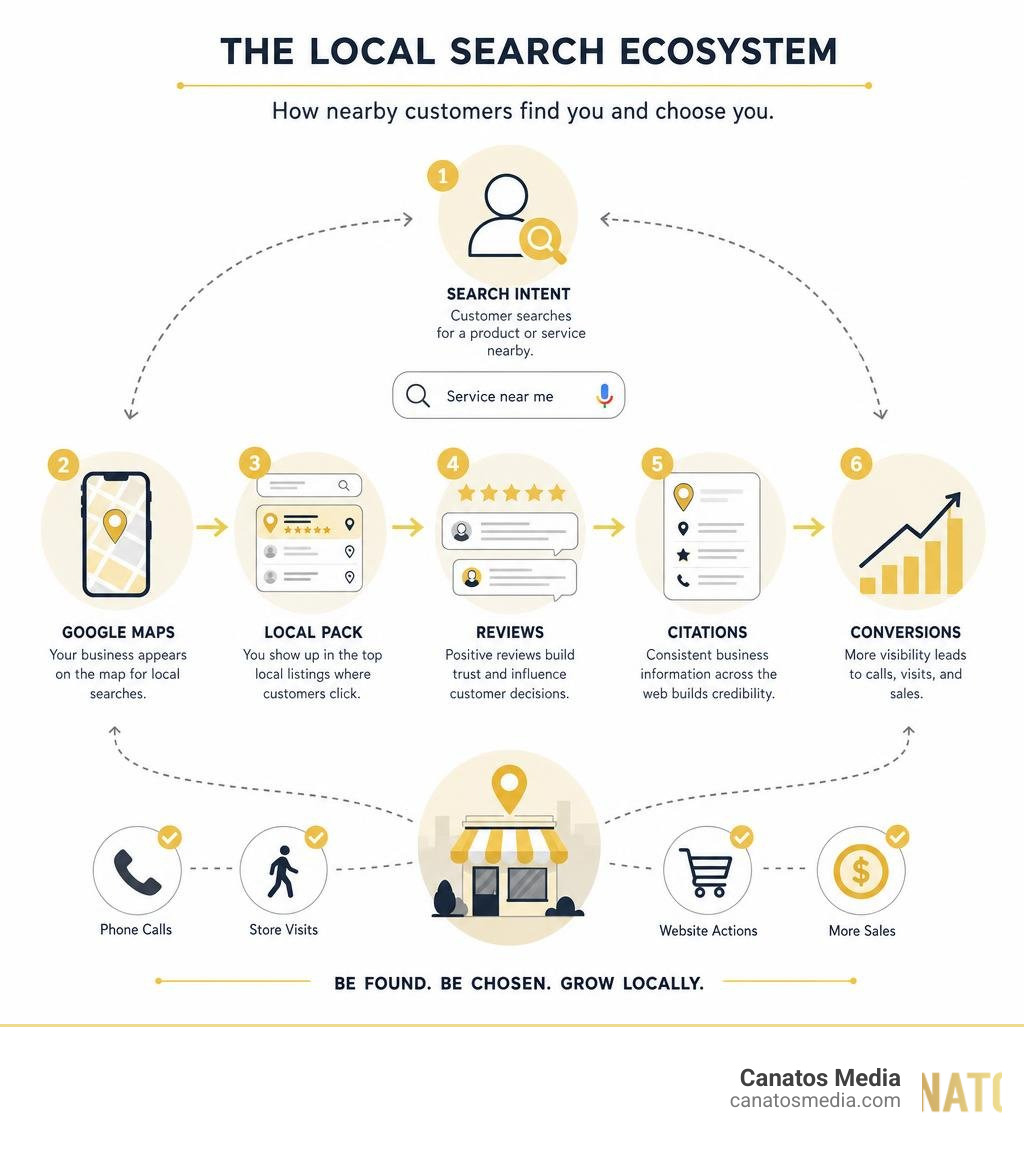
Local small business seo terms made easy:
What is Local Small Business SEO and Why It Matters in 2026
If you run a business in the Tri-State area or out on Long Island, your playing field is highly competitive but incredibly rewarding. Whether you are a boutique in Montauk, a family dentist in Nassau County, or an accountant in Hoboken, you aren’t trying to capture the attention of the entire world. You just need the people driving past your storefront or sitting on their couches three blocks away to find you.
This is where local small business SEO differs fundamentally from traditional, national SEO. Traditional SEO focuses on ranking for broad, non-geographical keywords. For instance, a national flour brand wants to rank for “how to bake sourdough bread.” That is a massive, highly competitive keyword.
In contrast, local SEO is all about local search intent and the proximity factor. If you own a bakery in Suffolk County, you want to rank for “fresh sourdough bread near me” or “bakery in Huntington.” The search engine uses the user’s real-time geographic location (via GPS, IP address, or cell towers) to serve up results that are physically close to them.

To help you visualize this, we have broken down the core differences in the table below:
| Feature | Traditional SEO | Local SEO |
|---|---|---|
| Target Audience | National or global searchers | Local, geographically defined searchers |
| Primary Goal | Drive website traffic and global brand awareness | Drive foot traffic, phone calls, and local physical visits |
| Key Ranking Factors | Backlink profile, domain authority, broad content | Proximity, Google Business Profile, local reviews, citations |
| Primary Search Element | Standard organic blue links | Google Maps, the “Local 3-Pack,” localized organic results |
| Competition Level | Extremely high (competing with global giants) | Moderate (competing only with businesses in your immediate area) |
If you want to dive deeper into how search engines evaluate websites on a broader scale, you can learn more about the fundamentals of local search to build a solid foundation.
The Core Benefits of Local Small Business SEO
Many small business owners we talk to on Long Island and across the Tri-State area feel overwhelmed by the thought of digital marketing. They worry they will have to spend thousands of dollars a month on paid ads just to stay relevant. But local SEO is actually the ultimate equalizer. Here is why:
- Explosive Local Brand Awareness: When you rank in the top three map spots, every neighbor searching for your service sees your name first. It turns your business into a household name in your community.
- Highly Cost-Effective Marketing: Unlike paid digital ads where the leads stop the second you turn off your budget, organic local search positions are long-lasting. Once you claim those top spots, they continue to drive free leads month after month.
- Instant Trust and Credibility: When Google places your business in the coveted Map Pack, it acts as a stamp of approval. Combined with a steady stream of positive customer reviews, potential clients will trust you before they even pick up the phone.
- Incredible Conversion Rates: People searching with local intent are highly motivated. They aren’t just researching; they are looking to buy today. In fact, 28% of local searches result in a purchase within 24 hours.
- Drives Direct Foot Traffic: If you run a brick-and-mortar storefront, ranking highly on mobile map searches is the single best way to guide physical customers directly to your front door.
If you are operating on a tight budget, you don’t have to break the bank to get started. You can discover affordable SEO services that won’t make your wallet cry and begin building your local authority step-by-step.
Core Pillars of Local Search Dominance
To win at local small business SEO, you have to understand how Google decides who gets the spotlight. When a user types in a query with local intent, Google deploys its local ranking algorithm. This algorithm is built upon three core pillars: Relevance, Distance, and Prominence.
- Relevance: How well does your business match what the user is searching for? If someone searches for “organic dry cleaners,” Google won’t show a standard laundromat unless its profile and website clearly state they offer organic services.
- Distance (Proximity): How far is your business from the searcher or the search location specified? While you cannot control where a searcher is standing, you can control how clearly you define your service areas.
- Prominence: How well-known or trusted is your business? Google measures this by looking at your reviews, your backlink profile, your local directory presence, and how active you are online.
When these three pillars align, Google rewards your business by placing you in the Local Pack (also known as the Map Pack or the Local 3-Pack). This is the box of three featured local business listings that appears at the very top of Google’s search results, right beneath the map.
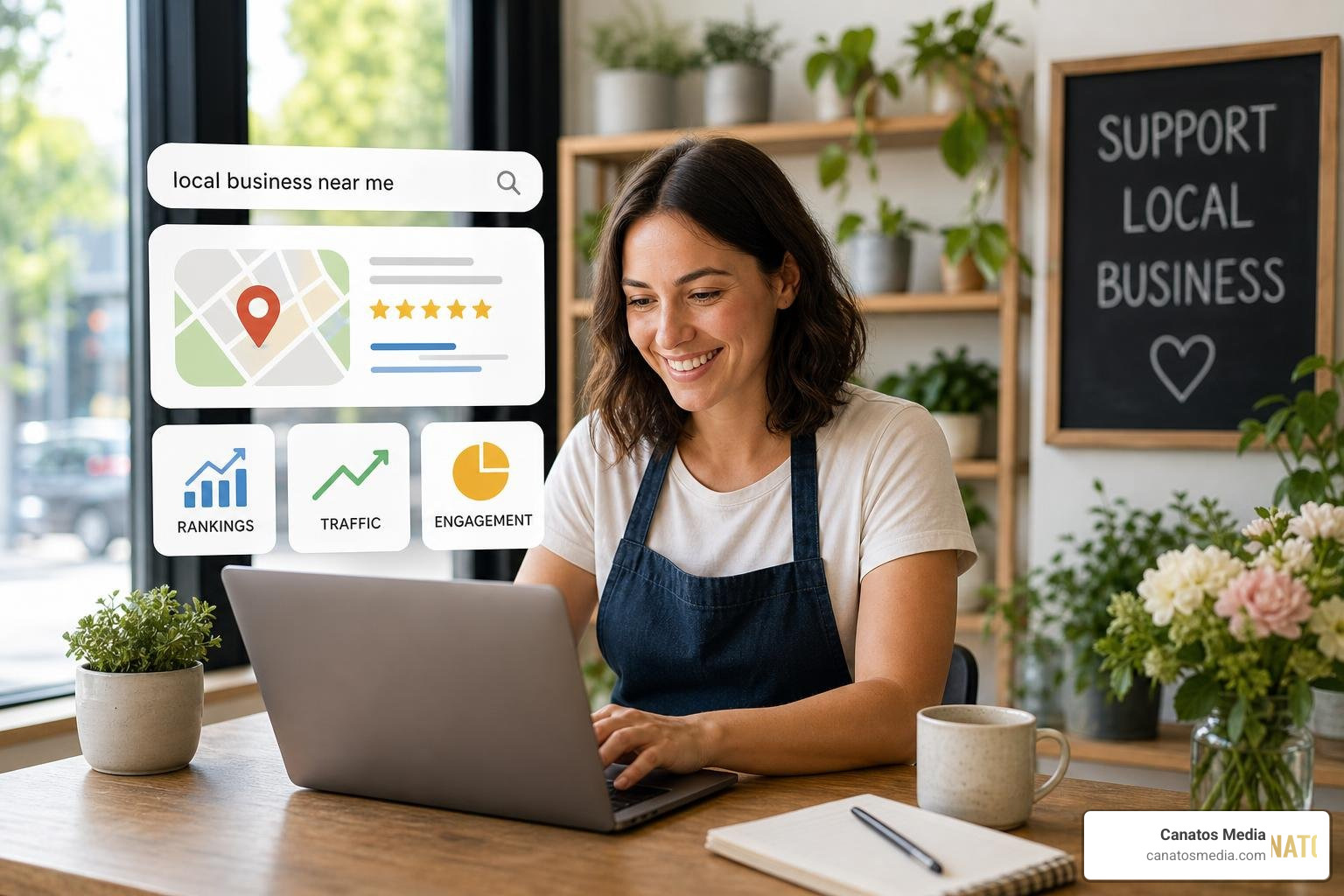
Because the Local Pack occupies the most valuable real estate on mobile and desktop screens, it captures roughly 75% of all local search clicks and calls. If you aren’t in those top three spots, you are essentially handing your local customers directly to your competitors.
How Google Ranks Local Small Business SEO
While we can’t control the physical distance between your shop and the searcher, we can absolutely maximize your Relevance and Prominence. Google’s local ranking algorithm relies heavily on specific off-page and on-page signals to determine your worthiness.
First, your proximity signals must be crystal clear. This means your physical address must be verified, and your website must clearly outline the specific cities and neighborhoods you serve.
Second, review velocity plays a massive role. It is not enough to have 100 great reviews from three years ago. Google wants to see a steady, natural influx of fresh, positive reviews. A business with 40 reviews—with five of them submitted in the last two weeks—will often outrank an older competitor with 150 stagnant reviews.
Third, citation consistency is vital. If your business is listed as “Canatos Media” on Google, “Canatos Media LLC” on Yelp, and “Canatos Marketing” on the YellowPages, Google’s algorithm gets confused. That confusion dilutes your prominence score. Keeping your Name, Address, and Phone number (NAP) identical across the entire web is a non-negotiable rule.
To make sure your technical and local foundations are built correctly, you can find reliable providers with our SEO services 101 guide to help navigate the complex landscape of search algorithms.
Google Business Profile and Reputation Management
Your Google Business Profile (GBP) is the single most important digital asset for local search. It is the control center for how your business appears on Google Maps and search results. If you haven’t claimed, verified, and fully optimized your GBP, you are invisible.
To optimize your Google Business Profile for maximum impact:
- Fill Out Every Single Field: Don’t skip anything. Enter your exact business name (no keyword stuffing!), category, business hours, holiday hours, local phone number, and a detailed, keyword-rich business description.
- Select Accurate Categories: Your primary category is a massive ranking signal. Choose the most precise primary category possible (e.g., “Italian Restaurant” instead of just “Restaurant”), and use secondary categories to capture related services.
- Upload High-Quality, Real Photos: Avoid stock photography. Upload real, high-resolution photos of your storefront, your team, your work, and your products. Keep adding new photos weekly to signal to Google that your business is active.
- Leverage Google Posts: Think of Google Posts as free social media space directly on your search listing. Use them to share weekly updates, promotions, events, and helpful tips.
- Build an Automated Review System: Don’t just hope customers leave reviews. Implement a system—using post-service SMS text messages, email follow-ups, or physical QR codes at your counter—to ask for reviews when customer satisfaction is highest.
- Respond to Every Single Review: Always reply to reviews within 24 hours. Thank your positive reviewers, and address negative feedback professionally and constructively. Google notices your engagement, and so do prospective customers.
For a deeper dive into managing your digital footprint and ensuring your business stays ahead of the curve, you can read how local businesses dominate search with smart reputation management.
Actionable Strategies to Improve Local Search Visibility
Now that you understand the rules of the game, let’s look at the actual strategies you can implement to push your business to the top of the local search results.
First, let’s talk about local citation building. A citation is any online mention of your business’s Name, Address, and Phone number (NAP). These citations live on local directories, review platforms, and social media networks.
To build local authority, you should submit your business to the core citation stack: Yelp, Apple Maps, Bing Places, Nextdoor, and your local Chamber of Commerce. For businesses on Long Island or in the Tri-State area, getting listed in regional business directories—like local business associations in Nassau or Suffolk County—sends incredibly strong geographical signals to Google.
Second, mobile optimization is absolutely non-negotiable. Over 60% of local searches are performed on mobile devices while people are on the move. If your website takes more than three seconds to load, has tiny text, or lacks a prominent, clickable phone number, those mobile searchers will bounce immediately.
Third, prepare for voice search. With smart assistants like Siri, Alexa, and Google Assistant integrated into daily life, people search conversationally. Instead of typing “dry cleaner Long Island,” they ask, “Hey Siri, where is the closest dry cleaner open right now?” Optimizing for natural, conversational language and answering direct questions on your website is key to capturing this growing traffic.
On-Page Optimization and Local Small Business SEO
Your website needs to be optimized so that Google can easily understand exactly what you do and where you do it. This starts with a smart local keyword strategy.
Instead of targeting broad, highly competitive terms, weave localized keywords naturally into your page titles, headings, meta descriptions, and body copy. For example, instead of just targeting “interior designer,” use terms like “residential interior designer in Huntington NY” or “Suffolk County home decorator.”
However, be careful to write for humans first. Cramming keywords like “best plumber in Nassau County” into every single paragraph looks spammy, ruins the user experience, and will actually get you penalized by Google.
Next, you must implement structured data, specifically LocalBusiness schema markup. Schema is a piece of code you add to your website that acts like a translator for search engines. It tells Google’s spiders exactly what your business name is, your physical address, your phone number, your business hours, and your service areas.
Implementing schema is incredibly powerful because it helps Google confidently understand your business details, making you much more likely to be featured in rich search results and AI-driven search overviews.
To master this technical side of things, you can master Google search engine optimisation without losing your mind and read up on how to implement these changes, while also ensuring you learn the rules for mobile SEO success in 2026 to keep your mobile visitors happy.
Creating High-Converting Location Landing Pages
If your business serves multiple towns, counties, or neighborhoods across the Tri-State area, you shouldn’t try to cram all of those locations onto a single homepage. Instead, you need to create dedicated, high-converting location landing pages.
A common mistake we see is creating “thin” location pages—pages that are identical except for the city name swapped out in the headline. Google hates duplicate content and will often ignore these pages entirely.
To build high-converting location pages that actually rank:
- Write Unique, Localized Content: Write at least 500 words of unique copy for each location page. Mention local landmarks, community events you sponsor, or specific projects you have completed in that specific neighborhood.
- Embed a Custom Google Map: Embed a Google Map pointing directly to your verified physical location or service area radius for that specific branch.
- Showcase Local Reviews and Testimonials: Feature reviews specifically from customers who live in that town. It builds instant, hyper-local trust.
- Include Clear, Local Contact Details: Display the specific phone number, physical address (if applicable), and localized business hours for that branch.
- Make the Call-to-Action (CTA) Prominent: Ensure there is a clear, easy-to-use contact form or a click-to-call button right at the top of the page.
If you want to maximize the leads you capture from these pages, you should learn how to optimize local landing pages for high conversion lead capture in 2026 to turn those local searchers into paying clients.
Frequently Asked Questions about Local SEO
Navigating local search can spark a lot of questions. Here are some of the most common queries we hear from small business owners in our community.
How long does it take to see results from local SEO?
Local SEO is a compounding investment, not an overnight switch. If you are starting with a brand-new website and a fresh Google Business Profile, it typically takes 3 to 6 months of consistent optimization, citation building, and review generation to see significant ranking improvements.
However, if you have an existing business with some history, optimizing your Google Business Profile and correcting NAP inconsistencies can often yield noticeable ranking boosts and increased phone calls within 30 to 90 days.
Do service-area businesses need a physical address to rank?
No, you do not need a public storefront to rank on Google Maps. If you are a plumber, electrician, or mobile dog groomer who travels to customers, you can set up your Google Business Profile as a Service-Area Business (SAB).
During setup, you will verify your profile using your home address or office, but you can choose to hide your physical address from the public. You will then define your service radius by listing the specific cities, counties, or ZIP codes you serve.
What are the most common local SEO mistakes to avoid?
- Inconsistent NAP Data: Having different phone numbers, old addresses, or slightly different business names scattered across the web confuses Google and tanks your rankings.
- Keyword Stuffing Your Business Name: Adding extra keywords to your Google Business Profile name (e.g., “John’s Plumbing – Best Plumber Long Island”) violates Google’s terms of service and can lead to an instant profile suspension.
- Incentivizing Customer Reviews: Offering discounts, freebies, or gift cards in exchange for reviews is strictly prohibited by Google. If caught, Google will delete your reviews and may permanently ban your business profile.
Conclusion
Building a successful local business on Long Island or across the Tri-State area requires more than just offering great services—it requires being visible to the neighbors who are actively searching for you. Local small business SEO is the bridge that connects your hard work with the high-intent customers right down the street.
At Canatos Media, we believe in an integrated digital marketing strategy that connects content, targeting, and conversions for measurable growth. We don’t just focus on keywords; we help you tell your story and build trust. From creating cinematic short-form videos that capture attention on social media to managing your paid ads, optimizing your website, and executing a flawless local SEO strategy, we handle the heavy lifting so you can focus on running your business.
Ready to stop hiding from your customers and dominate your local market? Get started with our professional digital marketing services today, and let’s put your business on the map.