1. Unified CRM Integration Across All Marketing Channels
Most business owners treat lead generation like separate islands: social media ads over here, email marketing over there, SEO somewhere else entirely. The result is predictable: leads fall through the cracks, your sales team can’t track where prospects came from, and you’re spending more to acquire customers than you should.
A true multi-channel lead generation system connects every touchpoint into one coherent machine. When video content drives attention, landing pages capture details, email nurtures prospects automatically, and your CRM tracks everything in real time, your cost per lead drops while your conversion rate climbs.
We’ve built lead generation systems for growth-focused business owners managing multiple locations or service-based brands where visibility and consistency matter. Here are the eight foundational components that separate scalable systems from scattered marketing efforts.
Your CRM should be the central nervous system of lead generation, not a dusty database. Every lead source—paid ads, website forms, email signups, social media inquiries—needs to feed automatically into one system so your team sees a complete view of each prospect.
Without integration, your sales team wastes time manually entering data, and leads often slip through because no one owns follow-up. With proper CRM architecture, leads hit the system, triggers fire automatically, and your workflow begins without human intervention.
What this looks like in practice:
- A prospect submits a form on your website; their info appears in your CRM immediately
- They’re tagged by lead source, campaign, and location (crucial for multi-location brands)
- Assignment rules push them to the right salesperson based on geography or service type
- Automated tasks remind the team to follow up within 24 hours
The key is mapping all your marketing channels to one CRM with proper field structure. Hubspot, Pipedrive, and Salesforce all work well, but the setup matters more than the tool. We ensure your CRM schema reflects your actual sales process so data flows cleanly and your team trusts the system.
Action item: Audit where leads currently live. If they’re in spreadsheets, email inboxes, or multiple disconnected platforms, that’s your first project.
2. Video-Driven Landing Pages That Convert Social Traffic
Video content captures attention on social media, but most businesses send that traffic to generic landing pages. The mismatch kills conversions. When a prospect watches an engaging video ad and lands on a static webpage with text and a form, they often bounce.
High-performing landing pages match the energy and message of the video that drove the click. We build cinematic brand storytelling assets and pair them directly with optimized landing pages designed to convert the warm traffic that video creates. Video on the landing page itself reduces bounce rate and increases form submissions by clarifying what the prospect will experience.
Consider a service-based brand running a video ad about their free consultation process. That video should appear on the landing page itself, with a clear CTA below it. The prospect sees proof and detail in motion, then decides whether to book a call. Friction drops, conversions rise.
Landing page structure for video traffic:
- Lead with the same video or a 30-second teaser
- Remove navigation to avoid distraction
- Use scarcity or urgency language tied to actual availability
- Include social proof (testimonials, review counts, client logos)
- One primary CTA (call, form, chat)
We design landing pages with conversion metrics built in, so you see which variations, headlines, and CTAs perform best. Video-driven landing pages convert 20-40% higher than text-only alternatives.
Action item: Identify your top-performing social video ad. Create a dedicated landing page that mirrors its narrative and energy.
3. Automated Email Nurture Sequences for Lead Qualification

Not every lead is ready to buy today. The ones who aren’t ready often go cold because your team’s working on prospects further down the funnel. Automated email sequences keep warm leads engaged without salespeople doing manual outreach.
A well-designed nurture sequence typically spans 5-10 emails over 2-4 weeks, each one moving the prospect closer to a decision. The sequence itself qualifies leads by tracking which emails get opened, clicked, and responded to. If someone’s opening every email and clicking links, your sales team knows to prioritize them.
Effective nurture sequences work because they educate without selling. An early email might address a common objection. A later one shares a case study. Another offers a free resource. By the time your salesperson calls, the prospect has absorbed real value and trusts the brand.
Sequence elements that work:
- Email 1: Immediate value (free guide, discount code, intro video)
- Email 2-4: Educational content addressing prospect pain points
- Email 5-7: Social proof and case studies
- Email 8-10: Clear CTA to book a call, with urgency if appropriate
Most businesses fail here because they either send too many emails (annoying people into unsubscribes) or too few (leads forget who you are). A rhythm of 2-3 emails per week for qualified leads works for most service-based brands.
Action item: Write down your top five prospect objections, then create one email for each addressing that concern directly.
4. Cross-Platform Analytics and Attribution Tracking
You’re running Meta ads, Google Ads, social organic content, email campaigns, and SEO simultaneously. Without proper attribution, you don’t know which channel actually created the revenue. So you either overspend on the wrong channels or underfund winners.
Attribution tracking shows you which touchpoints led to conversions. Did the lead come from a video ad, then click an organic social post, then open an email before booking a call? Good attribution gives you that full path. You’ll see that video is driving awareness, email is driving decisions, and organic social is reinforcing trust.
This matters enormously for scaling. Once you know that a $500 spend on a specific ad campaign generates 10 qualified leads worth $5,000 in revenue, you can repeat that spend confidently. Without attribution, you’re flying blind.
Tools like Google Analytics 4, Mixpanel, and native platform dashboards help, but the real work is in UTM parameters, proper conversion tracking, and CRM sync. We set up attribution systems so you see which channels drive not just clicks, but actual revenue.
What to track:
- First-touch attribution (which channel introduced the lead)
- Multi-touch attribution (all touchpoints before conversion)
- Cost per lead by channel
- Lead quality by source (do Meta leads convert higher than Google leads?)
- Customer lifetime value by acquisition channel
Action item: Create a simple spreadsheet tracking leads by source for the next 30 days. Calculate cost per lead for each channel. You’ll immediately see where money is or isn’t working.
5. Strategic Meta and Google Advertising Funnels
Most businesses run Meta and Google ads reactively: “We need leads this month, so let’s run an ad.” Strategic advertising instead builds funnels that move cold prospects to warm to sales-ready over weeks or months.
A proper funnel has awareness campaigns (reaching cold audiences with entertaining video content), consideration campaigns (targeting people who visited your site or watched your video), and conversion campaigns (targeting warm audiences ready to book or buy).
We structure Meta ads management and Google campaigns to segment audiences and test different creatives. Video-based awareness campaigns introduce your brand. Retargeting campaigns remind people who’ve seen your content but haven’t converted. Final-click campaigns target people searching directly for your service or product.
The efficiency gain is substantial. Instead of a single broad campaign reaching everyone with unclear results, you’re building sequential campaigns that nurture people progressively closer to a sale. This approach typically improves ROAS (return on ad spend) by 30-60% compared to scattered ad management.
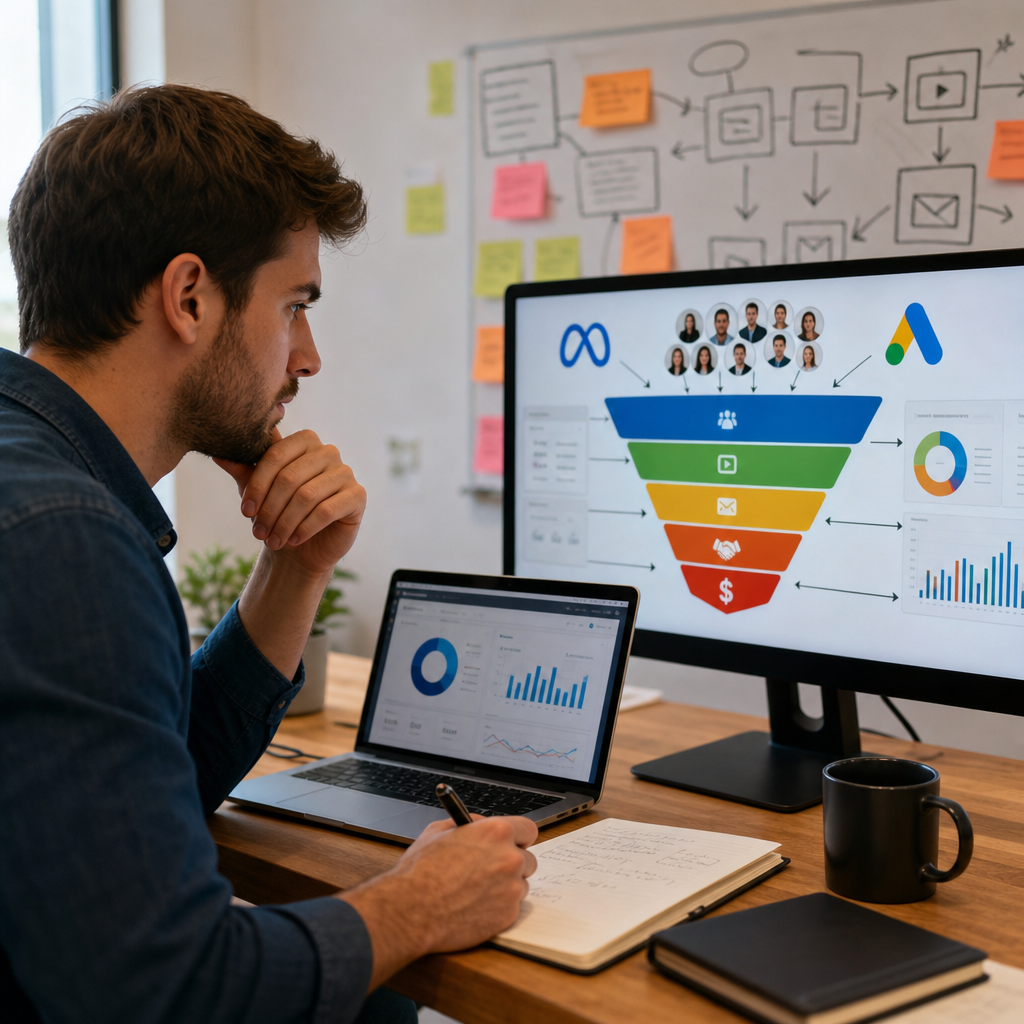
Funnel structure:
- Awareness: Broad audiences, video-first creative, brand messaging
- Consideration: Website visitors, video engagers, lookalike audiences
- Conversion: Cart abandoners, high-engagement audiences, search intenders
- Retention: Past customers, email subscribers, engaged followers
Each layer has different KPIs. Awareness campaigns succeed on views and engagement, not immediate conversions. Conversion campaigns live and die on cost per lead or cost per sale.
Action item: Map your current ad spend across these four funnel stages. If you’re only spending in one stage, that’s your scaling bottleneck.
6. SEO-Optimized Content That Attracts High-Intent Leads
Paid ads create immediate visibility but stop the moment you stop spending. SEO creates cumulative, long-term visibility that compounds over months and years. High-intent searchers (people actively looking for your solution) often convert higher than cold ad audiences because they’re already in buying mode.
Content optimized for search intent addresses the specific questions your customers ask before they contact you. A service-based brand might rank for “how to [solve problem]” or “[problem] near me.” A product brand might rank for “[product type] comparison” or “best [product category].”
We audit search intent across your industry, create content addressing high-intent keywords, and optimize pages technically so search engines rank them. This generates a steady stream of qualified leads that cost nothing per click once they convert to visits.
Content strategy for lead generation:
- Identify high-intent keywords (searches showing buying intent)
- Create long-form content (1500+ words) addressing those queries
- Optimize on-page elements (title, meta description, headers) for keywords
- Build internal links between related content pieces
- Update content regularly to maintain rankings
SEO takes 3-6 months to show meaningful results, but that timeline justifies the investment because you’re building an asset that continues producing leads years later. A blog post that ranks for a valuable keyword can drive dozens of leads monthly indefinitely.
Action item: Search your main service or product keyword on Google. Review the top 5 results. Could you create better, more detailed content? That’s your starting point.
7. Social Media Management Connected to Sales Workflows
Most social media management happens in isolation. Your team posts content, engages with comments, maybe generates some clicks. But those engaged followers rarely become structured leads because there’s no system converting social attention into sales conversations.
Connected social media management treats every comment, DM, and link click as a potential lead worthy of follow-up. When someone engages heavily with your content, they’re signaling interest. That signal should trigger a response from your sales team or nurture sequence, not go unanswered.
We manage social accounts with lead generation in mind. Every piece of content has a clear CTA. Comments on posts are responded to within hours, building relationship. DMs are monitored and answered promptly. High-engagement followers are invited to join email lists or book consultations.
Social-to-sales handoff process:
- Monitor engagement daily (comments, shares, saves)
- Respond to genuine inquiries within 24 hours
- Invite active followers to email list or webinar
- Tag engaged followers in your CRM
- Brief sales team weekly on hot social leads
This turns social media from a brand-building expense into a lead generation channel. You’re still building brand presence, but now you’re actively converting attention into conversations.

Action item: Review comments on your last 5 posts. Which commenters showed genuine interest? Reply to them personally and suggest a next step (email signup, free resource, consultation).
8. Website Design and Optimization for Lead Capture
Your website is where all channels funnel: paid ads, social media links, email CTAs, organic search results. If your website doesn’t convert visitors into leads efficiently, all other efforts underperform. A website optimized for lead capture has clear value messaging, reduced friction on forms, and multiple strategic CTAs.
Most websites are built for brand impression, not conversion. They’re beautiful but unclear. Visitors don’t know what you do or how to take the next step. Optimized sites are equally professional but laser-focused on moving visitors toward a specific action: book a consultation, download a resource, join your email list.
We design websites with lead capture built in from the ground up. Page load speed is fast (slow sites kill conversions). Navigation is minimal so visitors focus on the primary CTA. Forms are short and clearly explain the value they’ll receive in return. Page copy addresses specific customer pain points and shows how you solve them.
Conversion-focused website elements:
- Clear value proposition above the fold
- Short contact forms (name, email, phone, 1-2 custom fields)
- Multiple strategic CTAs throughout pages
- Fast load times (under 3 seconds)
- Social proof and testimonials on key pages
- Clear explanation of next steps after form submission
- Mobile optimization (50%+ of traffic is mobile)
We also integrate your website with your CRM and email platform so leads flow automatically into your nurture sequences. There’s no manual data entry, no lost leads, no gaps in follow-up.
Action item: Test your website on mobile. Can someone easily understand your value and submit a form without pinching and scrolling excessively? If not, that’s blocking conversions.
—
Building a multi-channel lead generation system isn’t about adopting eight disconnected tools. It’s about creating one coherent machine where every piece amplifies the others. Video content drives awareness and traffic. Landing pages convert that traffic. Email nurtures prospects automatically. Your CRM tracks everything. Paid ads accelerate the cycle. SEO builds long-term visibility. Social media keeps audiences engaged. Your website captures leads at scale.
When these systems work together, your cost per lead drops 30-50%, your sales team closes faster, and your business scales predictably. We specialize in building exactly this kind of integrated system for growth-focused business owners managing multi-location or service-based brands. Let’s discuss how to connect your marketing channels into one lead-generation engine that works.
Contact us today for a free consultation to see how we can help you grow your business.
Frequently Asked Questions (FAQ)
How do we integrate video content into a multi-channel lead generation system?
We create cinematic short-form videos specifically designed for your social platforms, then repurpose them across Meta and Google advertising campaigns while linking to optimized landing pages. Our video-driven approach captures attention in crowded feeds and drives qualified traffic directly into your lead capture systems, where automated nurture sequences begin qualifying prospects immediately.
What’s the difference between lead generation strategy and a complete lead generation system?
A strategy outlines your approach, but we build the actual system that executes it. We connect your CRM to all marketing channels, set up automated email workflows, implement cross-platform analytics, and ensure your website and social content work together as one unified engine. This means every lead we capture gets tracked, nurtured, and handed to your sales team at exactly the right moment.
Can we track which marketing channel actually generates our sales?
Yes. We implement cross-platform attribution tracking that shows us which combination of Meta ads, Google campaigns, SEO content, and social media actually drives conversions for your business. This data lets us continuously optimize our spending and content strategy so we’re not guessing about what works.