Day: July 17, 2026

  • Choosing the Right Monthly Video and Social Management Agency Model for Growth

    Choosing the Right Monthly Video and Social Management Agency Model for Growth

    The Gap Between Content Creation and Lead Generation

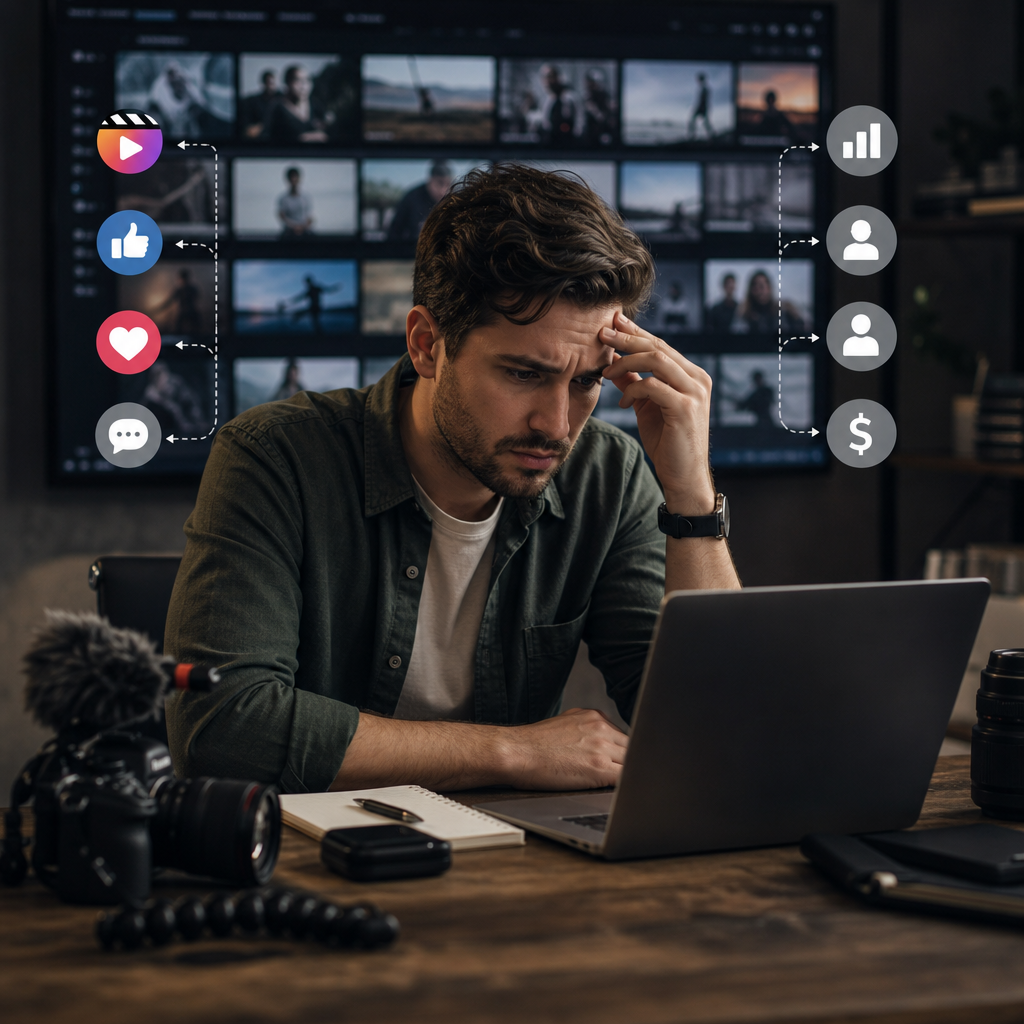
    Most brands create content and hope it drives results. They post videos on Instagram, share updates on Facebook, and expect phones to ring. The reality is messier: great content alone doesn’t convert viewers into customers. There’s a critical gap between what catches attention and what actually generates qualified leads.

    We see this constantly with multi-location and service-based brands. They invest thousands in video production, but the content sits isolated from their paid advertising strategy, their SEO efforts, and their lead capture systems. A beautiful 15-second video means nothing if it’s not part of a coordinated system designed to move prospects from awareness to action.

    The best-performing brands we work with treat video and social management as interconnected pieces. Your short-form content feeds your paid campaigns. Your social presence reinforces your SEO. Your consistent posting builds authority that makes lead generation more efficient. When these layers work together, your marketing compounds instead of scatters.

    Why Many Brands Struggle with DIY Video and Social Strategies

    Building content in-house sounds efficient until you map out the actual work. Someone on your team has to script, film, edit, post, respond to comments, manage ad spend, and analyze performance. That’s not one person’s job. It’s three jobs compressed into unrealistic timelines.

    We’ve watched business owners juggle video production while answering customer calls. We’ve seen social media managers burn out trying to learn paid advertising. Skill gaps multiply the problem: your editor might not understand what makes content perform on TikTok versus YouTube. Your ads person might not see why cinematic storytelling matters. Without alignment, you’re spending more and getting less.

    DIY also creates consistency gaps. When your team manages everything, posting schedules slip. Quality becomes uneven. Campaigns lose momentum. Meanwhile, your competitors who’ve outsourced this work are building momentum month after month with predictable posting, professional production, and coordinated strategy.

    The cost of staying DIY often exceeds the cost of hiring a capable partner. When you factor in salary, tools, training, and opportunity cost (the revenue you could generate if your team focused on core business), outsourcing becomes the financially smarter move.

    How Integrated Video Production and Management Works

    Integration means your video production strategy, social media posting schedule, paid advertising, and lead generation systems share the same objectives and data. Instead of silos, you have feedback loops.

    Here’s the flow: We produce short-form video content tailored to your audience and platform. That content gets distributed across your organic social channels on a consistent schedule. Simultaneously, we repurpose and adapt the same content for paid campaigns on Meta and Google. The engagement data from both organic and paid informs what we produce next. Your social presence builds authority signals that strengthen your SEO. Meanwhile, the leads coming through your systems get tracked and fed back into campaign optimization.

    This integration reduces wasted effort and amplifies results. A single piece of cinematic content can serve five functions: organic reach, paid conversion, SEO signals, email nurture, and brand storytelling. When everything connects, your marketing budget works harder.
    Our Approach to Cinematic Short-Form Content Strategy

    We don’t treat short-form video as throwaway content. Every video we produce follows a narrative structure designed to hold attention, communicate value, and create desire for action.

    Cinematic quality means investing in production values that make your brand stand out. It means thoughtful lighting, intentional sound design, and editing that serves the story rather than distracting from it. But it’s not about making art films. It’s about making content that performs.

    We start by understanding your customer’s decision journey. What questions keep them awake at night? What objections do they voice before buying? What social proof resonates with them? We script content around these insights, then produce it with the production quality that commands attention in crowded feeds.

    The strategy layer ensures consistency. We don’t produce random videos. We develop a content calendar that addresses specific themes monthly, showcases different customer success stories, and creates narrative momentum. This consistency builds trust and keeps your brand top-of-mind as prospects move toward purchase decisions.

    Building Predictable Lead Generation Systems

    Predictable lead generation requires two things: a reliable flow of qualified traffic and a conversion system that captures that traffic efficiently.

    We build this by layering video content into a broader lead funnel. Your organic social content builds awareness and audience. Your paid video campaigns reach prospects at specific stages of their decision journey. Your website captures their information through strategically placed lead magnets and conversion points. Your email sequences nurture those leads until they’re ready to engage sales.

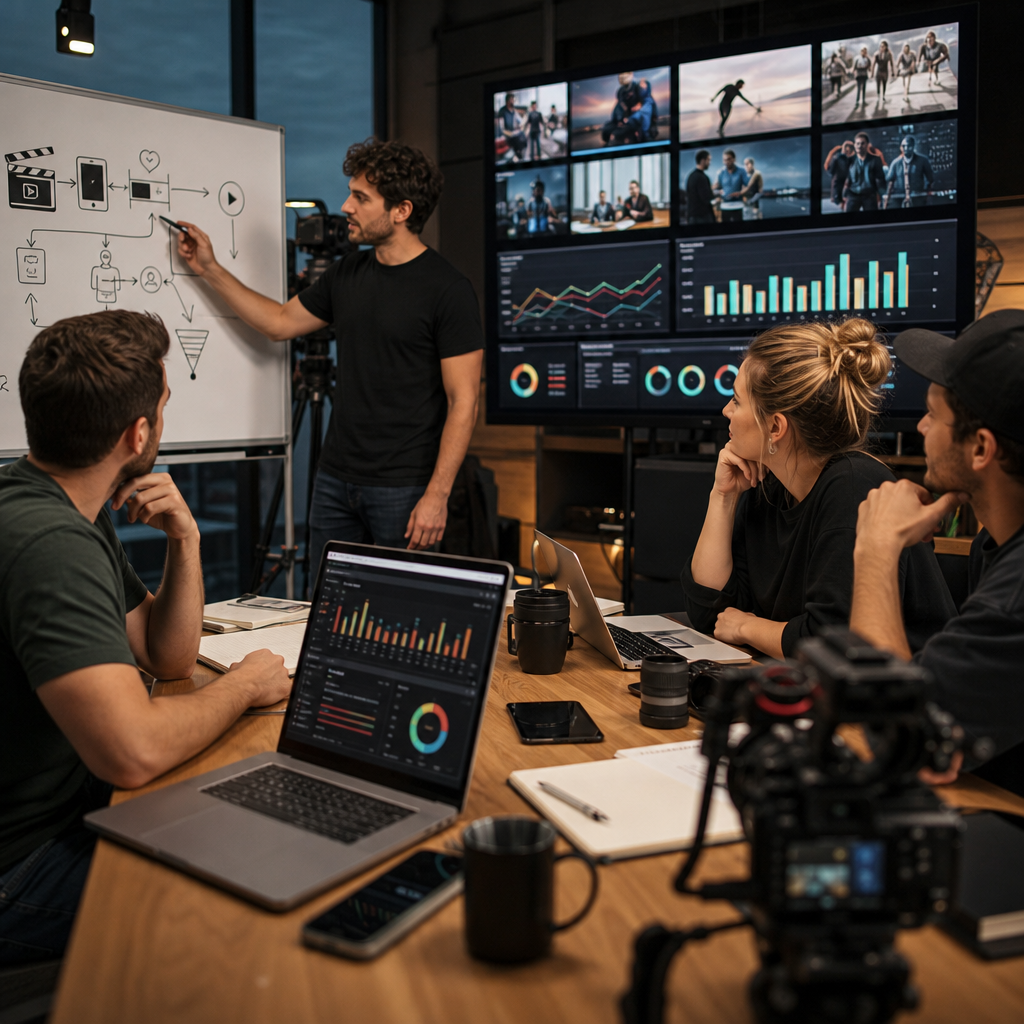
    The system only works when every element gets measured. We track which videos drive clicks. Which platforms deliver the lowest-cost leads. Which messaging resonates with different audience segments. That data informs monthly adjustments. A conversion rate that slips gets immediate attention. A platform that underperforms gets tested with different creative. Success isn’t luck. It’s systematic refinement.

    The Cost-Benefit of Full-Service Monthly Partnerships

    Monthly retainers change the economics of video and social management. Instead of paying project rates for sporadic content, you pay a stable fee for consistent output and strategic optimization.

    This stability benefits both sides. You get reliable content production and management. We gain the time to truly understand your business, test strategies thoroughly, and compound results month over month. Annual contracts make sense when a partner knows your brand deeply.

    The all-in cost per lead drops significantly with monthly partnerships. When we produce 8-12 videos monthly instead of 2-3, production costs per piece decrease. When we manage ongoing paid campaigns instead of starting from scratch each time, we skip the learning curve. When we have months to optimize rather than weeks, we hit better conversion rates.
    For most multi-location and service-based brands, a full-service monthly retainer costs less than hiring a part-time employee while delivering more specialized expertise. Explore our flexible packages built to grow your brand and generate leads.

    Measuring Success: ROI Metrics That Matter

    Not all metrics deserve attention. Vanity metrics like views and likes feel good but don’t move the needle. Real ROI measurement focuses on business outcomes.

    Track these metrics consistently:

    • Cost per qualified lead (actual leads, not just clicks)
    • Lead-to-customer conversion rate
    • Customer acquisition cost compared to customer lifetime value
    • Video engagement rates segmented by platform and content type
    • Paid ad return on ad spend (ROAS)
    • Website traffic from social and organic channels
    • Email open and click rates for leads captured through video

    The data tells you what’s working. If one video format drives 3x more leads than another, you shift production toward that format. If a particular platform delivers leads at half the cost of competitors, you adjust budget allocation. Metrics-driven decisions beat gut feelings every time.

    How We Structure Our Monthly Video and Social Model

    Our monthly model includes video production, social media management, paid advertising oversight, and lead tracking.

    Typically, we produce 8-12 short-form videos monthly tailored to your platforms and audience. We handle scripting, shooting, editing, and revisions. Your social channels get managed with consistent posting schedules, community engagement, and growth strategies. We oversee your paid campaigns on Meta and Google, continuously testing creative variations and audience targeting. We track performance and deliver monthly reports showing leads, costs, and ROI.

    The mix adjusts based on your needs. A brand launching might need heavier production and paid spend. A mature brand might optimize more and produce less. Our all-in-one social content and management platform consolidates these services so you work with one team that understands both your creative direction and your business goals.

    Why Consistency and Quality Separate Winners from the Rest

    The brands dominating their markets share two traits: they publish consistently and they maintain quality standards.

    Consistency builds momentum. When you post weekly instead of randomly, algorithms favor you. Your audience develops habits around your content. Your team builds efficient production routines. Momentum compounds: month three outperforms month one because you’ve built an audience and refined your approach.
    Quality protects your brand. A single poorly produced video can undermine months of trust-building. Your customers notice when production values drop or messaging becomes inconsistent. Conversely, reliably excellent content signals professionalism and stability.

    The brands we work with commit to this discipline. They understand that a weekly two-minute video produced with care beats sporadic content made in haste. They see video and social not as occasional marketing tactics but as foundational business infrastructure.

    Getting Started with Your Transformation

    Start by auditing where you are. What videos are you producing now? Which platforms matter most for your audience? What’s your current lead volume and cost per lead? What’s consuming your team’s time without clear ROI?

    The next step is clarity about your growth targets. Do you want to double leads? Enter new markets? Build authority in your niche? Your targets shape the strategy. A brand aiming for premium positioning needs different content than one competing on volume.

    From there, you can explore whether a monthly video and social management partnership makes sense for your situation. We’re here to discuss your specific needs and show you what integrated video production and social management can deliver. Reach out, and let’s map out a path forward.

    Contact us today for a free consultation to see how we can help you grow your business.

    Frequently Asked Questions (FAQ)

    What’s included in your monthly video and social management partnership?

    We handle everything from cinematic short-form video production to ongoing social media management, paid advertising on Meta and Google, SEO optimization, and lead generation system setup. Our team produces content, manages your accounts, runs targeted ad campaigns, and tracks performance metrics to ensure we’re driving measurable results for your business each month.

    How do you ensure our video content actually converts to leads and sales?

    We build integrated systems that connect your video content directly to lead capture and nurturing workflows rather than treating content as standalone posts. Our approach combines high-quality cinematic storytelling with strategic ad targeting, landing page optimization, and tracking that measures exactly which content drives qualified leads and customers to your business.

    Why is a full-service monthly model better than hiring freelancers or doing it in-house?

    We provide continuity, accountability, and cross-functional expertise that scattered freelancers can’t match. When one team handles your video production, social strategy, paid ads, and SEO together, we see the complete picture of what’s working and adjust everything in concert. This integrated approach costs less than hiring multiple specialists and delivers faster, more predictable growth.
  • A – Z Guide to Live Production Services

    A – Z Guide to Live Production Services

    What Is Live Production — and Why It Matters in 2026

    Live production is the real-time process of capturing, switching, mixing, and delivering audio and video content to an audience — whether that audience is in a stadium, watching on TV, or streaming on their phone.

    Here’s a quick breakdown of what live production actually covers:

    Element What It Means
    Multi-camera switching Cutting between camera angles in real time
    Audio mixing Balancing sound from mics, music, and effects live
    Graphics & overlays Lower thirds, scoreboards, brand visuals
    Signal routing Getting the right feed to the right screen or platform
    Transmission Delivering the final output to broadcast, stream, or venue
    Communications Keeping crew connected via intercom systems

    Live production today spans everything from corporate town halls and sports broadcasts to K-Pop concerts and university esports events. It can happen on-site, remotely, or entirely in the cloud — and the line between those models is getting blurrier every year.

    The scale can be enormous. A single large concert can involve 60–70 crew members and over 20 partner companies working in sync. Miss one cue, and the whole show falls apart.

    I’m Nic Canobbio, founder of Canatos Media, and I’ve spent over two decades overseeing live production and content strategy — from national podcasts to social media content that has reached over 60 million views. In this guide, I’ll walk you through everything you need to know to understand, plan, or hire for a live production.

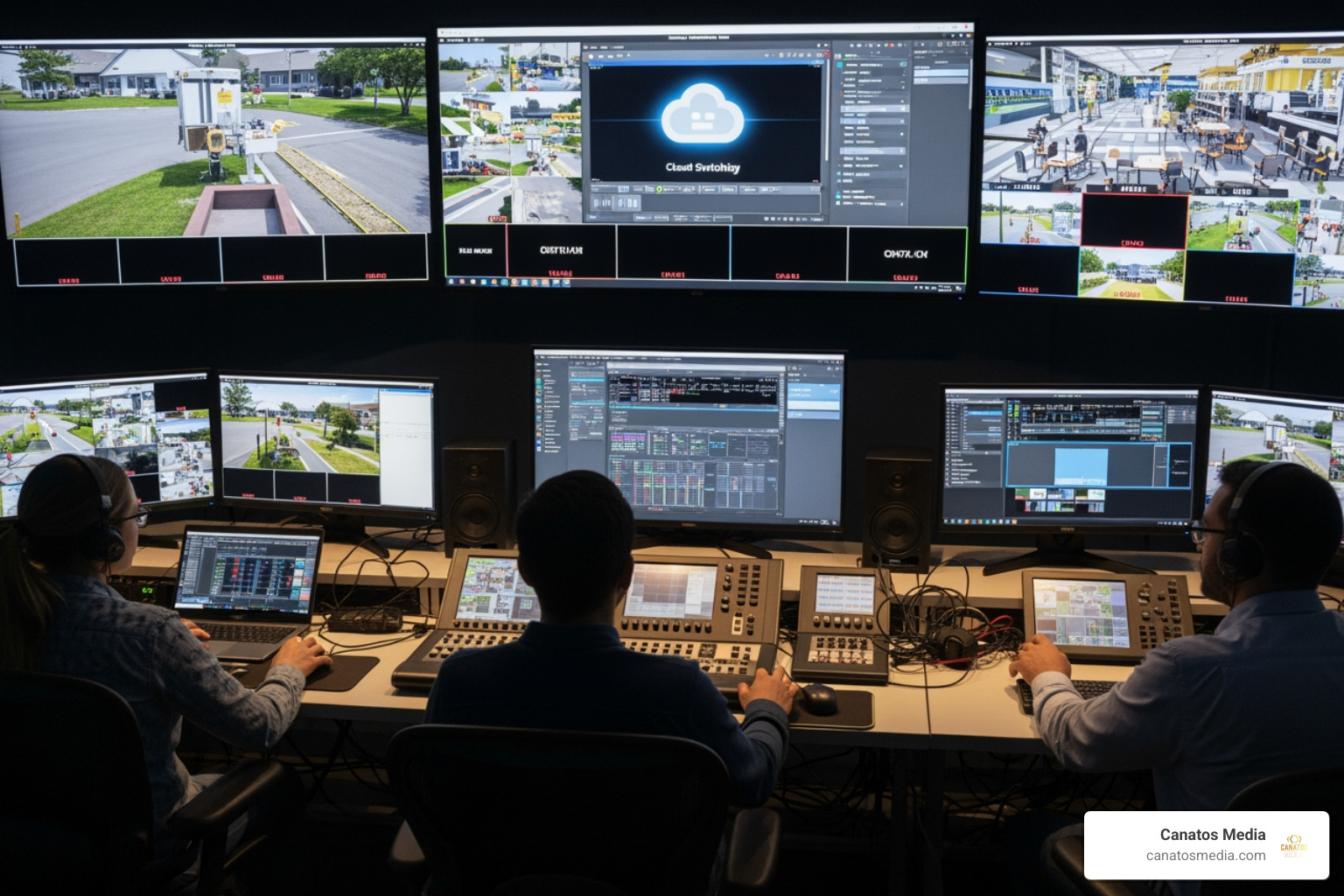
    Live production ecosystem infographic showing on-site, REMI, and cloud models with key components infographic

    Modern Live Production Workflows: On-Site, REMI, and Cloud Models

    remote production setup and cloud switching

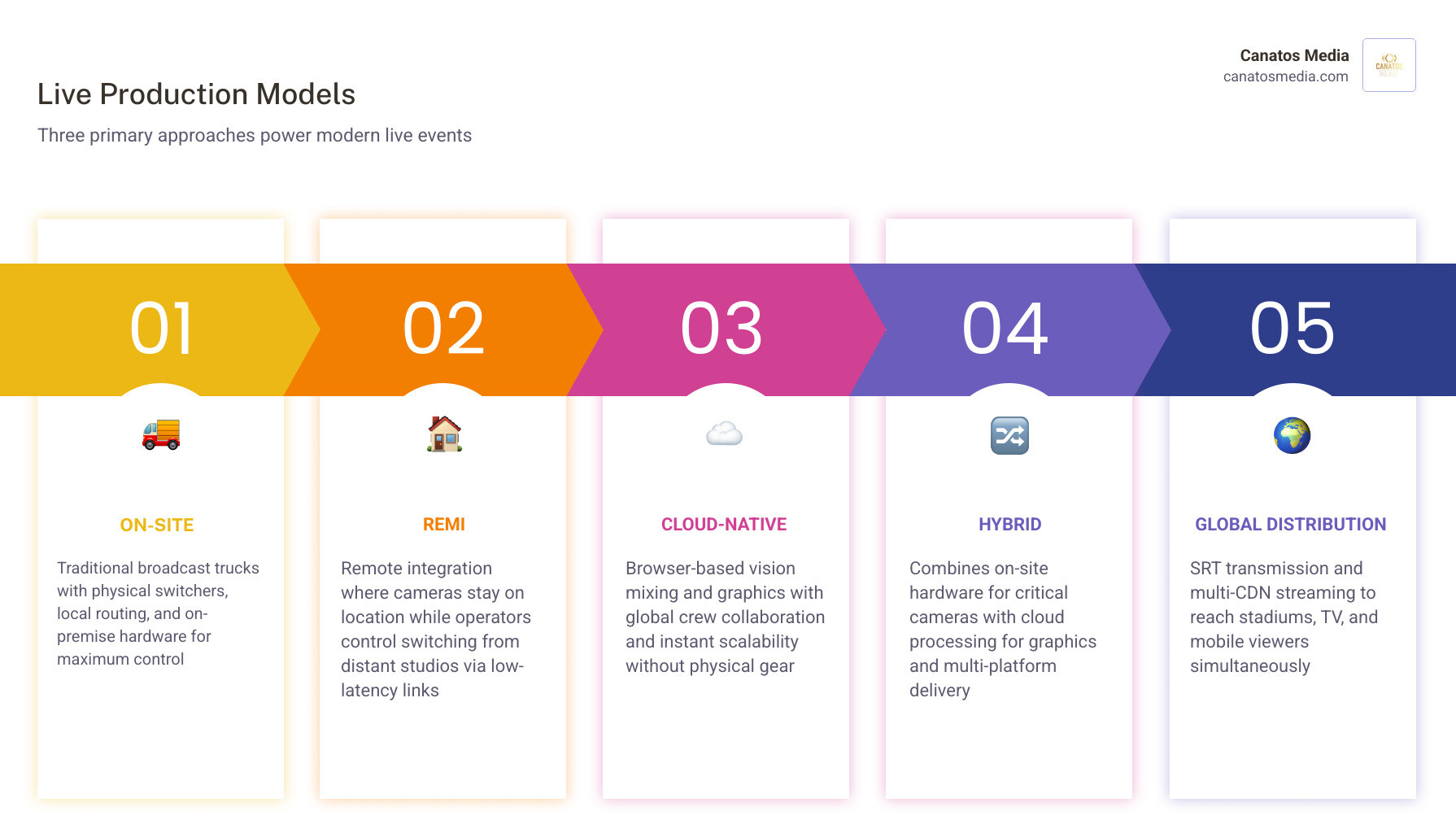
    The landscape of live production in 2026 is defined by flexibility. Gone are the days when producing a high-quality live event meant parking a multi-million dollar broadcast truck outside a venue and running miles of heavy coaxial cable. Today, producers balance on-site hardware, remote production (REMI), and cloud-native environments to build workflows that fit their specific budget, scale, and distribution needs.

    Understanding how these models differ is the first step to executing a flawless broadcast. Whether you are planning a corporate town hall or a multi-venue conference, choosing the right framework will determine your technical requirements and your overall budget. For a deeper look at setting up web-based broadcasts, check out our resource on The Essential Guide to Hiring a Webcasting Production Company.

    On-Premises and Hybrid Infrastructure

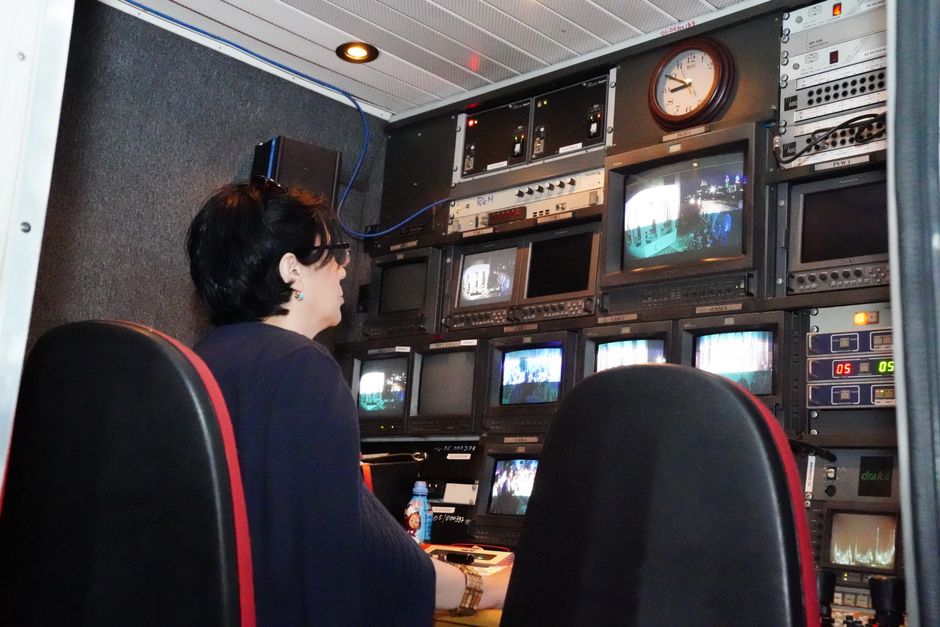
    Traditional on-premises production relies heavily on physical hardware located directly at the venue. This setup utilizes physical production switchers, local SDI or IP routing (such as SMPTE ST 2110), and dedicated hardware for graphics, audio mixing, and engineering.

    For iconic regional venues in the tri-state area, such as the historic State Theatre New Jersey or the bustling stages supported by NJPAC Productions , on-site infrastructure remains a critical foundation. Having hardware on-site minimizes latency to near-zero, which is essential when feeding massive LED screens inside the venue where even a microsecond of delay between the performer’s mouth and the screen can break the illusion for the audience.

    However, modern on-premises setups are rarely isolated. Most operate as hybrid infrastructures, leveraging local processing for in-venue displays while sending clean video feeds to remote teams via IP networks for secondary broadcasts or localized streams.

    Cloud-Native Live Production Platforms

    On the other end of the spectrum lies cloud-native live production. Instead of shipping physical racks of gear to a venue, technical directors can now run an entire broadcast control room from a standard web browser.

    Platforms like Live Cloud Production | Grabyo have revolutionized this space by supporting up to 16 live HD video inputs and distributing those feeds to as many as 20 simultaneous endpoints at 60 frames per second. These browser-based control rooms handle everything from vision mixing and multi-track audio routing (supporting up to 64 channels) to instant replays and real-time graphics.

    Similarly, Chyron LIVE® – Cloud-Native Live Production Platform – Chyron offers an all-in-one cloud environment that allows remote distributed teams to collaborate seamlessly. It supports up to 12 remote guests and features customizable touchscreen interfaces, making it possible to produce a high-end broadcast with a lean, geographically dispersed crew. By removing the need for physical OB vans, cloud-native platforms democratize professional live video production for organizations of all sizes.

    Scaling Across Venues and Global Audiences

    When an event scales across multiple venues or targets a massive global audience, transmission reliability becomes the primary challenge. This is where Secure Reliable Transport (SRT) and advanced hardware codecs play a pivotal role.

    A prime example of scaling live production to extreme limits occurred during the 2025 Asia Tour Encore for the virtual group PLAVE. To keep over 35,000 in-person fans at the Gocheok Sky Dome perfectly synchronized with a global live stream and simultaneous live cinema broadcasts, the production team deployed 16 AJA BRIDGE LIVE units. You can read the technical breakdown in the article AJA gear powers PLAVE Asia Tour Encore . This specialized video infrastructure managed low-latency SRT-based 4K transmission, ensuring that the real-time motion-capture dancers and the virtual band avatars stayed in perfect sync across multiple continents.

    To help you decide which model fits your next project, here is a quick comparison of the three primary workflows:

    Production Model Primary Advantage Best Suited For Key Challenge
    On-Site (On-Premises) Near-zero latency, maximum control over local feeds Arena concerts, theatrical plays, local venue screens High shipping and travel costs, massive physical footprint
    REMI (Remote Integration) Centralized crew keeps travel costs low Multi-venue corporate events, regional sports Requires robust, high-bandwidth upload speeds at the venue
    Cloud-Native Highly scalable, pay-per-hour, browser-accessible Digital-first broadcasts, esports, multi-platform streams Dependent on public internet stability, requires cloud-trained operators

    Technical Integration: Audio, Video, Graphics, and Communications

    audio and video engineers at a live event

    A successful live broadcast is like a symphony; if the brass section is out of time with the strings, the performance is ruined. In live production, this means your video switchers, audio consoles, real-time graphics engines, and crew communication systems must function as a single, unified organism.

    When managing complex multi-location events, ensuring this technical integration is seamless is paramount. For brands operating across several regions, integrating these high-end visual tools with localized content strategies is key to maintaining brand consistency, as discussed in our guide on End-to-End Video Production and Ads Management for Multi-Location Brands.

    The Role of AI and Automation in Live Production

    Automation is no longer about replacing human operators; it is about freeing them to focus on creative storytelling. Modern live automation systems act as the invisible backbone of high-pressure broadcasts.

    Systems like Producer – LiveEdit add a powerful automation engine directly to the production workflow. By connecting to video switchers, PTZ cameras, media players, and lighting desks, it allows producers to lock their entire show to a unified timecode (supporting LTC, MTC, Art-Net, and OSC). During rehearsals, the system can automatically record multiple camera angles, allowing the director to instantly replay and compare takes to perfect the show’s timing before going live.

    On the cloud side, Live Producer X | Cloud Live Video Production | Grass Valley leverages Grass Valley’s AMPP platform to offer high-end visual control through an intuitive, hierarchical workflow. It simplifies complex tasks like picture-in-picture transitions, animated wipes, and multi-layered graphics, giving solo operators or remote crews the ability to execute network-grade shows with minimal manual overhead.

    Synchronizing Multi-Camera Feeds and Graphics

    The technical complexity of synchronization multiplies when virtual elements are introduced. In modern entertainment, virtual avatars, augmented reality (AR) overlays, and physical performers must coexist in the same visual space.

    Achieving this requires precise timecode alignment and real-time rendering engines. As highlighted in the behind-the-scenes look at virtual entertainment production, Maximizing Experiences While Supporting Talents’ Emotions: Interview with the Live Production Division | COVERedge , live production is not just about technical execution—it is about translating the artist’s emotional journey into visual metaphors. Whether using motion-capture suits to drive digital avatars or coordinating live violinists with dynamic LED backdrops, maintaining exact alignment between stage visuals and performers is essential to keep the audience fully immersed in the experience.

    As the technology driving live production evolves, so must the talent operating it. The industry is experiencing a massive shift toward software-defined workflows, requiring a new generation of professionals who are as comfortable with IP networking and cloud architecture as they are with traditional camera framing and audio mixing. To understand how these production trends fit into a broader business strategy, explore The Ultimate Guide to Video Marketing for Service Businesses in 2026.

    Educational Pathways and Certifications

    The most effective training programs bridge the gap between classroom theory and real-world pressure. Modern certifications focus heavily on hands-on control room operations, IP networking, and multi-camera event design.

    In the tri-state area, local institutions and community theaters play a vital role in fostering this talent. Organizations like the Music Mountain Theatre | Live Theatre | 1483 New Jersey 179 … provide practical, grassroots environments where aspiring technicians can learn the fundamentals of live audio engineering, theatrical lighting design, and stage management. These local stages serve as proving grounds, preparing crew members to step up to complex, high-stakes corporate and broadcast environments.

    Choosing the Right Live Production Partner

    For businesses looking to host an event, choosing a production partner can feel overwhelming. The right partner should offer a balance of cutting-edge technology, creative vision, and deep regional expertise.

    In the competitive New York and Long Island market, clients look for full-service capabilities that handle everything from concept to execution. When evaluating providers, it helps to look at established regional specialists. For instance, a premier Long Island Video Production Company or a dedicated Long Island Video Production Company | New York can offer tailored local insights and rapid deployment. Additionally, partnering with experienced Event Production Companies on Long Island NY ensures that your lighting, audio, rigging, and video logistics are managed by teams who understand the unique structural and regulatory requirements of local venues.

    At Canatos Media, we believe that live video shouldn’t exist in a vacuum. We specialize in taking the high-impact moments captured during your live events and turning them into a continuous stream of cinematic, short-form content that drives real business growth. If you are ready to elevate your brand’s digital presence, explore how you can Scale your brand with Canatos Media.

    Frequently Asked Questions about Live Production

    What is the difference between REMI and cloud-based live production?

    While both models allow production teams to work remotely, they utilize different technical infrastructures. REMI (Remote Integration Model) typically involves capturing video feeds on-site and transmitting them back to a physical, centralized broadcast studio or OB van where the actual switching and mixing occur on hardware. Cloud-based live production bypasses physical control rooms entirely; all video and audio feeds are sent directly to cloud servers, and the production team controls the entire broadcast via a standard web browser from any location with an internet connection.

    How does AI improve live event production workflows?

    AI is primarily used to automate repetitive, high-speed tasks during a live broadcast. This includes real-time automated captioning and multi-language localization, automated camera tracking for PTZ cameras, and AI-driven clip creation that can instantly recognize key moments (like a goal in a sports match or a dramatic peak in a speech) to generate instant replays and social media clips without human intervention.

    What should a business look for when hiring a live production company?

    A business should prioritize reliability, clear communication, and a strong portfolio of similar events. Key factors to consider include:

    • Redundancy: Do they have backup power, secondary internet lines, and fail-safes for critical equipment?
    • Scalability: Can they handle both in-person venue needs (like PA systems and LED walls) and digital streaming audiences simultaneously?
    • End-to-End Integration: Do they manage all disciplines (audio, video, lighting, and communications) under one cohesive team, or do they rely on uncoordinated subcontractors?

    Conclusion

    In 2026, live production is no longer just about broadcasting a single moment in time; it is about creating an immersive, multi-platform experience that continues to engage audiences long after the live stream ends. Whether you are leveraging hybrid on-site infrastructure in New Jersey, utilizing cloud-native switching via Grabyo or Chyron, or scaling a global broadcast with SRT transmission, the goal remains the same: delivering flawless, high-impact stories to your audience.

    At Canatos Media, we bridge the gap between live event energy and long-term digital growth. We don’t just help you capture the moment; we specialize in scaling that footage into high-performing, cinematic content that fuels your marketing funnel. To learn more about our philosophy on content creation, check out our insights on How We Scale Cinematic Short-Form Content Without Sacrificing Quality.

    If you are ready to build an integrated video strategy that connects high-end production with targeted ads and measurable business growth, explore our approach to End-to-End Video Marketing: How We Drive Real Results for Growing Businesses, or take the next step to Scale your brand with Canatos Media today.