Day: July 18, 2026

  • Local Growth Marketing: Finding the Right Creative and Ad Partner

    Local Growth Marketing: Finding the Right Creative and Ad Partner

    The Multi-Location Marketing Challenge: Why Standard Agencies Fall Short

    Running multiple locations or serving customers across different geographic areas feels like managing multiple businesses simultaneously. Each market has its own dynamics, competitor density, and customer behavior patterns. Yet most traditional agencies treat local growth like a checkbox they complete once, then move on.

    The problem runs deeper than inconsistent execution. Standard agencies typically operate in silos: a creative team makes content, a separate ad team runs campaigns, and social media gets managed by whoever has bandwidth. This fragmentation means your message shifts between channels, your creative doesn’t align with your ad strategy, and nobody’s accountable for actual lead volume or sales impact.

    Multi-location brands specifically struggle because they need consistency at scale. A dental practice with three clinics shouldn’t have three different brand voices or three separate customer journey strategies. Yet without the right partner, that’s exactly what happens. Each location gets generic advice, and you’re left cobbling together results from disconnected efforts.

    What we see work is the opposite approach: unified strategy, localized execution. One cohesive brand story that resonates with each market, supported by location-specific ad spend and creative variations that speak to local customer needs. This requires a partner who understands both the creative side and the performance side equally well.

    Why Creative Quality and Ad Performance Are Inseparable

    Many business owners still think of creative and advertising as separate functions. You hire someone to make a nice video, then you hire someone else to run ads. The reality is that exceptional creative without strategic ad deployment underperforms, and smart ad targeting can’t compensate for weak creative.

    The relationship works like this: high-quality visual content gives your ads permission to take up space in someone’s feed. People scroll past thousands of pieces of content daily. Cinematic production value, clear value propositions, and authentic storytelling are what stop the scroll. Once you have attention, strategic ad targeting and bid optimization determine whether that attention converts into a lead or sale.

    We’ve watched campaigns fail because creative was generic even though ad targeting was precise. We’ve also seen beautifully produced content underperform because it wasn’t aligned with the audience segment seeing it or the landing page experience didn’t match the promise in the ad.

    The strongest local growth marketing partners treat these as a single system. The creative is built with ad performance insights in mind: understanding which hooks work, which video lengths get watched, which calls-to-action drive conversions. The ad strategy, in turn, is informed by what the creative actually communicates. This integration is what separates campaigns that generate a few leads from campaigns that become predictable lead generation engines.

    What Integrated Local Marketing Actually Requires

    Building a true local growth marketing system means pulling together several pieces that most agencies keep separate.

    First, you need a unified brand strategy that defines how your company shows up across all channels and locations. This isn’t a logo and color palette. It’s a clear understanding of your unique value, your customer’s actual problems, and the story that makes people care enough to take action. For multi-location brands, this strategy should feel consistent whether someone discovers you on Instagram, Google, or through a local search result.

    Second, you need creative production capabilities specifically built for short-form content. Long-form brand videos are fine for websites, but local growth happens through short-form content on social platforms and search ads. This means a partner who shoots fast, tests often, and understands the nuances of what works on different platforms.

    Third, paid advertising expertise across both Meta and Google is essential. Meta platforms (Instagram and Facebook) excel at awareness and consideration; Google ads capture high-intent searches. Most local businesses need both, but few agencies optimize them together as a unified system.

    Fourth, you need lead capture infrastructure. Great content and targeted ads funnel traffic somewhere. That somewhere should be a landing page specifically designed to convert visitors into leads, connected to your CRM so follow-up happens automatically. This often gets overlooked, but it’s where the actual conversion happens.

    Finally, you need someone accountable for results. Not impressions or reach, but actual leads and sales attributed back to your marketing efforts. This requires clean data tracking, regular performance reporting, and willingness to adjust strategy based on what’s actually working.

    When these pieces work together, local growth becomes predictable and scalable.

    Short-Form Video as Your Local Growth Engine

    Video dominates how people consume information in 2026. But not in the way many business owners think. Most people aren’t watching ten-minute brand documentaries. They’re watching fifteen-second Instagram Reels, thirty-second TikTok clips, and six-second YouTube bumper ads while scrolling.

    Short-form video is particularly effective for local growth marketing because it’s designed to stop scrolling and generate immediate interest. A potential customer needs to understand your value proposition within the first three seconds. A local dentist might show a before-and-after transformation in under thirty seconds. A service company might demonstrate problem-solution in under twenty seconds.

    The production approach matters too. Generic stock footage with voiceovers doesn’t work. People respond to authentic, cinematic content that looks professional but feels real. This is where many brands stumble. They invest in polished national ads when what drives local growth is consistent, high-quality short-form content that can be produced regularly and tested rapidly.

    We recommend a monthly cadence of short-form video production that covers different angles of your value prop: customer testimonials, problem-solution demonstrations, behind-the-scenes glimpses, local event highlights, FAQs. This library of content then fuels both organic social posting and paid advertising campaigns. One piece of content might perform well organically on your Instagram feed, then get repurposed as paid ads targeting high-intent audiences.

    The efficiency here is significant. A single production day can generate twelve to twenty social-ready clips that feed your marketing for months. This is how you maintain consistent presence across locations without burning through budget on constant new productions.

    Building Lead Generation Systems That Work Across Locations

    For multi-location brands, centralized lead generation systems with local routing are game-changers. When someone clicks your ad or messages you on Instagram, they should be instantly connected to the right location, not sent to a generic contact form that disappears into the void.

    This requires integrating several components: your CRM or lead management software, your messaging platforms (Instagram DMs, Facebook Messenger, text), your location-specific phone numbers, and your team’s workflow. When done right, a lead generated in Location A gets routed to Location A’s team automatically. Follow-up is triggered instantly rather than waiting for someone to remember to check a shared email inbox.

    Most businesses leave lead generation fragmented because it seems complex to set up. The cost is high: leads get lost, follow-up is inconsistent, and you never get a clear picture of which marketing efforts actually drive business. The investment in integration pays for itself quickly through improved conversion rates and better data about what’s working.

    For each location, you should track:

    • Where leads come from (which ad, which keyword, which channel)
    • How quickly they’re contacted (response time correlates directly with conversion)
    • Whether they convert to customers (otherwise you don’t know if your marketing is actually working)
    • Customer lifetime value by source (helps you understand where to invest)

    When you have this data, you can make intelligent decisions about budget allocation, creative testing, and location-specific strategies.

    The Hidden Cost of Fragmented Marketing Tools

    Business owners often build their marketing stack piece by piece: a social media scheduling tool here, a Facebook Ads account there, Google Ads managed one way, SEO handled separately, website built on a different platform entirely. Over time, these tools create invisible costs that drain resources and results.

    The operational cost is real. Your team spends time moving data between systems, manually tracking performance, creating reports that should be automated. Someone’s managing your Instagram schedule in one tool, your Facebook ads in another, your website content in yet another. Nobody has a complete picture of what’s working.

    The performance cost is higher. When your ad strategy isn’t informed by your website analytics, you optimize for the wrong metrics. When your CRM doesn’t connect to your ads, you can’t attribute leads back to specific campaigns. When your social content isn’t aligned with your website messaging, the customer journey feels disjointed.

    We’ve found that businesses with integrated systems outperform fragmented ones consistently. Not because the individual tools are better, but because data flows smoothly, teams coordinate efficiently, and strategy adjusts quickly based on real performance data. Integration also matters when working with an end-to-end video marketing partner who needs visibility into your full performance picture to make informed recommendations.

    How We Connect Creative Content to Measurable Results

    The connection between what we create and what actually happens in your business comes down to three things: clear tracking, honest reporting, and constant optimization.

    We set up your tracking infrastructure first. That means proper UTM parameters on every ad, pixel implementation that actually works, and CRM integration that captures lead source data. Without this, you’re operating on assumptions rather than facts.

    From there, we establish a baseline. What’s your current cost per lead? Your lead-to-customer conversion rate? Your customer acquisition cost by channel? These numbers become the target we improve against.

    Our monthly reporting focuses on what matters to your business: leads generated, cost per lead, sales attributed to marketing, and ROI. We identify which pieces of content and which ad campaigns are actually driving results, then we double down on what works and adjust what doesn’t.

    The optimization happens weekly in most cases. Ad performance data updates daily. Video engagement metrics tell us which creative angles resonate most. We test new messaging, new audience segments, new landing page variations. Each test generates data that feeds the next iteration.

    This relentless focus on connection between creative and results is what separates effective marketing from activity that just keeps the lights on.

    Strategic Ad Optimization Beyond Platform Best Practices

    Running ads on Meta and Google requires understanding their algorithms and best practices. But competitive advantage comes from going beyond that baseline.

    Platform best practices get commoditized quickly. Everyone learns to set up audiences, everyone learns about lookalike campaigns, everyone knows about bid strategies. What separates strong performers is depth of strategic thinking about your specific business situation.

    For a multi-location service business, that might mean testing different geographic bid strategies: investing more heavily in high-conversion locations, testing expansion in underperforming areas, and adjusting creative based on local seasonality. For a retail brand, it might mean different messaging for new customer acquisition versus cart abandonment recovery.

    We also think strategically about creative rotation. Rather than setting ads and letting them run, we test new variations every two weeks. Fatigue is real: audiences get tired of seeing the same creative, performance declines. By rotating in fresh short-form content continuously, we maintain engagement and lower cost per result.

    Ad sequencing is another layer. Someone who clicks your ad but doesn’t convert gets shown a follow-up ad the next day with different messaging. Someone who visits your website but doesn’t request a lead magnet sees a targeted message about that specific offer. This isn’t advanced technology; it’s strategic thinking about customer journey.

    Scaling Local Success Without Scaling Your Headcount

    One of the biggest opportunities we see is helping multi-location brands scale their marketing without scaling their team proportionally.

    This works through a combination of systems, automation, and strategic outsourcing. Your in-house team focuses on strategy, customer communication, and what only they can do. Everything else gets systematized or handled by your marketing partner.

    Monthly content production, for instance, can be handled entirely by your creative partner. You collaborate on strategy and messaging, but the actual shooting, editing, and asset organization happens outside your office. Your team focuses on distributing that content and managing customer response.

    Lead routing and follow-up can be fully automated once set up properly. New leads flow into the right location’s queue, get initial outreach automatically, and trigger team notifications. Your people time gets spent on quality conversations, not administrative work.

    Paid advertising management, creative testing, and performance optimization all happen on your partner’s side. Your team receives weekly updates but doesn’t need to live in ad platforms themselves.

    The result is that growing from three locations to five locations doesn’t require hiring additional marketing staff. Your existing team can focus on improving conversion and customer experience while your partner handles scaling the lead generation machinery.

    Real Outcomes: Lead Generation and Sales Impact

    The best measurement of any marketing partnership is what actually happens in your business.

    We work with multi-location service businesses where our partnership has doubled lead volume while reducing cost per lead by thirty to forty percent. We work with retail brands where consistent short-form video content has become their most cost-effective customer acquisition channel. We work with companies where lead routing optimization has improved sales conversion rates because response time dropped from twelve hours to five minutes.

    These outcomes aren’t luck or one-time wins. They come from systematic work: setting up proper tracking, testing constantly, optimizing based on data, and maintaining consistent creative production. They come from understanding that marketing is a system, not random activities, and that every component needs to work in service of measurable business goals.

    If you’re managing multiple locations or serving customers across different areas, you likely recognize how difficult true integrated local growth marketing feels with standard agency approaches. The right partner eliminates that fragmentation. You get unified strategy, consistent creative quality, coordinated paid advertising, and accountability for actual results.

    The next step is clarity on your current situation. What’s your lead volume right now? Where are most leads coming from? How much are you paying per lead? Once you understand your baseline, you can decide whether a more integrated approach makes sense for your growth. We’re happy to discuss what local growth marketing could look like for your specific business.

    Contact us today for a free consultation to see how we can help you grow your business.

    Frequently Asked Questions (FAQ)

    How do we help multi-location businesses generate leads consistently across different markets?

    We build integrated systems that combine cinematic short-form video content with localized ad strategies, social media management, and lead capture workflows. Our approach ensures that each location gets customized messaging while maintaining your brand’s visual consistency, so you’re not juggling separate agencies or tools for different regions.

    What makes short-form video different from traditional advertising for local growth?

    We’ve found that short-form video stops the scroll and builds trust in seconds, which translates directly to higher engagement and lead quality compared to static ads. When we pair this content with strategic Meta and Google advertising, we’re not just getting views—we’re creating pathways that turn attention into qualified leads for your sales team.

    Why do you recommend combining creative production with advertising management instead of hiring separate agencies?

    When we own both the content creation and ad performance, we can optimize in real time based on what’s actually converting for your business. There’s no communication gap between the creative team and the people running your ads—we adjust messaging, angles, and targeting together based on lead data, which eliminates the waste that happens when these functions are separated.
  • Seeing is Believing: Why Audiovisual Production Companies are Your Secret Weapon

    Seeing is Believing: Why Audiovisual Production Companies are Your Secret Weapon

    Why Audiovisual Production Companies Are the Fastest Way to Grow Your Brand

    Audiovisual production companies are specialized agencies that handle the full process of creating video and audio content — from concept and scripting through filming, editing, and distribution — for businesses, brands, and organizations.

    Here’s a quick breakdown of what they do and why they matter:

    What They Do Why It Matters for Your Business
    Create branded video content Builds awareness and trust faster than text
    Manage full production workflow Saves you time, gear costs, and guesswork
    Deliver platform-ready formats Content works across social, web, and live events
    Combine strategy with storytelling Videos drive measurable leads and sales
    Scale content across locations Consistent brand voice everywhere you operate

    Right now, over 500 million hours of video are watched on YouTube every single day. And 86% of businesses are already using video as a marketing tool. If your brand isn’t showing up on screen, your competitors are — and they’re getting the attention you’re leaving behind.

    The global video production market was worth $13.7 billion in 2023 and is on track to nearly double by 2030. That growth isn’t happening by accident. It’s being driven by brands that figured out a simple truth: seeing is believing. Video builds credibility, explains your offer, and converts viewers into customers faster than almost any other format.

    I’m Nic Canobbio, founder of Canatos Media, and with over two decades in media production — including overseeing live production, launching a national podcast, and creating social content with over 60 million views — I’ve worked across every corner of the audiovisual production companies landscape. In the sections below, I’ll break down exactly how to find the right production partner, what to pay, and how to avoid the mistakes that waste time and budget.

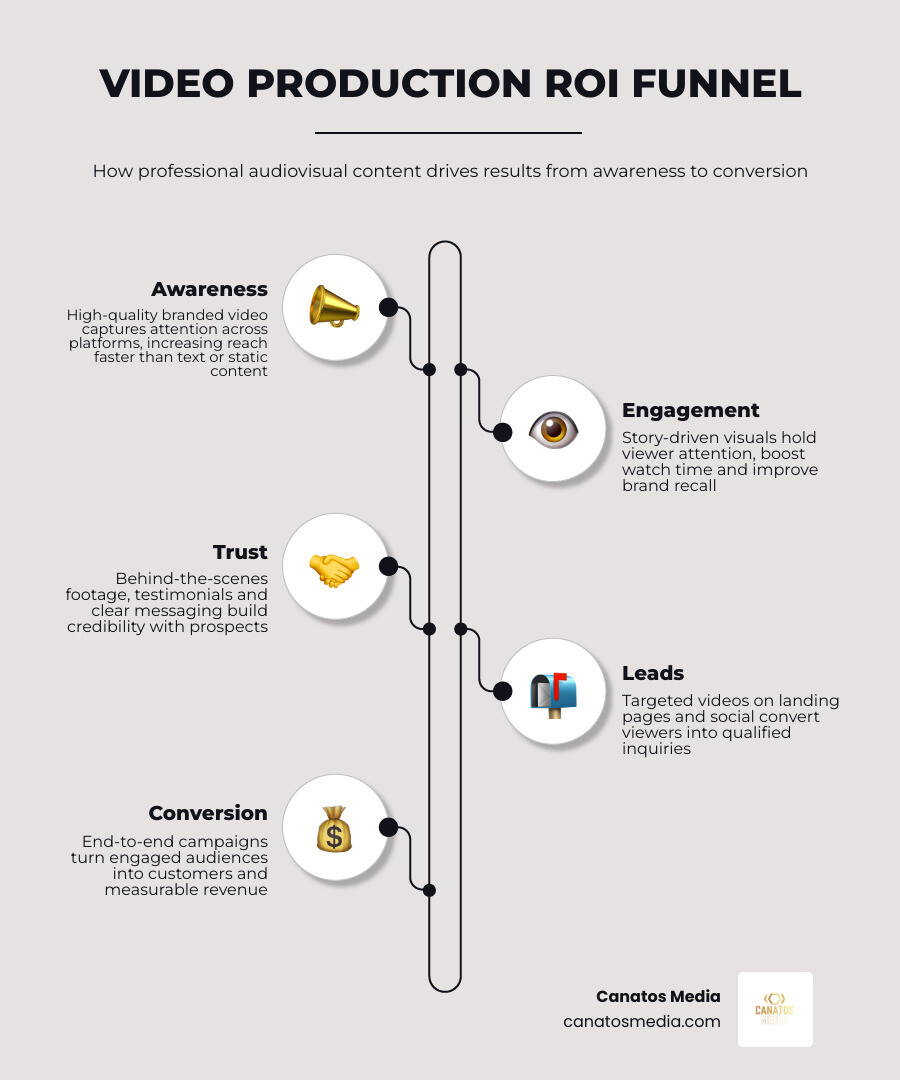
    Video production ROI funnel infographic: Awareness to Conversion for modern brands infographic

    The Main Types of Audiovisual Production Companies and Their Services

    Not all audiovisual production companies do the same thing. Some are built for brand marketing. Others focus on live events, documentaries, commercials, or entertainment. Choosing the right type matters because the best partner for a polished product launch may be the wrong partner for a hybrid conference or a training library.

    Here are the main categories clients usually run into:

    1. Full-service production companies
    2. Boutique specialist studios
    3. Corporate video producers
    4. Commercial production companies
    5. Event and live-stream teams
    6. Documentary and narrative storytellers
    7. Immersive and emerging-tech specialists

    Full-service

    A full-service team handles strategy, creative development, pre-production, filming, editing, motion graphics, sound, and delivery. This is often the best fit if you want one partner to manage the whole process instead of juggling freelancers like you’re trying to direct traffic at rush hour.

    For brands that need video to support broader growth goals, this integrated model is especially useful. We see the biggest gains when production connects with targeting, publishing, and performance. If you want a deeper look at that approach, our guide to end-to-end video marketing breaks down how content turns into business results.

    Boutique

    Boutique studios usually specialize in a narrow lane such as animation, luxury brand films, social-first content, or post-production. They can be excellent when you already know exactly what you need and want highly focused expertise.

    The trade-off is that you may need to bring more strategy, coordination, or distribution planning yourself.

    Corporate

    Corporate production companies focus on business communication. Their work often includes:

    • Internal communications
    • Recruiting videos
    • Onboarding and training content
    • Executive messaging
    • Case studies and testimonials
    • Brand films
    • Investor or stakeholder communications

    These teams understand that the goal is not just “make it pretty.” The goal is clarity, consistency, and trust.

    Commercial

    Commercial production companies are built for ads and campaigns. They tend to work with tighter creative direction, stronger visual polish, and campaign deliverables for paid media, broadcast, streaming, and social placements.

    If you’re running Meta or Google campaigns, commercial thinking matters because the footage needs to perform, not just impress your cousin who “knows cameras.”

    Documentary and narrative

    These companies are strongest at human stories, interviews, field production, and emotion-driven structure. They are ideal for founder stories, mission-driven brands, customer stories, and mini-doc style campaigns.

    Choosing Audiovisual Production Companies for Corporate Growth

    For most businesses in the tri-state area and Long Island, the right production partner is the one that understands business outcomes, not just camera settings.

    If your goals are growth-focused, look for a company that can support:

    • Brand films that explain who you are
    • Training videos that reduce repeated manual teaching
    • Internal communications that keep teams aligned
    • Customer proof content that shortens sales cycles
    • Short-form clips for social and paid distribution
    • Lead generation content tied to landing pages and ads

    That last point is huge. A beautiful video with no conversion path is basically a very expensive screensaver. Our article on lead generation video production explains what to ask if your goal is pipeline, not applause.

    Event and Documentary Specialists

    Event-focused AV teams specialize in:

    • Live streaming
    • Hybrid meetings
    • Webcasting
    • Multi-camera capture
    • Audio reinforcement
    • Lighting and staging
    • Real-time switching
    • Recording for post-event content

    Documentary specialists bring a different superpower: story depth. They know how to capture unscripted moments, interviews, and real environments without making everything feel stiff and over-rehearsed.

    For brands that want authentic, high-trust content, documentary-style production often works beautifully alongside short-form video production. One long interview day can become a brand story, social clips, recruiting snippets, and paid ad creative if planned correctly.

    Today, the AV world is wider than ever. Traditional filming still matters, but technology is changing how content is planned, captured, and delivered.

    virtual production LED volume

    The biggest shifts we see in 2026 include:

    • AI-assisted scripting, editing, logging, and versioning
    • Virtual production with LED environments
    • Remote collaboration and review tools
    • 360-degree video and immersive content
    • High-resolution capture including 8K workflows
    • Spatial and interactive experiences for niche use cases

    That does not mean every brand needs cutting-edge gear for every project. Sometimes a single-camera interview and smart edit outperform a flashy tech demo. The point is fit, not novelty.

    AI is particularly useful when it helps teams move faster without making the work generic. It can support planning, rough cuts, captions, color workflow, and content adaptation. But human strategy, taste, and storytelling still matter. A lot.

    If you’re producing content at volume across teams or locations, this balance becomes critical. Our guide on scaling cinematic content covers how to maintain quality while increasing output.

    Specialized Skills in Modern Audiovisual Production Companies

    Some projects absolutely require specialized capabilities. Others don’t.

    Here are a few specializations worth paying extra for when the project truly calls for them:

    • Drone footage and aerial cinematography
    • Live streaming and webcasting
    • Animation and motion graphics
    • 3D or virtual production
    • Multi-camera event capture
    • Advanced sound design
    • Foreign language localization
    • 360-degree or immersive video

    The key question is simple: does the specialty improve the outcome, or just the mood board?

    For example:

    • Drone footage is valuable for real estate, destination, construction, campuses, and large facilities.
    • Live streaming expertise is essential for virtual and hybrid events because reliability matters more than cinematic bokeh.
    • Animation is ideal when your service is complex or difficult to film.
    • General production skills are enough for many testimonials, talking-head explainers, and social ads.

    When webcasting is part of the mix, we recommend looking carefully at technical redundancy, crew experience, and remote audience management. Our article on hiring a webcasting production company goes deeper on what separates a smooth live event from a public stress test.

    The Role of Geographic Location and Local Talent

    Location still matters, even in a remote-friendly world.

    For clients in the tri-state area and Long Island, working with a regional partner can simplify:

    • Travel and scheduling
    • Permit familiarity
    • Access to local crew and talent
    • Faster site visits and scout days
    • Lower logistics costs
    • Better understanding of local audiences and markets

    The tri-state area remains a major production hub because it offers talent, studios, locations, and deep freelance networks. If you need support staffing a project, local directories such as LOCAL TALENT / RESOURCES – South Jersey Film Office can help illustrate the depth of regional crew ecosystems. For businesses comparing nearby options, regional production pages like Video Production in NJ & New York – Twinlight Studios®, Long Island Video Production Company | New York, Long Island Video Production Company | Solvis Media LI NY, and local listings such as THE BEST 10 VIDEO/FILM PRODUCTION IN LONG ISLAND, NY show how geographically specific many searches really are.

    That said, location should not outweigh process. A nearby team with poor communication is still a headache, just a local one.

    For brands creating content across multiple branches or service areas, consistency matters more than proximity alone. That’s why we focus on systems that support scalable short-form production.

    Pricing Structures and Project Management Workflows

    Pricing is one of the biggest mysteries in this industry. Clients ask, “How much does a video cost?” and the honest answer is, “What kind of video, with how many people, at how many locations, for how many deliverables, by when?”

    Not annoying. Just true.

    Here is a simple framework:

    Project Type Typical Timeline Common Pricing Model Main Cost Factors
    Social short-form shoot 1-3 weeks Fixed package or retainer Shoot time, edit volume, revisions
    Corporate interview video 2-4 weeks Fixed project fee Crew size, location, graphics, audio
    Event coverage 1-3 weeks plus event day Day rate or package Cameras, streaming needs, operators
    Commercial campaign 4-8+ weeks Custom quote Creative development, talent, locations
    Training video series 3-8+ weeks Project fee or retainer Script volume, filming days, versions

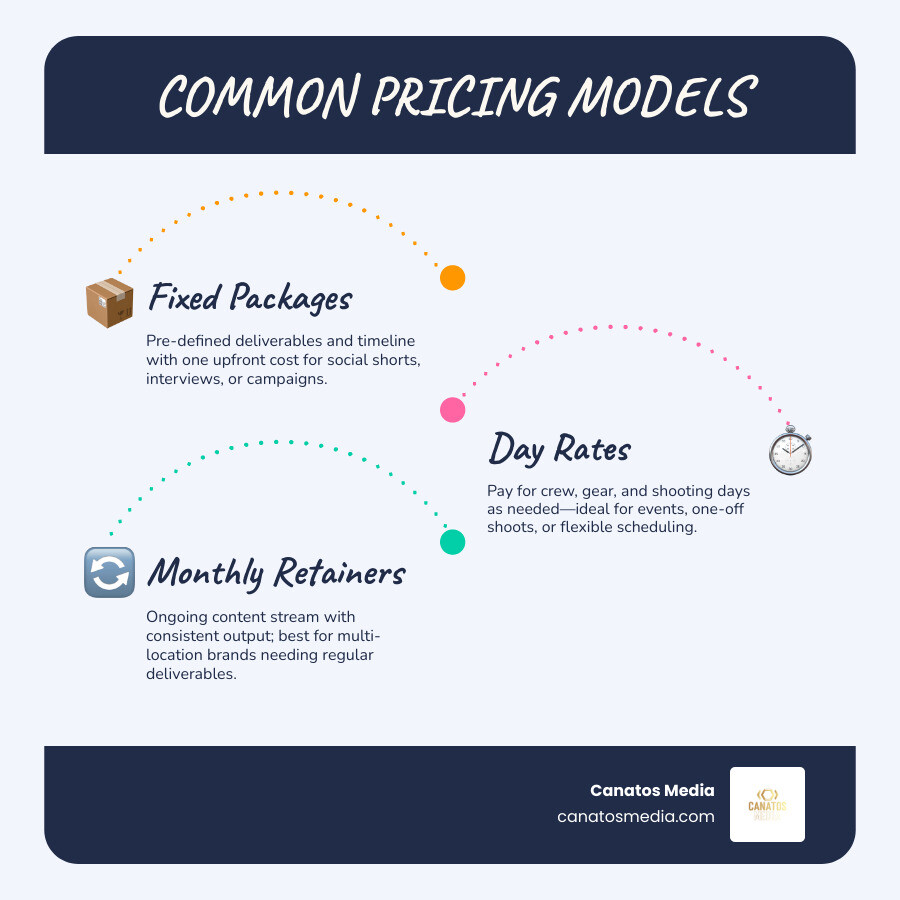
    Most production companies use one or more of these pricing models:

    • Fixed-price packages for defined deliverables
    • Day rates for crew, gear, and production days
    • Monthly retainers for ongoing content
    • Custom bids for larger or more complex projects

    Retainers are increasingly common because many brands no longer need one heroic video per quarter. They need a reliable stream of content. If that sounds familiar, our piece on budget-friendly video production explains how to keep output high without letting cost drift upward.

    infographic of video project pricing factors and timelines infographic

    Factors Influencing Production Costs

    The biggest cost drivers are usually:

    • Creative development and scripting
    • Crew size and shoot duration
    • Talent or voiceover fees
    • Location permits or rentals
    • Equipment rentals or specialty gear
    • Set design, props, wardrobe, and styling
    • Motion graphics, VFX, or animation
    • Music licensing and sound mix
    • Number of edit versions
    • Revision rounds
    • Turnaround speed

    Specialized work costs more because the margin for failure is smaller. Live streaming is a good example. You are not just paying for cameras. You are paying for planning, switching, audio capture, internet stability, backup systems, and people who know what to do when something goes sideways.

    Concept to Delivery: The Management Chain

    A strong production company should be able to walk you through the process from start to finish. A typical workflow looks like this:

    1. Discovery and goal setting
    2. Creative development
    3. Scripting or storyboarding
    4. Production planning
    5. Filming or live capture
    6. Post-production
    7. Review and revisions
    8. Final delivery and distribution planning

    Good project management is what keeps this chain from breaking.

    In our experience, clients should expect:

    • A clear point of contact
    • Defined milestones
    • Production schedules
    • Shot lists or creative outlines
    • Transparent revision rounds
    • File delivery standards
    • Versioning for different platforms
    • Quality control before final handoff

    For live or hybrid productions, redundant systems matter too. Backup audio paths, extra recording routes, duplicate media capture, and contingency planning are not glamorous, but neither is apologizing to 500 attendees because the stream vanished.

    Distribution strategy should also be discussed before filming, not after. If the content will live on paid social, landing pages, internal portals, or event screens, those use cases affect framing, pacing, aspect ratio, and editing choices from day one.

    Evaluating Portfolios and Avoiding Common Challenges

    A slick reel is helpful, but it should not be the only thing you evaluate.

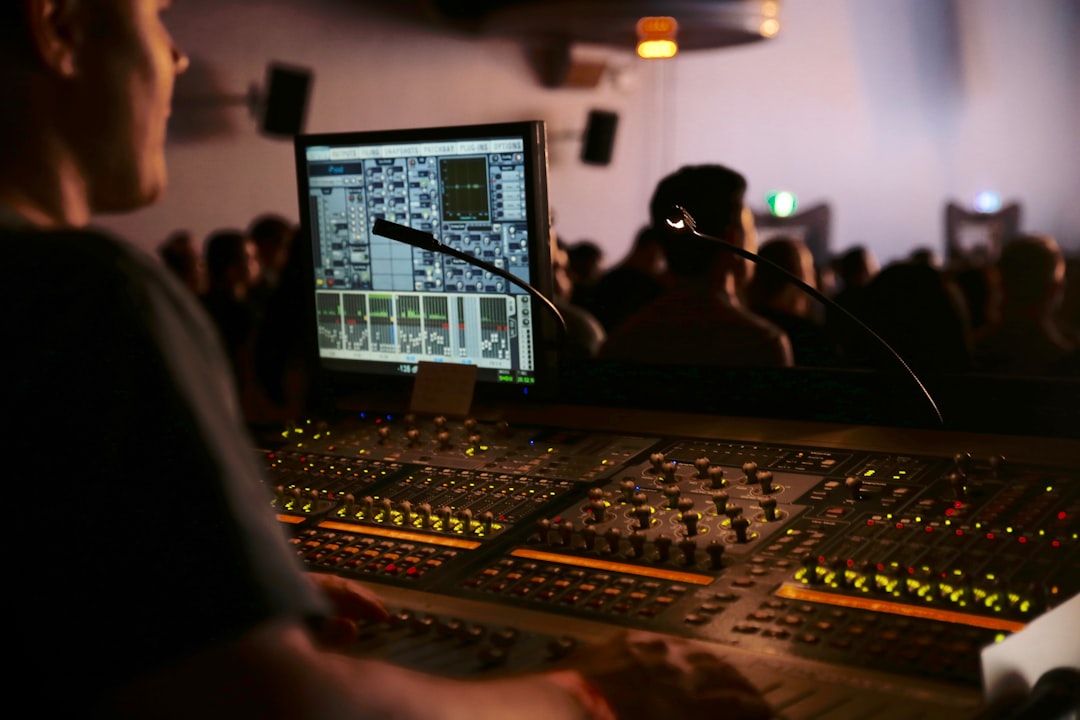
    professional editing suite with multiple monitors

    The average production company handles roughly 50 to 200 projects per year, and corporate plus commercial work makes up a large share of industry revenue. That means many portfolios are broad. Broad is fine. Relevant is better.

    What to Look for in a Portfolio

    When reviewing a production company’s work, look for four things:

    1. Visual style

    Does the work feel polished, intentional, and consistent? You are not just judging image quality. You are judging taste.

    2. Narrative depth

    Can they tell a story, or only assemble nice shots with dramatic music? Both have their place, but your project may need one more than the other.

    3. Technical execution

    Pay attention to:

    • Clean audio
    • Consistent lighting
    • Stable camera work
    • Natural color
    • Smooth editing
    • Appropriate graphics
    • Strong pacing

    If the audio is bad, viewers forgive exactly no one.

    4. Industry relevance

    A portfolio does not need to match your industry perfectly, but it should show understanding of similar objectives. A company that excels at music videos may not automatically be the best fit for compliance training. Likewise, a team that only shoots conference recaps may not be right for high-conversion ad creative.

    Also ask practical questions:

    • Have they handled projects at your scale?
    • Can they manage stakeholders and feedback?
    • Do they understand the platforms where the content will run?
    • Have they worked with multi-location brands?
    • Can they maintain brand consistency over time?

    If you need a model for this kind of integrated support, our page on end-to-end production for multi-location brands shows how strategy, production, and distribution can stay aligned.

    Avoiding Collaboration Pitfalls

    Most production problems are not caused by cameras. They are caused by unclear expectations.

    The most common issues we see are:

    • Vague goals
    • Late feedback
    • Too many decision-makers
    • Undefined revision limits
    • Scope creep
    • Missing rights or usage terms
    • Unrealistic timelines
    • No approval process

    Here is how to avoid them:

    Set clear objectives early

    Define what success looks like before creative begins. Is the video meant to educate, convert, recruit, train, or recap?

    Build structured feedback loops

    Choose who gives feedback, when, and in what format. Ten people emailing random opinions at midnight is not a workflow.

    Clarify intellectual property and usage

    Make sure your agreement covers footage ownership, licensing, music rights, talent releases, and where the final content can be used.

    Create sign-off stages

    Approve strategy, script, shoot plan, and edit milestones in sequence. This prevents major changes after production has already happened, which is the industry version of deciding to add a basement after the house is built.

    Frequently Asked Questions about Audiovisual Production

    How much do audiovisual production companies typically charge in 2026?

    In 2026, pricing usually falls into fixed packages, day rates, retainers, or custom bids. Small social content shoots may be quoted as simple packages, while commercial campaigns, live events, and multi-day productions are typically custom-scoped.

    Costs rise based on:

    • Number of shoot days
    • Crew size
    • Complexity
    • Talent
    • Locations
    • Equipment
    • Motion graphics or animation
    • Revision rounds
    • Speed of turnaround

    The best way to compare proposals is not just by total price, but by scope clarity. Ask what is included, what counts as a revision, who owns the assets, and how many deliverables you receive.

    How is AI changing the production process for businesses?

    AI is making production faster in areas like concept support, transcription, shot logging, captioning, rough editing, color assistance, content repurposing, and versioning. It can lower turnaround time and help teams create more formats from the same footage.

    But AI should support the process, not replace strategy and human storytelling. Overuse can make content feel generic, especially when every brand starts sounding like the same enthusiastic robot with perfect grammar.

    The winning approach is selective use: automate repetitive tasks, keep creative judgment human.

    What is the typical timeline for a professional video project?

    A straightforward brand or corporate project often takes 2 to 4 weeks. More involved campaign work can take 4 to 8 weeks or longer. Event work depends on the date of the event plus post-production needs. Ongoing retainers create the fastest turnaround over time because planning, approvals, and production systems are already in place.

    Timeline usually depends on:

    • Creative complexity
    • Scheduling
    • Stakeholder approvals
    • Number of filming locations
    • Edit versions needed
    • Whether animation, localization, or live components are involved

    Conclusion

    The best audiovisual production companies do more than make good-looking videos. They bring structure, specialized skill, creative direction, and business thinking to the entire process.

    That matters because content alone is not enough anymore. It has to connect to targeting, distribution, and conversion. In other words, the camera is not the strategy. It is the amplifier.

    At Canatos Media, we approach production that way: cinematic content tied to measurable growth. We help businesses connect story, platform, and performance so the final output does something useful in the real world – attract attention, generate leads, support sales, and keep brand messaging consistent across locations.

    If you want a partner that can connect production with paid media, social management, SEO, and website support, explore our End-to-End Video Production and Ads Management for Multi-Location Brands page. Because in 2026, the brands that grow fastest are not just being seen. They are being remembered.