Day: July 30, 2026

  • Beyond the Scroll and How to Craft Online Strategies That Actually Work

    Beyond the Scroll and How to Craft Online Strategies That Actually Work

    Why Digital Marketing, Social Media, and Online Strategies Define Business Growth Today

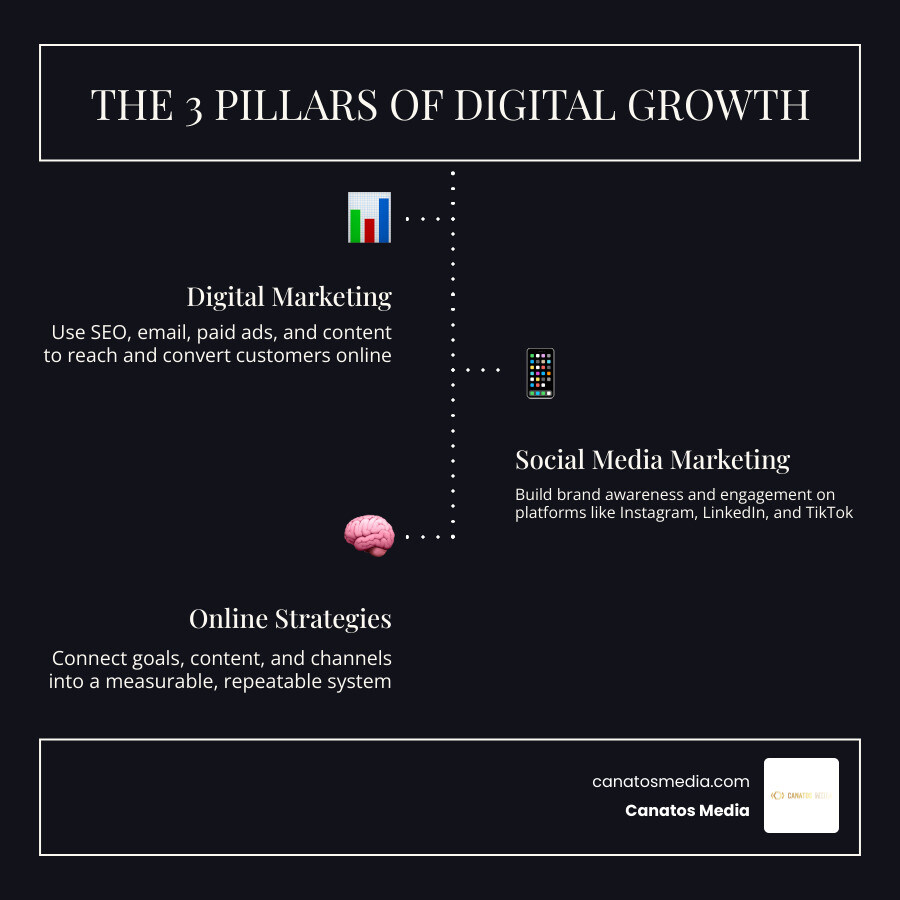
    Digital marketing, social media, and online strategies are the core tools modern businesses use to get found, build trust, and turn attention into sales. Here is a quick overview of what they involve:

    • Digital Marketing — Using online channels (SEO, email, paid ads, content) to reach and convert customers
    • Social Media Marketing — Building brand awareness and engagement on platforms like Instagram, Facebook, LinkedIn, and TikTok
    • Online Strategies — The structured plans that connect your goals, content, and channels into measurable results

    Together, these three pillars form a system. Each one supports the others.

    Think about this: as of October 2025, more than 6 billion people use social media worldwide. That is not a trend. That is where your customers already are.

    Yet most local businesses are still posting randomly, hoping something sticks. The result? Wasted time, invisible content, and no leads.

    The gap is not effort. It is strategy.

    Without a clear plan, even great content gets ignored. With one, a small business can compete with brands ten times its size.

    I’m Nic Canobbio, founder of Canatos Media, where I have spent over two decades helping brands cut through the noise with media production, social content, and data-driven digital marketing, social media, and online strategies — including content that has generated over 60 million views. In this guide, I will break down exactly what works, step by step, so you can stop guessing and start growing.
    Overview infographic of the digital marketing ecosystem: social media, SEO, paid ads, content, and email channels infographic

    Quick look at digital marketing social media and online strategies:

    What is Social Media Marketing and Its Role in Digital Marketing?

    To understand how to grow your business online, we have to look at the big picture. Many business owners we speak with in the Tri-State area and Long Island use the terms “digital marketing” and “social media marketing” interchangeably. However, they are not quite the same thing.

    Digital marketing is the umbrella. It includes everything from Search Engine Optimization (SEO) and email campaigns to pay-per-click (PPC) ads, mobile marketing, and even offline digital channels like interactive signs or rotating television screens in a bank lobby. Social media marketing (SMM) is a powerful, specialized subset under that umbrella.

    When we integrate SMM into a broader inbound marketing plan, we stop treating social media as a mere broadcasting megaphone. Instead, we use it to draw people in naturally. By sharing valuable content, building relationships, and utilizing professional systems, you turn cold scrollers into loyal advocates. If you want to see how to organize this on a daily basis, check out The Complete Guide to Social Media Management to learn how to keep your campaigns running smoothly.

    Defining the Core of Digital Marketing Social Media and Online Strategies

    Let’s break down how digital marketing social media and online strategies work together in simple terms:

    • Digital Marketing: This encompasses any marketing effort that uses the internet or digital technology—both online and offline—to connect with consumers.
    • Social Media Marketing: This is the practice of showing up on social networks to publish content, run targeted ads, and actively engage with your community.
    • Online Strategies: This is the master blueprint. It is the intentional plan that dictates which channels you use, how you position your brand, and how you measure success.

    The major shift from traditional media (like billboards, print ads, or local TV spots) to digital media is the power of targeting and two-way interaction. Traditional media casts a massive, expensive net over a broad area, hoping the right person sees it. Digital media allows us to target highly specific audiences based on precise data, ensuring your marketing dollars are spent on the people most likely to buy from you.

    Why Social Media is Critical for Modern Brands

    Social media is no longer just a place to share photos of your weekend; it has evolved into a primary discovery engine. Consumers use these platforms to research products, read reviews, and ask peers for recommendations before making a purchase. In fact, 63% of Gen Z and 49% of Millennials state that social media ads or recommendations directly influence their buying decisions.

    According to industry data, 86% of professionals reported that increased exposure was the leading benefit of social media marketing, while 76% pointed to a significant boost in website traffic. With over 6 billion active users globally, social media provides unprecedented access to your target market. It allows you to build trust through direct, human interaction. For a deeper look at how the landscape has shifted, you can read Your Complete Guide to Social Media Marketing in 2026 .

    Building the Foundation: SMART Goals and Audience Research

    Diving into social media without a strategy is like trying to drive across Long Island without a map or GPS. You might burn a lot of fuel, but you probably won’t end up where you want to be. Before you record a single video or write a caption, you need a solid foundation built on clear goals and deep audience research.

    Setting SMART Goals for Digital Marketing Social Media and Online Strategies

    Every successful campaign starts with goals that are Specific, Measurable, Attainable, Relevant, and Time-bound (SMART). Instead of saying, “We want to grow our Instagram,” a SMART goal sounds like: “We want to increase our inbound leads from Instagram Reels by 15% over the next three months.”

    Your goals should align directly with different stages of the marketing funnel:

    1. Top of Funnel (Awareness): Focus on metrics like reach, impressions, and follower growth to get your brand in front of new eyes.
    2. Middle of Funnel (Consideration): Track engagement rate, saves, shares, and website clicks to build relationships with interested prospects.
    3. Bottom of Funnel (Conversion): Measure lead form sign-ups, direct messages, and sales conversions.

    By mapping your objectives to these stages, you ensure your social media activity directly supports your bottom-line business growth.

    Researching and Defining Your Target Audience

    You cannot write content that resonates if you do not know exactly who you are talking to. To build accurate buyer personas, we look at several key factors:

    • Demographics: Age, location, job title, and income levels. For businesses in the Tri-State area, segmenting by specific neighborhoods or professional hubs can make your messaging incredibly relevant.
    • Behaviors: What time are they online? Do they prefer quick, high-energy videos, or do they read long-form professional articles?
    • Social Listening vs. Social Monitoring: Social monitoring tracks specific mentions of your brand or direct customer service queries. Social listening goes deeper—it involves analyzing the broader industry conversations, tracking what your target audience complains about, and discovering what solutions they are actively searching for.

    Choosing Platforms and Crafting Your Digital Marketing Social Media and Online Strategies

    A common mistake is trying to be everywhere at once. If you try to maintain active, high-quality profiles on ten different platforms with a small team, you will quickly burn out. It is far better to show up consistently and brilliantly on two or three channels where your audience actually spends their time. To see how to turn this attention into actual clients, check out our guide on Building a Repeatable Social Media Funnel from Reels to Booked Consultations.

    Selecting the Right Social Media Platforms

    Each social media platform has its own unique culture, demographic makeup, and content strengths. Here is a comparison of the major players in 2026:

    Platform Monthly Active Users Dominant Demographic Best Content Formats Primary Strength
    Facebook 3.07 Billion Ages 25–34 Images, local updates, link shares Local community building, event promotion
    Instagram 3.00 Billion Ages 18–34 Reels, Carousels, Stories Visual storytelling, brand discovery
    TikTok 1.90 Billion Ages 18–24 Short-form vertical video Rapid organic reach, viral trends
    LinkedIn ~1.00 Billion Professionals (25–54) Text posts, PDF documents, articles B2B marketing, thought leadership
    Pinterest ~500 Million Women (18–44) High-quality video pins, graphics Visual search engine, e-commerce traffic

    In 2026, we are also seeing the rise of decentralized platforms like Bluesky and Mastodon. These networks are not owned by a single corporation; instead, they are made up of smaller, community-led servers. Marketing here requires a shift away from highly polished, corporate broadcasting toward authentic, community-first conversations.

    Creating Engaging Content and Content Pillars

    To keep your brand consistent and prevent writer’s block, establish 3 to 5 “content pillars.” These are recurring themes or topics that your business will focus on. For example, a local home remodeling company on Long Island might use these pillars:

    • Educational: “How to prepare your home for a Tri-State winter.”
    • Behind-the-Scenes: Cinematic short-form videos showing the craftsmanship of a live renovation.
    • Social Proof: High-quality before-and-after photos and client video testimonials.
    • Company Culture: Spotlights on local team members and community involvement.

    When creating content, focus on making it “sticky”—meaning it grabs attention in the first two seconds, provides immediate value, and encourages the user to share it. Different formats serve different purposes on platforms like Instagram. Reels are designed for massive reach and discoverability via the explore algorithm, while Carousels (multi-slide image posts) are perfect for driving deeper engagement and keeping users on your post longer.

    The Role of Content Calendars and Scheduling

    Consistency is the secret weapon of social media. The algorithms favor accounts that post reliably. To keep your sanity, we highly recommend using a structured content calendar.

    By mapping out your posts a week or a month in advance, you can engage in content batching. Instead of scrambling every morning to figure out what to post, spend one dedicated day filming videos, taking photos, and writing captions for the next two weeks. You can then use scheduling tools to automate the publishing process, allowing you to focus your daily energy on replying to comments and building real relationships with your community.

    Measuring ROI, Competitive Analysis, and Evolving Your Strategy

    Your social media efforts should never exist in a vacuum. To justify the time and money spent, you must track your results, keep an eye on the market, and adjust your approach based on real data. To complement your organic efforts with highly targeted paid campaigns, refer to The Ultimate Guide to Social Media Ads.

    Tracking Key Metrics and Social Media ROI

    Tracking Return on Investment (ROI) can be tricky because social media often drives indirect conversions. A customer might watch your Instagram Reels for months, never click a link, but later type your website URL directly into their browser to book a consultation.

    To measure ROI accurately, we track a mix of direct and indirect key performance indicators (KPIs):

    • Engagement Rate: Are people actually interacting (liking, commenting, saving) with your content?
    • Reach and Impressions: How many unique eyes are seeing your brand?
    • Referral Traffic: How many visitors is your website receiving directly from social media links?
    • Conversion Rate: The percentage of social media visitors who take a desired action (like calling your business or filling out a contact form).

    To dive deeper into setting up paid tracking systems and maximizing your ad spend, read our quick-start guide: Paid Social Media Advertising: From Zero to Hero in One Hour.

    Conducting a Competitive Analysis

    You do not have to reinvent the wheel. By conducting a thorough competitive analysis, you can learn from your competitors’ successes and failures. Look at 3 to 5 local competitors in the Tri-State area:

    • Which platforms are they most active on?
    • What kind of content gets their highest engagement?
    • Are there gaps in their strategy? (e.g., Maybe they post great photos but completely ignore short-form video).

    Use these insights to refine your own content pillars and claim your unique space in the local market.

    Evaluating and Evolving Your Strategy Over Time

    The digital landscape changes fast. Algorithms update, new platforms emerge, and consumer behaviors shift. We recommend adopting a “fail fast” mentality. Set up a monthly or quarterly review process to look at your analytics. If a specific content format is performing poorly, cut it quickly and reallocate your resources to what is working. Continuous optimization is the only way to maintain a high-performing online presence.

    The Pros and Cons of Social Media Marketing for Businesses

    Before committing your hard-earned budget, it is important to weigh the benefits and challenges of social media marketing:

    The Pros:

    • Massive Brand Exposure: It is the fastest way to get your business in front of thousands of local Tri-State residents.
    • Direct Customer Connection: You can have real-time, two-way conversations with your customers, helping to resolve issues and build deep loyalty.
    • Rich Customer Data: Social platforms provide incredibly detailed analytics about who your audience is and how they behave.
    • Cost-Effective Organic Reach: Creating an account and posting organic content is entirely free, making it highly accessible for small businesses.

    The Cons:

    • Algorithm Volatility: Organic reach can drop overnight when platforms update their algorithms, making paid advertising a necessity for consistent visibility.
    • Time and Resource Intensive: Creating high-quality, cinematic video content and managing daily engagement requires consistent effort and expertise.
    • Public Reputation Risks: Negative reviews or customer complaints are highly visible and must be handled quickly and professionally to protect your brand.

    For many local business owners, partnering with a specialized team is the best way to maximize the pros while eliminating the cons. To see how this dynamic works, explore why a Social Media Marketing Agency & Small Business: Matches Made in Heaven is often the perfect growth formula.

    Frequently Asked Questions About Online Marketing Strategies

    FAQ concept graphic showing common questions about digital marketing

    What is the difference between digital marketing and social media marketing?

    Digital marketing is the overarching term for any marketing that uses digital technology. It includes online channels (SEO, email marketing, PPC, websites) as well as offline digital channels (digital billboards, TV screens). Social media marketing is a specific subset of digital marketing that focuses exclusively on social networking platforms like Instagram, Facebook, and LinkedIn.

    How do you measure social media ROI?

    We measure social media ROI by tracking both direct conversions (such as sales or lead forms filled out directly from a social link) and indirect value (such as brand awareness, customer retention, and referral traffic). Using tracking pixels and multi-touch attribution helps connect your social efforts to your actual revenue.

    How often should a business post on social media?

    Quality always beats quantity, but consistency is key. As a general rule of thumb for 2026:

    • Instagram: 3–5 times per week (mix of Reels and Carousels)
    • LinkedIn: 2–3 times per week
    • Facebook: 3–5 times per week
    • TikTok: 2–4 times per week

    Conclusion

    Building a powerful online presence requires an integrated approach. True success comes when your high-quality content, targeted paid ads, search engine visibility, and modern web design all work together to tell a cohesive brand story.

    At Canatos Media, we specialize in creating this exact synergy for businesses throughout the Tri-State area and Long Island. We produce cinematic, scroll-stopping short-form videos, manage your daily social media channels, run high-converting Meta and Google ad campaigns, optimize your SEO, and support your website. Our unique strength is our integrated strategy, designed to connect creative content with precise targeting to drive measurable business growth.

    Ready to take your brand beyond the scroll? Learn more about Meta Ads Management and let’s start building a strategy that actually works for your business.


  • Why Video-First Growth Requires More Than Production Alone

    Why Video-First Growth Requires More Than Production Alone

    The Real Problem With Video-Only Agencies

    Many businesses invest in video production hoping it will solve their growth problem. They commission beautiful content, post it across social media, and wait for results. Months pass. Views come and go. But leads and sales remain flat.

    The disconnect happens because production quality and business growth are two different challenges. A video-only agency excels at one thing: making your content look professional. They understand lighting, color grading, pacing, and storytelling technique. But they often stop there. They hand off the finished video and move to the next project.

    What gets left behind is everything that turns views into customers. Distribution strategy falls to you. Paid advertising setup becomes guesswork. Lead capture remains disconnected from your actual sales process. The result feels like a one-way broadcast rather than a strategic growth engine.

    We see this pattern repeatedly with brands that come to us after working with production-focused shops. They have galleries of stunning content sitting on their channels, underperforming against their potential. The videos aren’t the problem. The strategy around them is.

    Why Production Talent Isn’t Enough for Business Growth

    Cinematic quality and strategic effectiveness operate in different dimensions. A cinematographer can frame a shot perfectly while missing the conversion opportunity entirely. A brilliant editor can craft emotional pacing that never prompts viewers to take action.

    Growth requires bridging that gap. Your content needs to do two jobs at once: capture attention through visual excellence and guide viewers toward a measurable business outcome. Most video agencies optimize only for the first part.

    Consider a multi-location service business we worked with. Their previous agency produced beautiful brand stories about their company history and values. Objectively, the videos were well-made. But they didn’t address customer pain points, didn’t include clear calls to action, and weren’t distributed to their actual service areas. Views accumulated. Leads didn’t.

    The missing layer was strategy: understanding which messages resonate with your specific audience, where that audience spends time, what action you want them to take, and how to measure whether they take it. Production talent alone can’t answer these questions.

    What to do next: Audit your existing video content. Count how many videos have a clear conversion goal tied to them. If most are purely brand awareness plays without lead or sales tracking, you’ve identified the gap.

    How We Connect Visual Content to Revenue

    At Canatos Media, we work backwards from your business goal. Before we shoot a single frame, we define what success looks like: qualified leads from specific regions, email subscribers, consultation bookings, or e-commerce orders.

    That goal shapes every creative decision. Which audience segment gets which message. What pain points to emphasize. Where the call to action appears in the video and what it asks viewers to do. This is why our cinematic storytelling guide emphasizes connecting story with sales rather than treating them as separate objectives.

    Once content is produced, we own the distribution strategy. We don’t hand off a video and hope. We build paid advertising campaigns around it, manage the social platforms where your audience congregates, and optimize based on real performance data.

    Revenue connection means your content gets seen by the right people, at the right time, with the right message. A 30-second video about your service gets amplified to homeowners in your service areas searching for that exact solution. A product demo lands in front of prospects already considering competitors. A client testimonial reaches people in the consideration stage of buying.

    This requires integration. Your video content, paid advertising strategy, social media calendar, and lead capture system all work as one mechanism rather than disconnected pieces.

    Our Integrated Approach to Video-Driven Lead Generation

    We operate as a full-service video-first marketing agency because growth rarely happens through one channel alone. Your content needs support across multiple systems working in concert.

    Our integrated approach includes:

    • Short-form video production optimized for each platform (reels, stories, TikTok, YouTube Shorts)
    • Paid advertising campaigns across Meta and Google that amplify your best-performing content
    • Social media management that maintains consistent presence and engagement
    • Website design and support that converts traffic into leads
    • SEO and video optimization that helps content rank organically
    • Lead generation systems that nurture prospects from awareness through conversion

    Each component strengthens the others. A social media post drives traffic to your website. Paid ads amplify high-performing organic content. SEO brings qualified search traffic. Website lead forms capture names that feed your email nurturing. Together, these systems compound over time.

    Many brands treat these as separate line items: hire an editor, hire a social media manager, hire an SEO specialist. That fragmentation creates gaps and missed opportunities. We build them as interconnected parts of your growth engine.

    From Cinematic Storytelling to Paid Advertising Systems

    Beautiful storytelling and performance-driven advertising aren’t at odds. They’re complementary forces that multiply impact when aligned.

    Your brand story creates emotional connection and differentiation. Why your company exists. What makes your approach different. What results customers can expect. This narrative foundation becomes the backbone for all your advertising. It’s the “why” that turns interested viewers into committed customers.

    From that story, we derive advertising angles tailored to different audience stages. Cold audiences who don’t yet know you see brand awareness content. Warm audiences see product-focused demos. Hot audiences who’ve already engaged see testimonial-driven conversion ads. All of these flow from the same core story, just emphasized differently.

    We manage this across Meta’s platform (where most of your multi-location customer base lives) and Google’s ecosystem (where people actively search for solutions). Each platform has different strengths. Meta builds awareness and engagement. Google captures high-intent search traffic. Used together, they create a comprehensive reach strategy.

    The advertising systems feed data back to content creation. We see which story angles drive engagement. Which video lengths convert best. Which calls to action resonate. This becomes the input for your next content production cycle, continuously improving results.

    Content without distribution reaches almost nobody. Distribution without quality content wastes budget. The missing link most brands overlook is matching great content with a distribution strategy that reaches the right people.

    Many brands post organically to social media and hope the algorithm favors them. Posting matters, but it’s not a growth strategy. The algorithm prioritizes engagement and watch time, which helps, but it doesn’t target based on purchase intent or business fit.

    Strategic distribution means asking: Who exactly needs this content? Where do they spend time? How much are we willing to spend to reach them? What conversion value justifies that spending? These questions shape everything from audience targeting to ad spend allocation.

    A home service company might find that $5,000 in monthly Meta advertising targeting homeowners in their service areas generates 50 qualified leads, with a conversion rate high enough to make that profitable. Organic posting alone might reach 2,000 people per month, mostly outside their service area. The paid strategy dramatically improves targeting efficiency and business outcome.

    This doesn’t mean abandoning organic. Organic content builds community and provides free reach. But strategic paid distribution behind your best content is what turns a passive social media presence into an active lead generation engine.

    Our Social Media Management and Meta Advertising Integration

    Social media for most brands becomes reactive: post when you remember, respond to comments sporadically, wonder why reach is declining. We approach it as a growth channel with specific business objectives.

    Our social media management integrates directly with Meta advertising. We maintain a consistent content calendar that keeps your brand visible and engaged. Within that calendar, we identify high-performing organic content worthy of paid amplification. A post getting strong engagement gets promoted to a larger audience through ads.

    We also build social proof strategically. Testimonials, results, and client stories get prioritized and amplified. These become the ads themselves, leveraging authentic customer voices to build trust with cold audiences.

    Meta’s advertising platform handles sophisticated targeting. We reach business owners in specific locations, people interested in solutions your brand provides, and audiences similar to your best customers. Ad creative alternates between testimonial-driven content, educational content, and promotional offers, testing what resonates most.

    This requires constant monitoring and optimization. We check performance data weekly, pause underperforming ads, and increase investment in what works. Your best-performing video content gets more ad spend. Weak performers get revised or replaced.

    SEO and Video Optimization for Maximum Visibility

    Video content can dominate search results if optimized correctly. Most video creators miss this opportunity entirely.

    We optimize every video for search: choosing keywords that match how your target audience actually searches, crafting descriptions that tell search engines what the content is about, using transcripts that improve indexing and accessibility, and building internal links to relevant pages on your website.

    This means your short-form videos don’t just reach people on social platforms. They also appear in Google search results when prospects search for solutions you provide. A homeowner searching “emergency plumbing near me” or “how to fix a leaky faucet” might find your video in Google results, YouTube results, or both.

    We also ensure your website integrates video effectively. Videos on your pages increase time on site, lower bounce rates, and send positive signals to search engines. They improve conversion rates because prospects would rather watch a 60-second video demonstration than read paragraphs of text.

    Your entire content library becomes an SEO asset when built with search optimization in mind from day one.

    Building Lead Generation Systems Around Your Content

    Content generates awareness and interest. Lead generation systems convert that interest into captured contact information and measurable sales opportunities.

    We build these systems to work alongside your video content. Every piece of content should have a clear next step. A social media video drives viewers to a landing page. The landing page offers something valuable in exchange for email address or phone number. An automated email sequence nurtures that lead with additional content and offers.

    For service-based brands, this might look like: video highlighting a common problem, landing page offering a free consultation or audit, email sequence educating about solutions, final email offering to schedule time.

    For e-commerce brands, it might be: product demo video, landing page with discount code, email nurturing with product recommendations, retargeting ads for abandoned carts.

    The key is tracking performance at every stage. How many people watched the video? How many clicked through to the landing page? How many submitted their information? How many converted to customers? This data shows us where to improve and how to allocate resources.

    How We Support Multi-Location and Service-Based Brands

    Multi-location and service-based businesses face a specific challenge: managing consistent brand presence while serving different local markets. National campaigns miss local context. Pure local campaigns miss economies of scale.

    We solve this by creating a core brand library that works everywhere, then localizing for specific markets. The same brand story and key messages appear in every location, but we customize targeting, calls to action, and occasionally specific creative elements for regional relevance.

    A dental practice with five locations can run a national awareness campaign about cosmetic dentistry, then layer location-specific ads targeting each market with different service offers. A home service company can showcase the same cinematic brand story across all regions, while allocating ad spend based on where leads are most likely to convert.

    We also help manage multiple service areas without spreading your ad budget too thin. Our data-driven approach identifies which locations and services generate the best leads, then concentrates resources there while maintaining presence elsewhere.

    For a deeper dive into this challenge, our [multi-location brand growth guide] covers how to build video campaigns that drive growth across markets.

    The Results Our Clients See With Integrated Strategy

    When production quality meets strategic distribution, the results compound quickly.

    A service-based client went from 3-4 monthly leads to 30+ within three months. The improvement wasn’t from better videos alone. Their previous agency’s videos were professionally made. The difference was adding paid advertising, social media consistency, and lead capture systems around that content.

    Another multi-location brand reduced cost per lead by 60% within six months. They had been running paid ads before, but without quality content. Better videos meant higher click-through rates on ads, lower cost per view, and ultimately lower cost per lead.

    E-commerce clients see similar impacts on conversion rate. Video on product pages increases average order value by 20-30% because prospects understand the product better before buying.

    These results don’t happen from video production alone. They happen when production meets strategy, distribution, and optimization.

    Taking Your Video Marketing From Content to Conversions

    The gap between producing video content and generating business growth is exactly what we solve. Most brands produce beautiful content that underperforms because the strategy, distribution, and conversion systems aren’t built around it.

    Start by auditing your current situation. What video content do you have? Where is it distributed? How many leads or sales does it generate? If views are high but conversions are low, the problem isn’t production quality. It’s strategy.

    We help growth-focused business owners bridge that gap. We produce cinematic short-form content built for performance, amplify it through integrated advertising, manage consistent presence across social platforms, optimize for search visibility, and build lead capture systems that turn attention into measurable results.

    If you’re ready to move beyond video-only agencies and build a truly integrated growth strategy, let’s talk about what’s possible for your brand.

    For further reading: Multi-location brand growth.

    Contact us today for a free consultation to see how we can help you grow your business.

    Frequently Asked Questions (FAQ)

    What makes your approach different from other video production companies?

    We don’t just create cinematic content and hand it off. Our entire process is built around connecting visual storytelling to measurable business outcomes through integrated advertising, social media management, and lead generation systems. We handle everything from production to paid distribution on Meta and Google, so your content actually drives leads instead of just getting views.

    How do you ensure video content converts to leads for service-based and multi-location businesses?

    We combine short-form video production with strategic paid advertising, SEO optimization, and lead capture systems tailored to how your customers actually search and buy. Our team works backward from your conversion goals, then builds the content and distribution strategy to hit those targets across all your locations.

    Do you manage the ongoing distribution of videos after production?

    Yes. We handle social media posting, Meta advertising campaigns, performance tracking, and content optimization. We also integrate our video content with AEO strategies to boost visibility when potential customers are actively searching for your services.