The Ultimate Guide to Social Media Ads
Why Social Media Ads Are the Fastest Way to Grow Your Business Online
Social media ads are paid promotions that businesses run on platforms like Facebook, Instagram, TikTok, YouTube, and LinkedIn to reach targeted audiences and drive real business results.
Quick answer — what you need to know:
| Question | Answer |
|---|---|
| What are they? | Paid content shown to targeted users on social platforms |
| How do they differ from organic? | Organic reach is free but limited; paid ads guarantee visibility to specific audiences |
| Top platforms | Facebook, Instagram, YouTube, TikTok, LinkedIn |
| Average cost | $0.38–$5.26 per click depending on platform |
| Who should use them? | Any business that wants faster reach, leads, and sales |
Nearly 5.2 billion people use social media worldwide. And here’s the number that should stop you in your tracks: 80% of people make purchasing decisions based on what they see on social media.
Yet most local business owners are either ignoring paid social entirely — or burning budget on ads that don’t convert.
That gap is exactly what this guide closes.
Social media advertising is now the second-largest digital ad market in the world, trailing only search advertising. Meta alone controls nearly 24% of all global digital ad spend. This isn’t a trend. It’s where attention lives, and where your customers are making buying decisions every single day.
Whether you’re running a single location or managing multiple, this guide walks you through every key decision: which platforms to use, what formats work, how much to spend, and how to measure what’s actually working.
I’m Nic Canobbio, founder of Canatos Media, and over the past two decades I’ve built and scaled social media ad strategies that have generated over 60 million views across platforms. I’ll share exactly what works — and what wastes your budget.
What Are Social Media Ads and How Do They Work?
To understand why paid social is such an absolute powerhouse for growth, we have to look at the fundamental shift from organic social media marketing to paid advertising.
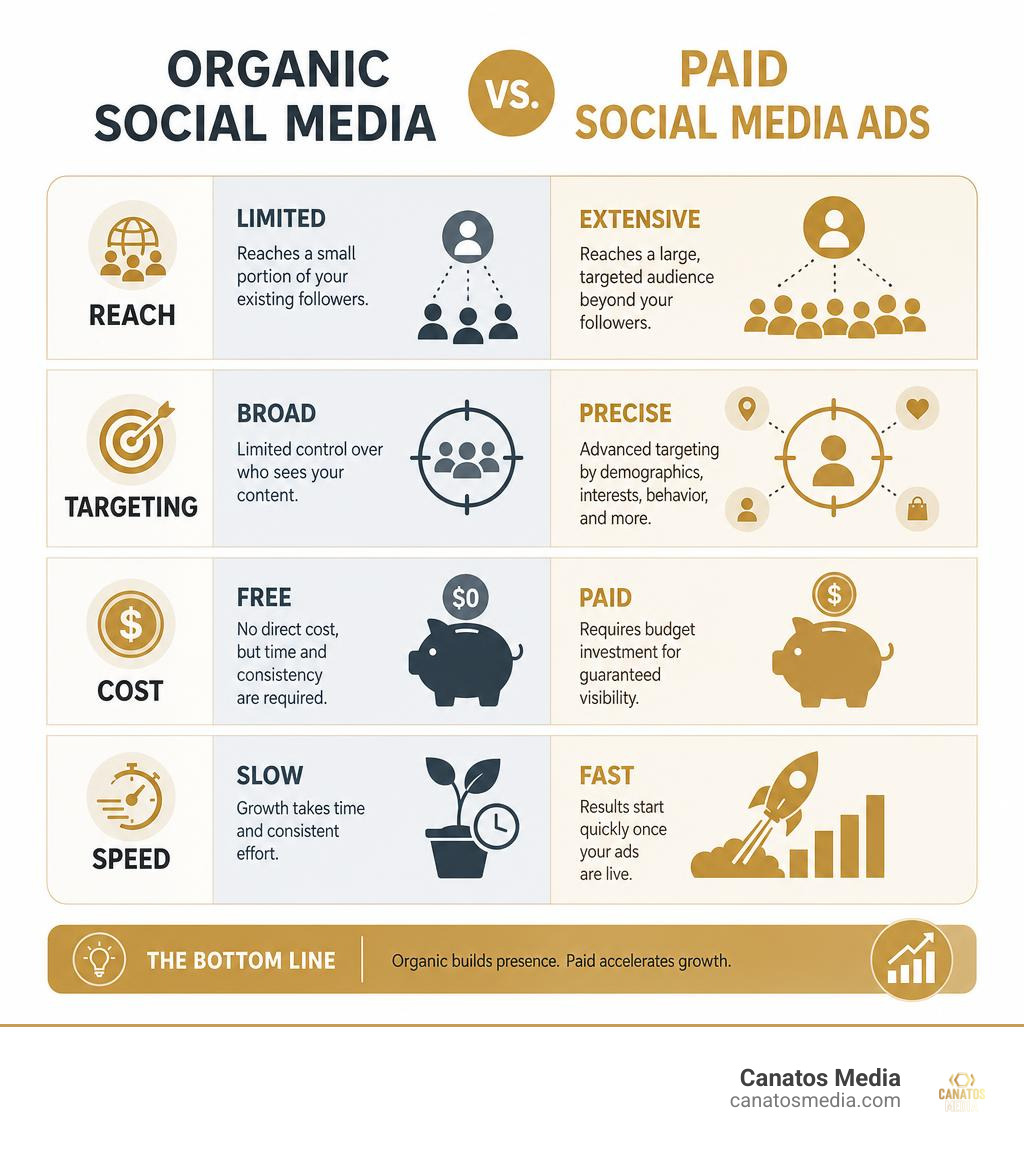
Organic social media is fantastic for nurturing the community you already have. It is your digital storefront, your brand’s personality, and your customer service desk. But let’s be completely honest: organic reach has plummeted across almost every major network over the last few years. If you post an update on your business page today, you are lucky if 2% to 5% of your followers actually see it in their feeds. Relying solely on organic reach to acquire new customers is like standing on a street corner whispering and hoping someone three blocks away hears you.
Paid social media ads, on the other hand, are like handing you a megaphone with a laser-guided targeting system.
When you run paid social campaigns, you bypass the restrictive organic algorithms entirely. You pay to place your content directly in front of the exact people who are most likely to buy from you. This is why we created our guide on Paid Social Media Advertising From Zero to Hero in One Hour—to show business owners that you don’t need to wait months for organic traction when you can launch highly targeted campaigns in an afternoon.
The Mechanics of Paid Social: Targeting and Machine Learning
The true magic of paid social lies in how these platforms find your customers. Unlike search engines, which rely on what someone is typing in at that exact second (search intent), social platforms rely on deep behavioral data and interest targeting.
When you set up a campaign, you can define your target audience using three primary layers:
- Demographics: Age, gender, location, job titles, income, and education.
- Interests and Behaviors: What pages they like, what content they interact with, their shopping habits, and even the devices they use.
- Custom and Lookalike Audiences: You can upload your existing customer list, and the platform’s machine learning algorithm will find “lookalikes”—millions of other users who share identical behavioral traits with your best buyers.
Once your campaign goes live, the platform’s machine learning engine takes over. The system enters a “learning phase” where it tests your ads on small segments of your target audience to see who clicks, watches, or converts. As it collects data, it optimizes delivery, showing your ads to the users most likely to take your desired action. If you don’t set this up correctly, however, you run the risk of overspending, which is why we always warn business owners to Stop Burning Cash on Bad Meta Ads by understanding how these algorithms function before launching.
Every ad campaign is built on a specific campaign objective. Whether you want to build top-of-funnel brand awareness, drive traffic to a blog, capture leads via a native form, or secure direct e-commerce sales, choosing the right objective tells the algorithm exactly what to optimize for.
The Top Platforms and Formats for Paid Social
Not all social media platforms are created equal. Each network has its own unique user culture, primary demographics, and ad placements. To get the best return on your ad spend, you must match your product or service to the platform where your target audience naturally hangs out.
Choosing the Right Platform for Your Social Media Ads
Let’s look at the breakdown of the major players in 2026:
- Active Users: Over 3.03 billion active users.
- Key Demographics: Spans all age groups, but holds the strongest purchasing power among users aged 25–65+.
- Why Use It: Facebook remains the undisputed king of local lead generation and e-commerce. Its targeting capabilities and sheer volume of historical user data are unmatched.
- Active Users: At least 1.7 billion users.
- Key Demographics: Highly popular among Millennials and Gen Z (ages 18–44).
- Why Use It: Highly visual. If you sell lifestyle products, fashion, food, or aesthetic services, Instagram is your playground. It is also the home of Reels, which are incredibly effective for short-form video ads.
YouTube
- Active Users: Over 2.5 billion monthly active users.
- Key Demographics: Broad appeal across all age groups, particularly strong with males and younger demographics who prefer video over text.
- Why Use It: YouTube functions as the world’s second-largest search engine. Running video ads here allows you to capture users who are actively looking to learn, solve a problem, or be entertained.
- Active Users: 1.15 billion users.
- Key Demographics: Professionals, decision-makers, B2B buyers, and job seekers (ages 25–64).
- Why Use It: If you are a B2B company, LinkedIn is essential. While it is notoriously expensive, it allows you to target users by specific job titles, industries, company sizes, and seniorities.
TikTok
- Active Users: 1.6 billion active monthly users.
- Key Demographics: Dominated by Gen Z and younger Millennials (ages 13–34), though older demographics are growing rapidly.
- Why Use It: TikTok is built on raw, authentic, and video content. If you can create ads that “don’t look like ads,” you can unlock massive, low-cost virality.
- Active Users: 553 million monthly users.
- Key Demographics: Highly female-skewed (approx. 70%), with users actively planning future purchases (weddings, home decor, fashion, DIY).
- Why Use It: Pinterest users have high commercial intent. They use the platform as a visual search engine to plan what they want to buy next.
Snapchat
- Active Users: 443 million daily active users.
- Key Demographics: Heavily skewed toward Gen Z and younger audiences (ages 13–24).
- Why Use It: Great for mobile-first, interactive campaigns, AR filters, and reaching a younger demographic at a lower ad cost.
X (formerly Twitter)
- Active Users: Around 611 million monthly active users.
- Key Demographics: Highly educated, tech-literate, and male-skewed.
- Why Use It: Excellent for real-time engagement, tech, finance, and news-related promotions.
To build a truly bulletproof strategy, many businesses run a hybrid approach. If you want to see how to balance your strategy across different ecosystems, check out our guide on Meta Google Advertising. Additionally, mastering the back-end software is crucial to your success, so we highly recommend reading up on How to Navigate Meta Ad Manager Like a Pro to avoid costly setup mistakes.
Ad Formats and Creative Specifications
Once you have selected your platform, you need to choose the right ad format to showcase your offer. The primary formats include:
- Photo Ads: A single, high-quality image paired with a compelling headline and caption. Best for clean, straightforward product showcases or quick local promotions.
- Video Ads: Engaging video clips that tell a story or demonstrate a product. In 2026, short-form, vertical video (9:16 aspect ratio) is the highest-converting format across almost all networks.
- Carousel Ads: These allow you to showcase up to 10 images or videos within a single ad, each with its own link. They are incredibly effective for showing multiple products, highlighting different features of a single product, or telling a step-by-step story. If you are developing your own campaigns, you can refer to the Instagram Carousel Ads | Developer Documentation for detailed technical specifications and API guidelines.
- Story Ads: Full-screen vertical ads that appear between users’ organic stories. They offer an immersive experience with high conversion rates when paired with a clear swipe-up CTA.
- Collection Ads: A primary video or image accompanied by four smaller product images in a grid layout, allowing users to browse and buy products directly within the social app.
To make your life easier, you don’t always have to create ad creatives from scratch. You can leverage your top-performing organic posts and boost them to a wider target audience. For a deep dive into the technical side of how to do this, check out the official guide on how to Use Posts as Instagram Ads | Developer Documentation.
Furthermore, if you want to drive direct, high-intent conversations with your prospects, you can set up campaigns that open directly into a chat. You can learn how to build these interactive experiences using the Ads that Click to Messenger | Developer Documentation to capture leads instantly in real-time.
How Much Do Social Media Ads Cost in 2026?
One of the most common questions we hear is: “How much should I expect to spend?”
The honest answer is that social media advertising is highly accessible, allowing you to start with as little as $5 to $10 a day. However, your actual costs—measured primarily in Cost Per Click (CPC) and Cost Per Mille / Cost Per Thousand Impressions (CPM)—will vary wildly depending on your industry, target audience, season, and campaign objective.
To give you a realistic picture of the paid social landscape in 2026, here is a comparison of average costs across the major networks:
| Platform | Average CPC (Cost Per Click) | Average CPM (Cost Per 1,000 Impressions) | Primary Audience Focus |
|---|---|---|---|
| $0.70 – $0.97 | $7.19 – $12.50 | Broad / All Demographics | |
| $0.20 – $3.56 | $7.91 – $11.00 | Visual / Millennials & Gen Z | |
| YouTube | $3.21 | $9.68 | Video / Educational & Entertainment |
| $5.26 | $6.59 | B2B / Professionals & Decision-Makers | |
| TikTok | $1.00 | $6.06 | Short-Form Video / Gen Z & Millennials |
| $0.10 – $1.50 | $2.00 – $5.00 | Visual Search / Shopping & DIY | |
| Snapchat | $0.57 (per swipe up) | $2.19 | Youth / Interactive Mobile |
| X (Twitter) | $0.38 | $6.46 | Tech, Finance, Real-Time News |
Note: These benchmarks represent median averages. If you are in a highly competitive industry like legal services, finance, or dental care, your CPCs will naturally skew higher. For a deep dive into industry-specific performance metrics, check out the comprehensive Facebook Ads Benchmarks 2025: NEW Data, Trends, & Insights for Your Industry | WordStream.
Understanding Bidding Strategies and Budget Allocation
Social media platforms run on an auction-based system. You are competing with thousands of other advertisers to get your ad in front of the same user. To win the auction without overpaying, you need to understand the platform’s bidding options:
- Lowest Cost / Maximize Conversions: The platform automatically bids to get you the most results possible for your budget. This is the best option for beginners.
- Cost Cap / Bid Cap: You set the maximum amount you are willing to pay for a click or a conversion. This keeps your costs predictable but can limit your reach if your cap is set too low.
- Target ROAS: The system adjusts bids to hit a specific return on ad spend. This is ideal for mature e-commerce brands with plenty of historical pixel data.

When allocating your budget, we recommend starting with a 70/30 split. Allocate 70% of your budget to prospecting campaigns (reaching new people who have never heard of you) and 30% to retargeting campaigns (reaching people who have visited your website, watched your videos, or interacted with your social pages).
Best Practices for Running Successful Campaigns
Launching a campaign is only 10% of the battle. The real work lies in optimization, testing, and scaling. To ensure your campaigns generate a positive return, you must treat your ads as an ongoing scientific experiment.
How to Measure the ROI of Social Media Ads
If you aren’t tracking your metrics, you are essentially throwing money into a black hole. To understand if your social media ads are actually working, you need to focus on the key performance indicators (KPIs) that align with your ultimate business goals:
- Return on Ad Spend (ROAS): The total revenue generated divided by the total ad spend. If you spend $1,000 and make $5,000, your ROAS is 5x.
- Cost Per Acquisition (CPA) / Cost Per Lead (CPL): How much it costs you to acquire a paying customer or a qualified lead.
- Conversion Rate (CVR): The percentage of people who clicked your ad and completed your desired action on your landing page.
- Click-Through Rate (CTR): The percentage of people who saw your ad and clicked it. A low CTR (under 1%) usually means your creative or targeting is missing the mark.
To manage this data effectively, you need a structured approach. We keep our readers updated with our specialized resources in our Category: Ad Management and compile our best optimization strategies under our Tag: Paid Ads.
Creative Strategies and Optimization Tips
If you want your ads to convert in 2026, you must prioritize the quality and authenticity of your creative assets. Here are our proven strategies for running successful campaigns:
- Embrace Cinematic Short-Form Video: Social feeds are faster and more crowded than ever. Standard static images rarely stop the scroll anymore. If you want to capture attention, you need engaging, high-production-value video assets. To see how this works in practice, read our analysis on How Cinematic Short Form Content Improves Meta Paid Ad Performance.
- Scale and Adapt Your Creative: Don’t just create one video and hope for the best. You need to adapt your creative assets to fit different platforms and placements. Learn How to Scale Short Form Ad Creative Across Meta and Google Ads to maximize your production budget.
- Optimize for Local Lead Generation: If you run a local brick-and-mortar business or service company, your video ads should be highly tailored to your local community. See our step-by-step guide on How to Optimize Short Form Video Ads for Local Lead Generation.
- Leverage User-Generated Content (UGC): People trust other people far more than they trust brands. Running ads that look like organic organic reviews, unboxing videos, or customer testimonials can dramatically lower your acquisition costs.
- Fight Creative Fatigue: In social media, ad creatives decay quickly. Because users scroll their feeds daily, they will quickly get tired of seeing the same ad over and over. Rotate your creative assets every 1 to 2 weeks to keep your frequency low and your conversion rates high.
- Build a Systematic Follow-Up Process: No matter how incredible your ads are, they are only as good as your sales follow-up. For example, in our breakdown of The Gym Owner’s Guide to Paid Ads in 2026 – Two-Brain Business, we highlight that lead quality issues are almost always follow-up problems. If you don’t reach out to a new lead within 5 minutes of them submitting a form, your conversion rates will plummet.

Frequently Asked Questions About Paid Social
What is the difference between paid social and paid search?
Paid search (like Google Ads) is based on pull marketing. It captures users who are actively searching for a specific keyword with high intent (e.g., “plumber near me”). Paid social (like Meta Ads) is based on push marketing. It introduces your brand, product, or service to users based on their interests, behaviors, and demographics while they are browsing socially. Paid search is ideal for capturing immediate demand, while paid social is unmatched for building brand awareness, visual discovery, and generating demand where none existed before.
How often should I refresh my ad creatives to avoid fatigue?
As a general rule of thumb, you should refresh your ad creatives every 10 to 14 days for active, high-budget campaigns. If your target audience is smaller (such as a local geographic radius of 5 miles), your ads will reach the same people multiple times very quickly, meaning you may need to rotate creatives even faster to prevent your cost-per-click from rising.
What is a good benchmark for social media ad ROI?
While a “good” ROI depends heavily on your business model, profit margins, and industry, a standard benchmark for e-commerce is a 3x to 4x ROAS (Return on Ad Spend). For lead-generation businesses, a healthy benchmark is to ensure that your Customer Acquisition Cost (CAC) is at least 3 to 5 times lower than your Customer Lifetime Value (CLV).
Conclusion
Running successful social media ads in 2026 is no longer about simply hitting a “Boost Post” button and hoping for the best. It requires an integrated digital marketing strategy that seamlessly connects cinematic short-form video, hyper-precise audience targeting, and high-converting sales funnels.
At Canatos Media, we specialize in helping brands build, run, and scale profitable paid media campaigns. From producing high-end, scroll-stopping video content to managing complex ad accounts across Meta and Google, we handle the heavy lifting so you can focus on running your business.
Ready to stop burning cash and start driving measurable growth? Dive into our comprehensive Meta Ads Management Ultimate Guide to learn how we structure high-performing campaigns, or reach out to our team today to build a custom paid social strategy for your business.