Why Multi-Location Brands Struggle With Generic Landing Pages
Running a business across multiple locations creates a fundamental problem: your customers are different in every market, but many brands treat them all the same. A dental practice in Phoenix operates differently than one in Denver. Their patient demographics differ, local competition varies, and seasonal demand shifts on different timelines. Yet a single generic landing page ignores these realities entirely.
When you push all traffic from all locations to one landing page, you’re asking a Dallas homeowner to relate to messaging designed for someone in Chicago. The content doesn’t match their local market, the testimonials come from unfamiliar neighborhoods, and the call-to-action doesn’t reflect their specific needs or pain points. Visitors bounce because the page feels irrelevant, even though your service is exactly what they need.
This disconnect costs you conversions. A visitor from your Fort Worth location sees no local social proof, no address they recognize, and no evidence that you understand their market. They leave and find a competitor who does. The problem compounds across your network: each branch could generate qualified leads if prospects felt like your message was built for them, not broadcast at them.
Action step: Audit your current landing pages by location. Does your Arizona page feel different from your Nevada page, or do they share identical copy and imagery?
The Cost of One-Size-Fits-All Digital Strategies
One centralized landing page simplifies operations but erodes performance. You save engineering time and reduce maintenance overhead, but you trade conversion power for convenience. Here’s what that trade-off costs:
Missed local SEO opportunity: Search algorithms reward location-specific content. When someone searches “dental implants in Phoenix,” Google favors pages that answer that exact query with Phoenix-relevant details. A generic national page ranks for nobody’s specific search.
Wasted ad spend: If you’re running Meta or Google Ads to drive traffic from different regions, sending all that traffic to one landing page means paying for clicks that land on irrelevant content. A prospect in San Diego clicking your ad expects to see San Diego information. Instead, they see generic messaging and leave.
Lower lead quality: When prospects don’t see themselves reflected on your page, the ones who convert tend to be less qualified. You’re attracting curiosity clicks instead of high-intent searchers who believe you serve their specific market.
Difficulty scaling feedback: With one page, you can’t test messaging variations by region. You can’t identify which locations have messaging problems versus which have traffic problems. You’re stuck with aggregate data that hides local performance issues.
Building separate pages for each location requires more upfront effort, but it eliminates these leaks in your funnel. You pay less per lead because qualified traffic increases, and your team gets clearer data about what works in each market.
Action step: Calculate your current cost per lead. Compare it against what you’d expect if conversion rates improved by 15-25% (realistic with location-specific optimization). That gap represents your opportunity.
How Location-Specific Pages Drive Higher Conversion Rates
Location-specific pages convert better because they eliminate friction. When a prospect lands on a page that addresses their neighborhood, their local concerns, and their regional market, they stay longer, scroll further, and engage more deeply.
The mechanics are simple but powerful. A plumbing company serving multiple cities should have separate pages that mention local service areas, show work completed in those neighborhoods, feature testimonials from customers they know, and reference local events or seasonality. A Fort Lauderdale page mentions hurricane season and salt-water corrosion. A Denver page addresses winter freeze damage. Same service, different context.
This relevance compounds across the page. Prospects see local images, local phone numbers, local addresses, and local service areas. Every element reinforces that you’re not a national company parachuting into their market; you’re embedded in their community. Trust increases, hesitation decreases, and the decision to contact you becomes easier.
We’ve observed 20-35% conversion rate improvements when clients implement proper location pages versus their previous one-size-fits-all approach. Some of that comes from better-qualified traffic. Some comes from psychological relevance. The combination creates measurable lead growth.
Action step: Pick your highest-traffic location and design one location-specific page as a test. Measure conversion rate against your generic version for 30 days.

Our Approach to Building Scalable Local Landing Page Systems
Building individual pages for 10, 50, or 100 locations requires a system. At Canatos Media, we’ve developed a framework that makes this scalable without creating maintenance chaos.
We start by identifying your core value proposition, then create one master template that separates global content (what’s true everywhere) from local variables (location-specific details). This template approach means you design once, then generate pages for each location by swapping in local data.
The template includes fixed sections like your core service description, your company overview, and your primary call-to-action, combined with flexible sections for local images, local testimonials, local service areas, local team introductions, and local contact information. We build these templates in your content management system so adding a new location is a data entry task, not a design project.
We also create a local content audit process. For each location, we gather recent testimonials, local project photos, local team member details, and insights about local market conditions. This content library becomes your reference point for populating each page authentically.
Finally, we establish a maintenance schedule. Even scalable systems need updating. New testimonials arrive, team members change, service areas expand. Without a process, pages become stale and outdated. We help you build workflows so updates stay current.
Action step: List your locations and identify what unique information each one should showcase. Start gathering local testimonials and photos now.
Setting Up Location-Based Lead Capture Architecture
A location page without proper lead capture is a dead end. Your prospect lands, gets engaged, and then has nowhere to go. You need architecture that captures their information while preserving location context.
We design forms that collect lead data while noting which location brought them in. This means your sales team gets location-context with every lead. If Sarah contacts you from your Denver page, your team immediately knows she’s a Denver-area prospect and can address Denver-specific concerns.
The lead capture should also include pre-qualification fields relevant to your business. A home services company might ask about the type of work needed. A professional services firm might ask about company size or industry. These fields help your team prioritize and customize their outreach.
Beyond the form, we integrate location page lead capture with your CRM or lead management system. This means every lead that comes through a location page automatically routes to the right team member or location manager. No manual sorting, no lost context.
We also recommend multiple capture opportunities on each page. Not everyone converts at the same point. Some convert early after seeing your headline. Others need to scroll further. Build forms at the top, middle, and bottom of the page. Offer phone calls, form submissions, and live chat as options.
Action step: Map out which team member or location should receive leads from each page. Set up your routing rules before launching pages.
Optimizing Each Local Page for Search Visibility
Location pages serve both humans and search engines. Optimization for search visibility ensures your pages get found by local prospects actively searching for what you offer.
Start with local keyword research. Don’t just target “plumbing services.” Target “emergency plumbing in Phoenix,” “residential plumbing in Scottsdale,” and “plumbing repairs in Tempe.” These location-specific keywords have less search volume individually, but they’re lower competition and higher intent. A prospect searching for “plumbing in Phoenix” is ready to call someone in Phoenix.
Each location page should have unique title tags and meta descriptions that include the location name. Use heading hierarchy (H1, H2, H3) to structure content naturally while including location keywords. Write naturally, not for keyword stuffing, but keywords should appear in your headings, your opening paragraph, and your service descriptions.
Build internal linking between related location pages. Your Denver page might link to your Boulder page (nearby location) and your Colorado Springs page (same state). This architecture helps search engines understand your location network and distributes page authority across your local pages.
Ensure consistent NAP (Name, Address, Phone) data across all pages. If you’re a multi-location business, each page should display the correct address and phone number for that location. Inconsistency confuses search engines and prospects.

Finally, encourage location-specific reviews and testimonials. Local landing pages matter more when they’re backed by social proof from that community. A Phoenix page with Phoenix reviews ranks better and converts better than the same page with national reviews.
Action step: Run a local keyword analysis for your top three locations. Build a keyword list for each page before writing content.
Connecting Local Pages to Integrated Lead Management
Location pages are part of a larger system. Without integration to your lead management process, you’ll generate leads without the ability to act on them efficiently.
We integrate local landing pages with your CRM, email marketing platform, and sales tools. When a lead submits a form on your Phoenix page, that lead automatically enters your system tagged as Phoenix, triggering location-specific email sequences and routing to the Phoenix manager.
This integration also enables smarter follow-up. Different locations might have different sales cycles. Your Denver location might close faster than your Phoenix location, so they need different follow-up timing. Integration lets you set location-specific workflows.
We also connect your pages to your paid advertising platform. When someone converts on a location page, that conversion data flows back to Meta or Google, improving your audience targeting and bid optimization for future campaigns to that location. This creates a feedback loop where your ads get smarter over time.
Finally, we ensure your local pages can track phone calls as conversions. Not every lead submits a form; some call directly from the page. Click-to-call tracking captures these conversions and attributes them to the correct location page, giving you complete conversion visibility.
Action step: Audit your current tech stack. Identify gaps in integration between your landing pages, your CRM, and your advertising platform.
Testing and Refining Your Location-Specific Funnels
Launching location pages is the beginning, not the end. Refinement comes through systematic testing.
We run A/B tests on elements that vary by location: headline styles, testimonial emphasis, call-to-action wording, form length, and image selection. A headline that resonates in Denver might not resonate in Dallas. Testing reveals these differences.
Heatmaps and session recordings show how prospects interact with each location page. Are they scrolling past your main value proposition? Do they get stuck on the form? Are they leaving before they reach your call-to-action? These insights guide refinement.
We also test whether certain location pages need messaging adjustments. If your Phoenix page converts at 8% but your Denver page converts at 4%, the Phoenix page is working better. Analyzing the differences helps you improve Denver’s page.
Seasonal testing also matters. A location might perform differently in summer versus winter. Test messaging variations that address seasonal concerns: winter freeze issues in Colorado versus summer heat issues in Arizona.
Document what works. If you discover that longer testimonials outperform short testimonials in your midwest locations but short testimonials work better in your southwest locations, standardize that learning. Apply winning variations to similar locations.
Action step: Choose one key metric to test first (headline, form length, or call-to-action wording). Run tests for 30 days before making adjustments.
Measuring Performance Across Multiple Geographic Markets
With multiple location pages, you need clear measurement frameworks. Vanity metrics like page views don’t tell you whether your system is working.
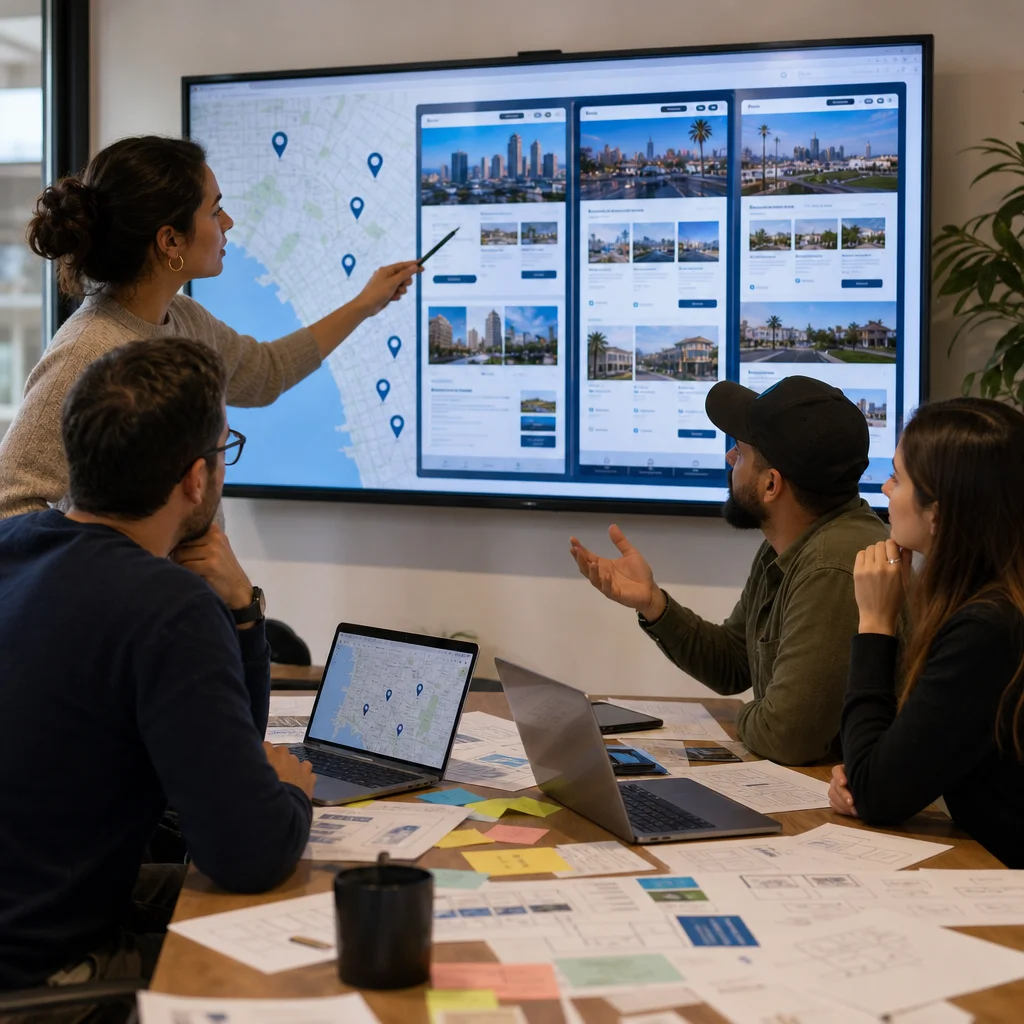
Track conversion rate by location. Which pages convert highest? Which ones lag? Conversion rate is the most important metric because it directly reflects whether your page strategy is working in each market.
Track cost per lead by location. If you’re running paid ads to these pages, compare how much you pay per lead across locations. Some locations might have more expensive traffic but higher-quality leads. Context matters.
Track lead quality by location. Not all leads are equal. A lead that closes is worth more than a lead that never engages. Compare close rates, average customer value, and lifetime value across locations. A page that generates many cheap leads isn’t better than a page that generates fewer expensive leads if the expensive leads close more often.
Track time to conversion. How quickly do prospects from each location convert? Slower conversion might indicate sales process issues rather than page issues.
Build dashboards that let each location manager see their own performance. Transparency drives accountability and improvement. When a manager sees their conversion rate compared to other locations, they’re motivated to optimize.
Set benchmarks. After running for 90 days, you’ll have baseline data. Use that data to set targets for each location. “Denver should convert at 10%” gives your team a clear goal.
Action step: Build a simple spreadsheet tracking leads, conversions, and conversion rate by location. Review it weekly.
Building Your Local Landing Page System With Us
Location-specific landing pages deliver measurable results when built systematically. The strategy works because it addresses what prospects actually need: evidence that you understand their local market and can serve them right now.
We help growth-focused business owners build these systems end-to-end. We research your local markets, design scalable page templates, integrate them with your lead management systems, and optimize them for both search visibility and conversion. We handle the complexity of maintaining dozens or hundreds of location pages so your team focuses on sales and service.
If you’re managing multiple locations and want to turn that geographic diversity into a competitive advantage, contact us to discuss how we structure local landing page systems for your specific business. We’ll audit your current approach and show you where location-specific optimization can drive the most immediate impact.
The best time to start was when you opened your second location. The next best time is today.
Contact us today for a free consultation to see how we can help you grow your business.
Frequently Asked Questions (FAQ)
How do we build local landing pages that actually convert for multi-location brands?
We create branch-specific landing pages tailored to each location’s market conditions, local service offerings, and geographic keywords. Our process starts by mapping your customer journey at each location, then we design dedicated landing pages with location-specific content, calls-to-action, and lead capture forms that feed directly into your sales workflow. We optimize each page for local search visibility while maintaining consistent branding across your entire portfolio.
Why can’t we just use one generic landing page for all our locations?
Generic pages fail because they don’t speak to the specific needs, pain points, or local competition your customers face in different markets. When a potential customer lands on a page that doesn’t reference their city, their neighborhood’s unique challenges, or local service details, conversion rates drop significantly. We’ve found that location-specific pages addressing these factors generate 2-3x higher conversion rates than one-size-fits-all approaches.
How do we connect these local landing pages to lead management across all locations?
We build a centralized lead management architecture that routes leads from each location’s page to the right sales team or location manager in real-time. Our system captures location data, tracks which pages and campaigns drive the highest-quality leads per branch, and integrates with your CRM so nothing falls through the cracks. This gives you both local control and company-wide visibility into performance across your entire network.