Why Local Landing Pages Matter for Multi-Location Businesses
If you operate across multiple service areas, a single homepage doesn’t cut it anymore. Local landing pages let you speak directly to customers in specific markets with messaging, offers, and proof points that matter to them. A roofing company in Denver needs different reassurance than one in Phoenix. A dental practice in suburban Chicago operates under different competitive pressures than one downtown.
We’ve seen multi-location service businesses dramatically improve lead quality by creating dedicated landing pages for each service area. These pages reduce friction by making visitors feel immediately understood. When someone searches for “HVAC repair near me” and lands on a page built for their exact neighborhood, conversion rates climb because relevance skyrockets.
Local landing pages also give you granular control over your marketing spend. You can test messaging, offers, and targeting by geography without diluting your brand voice or spreading resources too thin across generic content.
The Conversion Problem Most Service-Based Brands Face
Most service-based businesses rely on a handful of universal landing pages, then wonder why conversion rates stagnate. The problem isn’t traffic volume. It’s that generic pages miss the local context that converts.
Here’s what typically happens: A roofing company runs ads to “roof repair” across five states and sends all clicks to one landing page. That page mentions testimonials, certifications, and pricing, but it doesn’t acknowledge that storm damage in Texas looks different than hail damage in Colorado. It doesn’t reference local licensing boards, regional building codes, or neighborhood-specific competition. The visitor feels like they’re reading a template, not a message crafted for them.
Another common mistake is burying location information. If someone has to scroll past three sections to find your service area, phone number, or local address, they’ve already bounced. Search engines also reward pages that clearly and prominently feature location-specific keywords and schema markup.
The result: visitor-to-lead conversion drops 15-40% compared to what targeted local pages achieve.
How Targeted Local Landing Pages Drive Qualified Leads
Targeted local landing pages work because they solve two problems at once. First, they match search intent precisely. When someone in Salt Lake City searches “commercial cleaning services,” they want a company operating in Salt Lake City, not a national franchise. A local page removes doubt.
Second, they improve your ad relevance scores on Google and Meta. When your ad copy, landing page headline, and location targeting all align, platforms recognize the coherence and often lower your cost per click while raising impression placement quality.
We’ve seen service businesses generate 2-3x more qualified leads per dollar spent by shifting to location-specific campaigns paired with dedicated landing pages. A pest control company running the same ad to ten different cities with ten different landing pages (each highlighting local expertise, service areas, and local customer wins) consistently outperforms the same company running a single universal campaign.
Qualified leads matter more than volume. A targeted local page attracts people ready to buy in your service area, not just browsers curious about your industry.
Core Elements of High-Converting Local Landing Pages
Every high-converting local landing page includes these structural elements:
Clear location identification at the top. Your headline or subheading should name the city or neighborhood within the first three words. “Commercial Cleaning Services in Denver” beats “Your Local Cleaning Experts.”
Proof tailored to that location. Use testimonials, case studies, and before/after photos from that specific area. If you don’t have location-specific proof yet, feature results similar to what local customers expect, then gradually replace generic examples as you accumulate local wins.
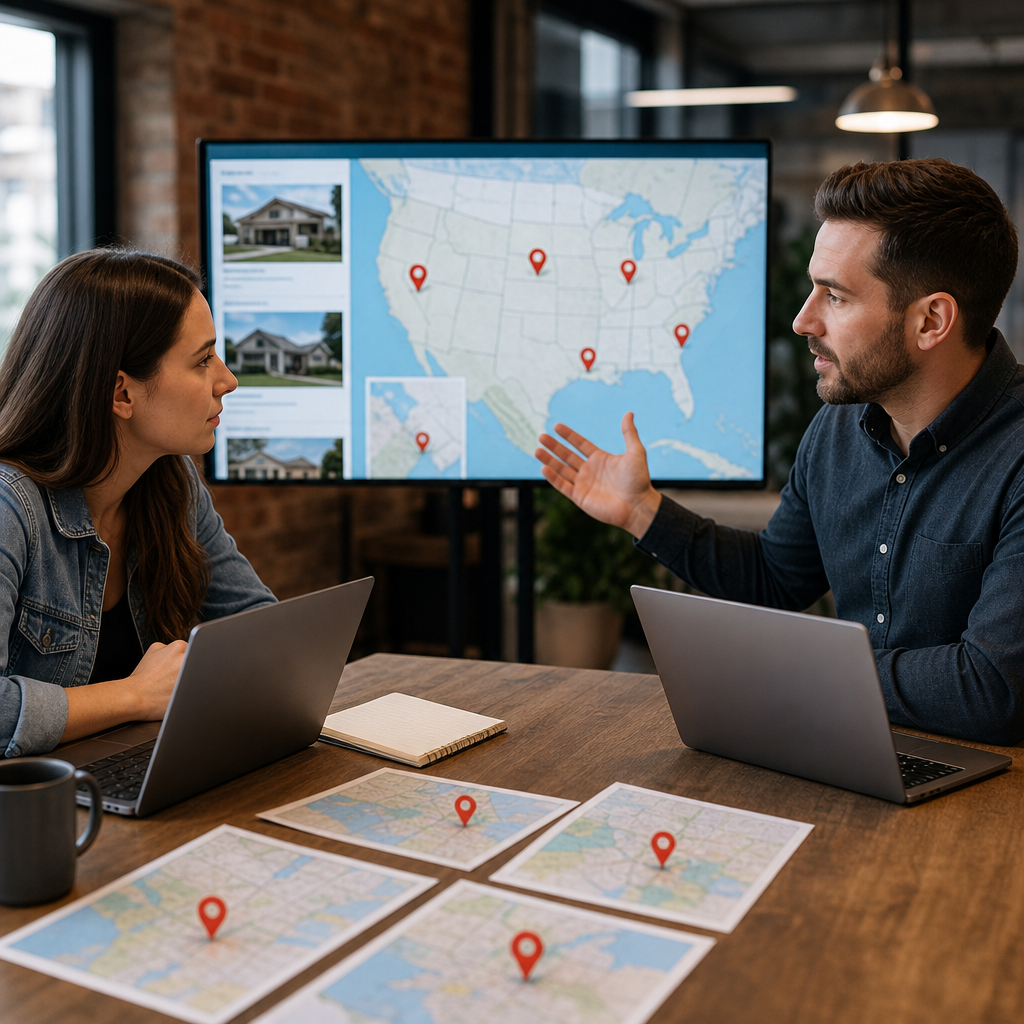
Specific service details. Don’t say “we serve the area.” List neighborhoods, zip codes, suburbs, and service boundaries. The more specific, the clearer you are to both visitors and search engines.
Prominent contact options. Include a phone number, contact form, and appointment scheduler above the fold. Local service businesses still convert heavily on phone leads, so don’t bury that option.
Local trust signals. Feature local certifications, partnerships, awards, or affiliations. A home services company might highlight local chamber membership or licensing board standing.
Comparison to regional competition. Subtle references to why your location matters help. “Unlike national chains, our technicians live and work in the community we serve” works better when you back it up with specific local commitments.
Speed, mobile optimization, and clean design matter as much as content. If your page loads slowly or requires pinching to read on mobile, you’ve already lost most local traffic.
Integrating Video Content Into Local Landing Pages
Video dramatically lifts local landing page conversion, especially for service businesses where trust is paramount. We recommend pairing your location-specific pages with short-form video that shows your team, process, or local results.
A 15-30 second video of your team introducing themselves on that page, mentioning the neighborhood by name, builds trust faster than paragraphs of text. Video views also signal engagement to search engines, which can improve ranking for that page over time.
The most effective approach is pairing cinematic short-form video production with each location page. You might feature a testimonial from a local customer, a before/after walkthrough of a recent local project, or a brief team introduction shot in your local office.
We typically recommend one hero video per location landing page, positioned above the fold or early in the page. Test whether it performs better at the top or after your main copy, since some audiences prefer to read first.
Creating Location-Specific Messaging That Resonates
Generic service messaging doesn’t convert. “We provide quality HVAC services” could apply anywhere. “We’ve served Denver’s south suburbs for 12 years and replace 200+ HVAC systems annually in this exact area” has teeth.
Start by researching what your local audience actually searches for and what concerns them. A healthcare clinic in a retirement community faces different messaging needs than one in a young family neighborhood. A plumber in an older neighborhood might emphasize experience with aging infrastructure, while one in new construction zones highlights efficiency and smart home integration.
Interview your local team members and recent customers from that area. Ask what matters most to them about choosing a service provider locally. You’ll discover messaging angles you’d never reach through generic copywriting.
Location-specific offers also outperform universal promotions. “First-time customers in the Highlands get $50 off” performs better than “Get $50 off your first appointment.” It signals you’re local and invested in that community.
Avoid overly broad claims. “Best in the state” doesn’t resonate as much as “Most recommended in the Westminster area for five years running,” if you can back it up.
Technical SEO Setup for Local Landing Page Performance
Search engines need to understand your pages are genuinely local, not just claiming it. This starts with proper schema markup. Implement LocalBusiness schema on every location page, including your company name, address, phone number, service areas, business hours, and local reviews.

Your page URL structure matters too. A URL like yoursite.com/denver-hvac-repair or yoursite.com/locations/denver-co performs better than a generic URL with location data buried in the page. Search engines parse URLs, so location in the path helps.
Include location keywords naturally throughout your page: in headlines, body copy, alt text for images, and meta descriptions. Use city names, neighborhoods, and regional landmarks. Avoid keyword stuffing, which tanks rankings, but lean into specific geographic references.
Internal linking between location pages reinforces local relevance. If you service ten cities, link between them with anchor text like “Also serving Denver” or “See our Phoenix services.” This architecture signals to search engines that you’re genuinely operating across multiple local markets.
Ensure your NAP (name, address, phone) is consistent across your website, Google Business Profile, and citations. Inconsistencies confuse search engines and hurt local ranking potential.
Building Lead Capture Systems Into Your Local Pages
Your conversion mechanic depends on how your local customers prefer to contact you. Some service industries (home repair, healthcare) work well with phone leads. Others benefit more from contact forms or appointment scheduling.
Most successful local service pages use a hybrid approach: prominent phone number for immediate calls, plus a form or scheduler for people researching outside business hours.
Position your lead capture tool early, not at the bottom. Above-the-fold contact options see 3-5x higher conversion than below-fold forms, regardless of how good your page copy is.
Test messaging on your CTA buttons too. “Call now for same-day service” outperforms “Contact us” for emergency services. “Schedule a free consultation” works better when you’re selling expertise, not urgency.
Capture only essential information on your form. Asking for company name, phone, email, and service type usually works. Adding 5-10 fields drops completion rates by 40-60%, so resist the urge to gather everything upfront.
Connecting Landing Pages to Your Paid Advertising Strategy
Your local landing pages should inform every dollar you spend on paid search and paid social advertising. Ad copy should match landing page headlines as closely as possible. Search engines reward this alignment and so do visitors who see consistent messaging.
For Google Ads, match your location targeting to your landing pages. If you have a specific landing page for Denver, run ads targeting Denver and surrounding areas to that page. If you’re running ads to multiple locations, ensure you have a unique landing page for each.
On Meta, you can create custom audiences by location and serve unique ads and landing pages to each. A dental practice can run different video ads and landing pages to people searching in different neighborhoods, each highlighting local dentists, hours convenient to that area, and testimonials from patients in that zip code.
Dynamic ads work well too. If you have a feed of services, locations, or local inventory, Meta can automatically show different variations to different location-based audiences, each driving to the appropriate local landing page.
The key is intentionality. Every ad should have a matched landing page. Sending traffic from multiple ads or locations to a single universal page dilutes relevance and hurts conversion.
Measuring and Optimizing Local Landing Page Performance
Track these metrics separately for each location page: traffic volume, bounce rate, conversion rate, cost per lead, and lead quality (how many leads convert to paying customers).

Use UTM parameters on all ads driving to local pages so you can distinguish traffic source, campaign, and location in your analytics. This reveals which location pages, ad campaigns, and keywords drive the best ROI.
Most service businesses should expect local landing page conversion rates between 5-15%, depending on industry and traffic quality. If a page underperforms, check whether it’s a traffic quality issue (wrong audience reaching the page) or a page quality issue (poor conversion mechanics).
A/B test one element per local page at a time: headline, hero image or video, CTA button text, form fields, or social proof layout. Small changes often improve conversion by 10-20%. Since these tests compound, optimizing gradually builds powerful results.
Seasonal and competitive factors matter locally. The same page might convert better in winter for HVAC services or summer for pool services. Track performance by season and adjust messaging, offers, and bids accordingly.
Monthly reviews keep you aligned with what’s working. Set a reminder to review each location page’s performance, compare it to previous months, and identify one optimization to test.
Our Approach to Local Landing Page Strategy
We build local landing page systems that treat each location as a distinct market with its own audience, competition, and conversion mechanics. Our process starts with research: understanding your local customer base, competitive landscape, and what messaging converts best in each area.
Next, we create location-specific landing pages that combine compelling local messaging with technical SEO rigor. We layer in cinematic video content when appropriate, build conversion mechanics tailored to your sales process, and ensure every page loads fast on mobile.
Then we integrate these pages into paid advertising campaigns, testing messaging, offers, and audience targeting by location. We measure everything and optimize continuously, prioritizing the locations and campaigns that deliver the strongest ROI.
The result is a local lead generation engine that scales. As you add locations or expand service areas, your system grows with you without diluting performance or brand consistency.
If you’re ready to move beyond generic landing pages and start capturing qualified local leads, we’d like to help. Reach out to discuss your specific markets and challenges.
Contact us today for a free consultation to see how we can help you grow your business.
Frequently Asked Questions (FAQ)
How do we help multi-location businesses create landing pages that actually convert visitors into leads?
We build location-specific landing pages with targeted messaging, video content, and lead capture systems designed to turn traffic into qualified prospects. Our approach combines cinematic short-form video, conversion-focused design elements, and integrated paid advertising strategies so each location page works as a lead generation tool rather than just an information page.
Why does video content matter on local landing pages?
We’ve found that video significantly increases engagement and trust on landing pages for service-based businesses. We incorporate short-form cinematic content that tells your brand story while addressing local customer pain points, which helps visitors understand your value before they submit a lead form.
Can we integrate our local landing pages with our paid advertising campaigns?
Yes, we connect your landing page strategy directly to your Meta and Google advertising efforts. We design pages around the specific keywords and audience segments we’re targeting in paid campaigns, ensuring consistent messaging and maximizing your return on ad spend across locations.