Why Service Businesses Struggle With Ad Creative Costs
Service businesses face a unique challenge in digital marketing: you need constant creative assets to maintain ad relevance and performance, yet traditional production costs eat into already-thin margins. Whether you’re a plumbing company, HVAC contractor, pest control network, or dental practice, the math feels impossible. Traditional commercial video production can run $5,000 to $25,000 per project, and you’re told you need multiple variations to test effectively.
This creates a false choice: spend heavily on polished production or go cheap with low-quality content that underperforms. Most service business owners land somewhere in the middle, producing mediocre creative that generates poor ad performance, which then justifies cutting the budget further. The cycle repeats.
The real problem isn’t that quality costs money. It’s that most service businesses haven’t found a production model built specifically for the speed and volume that paid advertising demands. You’re not making a commercial for a Super Bowl spot. You need dozens of ads per quarter, tested and optimized continuously.
Action item: Audit your current ad spend for the past three months. Calculate the cost-per-result by creative. You’ll likely find that 70% of your budget went to 30% of your creatives, and the rest underperformed because it was either outdated, poorly shot, or misaligned with audience intent.
The Hidden Cost of Generic, Poorly Performing Ads
Running a generic, poorly produced ad doesn’t just waste budget on impressions. It trains your audience to ignore you. When someone sees blurry footage, awkward voeovers, or stock-footage backgrounds, they swipe. Your cost-per-result climbs, your cost-per-lead skyrockets, and you abandon the channel thinking it doesn’t work for your business.
Consider this scenario: you run a home repair franchise with 12 locations. You use one mediocre video ad across all franchises, targeting homeowners in each market. The ad has a 1.2% conversion rate. You spend $5,000 per month and get 60 leads. Your cost per lead is $83. Your sales team closes 20%, so you’re paying $415 per actual job. After job costs and overhead, you’re losing money.
Now swap that generic video for one that shows actual before-and-after transformations, includes real customer testimonials, and highlights what makes your service different. That same $5,000 might generate 150 leads (a 3% conversion). Your cost per lead drops to $33. Same budget, 2.5x more qualified opportunities.
The gap between these scenarios isn’t camera quality. It’s relevance and authenticity. Generic ads fail because they don’t answer the question your audience is actually asking: “Is this the right solution for my specific problem?”
Bad creative also damages trust. Prospects notice production corners you cut, and they assume you cut corners on service too.
What Makes High-Performing Ad Creative Actually Work
High-performing ad creative has three characteristics, regardless of your service industry.
First, it leads with specificity. Instead of “We’re the best plumbing company,” show a specific problem being solved: “We fixed a burst pipe in under 2 hours without tearing out walls.” The specificity makes it credible and relevant to someone with that exact problem.
Second, it demonstrates before and after or problem and solution in rapid sequence. Your audience doesn’t have time to figure out what you do. The first 3 seconds must show transformation or outcome. A roofing company ad should show the leaky roof, the crew at work, and the completed job, all within the first frame.
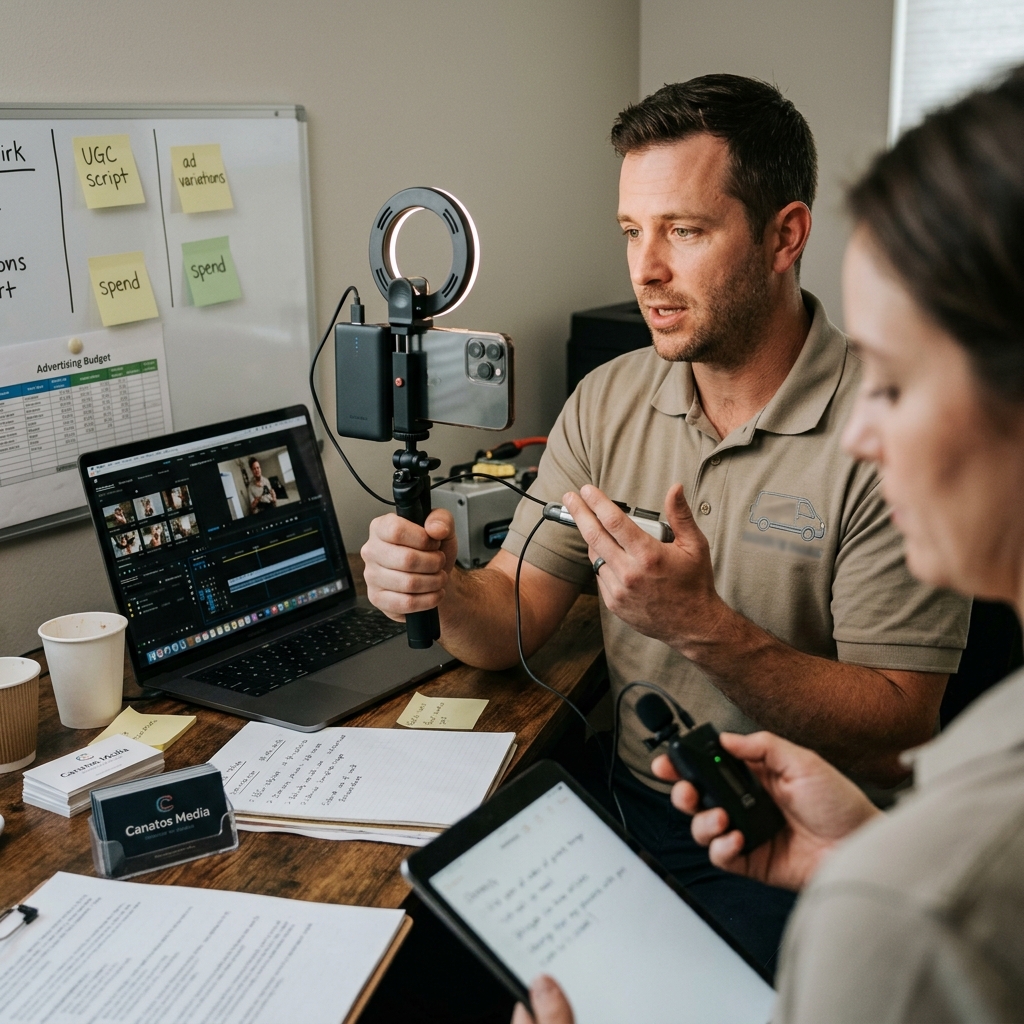
Third, it uses real people or realistic scenarios. Actors and stock footage signal that you’re generic. Real job sites, real customers, real before-and-after photos build trust. Even short-form content—15 to 60 seconds—works better when it feels authentic rather than polished.
These elements work because they reduce friction. Your prospect doesn’t have to imagine the result or translate your messaging into their situation. You’ve done it for them.
Our Approach to Cost-Effective Creative Production
We built our creative production model specifically for service businesses that need high volume and rapid testing. Rather than treating each ad like a one-off production, we develop content systems that allow us to shoot 10 to 20 variations in a single day, with genuine variety in messaging and visual approach.
Our process starts with strategic asset planning. Instead of guessing what will work, we map your ideal customer’s objections and questions: “How quickly do you respond?” “Will you damage my property?” “How much will this cost?” Each question becomes the spine of a different ad creative. We shoot once, but we produce multiple narratives.
We also use cinematic short-form content that balances professionalism with authenticity. You get polished video that feels real, not sterile. This approach costs roughly 40-60% less than traditional commercial production because we’re efficient with crew, location, and editing time. We’re not building commercials. We’re building ad assets that convert.
Finally, we integrate production with paid ad management. You’re not paying a production company that disappears once the video is done. We produce, we manage your Meta and Google ad accounts, we test variations, and we iterate based on performance data. This integration means production decisions are made with conversion metrics in mind, not just aesthetics.
Short-Form Video Content That Converts Without Premium Price Tags
Short-form video outperforms longer content on Meta, TikTok, and Google ads, and it’s significantly cheaper to produce. A 15-second ad costs about 25% of what a 60-second commercial costs, yet testing shows 15 to 30-second videos often convert better for service businesses because people are impatient.
Short-form doesn’t mean low-quality. It means intentional. Every frame serves a purpose. There’s no filler, no long setups, no moments where a prospect might scroll past. You open with the transformation, demonstrate value, and close with a clear next step.
For example, a pest control business might produce five 15-second ads in one shoot: one focusing on same-day service, one on pet-safe treatments, one on warranty guarantees, one on local expertise, and one on cost. Each targets a different customer concern. You test all five in a single Meta campaign. The top two get budget increases. The weaker three get paused. After two weeks, you produce five new variations and repeat.
This testing velocity is impossible with expensive, long-form production. It’s built into our short-form video production approach. You get cinematic quality on a pace that matches the speed of paid advertising optimization.
Strategic Ad Testing to Stretch Your Creative Budget
Most service businesses run the same three or four ads until they tank, then they rush to produce new creative. This is reactive and wasteful. Strategic testing is proactive and efficient.
Structured testing means you allocate your budget intentionally across four tiers:
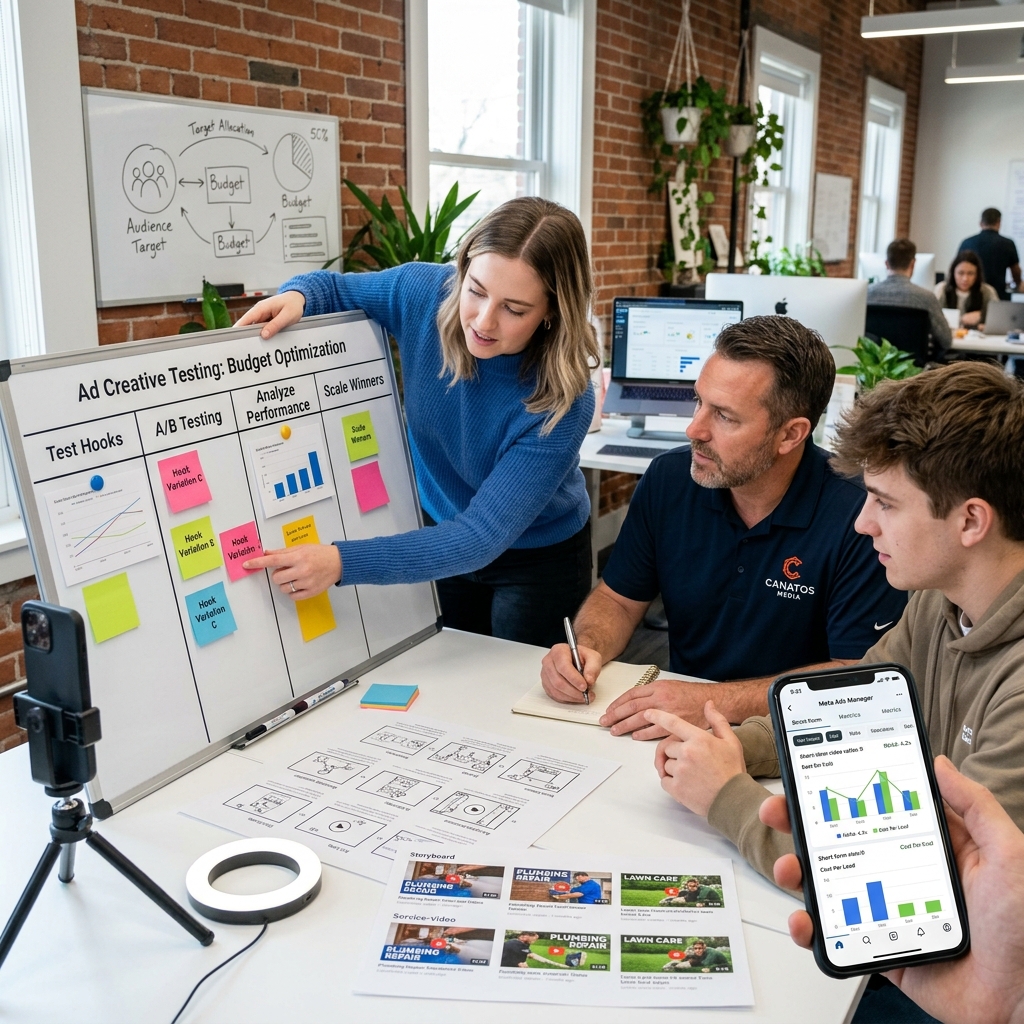
- Winner ads (60% of budget): Your proven top performers. These continue running while you gather more data.
- Testing ads (25% of budget): New variations you’re evaluating. These get modest budget to determine if they outperform the winners.
- Learning ads (10% of budget): More experimental. Different messaging angles, different visual approaches. You expect most to underperform, but one might unlock a new audience segment.
- Holdout budget (5%): Reserved for rapid iteration once you identify a winner.
This structure means you’re always producing. You’re never caught flat-footed with stale creative. And you’re not betting the entire budget on one guess.
We map this testing schedule across your calendar so production timelines align with campaign pacing. If you’re running a spring promotion, we’re producing test variations in January. By the time the campaign launches, you have data on what works, and you’re optimizing rather than discovering.
Measuring Creative Performance to Eliminate Wasted Spend
You can’t optimize what you don’t measure. Many service businesses run ads but don’t tie creative performance to actual business results. They know a video got 1,000 clicks, but not how many of those clicks turned into scheduled appointments.
We track every creative asset through the full funnel: impression, click, form submission, phone call, scheduled appointment, and closed job. This reveals which ads are attracting the right prospects versus which are driving cheap clicks that waste your sales team’s time.
A video ad might have a low cost-per-click (good) but a low close rate (bad), meaning it’s attracting bargain hunters. A different creative might have a high cost-per-click but a high close rate, meaning it’s attracting serious buyers. The second creative is the real winner, even if the first looks better in raw metrics.
We set up UTM parameters and call tracking so every ad has a unique identifier in your analytics. You can see not just traffic but revenue attribution. That’s the data that justifies continued investment and reveals where to double down.
How We Bundle Creative Production With Paid Ad Management
The gap between a good video and a good-performing video is media strategy. Brilliant creative shown to the wrong audience underperforms. Mediocre creative shown to the right audience can still convert.
We bundle production and paid ad management so these decisions happen together. When we’re shooting your creative, we’re thinking about audience targeting, placement strategy, and testing sequence. When we’re managing your Meta or Google ads, we’re thinking about which creative variations to test based on performance data.
This integration also means we’re not overscheduling production. If your top ad is still converting well and your budget is climbing, we don’t rush into new production. We optimize existing assets first. If your top ads are plateauing, we move into production mode and develop fresh variations.
You get a coordinated system, not a production company and an ad agency that don’t talk to each other. Your budget stretches further because decisions are strategic rather than siloed.
Real Results: Service Businesses Seeing 3x Better ROI
We work with multi-location service businesses across home improvement, HVAC, pest control, and trades. The pattern is consistent: once they shift from sporadic, generic creative to structured production and testing, their ad ROI improves dramatically.
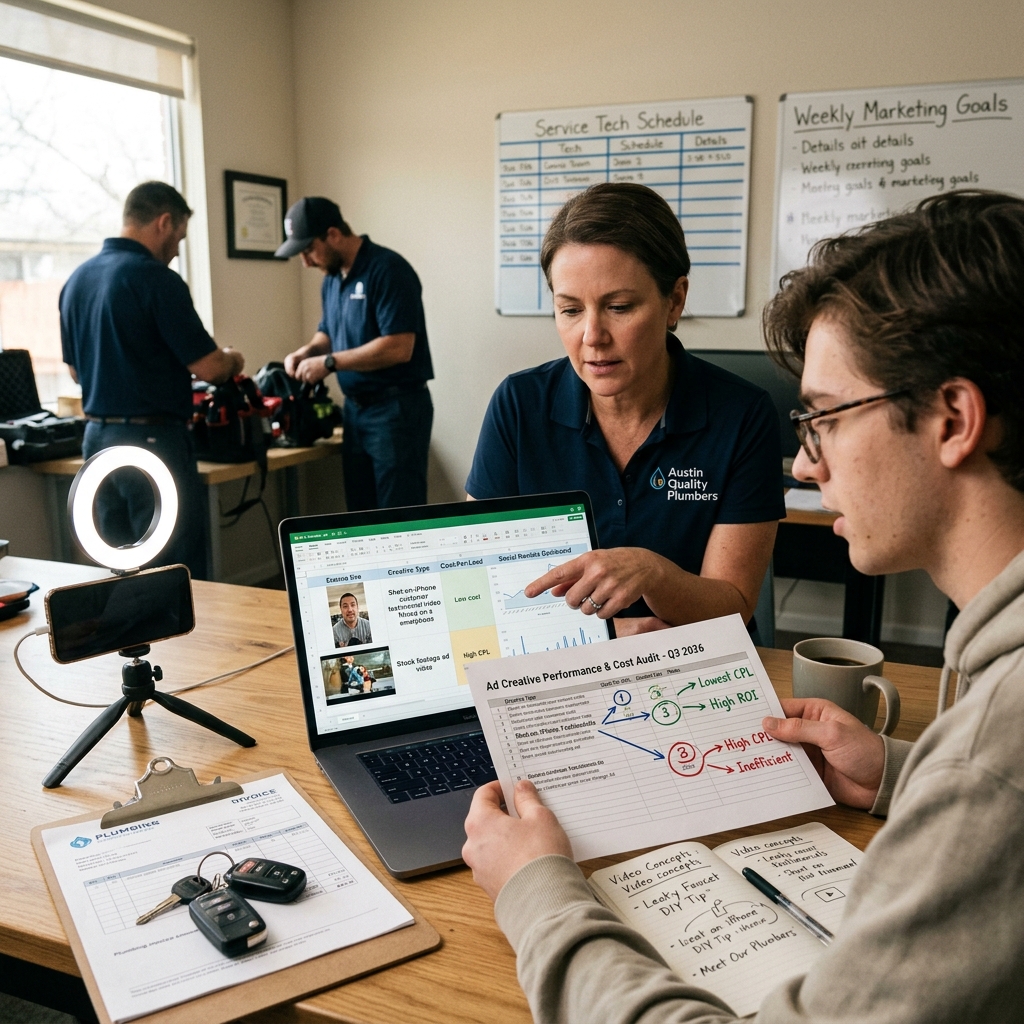
A regional HVAC franchise was spending $8,000 per month on ads with a cost-per-lead of $78. After moving to our model, they produced 12 variations focused on different pain points (summer cooling, winter heating, emergency service, maintenance plans). Within 60 days, their cost-per-lead dropped to $32, and they increased ad spend to $12,000 per month because the math worked. Same budget mindset, but now they’re generating 3x the leads with better quality.
A plumbing network in the Northeast was running one generic ad across seven markets. By producing location-specific variations that mentioned local landmarks and referenced neighborhood-specific issues, they saw a 2.4x improvement in cost-per-lead within 45 days.
These aren’t outliers. They’re the norm when creative strategy aligns with audience targeting and you’re testing continuously rather than hoping once.
Getting Started With Our Budget-Friendly Creative System
Start by auditing your current creative inventory. List every ad you’re running. Note the cost-per-result for each. Identify your top three performers and your bottom three. What’s different about the winners? Is it specificity? Visual clarity? Audience targeting? Once you see the pattern, you know what to produce next.
Next, map your customer’s objections. If you’re a service business, your prospect has questions: timeline, cost, disruption, warranty, credentials. Each becomes a separate ad variation. You’re not guessing. You’re strategic.
Then, reach out to us. We’ll review your current performance, propose a production schedule that aligns with your ad budget and business cycles, and show you how to test in a structured way. Most service businesses see payback on creative investment within 30 to 60 days.
The goal isn’t cheaper production for its own sake. It’s building a system where your marketing budget generates more leads, more qualified prospects, and more closed jobs. When creative production is efficient and testing is strategic, that math works.
Contact us today for a free consultation to see how we can help you grow your business.
Frequently Asked Questions (FAQ)
How do we keep ad creative production costs low without sacrificing quality?
We leverage short-form video formats and streamlined production workflows that eliminate unnecessary expenses while maintaining cinematic quality. Our team focuses on what actually drives conversions for service businesses, so we cut out costly elements that don’t impact performance. By bundling creative production with our paid ad management, we optimize production budgets across your entire campaign strategy rather than treating video creation as an isolated cost center.
Why does generic ad creative cost service businesses more money in the long run?
Poor-performing ads waste your budget through low conversion rates and high customer acquisition costs, even if the production itself was inexpensive. We’ve found that poorly targeted or uninspired creative leads to audiences ignoring your message entirely, forcing you to spend significantly more to reach your goals. Our approach focuses on creating specific, conversion-driven content that reduces overall ad spend by improving the efficiency of every dollar you invest.
What’s included when we manage both creative production and paid advertising for your account?
We handle everything from shooting and editing your ad content to testing multiple variations, analyzing performance data, and optimizing placements across Meta and Google. This integrated approach means we’re not just creating videos in a vacuum—we’re building creative assets with your ad performance targets in mind from day one. You get strategic testing, performance measurement, and ongoing creative refinement all coordinated as one cohesive system.