The Gap Between Views and Bookings: Why Most Brands Struggle
Your Instagram Reel gets 15,000 views. Your TikTok video trends in your niche. But when you check your calendar, the consultation slots remain empty.
This is the most common frustration we hear from growth-focused business owners. High view counts feel good until you realize they don’t translate to actual revenue. The problem isn’t that your content isn’t getting seen. It’s that your content isn’t structured to move people toward a specific action.
Most brands treat social media like a broadcast channel rather than a sales system. They create entertaining or informative content, hope it resonates, and expect people to magically find their booking page. That’s not a funnel. That’s luck.
A real social media funnel guides prospects through stages: awareness, consideration, and decision. Each piece of content has a job. Some attract strangers. Others build trust. The final stage converts interest into action. Without this structure, views pile up but bookings stall.
Action step: Audit your last five best-performing posts. Did any include a clear next step or call-to-action that led to a booking?
How Cinematic Content Changes the Conversion Game
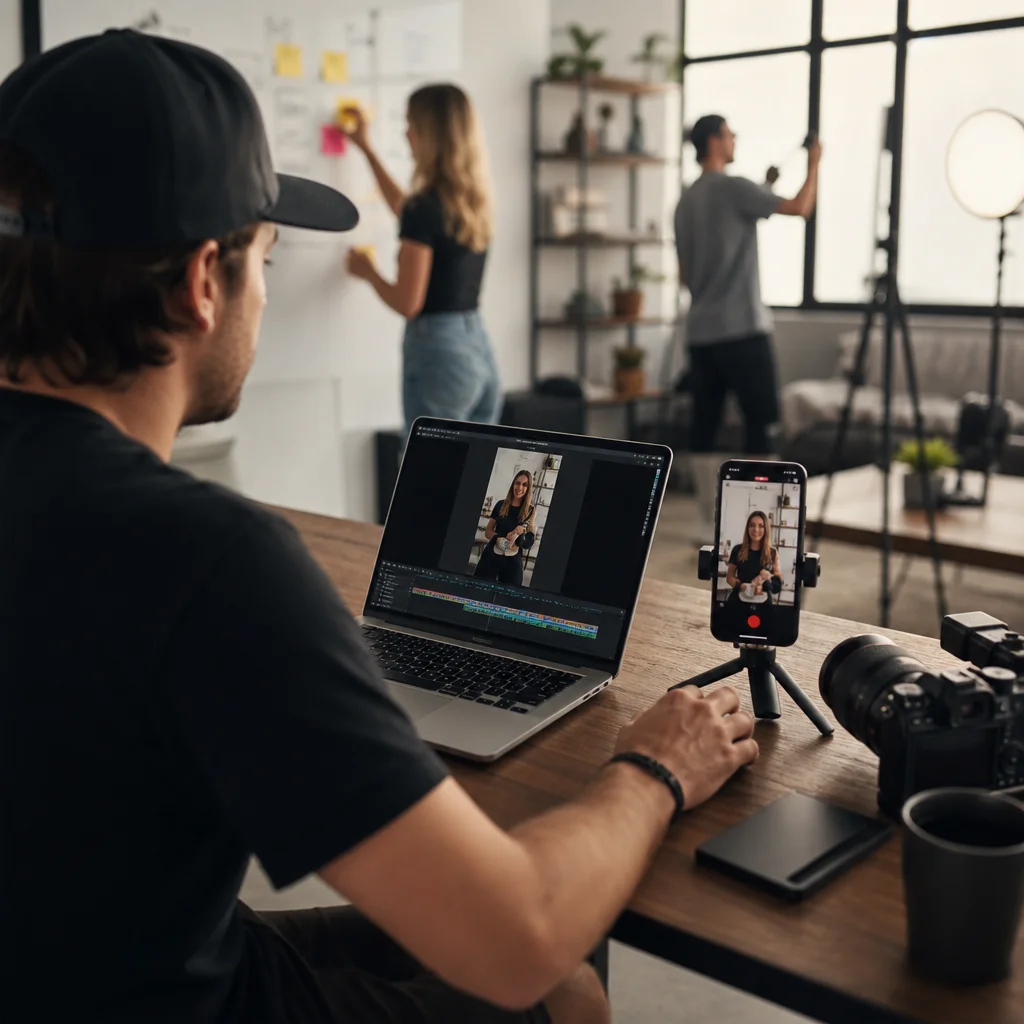
Cinematic content is different. It doesn’t just inform or entertain. It creates an emotional anchor that makes people remember your brand and trust your authority.
When a video feels professionally produced, shot with quality lighting, sound design, and storytelling, viewers subconsciously perceive higher value. That perception matters. A service-based business owner featured in a cinematic brand story doesn’t look like everyone else in their niche. They look established, intentional, and worth booking.
Beyond perception, cinematic content performs better at every funnel stage. In the awareness phase, it stops scrolls. During consideration, it builds confidence in your expertise. At decision time, it creates the psychological safety needed to schedule a consultation.
The key is pairing that cinematic quality with funnel-specific messaging. A beautifully shot video that doesn’t align with where your prospect sits in their buyer journey won’t convert. But when you combine professional production quality with strategic message architecture, conversion rates climb significantly.
Action step: Identify which funnel stage your current content primarily targets (awareness, consideration, or decision). Then create one piece of cinematic content for the stage you’ve been neglecting.
Structuring Your Funnel: Awareness to Action Stages
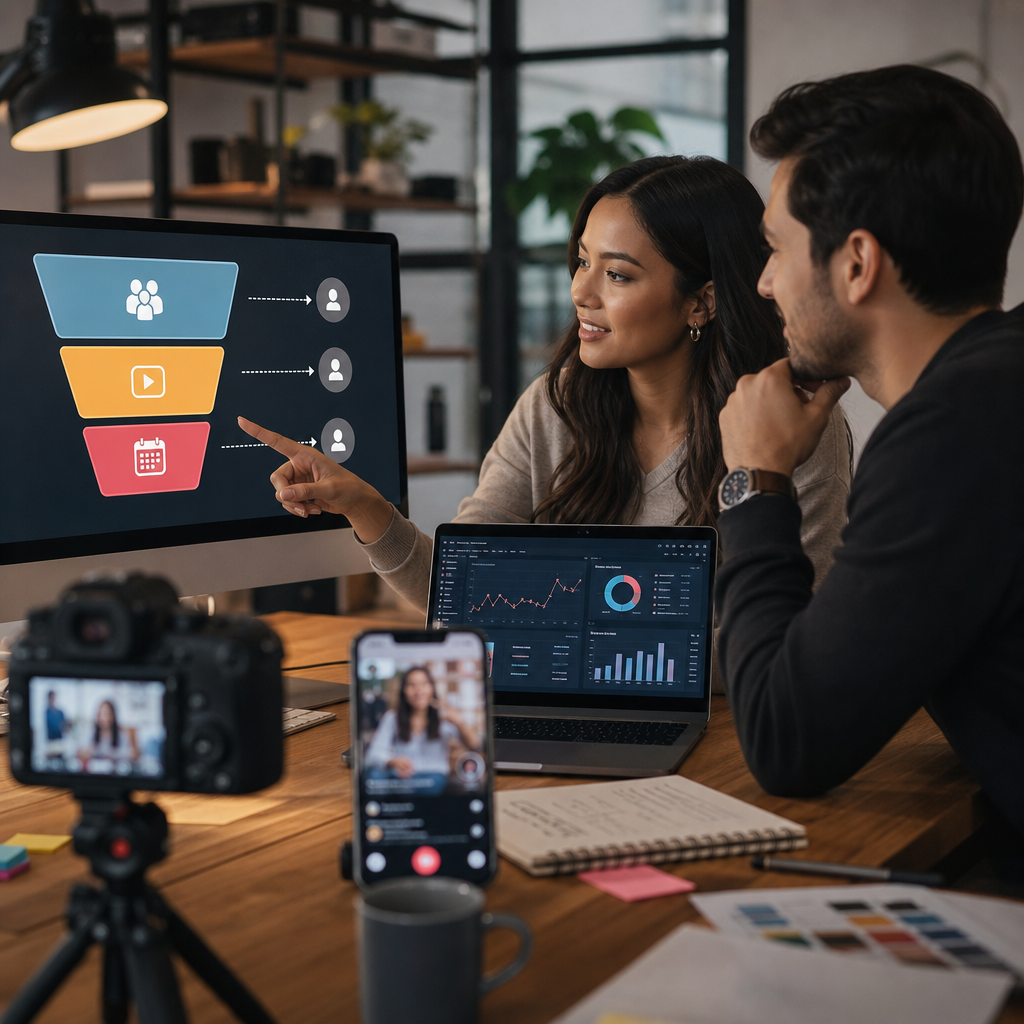
A repeatable social media funnel has three primary stages, and each requires different content and strategy.
Awareness stage: Prospects don’t know you exist. Your content here answers questions, solves surface-level problems, and showcases expertise. Think educational short-form videos, behind-the-scenes reels, or clips highlighting common client challenges. The goal is reach and relevance, not conversion.
Consideration stage: Prospects know about you and are comparing options. Content here shows your unique approach, demonstrates results, and addresses specific concerns. Case study videos, testimonials, and “here’s how we do it differently” content lives here. You’re building trust and differentiation.
Decision stage: Prospects are ready to commit but need final reassurance. Content here emphasizes your booking process, shares transformation stories, and removes friction. Testimonial compilations, walk-through videos of your consultation, and clear CTAs belong in this zone.
Most brands over-invest in awareness and skip decision. That’s why they accumulate viewers but not bookings. A balanced funnel dedicates roughly 60% of effort to awareness, 25% to consideration, and 15% to decision content. Adjust based on your sales cycle, but don’t ignore decision-stage content.
Action step: Map your last month of social posts into these three stages. Identify which stage is underrepresented and plan three new pieces of content for that zone.

Creating High-Intent Short-Form Content That Drives Bookings
High-intent content speaks directly to prospects who are closest to making a decision. These viewers aren’t casually scrolling. They’re searching for solutions.
The structure for high-intent reels follows a pattern: Problem identification (first 2 seconds), your specific approach (next 5 seconds), proof or result (next 3-5 seconds), clear next step (final 2 seconds).
An example: A personal trainer creates a reel showing a common mistake they see in their consultation calls, demonstrates the correction, shows a client’s before-and-after, then ends with “Book your free form check at [link].” That’s high-intent. The viewer either recognizes the problem, sees the solution, and knows exactly what to do next.
High-intent content doesn’t need viral reach. It needs precision. A reel with 2,000 views from your ideal customer profile who understands your offer outperforms a 50,000-view video that attracts unqualified viewers. Focus on clarity and relevance over vanity metrics.
The best high-intent content directly references your offer. “If you’re ready to hire a fractional CFO” or “For service-based business owners scaling past $500K” immediately signals whether the content is for them. This filtering actually improves your booking rate because you’re speaking to the right people.
Action step: Create one high-intent reel this week using the problem-approach-proof-CTA structure. Track how many consultation inquiries it generates over the next two weeks.
Integrating Meta and Google Advertising Into Your Funnel
Organic reach alone won’t sustain a repeatable funnel. Paid advertising accelerates results and creates consistency.
Meta advertising (Facebook and Instagram) works best for awareness and consideration stage content. You can target by interest, behavior, and demographics to reach people likely to need your service. The advantage is creative flexibility and audience precision at a relatively low cost per impression.
Google advertising targets people actively searching for solutions. Someone searching “hiring a social media manager near me” or “how to grow my service business online” is higher intent than someone casually scrolling. Google ads work best for decision-stage content and conversion-focused campaigns.
In a balanced approach, use Meta to build awareness and warm audiences with your cinematic content. Simultaneously run Google ads targeting high-intent keywords that point directly to booking pages or lead capture forms. This dual strategy captures both discovered interest and active searching.
Many brands underspend on advertising because they’re waiting for organic content to perform perfectly first. That’s backwards. Start with $300-500 monthly ad spend across Meta and Google, test messaging and audience segments, then scale what works. A repeatable funnel requires paid acceleration.
Action step: Set up one Meta awareness campaign targeting your ideal customer profile and one Google search campaign targeting booking-related keywords. Start with $250 combined monthly budget.
Building Automated Lead Capture Systems That Work
Content brings traffic. Automated systems convert traffic into captured leads.
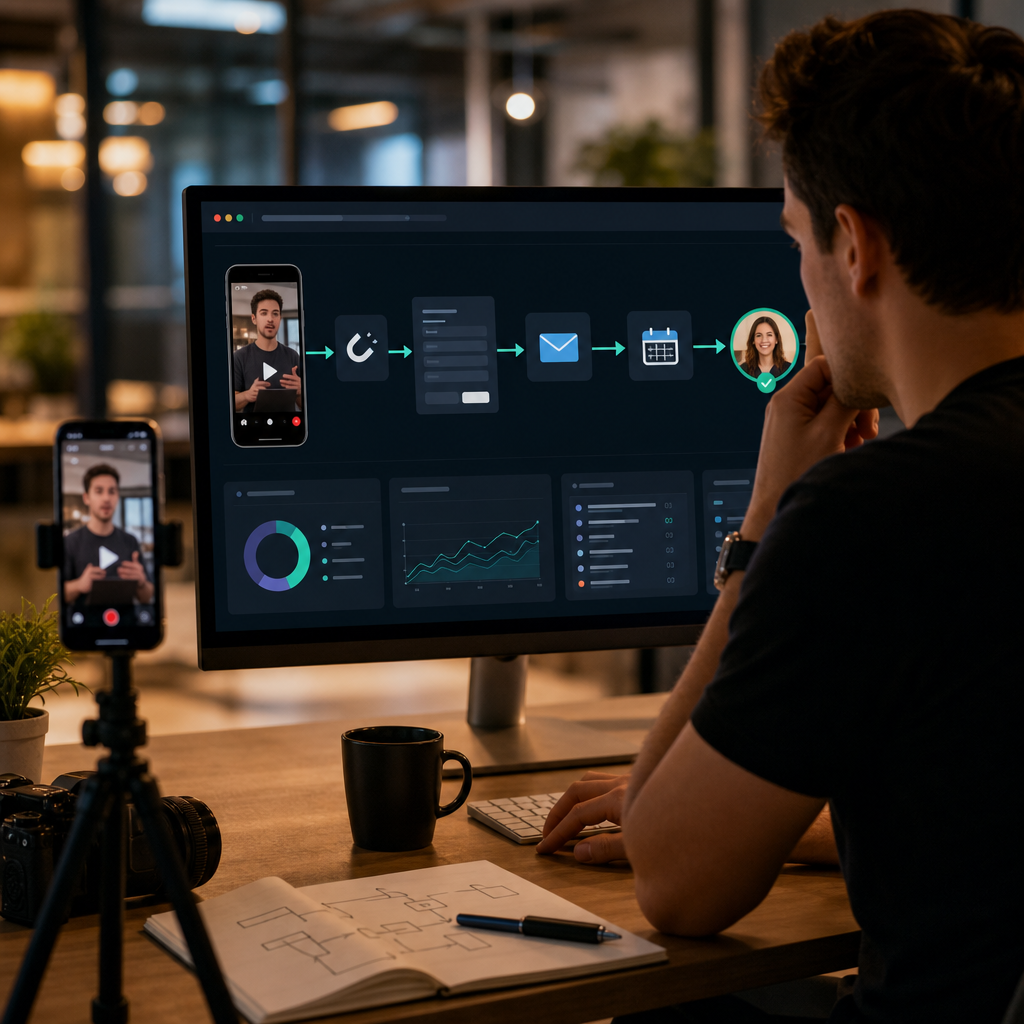
An effective lead capture system uses a form, email sequence, and follow-up strategy. When someone clicks “Book a consultation” from a reel or ad, they land on a simple form asking for name, email, and a question like “What’s your biggest challenge right now?” This takes 30 seconds to complete.
After submission, they receive an immediate email confirming their request and offering a booking link or next steps. A follow-up sequence of 2-3 emails over the next week keeps momentum, shares relevant case studies, and removes objections. This happens automatically.
Without automation, a great piece of content converts one person at a time, only when you’re actively managing messages. With automation, every piece of content works 24/7, converting prospects while you sleep.
The technology is simple: a landing page builder like Leadpages or Unbounce, email marketing software like ConvertKit or ActiveCampaign, and a scheduling tool like Calendly. Connect these three, and you have a basic system. As your volume grows, you can add workflows for follow-up, lead scoring, and dynamic email paths based on prospect behavior.
Action step: Audit your current booking process. Does a prospect get an immediate response after submitting? If not, set up an automated email confirmation and one follow-up sequence within the next week.
Using SEO to Feed Your Social Funnel With Qualified Traffic
SEO and social media aren’t separate channels. They’re complementary.
While social media brings rapid visibility and engagement, SEO feeds consistent, high-intent traffic to your website and content hub. A blog post optimized for keywords like “how to convert social media followers into leads” or “booking consultations best practices” captures people searching for exactly what you teach.
This search traffic then discovers your lead capture form, books a consultation, or joins your email list. Unlike social media, where algorithmic changes affect reach overnight, SEO traffic compounds over months. One well-optimized article can deliver leads for years.
The strategy is straightforward: identify keywords your ideal customers search for, create comprehensive content answering those searches, optimize that content for both search engines and readability, then promote it across your social channels. This creates a two-way flow: social drives engagement, search drives intent.
We structure this by identifying keywords aligned with each funnel stage. Awareness-stage keywords like “how to book a consultation” are high volume but lower intent. Decision-stage keywords like “book a consultation with a fitness coach” are lower volume but far more likely to convert.
Action step: Choose one keyword related to your service and create or optimize a piece of content targeting it. Include a clear lead capture element within that content.
Tracking and Optimizing Your Funnel Performance
A funnel without measurement is just guessing.
Track these core metrics: traffic by stage (how many people entered awareness, consideration, decision), conversion rate by stage (what percentage moved from one stage to the next), cost per lead, and cost per consultation booked. These numbers reveal where your funnel leaks.
If 10,000 people see your awareness content but only 200 click to consideration content, you have an awareness-to-consideration conversion problem. Maybe your CTAs are unclear or your messaging misses the mark. If 500 people reach decision content but only 20 book, your decision content isn’t compelling enough.
Most brands discover these leaks only after months of wasted effort. Regular tracking catches problems in weeks.
Use UTM parameters in your links to track which content drives which actions. Connect your analytics platform (Google Analytics, Metricool, or HubSpot) to your email system and CRM. This creates a complete view of how prospects move through your funnel.
Set benchmarks. If your awareness-to-consideration conversion is 2%, optimize until it’s 3-4%. Small improvements at each stage compound into dramatically higher booking rates.
Action step: Set up UTM parameters for your next three social posts. Track how many people click through to each stage of your funnel over the next 30 days.
Why Consistency Matters More Than Trends
A viral reel is exciting. A reliable system is profitable.
Viral content provides bursts of traffic but rarely builds repeatable revenue. A repeatable funnel runs on consistency: the same posting schedule, the same messaging frameworks, the same lead capture process, executed reliably week after week.
Trends change weekly. Your core message, your ideal customer, and your offer don’t. While others chase trending sounds and formats, you’re building assets that compound. An audience built on consistent value and clear positioning sticks around through algorithm changes.
This doesn’t mean ignoring trends entirely. Use trending formats when they align with your message. But don’t abandon your funnel strategy chasing virality. A consistent Tuesday morning reel that converts at 5% outperforms an inconsistent viral post that converts at 0.5%.
Consistency also builds brand recognition. When your ideal customer sees your content three times a week, they begin associating you with solutions in your niche. That recognition shortens the consideration phase and increases booking rates.
Action step: Commit to a posting schedule for the next 90 days: choose a frequency (daily, 3x weekly, or weekly) and stick to it, tracking how this consistency affects your booking rate.
Our Approach to Building Your Repeatable Funnel
We’ve built dozens of social media funnels that convert consistently. The process combines cinematic short-form content with strategic funnel architecture, paid advertising precision, and automated systems.
We start by mapping your specific buyer journey: how long does your consideration phase last, what objections appear, what questions do prospects ask before booking. This informs content and messaging strategy. Next, we audit your current content and identify gaps by funnel stage.
Then we produce cinematic content tailored to each stage. This isn’t just footage. It’s strategically designed video that moves prospects through your funnel. Simultaneously, we set up your lead capture infrastructure, email sequences, and ad strategy.
Finally, we monitor performance, test new messaging and audience segments, and optimize. After 60-90 days of consistent execution, most clients see booking rates increase by 30-50%.
If your social media generates views but not bookings, the gap isn’t your content quality. It’s your system. We help growth-focused business owners build systems that turn attention into revenue.
Ready to build your repeatable funnel? Start with a clear funnel audit: identify your biggest leak (awareness, consideration, or decision stage), create one piece of content for that stage this week, and measure the impact. That single step often changes how you approach social media forever.
For further reading: Convert viewers into leads.
Contact us today for a free consultation to see how we can help you grow your business.
Frequently Asked Questions (FAQ)
How do we turn social media views into actual booked consultations?
We build a structured funnel that moves viewers from awareness through multiple touchpoints before they’re ready to book. Our approach combines cinematic short-form content that captures attention, strategic paid advertising to reach high-intent audiences, and automated lead capture systems that make booking frictionless. Most brands skip steps in this journey, which is why they see views but no conversions.
What makes short-form video content more effective for lead generation than traditional ads?
We’ve found that cinematic, story-driven short-form content builds trust and keeps viewers engaged far longer than standard promotional ads. When we pair this content with clear calls-to-action and retargeting through Meta and Google, viewers already feel connected to your brand before they enter your lead capture system. The format itself aligns with how people actually consume content on social platforms in 2026.
How do we measure whether our social media funnel is actually working?
We track specific metrics across each stage of your funnel, from initial impression through booked consultation. Our reporting focuses on conversion rates at each touchpoint, cost per qualified lead, and ultimately cost per booking. This data guides our optimization decisions, so we’re constantly improving performance rather than just creating content and hoping it converts.