The Fragmented Marketing Problem Holding Your Growth Back
Most business owners operate with marketing tools scattered across different vendors. Your website lives with one provider, social media management with another, video content comes from a third, and paid advertising runs through a fourth. Each vendor optimizes their piece without seeing the bigger picture of how prospects actually move from awareness to conversion.
This fragmentation creates a fundamental problem: your brand message becomes inconsistent, your budget gets duplicated, and insights stay siloed. When a prospect watches your video on Instagram, clicks to your website, and sees a completely different visual style or messaging approach, it breaks trust. They don’t feel like they’re engaging with one coherent brand.
We’ve watched growth-focused business owners invest significant resources into quality content only to see weak results because nothing connected to their actual sales channels. The video performed well. The website had decent traffic. But they weren’t working together to move prospects through a clear path to purchase.
How Disconnected Services Create Wasted Budget and Missed Opportunities
When services operate independently, waste accumulates quietly. Here’s what typically happens:
Your video production team creates cinematic content optimized for engagement but doesn’t coordinate with whoever manages your website. That stunning 30-second hero video never appears on your homepage. Instead, your website uses generic stock footage while the custom content sits unused on Instagram.
Paid advertising dollars get wasted because your landing pages don’t match your ad creative. You’re running video ads promoting a specific offer, but prospects land on a generic product page. The disconnect kills conversion rates, and your team blames the creative instead of recognizing the system failure.
SEO and video production happen separately, so keyword opportunities get missed. You’re producing content around topics your audience searches for, but it’s not structured to rank. Meanwhile, your website content doesn’t drive people to your video assets where engagement actually happens.
The real cost isn’t just the duplicate spending. It’s the lost leads. When your social media presence, website, advertising, and content aren’t synchronized, prospects fall through gaps. Some never make it to a contact form. Others can’t find clear next steps. The friction compounds at every touchpoint.
The Case for Unified Digital Growth Across All Channels
A unified approach means your website, video content, advertising, and social presence all serve the same conversion goals. Your brand story is consistent across channels. Your messaging hierarchy is deliberate. Your prospects experience a clear path forward.
When everything connects, several things shift:
Your website becomes the hub that ties video content, paid ads, and organic social together. Instead of treating video as entertainment and your website as separate infrastructure, video becomes a core component of your conversion system. A prospect watching your Instagram video can click directly to a relevant page on your site that deepens their interest.
Your advertising becomes more effective because creative and landing page experience match. You’re not hoping prospects forgive the friction between platforms. You’re removing friction entirely.

Your content strategy produces assets that serve multiple purposes. A cinematic brand film works as a homepage hero, a YouTube asset, a social series, and an advertising video. One investment. Multiple channel applications.
Your team moves faster because everyone works from a single strategic vision instead of coordinating across vendors with competing priorities.
Why Video Content Drives Higher Engagement and Conversion Rates
Video stops the scroll in ways static content simply cannot. On social platforms where attention is fragmented, a well-crafted video captures viewers in the first three seconds and holds them long enough to communicate something meaningful.
The numbers reflect this. Video content generates substantially higher engagement rates than text or image-only posts. When that video tells an authentic brand story rather than pushing a generic product message, engagement converts into action. Prospects who watch your full video are exponentially more likely to take a next step than those who only see headlines.
Conversion performance improves because video creates emotional context. Someone reading your service description understands features. Someone watching a short film showing your service in action understands value. The emotional connection makes the purchase decision feel less risky.
Cinematic production quality amplifies this effect. When your video has production value comparable to professional media, prospects unconsciously assign higher credibility to your brand. It signals that you invest in excellence, that you’re serious about your business, and that their experience with you will match that quality standard.
How We Combine Website Design With Cinematic Video Storytelling
Our approach treats your website as the stage where video becomes the lead performer. Instead of video as optional content, we design your site architecture around video-first experiences.
Your homepage doesn’t just display a video hero section. That video conveys your core value proposition in ways a headline alone cannot. Below it, your site guides prospects deeper through complementary video content, testimonial films, process walkthroughs, and case study narratives. Each video serves a specific purpose in the conversion journey.
We ensure your website design and video aesthetics share a unified visual language. Color palettes, typography, motion design, and overall atmosphere feel intentionally connected. When someone moves from watching your social video to landing on your site, they feel they’re in the same brand universe, not a different vendor’s property.
Beyond visuals, your site structure amplifies video ROI. We integrate video with strategic copywriting, clear calls-to-action, and conversion pathways that turn viewers into leads. Video pulls attention. Site structure channels that attention toward measurable outcomes.
Integrating Social Media, Advertising, and SEO Into One System
Your social media content feeds your advertising strategy, which drives traffic to your SEO-optimized website, which incorporates video assets across multiple formats. Instead of managing these as separate campaigns, we treat them as one interconnected system.
Content created for your social channels gets repurposed for paid advertising. A short-form video performing well organically becomes a paid ad to reach broader audiences at the moment they’re most likely to convert. Insights from paid performance inform what organic content we create next.
Your website becomes SEO-friendly by intentionally incorporating video content around your target keywords. Video increases time-on-page, which improves rankings. Better rankings drive organic traffic to pages featuring your cinematic content. That organic visitor engages with video, triggering the conversion pathway we’ve designed.
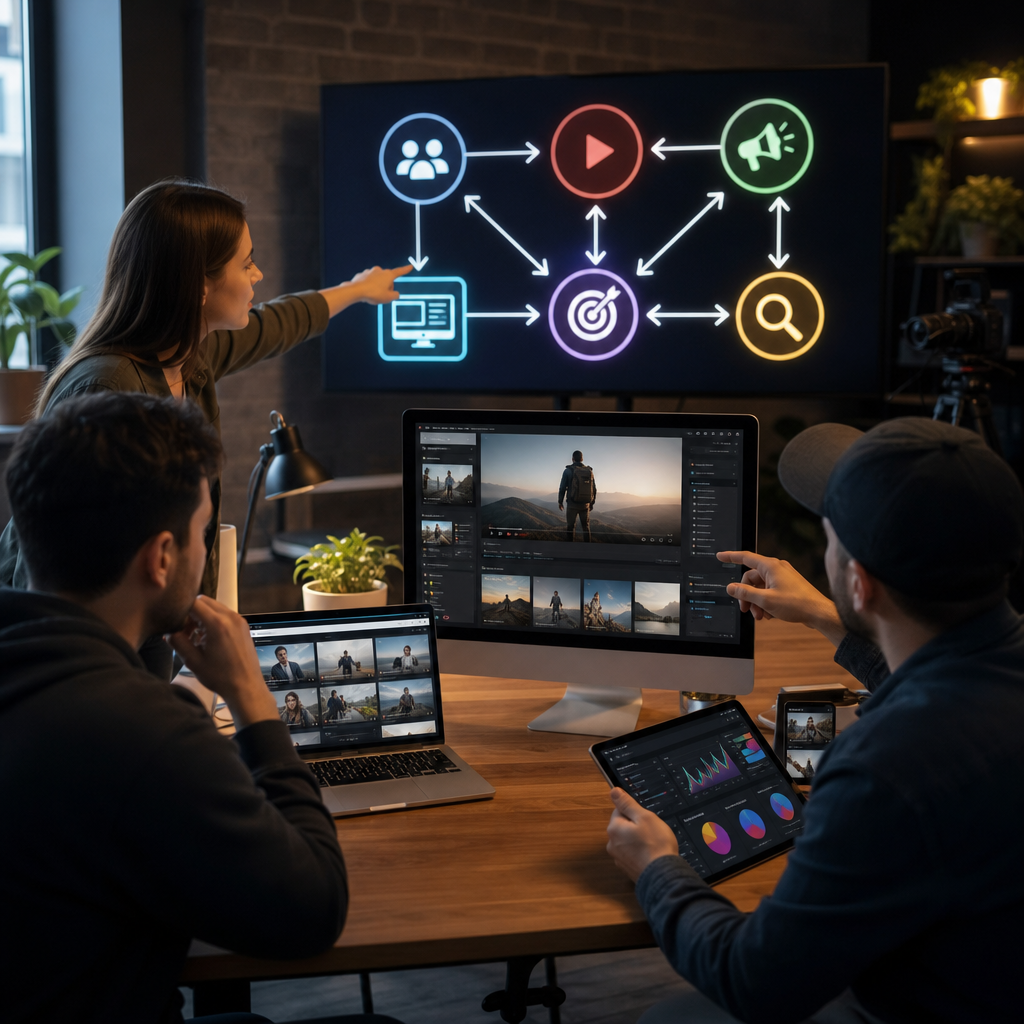
Paid advertising to social platforms drives people to video content that builds familiarity with your brand, then retargeting brings them back when they’re ready to convert. This sequence creates multiple touchpoints instead of hoping a single ad impression converts a cold prospect.
Real Results: Lead Generation Through Connected Digital Assets
When video and website work together as part of a broader integrated strategy, lead volume increases measurably. We’ve seen service-based businesses nearly double their monthly qualified leads within six months of implementing a unified approach.
The improvement comes from several factors. First, prospects move further through your sales funnel faster because every touchpoint reinforces your value and removes friction. Second, your cost per lead decreases because you’re not wasting budget on ads that don’t connect to good landing experiences. Third, lead quality improves because prospects who’ve engaged with multiple video assets and your full website experience are more informed and more serious.
One example: a multi-location service business implemented a video-first website redesign integrated with a retargeting campaign. Their previous approach ran ads separately from website updates. Within three months, their monthly qualified leads increased by 78 percent while cost per lead dropped 34 percent. The improvement came from prospects engaging with cinematic brand content, experiencing a cohesive website, and seeing strategic retargeting ads at the right moment.
Building a Cohesive Brand Message Across Video and Web
Consistency in messaging is how you build brand recognition that converts. If your video talks about customer success stories but your website emphasizes low prices, prospects feel confused about what you actually stand for. That confusion becomes friction that blocks conversion.
We develop a clear brand narrative that guides all content. Your video tells this story visually. Your website copy reinforces it verbally. Your paid advertising references it. Your social media extends it. A prospect encountering your brand across channels should feel they’re hearing one unified story from different angles, not different messages from different departments.
This clarity builds trust faster. When everything about your brand communicates the same core value, prospects believe you know who you are. When messaging conflicts, they assume you don’t have your act together. The difference shows up directly in conversion rates.
Why Your Website Needs Video-First Design for 2026
Search engines, social platforms, and user behavior have fundamentally shifted toward video. In 2026, a website without integrated video content underperforms competitor sites that leverage it strategically. You’re not just missing engagement. You’re missing signals that search algorithms reward.
Users expect to see video on modern websites. When they don’t find it, the site feels outdated. When they do, they stay longer, explore deeper, and engage more. That behavioral signal tells search engines your content resonates with visitors.
From a practical standpoint, video-first design means your website architecture prioritizes video content in key locations. Your above-the-fold section features video. Your service pages include video demonstrations. Your case studies show video results. Your FAQ answers include video explanations.
This isn’t about adding video everywhere. It’s about strategic placement where video actually improves user experience and conversion rates. The difference between a website that mentions video somewhere and one designed around video as a core asset is substantial.
Measuring ROI When Website and Video Services Work Together
When services work in silos, attribution becomes nearly impossible. Did the video generate the lead or did the website? Was it organic search or paid advertising that converted them? The uncertainty makes it hard to justify continued investment.

An integrated system creates clear attribution. We track prospects through their entire journey from video view to website visit to lead submission. You see exactly which content pieces drive engagement, which pages convert best, and which advertising spend produces qualified leads.
We measure video performance not just by views but by downstream actions. How many people who watched your video eventually submitted a contact form? Of those, how many became paying customers? These metrics guide everything we optimize. A video with modest view counts but excellent conversion attribution is more valuable than one with massive reach but minimal business impact.
Your monthly reports show unified metrics across channels. You see how your video content drives website traffic. How your website optimizations affect conversion rates from paid advertising. How SEO improvements compound video reach. The integrated view makes it clear why unified services outperform fragmented ones.
Getting Started With Your Unified Digital Growth Strategy
The transition from fragmented to integrated marketing requires strategic thinking, not just tool switching. You need a partner who understands how video, website design, advertising, and SEO interconnect and can orchestrate them toward consistent business outcomes.
Start by auditing your current situation. Which channels drive the most engagement? Which conversions? Where do prospects fall off? This baseline shows where integrated improvements will have the biggest impact.
Next, develop a unified brand narrative and visual strategy. Everything flows from clarity about who you serve, what problem you solve, and why your approach works. This becomes the foundation for all video, website, and advertising content.
Then, audit your website architecture. Does it position video strategically? Do conversion pathways exist from social to site to lead form? Are landing pages cohesive with your advertising creative? These structural improvements often produce immediate ROI.
If you’re ready to move beyond fragmented services and build a system where your website, video content, social presence, and advertising work together toward measurable growth, we’re here to help. At Canatos Media, integrated digital growth is our core approach. We combine cinematic video storytelling with full-service digital strategy because we’ve seen the impact of unified systems on business results.
Let’s discuss how we can build your integrated growth engine.
For further reading: Cinematic storytelling guide.
Contact us today for a free consultation to see how we can help you grow your business.
Frequently Asked Questions (FAQ)
How do we integrate website design with video content to improve conversions?
We build your website around your video content from the start, placing cinematic storytelling at the center of your user experience rather than as an afterthought. Our approach ensures that visitors see compelling video assets immediately, which increases time on page and naturally guides them toward lead capture or purchase actions. We also optimize video placement, loading speeds, and calls-to-action so that each element works together to move your audience through the customer journey.
Why does combining social media, advertising, and SEO into one system produce better results?
When we manage these channels separately, your brand messaging becomes inconsistent and your budget gets wasted on overlapping efforts. We create a unified strategy where your social content informs our paid advertising angles, your website’s SEO structure supports your video distribution, and your advertising data shapes the next round of content we produce. This interconnected approach means every dollar you spend reinforces the others, creating compounding returns instead of isolated campaign performance.
What’s the difference between working with us versus hiring separate video and web vendors?
We own both the video production and website strategy under one roof, which means we can see how a cinematic piece performs on social, adjust your site architecture based on viewer behavior, and reallocate budget between channels in real time. With separate vendors, you’re coordinating between teams with different priorities, losing days to communication, and missing opportunities to capitalize on what’s actually working. We take full responsibility for your integrated results, not just individual deliverables.