Why Multi-Location Brands Struggle with Video Production Consistency
Multi-location brands face a unique challenge: how do you maintain cinematic quality and brand consistency when your content needs are spread across five, ten, or fifty locations? The answer isn’t hiring a production team at every site or letting each branch create content independently. Instead, you need a centralized video production system that scales without sacrificing quality or responsiveness to local market needs.
We’ve helped service-based and franchise businesses solve this exact problem. Here’s how we think about scaling video production across distributed teams and what actually works in practice.
When you operate across multiple locations, video content becomes fragmented by default. Each branch manager has different priorities. They’re focused on their local revenue, not corporate brand standards. One location films testimonials on an iPhone, another uses a professional crew. One team edits videos in-house, another outsources to whoever’s cheapest. The result is a scattered collection of video assets that don’t feel like they came from the same company.
The root cause isn’t lack of intent. It’s logistical friction. Coordinating with production teams across time zones, managing approval workflows, sourcing talent locally, and maintaining quality standards all require structure that most growing businesses simply don’t have yet. Without a single source of truth for video style, messaging, and technical specs, consistency becomes nearly impossible.
This inconsistency damages brand perception. Customers notice when a video from your New York location looks nothing like one from your Denver branch. It signals that your business isn’t cohesive, which undermines trust. For franchise models especially, inconsistency threatens the entire value proposition of the brand.
The Hidden Costs of Managing Video Content Separately at Each Location
Most multi-location brands don’t calculate the true expense of decentralized video production. On the surface, letting each branch handle their own content seems efficient. In reality, it multiplies costs across multiple dimensions.
Redundant production spending is the obvious one. If five locations each hire their own videographer or agency, you’re paying five separate setup fees, equipment costs, and project management overhead. That’s roughly 5x the price compared to centralizing production and distributing the work across a single team or agency relationship.
Beyond dollars spent, there’s hidden process waste. Each location reinvents the workflow. They figure out how to brief a videographer. They learn editing software. They create approval processes. They troubleshoot technical issues. Multiply that across ten branches and you’ve burned hundreds of hours on tasks that could be standardized and automated.
There’s also opportunity cost. When video content isn’t coordinated, you miss cross-promotional leverage. A customer success story from one location could be adapted and deployed across your entire brand, amplifying ROI. But if that content was shot randomly and archived locally, nobody knows it exists.
What to do next: Audit your current video spending across all locations. Include production costs, personnel time, editing, and any paid advertising attached to those videos. This baseline will clarify how much efficiency you’re leaving on the table.
Building a Unified Video Production System That Works at Scale
A unified system starts with standardized templates and processes, not standardized content. Your Denver location needs different local testimonials and service highlights than your Miami branch. But they should both follow the same visual language, editing rhythm, and messaging framework.
Here’s the structure we recommend:
- Establish a master brand video guide that covers shot types, color grading, music, pacing, and on-camera talent standards. Think of it as a style sheet for video production.
- Create content buckets that each location should produce monthly. These might include testimonial videos, service explainers, staff introductions, or quick tips. Consistency comes from producing the same types of content, not the same content.

- Centralize approvals and editing. Locations submit raw footage or briefs. A central team handles post-production and quality assurance. This prevents quality drift and keeps timelines predictable.
- Build a simple asset library where all locations can access music, graphics, templates, and approved messaging. When a new location launches, they don’t start from zero.
- Implement a distribution calendar so all locations post coordinated content on the same dates, creating momentum across your social channels.
Systems work because they remove decision-making friction. Your location managers don’t need to debate whether to use a drone shot or judge whether editing is “cinematic enough.” They follow the playbook, submit their footage, and trust the process.
How We Coordinate Cinematic Content Across Your Entire Business
At Canatos Media, we treat multi-location video production as an integrated project, not a series of individual shoots. Our approach centers on understanding your business model first, then building workflows that scale.
We start by identifying your core content themes. For a home services brand, that might be before-and-after transformations, customer testimonials, and process explanations. For a healthcare practice, it could be practitioner introductions, patient stories, and educational content. Once we’ve defined these themes, we build a content calendar that works for all locations.
Next, we create production guides specific to your brand. These guide local teams on what to film and how. The guide includes shot lists, lighting and audio standards, and messaging frameworks. Locations don’t need production experience to execute it.
We then coordinate shoots either by sending crews to multiple locations or by training local teams to capture footage that our production team refines. For brands with many locations, we often use a hybrid approach: we shoot flagship locations ourselves to establish the look, then train location teams to maintain that standard with guidance and remote support.
Distribution and scheduling become seamless because we manage the calendar, edits, and approvals centrally. Your branches focus on operations; we handle the video pipeline.
Maintaining Brand Voice and Quality Standards Across All Locations
Quality drift happens when oversight is loose. Without regular checkpoints, one location might approve a video that doesn’t meet your standards. Then another location does something slightly different. Within months, your content looks fragmented again.
We prevent this through tiered review processes. Every video we produce goes through multiple quality checks before it reaches your locations. We evaluate technical quality, brand alignment, messaging accuracy, and local relevance in sequence. If something doesn’t meet our standard, we iterate before the location sees it.
We also establish feedback loops with your locations. If a branch manager has notes, they submit them early in the edit process, not after it’s finished. This keeps revisions efficient and prevents costly re-shoots.
Brand voice consistency requires trained judgment, not just templates. We audit every video against your brand guidelines, but we also maintain an intuitive sense of what feels “right” for your company. That judgment improves over time as we produce more content.
Actionable takeaway: Create a quarterly video audit where you review performance and quality metrics across all locations. Celebrate consistency wins and use outliers as teaching moments for refinement.
Integrating Video Production with Your Multi-Location Social Media Strategy
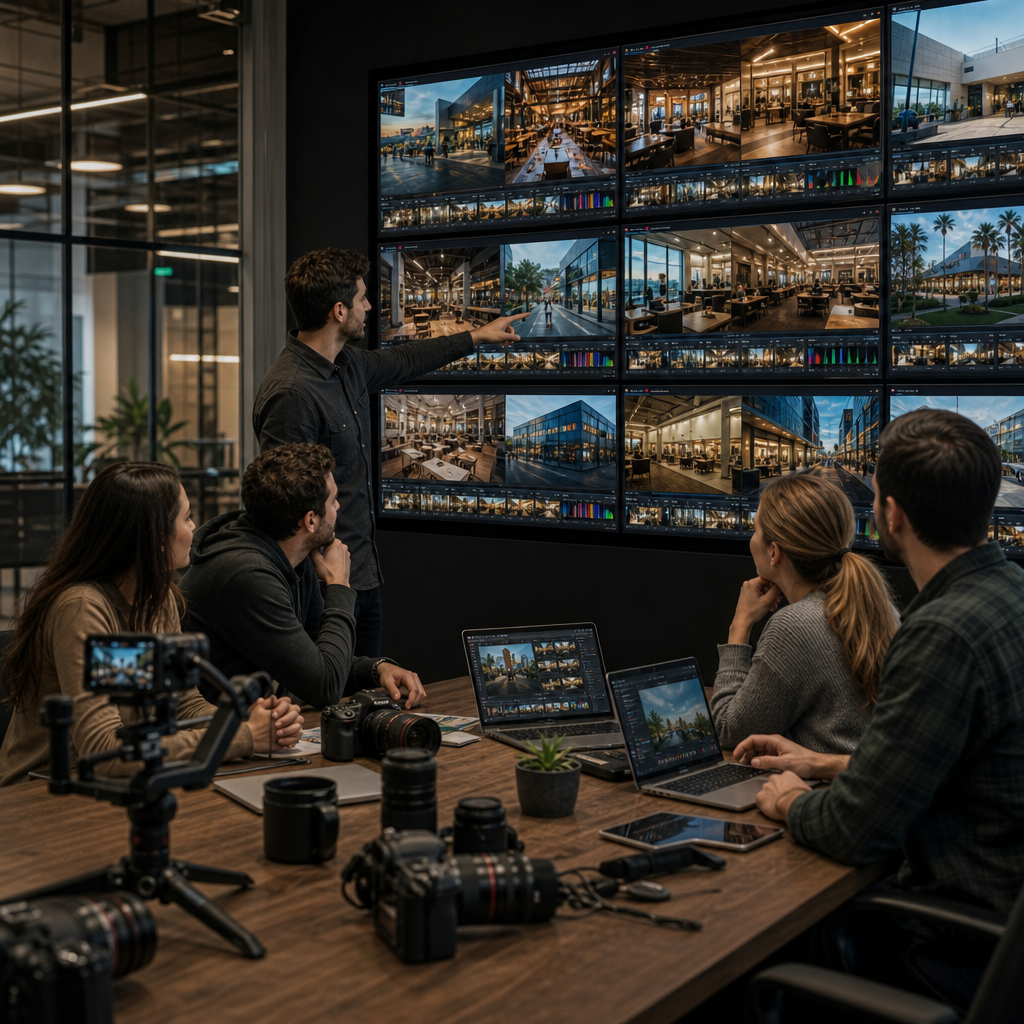
Video production only delivers ROI when it’s distributed strategically. A beautifully cinematic video buried in one location’s Instagram story reaches far fewer people than the same video coordinated across your entire social presence.
We integrate video production with all-in-one social content management to ensure every piece of content serves a larger strategy. This means:
- Videos are adapted for different platforms (short-form for Reels, longer for YouTube, static frames for LinkedIn)
- Posting is coordinated so your brand maintains visibility without cannibalization
- Hashtags and messaging are localized where it makes sense, but aligned with corporate messaging
- Performance data flows back to production planning so we know which content types resonate
For multi-location brands, this integration is essential. A video that performs well in one market probably has audience potential in others. But you only discover that if you’re monitoring performance centrally and experimenting with cross-market distribution.
Turning Scaled Video Content into Leads and Sales from Every Branch
Scaling video production is worthwhile only if it drives measurable business results. For most of our clients, this means generating qualified leads and supporting sales conversations at each location.
We structure video content to serve the customer journey. Top-of-funnel videos introduce your brand and solve common problems. Middle-funnel content addresses specific pain points and showcases your solution. Bottom-funnel testimonials and case studies drive conversion.
Every location produces content across this spectrum, which means every location has materials to share with prospects at every stage of their buying process.
We pair video content with meta and Google advertising to ensure your videos reach your ideal customers, not just your existing followers. A testimonial video from your Dallas location might perform well in Dallas, but with paid promotion, it can also drive leads in Houston, Austin, and beyond. Centralized production makes this kind of geographic expansion straightforward.
Tracking ROI requires clean attribution. We set up UTM parameters, landing page coordination, and CRM integration so you can see exactly how many leads each video generates at each location. This data informs content planning and helps justify ongoing investment.
Technology and Workflows That Make Centralized Video Production Possible
Scaling video production without technology is exhausting. You need systems that handle submission, organization, review, and distribution without constant manual coordination.
Our workflow typically uses a combination of tools: project management software to coordinate timelines and deliverables, cloud storage for secure asset transfer, automated naming and organization systems so nothing gets lost, and scheduling tools to coordinate posting across platforms and locations.
For locations that capture their own footage, we provide simple submission templates. They don’t upload raw 4K files randomly. They submit organized folders with metadata: location, shoot date, content type, and any notes. This structure saves our editors hours and prevents confusion.
Review and approval happen in dedicated platforms where stakeholders can comment on specific frames, request changes, and approve simultaneously. Everything is documented, which matters if you need to explain decisions later or reference a previous approval conversation.
The tech stack removes friction so location managers stay focused on their business, not on figuring out how to send video files to headquarters.
Measuring Performance and ROI Across Your Multi-Location Video Campaigns

You can’t optimize what you don’t measure. For multi-location video campaigns, tracking needs to be systematic and granular enough to reveal patterns.
We monitor several metrics in tandem:
- Engagement by location and video type: Which types of content perform best in each market? Does testimonial content resonate more in some regions than others?
- Lead quality and volume: Are viewers who watch your videos actually qualified prospects, or are they casual viewers?
- Cost per lead by content type and location: Some videos might drive cheaper conversions than others. That insight should shape future production.
- Social reach and impressions: Are videos expanding your organic reach, or just being seen by existing followers?
- View-through rates and drop-off points: If viewers stop watching at a specific moment, that tells us something about pacing or messaging.
We review these metrics monthly and adjust strategy accordingly. Maybe one location’s branch managers are naturals on camera, so we produce more testimonials there. Maybe educational videos underperform despite high production quality, so we shift budget toward customer stories. Data drives these decisions.
For multi-location brands, this analysis often reveals surprising opportunities. A content type that underperforms at one location might be gold at another. You only discover that if you’re comparing performance systematically across your entire network.
The investment in video production scales most efficiently when you’re learning from data and doubling down on what works.
Getting started with scaled video production doesn’t require perfect planning or massive upfront investment. It requires clarity on your content strategy, commitment to consistency, and partnership with a team that understands how to coordinate production across distributed operations.
We’ve built systems that work for service-based franchises, multi-location healthcare practices, home service companies, and enterprise retail brands. The fundamentals are the same: centralize production, standardize process, measure results, and iterate.
If you’re managing video content across multiple locations and want to explore how a unified approach could improve quality and ROI, let’s talk about your specific situation.
Contact us today for a free consultation to see how we can help you grow your business.
Frequently Asked Questions (FAQ)
How do we maintain consistent brand voice and quality across video content produced at different locations?
We build a centralized creative framework that every location follows, including detailed brand guidelines, shot lists, and approved messaging templates. Our team handles all post-production and editing in-house, which means we control the final output regardless of where footage originates. We also conduct quarterly reviews of all location-based content to catch any drift early and provide feedback that keeps everything aligned with your brand standards.
What’s the typical timeline for us to scale video production across your entire business?
We usually begin with a discovery phase to understand your locations, current workflows, and content needs, which takes 2-3 weeks. From there, we implement our production system, train your on-site teams on filming standards, and launch content creation within 4-6 weeks. After that, we operate on a consistent monthly cadence, with each location contributing footage that we coordinate into a unified social media and advertising strategy.
How do we turn video content from multiple locations into actual leads and sales?
We don’t just produce videos and hope they perform. We integrate each location’s content into targeted paid advertising campaigns on Meta and Google, direct traffic to location-specific landing pages, and feed leads directly into your sales systems. We track performance by branch so you can see exactly which locations and content types generate the highest ROI, then we optimize spending accordingly.