The Challenge of Producing Video Content Across Multiple Locations
Growing businesses with multiple locations face a unique problem: they need consistent, high-quality video content across dispersed sites, but the production costs balloon quickly. A shoot in Denver, another in Austin, a third in Miami. Equipment rental, crew travel, permits, location coordination. The math stops making sense fast.
We work with multi-location brands every quarter, and the pattern is clear. Most owners either abandon video content entirely or settle for inconsistent, low-quality footage that doesn’t reflect their brand. Neither option moves the needle on lead generation or brand perception.
The good news: scaling video production across multiple locations is possible without doubling your budget. It requires smarter planning, lean operational systems, and strategic use of tools that already exist in your workflow. We’ve helped service-based and retail brands cut their per-location production costs by 40% while improving output quality.
This guide covers the systems and strategies we use to help growth-focused businesses produce professional video content at scale without overspending.
Producing video at scale across multiple sites introduces friction at every stage. You’re managing different stakeholders at each location, coordinating logistics across time zones, ensuring brand consistency while adapting to local contexts, and consolidating footage from dispersed teams.
A dental practice with five locations wants to showcase patient testimonials, procedures, and team culture. Doing this well means scheduling shoots at each office, managing patient privacy and consent, coordinating with staff who have limited availability, and ensuring the visual style matches across all locations. One location might have great natural light. Another might be cramped and poorly lit. A third might have scheduled patients all day, making crew coordination a nightmare.
The production overhead multiplies. Travel costs for crew, equipment shipping, setup time at unfamiliar spaces, and location-specific problem solving all add up. Many teams end up splitting the work across internal resources and freelancers, which creates consistency gaps and communication breakdowns.
Your audience doesn’t care about the logistical difficulty behind the scenes. They notice when your brand looks polished at one location and amateurish at another. Consistency signals trust and competence. Inconsistency signals disorganization.
The real cost isn’t just the crew and equipment. It’s the time spent managing production across dispersed teams and the missed opportunity to create content that converts.
Why Traditional Video Production Doesn’t Work for Growing Brands
Traditional video production operates on a project basis. You hire a production company, they shoot for a day or two, hand you finished videos weeks later, and you pay a premium for custom work that takes time to scale.
This approach breaks down when you need regular output across multiple sites. You’re paying full production rates for each location. You’re dependent on a specific crew’s availability. You’re waiting weeks between concept and delivery. And you’re producing expensive, long-form content when short-form video is what actually drives engagement and conversions on social platforms.
Most traditional production workflows also assume you’re making one or two hero videos per quarter. They’re not designed for brands that need dozens of short-form pieces monthly. The cost per piece stays high. The turnaround time stays slow.
Growing brands need a different model: one built on systems rather than projects. You need repeatable processes, lean crews who understand your brand and locations, efficient production schedules, and fast turnaround on short-form content optimized for social and paid channels.
That shift in approach changes everything. Instead of hiring a new production company for each location, you build a sustainable system that your internal team or a dedicated partner can execute repeatedly.
How Strategic Planning Reduces Production Costs
The biggest opportunity to cut costs happens before anyone picks up a camera: planning.
Most teams jump into production without a clear content strategy. They shoot whatever seems interesting, create longer-form pieces that take time to edit, and end up with content that doesn’t fit their distribution channels. Inefficiency baked in from the start.
Strategic planning starts with defining exactly what content you need. For a multi-location brand, this means mapping out:

- What stories need to be told at every location (team culture, service overview, customer results) vs. location-specific stories
- Which short-form formats work best for your audience and paid channels (15-30 second testimonials, 60-second process breakdowns, etc.)
- How many pieces you need monthly and how those break down across locations
- What equipment and crew capabilities are truly necessary vs. nice-to-have
This clarity lets you consolidate production days. Instead of scheduling separate shoots at each location, you might batch them: fly a core crew to three locations over five days, then handle the remaining two locations with local freelancers or internal teams using standardized guidelines.
You also shift from building hero content to building a content library. You’re not producing ten 5-minute videos. You’re producing 50-60 short-form pieces that can be repurposed, recut, and distributed strategically. The per-piece cost drops dramatically when you’re thinking in volume.
What to do next: Audit your current content needs location by location. Identify the 3-4 core story types that work across all sites, then build a production calendar that batches shoots strategically rather than treating each location as an isolated project.
Streamlining Equipment and Crew for Efficiency
Lean equipment lists beat comprehensive gear collections when scaling across locations. You need tools that are reliable, portable, and capable of producing cinematic quality without requiring expert-level technical knowledge.
A focused kit might include:
- Two camera bodies with interchangeable lenses (covering wide, standard, and telephoto focal lengths)
- Wireless audio systems (critical for interviews and testimonials)
- Portable lighting kits that work in any environment
- Tripods and stabilization tools
- Editing and color-grading laptops
- Portable power and backup batteries
This setup handles 95% of what you’ll shoot without excess baggage or unnecessary complexity. More gear means more weight, more setup time, more variables to troubleshoot on location.
Crew composition matters equally. Instead of large teams with specialized roles, consider smaller units of 2-4 people who can adapt. One person handles camera and lighting decisions. Another manages audio and interviews. A third handles logistics and second-camera work if needed. This setup is flexible enough to scale from a single location shoot to managing three simultaneous shoots in different offices.
Cross-training is essential. Everyone on the team should understand the core workflow: how to frame shots that work for your brand, how to capture clean audio, how to manage time on a tight schedule. This redundancy saves you when someone’s unavailable and speeds up production overall.
Action item: Document your essential equipment list and get it dialed in. That becomes your standard kit for all multi-location shoots, reducing setup variability and training time.
Maximizing Production Value Through Cinematic Techniques
Budget doesn’t determine visual quality. Technique does.
Cinematic production relies on fundamentals that cost nothing: camera movement, framing, lighting direction, and color consistency. Master these and your footage looks intentional and professional regardless of budget constraints.
Movement draws attention and creates energy. Rather than static talking-head interviews, use slow push-ins, subtle dolly moves, or handheld follow shots to create dynamism. These techniques don’t require expensive equipment. A basic slider or handheld stabilization with deliberate movement technique elevates the visual impact significantly.
Framing and composition are about intentionality. Shoot with depth. Position your subject in foreground, middle ground, and background layers. Use negative space meaningfully. Vary your shot sizes across a sequence: wide establishing shots, medium shots for context, tight shots for emotion and detail. This variety creates visual interest and tells a more complete story.
Lighting direction is transformative. Three-point lighting sounds formal, but the principle is simple: key light from one side, fill light to prevent harsh shadows, accent light to separate your subject from the background. You can achieve this with basic LED panels and diffusion. The look goes from “we shot this on a phone” to “this was intentionally lit.”
Color consistency across locations is critical for brand cohesion. Shoot with a color reference card at each location, apply matching color grades in post-production, and maintain consistent color palettes. This ensures your footage looks like it belongs to the same brand even when shot in completely different environments.
These techniques work at scale because they’re process-based, not equipment-dependent. Train your crew on them and they apply at every location.
Leveraging Technology to Automate Post-Production Workflows
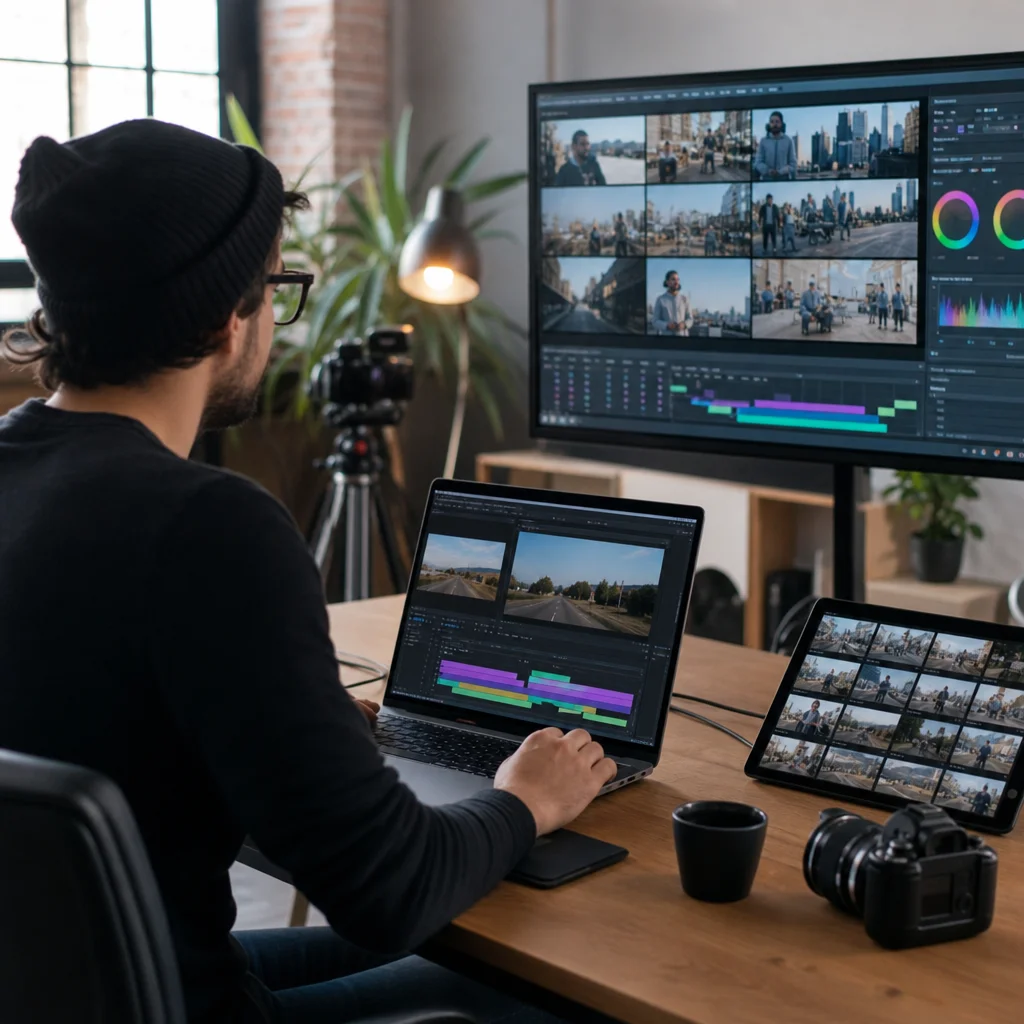
Post-production is where many teams waste time and money. Inefficient editing workflows, manual color grading of every shot, and piecemeal delivery of finished content stretch timelines and budgets.
Modern software handles the repetitive work. Proxies and transcoding speed up editing performance on standard computers. Automated color matching tools reduce the time spent color-grading across multiple shoots. Template-based editing systems let one person produce multiple cut variations from the same raw footage in hours instead of days.
Cloud-based collaboration keeps remote teams aligned. Your crew in Denver can upload footage directly to a shared workspace. An editor in your main office starts working on cuts immediately. You review and provide feedback remotely. Revisions happen in real-time without shipping hard drives or waiting for uploads.
AI-powered tools are becoming practical too. Automated transcription saves hours of manual logging. AI-powered background removal lets you create custom branded environments in post. Automated color correction applies consistent grades across batches of footage.
The key is building a workflow stack that handles your specific volume and format needs. If you’re producing 40-50 short-form videos monthly, your workflow needs to support rapid turnaround and batch processing. If you’re managing multiple editors across locations, your tools need strong collaboration features.
Next step: Map your current editing workflow from footage ingest to final delivery. Identify bottlenecks where automation or better tools could save time, then test solutions on a pilot project.
Building Reusable Systems for Consistent Output
Scaling requires repeatable systems that don’t depend on specific people or one-off solutions.
Document everything. Create shot lists that travel with your crew. These lists define the essential shots needed at every location: interviews with staff or clients, facility tours, service demonstrations, environmental shots. A standardized shot list ensures consistency without micromanaging. Your crew knows what needs to happen. They have flexibility in how they capture it.
Build brand guidelines specific to video production. Define acceptable camera movements, focal length preferences, audio quality standards, color palette ranges, and graphics treatments. These guidelines aren’t restrictive. They create a framework that feels cohesive across locations while allowing creative flexibility.
Create templates for common content types. A testimonial interview has a predictable structure: wide establishing shot, medium interview shot, close-up detail shots, B-roll of the service or product. Codify this template. Every location follows it. Every editor knows how to cut it. Production becomes faster and more consistent.
Establish a content calendar that balances consistency with flexibility. You might require every location to produce two testimonials and one team culture piece monthly. How they approach those is flexible. The output targets are predictable. This rhythm keeps content flowing without requiring constant production planning.
Train your teams to this system. When everyone understands the framework, production decisions get faster and quality stays consistent across locations.
Integrating Video Content Into Your Overall Digital Strategy
Production efficiency means nothing if your content doesn’t reach the right people or drive measurable business results.
Video is one component of a larger digital system. Short-form content works best when integrated with social media management, paid advertising, and search optimization. A testimonial video shot at your Austin location becomes:
- An organic post on Instagram and TikTok
- An ad variant for Meta Ads Manager targeting local audiences
- A carousel ad on Google highlighting customer results
- A website element supporting your services pages
- A lead magnet gated behind an email form
This repurposing multiplies the value of your production investment. You’re not making one piece of content. You’re making ten variations of the same core asset.
Paid advertising amplifies what works. Not every piece of content will convert equally. Test short-form videos across different audience segments and ad placements. Double down on winners. Pause underperformers. This iterative approach requires good attribution tracking and honest performance measurement.
Social media strategy shapes what you shoot. If Instagram Reels drive more engagement and conversions than TikTok for your audience, prioritize that format. If testimonials outperform behind-the-scenes content, shoot more testimonials. Let performance data inform your production priorities.
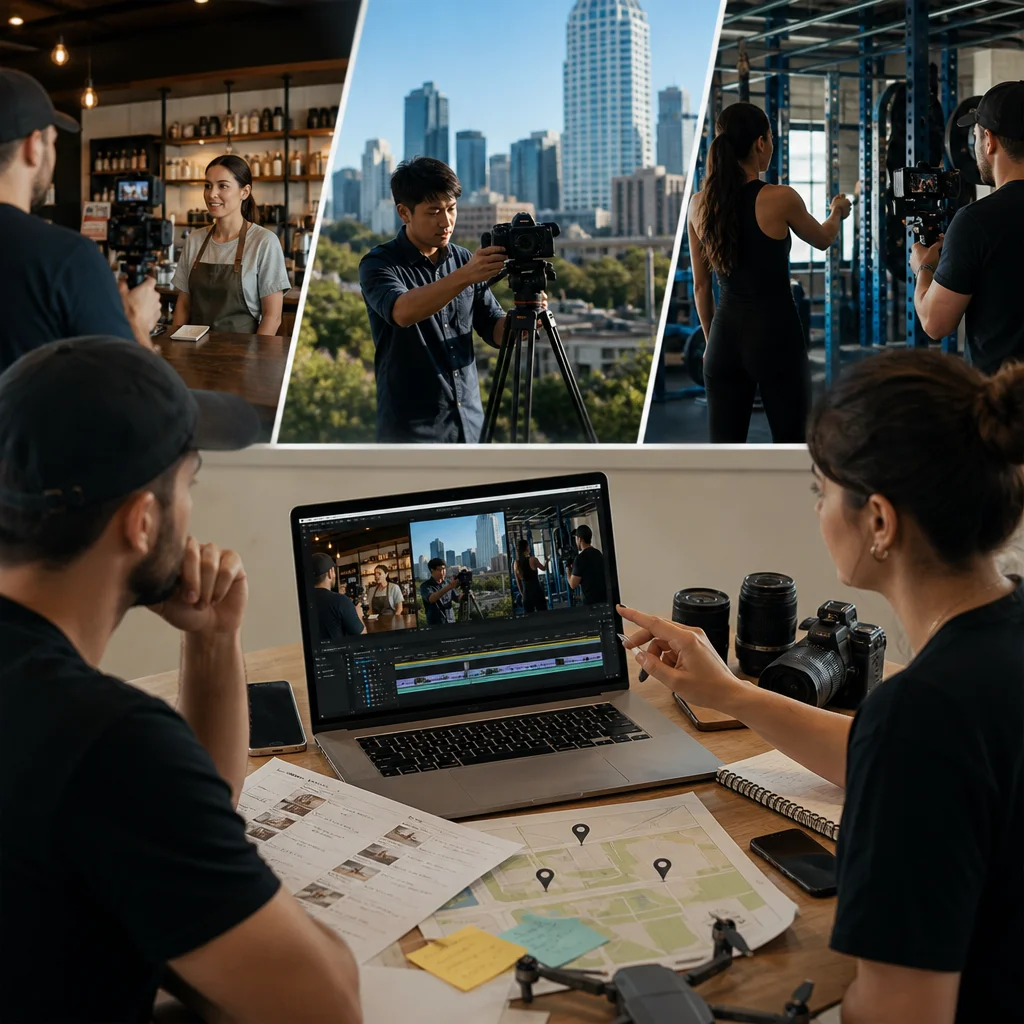
Efficient multi-location video production works best when your video strategy aligns with your broader digital marketing goals: lead generation, brand awareness, customer retention, or sales acceleration.
Measuring ROI and Optimizing Your Video Investment
You’re spending money on production. You need evidence that it’s working.
Set clear benchmarks before you shoot. Define what success looks like: cost per lead, engagement rate on social content, conversion rate on video ads, growth in qualified prospects month-over-month. These metrics shape your production priorities and help you make smarter decisions about where to invest.
Track performance at every stage. Monitor organic video engagement on social platforms. Measure click-through rates and conversion rates on video ads. Track how many leads came directly from video content vs. other channels. Use UTM parameters to attribute leads back to specific videos and locations.
The data often surprises teams. A short testimonial might outperform a polished 2-minute brand story. A casual behind-the-scenes clip might drive more engagement than a carefully scripted piece. Let results guide production decisions rather than assumptions about what should work.
Calculate cost per lead for video content and compare it to other marketing channels. If video production is costing you $2,000 per location per month and generating leads at $40 each, that’s valuable information. If it’s generating leads at $200 each, you need to adjust either production approach or distribution strategy.
Return to your production planning quarterly. Which content types deliver results? Which locations produce better content? What’s working and what isn’t? Use this data to refine your system, double down on what works, and adjust what doesn’t.
How We Help Growth-Focused Businesses Scale Video Production
We work with multi-location brands and service-based businesses that need consistent, high-quality video content without the premium agency budget. Our approach combines strategic planning for multi-location video campaigns with lean production workflows and integrated digital strategy.
We handle the production planning, crew coordination, and post-production so your team focuses on running your locations. We build systems that scale with your business, not production costs that grow linearly. We optimize your content for social platforms and paid channels, ensuring every shot serves a purpose in your larger marketing system.
Most importantly, we connect production to results. Our focus isn’t making beautiful videos. It’s making videos that generate leads, build brand trust, and drive measurable business growth.
If you’re managing multiple locations and struggling with video production costs or consistency, we can help. Reach out to discuss your situation and how we approach scaling video for growing brands.
Contact us today for a free consultation to see how we can help you grow your business.
Frequently Asked Questions (FAQ)
How do we keep multi-location video shoots affordable without sacrificing quality?
We use strategic planning and streamlined crew structures to reduce costs while maintaining cinematic production value. Our approach combines careful location scouting, consolidated shooting schedules, and proven cinematic techniques that deliver premium-looking content without expensive equipment or bloated crews. We’ve found that intelligent planning upfront eliminates wasteful expenses during production while keeping your final content visually compelling.
What makes our video production systems different from traditional agencies?
We build reusable frameworks and automation into our workflows so you’re not paying premium rates for custom work every single time. Our post-production systems, equipment standardization, and repeatable processes let us scale your video content efficiently while maintaining consistent output across all your locations. This means you get professional results faster and more affordably as your brand grows.
How do we measure whether our video investment is actually generating leads and sales?
We integrate your video content into a complete digital strategy that tracks performance across social media, paid advertising, and your website. We don’t just produce videos in isolation; we connect them to your lead generation systems and measure actual conversions from awareness through sales. This way you see exactly which content and distribution channels are driving real business results.