Day: June 19, 2026

  • Maximizing Visibility with Answer Engine Optimization Services in 2026

    Maximizing Visibility with Answer Engine Optimization Services in 2026

    Why Traditional SEO Alone No Longer Drives Visibility

    The search landscape has shifted beneath our feet. For years, businesses optimized for keyword rankings, built backlinks, and monitored page position to capture traffic. That strategy still matters, but it no longer tells the complete story.

    Traditional SEO assumes users are typing questions into a search box and clicking blue links. Today, many consumers ask questions directly to AI-powered tools, chat interfaces, and voice assistants. When someone asks ChatGPT, Claude, or Perplexity a question, they’re not visiting your website through a search result. They’re getting an answer synthesized from multiple sources, and your content may be invisible.

    This shift means visibility alone doesn’t guarantee leads or sales. A business can rank on page one and still miss customers who’ve already moved to answer engines. The first-mover advantage now belongs to brands that appear in AI-generated responses, cited sources, and structured answer formats.

    We’ve watched high-traffic websites fail to convert because their audience sourced answers elsewhere. Conversely, we’ve seen businesses with moderate traffic accelerate growth by optimizing for where their customers actually search.

    Actionable takeaway: Audit your traffic sources this week. Look beyond organic search at where your potential customers are asking questions and finding answers.

    Understanding Answer Engine Optimization and Its Impact on Your Business

    Answer Engine Optimization (AEO) is the practice of structuring and presenting your content so it appears prominently when AI systems synthesize answers to user queries. Unlike traditional SEO, which focuses on ranking for keywords, AEO focuses on being cited, quoted, and recommended by answer engines.

    The impact on your business is immediate and measurable. When an AI tool cites your content as authoritative, several things happen: you gain credibility through third-party validation, you attract qualified visitors who’ve already had their initial questions answered and are now ready to engage, and you position your brand as a trusted resource.

    For service-based businesses and multi-location brands, this is particularly powerful. A local service provider who appears in AI responses for “best plumbing in Denver” or “HVAC maintenance explained” gains both visibility and authority in their market. E-commerce brands benefit similarly, as answer engines often surface product recommendations and buying guides.

    We’ve seen AEO drive lead generation for clients across industries. The key difference is that AEO traffic tends to be more intent-rich and conversion-ready because the user has already received foundational answers and is actively seeking implementation or purchase options.

    How AEO Differs From Conventional Search Engine Optimization

    The core distinction is the entity answering the user’s question. Traditional SEO optimizes for Google’s ranking algorithm. AEO optimizes for AI systems that read content and synthesize responses.

    Google search rewards keyword density, backlinks, and domain authority. Answer engines reward clarity, expertise, and structured information. A piece of content can rank well on Google but rarely appear in AI answers if it’s not architected correctly. Conversely, highly authoritative content poorly formatted for AI visibility will underperform in answer engines.

    Here’s where they diverge in practice:

    • Content structure: SEO favors long-form content with natural keyword integration. AEO favors clearly labeled sections, numbered steps, and definition-style passages that AI can easily extract and cite.
    • Source authority: SEO weighs domain age and backlink volume. AEO prioritizes author expertise, citations, and verifiability signals within the content itself.
    • User intent matching: SEO targets keywords. AEO targets specific answer types (how-to, list, definition, comparison).
    • Claim substantiation: SEO relies on relevance signals. AEO requires visible evidence, data, examples, and expert attribution.

    Both strategies matter. Most businesses need both traditional search visibility and answer engine visibility. The difference is implementation. You can’t simply apply SEO tactics and expect AEO success.

    The Role of AI-Powered Search in Modern Consumer Behavior

    AI search tools are no longer niche products. Major platforms including Google, Bing, and dedicated answer engines process millions of queries daily, and usage continues to accelerate among younger demographics and early adopters.

    Consumer behavior has changed accordingly. When someone searches “how does email marketing work,” they’re likely asking ChatGPT or Perplexity rather than typing into Google. When they ask “best CRM for small business,” they want synthesis and recommendations, not a list of search results.

    This behavioral shift affects businesses across the board. B2B companies lose qualified leads when decision-makers research solutions through answer engines instead of traditional search. E-commerce brands lose traffic when product recommendations come from AI rather than reviews. Service providers lose phone calls when their expertise isn’t visible in AI-generated guides.

    The competitive advantage goes to businesses that adapt. Companies embedding themselves in answer engine visibility are capturing users earlier in the decision journey, building trust before competitors appear in conversation, and establishing authority in their market.

    We’re designing our client strategies around this reality. It means creating content that answers real customer questions with such clarity and expertise that AI systems naturally cite and recommend it.

    Our Integrated Approach to AEO and Digital Marketing

    We combine AEO AI search optimization with our full-service digital strategy because visibility means nothing without conversion. Here’s how we structure it:

    First, we identify the specific questions your target customers are asking across all platforms. We analyze search queries, social conversations, customer inquiries, and industry forums to build a map of customer intent.

    Second, we create content that directly answers those questions with the depth and structure that answer engines require. This includes step-by-step guides, expert definitions, data-backed comparisons, and solution frameworks that showcase your unique approach.

    Third, we distribute this content strategically across your owned channels, social platforms, and earned media to build the citation network that answer engines favor. Content that appears in multiple authoritative places signals importance.

    Fourth, we measure how often your content appears in AI-generated responses and track the quality of traffic it drives. We adjust content architecture, topic coverage, and distribution based on real performance data.

    This integrated approach works because AEO isn’t separate from your overall marketing strategy. It’s foundational to it. Every piece of content we create serves multiple purposes: ranking in search, answering customer questions, supporting sales conversations, and establishing authority in your market.

    Creating Content That Answers Customer Questions Across Platforms

    The best AEO content starts with a genuine customer question. Not a keyword phrase, not a marketing angle, but a real question your target audience asks.

    A roofing contractor’s customers ask: “How long does a roof last?” “What are signs my roof needs replacing?” “How much does roof replacement cost?” These questions appear in search, social comments, support emails, and answer engine queries. By answering them thoroughly once, you create a foundational piece of content that serves multiple channels.

    Effective answer content has several characteristics:

    • Immediate clarity: The answer appears in the first paragraph or first numbered step. Readers and AI systems should understand the core response before reading deeper.
    • Expert voice: Explain not just what, but why. A roofing contractor explaining roofing materials and climate impact provides more value than a generic article.
    • Structured information: Use headings, lists, tables, and definitions that answer engines can parse and cite directly.
    • Verifiability: Include data, expert quotes, case studies, or specific examples that substantiate claims.
    • Multi-format delivery: Your answer should work as a blog post, video script, social caption, and email content.

    We start every client project by documenting the questions their ideal customers ask. From there, content creation becomes systematic and strategic rather than guesswork.

    Combining AEO with Short-Form Video for Maximum Impact

    Answer engines cite text, but customers consume content in many formats. This is where short-form video production amplifies AEO strategy.

    Video content answers questions differently than text. A 60-second video showing how to fix a common problem reaches different audiences and reinforces answers that appear in AI responses. Someone who reads your written guide on LinkedIn is more likely to engage when they later see your video answer on TikTok or Instagram Reels.

    Video also builds authority faster. A founder on camera explaining their methodology has more credibility than the same information in text alone. This matters to answer engines, which increasingly weight multimedia authority signals.

    Here’s how they work together in practice: Your long-form written answer explains a complex topic thoroughly, appears in answer engine responses, and drives traffic to your website. Your short-form video clips the key insights, reaches audiences on social platforms, and directs viewers to the full answer. Together, they create multiple touchpoints and reinforce your expertise.

    We structure written answers specifically to be videofied. That means clear steps, visual moments, and narrative flow that translates to short-form content. One great answer becomes 3-5 video assets that serve different platforms and audiences.

    Measuring AEO Success Through Lead Generation and Sales

    Visibility metrics alone don’t indicate success. We measure AEO effectiveness through two lenses: answer engine appearance and business outcomes.

    Answer engine metrics: How often your content appears in AI responses. Which queries trigger your answers. How frequently your content is cited versus competitors. These signals indicate market share in the answer engine space.

    Business metrics: How much traffic answer engines send to your website. Conversion rate of answer engine traffic versus search traffic. Cost per lead and lead quality. Whether customers cite your answer engine appearance when explaining why they chose you.

    Many of our clients find that answer engine traffic converts at higher rates than search traffic. The reason is clear: answer engine visitors have already received a basic answer and are now actively seeking implementation or purchase. They’re further along the decision journey.

    We establish baseline metrics for each client, then optimize content, distribution, and follow-up processes based on what drives actual leads and sales. A piece of content appearing in answer engines is only valuable if it connects to your business objectives.

    Why Businesses Are Shifting Their Digital Strategy to AEO

    The shift isn’t optional anymore. Brands that ignore answer engine visibility are ceding market share to competitors who optimize for it. Early adopters already capture disproportionate share of AI-driven traffic because they published optimized content first.

    Businesses are shifting because the ROI is measurable. Unlike some marketing tactics that feel like speculation, AEO produces clear attribution. You can see that a customer learned about your solution through an answer engine, engaged with your content, and became a customer.

    The shift also reflects reality. Search behavior has changed. Your target market is asking questions in different places. Meeting them where they are is business strategy, not marketing trend.

    Companies that build AEO into their strategy also build a stronger overall digital foundation. Content optimized for answer engines tends to be more useful, better structured, and more authority-building than content created without this lens. It elevates everything you publish.

    Getting Started with Our AEO Optimization Services

    Starting your AEO journey requires three steps:

    Map your customer questions. Document every question your target customers ask about your industry, solutions, and buying process. This becomes your content roadmap.

    Audit your current content. Review what you’ve published and identify which pieces answer customer questions effectively. Determine what’s missing and what needs restructuring for answer engine visibility.

    Create and optimize. Build new content around your highest-priority customer questions, structured specifically for answer engine appearance and audience conversion. Then distribute strategically to build the citation authority that AI systems reward.

    We handle this entire process for our clients. We combine AEO with social media management, paid advertising, video production, and website strategy to create integrated marketing systems that turn visibility into leads and sales.

    If you’re ready to capture traffic from answer engines and reach customers earlier in their decision journey, let’s talk about your AEO strategy. The businesses gaining traction now are the ones who started optimizing last year.

    Contact us today for a free consultation to see how we can help you grow your business.

    Frequently Asked Questions (FAQ)

    How does AEO differ from traditional SEO, and why should we invest in both?

    We’ve found that traditional SEO focuses on ranking for broad keywords, while our answer engine optimization services target the specific questions your customers are asking across AI-powered search platforms and conversational interfaces. We recommend investing in both because they serve different parts of the customer journey: SEO captures high-intent searches on Google, while AEO positions your brand as the authoritative answer on emerging AI search platforms like Perplexity and ChatGPT. Our integrated approach ensures you’re visible regardless of how your customers search.

    What role does short-form video play in our AEO content strategy?

    We use short-form video to reinforce the answers we’re providing through text-based AEO content, creating a multi-format presence that appeals to how modern audiences consume information. When we optimize video content with structured data and answer-focused messaging, we amplify your visibility across both traditional search and AI answer engines. This combination significantly increases the likelihood that your brand appears when AI systems synthesize answers for users.

    How do we measure whether our AEO efforts are actually generating business results?

    We track AEO success through lead generation metrics and sales conversions rather than vanity metrics like rankings or traffic volume. Our team connects AEO campaign data directly to your CRM and sales pipeline so we can show exactly which answer-optimized content drives qualified leads and closes deals. This approach gives us clear accountability and lets us refine our strategy based on what actually moves your business forward.
  • Animation Station: The Ultimate Guide to Digital Marketing Animation Videos

    Animation Station: The Ultimate Guide to Digital Marketing Animation Videos

    Why Animated Video Is Now the Engine of Digital Marketing

    A digital marketing animation video is one of the fastest ways to grab attention, explain your offer, and turn viewers into customers — all in under two minutes.

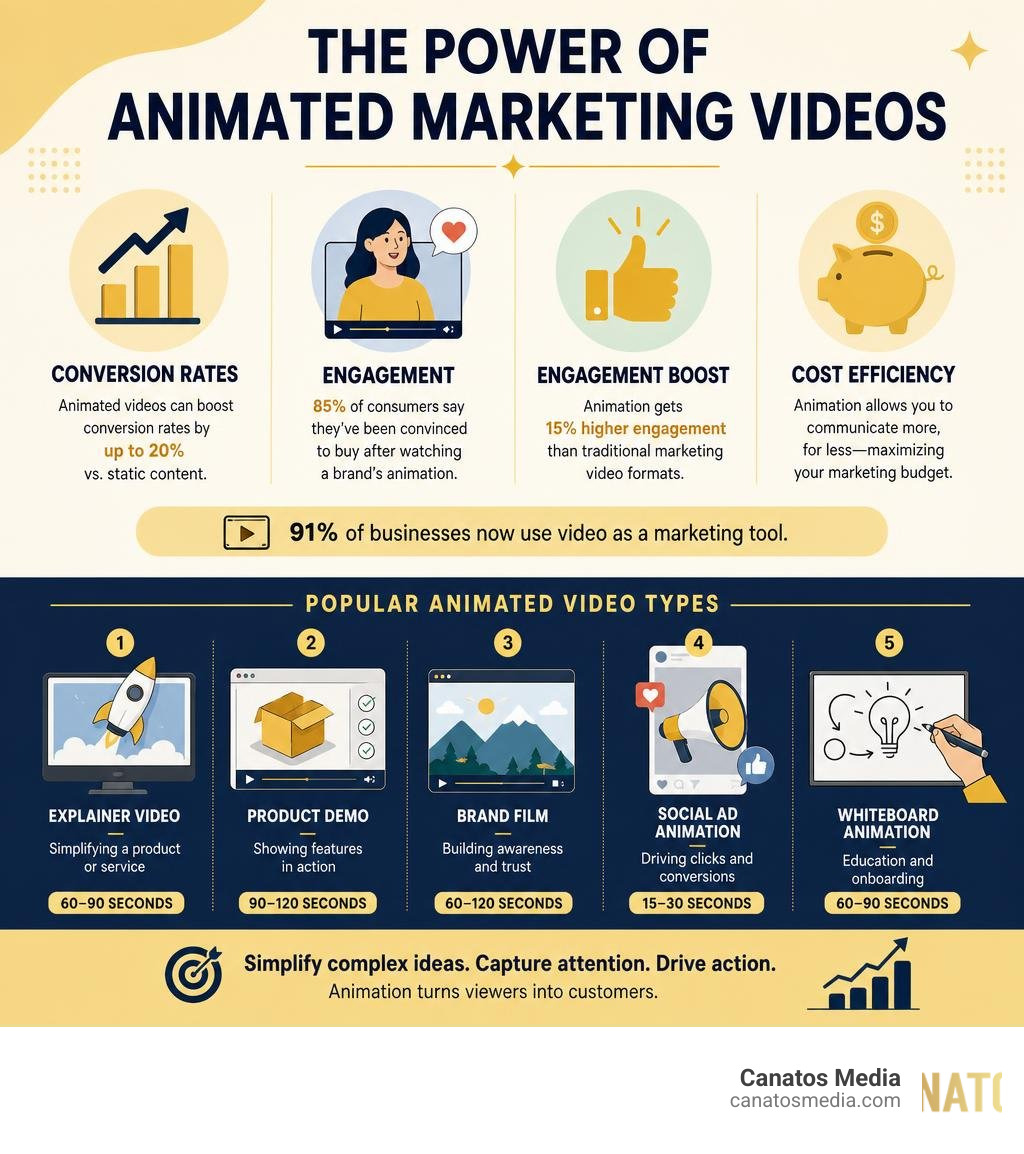
    If you’re looking for the key types and benefits at a glance:

    Type Best For Avg. Length
    Explainer Video Simplifying a product or service 60-90 seconds
    Product Demo Showing features in action 90-120 seconds
    Brand Film Building awareness and trust 60-120 seconds
    Social Ad Animation Driving clicks and conversions 15-30 seconds
    Whiteboard Animation Education and onboarding 60-90 seconds

    Why animation works:

    • Animated videos can boost conversion rates by up to 20% vs. static content
    • 85% of consumers say they’ve been convinced to buy after watching a brand’s animation
    • Animation gets 15% higher engagement than traditional marketing video formats
    • 91% of businesses now use video as a marketing tool

    Animation isn’t just a creative choice anymore. It’s a growth strategy. Brands from Starbucks to Amazon use animated video to cut through the noise, simplify complex ideas, and move people to act — at a fraction of the cost of live-action production.

    But here’s the thing most guides miss: a beautiful animation that wins internal applause won’t always win customers. The difference is strategy — the right style, the right message, and the right platform.

    That’s exactly what this guide covers.

    I’m Nic Canobbio, founder of Canatos Media, where I’ve spent over two decades driving results through media production and content strategy — including building social content that has surpassed 60 million views, and integrating digital marketing animation video into high-performing paid and organic campaigns. In the sections ahead, I’ll walk you through everything you need to know to make animation work as a real business asset, not just a visual upgrade.

    Benefits of animated marketing videos: conversion rates, engagement, cost efficiency, and video types infographic

    Essential digital marketing animation video terms:

    Why Every Brand Needs a Digital Marketing Animation Video

    In today’s digital environment, capturing a prospect’s attention is harder than ever. Static images and text-heavy landing pages are no longer enough to keep users engaged. That is where a digital marketing animation video changes the game. By blending dynamic visuals, sound design, and clear storytelling, animations make your brand memorable and highly shareable.

    Beyond visual appeal, there are three primary reasons why animation has become an essential pillar of modern digital marketing:

    1. Massive Boost in Brand Awareness: Animation allows you to build a completely custom world that perfectly matches your brand guidelines. You are not limited by the physical constraints of live-action video—no actors to hire, no locations to scout, and no weather delays. You can create unique characters and visual metaphors that instantly stick in the minds of your audience.
    2. Direct Conversion Growth: According to industry data, incorporating an animated video on a landing page can increase conversion rates by up to 20% compared to static content. Because animations can hold attention longer, they give you the perfect opportunity to deliver a compelling call to action (CTA) to a highly engaged viewer.
    3. Unmatched Cost Efficiency: Traditional live-action shoots require directors, actors, equipment, location permits, and extensive post-production. If your product updates next month, you have to reshoot. With a digital marketing animation video, updating your message is as simple as modifying the design files and rendering a new version. This makes animation an incredibly sustainable, long-term asset that compounds in value.

    Animated marketing metrics showing conversion rate lifts

    To explore how animation fits into a broader, comprehensive video strategy, check out our resource on The Complete Guide to Video Marketing.

    Core Types of Animated Marketing Videos

    Not all animated videos serve the same purpose. To build a campaign that actually converts, you must match the style of animation to your specific marketing goals.

    Animation Style Best Marketing Goal Key Channels
    2D Motion Graphics Explaining complex data & tech SaaS Landing Pages, LinkedIn Ads
    2D Character Animation Building emotional connection Social Media, Brand Awareness Campaigns
    3D Animation High-end product showcases Product Launch Pages, Meta Ads
    Whiteboard Animation Educational content & tutorials Email Marketing, Help Centers, YouTube

    For instance, if your goal is to introduce your company’s core values, a character-driven brand film can establish a powerful emotional connection. A great example of this approach is the Animated Brand Video – SHFT – The Animation Guys, which blends 2D character movement with real-world urban backgrounds to position a brand as modern, tech-savvy, and highly approachable.

    On the other hand, if you need to explain a complex software feature, a technical motion graphics video is the superior choice. Let’s dive deeper into how these different styles function in practice.

    Explainer Videos and Product Demos

    If you run a SaaS company, a fintech platform, or a business with a complex service model, you know how difficult it can be to explain what you do in under a minute. This is where explainer videos and product demos shine. They excel at taking abstract, technical, or multi-step processes and turning them into simple, digestible visual narratives.

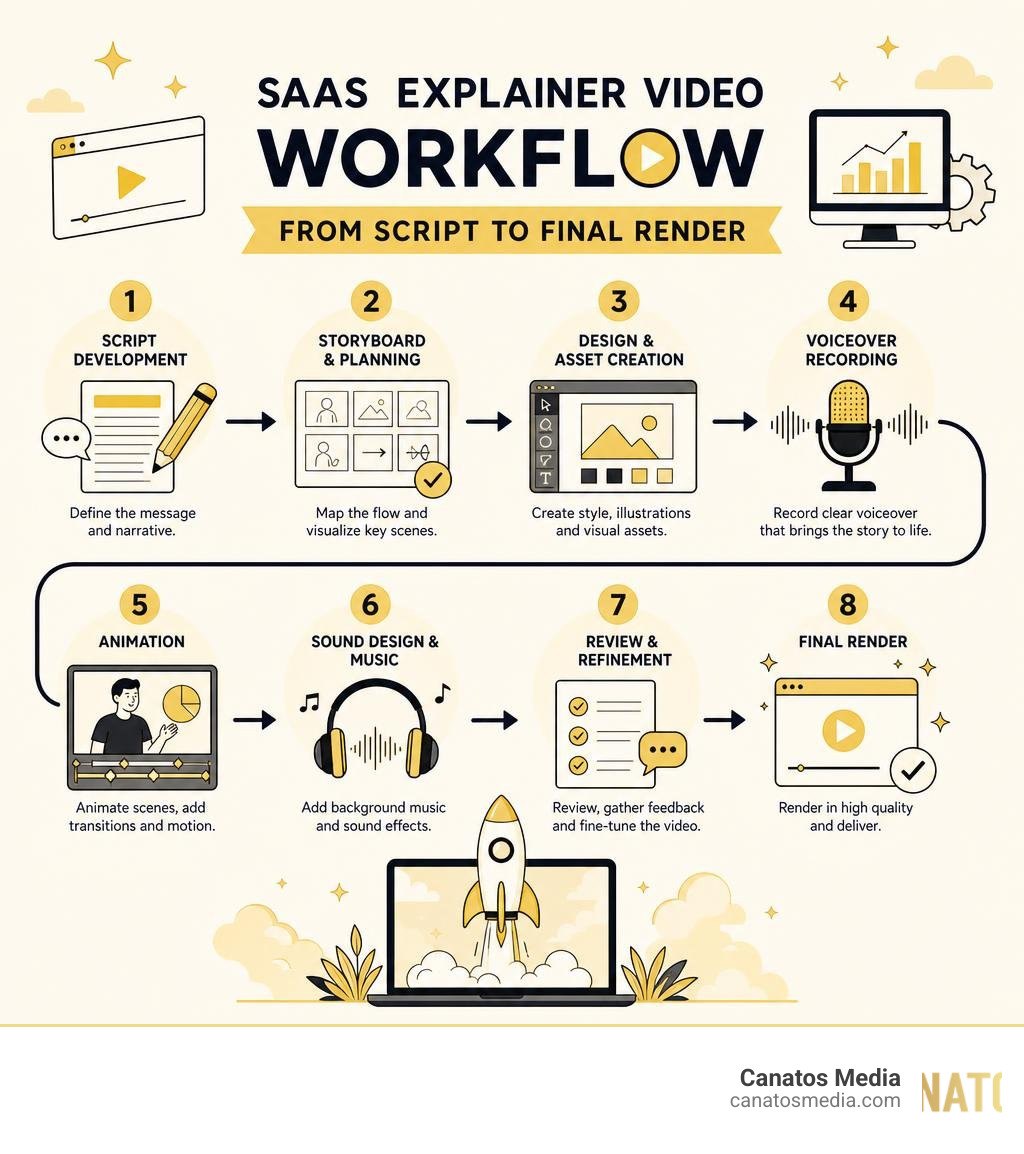
    SaaS explainer video workflow from script to final render infographic

    Instead of forcing prospects to read a 30-page whitepaper or sit through a dry, text-heavy slideshow, a 90-second animated explainer video can walk them through the problem, the solution, and the exact steps to get started.

    For example, creator platforms like Teachable have used animation to drive massive event registrations. Their summit campaign, highlighted in the Summit Animation Video for Teachable | VID, generated over 152,000 leads and nearly 70,000 registrations by using clean, modern motion graphics to communicate the value of their event.

    Whether you use cutting-edge AI tools like the Make AI Animated Explainer Video Maker in Minutes | Pexo to quickly prototype ideas, or work with a professional production agency to build custom assets, simplifying your offer is the fastest way to shorten your sales cycle.

    Choosing the Right Style for Your Digital Marketing Animation Video

    Selecting the right visual style is critical because it dictates how your audience perceives your brand’s authority and personality.

    Examples of 2D motion graphics vs 3D animation styles

    • 2D Motion Graphics: This style focuses on kinetic typography, shapes, and iconographies. It is clean, professional, and perfect for B2B tech companies that want to look sleek and modern.
    • 3D Animation: Highly detailed and realistic, 3D is ideal for physical product launches, medical devices, or high-end consumer goods. It allows you to show internal mechanics and angles that are impossible to capture with a camera.
    • Whiteboard Animation: This style simulates a hand drawing on a whiteboard in real-time. It is highly effective for educational content because the step-by-step drawing process naturally keeps viewers curious about what will be drawn next.

    If you need a quick overlay asset or want to explore pre-made motion graphics templates, platforms like the Digital Marketing Strategy 4K Animation, Motion Graphics | VideoHive offer excellent stock resources to help get your project off the ground.

    Best Practices for Creating High-Converting Animations

    Creating a high-converting digital marketing animation video requires a careful balance of art and science. It is not just about beautiful illustrations; it is about guiding the viewer’s eye and mind toward a specific action.

    To ensure your animation drives real business results, we recommend following a structured production process that prioritizes your marketing funnel. For a deep dive into how short-form video content fits into modern lead generation, read our guide on How Cinematic Short-Form Video Drives Meta and Google Lead Generation.

    Scripting and Storyboarding for Maximum Impact

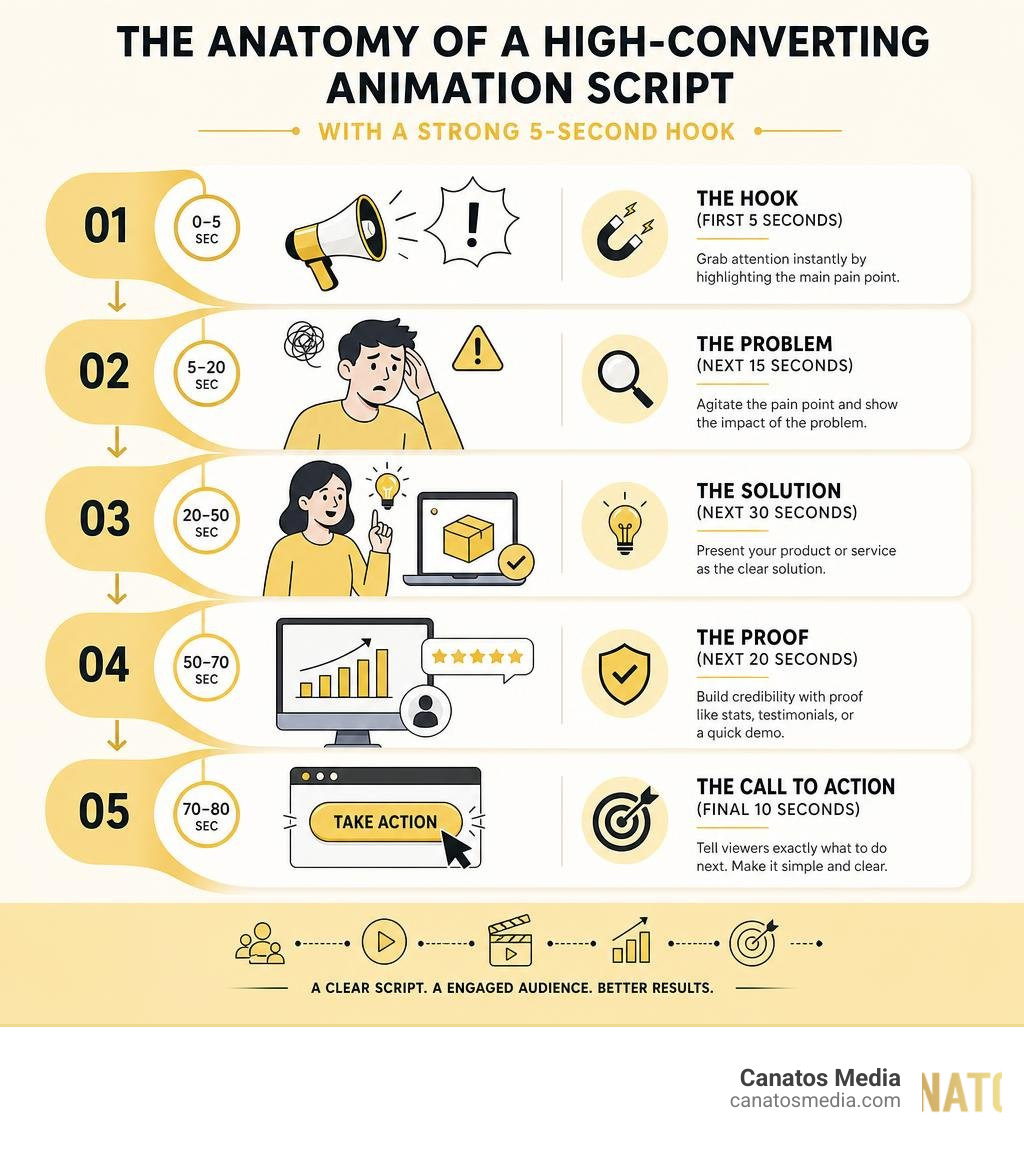
    The script is the foundation of your entire video. If the script is weak, even the most beautiful 3D animation will fail to convert. A high-converting script must follow a proven marketing structure:

    The anatomy of a high-converting animation script with a strong 5-second hook infographic

    1. The Hook (First 5 Seconds): Address your target audience’s primary pain point immediately. Do not start with a slow intro or a logo animation. Grab their attention right away.
    2. The Problem (Next 15 Seconds): Agitate the pain point. Show that you understand the frustration they are facing.
    3. The Solution (Next 30 Seconds): Introduce your product or service as the ultimate solution. Focus on the benefits of your offer, not just the features.
    4. The Proof (Next 20 Seconds): Briefly share a stat, a testimonial, or a visual demonstration that builds credibility.
    5. The Call to Action (Final 10 Seconds): Tell the viewer exactly what to do next, whether it is visiting a landing page, booking a call, or downloading an app.

    Once the script is locked, the storyboarding phase begins. This is where you map out the visual elements scene-by-scene to ensure the visual narrative perfectly supports the voiceover and keeps the viewer engaged.

    Optimizing Animations for Social Media and Paid Ads

    When you are running paid ads on platforms like Meta, Google, or TikTok, your animation has to be optimized for the user experience of those specific channels.

    • Design for Silent Autoplay: Up to 85% of social media users watch videos with the sound turned off. Your animation must make complete sense without audio. Use bold typography, kinetic text, and clear visual cues to deliver your message.
    • Use the Right Aspect Ratios: Do not rely on a single widescreen (16:9) video for every channel. Create square (1:1) cuts for feed ads and vertical (9:16) cuts for Reels, Shorts, and Stories.
    • Keep it Short and Punchy: For social ads, aim for 15 to 30 seconds. You need to deliver your value proposition and CTA before the user scrolls away.

    A great real-world example of this multi-format approach is detailed in the Shogun Animated Hype Video Case Study | Epipheo , where a 90-second core brand video was broken down into 15-second and 30-second ad cuts in both square and widescreen formats to maximize paid ad performance.

    For practical steps on optimizing your video campaigns for local audiences, see our guide on How to Optimize Short-Form Video Ads for Local Lead Generation.

    Measuring Campaign Success and Performance

    Investing in a digital marketing animation video is only half the battle. To maximize your return on investment, you must track how your target audience interacts with your content and measure its impact on your bottom line.

    To learn how to connect your top-of-funnel video views to real business appointments, explore our article on How to Measure Video Campaign ROI from Social Views to Booked Appointments.

    Key Metrics to Track

    When evaluating your video’s performance, look beyond “vanity metrics” like total views. Instead, focus on these actionable data points:

    • Play Rate: The percentage of landing page visitors who actually click play on your video. A low play rate usually means your video thumbnail or placement needs to be optimized.
    • Engagement / Retention Rate: This shows you exactly where viewers drop off. If 50% of your audience stops watching at the 10-second mark, your hook isn’t strong enough, or the video’s pacing is too slow.
    • Click-Through Rate (CTR): The percentage of viewers who click your call-to-action link during or after the video.
    • Conversion Rate: The percentage of video viewers who complete your desired goal (e.g., signing up for a trial or booking a consultation).

    By analyzing these metrics, you can make data-driven adjustments to your video placement, ad targeting, or even the video script itself. For more on how we turn these views into actual revenue, read about How We Turn Video Views into Real Revenue for Service Businesses.

    Additionally, high-quality video content plays an increasingly important role in modern search engine visibility. To understand how video assets can improve your organic reach, read How Video Content Drives Success in AI Search Results and AEO Optimization.

    Measuring the ROI of Your Digital Marketing Animation Video

    The success of your animated marketing campaign comes down to return on investment (ROI). To calculate this accurately, you need to look at your Customer Acquisition Cost (CAC) and compare it to the Lifetime Value (LTV) of the customers generated by your video campaigns.

    When an animated video successfully simplifies your value proposition, it pre-qualifies your leads. Prospects who watch your video before booking a call already understand what you do and how you can help them, which naturally leads to higher close rates and a lower overall CAC.

    To see how we align brand storytelling directly to lead generation, check out our insights on How We Connect Cinematic Brand Stories to Qualified Leads.

    Frequently Asked Questions about Animated Marketing Videos

    How much does a digital marketing animation video cost?

    The cost of producing an animated marketing video depends entirely on the style, complexity, and length of the project.

    • Basic Animations ($2,000 – $5,000): Typically includes clean, simple 2D motion graphics, basic character movements, or templated whiteboard animations. Great for startups or local service businesses on a budget.
    • Mid-Range Productions ($5,000 – $15,000): Custom-designed 2D animations, professional voiceovers, custom character designs, and highly polished motion graphics. This is the sweet spot for most growing brands.
    • Premium Animations ($15,000 – $30,000+): High-end 3D animations, complex character development, custom sound design, and multi-format ad packages.

    For businesses in the Tri-State area and Long Island, working with regional experts ensures your production budget is allocated efficiently. You can explore local services via resources like Video Production Services | Long Island Media Inc. or a dedicated Long Island Video Production Company | New York to get a sense of local market pricing.

    To learn more about video budgets and what to look for in a production partner, read our Beginner’s Guide to Video Production Services.

    Which industries benefit most from animated videos?

    While almost any business can benefit from video, animation is exceptionally powerful for industries with complex, abstract, or highly regulated offerings:

    • SaaS and Tech: Visualizes software interfaces, workflows, and cloud-based systems that cannot be captured with a traditional camera.
    • Fintech and Finance: Explains complex financial products, investment strategies, or security compliance in a way that feels safe, clear, and easy to understand.
    • Healthcare and Biotech: Animates cellular processes, medical devices, or patient treatment pathways with precision and clarity.
    • Service-Based Businesses: Local service providers use animation to make their booking and service processes feel incredibly straightforward and transparent.

    For a deeper look at how service-based businesses can leverage video to generate high-quality leads, check out our guide on Why Video Production is the Key to Modern Lead Generation for Service Businesses.

    Regional campaigns also show the power of local video storytelling. For example, local organizations frequently use video to build community trust, as seen in the Discover Long Island Launches Second Video Series in Award … campaign, which successfully boosted regional engagement.

    How long should a marketing animation video be?

    Your video’s length should be dictated by where it sits in your marketing funnel and where your audience will watch it:

    • Social Media Ads (Meta, TikTok, YouTube Shorts): 15 to 30 seconds. Focus on one clear message and a fast call to action.
    • Landing Pages & Website Homepages: 60 to 90 seconds. This is the ideal length for a standard product explainer video.
    • Deep-Dive Demos & Onboarding: 2 to 3 minutes. Perfect for prospects who are already in the consideration phase and want to see exactly how your product works.

    Conclusion

    A well-crafted digital marketing animation video is much more than a creative asset—it is a powerful conversion tool that simplifies your message, engages your audience, and drives measurable business growth. However, the most beautiful animation in the world will not deliver results without an integrated marketing strategy to back it up.

    At Canatos Media, we specialize in connecting high-quality video production with targeted digital marketing strategies. Serving businesses throughout the Tri-State area and Long Island, we build end-to-end campaigns that seamlessly integrate content creation, paid social advertising, SEO, and conversion optimization to turn casual viewers into loyal customers.

    Ready to elevate your brand’s digital presence and turn video views into real revenue? Explore our End-to-End Video Marketing: How We Drive Real Results for Growing Businesses services, and let’s build an animation strategy that actually converts.