Why Most Businesses Struggle With Fragmented Video Marketing
Growing businesses typically piece together their marketing from different vendors. A freelancer handles video production. A social media manager posts content. A paid ads specialist runs campaigns. An SEO consultant optimizes the website. Each team member works in isolation, and critical information gets lost in translation.
This fragmentation creates real problems. Video content produced without understanding your paid advertising strategy doesn’t drive the right conversions. Social media posts don’t align with your website’s messaging. Ads promote content that wasn’t designed to capture qualified leads. Teams spend more time coordinating than actually executing, and your marketing budget gets stretched thin across disconnected efforts.
The result is predictable: You end up with decent content that underperforms because it wasn’t built to work as part of a larger system. Businesses see modest engagement but struggle to trace that engagement back to actual business results.
Actionable takeaway: Before hiring your next vendor, map out your entire customer journey. Where do prospects see you first? What content moves them forward? Where do they convert? If your answer involves multiple vendors working independently, you’ve identified your gap.
The Hidden Costs of Managing Video Separately From Your Digital Strategy
When video production operates separately from your digital strategy, you’re paying a steep price that doesn’t always show up in your budget spreadsheet. First, there’s the inefficiency cost. A video producer creates content based on their understanding of what “looks good.” Meanwhile, your paid ads specialist knows exactly which messaging angle drives conversions. These insights never connect.
Second, you waste production resources. Shooting multiple videos for different platforms or purposes often means recreating similar content instead of maximizing what you’ve already produced. A 30-second video could work across TikTok, Instagram Reels, YouTube Shorts, and paid ads with smart adaptation, but that only happens when production and distribution strategy overlap.
Third, there’s the intelligence gap. Your social media manager sees what content gets engagement. Your ads team sees what generates conversions. Your website analytics show where visitors drop off. But nobody sees the complete picture. Each vendor optimizes their piece without understanding how it affects the whole system.
The financial impact compounds quickly. You’re paying for separate consultations, separate strategy sessions, and separate revisions. More critically, you’re losing opportunities because your marketing isn’t orchestrated.
Actionable takeaway: Calculate the total cost of your current marketing vendors. Then identify which insights each one has that the others are missing. That gap represents money you’re leaving on the table.
What End-to-End Video Marketing Actually Means
End-to-end video marketing means every piece of your video strategy connects to your business goals. It starts with your core message and target audience, then extends through production, distribution, advertising, and measurement.
In practice, this means:
- Your video content is created specifically to feed your marketing funnel, not just to look cinematic
- Short-form content is produced in ways that work across multiple platforms and ad formats
- Messaging in your videos aligns with what your paid ads team is testing and what your website is communicating
- Distribution strategy is determined before production even begins, not as an afterthought
- Analytics from video performance inform future production decisions
- Every video serves a clear business purpose: building awareness, generating leads, or driving conversions
The key difference from traditional video production: We don’t make videos and then figure out where to use them. We determine where they need to go and what they need to accomplish, then design production around those requirements.
This approach eliminates the waste of fragmented marketing while giving you a cohesive brand voice across every platform your customers use.
How We Combine Short-Form Content With Complete Digital Systems
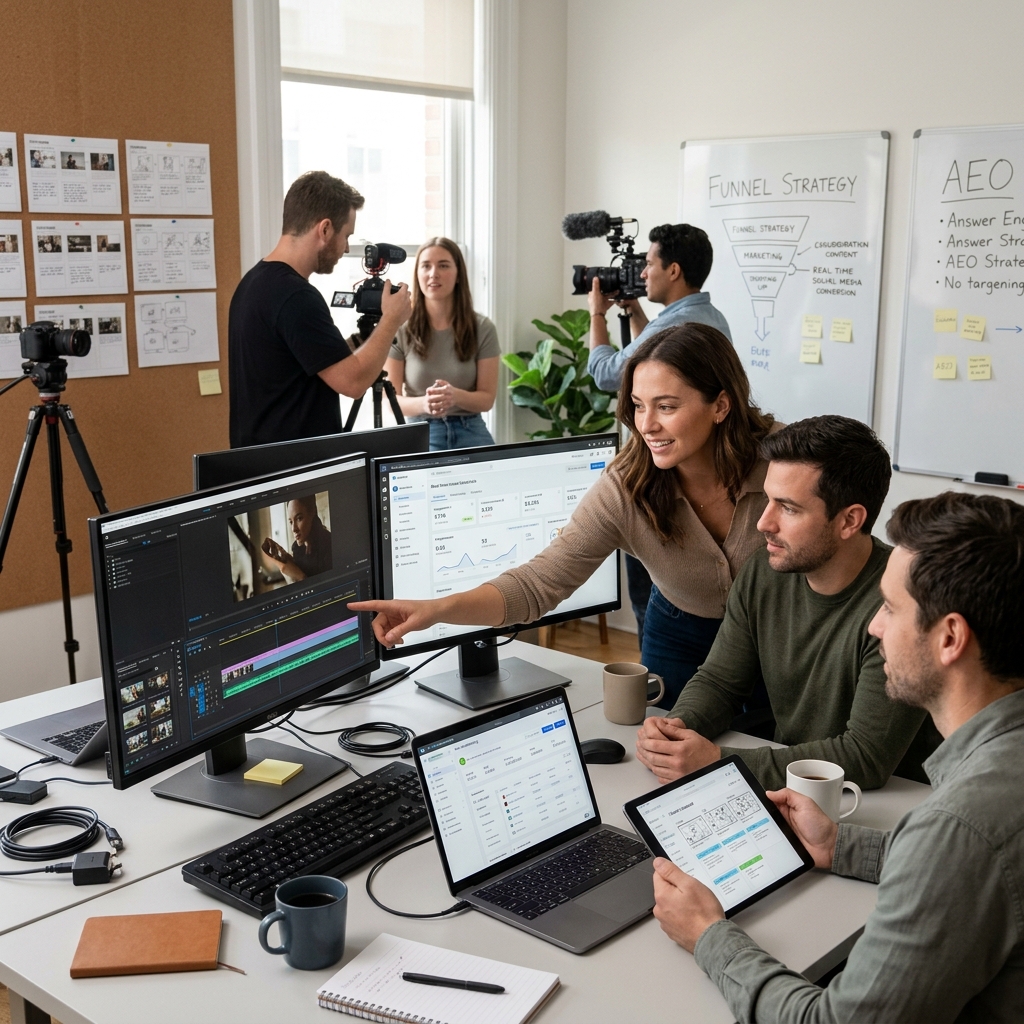
We build short-form video as the engine of your digital strategy, not as an isolated content type. Here’s how the system works together.
Video production becomes the source material for multiple channels. A single shoot day might produce content for organic social posts, paid ad variations, website heroes, email sequences, and even lead magnets. This efficiency doesn’t sacrifice quality because we plan for multiple uses during production.
Social media management uses video as the primary content format because it outperforms text and static images dramatically. But posting video isn’t enough. We schedule, respond to comments, and test different posting times based on when your audience is active. Video gets amplified through consistent, strategic posting.
Paid advertising then takes your best-performing organic video and distributes it to cold audiences at scale. We test different cuts, captions, and calls-to-action based on the platform. Meta ads work differently than Google ads, and both require format variations we’ve already accounted for during production.
Lead generation systems capture the attention video creates. Forms, landing pages, and email sequences are ready to convert viewers into prospects the moment they’re interested.
SEO and website optimization ensures your video content supports your search rankings and keeps visitors on your site longer, which search engines reward.
These pieces move in coordination rather than in parallel. That coordination is where real results happen.
The Role of Cinematic Storytelling in Your Marketing Funnel
Storytelling is the bridge between awareness and conversion. Generic product videos or talking-head testimonials don’t create emotional connection. Cinematic storytelling does.
When we produce your short-form video content, we’re not just explaining what you do. We’re showing how your solution changes someone’s life or business. We craft narratives that make viewers want what you’re offering before you ever ask them to buy.
This works across your entire funnel:
- Awareness stage: Cinematic videos that tell brand stories or demonstrate problems your audience faces, making them stop scrolling
- Consideration stage: Narrative videos showing how similar customers benefited from your solution
- Decision stage: Testimonials and case study videos that build trust and lower barriers to conversion
The production quality matters here because it signals credibility. Poorly produced video says you don’t care about details. Cinematic video says you’re a professional, established business worth trusting with their money.
Actionable takeaway: Review your top three performing videos. Are they cinematic stories that create emotion, or are they functional explanations? If they’re functional, there’s room to improve performance by adding narrative and polish.
Turning Video Viewers Into Qualified Leads
Views are vanity metrics if they don’t convert. Our approach ensures every video viewer has a clear path to becoming a lead.
This starts with intentional video placement. Organic videos on your social feeds build awareness and nurture existing followers. Paid videos reach cold audiences who’ve never heard of you. Each serves a different purpose, and the messaging shifts accordingly.
Then we embed conversion mechanics directly into the video experience. Captions direct viewers to click a link. End screens provide immediate paths to your website. Comment strategies encourage questions that let us reach out directly. Email sequences follow up with viewers who engaged but didn’t convert immediately.
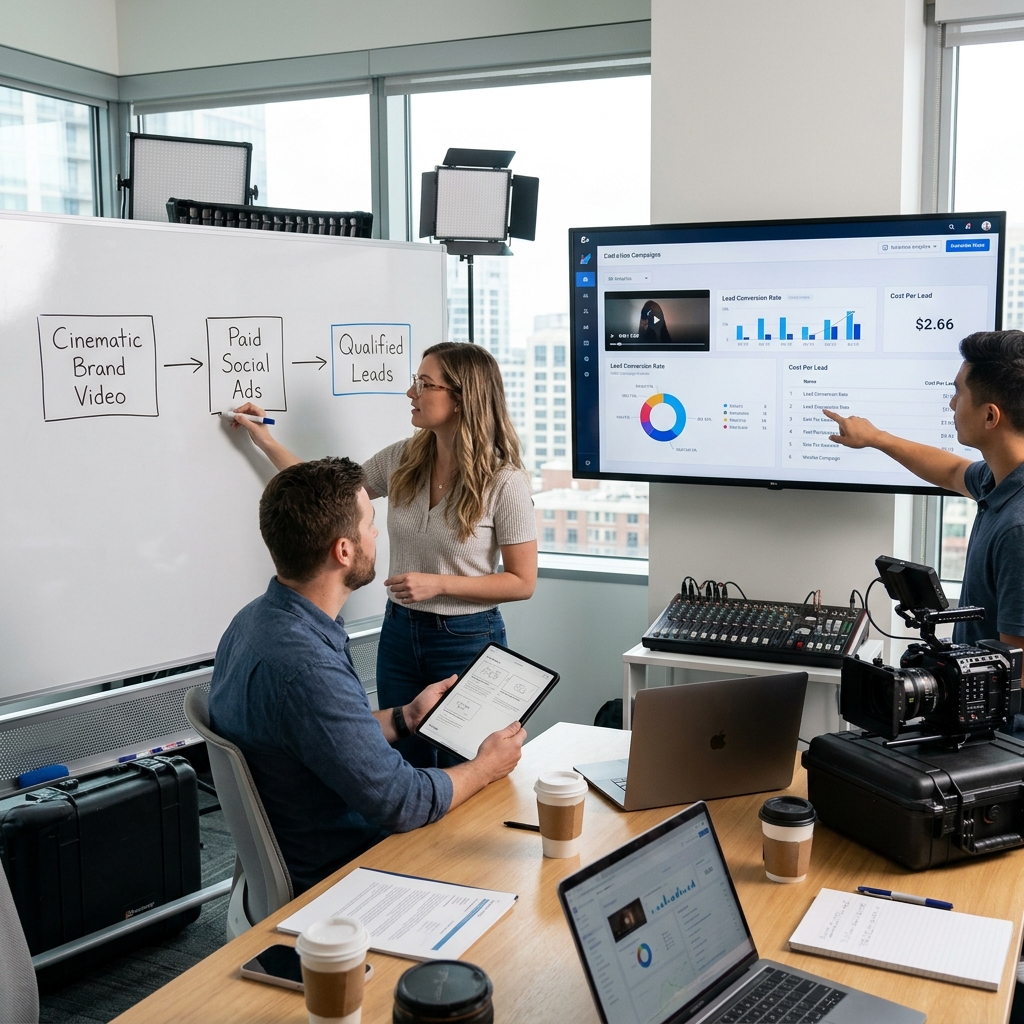
For viewers who are ready to convert, we have landing pages, contact forms, and offer pages optimized specifically for video traffic. The copy and design match the message they just saw, reducing friction.
We also segment your audience. Someone who watched your testimonial video is closer to buying than someone who watched your brand awareness content. They get different follow-up messages and offers because they’re at different stages.
Actionable takeaway: Look at your current video content. When someone finishes watching, what are they supposed to do next? If the answer isn’t clear, you’re losing conversions.
Integrating Video Across Your Social Media and Paid Advertising
Social media and paid ads work best when they’re coordinated, not competitive. We see them as two parts of one system.
Organic video on social media serves multiple purposes. It builds your audience, tests messaging ideas, and creates content you can repurpose into paid ads. Your organic content strategy directly informs what we promote with paid dollars.
When we move to paid advertising, we’re taking your best organic performers and distributing them to larger audiences. But paid ads aren’t just amplified organic content. We test different cuts, different captions, different calls-to-action. Meta ads get a specific format and message. Google ads get another. LinkedIn ads get another. Platform specificity matters because users behave differently on each platform.
The feedback loop runs both directions. What works in paid ads informs your organic strategy. Messaging angles that drive conversions on Meta get highlighted in your organic posts. We’re constantly learning from paid performance to improve organic content.
This integration also extends to your brand voice and visual identity. Every video, organic or paid, reinforces your brand standards so your audience sees consistent messaging everywhere they encounter you.
Measuring What Actually Matters: ROI From Video Content
Video ROI isn’t measured in views. It’s measured in leads, customers, and revenue. We track metrics that connect directly to business results.
Early in the funnel, we monitor engagement rates, completion rates, and reach. These show whether your video is stopping the scroll and keeping attention. But we don’t stop there.
As viewers move through your funnel, we track click-through rates to your website, form submissions, and email signups. These metrics show whether video is moving people toward conversion. We segment this data by video type, topic, and platform so we understand what actually resonates with your audience.
For paid video, we track cost per lead and cost per conversion. This tells us exactly how much you’re spending to acquire a qualified prospect or customer. We use this data to continuously optimize campaigns, turning off underperforming variations and doubling down on what works.
We also track revenue when possible, connecting video campaigns directly to sales. This is the ultimate metric because it shows net business impact.
Actionable takeaway: If you can’t connect your video marketing to at least one of these metrics (views, clicks, leads, revenue), the video isn’t part of a complete strategy. Demand metrics and optimization.
How We Scale Video Production Without Compromising Quality
Growing your video marketing typically requires producing more content more frequently. That scale can degrade quality if you’re not strategic about production workflows.
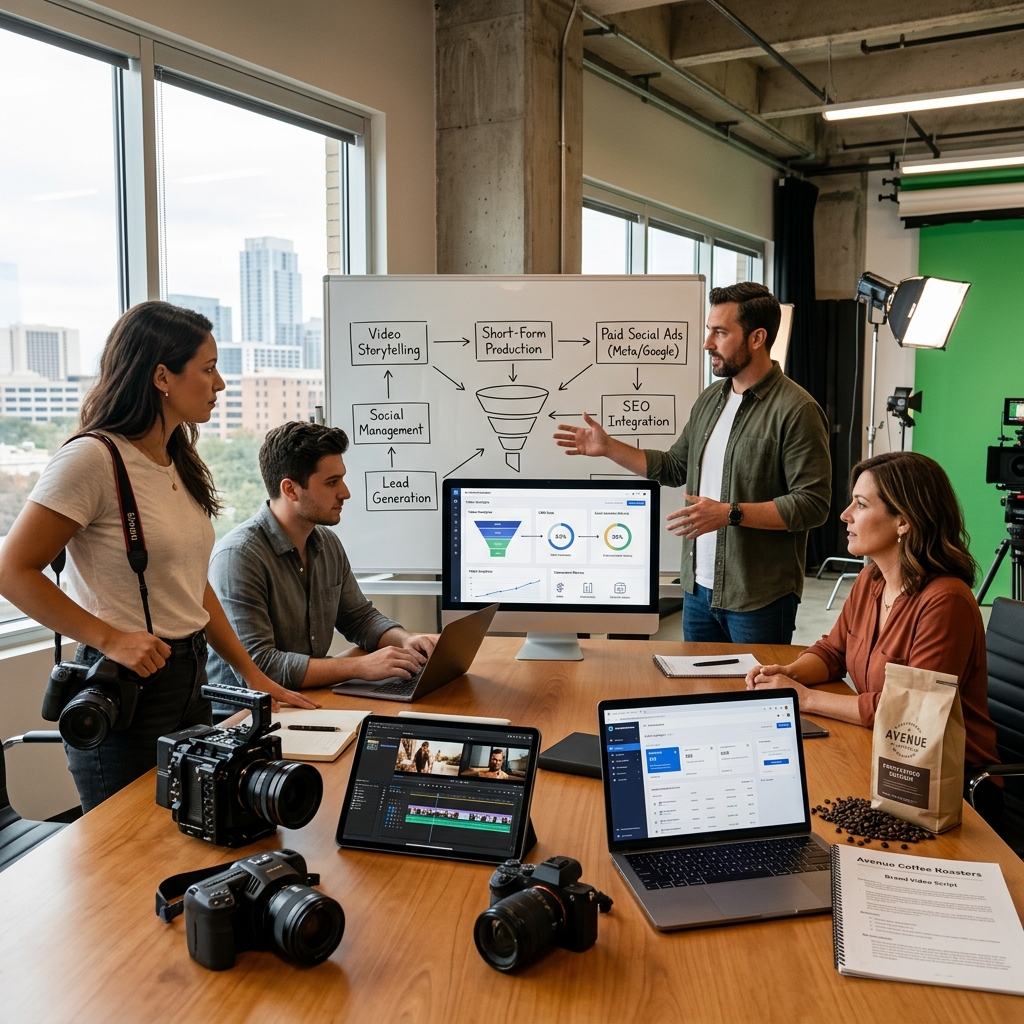
We handle scale through a combination of repeatable production systems and strategic variation. Your brand style guide creates guardrails so every video looks like it came from your business. Template-based workflows for certain video types (testimonials, quick tips, product demos) let us produce at volume without starting from scratch each time.
We also differentiate production effort based on each video’s purpose. Your hero brand story gets full cinematic treatment because it serves awareness and positions your business. Quick social media tips get produced efficiently without losing quality because they serve a different purpose.
Shooting schedules matter too. Batching production days means we’re shooting multiple videos in single sessions, which is more efficient and consistent. We plan the full month or quarter of content upfront so editing and post-production flow smoothly.
Technology helps here. We use templates, asset libraries, and organized workflows so production and editing happen faster without cutting corners on the final product.
Getting Started With a Comprehensive Video Marketing Strategy
If your marketing currently lives in silos, the first step is mapping your customer journey. Where do prospects first learn about you? What content moves them forward? Where do they currently convert or drop off?
From there, we develop a strategy that coordinates video production, social distribution, paid advertising, and lead capture. This strategy document becomes your roadmap, guiding which videos to produce, when, where they’ll live, and what success looks like.
Then we move into production. We typically start with your core brand story and top-performing video types based on your research, then expand to other content categories over time.
The entire process is measurement-focused. We’re constantly learning what works, optimizing production and distribution accordingly.
If you’re ready to move beyond fragmented video marketing and build a system that actually drives leads and sales, let’s talk about what an integrated strategy looks like for your business. We’ll show you how coordinated video marketing outperforms the vendor-by-vendor approach.
For further reading: End-to-end video marketing.
Contact us today for a free consultation to see how we can help you grow your business.
Frequently Asked Questions (FAQ)
How does combining video production with digital strategy actually improve our lead generation?
We handle both the creative and the conversion side, which eliminates the gap where most video campaigns lose momentum. Our short-form content drives attention on social platforms, while our simultaneous paid advertising and lead capture systems ensure that viewers convert into qualified prospects. When video production and digital strategy operate as one system rather than separate services, we typically see 3-4x higher lead quality because the messaging, timing, and audience targeting all reinforce each other.
What makes your approach different from just outsourcing video production?
We don’t hand off videos and walk away. Our team manages the entire journey from concept through performance tracking, which means we optimize based on real conversion data rather than vanity metrics like views. We also integrate our cinematic content directly into your Meta and Google campaigns, AEO strategy, and social media calendar so nothing sits unused. This integration is what transforms video from a content asset into a revenue-generating part of your marketing system.
How do we handle the workload of producing multiple videos without sacrificing quality?
We’ve built repeatable production workflows and cinematic templates that let us scale efficiently while maintaining the storytelling standard your brand needs. Our process balances efficiency with creativity, so we can deliver consistent output across your social channels, landing pages, and ad sets without cutting corners on the visual quality that actually converts viewers into leads.