1. Establishing Brand-Consistent Visual Guidelines Across All Locations
Managing video production across multiple locations presents a unique challenge. You need consistency that reinforces your brand identity, but you also need flexibility to capture authentic local moments. When done poorly, you end up with fragmented content that dilutes your message. When done well, scalable short-form video production becomes your competitive edge, turning distributed teams into a unified content engine.
We’ve helped multi-location service businesses and franchise owners solve this exact problem. Here’s what separates operations that scale smoothly from those that create bottlenecks, quality issues, and wasted resources.
Brand consistency isn’t about rigid rules that stifle creativity. It’s about creating a framework that every location can work within confidently, knowing their output will feel authentically “your brand.”
Start by documenting your visual language in one place. This means defining color palettes (specific hex codes, not just “blue”), approved fonts, logo usage, motion styles, and on-camera talent guidelines. If your brand uses quick cuts and energetic music, that’s a statement. If it uses longer shots and softer transitions, that’s equally important to lock down.
The difference between a guideline that gets followed and one that gets ignored is specificity. Instead of saying “use our brand colors,” show examples of how those colors appear in different lighting conditions, on various backgrounds, and across different video formats. Include do’s and don’ts. If you have multiple locations with different aesthetics (a luxury salon in Manhattan versus a suburban wellness center), create location-specific sub-guidelines that honor both the local environment and the brand standard.
Action step: Create a one-page visual brand sheet with five core rules and five actual video examples showing those rules in action. Share it with every location lead and make it part of your onboarding.
2. Building a Centralized Content Calendar for Distributed Teams
Without a shared content calendar, locations operate in silos. One team shoots product launches while another films customer testimonials, and nothing amplifies each other’s reach. A centralized calendar keeps everyone aligned on themes, posting days, and strategic objectives.
Set up a calendar tool that shows what’s going out across all channels, on all dates. Include campaign themes for each month, key promotional periods, and seasonal angles. If you’re running a paid ad campaign in Q2, your locations need to know that their organic content should complement that message. If a new service launches, every location should be capturing related content within the same week.
The calendar should include content type, location(s) involved, posting date, and the campaign it supports. Build in buffer time. A realistic timeline gives locations two to three weeks’ notice before a shoot date, which is enough time for crews to coordinate and enough lead time to adjust if something falls through.
Assign one person (or a small team) to own the calendar. This person communicates deadline shifts, consolidates requests, and prevents scheduling conflicts. Without clear ownership, calendars become outdated and people stop trusting them.
Action step: Audit your current posting schedule across locations. Identify one month where you’ll test a unified calendar theme (like “Team Spotlight Month”) and measure engagement lift.
3. Implementing Efficient Remote Approval Workflows
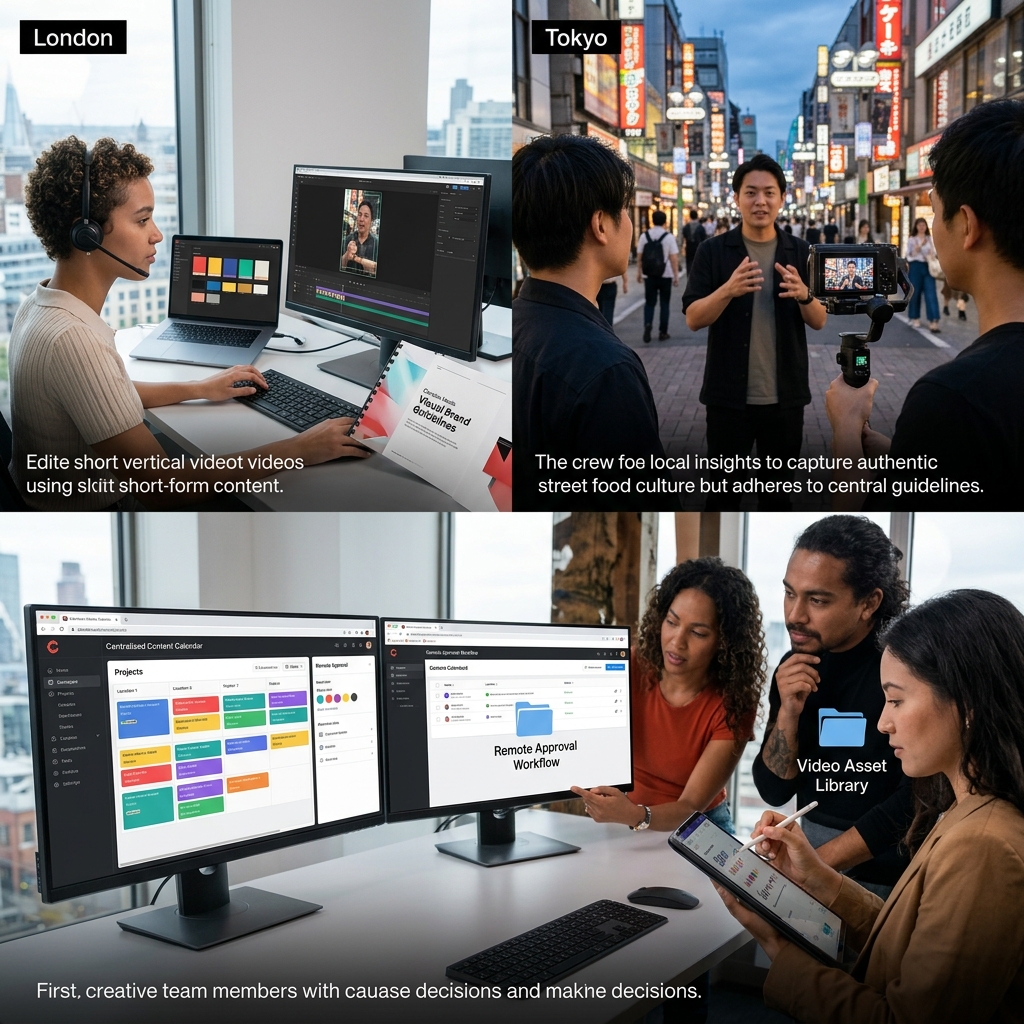
Long approval chains kill momentum. By the time a video gets signed off, the content feels stale and the team’s energy has moved to the next project.
Build a tiered approval system. Draft content goes to a local lead for quality check. Approved drafts move to a brand manager or creative lead for consistency review. Only significant deviations or brand concerns trigger back-and-forth revision cycles. Most videos should clear in one or two rounds.
Use a platform that keeps everything in one place. Dropbox, Frame.io, or similar tools let you embed approval directly into the video file, add timestamped comments, and track version history. This beats email chains and prevents confusion about which cut is the “final” one.
Set clear approval timeframes. If local approval takes 48 hours and brand approval takes another 24 hours, the team knows the video will be ready to post on Thursday. Missing that window means waiting another cycle. Predictability removes friction.
For routine content (weekly team updates, location features), consider pre-approval. The location submits a video that follows the established template and visual guidelines, and if it hits the checklist, it posts automatically. Save your critical review attention for campaign-critical content or new formats.
Action step: Map out your current approval chain. Time how long each step actually takes. If it’s over five business days for standard content, you need to streamline.
4. Leveraging Local Insights While Maintaining Brand Standards
Your locations see things headquarters doesn’t. A location team understands their community, their competitors, and what resonates with their local audience. Centralizing production doesn’t mean centralizing ideas.
Create a formal channel for location teams to pitch content ideas. This might be a monthly “content ideas” form where managers submit local angles that fit the brand calendar. Maybe a particular location has a unique event coming up, or a team member has a story that could resonate. Good ideas bubble up and get resourced.
The key distinction: local insights shape the stories you tell, not the visual language or brand voice. A fitness franchise’s New Jersey location might pitch content around a local sports team partnership. That’s valuable. But the video still needs the same color grade, music style, and on-camera talent approach as every other location’s content.
Establish approval criteria that encourage local ownership while protecting brand integrity. Ask: Does this idea serve our target customer? Does it fit our current campaign theme? Does it work within our visual guidelines? If yes to all three, resource it. If it’s outside the theme but the idea is strong, consider how it might shift next month’s calendar.
Action step: Send a one-question survey to all location leads: “What’s one story or moment unique to your area that you think our customers would care about?” You’ll be surprised at what comes back.
5. Optimizing Asset Management and Video Library Systems
When you’re producing dozens of videos a month across multiple locations, files get lost. The edit bay can’t find the project file. A new team member needs old footage for reference and spends an hour searching. Locations re-shoot content that already exists somewhere else.
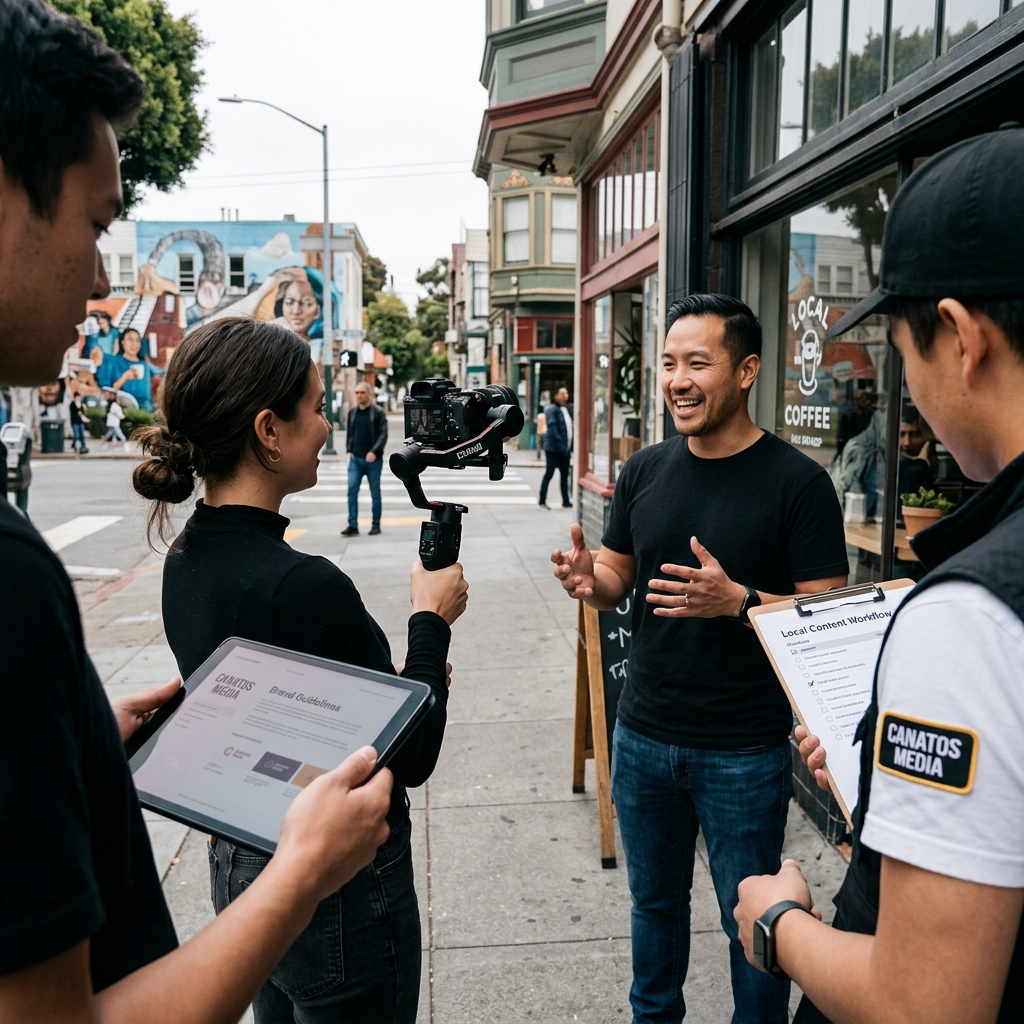
Implement a centralized asset library. This includes master footage, approved edits, graphics, music, and lower-third templates. Everything gets tagged by location, date, campaign, and content type. When a producer starts a new project, they can pull from existing approved assets instead of building from scratch.
Use clear naming conventions. A file called “NYC-Jan2026-CustomerTestimonial-v2-FINAL.mp4” tells you exactly what you’re looking at. Ambiguous names like “Edit-2.mp4” create confusion. Standardize this across all locations.
Back everything up redundantly. Cloud storage with version control prevents the scenario where someone accidentally overwrites a file and loses hours of work. Require all locations to export final assets to the central library within 24 hours of approval.
Action step: Spend one afternoon auditing your current file system. If you can’t locate three random videos within five minutes, you need a better system.
6. Creating Repeatable Video Formats That Scale
Format is the secret weapon of scalable video production. When you define specific formats and templates, production becomes teachable and efficient.
Identify the 4-6 core formats that drive results for your brand. This might be:
- 30-second customer testimonials (specific framing, music, graphics)
- 15-second product features (consistent b-roll approach, text overlay style)
- 60-second team culture videos (interview setup, on-camera talent guidelines)
- Behind-the-scenes location tours (camera movement style, pacing)
For each format, create a production brief that covers shot list, music style, pacing, graphics approach, and typical length. When a location knows they’re producing a “Format A: Customer Testimonial,” they understand the constraints and can execute independently.
Standardized formats also make editing faster. An editor working on the tenth testimonial can build off the ninth one’s template, making significant time savings. This is where scalable production truly becomes efficient.
Formats don’t mean boring. Within the framework, local variation is encouraged. The testimonial format includes guidelines on framing and graphics, but the actual story and location stay unique.
Action step: Document your three most-produced video types right now. Write a one-page production brief for each, including a reference video example.
7. Measuring Performance and ROI Across Multi-Location Campaigns
Production without measurement is just content creation. You need to know which formats, locations, and messages actually drive business results.

Set up unified analytics tracking. Every video across every location should be tagged with campaign source, location, and format. This means your social media manager can pull a report answering: “Which location’s testimonial videos drive the most website visits?” or “Do team culture videos outperform product features?”
Track both content metrics (views, shares, engagement rate) and business metrics (website traffic, lead form submissions, conversion rate). If a location consistently produces videos that drive leads at a better rate than others, reverse-engineer why and teach that playbook to underperforming locations.
Monthly reporting keeps teams accountable and informed. Show each location how their content is performing, celebrate wins, and share learnings. If Location A’s videos generate leads 20 percent cheaper than the average, other locations want to know what they’re doing differently.
Use these insights to refine your content calendar and formats. If short testimonials underperform but longer stories overperform, adjust next month’s production plan. If certain locations consistently miss targets, they might need different format guidance or additional training.
When you connect video production to actual lead generation and sales, it stops being “the content team’s problem” and becomes everyone’s growth lever.
Action step: Audit where your last 20 qualified leads came from. How many came through video content? Which videos drove those leads? Use this to set a baseline and build a measurement system around it.
For further reading: Case studies.
Contact us today for a free consultation to see how we can help you grow your business.
Frequently Asked Questions (FAQ)
How do we maintain video consistency when producing content across multiple locations?
We establish detailed visual guidelines that cover everything from color grading and font usage to camera angles and pacing. Our teams at each location follow these standards while we use a centralized asset management system to store approved templates, brand assets, and reference videos. This approach lets local teams move quickly without sacrificing the cohesive look that makes your brand recognizable across all platforms.
What’s the most efficient way to approve videos when we’re managing multiple locations?
We implement a streamlined remote approval workflow where all video drafts get reviewed in a shared system with timestamped feedback. Rather than lengthy email chains, we consolidate revision requests and use version control so teams know exactly which changes were made and why. This typically cuts approval cycles in half compared to traditional methods.
How do we measure whether our multi-location video strategy is actually generating leads and sales?
We track performance metrics across each location separately and in aggregate, monitoring view-through rates, engagement, click-through rates on paid campaigns, and ultimately how many qualified leads each video asset drives. Our reporting connects video performance directly to lead generation systems, so we can show you exactly which content formats and locations are delivering the strongest ROI for your business.