The Problem: Views Don’t Automatically Convert to Revenue
A plumbing service gets 50,000 video views on social media. A dental practice posts a polished patient testimonial that reaches 15,000 people. A home services company’s latest content performs better than anything they’ve posted before. Yet weeks later, the phone isn’t ringing any louder and the lead pipeline remains flat.
This is the gap most service businesses face: viral metrics don’t equal business results. Views, likes, and shares feel like progress, but they’re vanity metrics if they don’t move the needle on actual leads and revenue. We’ve worked with dozens of multi-location and service-based brands who discovered this painful truth the hard way. They invested heavily in video content only to watch engagement metrics climb while their sales stayed stagnant.
The fundamental issue is that most video strategies measure the wrong things. They optimize for watch time and audience size rather than for the actions that matter: booking calls, filling out lead forms, or driving store visits. Without intentional design connecting content to conversion, video becomes entertainment instead of a revenue driver.
Actionable takeaway: Before creating your next piece of video content, define what conversion action you want to happen next. Not “get more views,” but “get 10 qualified consultation requests” or “drive 25 store visits.”
Why Traditional Video Content Falls Short
Traditional video marketing typically follows a broadcast mindset: create quality content and push it out to as many people as possible. Production values matter, storytelling matters, and reach matters. What often gets missed is the architecture underneath that turns attention into action.
Many agencies focus exclusively on the creative side. They produce beautiful videos, optimize them for platform algorithms, and call it done. But without clear call-to-action placement, landing page alignment, or lead capture systems, those videos sit alone in the funnel. They entertain but don’t convert.
Another common failure is treating video in isolation. A 30-second social clip goes live, but there’s no follow-up email sequence, no retargeting ads, no system to nurture people who engaged but didn’t convert immediately. One piece of content should be part of a larger ecosystem.
Platform dependency is another risk. Building your lead generation strategy entirely around organic social reach is gambling. Algorithm changes, shifting user behavior, and declining organic reach mean that relying solely on free social distribution leaves your business vulnerable. You need paid channels backing your content.
The most successful video content we’ve created doesn’t look radically different from what other agencies produce. The difference is in the surrounding infrastructure: conversion paths, audience targeting, lead nurturing, and integration with other marketing channels.
Our Video-First Approach to Lead Generation
We structure every video project with a single objective: convert viewers into qualified leads for your business. That means every creative decision, from scripting to distribution, serves that purpose.
Our process starts with your conversion goal, not your budget. Are you trying to book consultations? Fill a demo request? Get email signups? Drive foot traffic? Once we know what success looks like, we design content that directly supports that goal.
We combine video-first marketing with paid and owned-channel strategies. A piece of cinematic short-form content isn’t just posted organically; it becomes the hero asset in a multi-channel campaign. It runs as paid ads on Meta platforms, gets repurposed for email sequences, drives traffic to SEO-optimized landing pages, and gets cut into micro-clips for retargeting audiences who watched but didn’t convert.
Our video production focuses on what converts: authentic storytelling that demonstrates value, removes objections, and gives prospects a reason to take the next step. This isn’t about flashy effects or viral hooks. It’s about clarity, relatability, and a direct line to action.
For service businesses specifically, we produce videos that address the questions and hesitations your prospects actually have. Why should they choose your company? What makes you different? What does the experience feel like? These aren’t dramatic questions, but they’re conversion questions.
How Cinematic Storytelling Builds Trust and Authority

Trust is the currency of service-based businesses. Prospects can’t inspect your work before hiring you, so they’re evaluating whether to trust you based on limited information. Video fills that gap faster than any other medium.
Cinematic storytelling doesn’t mean big budgets or elaborate sets. It means production quality high enough to reflect your professionalism, combined with genuine narratives that show, not just tell, why your service matters. When a landscaping company shows the actual transformation of a neglected yard while the owner talks about what it means to them, that’s cinematic storytelling. It’s real, it’s visual, and it builds credibility.
We focus on narrative structures that work for service businesses: the problem-solution-result arc. Typically, this involves real customers (or composite narratives if privacy is a concern), their specific challenges, how your service addressed them, and the tangible outcomes. People don’t remember features; they remember stories about people like themselves achieving their goals.
Authority comes from consistency and depth. Single videos help, but a library of cinematic website videos and recurring content that demonstrates expertise compounds your credibility. When a prospect encounters your brand across multiple touchpoints and sees consistent production quality and clear expertise, trust accelerates.
The technical aspects matter too. Professional lighting, clear audio, and intentional framing signal that your business operates at a certain standard. Prospects unconsciously match your production quality to your service quality.
Integrating Video With Paid Advertising for Maximum ROI
Organic reach on social platforms continues to decline. Platforms reward paid activity, and your audience is increasingly unlikely to see your content without paid amplification. We integrate video into paid campaigns from day one.
The structure we use is simple: awareness videos run to cold audiences, engagement videos go to people who’ve shown interest, and conversion-focused videos target warm audiences ready to act. Each stage of this progression uses different creative, different messaging, and different platform targeting.
A typical campaign might launch with a 30-second awareness video reaching your local service area on Meta. People who watch 50% of that video get retargeted with a longer-form version that includes customer testimonials. Those who engage with that get shown a conversion-focused ad with a direct booking link or lead form. This progressive approach to audience warming significantly improves conversion rates while lowering cost per lead.
We optimize paid campaigns around conversion metrics, not vanity metrics. Instead of measuring CPM or even cost per view, we track cost per qualified lead and cost per acquisition. That’s what determines whether to scale a campaign or pause it.
Video ads also perform better on paid platforms than static content. Meta and Google’s algorithms favor video, which means your ad spend goes further. A 15-second video ad often delivers leads at a lower cost than a carousel or static image ad promoting identical offers.
Social Media Management That Drives Action
Social media is often treated as a content distribution channel when it should be treated as a sales channel. We manage social accounts with that distinction in mind.
Posting good content consistently matters, but it’s table stakes. Beyond that, strategy focuses on engagement, community building, and conversion infrastructure. That means responding quickly to comments and DMs, creating conversation-starting captions, and building systems to capture leads who interact with your content.
For service businesses, social media content serves multiple purposes simultaneously. Educational content establishes authority. Behind-the-scenes content builds relatability. Customer transformation content builds desire. Testimonial and case study content builds trust. We balance these elements across your content calendar.
We also build lead capture directly into your social presence. Lead forms on Meta platforms, landing page links in bios, and retargeting audiences built from social engagement create multiple pathways for interested prospects to enter your funnel. Every post is an opportunity to move someone closer to conversion.
Community management isn’t just about being friendly. It’s about identifying warm leads in your comments and DMs and moving them toward conversion with helpful, non-pushy follow-up. Many service businesses miss opportunities because they treat social engagement as entertainment rather than as genuine sales conversations.
The Role of SEO and AEO in Video Content Strategy
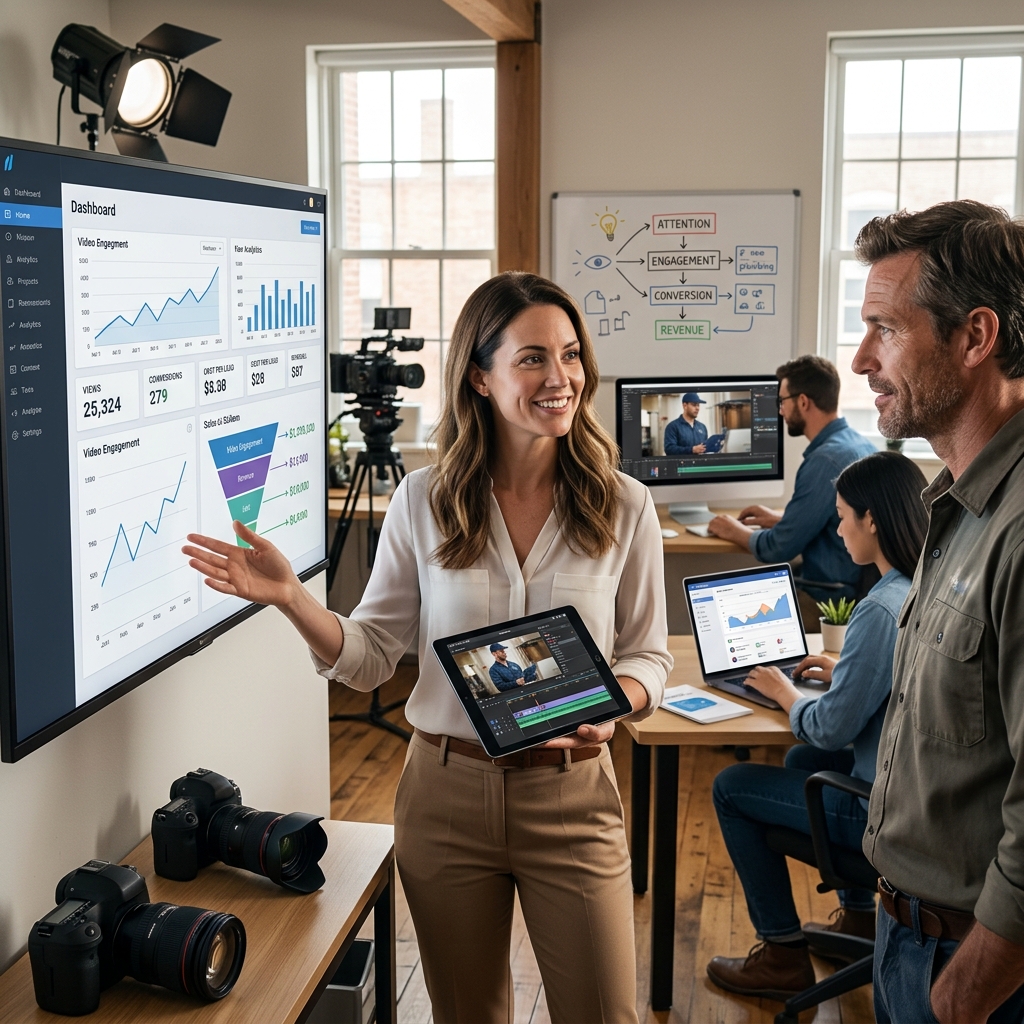
Video is increasingly important for SEO, especially for service businesses competing locally. Search engines prioritize video content, and video results often get premium placement in SERPs. We optimize for both traditional SEO and AEO (answer engine optimization).
When we produce video content, we optimize the surrounding elements: titles, descriptions, transcripts, and metadata. A video titled “How to Fix a Leaky Faucet” ranks differently than one titled “Local Plumber Explains Leaky Faucet Repair.” One is generic; the other targets local service search intent.
For service businesses, local SEO combined with video creates significant competitive advantage. A plumber producing videos that answer common questions people search for locally can rank in both traditional and video search results while outcompeting competitors relying only on static content.
Video transcripts matter more than most realize. Search engines can’t watch video, but they can read transcripts. Detailed transcripts with natural keyword inclusion help video content rank for relevant searches. Transcripts also improve accessibility and allow people to search for specific moments within your videos.
AEO optimization means structuring content to answer direct questions in formats that appear in AI-powered search results. Short-form video is excellent for this. A one-minute video answering a specific question your service prospects are asking increases chances of being featured in both traditional search and AI-powered answer snippets.
Our Lead Generation Systems: From Content to Conversion
Individual videos generate attention. Lead generation systems turn that attention into customers. We build systems that capture interested prospects at multiple stages and move them toward conversion efficiently.
The system starts with awareness content reaching cold audiences, progresses through engagement and nurturing stages, and culminates in conversion-focused messaging. Between each stage, data tells us who’s interested and who’s qualified.
Lead forms, email sequences, retargeting audiences, and SMS flows work together. Someone watches a social video, clicks through to a landing page, fills out a form to learn more. That triggers an automated email series answering common questions. If they don’t convert from email, they get retargeted with different messaging. If they open emails and click links, they get marked as high-intent and might qualify for a direct sales outreach.
For service businesses, we build systems that capture leads 24/7. A prospect filling out a form at 11 PM should get an automated response immediately, appointment booking options presented, and a follow-up sequence initiated. The system works while your team sleeps.
We also measure and optimize every component. Which videos drive the most leads? Which landing pages convert at the highest rate? Which audiences have the lowest cost per acquisition? These data points guide continuous improvement, ensuring your lead generation cost decreases over time.
Why Multi-Location Brands Choose Our Integrated Approach
Multi-location service businesses face unique challenges. National or regional reach, multiple service areas, varying local competition, and complex brand guidelines across locations require strategies that scale and adapt simultaneously.
Integrated video-first marketing works particularly well for multi-location brands because video content can be produced centrally then distributed and localized across many markets. A video showcasing your service quality can run nationally while location-specific ads drive prospects in each market to the nearest branch.
Centralized lead generation systems connected to location-specific CRMs ensure that prospects get routed to the right office and that all locations have visibility into how video and advertising are performing in their area. This creates accountability and allows underperforming locations to see what top performers are doing differently.
Standardized but flexible video content allows consistent brand messaging while adapting to regional preferences. A dental chain can use the same core testimonials and brand story nationally while running location-specific ads that mention proximity, hours, or local specialties.
We also manage the technical complexity that comes with serving multiple locations. Tracking which video campaign drove leads to which location, which audiences convert best in each market, and how to allocate budgets across territories becomes data-driven rather than guesswork.
Measuring Success: Tracking Views to Revenue
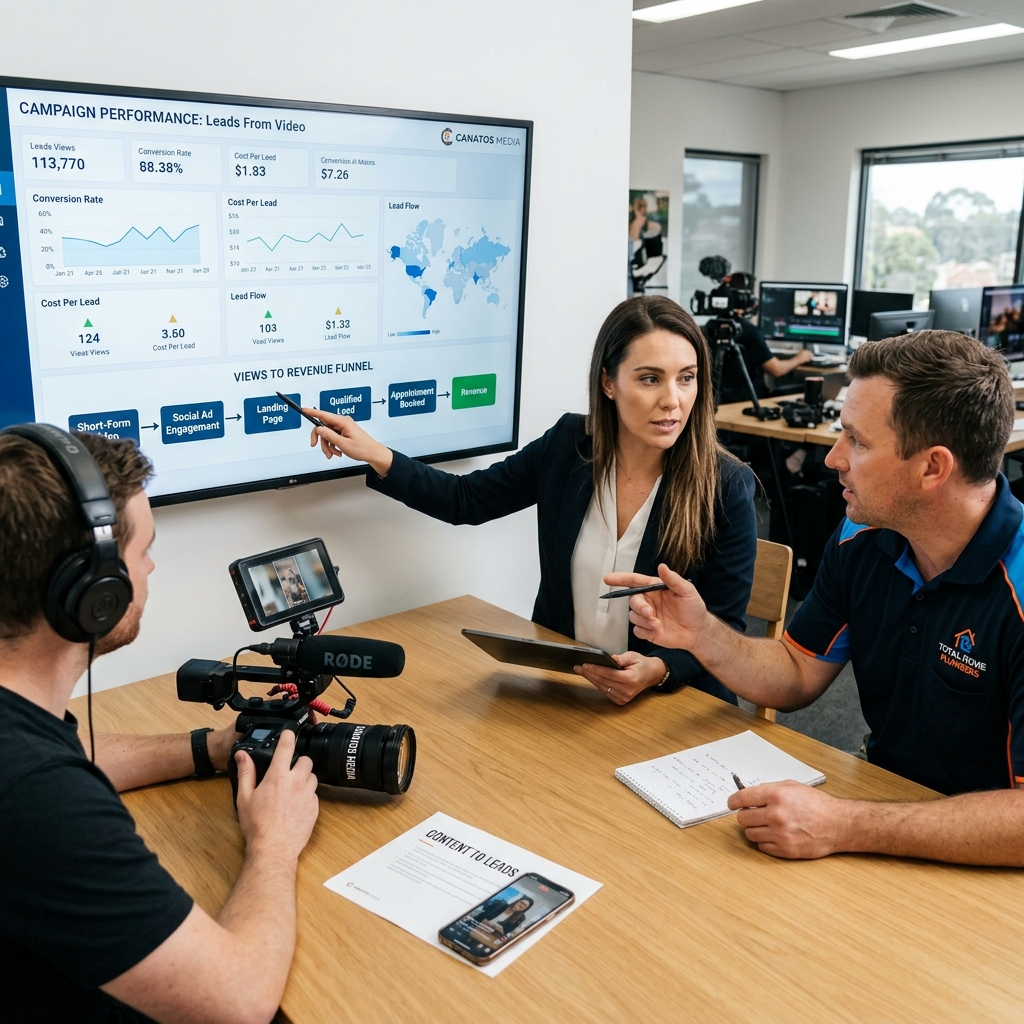
We measure video success through a revenue lens, not a viral metrics lens. That means connecting video performance to actual business outcomes.
Our baseline metrics for any video campaign include cost per lead, conversion rate from lead to customer, and customer acquisition cost by channel. We track where leads come from, which videos generate the highest-quality leads, and which audiences have the best lifetime value.
For service businesses, we also track location-specific metrics. A contractor with multiple offices can see exactly which video campaigns are driving appointments in each service area. A dental practice can measure which videos convert best for cosmetic services versus routine cleanings.
We use UTM parameters, audience tracking, and CRM integration to connect video viewership to actual revenue. If a video generates 1,000 views, 50 leads, 10 conversions, and $15,000 in revenue, we know the true ROI. Then we can confidently scale that campaign.
Monthly reporting shows not just what happened but why. Which elements worked? What can we improve? Where should we invest more? This analysis drives next month’s strategy.
Getting Started With Our Lead Generation Video Services
If your service business has plateaued despite decent social media engagement, video-first lead generation strategy is worth exploring. The gap between views and revenue typically comes from missing infrastructure, not missing content.
Start by auditing where your current video content sits in your funnel. Does it have clear calls-to-action? Does it connect to landing pages or lead forms? Does it get paid amplification? Does it retarget people who engaged but didn’t convert? Most service businesses find multiple gaps.
We recommend starting with one clear conversion objective. Choose the lead type that matters most to your business right now, then build a video content and paid strategy specifically designed to capture and convert those leads. Start small, measure carefully, then scale what works.
Let’s talk about your specific business and where video can drive the most immediate impact. We work with service businesses and multi-location brands across industries, and we’ve learned what separates video that generates views from video that generates revenue.
For further reading: Video-first marketing.
Contact us today for a free consultation to see how we can help you grow your business.
Frequently Asked Questions (FAQ)
How do you actually convert video views into leads and sales?
We combine cinematic short-form content with a complete digital ecosystem that moves viewers toward action. Our process starts with video storytelling that builds trust, then uses paid advertising to reach qualified audiences, social media management to nurture engagement, and lead capture systems to convert interest into contacts. We track everything from view metrics back to actual revenue so you see exactly which content and channels drive real business results.
What makes your approach different from just posting videos on social media?
We treat video as the entry point, not the entire strategy. Most agencies create content and hope it converts, but we layer in Meta and Google advertising to put your best videos in front of the right people, SEO and AEO optimization to ensure discoverability, and built-in lead generation systems that capture contact information. For service-based and multi-location brands, this integrated approach typically generates 3-5x more qualified leads than organic posting alone.
How do we measure whether this is actually working for our business?
We establish clear metrics before we start and track them throughout. We measure video performance (views, engagement, click-through rates), advertising efficiency (cost per lead, conversion rates), and ultimately revenue impact (which leads convert to paying customers and at what value). You’ll have access to our reporting dashboard that connects all these data points so you can see exactly how video views become revenue.