What Live Event Production Actually Is (And Why It Matters)
Live event production is the end-to-end technical and creative process of designing, building, and running a live experience — covering audio, video, lighting, staging, and rigging — so that every moment lands exactly as intended for both in-person and remote audiences.
Quick answer for corporate planners:
| What you need to know | The short version |
|---|---|
| What it covers | Audio, video, lighting, staging, rigging, and show management |
| Who it’s for | Corporate events, conferences, product launches, concerts, hybrid events |
| How it differs from event planning | Production handles technical execution; planning handles logistics and scheduling |
| Typical cost range | $25,000–$150,000 for 200–500 attendees; $250,000+ for multi-day summits |
| Recommended lead time | 3–6 months minimum; 6–12 months for complex builds |
| Biggest risk to avoid | No backup systems — the single largest driver of on-site failures |
Here’s the reality: most events fail not because of bad ideas, but because of poor technical execution. A CEO delivering a career-defining keynote shouldn’t have to wonder if the microphone will cut out. An investor summit shouldn’t look like a high school AV setup on the livestream.
The stakes are high — and the gap between a smooth show and a visible failure often comes down to whether the right production team was in place from the start.
I’m Nic Canobbio, and with over two decades overseeing live event production and media strategy at Canatos Media, I’ve seen how the right technical partner transforms a high-stakes event from stressful to seamless. In this guide, I’ll break down everything you need to know to plan, evaluate, and execute with confidence.
What Is Live Event Production?
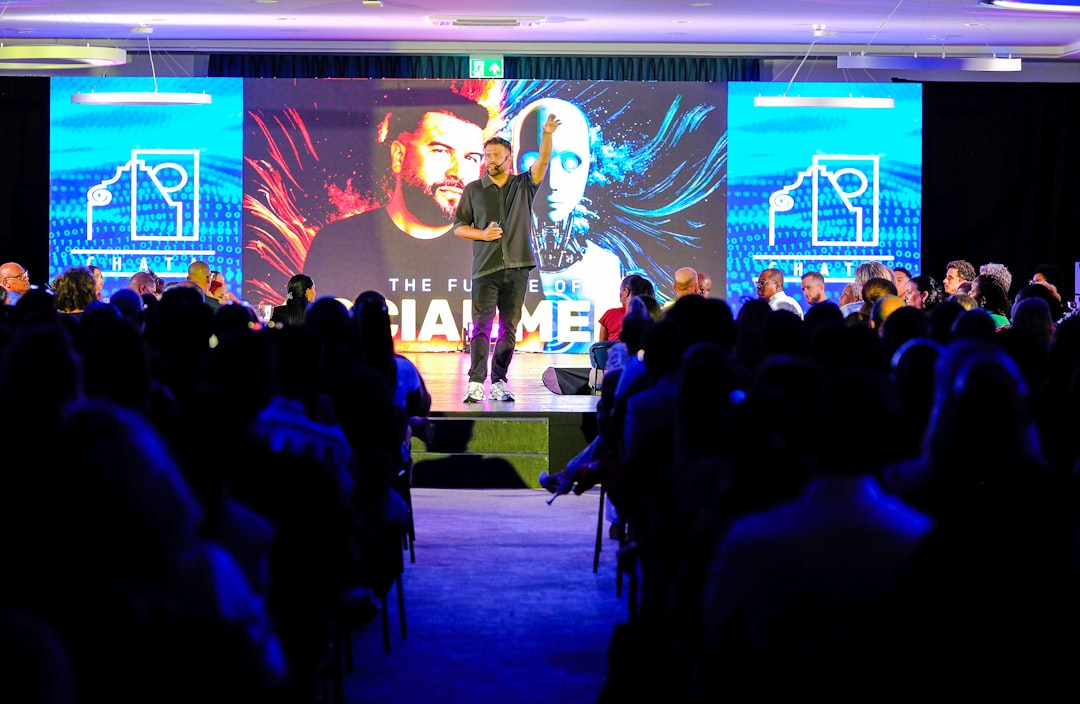
In its simplest form, live event production is the design and technical execution of a live experience. While it encompasses many moving parts, it is defined by the synchronized integration of five core disciplines: audio, video, lighting, staging, and rigging. Whether we are talking about a product launch in Manhattan or a multi-day conference on Long Island, the goal remains the same: to create an immersive environment that communicates a message with zero technical friction.
In May 2026, the definition has expanded. It’s no longer just about the people in the room; it’s about a “broadcast mindset.” This means treating every corporate event as if it were a network television show, ensuring that the 4K video feed for the remote audience is just as crisp as the LED wall for the attendees in the front row.
Live event production vs event planning vs event management
One of the most common points of confusion for businesses is where planning ends and production begins. Here is how we break it down:
- Event Planning: This is the “what” and the “when.” Planners handle the venue sourcing, catering, invitations, and overall logistics.
- Event Management: This is the “how” of the attendee experience. It involves registration, onsite flow, and managing the schedule.
- Live Event Production: This is the “technical how.” We handle the signal flow, the power requirements, the decibel levels, and the “Run of Show” (the minute-by-minute technical script).
| Responsibility | Event Planning | Event Production |
|---|---|---|
| Venue Selection | Primary Owner | Technical Site Survey |
| Budgeting | Overall Event Budget | Technical/Labor Budget |
| Content | Topic/Speaker Selection | Graphic/Video Formatting |
| Execution | Registration/Hospitality | Audio/Video/Lighting/Rigging |
Why live event production matters for high-stakes business events
For executive keynotes and high-stakes investor meetings, production is your insurance policy. High-quality production builds brand authority. Conversely, a flickering screen or a feedback loop in the audio can instantly diminish a speaker’s credibility.
In corporate events, the biggest driver of success is technical redundancy. Professional production teams build “fail-safes” into every system. If a primary video server crashes, a backup should take over in under two seconds—often without the audience or the presenter ever knowing there was a glitch.
The 5 Core Disciplines Behind Live Event Production
To understand how a show comes together, you have to look under the hood at the five pillars of the industry.

Audio: speech intelligibility, music, and broadcast mixes
In live event production, audio is the most critical element. If the video fails, you still have a speech; if the audio fails, you have an empty room. This involves more than just “turning up the volume.” It requires:
- PA Systems and Line Arrays: Specifically tuned to the acoustics of the venue.
- RF Coordination: Managing wireless frequencies so that microphones don’t pick up interference from local NYC radio stations.
- Dedicated Mixes: The “A1” (lead audio engineer) creates one mix for the room and a separate, cleaner mix for the broadcast or recording.
Video: screens, IMAG, streaming, and multi-camera capture
Video is where the “spectacle” happens. For any room with more than a few hundred people, Image Magnification (IMAG) is essential so that those in the back can see the presenter’s expressions. Modern setups often utilize 2.6mm or 2.9mm pixel pitch LED walls, which look incredibly sharp both in-person and on camera. Professional Live Event Production & Broadcast Services emphasize that signal integrity—using fiber optics instead of standard HDMI—is what separates a pro show from a hobbyist one.
Lighting: designing for the room and the camera
Lighting serves two masters: the human eye and the camera lens. A stage might look great to you, but if the “color temperature” is wrong, the speaker will look orange or ghostly on the livestream. We use a mix of “key lights” (to see the person), “fill lights” (to remove shadows), and “stage washes” to create depth and brand-consistent colors.
Staging, scenic, and rigging: the physical backbone of the show
Rigging is the most safety-critical discipline. It involve hanging thousands of pounds of gear over people’s heads. This requires structural reviews and adherence to OSHA practices. Staging and scenic work, meanwhile, involve the physical build—the branded backdrops, stage decks, and custom “scenic flats” that make the environment feel unique.

How a Corporate Production Team Executes an Event
A successful event isn’t won on the day of the show; it’s won in the weeks leading up to it.
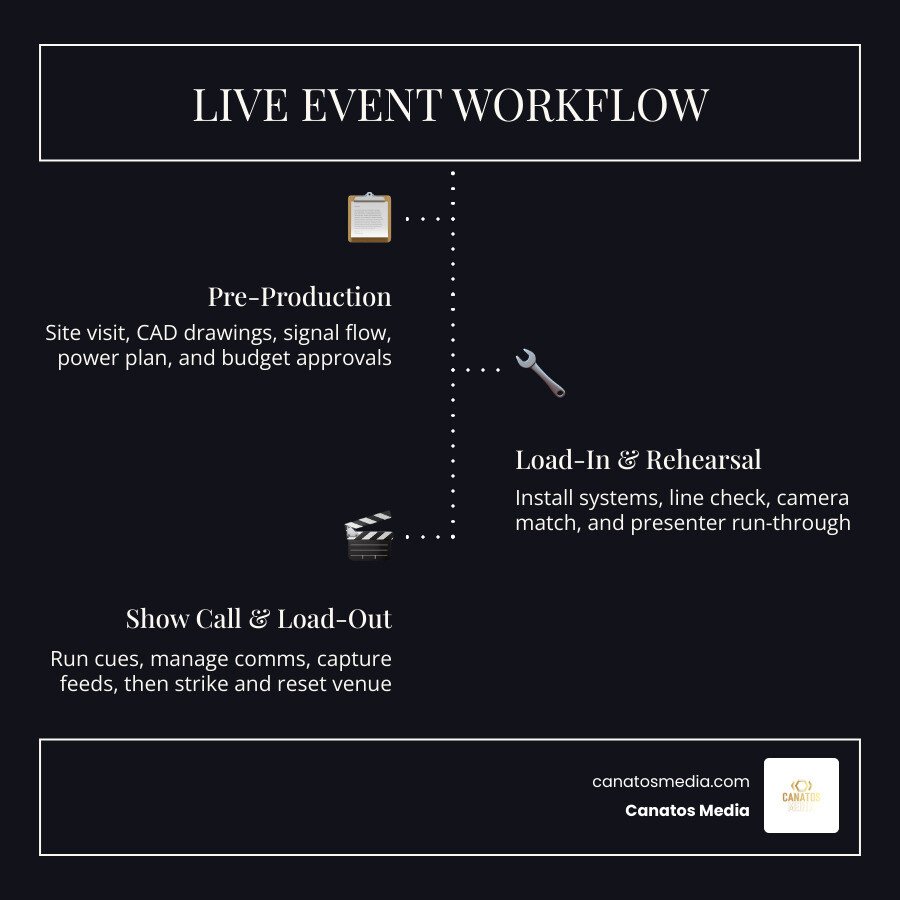
Pre-production: discovery, design, budgets, and technical planning
This phase starts with a site visit and the creation of CAD drawings. We map out every cable, power drop, and rigging point. We also establish the technical rider, which acts as the “single source of truth” for the entire installation. For a mid-sized corporate event (200–500 people), you can expect the production budget to range from $25,000 to $150,000, depending on the complexity of the LED walls and the size of the crew.
Load-in and rehearsal: building, testing, and refining the show
Load-in is the organized chaos of bringing gear off the trucks and into the room. Once the “line check” (ensuring every cable works) is done, we move to rehearsals. This is where we match camera colors and test every piece of content. Pro tip: Always schedule a full rehearsal the evening before or the morning of the event. Presenters almost always want to change something once they see their slides on a 40-foot LED wall.
Show call and load-out: running the event smoothly and striking safely
During the “show call,” the Show Caller (or Stage Manager) is the conductor. They are on a “comm” (intercom) system, telling the lighting tech when to fade, the video tech when to play the clip, and the audio tech when to open the mic. Once the event ends, the “strike” (load-out) begins. A professional crew can often dismantle a massive keynote setup in 3 to 6 hours, leaving the venue exactly as they found it.
Corporate Live Event Production vs Concert and Festival Production
While the gear might look similar, the priorities are worlds apart.
Precision vs spectacle: how goals shape technical choices
In a concert, the priority is “spectacle” and “energy.” In corporate live event production, the priority is “precision” and “messaging.” A CEO’s keynote doesn’t need strobe lights; it needs perfect framing for the camera and crystal-clear audio so that every stakeholder hears the financial results accurately.
AV rental company vs full-service production partner
This is a vital distinction.
- AV Rental Company: They drop off gear. You (or your hired help) have to figure out how to make it work together.
- Full-Service Production Partner: We provide the design, the engineering, the crew, and the accountability. We don’t just rent you a “box”; we deliver a “result.”
Questions to ask before hiring a live event production partner
When you are interviewing a potential partner, look past the sales presentation. Ask these questions:
- Do you have a specific redundancy plan for our primary video and audio feeds?
- Which of the five disciplines do you handle in-house, and which do you subcontract?
- Can you provide a case study of an event similar to ours in the Tri-State area?
- How do you handle scope changes that happen two weeks before the event?
- What is your approach to End-to-End Video Production and Ads Management for Multi-Location Brands if we need to repurpose this content later?
Technical Components, Crew Roles, Costs, and Timelines
Essential gear and crew for a high-stakes multi-camera live event production
To pull off a high-stakes broadcast, you need more than just a camera on a tripod. Essential roles include:
- Technical Director (TD): Operates the video switcher to choose which camera is “live.”
- Engineer in Charge (EIC): The “doctor” for the gear, ensuring everything stays powered and synced.
- V1 / Shader: Adjusts the color and brightness of every camera in real-time so they look identical.
- A1: The lead audio engineer responsible for the primary mix.
Typical cost ranges and recommended booking lead times
- Internal Meetings (<100 people): Often under $10,000.
- Mid-Sized Keynote (200-500 people): $25,000 to $150,000.
- Executive Summits / Multi-Camera Broadcasts: Frequently exceed $250,000.
For events over 200 people, a 3 to 6-month lead time is standard. If you need custom scenic fabrication or complex LED configurations, you should be looking at 6 to 12 months to ensure crew availability and venue coordination.
Why local venue expertise and technical redundancy are non-negotiable
In the Tri-State area and Long Island, venue expertise is everything. Knowing the loading dock height at a specific Manhattan hotel or the union labor rules at a convention center can save you thousands in “surprise” costs. Furthermore, redundancy isn’t a luxury—it’s a requirement. The Essential Guide to Hiring a Webcasting Production Company highlights that having a backup internet line and secondary encoders is the only way to guarantee a stream stays live.
How Remote and Cloud-Based Workflows Are Changing Live Event Production
The pandemic accelerated a shift toward REMI (Remote Integration Model) production. This allows a portion of the technical crew—like the graphics operator or the social media moderator—to work from a remote location via the cloud, while the cameras and essential gear remain on-site.
When remote production makes sense and where on-site teams still win
Remote production is great for cost efficiency and bringing in speakers from across the globe. However, for “mission-critical” moments—like a high-stakes product reveal—having an on-site team is still the gold standard. Local teams can react instantly to physical environment changes that a remote producer simply can’t see.
Benefits of modern hybrid and live-streaming workflows
Modern workflows offer:
- Increased Reach: Your audience is no longer limited by the fire code of the ballroom.
- Staffing Flexibility: You can hire the best “A1” in the country to mix your show remotely.
- Archive Capture: Every hybrid event is an opportunity to create Short Form Video Production content for your marketing channels.
- For more on the technical side of these setups, check out Live, hybrid and virtual event production.
Frequently Asked Questions about Live Event Production
How much does live event production cost for a corporate event?
As mentioned, budgets vary wildly. The main “drivers” of cost are the number of crew members, the size and resolution of the LED walls, and the complexity of the camera package. A multi-day event with a 20-person crew will naturally sit at the higher end of the $150k+ spectrum.
How far in advance should you book live event production?
Ideally, 6 months. This gives us time for site surveys, custom content creation, and securing the best technical talent in the region before they are booked for other shows.
What does full-service live event production include?
A full-service partner like Canatos Media handles everything from the initial creative design and technical drawings to the equipment, labor, on-site operation, and final load-out. We also provide End-to-End Video Marketing: How We Drive Real Results for Growing Businesses to ensure your event lives on long after the stage is struck.
Conclusion
Live event production is the invisible force that makes great events look effortless. Whether you are planning a gala on Long Island or a global summit in NYC, the difference between “good enough” and “world-class” lies in the details—the redundancy plans, the pixel pitch, and the experience of the crew behind the consoles.
At Canatos Media, we don’t just provide gear; we provide the peace of mind that comes with knowing your technical execution is handled by experts. If you’re ready to elevate your next event, learn more about our short-form video and production services and let’s start planning a show your audience will never forget.