Why Multi-Location Brands Struggle with Generic Landing Pages
Multi-location service businesses face a fundamental problem: a single landing page cannot serve customers across different markets effectively. When a customer in Austin searches for plumbing services, they don’t want to see generic messaging or learn about your Denver office. They want proof that you operate locally, understand local problems, and can serve them quickly.
Most multi-location brands default to a single homepage or a poorly configured location directory. This approach treats all markets as identical, which ignores critical differences in local competition, customer pain points, and search behavior. A dental practice in rural Montana operates in a completely different competitive landscape than one in suburban Chicago, yet both often use the same landing page copy.
The result: lower click-through rates from local search results, higher bounce rates when visitors land on irrelevant pages, and qualified leads slipping to competitors who invested in location-specific messaging.
The Cost of One-Size-Fits-All Web Strategies
Running a generic web strategy across multiple locations creates both direct and hidden costs. On the surface, you’re spending advertising budget to send traffic to pages that don’t convert at location-specific rates. A $5 cost-per-click becomes a $50 customer acquisition cost when your landing page fails to establish local credibility.
Beyond paid spend, you’re losing organic search visibility. Google’s algorithm prioritizes relevance and local intent matching. When someone in Phoenix searches “emergency AC repair near me,” a generic national page ranks lower than competitors with dedicated Phoenix landing pages that include local schema markup, local testimonials, and location-specific service details.
There’s also the customer experience cost: visitors who land on pages without their location information leave immediately. These are warm leads, already interested enough to click, yet you’re sending them away. That compounds over time. If you’re running campaigns across five locations and each experiences a 20% higher bounce rate due to irrelevant landing pages, you’re effectively wasting one-fifth of your ad budget.
How Location-Specific Pages Drive Higher Conversion Rates
Location-specific landing pages work because they match user intent with immediate, relevant answers. When someone lands on a page that shows their city name, mentions local neighborhoods they recognize, includes testimonials from nearby customers, and displays your address with service hours, trust builds instantly.
We’ve seen conversion rate improvements of 30-50% when service brands move from generic to location-targeted pages. A home services company might see 2% conversions on a generic “our services” page, but 3-4% on a page built specifically for each service area. That difference compounds quickly across five, ten, or twenty locations.
Location-specific pages also support higher-intent actions. Instead of a vague “contact us” form, visitors see a location-relevant call-to-action: “Schedule a free inspection in Mesa,” or “Call our Charlotte team.” They know exactly who they’re contacting and how long service typically takes in their area. This specificity reduces friction and increases qualified lead volume.
Search engines reward this relevance too. Pages optimized for local intent and keyword variations rank higher in local pack results and standard organic rankings. You’re not just converting better; you’re getting found more often.
Our Approach to Building Location-Targeted Landing Pages
We build location landing pages as a system, not as individual pages. Each location gets its own dedicated page with a consistent structure that allows for local customization without sacrificing brand cohesion.
Our process starts with a master template that defines the core structure: hero section, service overview, local social proof, location-specific details, and clear conversion elements. Within this framework, we customize:
- Headline and subheadline messaging (mentioning the city or neighborhood)
- Local imagery and video testimonials from customers in that area
- Service descriptions tailored to local market needs
- Address, phone, hours, and service radius details
- Local keyword variations in page copy and meta tags
- Structured data markup to help Google understand your local relevance
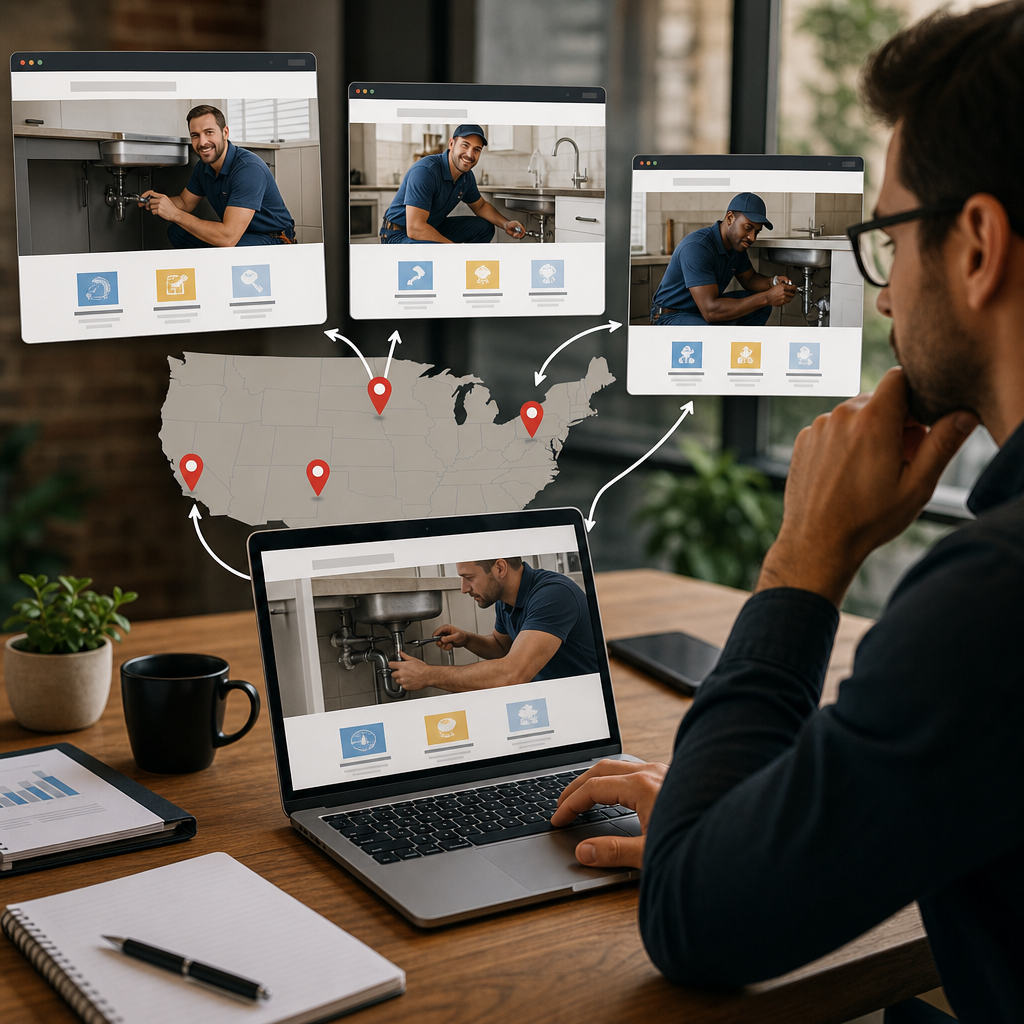
We also ensure technical consistency: consistent site architecture, proper linking between location pages and your main domain, and mobile optimization across all variations. This prevents your location pages from competing with each other or appearing as duplicate content.
The result is a scalable system where adding a new location doesn’t require rebuilding from scratch; it’s a templated process that maintains brand consistency while delivering local relevance.
Structuring Your Funnel for Local Search Intent
Your funnel must account for different customer journey stages within each location. Someone searching “best plumber in Denver” is in a research phase. Someone searching “emergency plumber near me” is ready to buy right now.
We structure location funnels in layers:
Awareness pages target broad local searches with service overviews, area coverage maps, and general information. These pages rank well and funnel interested visitors deeper.
Consideration pages address specific concerns: “How much does foundation repair cost in Denver?” or “What’s included in our spring HVAC inspection?” These pages capture visitors comparing options.
Decision pages are your location-specific landing pages designed for immediate conversion. Service area map, customer testimonials from nearby, pricing or booking forms, and clear next steps.
Each page type serves a purpose. Awareness pages build organic visibility and drive traffic. Consideration pages qualify visitors by answering their specific questions. Decision pages close the loop. Visitors may enter at any stage, but your site structure guides them toward local conversion actions.
Creating Location-Specific Ad Campaigns That Feed Your Funnels
Paid advertising becomes much more efficient when your landing pages match your ad targeting. When you run a Google Ads campaign for “plumber in Denver,” you send traffic to your Denver landing page, not your homepage or a generic services page.
We build location-specific ad campaigns that align with your landing page strategy. Each location gets its own campaign (or ad group) with:
- Location-targeted keywords and negative keywords
- Ad copy mentioning the city or service area
- Ad extensions showing the local address and phone number
- Landing pages dedicated to that location
This alignment reduces bounce rates because users see consistent messaging from click to landing. If your ad says “24-hour emergency plumbing in Nashville,” they land on a page specifically about Nashville emergency services with local numbers and testimonials. No surprise, no friction.
We also use dynamic location insertion to scale this efficiently. Instead of manually creating dozens of ad variations, you set up templates that automatically populate location names and details. This scales well across ten, fifty, or even hundreds of locations while maintaining campaign quality.
Connecting Social Media Traffic to Local Landing Pages
Social media drives awareness and consideration, but it often sends traffic to the wrong pages. A video about your service goes viral in a specific region, yet you send everyone to your homepage.
We connect social media campaigns directly to location landing pages by building social feeds based on geography. When you’re running a boosted post about your Henderson, Nevada location, the landing page destination is your Henderson landing page with local details, local social proof, and local conversion options.

This works particularly well for social media ads. A video testimonial from a Dallas customer, amplified with Dallas-targeted ads, lands visitors on your Dallas page where they see Dallas testimonials and local details. The continuity increases conversion.
We also use location-based audience targeting on Meta and Google to ensure social ads reach people in your service areas, then direct them to pages built for those areas. This prevents wasted reach and ensures budget goes toward qualified prospects.
Measuring Performance Across Your Multi-Location Network
With multiple location landing pages and campaigns, tracking performance requires a system. Without it, you can’t tell which locations drive profitable revenue and which need optimization.
We set up location-level tracking across all your funnels:
- UTM parameters tied to location landing pages so you can track conversions back to source
- Location-specific conversion goals (calls, form submissions, bookings) within Google Analytics
- Per-location campaign performance dashboards showing cost-per-lead and conversion rates
- Monthly reporting comparing location-level performance against targets
This data reveals patterns: Which locations convert highest? Which have the longest sales cycles? Which ad channels work best in each market? With this clarity, you optimize spend toward your best-performing locations and troubleshoot underperforming ones with targeted changes.
We also track leading indicators like landing page bounce rate by location, average session duration, and traffic quality. These metrics often predict conversion problems before they appear in conversion data, allowing faster fixes.
Tools and Systems We Use to Scale Geo-Targeted Funnels
Building and managing location-based landing pages at scale requires the right tech stack. We use specialized tools to keep the process efficient:
Landing page builders like Unbounce or Leadpages let us create location variations quickly while maintaining template consistency. Dynamic text replacement features automatically populate location names and details based on the visitor’s source or URL parameter.
CRM systems like HubSpot or Pipedrive track leads from location-specific sources through the sales process. This connects marketing data (which landing page they came from) to sales outcomes (did they become a customer?).
Analytics platforms give location-level visibility into user behavior and conversion performance. We configure Google Analytics 4 to track location-specific events and revenue attribution.
Ad management platforms streamline multi-location campaign creation and optimization. Google Ads Editor and Meta’s campaign management tools let us deploy location campaigns consistently across many markets.
We integrate these tools so data flows smoothly: leads captured on location landing pages sync to your CRM, Google Analytics tracks their behavior, ads platform reports on traffic source, and your team sees everything in one dashboard.
Common Mistakes Multi-Location Brands Make with Landing Pages
We see several patterns that sabotage multi-location landing page strategies. The first is creating location pages without local keyword research. You build a Denver page but optimize it for generic terms instead of Denver-specific searches. Result: the page ranks poorly because Google sees it as non-local content.

Second is inconsistent local social proof. You show customer testimonials from different states, or no local testimonials at all. Visitors have no reason to trust you locally. Include testimonials, case studies, or photos from customers in the specific location whenever possible.
Third is poor internal linking. Location pages sit isolated without links from your homepage, main services pages, or other location pages. This confuses search engines about your site structure and wastes link equity. We link location pages strategically from relevant hub pages and other location pages.
Fourth is neglecting mobile optimization on location pages. Many brands optimize their homepage for mobile but overlook location pages. Since most local searches happen on mobile, this is a critical miss. Every location page must load fast and display perfectly on small screens.
Finally, brands often fail to update location pages with current information. Address changes, new staff, updated service areas, or seasonal changes don’t get reflected. Stale pages lose trust and confuse customers. We recommend quarterly reviews of location page accuracy.
Getting Started with Your Local Funnel Strategy
Start by auditing your current location pages, if you have them. Document what exists, what’s missing, and where conversion opportunities live. Identify your top five service locations by revenue or growth potential.
Next, map your ideal funnel for one location: What do awareness-stage customers search? What do decision-stage customers need to see? Build or redesign landing pages for these two-to-three key locations as pilots.
Implement location-specific tracking so you understand current performance. Set up goals for calls, form submissions, or bookings by location. Run traffic to these pages for at least 30 days to gather baseline conversion data.
Once you have a proven template and process, expand to additional locations. At Canatos Media, we help service brands build these systems end-to-end: designing location pages, structuring campaigns, and setting up analytics. We combine location landing pages with cinematic video content and integrated ad strategies to drive qualified leads at scale.
If you’re managing multiple service areas and landing page performance feels scattered, we’d recommend starting with a location strategy audit. We can identify quick wins and outline a multi-month build plan that fits your budget and team capacity. Reach out if you’d like to discuss your specific situation.
Contact us today for a free consultation to see how we can help you grow your business.
Frequently Asked Questions (FAQ)
Why do we recommend separate landing pages for each location instead of one generic page?
We’ve found that customers searching for services in specific areas expect to see local details like their neighborhood, local testimonials, and area-specific offers. When we build individual landing pages for each location, we can match the search intent precisely, which dramatically improves conversion rates. A generic page dilutes this relevance and makes visitors uncertain whether your service actually serves their area, causing them to bounce to competitors.
How do we connect our social media video content directly to local landing pages?
We structure our video-to-funnel strategy by creating location-specific CTAs in your short-form content that direct viewers to the corresponding landing page for their area. Our paid advertising setup ensures that someone watching your cinematic brand video in Denver sees an ad that routes them to your Denver landing page, not a generic homepage. This continuity between creative and destination dramatically increases the likelihood of conversion because messaging remains consistent throughout their journey.
What metrics do we track to measure if our local landing pages are actually working?
We monitor conversion rates by location, cost per lead by service area, and which landing pages drive the highest-quality leads into your sales funnel. We also track how social traffic converts differently than paid search traffic for each location, which tells us where to allocate our production and advertising budget next. These insights help us continuously optimize which pages and locations deserve more investment.