Why Social Content Management Is the Backbone of Business Growth in 2026
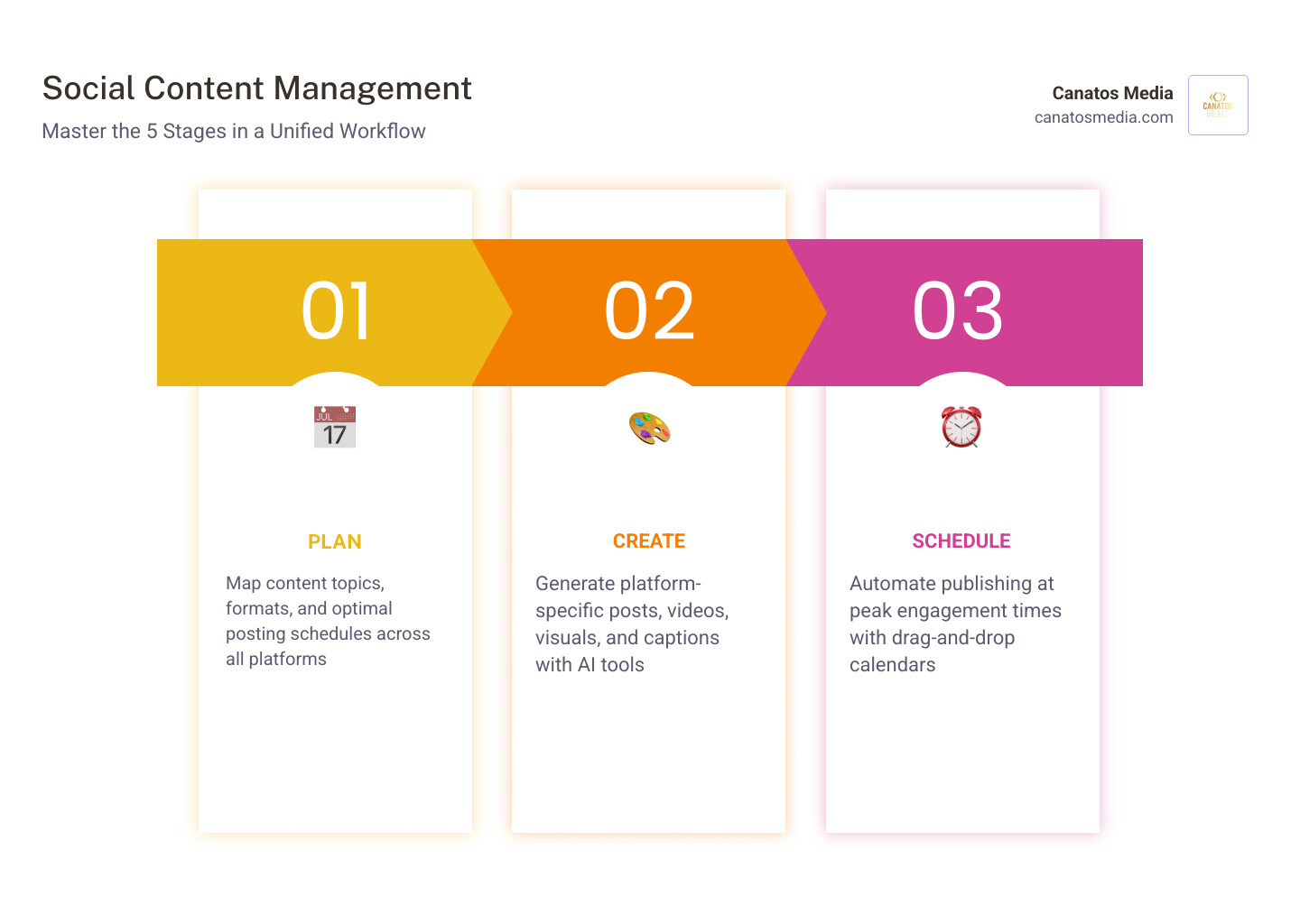
Social content management is the process of planning, creating, scheduling, publishing, and analyzing content across your social media platforms — all from a centralized workflow.
Here’s a quick breakdown of what it involves:
- Plan – Map out content topics, formats, and posting schedules
- Create – Produce platform-specific posts, videos, and visuals
- Schedule – Automate publishing at optimal times across channels
- Engage – Monitor comments, DMs, and mentions in one place
- Analyze – Track performance and tie results to real business outcomes
If you’re running a local business, you already know the problem. You’re posting on Instagram, LinkedIn, maybe TikTok — but it feels scattered. Hours disappear into copying captions, reformatting images, and pulling numbers into spreadsheets. Meanwhile, you’re not sure what’s actually driving new customers through the door.
You’re not alone. Many marketing teams describe being “buried in tabs” — manually stitching together data from five different platforms every week, with no clear picture of what’s working.
The good news? The right social content management workflow changes all of that. The best platforms in 2026 combine AI-powered content creation, automated scheduling, unified engagement tools, and ROI reporting — so you can stop guessing and start growing.
I’m Nic Canobbio, founder of Canatos Media, and my team has produced social content that’s reached over 60 million views — built on the same structured social content management systems we’ll break down in this guide. Let’s get into what actually works.
The Pillars of Effective Social Content Management in 2026
As we navigate the landscape of 2026, the complexity of social media has only increased. With the rise of niche platforms like Threads, Bluesky, and Mastodon alongside heavyweights like TikTok and LinkedIn, a “post and pray” approach is a recipe for burnout. Modern social content management requires a centralized command center that does more than just schedule posts; it must provide brand intelligence.

The core features we look for in a high-performing management platform today include:
- Unified Content Calendar: A single source of truth where you can see your entire strategy across all networks. The best tools offer list, feed, and grid views to visualize how your brand looks on every platform.
- Automated Scheduling & Optimal Timing: Gone are the days of guessing when to post. 2026 tools use historical data to identify exactly when your specific audience is most active.
- Unified Inbox: Managing DMs, comments, and mentions across five platforms is a full-time job. A unified inbox triages these conversations into one stream, ensuring no customer inquiry falls through the cracks.
- Sentiment Tracking: Understanding the “vibe” of the conversation around your brand. Are people happy, frustrated, or indifferent? Sentiment analysis helps you stay ahead of potential PR crises.
- Competitor Benchmarking: You can’t outperform the competition if you don’t know what they’re doing. Modern platforms allow you to track competitor engagement and growth rates directly alongside your own.
To truly master this, you need a Social Content Management Strategy that connects these tools to your broader business goals.
Essential AI Integrations for Content Creation
AI has moved past the “gimmick” phase and is now the engine driving efficient content production. In 2026, the best social content management tools integrate AI directly into the drafting process.
- Generative AI for Captions: AI assistants can now take a single prompt and generate platform-specific captions. It knows that a LinkedIn post needs a professional tone with clear line breaks, while a TikTok caption needs to be punchy and hashtag-heavy.
- Image Resizing and Previews: One of the biggest time-wasters is reformatting visuals. Modern tools automatically resize your images for every platform and provide a live preview so you know exactly how that Reel or Carousel will look before it goes live.
- Brand Voice Adaptation: Advanced AI now “learns” your brand voice. By analyzing your past successful posts, it can suggest edits to ensure every new piece of content sounds like you, not a robot.
Real-Time Engagement and Community Building
Engagement is the currency of social media. If you aren’t replying to your audience, the algorithm will eventually stop showing them your content. We utilize unified dashboards to handle “comment triage.” This allows us to flag high-priority messages—like a customer asking about pricing—while using 24/7 AI replies to handle common questions (like “What are your hours?”).
Crisis monitoring is another vital component. With real-time mention alerts across millions of websites and social networks, you can spot a negative trend before it spirals. In the tri-state area, where word-of-mouth travels fast, being the first to respond to a customer concern is a competitive advantage.
Overcoming API Hurdles and Streamlining Team Collaboration
Even with the best tools, we are still at the mercy of platform APIs (Application Programming Interfaces). Instagram, TikTok, and YouTube want users to stay inside their apps to see ads, so they often limit what third-party tools can do.

For example, while you can schedule most things, certain features—like selecting a specific trending audio on TikTok or adding a custom thumbnail to a YouTube Short—often still require a “manual touch” via the native app. Understanding these All-in-One Social Content and Management limitations is key to avoiding frustration.
Effective Approval Workflows for Modern Teams
If you’re an agency in New Jersey or a marketing team on Long Island, collaboration is where the wheels usually fall off. Email threads with “finalv2REALLY_FINAL.mp4″ are a nightmare.
Modern social content management platforms solve this with:
- Role-Based Permissions: Ensure only the right people can hit “publish.”
- Kanban Boards: Visualize content moving from “Idea” to “In Production” to “Approved.”
- Internal Commenting: Tag team members directly on a post draft to request a caption change or a color correction.
- Version Control: Track every change made to a post so you can revert back if needed.
Leveraging Employee Advocacy for Organic Growth
One of the most underutilized growth levers in 2026 is employee advocacy. Research shows that content shared by employees gets significantly higher engagement than content shared by brand accounts.
By using a Full-Service Social Media Management approach, you can provide your team with a library of pre-approved content. Your “ambassadors” can then share these posts to their personal LinkedIn or X profiles with one click. This decentralizes your brand strategy and can lead to engagement rate spikes—sometimes doubling the industry average.
Data-Driven Growth and ROI Reporting
If you can’t prove that social media is making you money, it’s just a hobby. For businesses in the tri-state area, every marketing dollar needs to work hard. We focus on moving beyond “vanity metrics” (likes and follows) and toward “business metrics” (conversions and revenue).
| Vanity Metric | Business ROI Metric | Why It Matters |
|---|---|---|
| Likes | Saves / Shares | Indicates high-value content that people want to revisit. |
| Total Followers | Action Rate | Shows what percentage of your audience is actually engaged. |
| Impressions | Click-Through Rate (CTR) | Measures how effective your “call to action” really is. |
| Reach | Cost Per Acquisition (CPA) | Ties social spend directly to the cost of getting a new customer. |
Leveraging AI for Social Content Management Analytics
You shouldn’t need a PhD in data science to understand your reports. AI-driven analytics now provide “Predictive Insights.” Instead of just telling you what happened last month, these tools can tell you what will happen if you keep posting the same type of content.
Automated PDF reports can be scheduled to hit your inbox every Monday morning, highlighting engagement spikes and sentiment analysis. This allows you to see the “why” behind the numbers without spending hours in a spreadsheet. Check out our guide on Advanced Social Analytics and Reporting for more on this.
Proving Impact Without a Dedicated Data Team
For smaller teams, the goal is revenue attribution. By using UTM parameters on every link you post, you can track a user from a LinkedIn post all the way to a demo request or a purchase on your website.
When you connect your social management tool to your CRM, you can see that a specific customer was acquired through social media. This kind of clarity is exactly what we teach in our Paid Social Media Advertising: From Zero to Hero in One Hour training—it’s about connecting the dots between content and cash flow.
Choosing the Right Workflow for Your Business Scale
The “best” tool depends entirely on your size and goals. A solo creator on Long Island has different needs than a global insurance provider with thousands of employees.
Optimizing Social Content Management for High-Growth Teams
Agile teams need speed. Features like bulk scheduling (uploading 100 posts at once via CSV) and RSS auto-feeds (automatically drafting a social post every time you publish a blog) are essential.
We also recommend “Evergreen Campaigns.” This is a feature that takes your best-performing content and automatically recycles it into your queue every few months. This ensures your new followers see your greatest hits without you having to lift a finger. This is a core part of an All-in-One Marketing Funnel strategy.
Affordable Solutions for Small Businesses and Creators
If you’re just starting, don’t feel pressured to buy the $500/month enterprise plan. Many platforms offer excellent free tiers that allow you to manage 3-5 profiles. Look for “per-channel pricing,” which allows you to pay only for what you use.
For beginners, a user-friendly mobile app is often more important than deep API integrations. Being able to snap a photo at a local event in New Jersey and schedule it immediately from your phone is a huge win for consistency.
Frequently Asked Questions about Social Content Management
What are the key limitations of social media management tools in 2026?
API restrictions remain the biggest hurdle. Most tools cannot post directly to personal Instagram profiles (they require a Business or Creator account). Additionally, platforms often limit video file sizes for third-party uploads, and features like “Product Tagging” or “Collab Posts” sometimes require you to finalize the post manually within the native app.
How can AI help grow social media followers?
AI helps by removing the guesswork. It analyzes millions of data points to suggest optimal timing for your specific industry and region. It also performs trend analysis, flagging topics that are about to go viral so you can create content while the “wave” is still building. Finally, AI engagement tools ensure you’re replying to followers 24/7, which signals to the algorithm that your account is active and valuable.
Which features are most important for proving social media ROI?
The “Big Three” are UTM integration, Conversion Tracking, and Automated Reporting. You need to be able to see exactly which posts led to website clicks, and which of those clicks turned into sales. Without these, you’re just measuring “noise,” not “impact.”
Conclusion
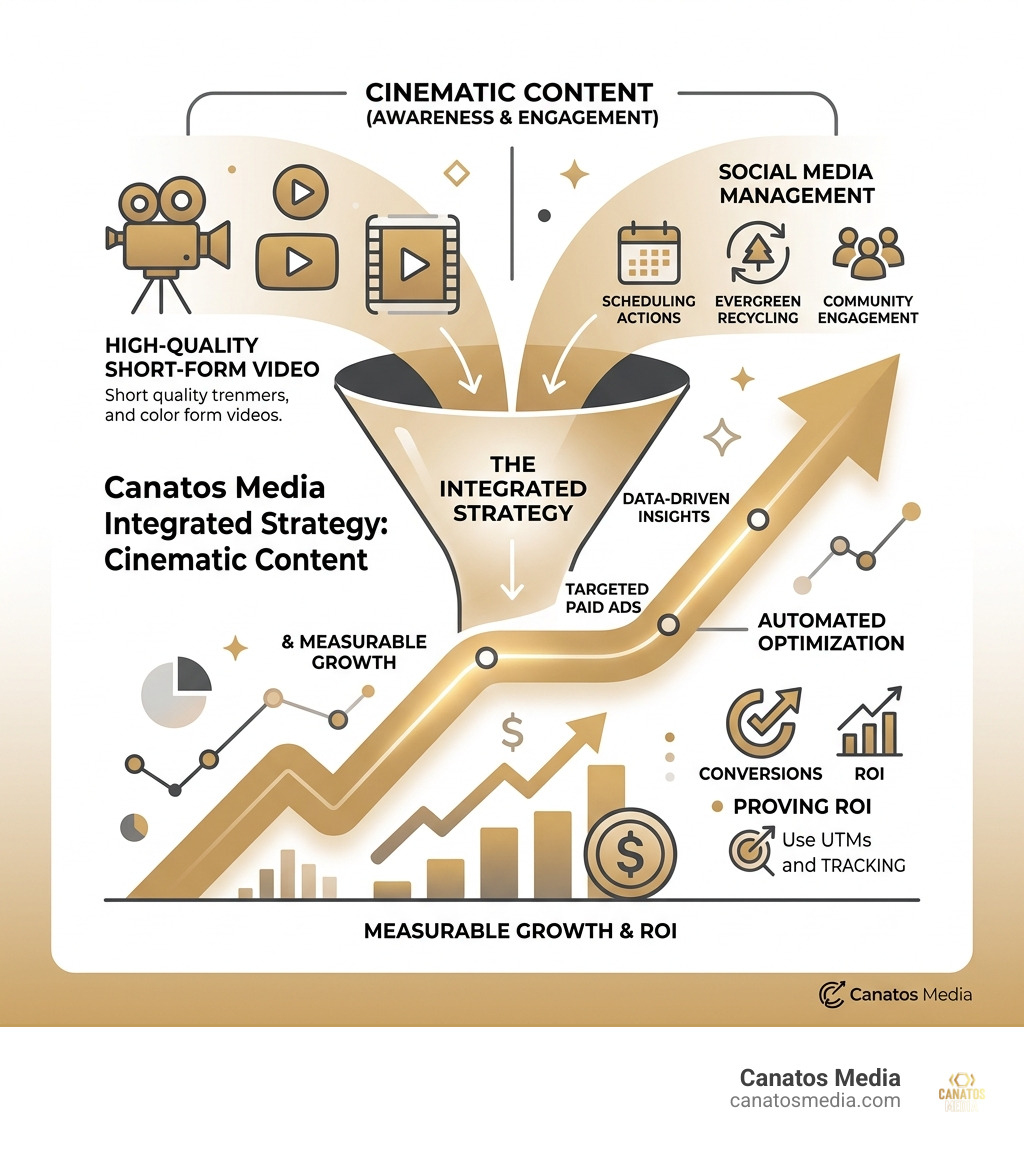
Mastering social content management in 2026 isn’t about working harder; it’s about working smarter with a centralized system. Whether you’re a local business in the tri-state area or a growing brand on Long Island, the goal is the same: move from “scattered posting” to an integrated strategy that connects content, targeting, and conversions.
At Canatos Media, we specialize in this exact intersection. We don’t just manage your social media; we create cinematic short-form videos that grab attention and run paid ads that turn that attention into measurable growth.
Ready to stop the manual grind and start seeing real results? Explore our All-in-One Social Content and Management solutions today and let’s build something that scales.