What Are Pre-Production, Production, and Post-Production?
Understanding pre production production post production is the foundation of every successful film or video project — whether you’re making a Hollywood feature or a short-form ad for your business.
Here’s a quick breakdown:
| Stage | What Happens | Typical Duration |
|---|---|---|
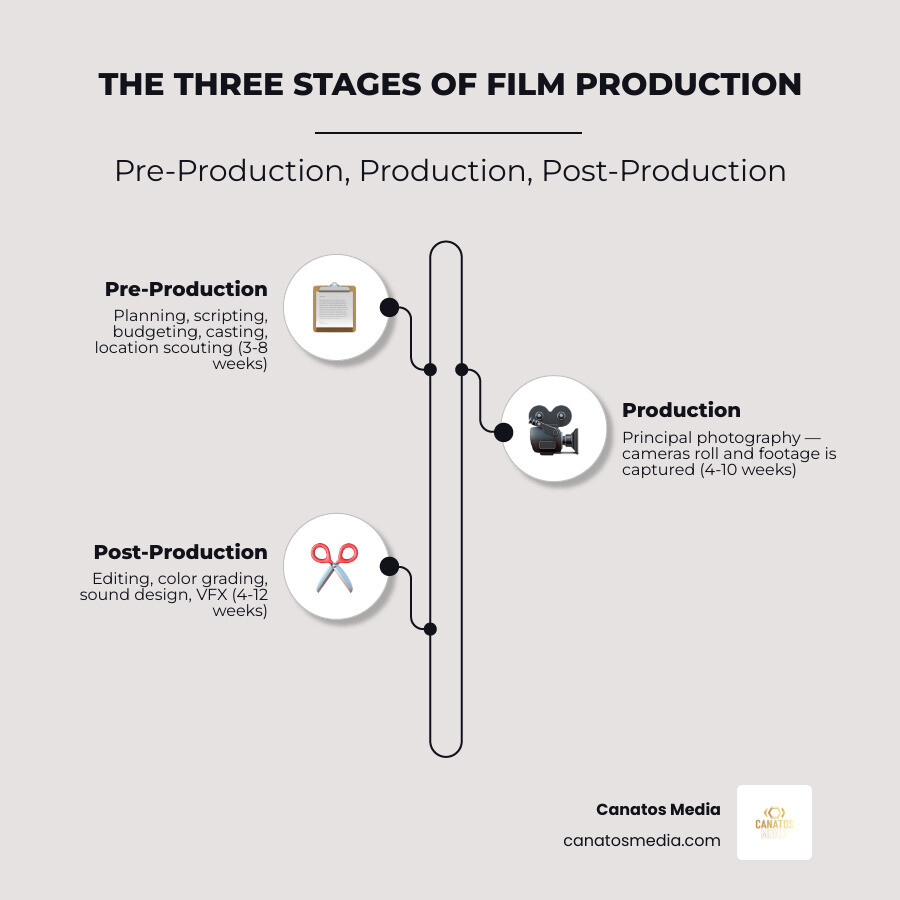
| Pre-Production | Planning, scripting, budgeting, casting, location scouting | 3-8 weeks |
| Production | Principal photography — cameras roll, footage is captured | 4-10 weeks |
| Post-Production | Editing, color grading, sound design, visual effects | 4-12 weeks |
Think of it like building a house. Pre-production is the blueprint. Production is the construction. Post-production is the finishing work that makes it livable — and beautiful.
Every stage depends on the one before it. Skip or rush any phase, and the cracks show up in the final product.
Most people think filmmaking is mostly about the shoot. It’s not. The shoot is actually the shortest part of the journey. The real work happens before the cameras roll and after they stop.
In 2026, this is true whether you’re producing a feature film or a 60-second video ad designed to convert leads for your local business. The principles don’t change — only the scale does.
I’m Nic Canobbio, founder of Canatos Media, and with over two decades of experience overseeing live production, content editing, and social media content that has reached over 60 million views, I’ve guided the full pre production production post production cycle across countless projects. In this guide, I’ll walk you through every stage so you know exactly what to expect — and how to get the most out of each one.
The Blueprint: Mastering Pre-Production
Pre-production is the planning and preparation stage where the vision for the project is solidified. It begins immediately after the “development” phase—where the initial idea is hatched and the script is finalized—and ends when the cameras are ready to roll. In the industry, we often say that for every hour spent in pre-production, you save five hours on set.
This phase is about logistics. It involves breaking down the script to identify every single requirement: how many actors do we need? What kind of locations? Is there a scene that requires a specific prop, like a vintage 1950s telephone or a high-end sports car? We tackle these questions now so we aren’t scratching our heads while a 20-person crew sits idle on the clock.
Key activities during this stage include:
- Script Breakdown: Identifying every character, prop, and location mentioned in the script.
- Budgeting: Allocating funds for crew, equipment, locations, and insurance. Pre-production typically accounts for 20-30% of a film’s total budget.
- Casting: Finding the right talent to bring the characters to life.
- Location Scouting: Finding and securing the perfect spots to film, which often involves getting permits and insurance in the Tri-State area or Long Island.
- Pre-Visualization: Creating storyboards and shot lists to map out exactly how each scene will look.
At Canatos Media, we believe that Short Form Video Production lives or dies in the planning phase. Without a clear map, you’re just capturing “content” rather than telling a story. For a deeper look at industry standards, check out The Essential Guide to Pre-Production Planning.
Why Pre-Production is Critical for Success
The primary goal of pre-production is risk mitigation. Filmmaking is expensive, and mistakes on set can lead to massive budget overruns. By planning meticulously, we ensure creative alignment between the director, the client, and the crew.
When we look at How We Scale Cinematic Short-Form Content Without Sacrificing Quality, the secret is always in the preparation. Thorough planning allows us to handle the “sprint” of production without losing sight of the brand’s goals. It prevents last-minute problems, such as showing up to a location only to realize there’s no power outlet for the lights, or hiring an actor who isn’t available for the necessary reshoot dates.
Essential Checklists and Tools
To keep things organized, we rely on several industry-standard tools and checklists. One of the most important is the storyboard, which is a frame-by-frame drawing of the script. This allows the director and cinematographer to agree on the visual style before a single light is plugged in.

Another vital tool is the shot list. This is a detailed list of every camera setup needed for a scene. We often group these shots by color or location to make the shooting day more efficient. For example, if we have three different scenes that take place in a kitchen, we’ll shoot all those “kitchen shots” at once, regardless of where they appear in the script. This is known as “shooting out” a location.
The Sprint: Navigating the Production Stage
Production, also known as principal photography, is the phase where the actual filming happens. If pre-production is the marathon of planning, production is the high-intensity sprint. For most feature films, this lasts between 4 to 10 weeks, though for a half-hour TV episode, it can be as short as 4 days.
This is the most expensive stage because you are paying for the entire crew, the talent, the equipment rentals, and the locations all at once. Every minute counts. The day usually starts with the “call sheet,” a document that tells everyone exactly where to be and when.
Executing the Pre Production Production Post Production Workflow
On a professional set, there is a very specific rhythm to the day. It usually follows a sequence:
- Block: The director and actors walk through the scene’s movement.
- Light: The crew sets up the lighting and camera while the actors go to hair and makeup.
- Rehearse: A final run-through with the full crew to ensure the camera movement matches the actors.
- Shoot: The actual recording.
The standard command sequence on set is a classic for a reason: “Sound?” (Sound mixer confirms they are recording), “Camera?” (Cinematographer confirms), “Marker!” (The slate is snapped), and finally, “Action!”
For businesses looking for Short Form Video Production, this stage is where we capture the high-quality raw footage that will eventually be polished into a final product. We always aim for multiple angles to give our editors plenty of options in the next phase.
Roles and Responsibilities on Set
A film set is a hierarchy designed for maximum efficiency. Understanding who does what is key to a smooth pre production production post production workflow:
- The Director: The creative lead who oversees the acting and visual style.
- The Producer: The “business” lead who manages the budget and schedule.
- The Assistant Director (AD): The drill sergeant of the set who keeps everyone on schedule and coordinates the different departments.
- The Cinematographer (DP): The person in charge of the camera and lighting.
- Gaffer and Grips: The lighting and rigging technicians.
- Sound Mixer: The person responsible for capturing clean dialogue.
In the Tri-State area, we work with highly specialized crews who understand that on-set logistics are just as important as creative genius. Everyone has a job, and when everyone does that job well, the production stays on track.

The Final Polish: Post-Production Processes
Once the director yells “Wrap!” on the final day of shooting, the project enters post-production. This is where the “bunch of files” we captured during production are assembled into a cohesive story. Many people think post-production is just “editing,” but it is actually a massive undertaking involving several distinct disciplines. For a deeper dive, see The Post-Production Process: A Step-by-Step Guide to the Final Cut.
Post-production can last anywhere from 4 to 12 weeks. It’s the stage where we fix the things we couldn’t control on set and add the layers of emotion—music, sound effects, and color—that make a video feel “cinematic.”
Achieving Picture Lock in Pre Production Production Post Production
The editing process typically moves through three main stages:
- The Assembly Cut: The editor puts all the “best takes” in order according to the script. It’s usually very long and lacks flow.
- The Rough Cut: The first real version of the film. The timing is tightened, and the story structure is refined.
- The Fine Cut/Picture Lock: This is the final version of the visual edit. Once we hit “Picture Lock,” no more changes are made to the timing of the shots. This is a critical milestone because it allows the sound and color departments to start their work without the “ground moving” under their feet.
Our approach to End-to-End Video Marketing ensures that the edit isn’t just “pretty”—it’s designed to drive real results for your business by keeping the viewer engaged until the final call to action.
Sound Design and Color Grading
After picture lock, the project moves into the “finishing” stages.
- Sound Design: This involves dialogue cleanup, adding “Walla” (background crowd noise), and Foley (recording sound effects like footsteps or doors slamming). It also includes the musical score and the final audio mix.
- Color Grading: This is the process of adjusting the colors to create a specific mood. Want the scene to feel cold and lonely? We’ll lean into the blues. Want it to feel like a warm summer memory? We’ll bring out the oranges and yellows.
Connecting the Dots: How the Stages Depend on Each Other
It is a mistake to view pre production production post production as three isolated boxes. They are deeply interconnected. If you have a poor script in pre-production, no amount of fancy editing in post-production can save the story. Conversely, if you capture beautiful footage but rush the sound design, the final video will feel “cheap” to the audience.
The budget often dictates where the emphasis goes. A high-concept sci-fi film might spend a massive chunk of its budget in post-production for visual effects (VFX), while a character-driven drama might put more resources into pre-production casting and rehearsals.
| Focus Area | Pre-Production Heavy | Post-Production Heavy |
|---|---|---|
| Project Type | Live Events, Interviews, Dramas | Sci-Fi, Music Videos, Animation |
| Main Goal | Accuracy and efficiency | Visual flair and “magic” |
| Risk | Lack of creative flexibility | “Fixing it in post” costs more |
For businesses, understanding these dependencies is vital. As we discuss in The Ultimate Guide to Video Marketing for Service Businesses in 2026, a balanced approach across all three stages is the most cost-effective way to produce high-quality content.
Common Pitfalls and How to Avoid Them
The most common mistake we see is “fixing it in post.” While modern software is powerful, it cannot fix a blurry image or a poorly recorded interview. It is always cheaper to do it right the first time on set than to pay a VFX artist to “clean it up” later.
Another pitfall is rushing the pre-production phase. When you don’t have a clear storyboard or shot list, you end up “searching” for the scene on set, which wastes time and exhausts the crew.
By Integrating Website Design and Video, we help businesses avoid these technical errors by ensuring the video content is planned with the final destination—your website or social media feed—in mind from day one.
Frequently Asked Questions about Pre Production Production Post Production
What is the most important stage of film production?
While every stage is vital, pre-production is arguably the most important. It is the foundation upon which everything else is built. A project with a solid plan can survive a difficult shoot, but a project with no plan will almost certainly fail, no matter how good the crew is.
How long does the average post-production phase last in 2026?
In 2026, post-production typically lasts between 4 to 12 weeks for professional projects. However, with the rise of AI-assisted editing and cloud collaboration tools, we are seeing these timelines compress for short-form content, often allowing for a “fine cut” within just a few weeks of shooting.
Can you fix production mistakes during the post-production stage?
To an extent, yes. We can use color grading to fix minor lighting issues or “digital makeup” to hide a blemish. However, you cannot fix fundamental issues like bad acting, out-of-focus shots, or distorted audio. The mantra should always be: “Get it right in the camera.”
Conclusion
The journey of pre production production post production is a meticulous progression from a simple idea to a polished, professional film. Each stage requires a different set of skills—from the logistical precision of pre-production to the high-energy execution of production and the creative artistry of post-production.
At Canatos Media, we specialize in navigating this entire lifecycle for our clients in the Tri-State area and Long Island. We don’t just “film videos”—we build integrated strategies that connect content, targeting, and conversions for measurable growth. Whether you need a cinematic short-form video for social media or a full-scale commercial production, we have the expertise to guide you through every step of the process.
Ready to bring your vision to life? Elevate your brand with professional short-form video production and let’s make something great together.