Blog

  • How to Find the Best Local Video Production Studio for Your Business

    How to Find the Best Local Video Production Studio for Your Business

    Why Local Video Production Studios Matter for Business Growth

    Video content drives business results. Brands using video see higher engagement rates, more qualified leads, and better conversion metrics across every platform. But not all video production delivers equal value.

    A local video production studio understands your market, your audience, and the specific challenges of your region. They’ve worked with businesses like yours. They know what resonates with your customer base. This local expertise combined with professional production quality creates content that actually converts, not just content that looks polished.

    For multi-location service businesses and growth-focused brands, the right video production partner becomes a core part of your marketing system. When video is integrated with your digital strategy, social media presence, and paid advertising, it becomes one of your most effective lead generation channels.

    Action: Before evaluating any video production studio, identify which 2-3 business growth metrics matter most to you (lead volume, customer acquisition cost, brand awareness, or sales revenue). This clarity guides every decision ahead.

    The Problem With Generic Video Production Agencies

    Many agencies treat video as an isolated deliverable. You hire them, they produce a video, you publish it, and the relationship ends. This creates several problems.

    Generic agencies often follow templated production processes that don’t account for your sales funnel, your audience journey, or how the content will actually perform on different platforms. A video that looks stunning on a demo reel might struggle on TikTok or Instagram Reels because the format, pacing, and messaging weren’t optimized for those specific channels.

    Cost is another issue. Agencies without local connections often inflate pricing or add unnecessary production layers. Worse, they rarely understand how to position your video within a broader marketing context. Your video exists in a system of paid ads, organic social posts, email sequences, and SEO. When video production operates in isolation, you lose the compounding effect that integrated marketing delivers.

    Action: Ask any production studio how they’ll use your video across multiple platforms and marketing channels. If they focus only on production quality and not distribution strategy, keep looking.

    What Sets Quality Video Production Apart

    Quality video production balances three elements: technical excellence, creative storytelling, and strategic purpose.

    Technical excellence means proper lighting, professional audio, smooth camera work, and color grading that matches your brand. But technical perfection alone doesn’t drive business results. A perfectly shot video about the wrong topic to the wrong audience generates zero leads.

    Creative storytelling is where your brand comes to life. It’s the difference between a product demo and a story about how your product transforms a customer’s life. The best production studios find the emotional truth in your business and make it visible.

    Strategic purpose ties both together. Your video should have a clear job to do: building brand awareness, educating prospects, nurturing leads, or driving immediate conversions. Every production decision from script to shot selection to editing pace serves that specific purpose.

    We look for clients who want all three. The investment is higher, but the business outcomes justify it. A 60-second video that generates 15 qualified leads is infinitely more valuable than a 4-minute brand film that looks incredible and drives nothing.
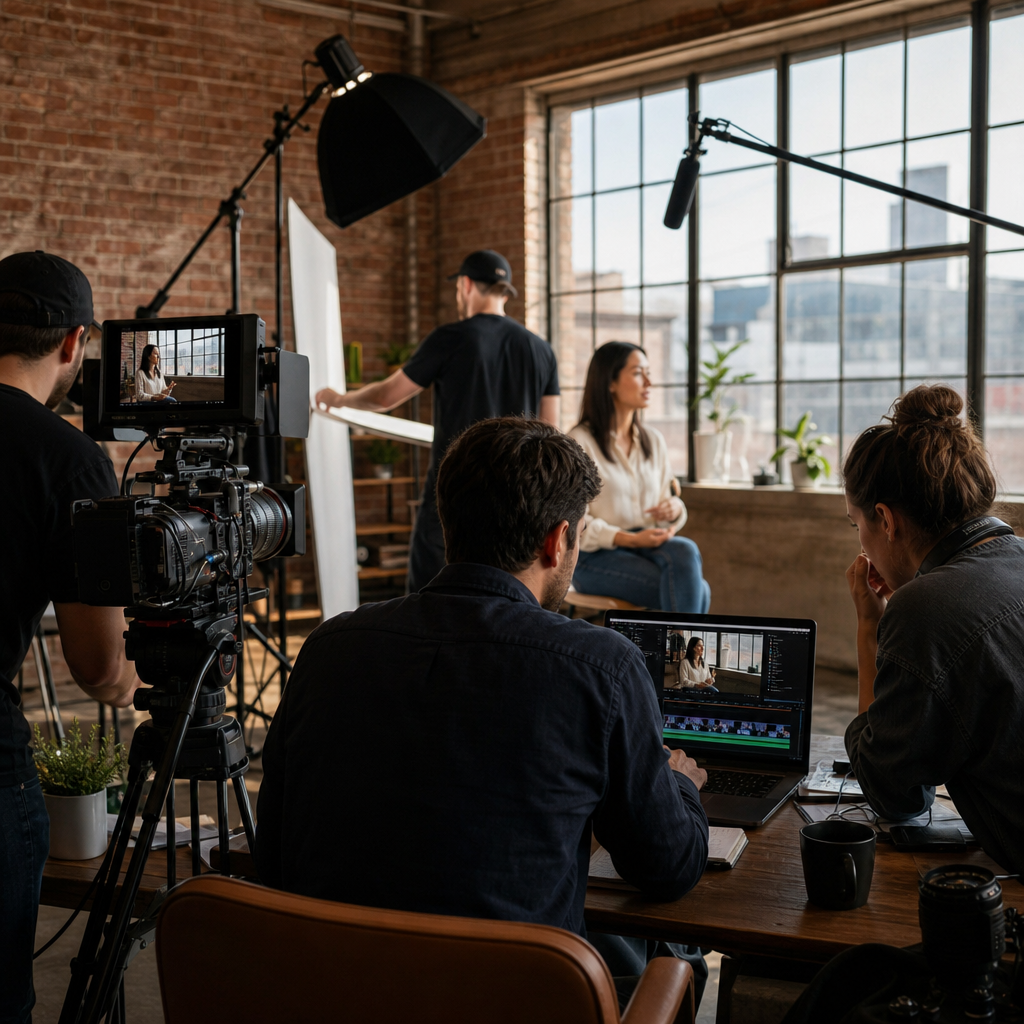
    Our Approach to Cinematic Brand Storytelling

    We combine short-form video production with full-service digital strategy. Our cinematic approach means every frame carries intention. We use professional equipment, experienced cinematographers, and creative directors who understand both visual storytelling and business metrics.

    But the real difference is how we think about your content ecosystem. We don’t create videos in isolation. We develop cinematic website videos that convert visitors into leads. We produce social content optimized for each platform’s algorithm. We create assets that feed your paid advertising, your email marketing, and your organic organic social strategy.

    This integrated approach means your video investment works harder. A single day of production becomes multiple content pieces. A hero video for your homepage generates short-form clips for social. Behind-the-scenes footage becomes educational content. Testimonials become social proof assets for ads.

    The result is better cost efficiency and better business outcomes. You’re not buying isolated videos. You’re building a content system that supports your entire customer acquisition strategy.

    How We Integrate Video with Your Digital Marketing Strategy

    Video without distribution is just art. Video with strategy becomes a growth tool.

    We integrate video into your broader digital ecosystem. This means coordinating with your social media management strategy, timing releases with paid advertising campaigns, optimizing messaging for your target audience, and measuring how video impacts your overall marketing performance.

    For example, a service-based business might launch a hero video on their website while simultaneously running short-form clips from that same shoot across Meta and Google advertising. Each piece serves a different purpose in your customer journey, but they’re all reinforcing the same core message and brand identity.

    We also consider AEO optimization (answer engine optimization) and traditional SEO when developing video content. This means creating videos that answer the actual questions your prospects are asking and ensuring those videos show up when people search for solutions.

    Action: List the 5 biggest questions your prospects ask before buying. Your next video production should answer at least one of these questions with clarity and proof.

    Lead Generation Through Strategic Video Content

    Lead generation video works differently than awareness video. It’s more direct. It addresses a specific problem and offers a clear next step.

    A lead generation video typically includes social proof (customer testimonials, results, case studies), specific details about your offer, and a clear call to action. It builds trust quickly because prospects are already considering your solution. Your job is to accelerate their decision.

    We’ve seen short-form video content (30-60 seconds) outperform longer formats for lead generation on social platforms. People scroll fast. Your hook is the first frame. Your value proposition is clear by second 5. Your call to action comes before they swipe away.

    This is where platform-specific production matters. A LinkedIn lead generation video needs different pacing and formatting than a TikTok version of the same message. We produce both from the same core shoot, ensuring consistency while respecting each platform’s unique audience and algorithm.
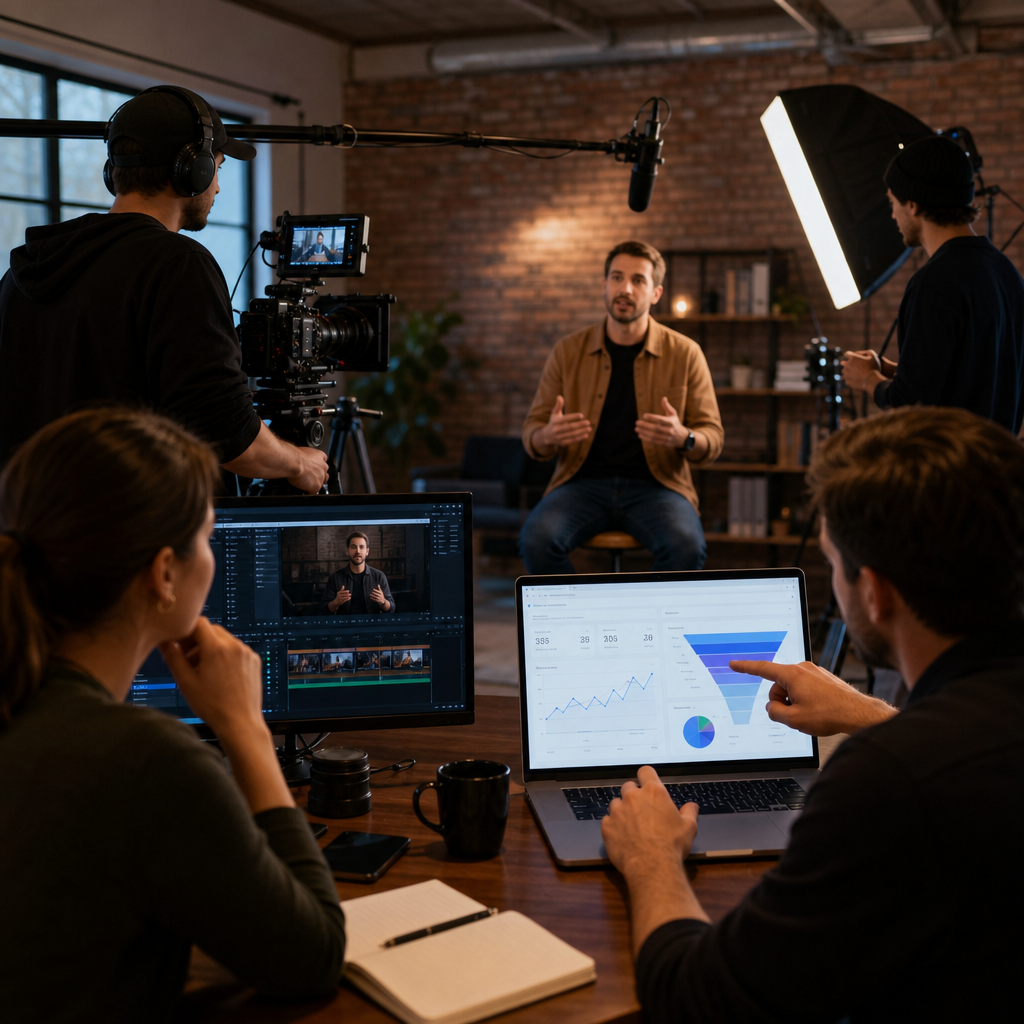
    The Process: From Concept to Launch

    Our production process starts with strategy, not equipment.

    First, we understand your business goal, your ideal customer, where they currently are in their buying journey, and what content will move them forward. This shapes everything that follows: script direction, shot lists, talent, locations, and editing style.

    Next comes pre-production: script development, location scouting, talent coordination, and shot planning. This planning phase is where quality differentiates itself. Detailed planning reduces on-set confusion, saves time, and ensures we capture the footage needed for your complete content ecosystem.

    Production day is execution. Professional crew, high-end equipment, experienced direction, and clear communication ensure we capture the content your strategy requires.

    Post-production includes editing, color grading, sound design, and motion graphics. We typically deliver multiple formats: a hero version for your website, short-form cuts for social platforms, vertical formats for mobile, and variations for paid advertising.

    Finally, we advise on distribution timing, platform selection, and integration with your broader marketing campaigns.

    Why Location Matters Less Than Capability

    You might assume a local video production studio means better pricing or faster turnarounds. Sometimes yes. More importantly, capability matters far more than geography.

    We serve clients across multiple states and time zones because our expertise transfers. We understand video production principles, digital marketing strategy, and business fundamentals. We conduct thorough discovery calls to understand your market, your customers, and your specific goals regardless of your physical location.

    Modern production logistics have changed everything. We can coordinate with your team remotely, incorporate your locations into shoots, and manage the entire process efficiently regardless of distance.

    What matters most is finding a production partner who understands your business model, has delivered results for similar companies, and thinks about video as part of your marketing system rather than as an isolated creative project.

    Measuring ROI on Your Video Production Investment

    Many businesses struggle to measure video ROI. This happens when video goals aren’t specific from the beginning.

    Define clear metrics before production begins. If your goal is lead generation, measure leads attributed to video content. If it’s brand awareness, track impressions and reach. If it’s driving website traffic, measure clicks and visitor sources. If it’s customer acquisition, track the path from video to customer.

    We typically recommend tracking:
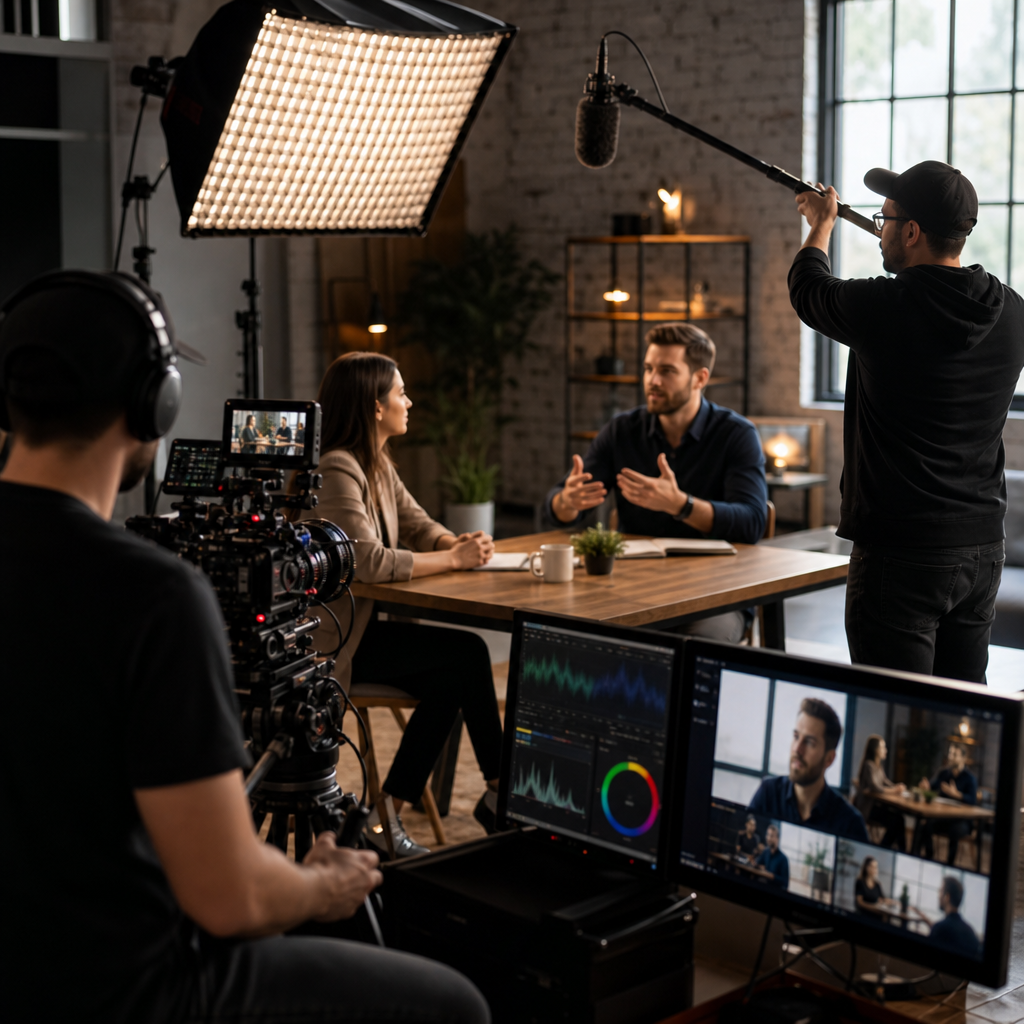
    • Video view completion rates (how far viewers watch)
    • Click-through rates on calls to action
    • Lead volume attributed to video campaigns
    • Cost per lead through video-driven traffic
    • Conversion rates from video-driven leads to customers
    • Customer lifetime value of video-attributed customers

    Some impact happens immediately. Paid video ads driving leads show results within days. Other impact is longer-term. A brand awareness video builds trust gradually and influences decisions weeks later.

    Expect initial video production to pay for itself within 3-6 months if properly distributed and integrated with your paid advertising and sales process. Ongoing production becomes increasingly efficient as you build a library of assets and refine what works.

    Getting Started with Professional Video Services

    Start by clarifying what success looks like for your business. Is it more leads? Higher customer quality? Faster sales cycles? Better brand differentiation? This clarity guides every production decision.

    Next, review case studies from production studios you’re considering. Look for results with businesses similar to yours. Ask questions about their approach, their team, and how they think about video as a business tool.

    Request a consultation. Quality production studios spend time understanding your business before quoting prices. They ask about your goals, your current marketing, your customer journey, and your growth metrics. This discovery process reveals whether they think strategically about video or just execute production.

    Finally, commit to integration. The best video production delivers maximum value when paired with ongoing social media management, paid advertising, and performance measurement. Video works hardest as part of a system.

    We’re here to help you build that system. Reach out to discuss your goals, and let’s explore how professional video production and integrated marketing can drive measurable growth for your business.

    Contact us today for a free consultation to see how we can help you grow your business.

    Frequently Asked Questions (FAQ)

    How do we measure the ROI of video content we produce for your business?

    We track performance through multiple metrics tied directly to your business goals. Our team monitors view-through rates, engagement metrics, click-through rates to your website, and most importantly, the leads and sales generated from each video campaign. We integrate our video content with our paid advertising and lead generation systems so you can see exactly how many customers came through video versus other channels.

    What’s the difference between working with us versus hiring a freelance videographer?

    We provide an integrated system where video production connects directly to your social media strategy, paid advertising campaigns, and lead generation funnels. A freelancer typically delivers finished videos without managing how those videos perform across your marketing channels or optimizing them for conversions. Our approach means we’re accountable for results, not just deliverables.

    Why does location matter less than we might think when choosing a video production partner?

    Modern production tools and our team’s expertise in cinematic storytelling can be applied to any business regardless of geography. What actually matters is whether your production partner understands your industry, your target customer, and how to create content that converts viewers into leads. We’ve worked with multi-location and service-based brands across different regions because we focus on strategy and execution quality rather than proximity.

  • How to Select a Local Growth Marketing Partner for Creative and Ads

    How to Select a Local Growth Marketing Partner for Creative and Ads

    The Challenge of Finding the Right Marketing Partner

    Choosing a local growth marketing partner feels like navigating a maze. You’ll find agencies claiming expertise in everything from TikTok to enterprise SEO, yet many lack the depth to execute effectively on any single channel. The result: scattered budgets, mixed results, and wasted months.

    The real problem isn’t the number of options available. It’s that most agencies specialize in only one piece of the puzzle. One handles paid ads but produces generic creative. Another creates beautiful content but can’t tie it to lead generation. You end up piecing together a fragmented team across multiple vendors, each charging separately and pointing fingers when performance lags.

    Multi-location and service-based business owners face a distinct challenge: their marketing needs aren’t simple. They require cohesive brand messaging across multiple channels, consistent visual storytelling, and systems that actually convert attention into qualified leads. Finding one partner who understands both the creative side and the measurable performance side is rare.

    Actionable first step: Before reaching out to any agency, list the three to five biggest gaps in your current marketing. Are you missing high-quality video content? Is your paid advertising underperforming? Do you lack a consistent social media presence? This clarity makes evaluating partners infinitely easier.

    What Sets Apart a True Growth-Focused Marketing Agency

    Growth-focused agencies operate with a single north star: measurable business outcomes. They don’t optimize for vanity metrics like follower counts or video views. Instead, they connect every creative asset, ad spend, and content piece directly to your lead generation and revenue goals.

    Here’s what separates these agencies from the rest:

    • Business acumen, not just creative talent. They ask questions about your sales cycle, customer acquisition cost, and lifetime value before proposing a strategy.
    • Data-driven creative decisions. They test video angles, messaging, and formats based on what actually converts for your audience, not what looks coolest.
    • Ownership mentality. You’re not a project number. They track KPIs alongside you and adjust tactics when something isn’t working.
    • Cross-channel integration. Video, paid ads, SEO, and social media aren’t isolated; they reinforce each other within a unified strategy.

    A true growth partner understands that creative excellence and performance metrics aren’t opposing forces. Cinematic, high-quality content performs better because it earns attention and builds trust. That attention is worthless without strategic paid amplification and lead capture systems backing it up.

    When evaluating potential partners, look for those who ask about your business model first and creative direction second. This ordering reveals where their priorities actually lie.

    Why Creative Quality Directly Impacts Your Lead Generation

    Many business owners treat creative as a nice-to-have. They budget heavily for paid ads but skimp on video or graphic design, assuming engagement and conversions will follow. This approach leaves money on the table.

    The mechanics are straightforward: poor creative gets skipped. High-quality creative stops the scroll. When someone pauses their feed to watch your video or read your message, they’re signaling openness. That’s when you have permission to speak directly to their problem and present your solution.

    Consider a service-based brand running paid ads. A generic ad showing a logo and tagline might achieve a 1% click-through rate. The same targeting and budget backing a professionally produced video demonstrating your service in action could yield a 3-4% CTR. That’s not luck. It’s the compound effect of quality creative capturing attention.

    The secondary benefit is brand trust. Cinematic production doesn’t just look better; it signals professionalism and investment. Prospective clients subconsciously think, “This company takes itself seriously enough to produce quality content. They probably deliver quality work too.” This perception shortens sales cycles and increases deal sizes.

    Short-form video production has become non-negotiable for growth brands, particularly those operating in competitive local markets. But the quality bar matters enormously. Smartphone footage edited quickly won’t achieve the same results as professionally shot and edited content.

    How Integrated Services Eliminate Agency Fragmentation

    Working with three or four separate agencies creates operational friction and strategic misalignment. Your video producer doesn’t know what messaging your paid ad agency tested. Your social media manager isn’t aware of your SEO roadmap. The result: inconsistent brand voice, wasted ad spend, and lost opportunities.

    Integrated agencies solve this by keeping all moving parts under one roof. When a video is produced, the same team that handles your ads knows how to edit it for platform optimization and audience insights. When your SEO strategy identifies high-intent keywords, your content and ad teams immediately incorporate them. When social media reveals which messages resonate, that intelligence flows into video production and paid strategy.

    This coordination compounds over time. A six-month campaign with an integrated partner generates learnings that improve month seven. With fragmented vendors, you’re perpetually starting from scratch because institutional knowledge stays siloed.

    Beyond strategy, integration simplifies operations. One point of contact. One reporting dashboard. One budget to manage. One team that understands your business deeply. These might sound like efficiency gains, but they directly translate to faster execution and better results.

    Evaluating Technical Expertise in Paid Advertising and SEO

    Paid advertising and SEO are technical disciplines that require current expertise. The platforms, algorithms, and best practices shift constantly. An agency boasting Facebook ad expertise from 2023 may be dangerously behind on Meta’s current performance marketing approach.

    When evaluating paid advertising capability, ask these specific questions:

    • What’s your typical return on ad spend (ROAS) target, and how do you approach achieving it?
    • How do you structure accounts for conversion optimization versus brand awareness?
    • What’s your process for audience targeting and testing?
    • Can you speak to recent changes in platform algorithms and how you’ve adapted?

    For SEO, the evaluation should focus on strategy beyond keyword rankings:

    • How do you approach technical SEO audits and site architecture recommendations?
    • What’s your process for content research tied to business goals?
    • Do you handle local SEO differently for multi-location brands?
    • Can you explain your approach to AI and automation in modern SEO?

    Request case studies or references showing concrete results. “We grew organic traffic” is meaningless without context. Better: “We increased organic traffic from 500 monthly sessions to 3,000 in eight months while maintaining conversion rate,” paired with documentation of the strategy applied.

    Assessing Video Production Capabilities for Your Brand

    Video production quality varies dramatically, and the difference isn’t always apparent until you see the final product. Budget matters, but so does the team’s understanding of your brand and audience.

    Evaluate based on these criteria:

    • Pre-production planning. Do they ask detailed questions about your brand, messaging, and goals before writing scripts? Or do they move straight to production? The former indicates professionalism.
    • Equipment and technical capability. Professional-grade cameras, lighting, and audio equipment are non-negotiable for commercial content. Smartphone footage has its place, but not for brand storytelling.
    • Portfolio alignment. Request samples in your industry or serving similar business models. A production company strong at food and beverage content may struggle with B2B service videos.
    • Turnaround and scalability. Can they produce content on a consistent schedule? Growing brands need repeatable systems, not one-off projects.
    • Post-production sophistication. Color grading, sound design, motion graphics, and pacing separate professional work from amateur. Request examples showing their post-production capability.

    The best partnerships involve the video team participating in strategy conversations. They understand not just how to produce well, but how to produce for performance.

    Questions to Ask Before Committing to a Partnership

    Before signing an agreement, interview potential partners thoroughly. Their answers reveal their true capabilities and whether they’re a good fit for your business.

    Ask these questions:

    • How do you set and track success metrics, and when do we review them together?
    • What does your typical onboarding process look like, and how long before we see results?
    • How do you handle reporting and communication? What’s the frequency and format?
    • If performance stalls, what’s your process for diagnosing and course-correcting?
    • Walk me through a recent project where results fell short of expectations. How did you handle it?
    • What’s your team structure, and who will be working directly on our account?
    • Do you require long-term contracts, or can we start with a shorter commitment?

    Pay attention not just to answers but to how they answer. Do they speak with confidence grounded in specifics, or do they use vague language? Do they acknowledge limitations in what they can deliver? Honest agencies will say things like, “Lead generation takes time to optimize; I’d expect meaningful results within 90 days.” Overpromisers will guarantee immediate results.

    How Our Approach Delivers Measurable Results for Multi-Location Brands

    We work with multi-location and service-based brands by building integrated systems that connect creative production, paid advertising, social media, and lead capture into a unified growth engine. Our process starts with understanding your business model deeply: customer acquisition cost targets, sales cycle length, margin requirements, and scaling goals.

    From there, we produce high-quality cinematic content that tells your brand story authentically. This content becomes the foundation for your All-in-One Marketing Funnel across paid ads, organic social, email, and your website.

    We manage Meta and Google advertising with a performance mindset, continuously testing and optimizing toward your ROAS targets. Simultaneously, we develop SEO strategies that capture high-intent local searches specific to each location. Social media isn’t just broadcasting; it’s a testing ground where we identify messaging and creative angles that resonate, then amplify those winners through paid channels.

    Reporting isn’t buried in dashboards. We track leads generated, qualified opportunity rate, customer acquisition cost, and lifetime value. You see exactly how marketing activity translates to business growth.

    The Cost of Wrong Partner Selection and How to Avoid It

    Choosing the wrong partner costs more than the contract price. There’s the cost of wasted time (typically 3-6 months before recognizing misalignment), wasted budget (creative that doesn’t perform, ads run with poor targeting), and the distraction of team leadership managing multiple vendors and conflicting advice.

    There’s also the opportunity cost. Every month partnering with an underperforming agency is a month your competitors are pulling ahead if they’ve invested in the right team.

    The most common mistakes we see:

    • Choosing based on proposal price alone rather than capability and track record.
    • Selecting agencies with impressive portfolios that don’t match your business type.
    • Assuming one platform specialist (e.g., a Facebook ads expert) can manage your full digital strategy.
    • Not asking enough questions about how they define success and measure results.

    Avoid these traps by running a thorough evaluation process. Get references. Request case studies with specifics. Have detailed conversations with the actual people who’ll work on your account, not just business development. If an agency hesitates to provide this level of transparency, that’s a red flag.

    Getting Started With Your Local Growth Marketing Strategy

    Start by clarifying what success looks like for your business over the next 12 months. Define specific targets: number of qualified leads per month, cost per acquisition, conversion rates, revenue growth. Write these down. Any agency you interview should be able to map their strategy toward these goals.

    Next, document your current marketing reality. What’s working? What’s not? Where are your biggest gaps? This inventory makes it easier to evaluate proposed solutions and identify which agency understands your actual situation versus pitching a generic playbook.

    Request strategy consultations from two to three potential partners. Not sales pitches, but genuine strategy conversations where they ask questions and propose approaches based on your specific business. Pay for these consultations if needed; it’s a small investment that yields clarity.

    Once you’ve identified a partner whose approach resonates, propose a smaller initial project or shorter contract term (3-6 months) before committing long-term. This allows you to assess their execution quality, communication, and results with limited risk.

    Growth marketing partnerships work best when both sides are aligned on goals, transparent about progress, and committed to continuous improvement. With the right local growth marketing partner, your business can accelerate significantly.

    Contact us today for a free consultation to see how we can help you grow your business.

    Frequently Asked Questions (FAQ)

    What makes Canatos Media different from hiring separate agencies for video, social media, and ads?

    We handle everything under one roof, which means your video content, social strategy, and paid advertising work together seamlessly instead of operating in silos. Our team develops your cinematic content specifically designed for the platforms and campaigns where you’re running ads, so every piece of creative directly supports your lead generation goals. You get one strategic partner accountable for your results rather than coordinating multiple vendors with conflicting priorities.

    How do we measure whether a growth marketing partnership is actually working?

    We track everything that matters to your business: lead volume, cost per lead, conversion rates, and ultimately revenue generated from our campaigns. From day one, we establish clear metrics tied to your specific goals, whether that’s filling your sales pipeline or driving direct sales across your locations. You’ll have transparent reporting so you can see exactly how our video production, social management, and advertising investments are performing against your targets.

    Can we work with multi-location service businesses, or do we specialize in specific industries?

    We specialize in service-based and multi-location brands because they have unique challenges around scaling content, managing location-specific leads, and proving ROI across different markets. Our integrated approach works particularly well for these businesses since we can create brand-consistent content while customizing messaging and targeting for each location’s local audience. If you’re managing multiple locations or service areas, our systems are built to handle that complexity efficiently.

  • Brand Awareness Marketing Campaigns: From Ghosting to Gushing

    Brand Awareness Marketing Campaigns: From Ghosting to Gushing

    Why Most Brands Stay Invisible — And What the Best Campaigns Do Differently

    Brand awareness marketing campaigns are the engine behind why you reach for one product over another — even when a cheaper option sits right next to it on the shelf.

    Here’s a quick look at what they are and why they work:

    Question Quick Answer
    What is a brand awareness campaign? A coordinated effort to make more people recognize, recall, and trust your brand
    Why does it matter? 69% of consumers prefer buying from a familiar brand over the cheapest option
    What makes a campaign work? Consistent messaging, emotional connection, and showing up where your audience already is
    How do you measure success? Social engagement, website traffic, search volume for your brand name, and brand recall surveys
    Who can run one? Any business — from Fortune 500 to a local shop with a tight budget

    Think about this: when you need a tissue, you probably ask for a Kleenex. That’s not an accident. It’s the result of decades of intentional brand awareness work. The goal of every great campaign is to own a piece of your customer’s mental real estate before they ever decide to buy.

    In May 2026, with consumer attention more fragmented than ever across streaming, short-form video, and social platforms, the brands that win aren’t always the ones with the biggest budgets. They’re the ones with the sharpest stories and the most consistent presence.

    I’m Nic Canobbio, founder of Canatos Media, and I’ve spent over two decades producing content and building media strategies — including spearheading campaigns that generated over 60 million social media views — so I know what separates brand awareness marketing campaigns that stick from the ones that disappear into the noise. Below, I’ll break down real campaigns you can actually learn from, along with the strategies and metrics that make them work.

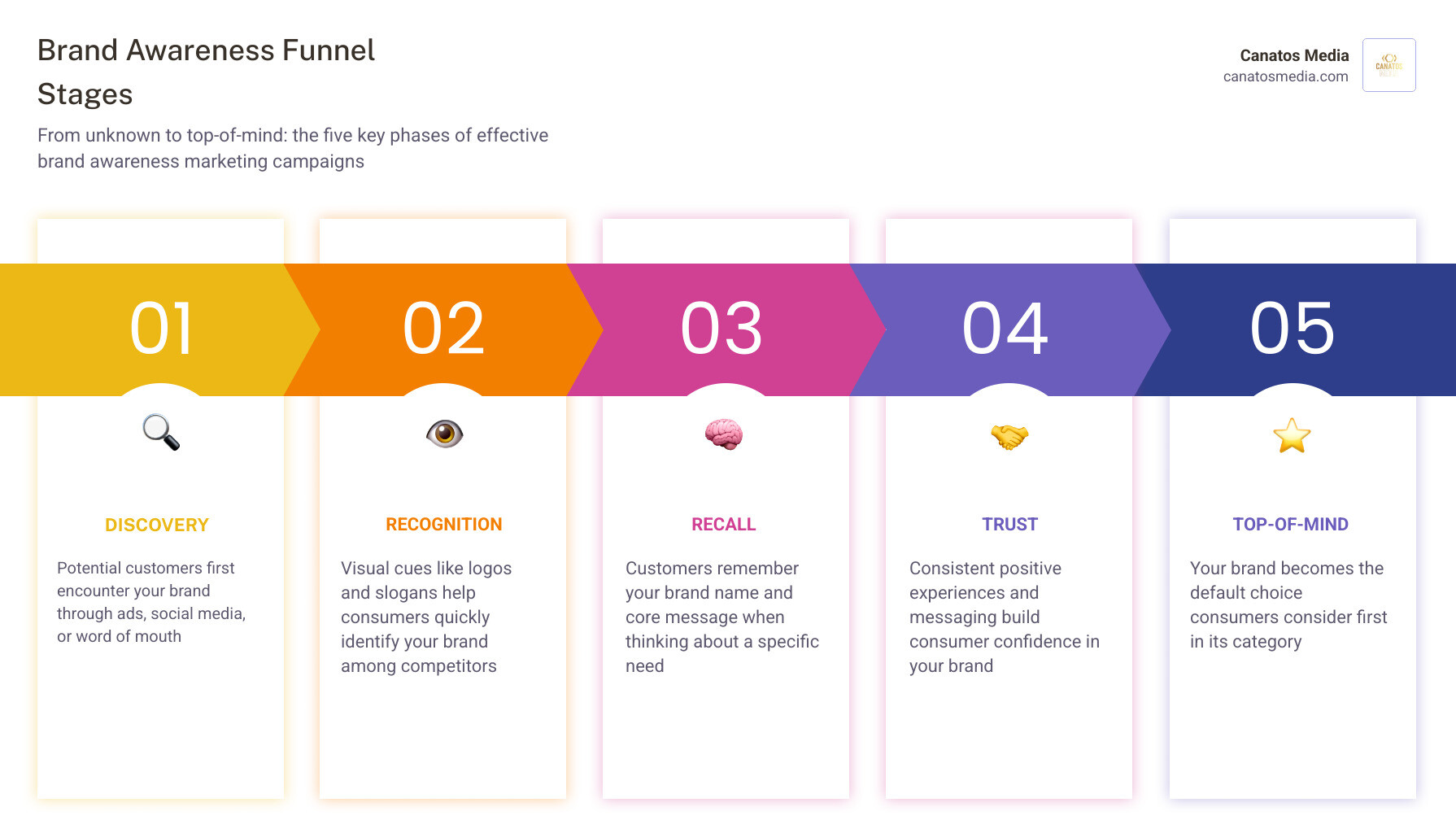
    Brand awareness funnel from unknown to top-of-mind: stages, tactics, and key metrics infographic

    Why Brand Awareness Marketing Campaigns Matter in 2026

    As we navigate the middle of 2026, the marketplace is no longer just about who has the best product; it’s about who has the best relationship with the consumer. Building brand awareness is the first step in the All-in-One Marketing Funnel, acting as the foundation for every lead generated and every sale closed.

    The growth of brand equity and its impact on premium pricing power

    Why is this so critical right now? Because brand equity — the value consumers perceive in your name alone — has reached record heights. In 2024, the world’s top 100 brands saw their aggregate value jump over 20% to a staggering $8.3 trillion. People aren’t just buying “stuff”; they are buying into identities. In fact, 79% of consumers are more likely to purchase from brands whose values align with their own.

    When brand awareness marketing campaigns succeed, they create “proprietary eponyms.” This is the holy grail of marketing where your brand name becomes the generic term for the product. Think of “Googling” a question or “Ubering” to a restaurant in Manhattan. This level of name recall allows businesses to charge premium prices. Research shows that 5 out of 10 consumers are willing to spend extra for a brand with an appealing image, even if a generic version exists for less.

    The Difference Between Recognition and Brand Awareness Marketing Campaigns

    It is common to use these terms interchangeably, but in creative digital marketing agencies, they represent two different levels of consumer psychology.

    • Brand Recognition: This is the “I’ve seen that before” phase. It relies on visual cues like your logo, your specific shade of blue, or a catchy jingle. It’s the ability of a customer on Long Island to spot your storefront or your social media ad and know it’s you.
    • Brand Awareness: This goes much deeper. It’s the “I know what they stand for” phase. It involves an emotional connection and an understanding of your brand’s attributes. While recognition is about the eyes, awareness is about the mind and heart.

    Effective brand awareness marketing campaigns bridge this gap. They take a logo and infuse it with meaning, ensuring that when a customer sees your brand, they don’t just recognize the shape — they recall your values, your quality, and how your product makes their life better.

    8 Standout Brand Awareness Marketing Campaigns to Study

    To understand how to move the needle for your own business, we have to look at the brands that are currently “winning” the attention war. These examples range from global giants to clever niche players.

    1. Heinz: “Look Familiar?”

    Heinz billboard showing a fry box that looks like their logo

    In late 2025, Heinz launched a brilliant campaign that turned every fry box in the world into a hidden billboard. They realized that the trapezoid shape of a standard French fry container perfectly matches the Heinz keystone logo. By simply pointing this out through minimalist photography, they leveraged a pre-existing consumer behavior. It didn’t feel like an ad; it felt like a discovery.

    2. Sydney Sweeney x American Eagle

    American Eagle’s collaboration with Sydney Sweeney is a masterclass in Gen Z targeting. By using a celebrity with genuine brand affinity, they saw their stock price jump 10% within 24 hours of the launch. They didn’t just post photos; they integrated AR try-on lenses and shoppable social edits, proving that modern awareness is interactive.

    3. Subaru: #MakeADogsDay

    Subaru has long aligned itself with pet lovers. Their #MakeADogsDay campaign used a “Tease, Reveal, Sustain” framework on social media to promote pet adoption. By focusing on a cause rather than a car, they achieved 100% positive sentiment and over 10 million video views, cementing their image as a brand that cares.

    4. Taco Bell: Freeing “Taco Tuesday”

    When Taco Bell challenged a long-standing trademark on the phrase “Taco Tuesday,” they turned a legal battle into a social justice movement for foodies. This campaign generated 21 billion earned media impressions. They showed that being a “challenger brand” is a powerful way to stay top-of-mind.

    5. Sheba: “Ignored to Adored”

    Cat owners know the struggle of being “ghosted” by their pets. Sheba’s campaign leaned into this relatable pain point, offering a 12-day program to win over a feline’s affection. It was funny, relatable, and perfectly positioned their product as the solution to a common emotional hurdle.

    6. CeraVe: “Face of Legs”

    Taking a cue from viral internet culture, CeraVe partnered with NBA star Kevin Durant (who had previously been teased online for having dry skin). By leaning into the joke and naming him the “Face of Legs,” CeraVe destigmatized skin care for men and expanded their awareness beyond just facial products.

    7. Spotify Wrapped

    Every December, Spotify turns its users into its marketing department. By providing personalized, shareable data stories, they create a viral loop that dominates social media for a week. This is experiential awareness at its finest — making the consumer the hero of the brand story.

    8. Dropbox: The Referral Engine

    Though an older example, Dropbox’s referral program remains a gold standard. By offering extra storage for every friend invited, they grew their customer base by 3,900%. This proves that awareness doesn’t always need a billboard; sometimes, it just needs a great incentive for word-of-mouth. At Canatos Media, we often use video marketing to amplify these kinds of referral wins for our clients.

    Strategies for Building Brand Awareness on Any Budget

    You don’t need a Super Bowl budget to make an impact. Whether you are a local business in the Tri-State area or a growing national brand, the principles of integrated marketing remain the same.

    Organic and Content-Driven Brand Awareness Marketing Campaigns

    Organic growth is about playing the long game. It’s about building authority so that when a customer is ready to buy, you are the first name they think of.

    • Content Marketing: 87% of B2B marketers say content is their top awareness driver. This includes blog posts, infographics, and short-form video.
    • SEO: If you aren’t on the first page of Google, you don’t exist to most consumers. Proper SEO ensures your brand appears when people search for solutions to their problems.
    • Social Media Engagement: Don’t just post and ghost. Interact with your followers. 49% of U.S. consumers say friends and family are their top sources of brand discovery — social media is the modern “backyard fence” where these recommendations happen.
    • Employee Ambassadors: Your team is your greatest asset. When employees share company culture and wins on their personal LinkedIn or Instagram, it humanizes the brand and expands reach exponentially.

    If organic is the slow burn, paid tactics are the gasoline.

    • Influencer Partnerships: This is no longer just for fashion brands. 61% of consumers aged 18-34 have been convinced to buy something by an influencer. The key is finding partners whose values match yours.
    • Retargeting: Ever visit a website and then see their ads everywhere? That’s retargeting. It keeps your brand top-of-mind for people who have already shown interest, preventing them from forgetting you.
    • Cinematic Video: In 2026, static images are easily ignored. We specialize in high-end video production because cinematic storytelling stops the scroll.
    • AR and 3D Billboards: For brands with larger budgets, immersive experiences like AR try-ons or 3D billboards in high-traffic areas (like Times Square) create “wow” moments that are highly shareable on social media.

    Measuring the ROI of Your Brand Awareness Efforts

    The biggest myth in marketing is that brand awareness can’t be measured. While it’s not as direct as a “Buy Now” button, we use several metrics to track growth.

    Metric Type What to Track Why it Matters
    Quantitative Website Traffic & Direct Hits Shows how many people are looking for you by name.
    Quantitative Social Reach & Mentions Measures the size of the conversation around your brand.
    Qualitative Brand Recall Surveys Asks consumers: “Which brands come to mind for [Product]?”
    Qualitative Sentiment Analysis Tracks if the conversation around your brand is positive or negative.
    Advanced New-to-Brand Metrics Amazon and other platforms now track if a sale came from a first-time customer.

    By using tools like Google Trends, social listening software, and Brand Lift studies, we can see exactly how brand awareness marketing campaigns impact the bottom line over time. We often integrate website design with video data to see how increased awareness translates into higher on-site conversion rates.

    Frequently Asked Questions about Brand Awareness

    How do you measure brand awareness success?

    We look at a combination of “hard” and “soft” data. Hard data includes increases in branded search volume (people typing your name into Google) and direct website traffic. Soft data comes from social listening and surveys that measure brand recall and sentiment.

    What is the difference between brand awareness and brand recognition?

    Recognition is purely visual — like recognizing a logo on a hat. Awareness is the deeper understanding of what the brand does, its reputation, and its values. You want recognition to get them to look, but you need awareness to get them to buy.

    Can small businesses build brand awareness with limited budgets?

    Absolutely. Small businesses can win by dominating “Local SEO” and being highly active in their specific community. Referral programs are also incredibly cost-effective. A well-placed QR code on offline marketing materials or a partnership with another local business can drive significant awareness without a massive ad spend.

    Conclusion

    In the fast-moving landscape of May 2026, brand awareness marketing campaigns are the difference between being a commodity and being a community staple. Whether you are leveraging the viral power of short-form video or the steady growth of SEO, consistency is your best friend.

    At Canatos Media, we don’t believe in marketing for the sake of “likes.” We believe in integrated strategies that connect cinematic content with precision targeting to drive measurable growth. From the Tri-State area to Long Island, we help businesses move from “invisible” to “indispensable.”

    Ready to stop ghosting your audience and start a conversation that converts? Let’s build something that sticks.

  • 7 Best Cinematic Short-Form Video Strategies for Lead Generation

    7 Best Cinematic Short-Form Video Strategies for Lead Generation

    1. Hook Your Audience in the First 3 Seconds

    Your opening frame determines everything. Viewers decide within the first second or two whether to keep watching or keep scrolling. The hook isn’t a tagline or voiceover. It’s a visual moment that creates curiosity or immediate value.

    Strong hooks typically fall into a few patterns:

    • A striking visual transition or movement that breaks the pattern of their feed
    • A problem statement that resonates instantly (“Your team is wasting 5 hours weekly on this”)
    • A result promise shown immediately (“We cut client onboarding time by 60%”)
    • A pattern interrupt like unexpected text overlays, dynamic cuts, or motion that demands attention

    Here’s the practical difference: a video that says “Learn how we help contractors” in voiceover will lose 70% of viewers before the message lands. A video that opens with before/after footage of a completed project, fast-paced and silent with bold text, stops the scroll.

    Test your opening 10 seconds independently. If someone mutes the sound, does your hook still work? If the answer is no, you haven’t hooked yet.

    Actionable takeaway: Shoot or edit at least three different opening sequences for your next video. Test each with a small paid audience segment. Track which one gets the highest watch-through rate, then apply that style to your next 5 videos.

    2. Master the Visual Language of Your Brand

    Consistency doesn’t mean repetition. It means recognizable patterns that train your audience to expect quality when they see your content in their feed.

    Visual language includes:

    • Your color palette and how it appears across cuts
    • The pacing of your cuts (slow and deliberate vs. punchy and rhythmic)
    • Specific camera movements you return to (slow push-in, parallax effects, top-down perspective)
    • Typography: font choices, text animation speed, placement on screen
    • How you treat transitions (hard cuts, fades, slide effects)
    • Your lighting signature (warm and intimate, cool and energetic, high-contrast)

    A roofing contractor’s brand might use aerial drone shots, warm golden hour lighting, and 1-2 second cuts to signal expertise and trust. A tech company might prefer quick-cut editing, blue and white palettes, and dynamic text overlays to signal innovation.

    When your audience sees that first second, they should already know it’s you. This builds brand recall without requiring logos or voiceovers.

    Document your visual language in a simple style guide: three reference videos that represent your look, the specific fonts you use, your key color hex codes, and the camera movements you prefer. This becomes your north star when creating new content or working with a production partner.

    Actionable takeaway: Pull three of your best-performing videos. Identify 2-3 visual elements they share. Make those elements non-negotiable in your next 10 videos.

    3. Build Lead-Capture Funnels Into Your Video Content

    A beautiful video that drives engagement but not leads is a beautiful waste of production budget.

    The conversion path should be designed into the video strategy, not bolted on afterward. This means understanding exactly where and how viewers will take the next step.

    Common lead-capture approaches:

    • End screens with a link to a lead form or landing page
    • Call-to-action text overlays that direct to a specific URL or DM prompt
    • Comments-based CTAs (“Reply with STRATEGY and we’ll send you our framework”)
    • Link-in-bio landing pages that change based on which video is currently performing
    • Direct messaging funnels where viewers DM a keyword or emoji

    The strongest approach depends on your platform and your audience behavior. On Instagram Reels, top-performing CTAs often ask for a DM or comment rather than clicking a link. On LinkedIn or TikTok, direct links perform differently.

    Here’s what makes the difference: your video should make the lead capture feel like the natural next step, not an interruption. If your video solves a specific problem, the CTA should be “Get the full framework we just showed you” or “See how this applies to your business.” Not “Click here for more info.”

    We embed the lead journey into the video production and scripting phase. The CTA isn’t an afterthought. The entire video is structured to make that conversion point feel inevitable.

    Actionable takeaway: Map your existing video CTAs. For the bottom 25% performers, change the CTA text, placement, or destination. Test each for two weeks before scaling.

    4. Integrate Short-Form Video Across Your Social Media Strategy

    Short-form video shouldn’t live in isolation on one platform. The best returns come from cross-platform distribution with platform-specific optimization.

    A single video asset can be repurposed across:

    • Instagram Reels (9:16 vertical, max 90 seconds)
    • TikTok (9:16 vertical, captions in-video)
    • LinkedIn (1:1 square works best, sound-on audience)
    • YouTube Shorts (9:16, leverages your YouTube SEO)
    • Facebook Reels (9:16, older demographic)

    But repurposing doesn’t mean uploading the same file everywhere. Platform algorithms reward native uploads, and each audience has different expectations.

    Instagram users expect polished, cinematic content. TikTok viewers accept a wider range of aesthetics but demand authenticity and trend participation. LinkedIn users want educational value and professional insights. Adjust your pacing, captions, and sometimes the intro based on platform.

    A video optimized for LinkedIn might have a longer hook because that audience will watch 4-5 seconds before deciding. A TikTok video needs to earn attention in 0.8 seconds.

    Coordinate your posting schedule so videos hit platforms during peak hours for your specific audience. Use consistent messaging and hashtag strategy, but vary the specific copy to match platform norms.

    Actionable takeaway: Pick your three strongest-performing videos from the last month. Reformat each for two platforms where you haven’t posted video content yet. Track reach and engagement against your current best performers.

    5. Use Data-Driven Creative to Maximize Conversions

    Cinematic doesn’t mean indulgent. Every shot, transition, and word should serve either emotional engagement or conversion metrics.

    We track metrics that most creators ignore:

    • Watch-through rate at 3 seconds, 50%, and full completion
    • Audience retention graph shape (are people leaving at specific moments?)
    • Which text overlay or visual element correlates with higher engagement
    • Conversion source tracking (which videos actually drive leads vs. which just get views)
    • Cost per lead by video type and platform

    Most businesses measure vanity metrics like total views or likes. We measure: did this video move someone closer to a sales conversation?

    This data informs every creative decision going forward. If videos with problem statements outperform result promises, you emphasize problems. If fast cuts lose viewers at the 15-second mark, you slow your pacing. If a specific visual style gets shared more, you double down on that style.

    This isn’t about data replacing creativity. It’s about using data to amplify what’s working and kill what isn’t.

    Test elements systematically: same script with three different paces, same concept with different opening visuals, same CTA with different placements. After 5-10 tests, patterns emerge. Double down on the winners.

    Actionable takeaway: Set up conversion tracking on your next five videos. Tag each video with its creative approach (problem-focused, result-focused, trend-based, educational). After they run for two weeks, compare cost per lead. Allocate next month’s budget toward the highest performers.

    6. Align Video Storytelling With Your Paid Advertising

    Short-form video content performs best when it’s part of a larger funnel, not a standalone tactic.

    Your organic videos should align thematically with your paid video campaigns. If you’re running paid ads about reducing client acquisition costs, your organic content should touch on that same pain point. This creates message consistency that compounds conversions.

    Here’s how alignment works in practice: A contractor creates organic videos showing the before/after of a renovation. Those videos build awareness and establish a cinematic brand. Simultaneously, paid video ads run that show the same project (or similar), but with a direct CTA to book a consultation. The viewer who sees the organic content first recognizes the paid ad as familiar and trustworthy. They’re more likely to click.

    The paid and organic content don’t need to be identical. But they should speak to the same transformation or benefit. This consistency builds credibility faster than isolated organic posts.

    Your production strategy should account for this. When you’re filming a project or shoot, capture content that will work both as organic storytelling and as paid ad creative. Some footage gets polished into a 2-minute narrative. Other clips become 15-second paid ads. One shoot becomes five to seven unique content assets.

    Actionable takeaway: Audit your current paid video campaigns. List the core benefit or transformation each one promises. Then check if your organic content addresses those same benefits. Fill gaps with new organic videos that prime your audience before they see your paid ads.

    7. Create Repeatable Systems for Consistent Content Production

    Consistency beats perfection. Publishing one cinematic video every month won’t move your business. Publishing one solid video weekly will compound measurably.

    The businesses that win with short-form video treat content production like a system, not a project. They develop workflows that turn one shoot into multiple videos, templates that speed up editing, and approval processes that don’t kill momentum.

    This is where many growth-focused business owners hit a wall. They create great content, then burn out trying to maintain it. The solution is systematization.

    We’ve built our short-form video production approach around this principle. We design shoots that yield 8-12 unique video assets. We develop branded editing templates. We create content calendars 6-8 weeks out. We assign roles: who shoots, who edits, who manages uploads and captions.

    A repeatable system typically includes:

    • A monthly or quarterly shoot day (vs. ad hoc filming)
    • A standardized shot list that covers multiple video concepts
    • A content calendar that ties videos to your sales cycles and audience needs
    • Templated editing workflows that reduce production time per video
    • A review and approval process that doesn’t bottleneck
    • A posting schedule that matches platform algorithms and your audience

    Without this system, you’ll produce content sporadically, miss posting deadlines, and eventually abandon the effort.

    Actionable takeaway: Schedule your next three shoot days for the next 90 days. For each shoot, define a target of how many unique videos you’ll create. Build an editing calendar backward from your posting schedule. Assign one person ownership of that calendar.

    For further reading: Short-form video production.

    Contact us today for a free consultation to see how we can help you grow your business.

    Frequently Asked Questions (FAQ)

    How do we help businesses turn short-form video views into actual leads?

    We build lead-capture systems directly into your video content by strategically placing calls-to-action, landing page links, and conversion points within each piece we create. Our approach combines compelling cinematic storytelling with proven funnel mechanics, so your audience doesn’t just watch and scroll past – they take the next step toward becoming a customer. We also integrate these videos across your paid advertising campaigns to maximize the number of qualified prospects who see your message.

    What’s the difference between how we produce short-form video versus generic content?

    We focus on cinematic quality and brand storytelling rather than quick, throwaway clips. Our team creates visually distinctive content that reflects your brand’s unique value, uses professional cinematography techniques, and tells a narrative that resonates with your specific audience. This elevated approach means your content stands out in crowded social feeds and builds genuine connection with potential customers, not just fleeting attention.

    Do we handle everything from video production to lead follow-up?

    We manage the full journey – from filming and editing your cinematic short-form videos to deploying them across social platforms, running paid campaigns, optimizing your website for conversions, and setting up systems to capture and nurture leads. Rather than juggling multiple vendors, you work with us as your single partner for video production, digital strategy, and lead generation execution.

  • X Surprising Ways to Find Engaging Video Content

    X Surprising Ways to Find Engaging Video Content

    Why Social Media Videos Are the Most Powerful Tool for Local Business Growth in 2026

    Social media videos are the fastest way for local businesses to grab attention, build trust, and turn viewers into paying customers online.

    Here’s a quick snapshot of what works in 2026:

    Goal Best Video Type Best Platform
    Brand awareness Short-form, entertaining clips TikTok, Instagram Reels
    Lead generation Tutorials, demos, testimonials YouTube, Facebook
    Sales conversion Product demos, social proof Instagram, Facebook Reels
    Community building Behind-the-scenes, UGC TikTok, Instagram Stories
    Reach new audiences Native 9:16 vertical video Instagram Reels, YouTube Shorts

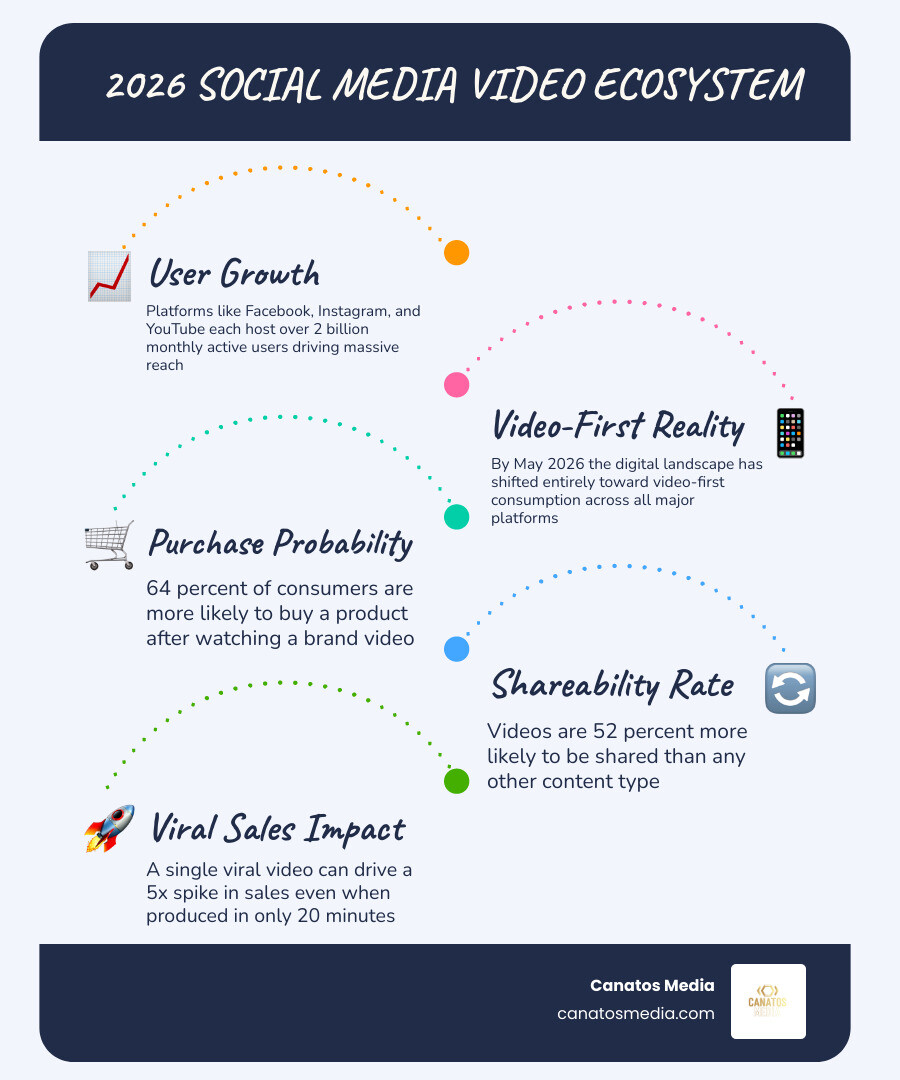
    The numbers back this up. 64% of consumers are more likely to buy a product after watching a brand’s video. People are 52% more likely to share videos than any other type of content. And a single viral video — even one made in 20 minutes — can drive a 5x spike in sales overnight.

    The challenge most local business owners face isn’t whether video works. It’s knowing where to find ideas that actually connect with their audience.

    That’s exactly what this guide covers.

    I’m Nic Canobbio, founder of Canatos Media, and I’ve spent over two decades in media production, overseeing social media videos that have collectively surpassed 60 million views. In this guide, I’ll share the surprising sources and proven strategies that consistently produce content that engages and converts.

    2026 social media video ecosystem: platforms, user stats, video types, and engagement benchmarks infographic

    The Power of Social Media Videos in 2026

    By May 2026, the digital landscape has shifted entirely toward a “video-first” reality. If you aren’t producing social media videos, you’re essentially invisible to a massive portion of the market. The statistics are staggering: Facebook now commands over 3 billion monthly users, Instagram hosts 2 billion (mostly aged 18–34), and YouTube remains a titan with 2.5 billion. Even TikTok, once the “new kid,” has solidified its place with 1.5 billion users.

    consumer purchasing a product on a mobile device after watching a video

    The real magic happens in the conversion data. We know that 64% of consumers are more likely to buy after a video touchpoint. But why? It’s because video bridges the gap between a cold brand and a trusted partner. As we’ve seen in Viral Video Marketing: 5x Sales From a Video Made in 20 Minutes, you don’t need a Hollywood budget to see a massive ROI. That case study proved that a simple, 20-minute production could result in a 5x spike in sales by simply using a familiar hook and posting consistently.

    In our work at Canatos Media, specifically within our Short-Form Video Production arm, we’ve found that the “30-second sweet spot” is the gold standard for engagement. While platforms allow longer clips, the average attention span in 2026 demands that you deliver your value proposition fast. Whether it’s driving brand awareness or a direct conversion lift, your video must earn every second of the viewer’s time.

    Surprising Sources for High-Engagement Content

    Where do the best ideas come from? Often, they are hiding in plain sight. High-engagement social media videos rarely come from a corporate boardroom; they come from real-life interactions and raw storytelling.

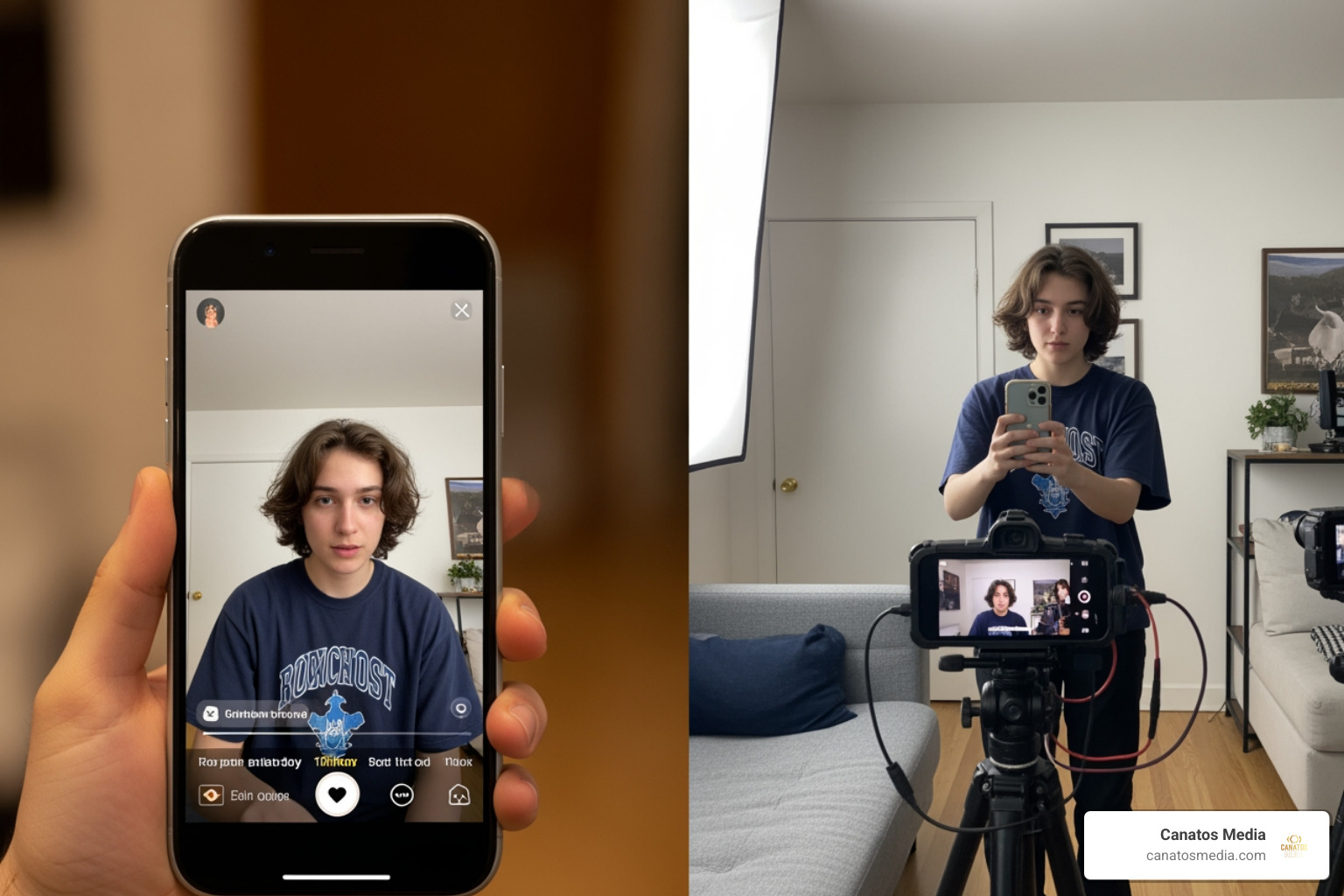
    split-screen showing a viral TikTok and a behind-the-scenes clip

    Take, for example, the concept of authenticity. In a world of AI-generated perfection, “real” wins. We saw this with Senator John Kennedy’s TikTok success, where his secret to going viral was simply being himself and avoiding the “typical politician” persona. People can smell inauthenticity from a mile away.

    Another incredible source of content is the “Human Connection” angle. A viral DoorDash friendship story showed how a simple interaction between a driver and a customer in a time of need could capture the hearts of millions. For your business, this translates to:

    • Employee Spotlights: Show the people behind the product.
    • Customer Testimonials: Let your happy clients do the selling.
    • User-Generated Content (UGC): Encourage your fans to post their own videos.

    Once you have these stories, you need to know Where to Post Your Vertical Masterpieces to ensure they reach the right eyes.

    For businesses in the tri-state area and Long Island, hyper-local content is a superpower. People love seeing their own backyard on screen. We’ve seen Long Island barbers TikTok trend by tapping into the style and energy of the new generation of customers right here in our community.

    Similarly, the Discover Long Island campaign successfully used video series to highlight local pride. When you tap into local landmarks, tri-state weather patterns, or regional humor, your social media videos feel like a conversation with a neighbor rather than an ad from a stranger. If you’re struggling to capture this professional yet local feel, our Social media video services are designed to bridge that gap.

    Mastering Technical Specs and Creative Archetypes

    To win in 2026, your videos must look “native.” This means they shouldn’t look like a TV commercial slapped onto a phone screen. They need to fit the aesthetic of the platform.

    The Technical Essentials

    According to the Meta Reels Ads Guide 2026, the standard for excellence is:

    • Resolution: 1080×1920 pixels (9:16 aspect ratio).
    • Safe Zones: Keep your text 250px from the top and 320px from the bottom to avoid being covered by UI elements like the “Like” button or caption.
    • Audio: Reels and TikTok are “sound-on” environments. Use trending audio or clear voiceovers.

    The Three Winning Archetypes

    1. The Pattern-Interrupt Hook: An unexpected visual or sound in the first 2 seconds that stops the thumb-scroll.
    2. The Demonstration Cut: Showing the product in action immediately—no long intros.
    3. The Social Proof Narrative: A real person talking about a real result.

    We’ve mastered How to Scale Cinematic Short-Form Content Without Sacrificing Quality by applying these archetypes across every campaign we run.

    Feature Instagram Reels YouTube Shorts TikTok
    Max Length 90 Seconds 60 Seconds 10 Minutes (but keep it short!)
    Aspect Ratio 9:16 9:16 9:16
    Key Metric Hold Rate View-through Rate Completion Rate

    Optimizing Social Media Videos for Maximum Reach

    Optimization isn’t just about the video itself; it’s about the data. We look at Hook Rate (what % of people stayed past 3 seconds) and Hold Rate (what % finished the video). If your hook rate is below 20%, Meta will actually charge you more for impressions because the algorithm thinks your content is boring.

    To combat this, we use open captions (subtitles burned into the video) and ensure we are following an audio-on strategy. Knowing How to Scale Short-Form Ad Creative Across Meta and Google Ads allows us to take a single high-performing video and turn it into a lead-generation machine across multiple platforms.

    Measuring Success and Scaling Your Strategy

    How do you know if your social media videos are actually making money? You have to look beyond “likes.”

    At Canatos Media, we focus on:

    • CPM Efficiency: Reels CPM is typically 20-40% lower than standard Feed ads.
    • ROAS (Return on Ad Spend): Are the videos driving sales?
    • ThruPlay: Measuring how many people watched at least 15 seconds.

    Tracking these metrics is vital, and we’ve outlined the process in our guide on the Top 7 Ways to Measure Short-Form Video ROI and Maximize Content Performance.

    For many businesses, the jump from “posting occasionally” to “scaling for growth” is where things get difficult. This is Why Agencies Outperform Freelance Marketplaces; an integrated strategy ensures that your creative, your targeting, and your website are all working together. For a deeper dive into how this applies to your specific industry, check out The Ultimate Guide to Video Marketing for Service Businesses in 2026.

    Frequently Asked Questions about Social Media Videos

    What is the ideal length for social media videos in 2026?

    While platforms allow for longer content, the most effective social media videos for engagement and ads are between 15 and 30 seconds. If you go over 45 seconds, you must have an incredibly strong narrative to maintain your hold rate.

    How do I make my videos look native to the platform?

    Shoot on a smartphone in vertical (9:16) mode. Avoid high-gloss, over-produced commercial vibes. Use the platform’s native fonts for captions and lean into “raw” storytelling. Research shows that creative adapted from horizontal formats underperforms native vertical content by 15-25%.

    Which metrics matter most for video performance?

    Focus on Hook Rate (the first 3 seconds) and Hold Rate (completion). If people aren’t stopping, your hook is weak. If they stop but don’t finish, your middle section is dragging. High performance in these two areas leads to lower CPMs and better ROAS.

    Conclusion

    The era of “maybe we should try video” is over. In 2026, social media videos are the heartbeat of digital marketing, especially for businesses in the tri-state area and Long Island. By sourcing authentic stories, adhering to technical best practices, and measuring what actually moves the needle, you can transform your social presence into a predictable growth engine.

    At Canatos Media, we specialize in this integrated approach. We don’t just make “pretty” videos; we create cinematic, high-converting content that fits into a larger strategy of SEO, paid ads, and brand management. If you’re ready to scale your brand with professional Short-Form Video Production, we’re here to help you lead the way.

  • Multi-Location Social Content Strategy: Driving Local Growth with Global Brand Consistency

    Multi-Location Social Content Strategy: Driving Local Growth with Global Brand Consistency

    Why Multi-Location Brands Struggle With Social Content Consistency

    When you operate across multiple locations, your social media presence becomes exponentially more complex. Each branch needs to feel authentically local while reinforcing a cohesive brand identity. The challenge isn’t just creating good content—it’s creating the right content, at the right time, for each market while staying aligned with your company’s core message.

    We work with multi-location service businesses and franchise owners who face this exact tension daily. The gap between corporate guidelines and local relevance is where most strategies fall apart. This guide walks you through building a system that works.

    The root problem is structural. Corporate sends down brand guidelines. Local teams send up requests for location-specific content. Marketing departments lose visibility into what’s actually being posted. Six months later, your brand looks fragmented across platforms.

    Most multi-location brands attempt one of three flawed approaches:

    Complete corporate control. Headquarters creates all content, posts the same thing everywhere. Result: Nothing resonates locally, engagement flatlines, and local teams feel ignored.

    Total local autonomy. Each location manages its own social accounts. Result: Brand messaging splinters, quality varies wildly, and you lose the amplification power of a unified voice.

    Hybrid chaos. Some content is centralized, some is local, but there’s no clear framework. Result: Inconsistent posting schedules, duplicate efforts, and wasted budget on ads that don’t align with location strategy.

    The real issue is that these approaches treat consistency and local relevance as opposing forces. They’re not. The solution requires a system, not just guidelines.

    The Cost of Disconnected Social Strategies Across Locations

    When social strategies aren’t coordinated across locations, the financial impact compounds quickly.

    Each disconnected location is essentially running its own small marketing operation. That means duplicated tool subscriptions, wasted ad spend on untested creative, and content teams reinventing wheels instead of building on proven concepts. A 10-location business running independent social strategies often spends 3-4x what a centralized system would cost.

    More critically, you lose audience velocity. If location A builds a 5,000-follower audience and location B independently builds another 5,000, those audiences never interact. In a unified system, that’s 10,000 people who see your message multiple times, creating network effects that multiply engagement and referrals.

    Inconsistent messaging also erodes trust. When customers see your brand messaging shift between locations—different tone, different visual style, different value proposition—they question which version is the “real” brand. This hesitation kills conversions.

    Ad spend inefficiency is another silent killer. Without a centralized content library and performance data, each location wastes budget testing basics that another location already solved. One location discovers that customer testimonials convert 3x better than promotional offers, but that insight never reaches the other nine locations. Every location reruns the same expensive experiments.

    Actionable takeaway: Audit your current social spend across all locations for the past three months. Calculate what percentage goes to successfully converting content versus learning-phase content that underperforms. That gap is your disconnection cost.

    How Cinematic Short-Form Video Creates Unified Brand Identity

    Video is the most efficient tool for encoding your brand identity into content. A 15-second professionally produced video tells your story faster and more reliably than paragraphs of text or static images.

    We’ve found that cinematic short-form content—video with professional production values, intentional pacing, and clear narrative structure—works as a universal translator between corporate brand standards and local relevance. Here’s why:

    A cinematic brand story is recognizable instantly. Your color grade, music, pacing, and narrator voice become signatures. When someone sees your content in their feed, they know it’s you before they process the message. This builds brand recall across markets far faster than inconsistent local content can.

    Short-form video also solves the local-versus-corporate tension elegantly. You can film 50 individual location testimonials using the same crew, equipment, and post-production style. Each testimonial is authentic and local. But they’re all visually and sonically identical, so they reinforce the same brand identity. Post them across different locations and they create a unified brand presence that feels both local and established.

    This approach works because viewers process visual consistency differently than they process message variation. People expect local differences in what you’re saying—different local teams, different customer stories. They expect visual consistency in how you’re saying it.

    Our short-form video production approach is built specifically to solve this. We create templates and workflows that let you produce dozens of location-specific videos while maintaining a unified brand aesthetic.

    Our Integrated Approach to Location-Based Content Production

    The system we’ve built starts with centralized creative direction and decentralized content creation.

    Here’s the framework:

    Content Planning Layer. Corporate defines quarterly themes, key messages, and campaign timelines. This gives every location direction without micromanaging. One quarter might focus on “customer success stories.” Another focuses on “seasonal promotions.” This prevents chaos while leaving room for local interpretation.

    Production Template System. Rather than building each video from scratch, we create reusable templates. A “customer testimonial” template specifies shot sequences, music, color grade, and pacing. Your location teams (or your crew) then film locally using that template. The output is identical in style but locally relevant in content.

    Distributed Asset Library. All produced content lives in a central, searchable library organized by location, content type, and performance metrics. This prevents duplication and lets faster-moving locations borrow winning concepts from slower ones.

    Approval Workflow. Before posting, all content routes through a quick approval layer that checks brand alignment without creating bottlenecks. This takes hours, not weeks.

    The result is content that gets posted consistently, on schedule, with local relevance and global brand coherence.

    Social Media Management That Scales Across Multiple Locations

    Scaling social media management across multiple locations requires removing three failure points: scheduling inconsistency, message fragmentation, and audience abandonment.

    Our all-in-one content engine handles this through centralized management with location-specific customization. Here’s what that looks like in practice:

    One central calendar shows all posting across all platforms and all locations. Managers see exactly what’s going live where and when. This prevents the common scenario where location A posts the same campaign content on Tuesday that location B posted on Friday, creating duplicate visibility instead of amplified reach.

    Content can be posted identically across locations or customized per location with a single template. That testimonial video? Post it everywhere. That seasonal promotion? Customize the location details but keep the creative identical.

    Engagement and community management happens locally but with centralized tracking. Your location teams respond to comments in real time, which builds genuine local relationships. But corporate sees aggregate engagement metrics and can identify which locations are winning and why.

    This structure requires the right tools and clear processes. Without them, you get inconsistency. With them, you get a unified social presence that feels both local and professional.

    Paid social advertising is where most multi-location strategies collapse. You’ve either got locations running ads independently (wasteful) or you’ve got corporate running ads for all locations (ineffective).

    The solution is a hybrid approach with centralized creative testing and location-level campaign management.

    Here’s the structure: Corporate (or your agency partner) identifies the top 5-7 highest-performing creative concepts. These get tested at scale against broad audience targets. Winning creative is documented.

    Then each location manager or regional operator runs location-specific campaigns using those proven creative concepts. Location A targets Denver metro customers. Location B targets Denver suburbs. Both use the same creative because it’s proven, but they segment audiences based on local geography and intent.

    This approach reduces ad testing waste while preserving local campaign control. You’re not testing 10 different creative directions per location. You’re testing 5-7 concepts once and deploying 10 times. The math is dramatically different.

    Budget allocation across locations should be performance-based, not equal. If location A consistently converts at 30% lower cost than location B, location A gets a bigger budget share. This creates natural incentives for locations to improve their conversion mechanics, and you’re not funding underperformance indefinitely.

    Building Local Authority While Maintaining Global Brand Voice

    Local authority comes from being present and relevant in your specific market. Global brand voice comes from consistency in how you communicate. These reinforce each other when done right.

    The key is separating voice from vocabulary. Your global brand voice is the underlying tone, values, and perspective. Your vocabulary is the specific words, references, and local details you use.

    For a multi-location fitness brand, the global voice might be “motivational but realistic about the work required.” The vocabulary changes per location: Denver location references high-altitude training. Phoenix location references desert heat resilience. Same voice, different dialect.

    This distinction lets you build genuine local authority without creating brand fragmentation. You sound like yourself in every market while speaking to each market’s specific context.

    Social content that anchors local authority includes location-specific staff spotlights, community partnership announcements, and location-relevant current events. These feel local because they are. They reinforce your brand voice because they’re created with centralized direction.

    Lead Generation Systems That Connect Content to Revenue

    Content without a lead generation system is just entertainment. We bridge this gap by treating content as the top of a lead funnel, not as a standalone asset.

    Every social content piece has a purpose in the funnel. Some content is pure awareness (brand story videos). Some is consideration (process explainers, customer results). Some is decision-stage (testimonials, pricing breakdowns). Mapping your content to funnel stage ensures your social strategy generates actual leads.

    The mechanics work like this: Awareness-stage content drives followers and early-stage engagement. Consideration content (which should link to your website) moves interested people toward a decision. Decision-stage content lives behind a lead form or drives direct contact.

    Without this structure, you get viral engagement that doesn’t convert to leads. With it, every piece of content serves a measurable business goal.

    The specific mechanics depend on your business. A service business might use location-specific landing pages paired with local testimonial videos. An e-commerce brand might use short-form how-to content that drives traffic to specific product pages. The framework adapts, but the principle stays: content connects to revenue through intentional conversion mechanics.

    Measuring Results Across All Your Locations

    You can’t manage what you don’t measure. For multi-location brands, this means tracking both brand-level metrics and location-level performance.

    Brand-level metrics show health: overall reach growth, engagement rates, audience quality. These indicate whether your unified content strategy is working. If brand engagement is flat while follower count grows, something’s wrong with content relevance.

    Location-level metrics show where to invest: conversion rates per location, cost per lead per location, local audience growth. These reveal where your strategy is working and where it needs adjustment.

    The critical metrics depend on your business model, but typically include:

    • Followers per location as a percentage of local market size
    • Engagement rate (total engagement divided by total followers)
    • Click-through rate to website per location
    • Cost per lead by location
    • Lead-to-customer conversion rate by location
    • Revenue attributed to each location’s social activities

    Dashboard reporting that shows all locations simultaneously, plus drill-down capabilities per location, gives you visibility. Without this, you’re flying blind.

    Getting Started With Your Multi-Location Social Strategy

    Start with an honest audit of your current state. Document what content exists, who’s creating it, where it lives, how it’s being shared, and what’s actually converting to business results. Most multi-location brands discover their social strategy is more fragmented than they realized.

    Next, define your brand voice and creative direction. What should your brand sound like? What visual style defines you? This becomes your template framework that all locations build within.

    Then build your content calendar for the next quarter with three tiers:

    • Tier 1: Corporate/brand content that posts identically everywhere (brand stories, company announcements)
    • Tier 2: Template-based content that each location customizes (customer testimonials, seasonal campaigns)
    • Tier 3: Pure-local content (community events, local staff spotlights)

    Allocate roughly 40% to tier 1, 40% to tier 2, and 20% to tier 3. Adjust based on what your audience responds to.

    Finally, invest in the right tools and processes. You need a central content library, approval workflow, and analytics dashboard. You need clear responsibilities for who creates what and who approves it.

    This is where we help. We manage the full operation: from content production and asset organization to social posting and performance reporting. If you’d rather build this internally, the framework above gives you the blueprint. If you want a partner to handle it, we’ve built systems specifically designed for multi-location brands.

    The difference between a fragmented social presence and a unified, lead-generating machine is structure. The good news is structure is learnable and implementable. Start with your audit, build your framework, and scale from there.

    Contact us today for a free consultation to see how we can help you grow your business.

    Frequently Asked Questions (FAQ)

    How do we maintain brand consistency across multiple locations while allowing for local customization?

    We create a centralized content framework with your core brand elements, then produce location-specific variations that keep your global identity intact. Our team builds templated short-form video content that highlights local teams, services, or promotions while maintaining consistent messaging, visual style, and cinematic quality across every location.

    Can we manage social media and advertising for all our locations from one dashboard?

    Yes. We’ve built our systems to scale across multiple locations with centralized oversight and location-specific reporting. You get a single point of contact managing your social accounts, ad campaigns, and content distribution, while we provide detailed analytics for each location so you can see exactly which strategies drive leads and revenue in specific markets.

    What’s the timeline for seeing results from a multi-location social content strategy?

    Most of our clients see initial engagement improvements within 4-6 weeks, but meaningful lead generation typically accelerates after 12 weeks as we optimize based on performance data across your locations. We focus on building systems that compound over time rather than chasing short-term wins, so your content strategy becomes more efficient and profitable the longer we work together.

  • Mastering Google Search Engine Optimisation Without Losing Your Mind

    Mastering Google Search Engine Optimisation Without Losing Your Mind

    What Is Google Search Engine Optimisation — and Why Does It Matter for Your Business?

    Google search engine optimisation is the practice of improving your website so it appears higher in Google’s unpaid (organic) search results — and gets found by the right people at the right time.

    Here’s a quick-reference summary of what it involves:

    SEO Element What It Means
    Crawling Google’s bots discover and read your pages
    Indexing Google stores your pages in its search database
    Ranking Google decides where your pages appear in results
    On-Page SEO Content, keywords, titles, and images on your site
    Technical SEO Site speed, mobile-friendliness, and structure
    Authority Links and trust signals from other sites

    Google processes over 8.5 billion searches every single day. The businesses that show up in those results don’t get there by accident — they earn it through consistent, smart SEO.

    But here’s the honest truth: most guides make this harder than it needs to be.

    There are no secret tricks. Google’s own documentation puts it plainly — “Sorry, there are no secrets here that’ll automatically rank your site first in Google.” What works is understanding how Google actually thinks, then building your site around that.

    This guide breaks it all down in plain language, starting from the ground up.

    I’m Nic Canobbio, founder of Canatos Media, and over the past two decades I’ve applied Google search engine optimisation as a core part of building content strategies that have driven over 60 million views across social and digital platforms. Whether you’re running one location or several, the principles I’ll walk you through are the same ones that move the needle.

    Infographic showing how Google crawling, indexing, and ranking work step by step in SEO infographic

    Similar topics to google search engine optimisation:

    Demystifying Google Search Engine Optimisation: The Core Fundamentals

    To understand google search engine optimisation, you must first understand how Google itself functions. Google is not a human editor flipping through a directory; it is a massive, automated system running constantly to map the web.

    When you optimize your site, you are essentially helping three main processes run smoothly: crawling, indexing, and ranking.

    • Crawling: Google uses automated programs called “crawlers” (or spiders) to explore the web. They find pages primarily by following links from pages they have already visited.
    • Indexing: Once a page is crawled, Google analyzes its content, images, and structure to understand what the page is about. It then stores this information in a giant database known as the search index.
    • Ranking: When a user types a query into Google, algorithms sift through billions of indexed pages to serve the most helpful, relevant, and high-quality results in a fraction of a second.

    To get started with these basics, we always recommend reviewing Google’s SEO Starter Guide, which outlines the technical and structural baselines of search visibility. Navigating these rules successfully is the first step toward a broader SEO Search Engine Optimization strategy that reliably places your brand in front of active buyers.

    How Google Search Works and Why It Matters

    Google’s crawlers are relentless. They discover the vast majority of web pages automatically. However, they do not have infinite resources. Google allocates a “crawl budget” to every website, which dictates how often and how deeply its bots will explore your pages.

    Once crawled, pages must be parsed. Historically, Google relied heavily on PageRank—an algorithm that evaluates the quantity and quality of links pointing to a page to determine its relative importance. While PageRank remains an active part of the ranking ecosystem, modern Google Search uses hundreds of complex, machine-learning-driven signals to assess quality, context, and user intent.

    These algorithms are not static. Google is constantly adjusting how it evaluates content. For perspective, Google made over 500 algorithm changes in 2010 alone—averaging nearly 1.5 updates per day. Today, in June 2026, those updates occur even faster, fueled by real-time AI refinements. If your site does not follow clean, standardized guidelines, a sudden algorithm core update can quickly drop your visibility.

    How Long Do Changes in Google Search Engine Optimisation Take to Show Results?

    A common source of frustration for business owners is the time lag in SEO. When you update a title tag, publish a new blog post, or fix a broken link, the impact is rarely instantaneous.

    Every change you make requires time to be processed on Google’s end. The timeline generally depends on:

    1. Crawl Frequency: How often Google crawls your site. Popular, high-authority sites with frequently updated content are crawled multiple times a day. Smaller, newer sites might only see crawlers once every few weeks.
    2. Indexation: The time it takes for Google to process the crawled data and update its index.
    3. Ranking Latency: The period during which Google’s core ranking systems reassess your page against competing pages.

    Some minor adjustments might take effect in a few hours, while larger structural site migrations or comprehensive content updates can take several weeks or even months to fully reflect in search results. Patience and consistent monitoring are vital.

    Setting Up Your Command Center with Google Search Console

    If you want to master google search engine optimisation without guessing, you need a direct line of communication with Google. That is exactly what Google Search Console (GSC) provides. It is a free tool that tells you how Google views your site, alerts you to technical issues, and displays your actual search performance.

    Google Search Console dashboard showing search performance and index coverage

    Setting up GSC involves verifying your site ownership (usually by adding a small TXT record to your DNS configuration or uploading an HTML file). Once verified, you gain access to diagnostic tools that remove the guesswork from SEO.

    Measuring Search Traffic and Performance

    Within Search Console, the Performance Report is your primary tool for tracking progress. It breaks down your organic traffic into four essential metrics:

    • Clicks: The number of times users clicked through to your website from Google search results.
    • Impressions: How many times a link to your site was seen by a user in search results (even if they didn’t click).
    • Average CTR (Click-Through Rate): The percentage of impressions that resulted in a click.
    • Average Position: Your site’s average ranking spot for selected queries.

    By analyzing the specific search queries that bring users to your site, you can identify which pages are performing well and which ones need optimization. If you notice a page has high impressions but low clicks, it’s a clear sign that your title link or meta description needs to be more compelling.

    Submitting Sitemaps and Inspecting URLs

    To ensure Google has the freshest view of your site, you should submit an XML sitemap directly through Search Console. A sitemap is a simple file that lists all the important pages on your website, making it easy for crawlers to find them. This is especially critical for large sites, e-commerce stores, or sites with complex directory structures.

    If you have recently updated a specific page and want Google to index it immediately, you can use the URL Inspection Tool.

    This tool provides direct crawl, index, and serving data from the Google index. It will tell you if the page is mobile-friendly, if structured data is properly configured, and if there are any crawl errors preventing index coverage.

    Technical SEO: Building a Fast, Mobile-First Foundation

    Technical SEO is the practice of optimizing your website’s infrastructure so search engine crawlers can access, crawl, and index your content without friction. If your technical foundation is weak, even the most brilliant content will struggle to rank.

    A major pillar of technical SEO is mobile-first indexing. Google shifted to a mobile-first indexing approach in 2016, meaning it primarily uses the mobile version of a website’s content for indexing and ranking. Because mobile devices account for the majority of Google searches globally, your mobile user experience is your actual search experience. For a deep dive into this topic, refer to The Definitive Rules for Mobile SEO Success in 2026.

    Additionally, security is a non-negotiable ranking signal. Your site must use HTTPS encryption to protect user data. Google also expects clean code rendering; if your site relies heavily on complex JavaScript, ensure it is fully crawlable and not blocked by local scripts. For official developer standards, consult the guide on Technical SEO Techniques and Strategies.

    Monitoring Core Web Vitals and Page Experience

    Google’s Core Web Vitals are a set of real-world, user-centered metrics that measure key aspects of web performance. You can monitor these directly within Search Console’s Page Experience report.

    • Largest Contentful Paint (LCP): Measures loading performance. To provide a good user experience, LCP should occur within 2.5 seconds of when the page first starts loading.
    • Interaction to Next Paint (INP): Measures page responsiveness to user inputs (like clicks or taps). A good INP score is 200 milliseconds or less.
    • Cumulative Layout Shift (CLS): Measures visual stability. Pages should maintain a CLS score of 0.1 or less to prevent annoying layout jumps while loading.

    Improving these metrics requires latency reduction. We achieve this by compressing heavy images, leveraging browser caching, minimizing render-blocking CSS/JavaScript, and utilizing a reliable Content Delivery Network (CDN).

    Site Structure, Descriptive URLs, and Canonicalization

    A clean site structure helps both users and search engines navigate your content. Your directory structure should group topically similar pages together, allowing Google to understand page relationships and crawl frequencies more easily.

    Keep your URLs descriptive and simple. Avoid long strings of random numbers or parameters.

    • Bad URL: https://canatosmedia.com/folder1/pub?id=93821&sort=true
    • Good URL: https://canatosmedia.com/blog/google-seo-guide

    When you have multiple URLs with identical or highly similar content (such as product variations in an e-commerce store), you risk duplicate content issues. Google resolves this by selecting a “canonical” URL—the primary version of the page it will index and rank. You can influence this decision by implementing explicit canonical tags (rel="canonical") in your page headers.

    Finally, manage crawling permissions using your robots.txt file. Use it to block crawlers from private or state-changing URLs (like checkout pages), but remember: never use robots.txt to prevent indexing. If a page is linked elsewhere on the web, Google can still index it without crawling it. To block indexing, use a noindex meta tag instead.

    Content Strategy: Creating Helpful, People-First Content

    In google search engine optimisation, quality content remains the single most important factor. Google’s algorithms are trained to identify and reward “people-first” content—material written genuinely to help, educate, or entertain human readers, rather than to manipulate search engines.

    Google evaluates content quality using the E-E-A-T framework:

    • Experience: First-hand, practical exposure to the topic.
    • Expertise: Professional knowledge, credentials, or deep understanding.
    • Authoritativeness: Recognition as a go-to source in your industry.
    • Trustworthiness: Honest, transparent, and accurate information (the most critical component).

    To stand out, your content must offer a unique perspective. Avoid summarizing what ten other websites have already said. Instead, share proprietary data, case studies, or expert insights that provide real “information gain.”

    Helpful, People-First Content Keyword-Stuffed, Search-Engine-First Content
    Written naturally, addressing user questions directly. Forced repetition of exact-match keyword phrases.
    Organized with clear, logical heading structures (H2, H3). Fragmented structure designed only to host links.
    Includes original insights, expert quotes, or unique data. Recycled, low-effort summaries of existing search results.
    Prioritizes readability, clear formatting, and visual aids. Cluttered with distracting advertisements and pop-ups.

    Writing for Humans First in Google Search Engine Optimisation

    When writing content, expect your readers’ search terms and write naturally. You don’t need to repeat a keyword phrase fifty times to rank for it. Google’s semantic search systems understand context, synonyms, and related concepts perfectly.

    Start by targeting a specific keyword phrase for each page, but focus on the search intent behind that phrase. Are users looking to buy, to learn, or to find a specific website? Map your content to that intent. If you are working with limited marketing budgets, check out our guide on Affordable SEO Services That Won’t Make Your Wallet Cry to see how to build a high-ROI content map without overspending.

    Keep your paragraphs short, use bullet points, and front-load your pages. Putting a concise summary or a “TL;DR” section in the first 30% of your document makes it highly readable for users and easily parsable for modern search engines.

    Optimizing Images, Alt Text, and Video Content

    Visual media makes your content more engaging, but search engines require help to understand it.

    Always add descriptive alt text to your images. Alt text serves a dual purpose: it assists visually impaired users reading your site via screen readers, and it tells Google exactly what the image depicts, helping you rank in Google Images.

    • Bad Alt Text: alt="image123.jpg"
    • Good Alt Text: alt="digital marketer reviewing Google Search Console performance reports"

    Compress all images before uploading them to prevent slow page load times. For video content, host videos with clear titles, descriptions, and schema markup. Videos are increasingly prominent in search results, and integrating them properly is a vital part of modern search visibility. To understand how video assets fit into the bigger picture, explore How Video Content Drives Success in AI Search Results and AEO Optimization.

    The New Era: Optimizing for AI Overviews, GEO, and AEO

    Search is undergoing its most significant evolution in decades. With the launch of Google’s conversational search features and Gemini-powered systems, the landscape has expanded from standard blue links to direct, synthesized answers.

    User interface of Google AI search results showing generative summaries

    According to Pew Research, 60% of Americans read AI summaries in search results. However, this presents a unique challenge for brands: research shows that Google AI Overviews recommend competitors 69% of the time, even when citing a brand’s own listicles.

    To navigate this shift, marketers are focusing on Generative Engine Optimization (GEO) and Answer Engine Optimization (AEO). The goal is no longer just ranking first; it is securing a citation inside the AI’s synthesized response.

    This new paradigm is built on core ranking systems. As officially documented in Google’s Guide to Optimizing for Generative AI Features, Google uses Retrieval-Augmented Generation (RAG) to ground its AI outputs in standard web index data. This means that traditional, foundational SEO remains the absolute prerequisite for AI visibility. For a broader look at this evolution, read our guide on Maximizing Visibility with Answer Engine Optimization Services in 2026.

    Structured Data and Rich Results in the AI Era

    Structured data (using JSON-LD schema markup) acts as a translator for search engines. It organizes your content into an explicit, machine-readable format, helping Google understand the entities, relationships, and facts on your page.

    By adding schema markup (such as Product, Article, FAQ, LocalBusiness, or Event schema), you make your site eligible for rich results—enhanced listings in search results that feature ratings, prices, images, or dropdown questions. In the AI era, structured data is even more critical. AI crawlers rely heavily on clean entity relationships to verify facts and attribute citations, making schema markup an essential tool for establishing brand authority.

    Ethical Promotion: White Hat vs. Black Hat Tactics

    As search engines become smarter, the distinction between ethical and manipulative SEO tactics grows sharper.

    • White Hat SEO: Focuses on human audiences, follows search engine guidelines, and builds long-term value. This includes writing high-quality content, improving site speed, and earning natural backlinks from reputable sites.
    • Black Hat SEO: Attempts to exploit algorithm loopholes to rank higher. Examples include keyword stuffing, sneaky redirects, cloaking (showing different content to users than to search engines), and buying spammy backlinks.

    While black hat tactics can sometimes yield short-term gains, they carry severe risks. Google continuously updates its spam detection systems. If your site is caught violating Google’s spam policies, it can be penalized, resulting in a dramatic loss of traffic or complete removal from the search index. Focus on ethical, sustainable white hat practices to protect your business.

    Frequently Asked Questions about Google SEO

    What is the difference between AI Overviews and AI Mode?

    AI Overviews are the inline, AI-generated summaries that appear at the top of standard Google search results for complex queries. They provide a quick answer alongside citations pointing to the source websites.

    AI Mode (introduced in May 2026) is a dedicated conversational tab within Google Search powered by Gemini 3.5 Flash. It allows users to engage in multi-turn, conversational follow-ups, attach files, and explore topics deeply without leaving the conversational interface. It uses a “query fan-out” technique to analyze a user’s prompt, generate multiple sub-queries, gather information from various index sources, and synthesize a unified response.

    No. While some webmasters have begun deploying llms.txt or llms-full.txt files at their site root as insurance for third-party AI platforms, Google Search does not require or use them. Google’s generative AI features rely entirely on its standard search crawler. If you want to control how Google’s AI crawlers access your site for training purposes while remaining visible in search, you can manage permissions using standard robots.txt directives and user-agents like Google-Extended.

    How can I improve my local SEO visibility?

    For businesses operating in specific geographic areas like Long Island or the broader Tri-State area, local SEO is essential. Start by claiming and fully optimizing your Google Business Profile. Ensure your Name, Address, and Phone Number (NAP) are completely consistent across the web.

    Additionally, leverage localized schema markup, gather genuine customer reviews, and build local backlinks. If you are running an online storefront alongside a physical location, make sure your product inventory is synced with Google Merchant Center.

    For e-commerce operators, local and organic visibility must work hand-in-hand. To avoid common pricing pitfalls, check out Stop Overpaying for Your Ecommerce SEO Packages and learn why organic positioning is critical in Why Your Store Needs Ecommerce Website SEO to Survive. For official guidelines on optimizing your local presence, refer to Google’s Guide to Improving Local Ranking.

    Conclusion

    Mastering google search engine optimisation isn’t about chasing every minor algorithmic shift or trying to trick a multi-billion-dollar system. It is about laying down a rock-solid technical foundation, understanding what your audience is searching for, and delivering incredibly helpful, unique content that answers those needs.

    Whether you are optimizing for traditional blue links or positioning your brand to be cited in Gemini’s AI Overviews, the core principles remain the same: build for humans first, keep your site fast and accessible, and let data guide your decisions.

    At Canatos Media, we don’t believe in isolated marketing tactics. We design integrated digital strategies that connect high-production visual content, social media management, paid campaigns, and technical SEO to drive measurable growth for businesses across Long Island and the Tri-State area.

    If you are ready to stop guessing and start growing your organic search presence with an experienced partner, explore our Canatos Media Services today. Let’s build a strategy that gets your business found.

  • How We Link Cinematic Short-Form Video Ads to Lead Generation Systems

    How We Link Cinematic Short-Form Video Ads to Lead Generation Systems

    The Lead Generation Problem With Most Short-Form Video Content

    Short-form video dominates social feeds for good reason: it stops scrollers, captures attention in seconds, and performs exceptionally well in algorithmic feeds. Yet most businesses struggle to convert that attention into actual leads.

    The gap exists because creating entertaining video and creating converting video require different skill sets. A video that gets 100,000 views but zero inquiries is expensive entertainment, not marketing. We see this constantly: brands pour budgets into production, nail the creative, then wonder why their phone isn’t ringing.

    The root cause is usually misalignment between creative messaging and lead capture infrastructure. A cinematic brand story might resonate emotionally, but if it doesn’t direct qualified prospects toward a next step—and if that next step isn’t optimized to convert—you’re leaving revenue on the table.

    Our approach flips this: we design short-form video ads with lead generation as the primary objective, not an afterthought.

    Why Cinematic Quality Matters for Ad Performance

    High production value doesn’t just look better—it performs better. When prospects see polished, professional video, they perceive your brand as established and trustworthy. That perception affects click-through rates, form completion rates, and conversion rates downstream.

    Consider two scenarios. A plumbing service runs a DIY video shot on a smartphone showing a quick fix. Another runs a cinematic 15-second spot showing a professional technician confidently solving the same problem in a real home, with clear audio and color grading that makes the work look intentional and expert. The second ad typically generates qualified leads at a lower cost per acquisition because viewers trust the brand more.

    Cinematic quality signals investment in excellence. It doesn’t require Hollywood budgets, either. Strategic lighting, clean audio, intentional framing, and professional editing create the perception of quality that drives performance.

    What to do next: Audit your current video ads. Do they match the production standard your competitors are setting? If there’s a noticeable gap, quality upgrades should be your first priority.

    Building the Bridge Between Creative and Conversion

    The bridge between “wow, that’s a great video” and “I want to learn more” is structure. Every frame needs to serve two purposes: tell a compelling story and guide viewers toward action.

    We accomplish this through strategic calls-to-action embedded in the narrative itself. Rather than a static end-card saying “Click the link,” the video protagonist might ask a question that mirrors your prospect’s problem, then the CTA follows naturally. The message becomes part of the story, not separate from it.

    The second part of the bridge is the landing experience. A viewer clicks your ad and lands on a page that feels disconnected from the video message? Conversion plummets. Landing pages must match the video’s tone, visual identity, and offer. Consistency removes friction.

    We also layer in audience precision. A cinematic video about a luxury service might be beautiful, but if it reaches bargain-hunters, the cost per lead rises. We segment audiences and adapt video messaging so high-intent prospects see ads tailored to their stage in the buyer journey.

    Our Integrated Video Ad Framework for Lead Capture

    Our framework connects four components: creative design, audience targeting, landing page optimization, and lead nurturing automation. They operate as one system.

    Creative Design begins with strategy, not aesthetics. We identify your ideal prospect’s core pain point, then build the video around solving or validating that pain. Cinematic production value wraps around that strategic core.

    Audience Targeting uses behavioral, demographic, and interest data to reach people actively seeking solutions in your category. We layer in custom audiences built from your existing customers, ensuring we’re reaching people most likely to convert.

    Landing Page Optimization removes friction and aligns with the video’s message. Forms are stripped to essential fields. Copy reinforces the video’s value proposition. Design maintains visual continuity.

    Lead Nurturing Automation ensures that leads who submit information receive immediate, relevant follow-up. Email sequences, SMS reminders, or calendar invitations—depending on your process—keep momentum going.

    When these four work in sync, short-form video becomes a lead generation engine rather than a brand awareness spend.

    Designing Ads That Drive Qualified Prospects

    Qualified leads start with messaging precision. A home services company might have three distinct prospect types: homeowners with emergency repairs, those planning renovations, and those shopping for maintenance contracts. A single video won’t convert all three equally.

    We create video variations addressing each segment’s primary concern. The emergency repair spot emphasizes speed and reliability. The renovation spot showcases design expertise. The maintenance spot highlights long-term value. Same brand, same cinematic quality, different angles.

    Within each video, we use pattern interrupts and specificity to stand out. A prospect scrolling sees dozens of ads. A video that opens with a surprising stat or a relatable problem immediately captures attention. Specificity (“We help HVAC contractors reduce service callbacks by 40%”) converts better than generality (“We help contractors”).

    We also design for the platform. A 15-second Instagram Reel has different pacing and caption strategy than a 30-second YouTube skippable ad. We optimize each format independently rather than repurposing one video across all channels.

    Actionable step: Identify three distinct prospect segments within your target market. What’s their primary concern today? Build your next video campaign around addressing that specific concern, not your entire value proposition.

    Multi-Platform Short-Form Video Ad Deployment

    Platforms have different audiences, algorithms, and ad formats. We deploy short-form video strategically across Meta platforms (Instagram, Facebook), Google (YouTube, Discovery), and emerging channels based on where your prospects spend time.

    Meta’s advantages are granular audience targeting and lower cost-per-view. Google’s strength is high-intent search and discovery placements where prospects are actively problem-solving. TikTok, if your audience skews younger, offers untapped reach with lower competition.

    We don’t spread budgets evenly. Instead, we test 20-30% across platforms, identify which delivers the lowest cost per qualified lead, then concentrate 70% there. This allocation strategy maximizes ROI.

    Platform-specific optimization matters too. Meta ads perform well with bold, direct CTAs and immediate value statements. YouTube skippable ads need the hook in the first 3 seconds, since viewers skip otherwise. Each platform gets tailored creative and messaging.

    Lead Nurturing Through Consistent Visual Messaging

    A prospect sees your video ad and clicks. They land, submit a form, then what? Many leads go cold because follow-up is generic or inconsistent with the original message.

    We build nurturing sequences that maintain the cinematic brand identity established in the ad. Follow-up emails include short video snippets or animated explainers reinforcing key points. The visual language—color, typography, imagery—stays consistent. This coherence builds trust and keeps your brand top-of-mind.

    Nurturing also happens through social proof and education. We sequence case studies, testimonials, and educational content that address objections prospects typically raise. If your video mentioned “30-day implementation,” your nurture sequence shows exactly how that timeline works.

    Timing matters as much as message. A prospect who completes a form immediately receives a confirmation and next step within hours. Those who don’t convert quickly enter a longer sequence with spaced touchpoints designed to nurture without feeling pushy.

    Measuring Performance and Optimizing for Results

    Without measurement, optimization is guesswork. We track video performance across multiple metrics: view-through rate (how many viewers watch to completion), click-through rate (how many click the CTA), landing page conversion rate (how many become leads), and cost per qualified lead (the metric that matters most).

    We also track post-click behavior. Did leads open follow-up emails? Did they schedule a call? Did they convert to customers? Video ads that generate cheap leads but poor-quality prospects aren’t winning. We optimize for full-funnel performance, not just initial metrics.

    A/B testing is continuous. We run variations on video messaging, CTA placement, audience segments, and landing page copy. Weekly analysis identifies what’s working and what’s wasting spend. Small improvements compound: if one variation outperforms by 15%, scaled across a month’s budget, that’s significant revenue impact.

    We use UTM parameters to track which videos drive the highest-value leads, platform attribution to understand the customer journey, and CRM integration to measure final conversions back to the ad that started the relationship.

    How We Execute End-to-End Video-to-Lead Systems

    End-to-end means we own every component: video production, ad setup, audience targeting, landing page design, lead capture forms, and nurture automation. This eliminates handoff delays and ensures all pieces align strategically.

    Our process begins with a discovery call. We understand your lead qualification criteria, sales cycle, and current conversion metrics. This context informs every creative and technical decision.

    We then produce short-form video using cinematic techniques: intentional cinematography, professional lighting, color grading, and sound design that signals quality. The script is written to convert, not just entertain.

    Simultaneously, we design and build a landing experience that converts video viewers into leads. We set up your all-in-one marketing funnel with proper tracking, automation, and CRM integration so leads flow smoothly into your sales process.

    Once live, we monitor performance daily, adjusting bids, audiences, and creative based on real data. This hands-on optimization is where most of the ROI is actually generated.

    Getting Started With Your First Campaign

    Begin by identifying your single highest-value prospect segment and the one core pain point they experience. Don’t try to solve everything. A focused campaign that converts well is more valuable than a broad campaign that underperforms.

    Next, define what “qualified lead” means for your business. Is it someone who books a consultation? Completes a needs analysis? Requests a proposal? Clear definition ensures your ads target the right people and your landing page captures the right information.

    Then allocate budget realistically. Short-form video ad campaigns typically need 2-3 weeks to gather meaningful performance data. We recommend starting with $1,500-3,000 per month if you’re new to video ads, scaling up once you’ve confirmed the lead generation economics work.

    Our team handles the strategy, production, setup, and optimization. Your role is defining the prospect and the next step in your sales process. From there, we build the system that connects video attention to qualified leads—and ultimately, to revenue.

    Ready to turn short-form video into a lead generation asset? Let’s talk about your first campaign.

    Contact us today for a free consultation to see how we can help you grow your business.

    Frequently Asked Questions (FAQ)

    How do we connect short-form video ads to actual lead generation?

    We build a complete funnel that starts with cinematic video content designed to stop the scroll, then routes viewers to custom landing pages or lead capture forms tailored to their stage in the buying journey. Our process includes platform-specific ad optimization (Meta, Google, etc.), lead nurturing sequences, and conversion tracking so you see exactly which videos and audiences produce qualified prospects. We don’t treat video as a vanity metric—every frame serves the goal of moving prospects toward a sales conversation.

    What makes our short-form videos perform better for lead generation than standard ads?

    We combine cinematic production quality with psychological triggers that build trust and urgency, which means viewers are more likely to stop and engage rather than scroll past. We also design every video with a clear call-to-action and value proposition specific to your audience segment, then A/B test messaging and creative angles to identify what actually converts. This approach typically delivers higher-quality leads at a lower cost per acquisition than generic video content.

    How do we track ROI on short-form video ad campaigns?

    We set up conversion tracking across all platforms where your ads run, then connect that data back to the original video creative and audience segment so we can see what’s working. We provide monthly performance reports that show metrics like cost per lead, lead quality, and attribution to sales opportunities, and we continuously optimize based on that data rather than vanity metrics like views or engagement alone.

  • Hire a Local Marketing Agency That Doesn’t Suck

    Hire a Local Marketing Agency That Doesn’t Suck

    Why Finding the Right Marketing Agency Near Me Can Make or Break Your Business

    Looking for a quick answer? Here’s how to find and hire a great local marketing agency:

    1. Search local directories like Thumbtack or Bark.com and filter by rating and reviews
    2. Check their case studies — look for real results in your industry, not just pretty websites
    3. Confirm their core services — at minimum: local SEO, paid ads, social media, and web design
    4. Ask about pricing — expect to pay around $370/month on average, with quality options ranging from $200 to $500/month
    5. Meet them in person — a local agency should be willing to sit down with you and learn your business

    Most local business owners waste months bouncing between agencies that over-promise and under-deliver. They sign contracts, pay retainers, and end up with a generic social media calendar and a dashboard full of metrics that don’t mean anything.

    Here’s the uncomfortable truth: not all marketing agencies are created equal — and proximity alone doesn’t make one worth hiring.

    With over 87 marketers listed in major cities on platforms like Thumbtack, and agencies rated as high as 4.90 out of 5 based on more than 162,000 reviews, there’s no shortage of options. The hard part isn’t finding an agency. It’s finding one that actually fits your business, your market, and your goals.

    This guide cuts through the noise. It gives you a clear, practical framework for vetting, choosing, and working with a local marketing agency that will actually move the needle.

    I’m Nic Canobbio, founder of Canatos Media — I’ve spent over two decades navigating media production, content strategy, and high-stakes business deals, which gives me a front-row seat to what separates agencies that drive growth from those that just burn your budget when searching for a marketing agency near me. Everything in this guide comes from that experience, plus hard data from the market.

    Infographic showing how to choose a local marketing agency: services, pricing range $200-$500/month, red flags, and key

    Marketing agency near me helpful reading:

    Why Hiring a “Marketing Agency Near Me” Beats Going Remote

    When you run a business in the Tri-State area or right here on Long Island, your market is unique. The rhythm of a Tuesday morning in Manhattan is entirely different from a Saturday afternoon in Nassau County. That is why hiring a local partner is almost always superior to hiring a remote team halfway across the country.

    A remote agency might know how to run a Facebook ad, but they do not understand the local consumer. They do not know the difference between the North Shore and the South Shore, nor do they understand the seasonal shifts that dictate how local residents spend their money. Working with a team that can physically visit your storefront, capture authentic local content, and sit down with you for a face-to-face strategy session changes everything.

    When we work locally, we tap into existing community connections and regional trends. This isn’t just about convenience; it is about building a brand that feels authentic to the people living in your neighborhood. If you want to dive deeper into how local agencies stack up against each other, check out our guide on A No-Nonsense Comparison of Local Digital Marketing Agencies.

    What to Expect When Searching for a Marketing Agency Near Me

    As you begin your search for a marketing agency near me, you will notice a wide variety of pricing models and service offerings. To help you make sense of the landscape, we have broken down the typical market data for local agencies versus massive national firms.

    According to data from platforms like Thumbtack, the average cost of marketing services sits around $370 per month. However, this varies depending on your business size and goals. A “Great Value” tier typically starts around $200 per month, while premium, highly tailored local campaigns sit closer to $500 per month.

    Feature Local Marketing Agency National / Remote Firm
    Average Cost $200 – $500+/month $1,500 – $5,000+/month
    Market Knowledge Deep understanding of Tri-State/Long Island Generalized, broad-market approach
    Communication In-person meetings & direct phone access Ticket systems & automated emails
    Content Creation On-site video, real photos of your team Stock photography & generic graphics
    Community PR Direct relationships with local media/influencers Automated, generic press releases

    When you look at local directories, you will find highly rated professionals right in your backyard. For instance, Thumbtack lists 15 five-star marketers in New York, NY alone, with 87 total marketers near you ready to quote. Using platforms like the THE BEST 10 MARKETING IN LONG ISLAND, NY – Yelp directory is an excellent starting point to see who is active in your immediate area.

    The Power of Local PR and Community Networking

    One of the most overlooked advantages of hiring a nearby agency is their established network. A local agency does not have to build relationships with regional media outlets, business chambers, or local influencers from scratch—they already have them.

    If you are a business on Long Island or in the surrounding NY/NJ/CT metro area, getting featured in local publications or participating in community events can build massive brand trust. Local PR is not about sending out a cold press release to a national wire service; it is about knowing the local editors, supporting regional charity events, and engaging in neighborhood online communities. When your marketing partner has their boots on the ground, they can weave your brand directly into the community fabric.

    5 Core Services Your Local Agency Must Master in 2026

    In 2026, marketing is no longer about running isolated campaigns. It is about creating an integrated digital ecosystem where your social media, website, search visibility, and paid ads all work together.

    A close-up of a modern digital marketing dashboard displaying local SEO metrics, conversion rates, and paid ad performance

    If you are looking for a partner to help you grow, they must have a firm grasp on how these channels connect. For a complete breakdown of how these moving parts fit together, read our article on The Ultimate Breakdown of What a Creative Digital Marketing Agency Actually Does.

    Local SEO and Google Business Profile Optimization

    If a customer searches for your services in your town and you do not show up in the “Map Pack” (the top three local map listings on Google), you are losing money to your competitors every single day.

    An expert local agency will optimize your Google Business Profile, build consistent local citations, and help you establish a system to collect and respond to customer reviews. They will also optimize your website for local keywords so that you rank high when people search for your services nearby.

    High-Converting Web Design and Development

    Your website is your digital storefront. It does not matter how many people click on your ads if your website is slow, confusing, or looks like it was built in 2012.

    A great local agency will focus on user experience, mobile speed, and conversion rate optimization (CRO). Every page should have a clear purpose, fast load times, and frictionless ways for potential customers to call you, book an appointment, or buy your products. Investing in high-quality web design is essential to elevate your local brand and turn visitors into paying customers.

    Organic reach on social media is harder than ever to achieve, which is why a hybrid approach of paid ads and organic content is essential. Your agency should be running targeted Meta (Facebook/Instagram) and Google Ads campaigns that place your brand directly in front of local buyers.

    But ads alone are not enough. In 2026, cinematic, short-form video content is the king of social media engagement. People want to see real faces, real projects, and real behind-the-scenes moments. If your agency is only posting stock images with generic captions, they are failing you. For businesses looking to scale using video, check out our curated list of the 5 Best Video Marketing Agencies for Growth-Focused Businesses in 2026.

    How to Evaluate and Choose a Local Marketing Partner

    Choosing an agency is a major business decision. You are not just hiring a vendor; you are choosing a partner who will represent your brand to the public.

    Two business owners in a bright office reviewing marketing case studies and digital performance charts on a tablet

    To avoid getting burned, you need a structured vetting process. Start by reading our guide on how to Stop Searching and Start Growing with the Best Local Marketing Companies.

    Red Flags to Avoid When Vetting a Marketing Agency Near Me

    When you are interviewing agencies, keep your guard up. Here are some immediate red flags that should make you run the other way:

    • Guaranteed Rankings: If an agency guarantees you the #1 spot on Google in 30 days, they are lying. Search algorithms change constantly, and no one has a secret cheat code.
    • Lack of Transparency: If they cannot explain where your ad spend is going or refuse to give you direct access to your ad accounts, they are hiding something.
    • Overuse of Stock Photography: If their own website and client portfolios are filled with generic stock images of people shaking hands, they lack the creative capability to build an authentic brand for you.
    • Vanity Metric Reports: If their monthly reports only talk about “impressions” and “likes” rather than leads, phone calls, and actual revenue, they are distracting you from a lack of real results.

    Verifying Industry Expertise and Client Results

    Before signing any contract, ask to see real case studies and client reviews from businesses similar to yours. Look for established firms in the region that can demonstrate a proven track record of success and transparent reporting.

    When reviewing their portfolio, pay attention to the metrics they highlight. Did they double a medical practice’s patient inquiries? Did they help a local restaurant increase bookings by 40%? These are the tangible results that matter. If you want a shortlist of top-tier creative teams to compare, check out The Best Creative Digital Agency Shortlist for 2026.

    Frequently Asked Questions About Local Marketing Agencies

    How much does a local marketing agency typically cost?

    While national agencies often demand hefty retainers starting at several thousand dollars per month, local marketing agencies are much more accessible for small and mid-sized businesses. On platforms like Bark and Thumbtack, the nationwide average sits at $370 per month. A basic, high-value campaign can cost around $200 per month, while premium, highly active local management typically ranges up to $500 per month.

    How long does it take to see measurable results?

    It depends on the channel. Paid advertising (like Google Ads and Meta Ads) can drive leads and phone calls within the first week of launching. Organic strategies like SEO and content marketing are long-term investments; you should expect to see measurable shifts in search rankings and organic traffic within 60 to 90 days, with full momentum building over 6 to 12 months.

    Do local agencies handle both organic and paid digital strategies?

    Yes, the best local agencies use an omnichannel approach. They combine organic strategies (like SEO, Google Business Profile optimization, and organic social posts) with paid strategies (like Google PPC and Meta Ads) to build a dominant local presence. This integrated approach ensures that you capture both immediate buyers and long-term brand advocates.

    Conclusion

    Finding a marketing agency near me does not have to be a stressful trial-and-error process. By focusing on local expertise, transparent pricing, and authentic content creation, you can find a partner that genuinely cares about your business growth.

    At Canatos Media, we do things differently. We serve the Tri-State area and Long Island with an integrated strategy that connects cinematic short-form video, hyper-targeted paid ads (Meta and Google), local SEO, and complete website support. We do not hide behind vanity metrics or send you confusing, automated reports. We focus on what actually matters: connecting your content to conversions to drive measurable growth.

    Ready to stop searching and start growing? Explore Canatos Media’s services today and let us build a marketing engine that actually works for your business.

  • How We Optimize Cinematic Video Ads for Maximum ROI on Meta and Google

    How We Optimize Cinematic Video Ads for Maximum ROI on Meta and Google

    Why Most Video Ads Fail to Convert: The Real Problem

    The core issue isn’t that video ads don’t work. It’s that most businesses treat them like broadcast content rather than performance marketing. We see brands spend five figures on production only to run ads with no clear offer, no urgency, and no tracking infrastructure behind them.

    Many video ads fail because they prioritize view counts over conversions. A 10-million-view video that generates zero leads is an expensive vanity metric. The disconnect happens when creative teams and performance teams don’t speak the same language. Filmmakers optimize for emotion and narrative; conversions live in specificity and clarity.

    Another major blocker: mismatched audience and message. We’ve watched companies blast the same 60-second hero video to cold audiences, warm prospects, and existing customers simultaneously. Each group needs different messaging, different lengths, and different calls-to-action. Running one generic ad wastes budget on viewers who aren’t ready to respond.

    Technical setup compounds the problem. Most platforms require pixel tracking, proper audience segmentation, and bid strategy alignment to deliver results. Without these fundamentals, even exceptional creative underperforms.

    Actionable next step: Audit your current video campaigns. Note which videos drove clicks, which drove actual conversions, and which just accumulated views. This baseline will clarify where your optimization gaps are.

    The Cinematic Advantage: How Premium Storytelling Drives Performance

    Cinematic production doesn’t mean slower, less effective ads. When done strategically, premium storytelling actually improves conversion rates because it builds trust and differentiation faster than generic stock footage.

    We’ve found that cinematic brand video campaigns outperform standard ads in three measurable ways. First, they stop the scroll. In a feed full of basic images and text, a beautifully shot 15-second video commands attention without sound. Second, they communicate quality and credibility instantly. A service-based company shot on professional equipment feels more established than one using smartphone footage. Third, they create emotional anchors that make people remember your brand and return to convert later.

    The key is pairing cinematic production with performance discipline. We don’t make art films; we make ads that sell. That means every shot serves a purpose, every transition reinforces your message, and every frame works without sound (since most platform views happen muted).

    A roofing contractor we worked with needed leads, not just brand awareness. We shot cinematic 15-second videos showing their process, their team, and real customer testimonials in a way that felt premium. The production quality signaled professionalism; the testimonials signaled social proof. Result: 3.2x return on ad spend within the first month.

    Cinematic storytelling also extends video lifespan. A well-crafted brand film works across multiple campaigns, platforms, and audiences over months or even years. That production investment compounds.

    Action for you: If your current video ads use basic B-roll or text overlays, consider investing in one high-quality 30-60 second brand film. Edit it into multiple shorter versions (15s, 6s) for different platforms and audiences. One premium production can fuel an entire quarter of campaigns.

    Meta Video Ad Optimization: Platform-Specific Strategies We Use

    Meta platforms (Facebook and Instagram) reward video ads that keep people watching. The algorithm prioritizes watch time and completion rate, which means your opening frame and first three seconds are critical.

    We structure Meta video ads differently than YouTube ads because the viewing context is different. Most Meta viewers are passive and muted. Your video must hook them instantly through visual storytelling, text overlay, or immediate action on screen. Hook first, then introduce your product or offer.

    Meta’s optimization options give us fine-grained control. We typically run campaigns with multiple objectives depending on the funnel stage:

    • Cold audiences: Optimize for video views to build awareness and generate creative feedback
    • Warm audiences: Optimize for conversions or lead form clicks with a clear offer
    • Retargeting: Optimize for conversion or catalog sales if you have an e-commerce component

    Our Meta and Google Advertising approach always includes A/B testing on primary elements: thumbnail image, opening hook, video length (we often test 6s vs 15s vs 30s), and call-to-action placement. We let the data guide optimization rather than guessing.

    We also adjust video specs for each Meta placement. Feed ads perform differently than Stories ads; Reels differ from standard video. We compress file sizes appropriately and frame content for vertical viewing when relevant.

    Your next move: Review your Meta ad account’s completion rates. If they’re below 50%, your hook isn’t working. Test shortening your video to 6 seconds or leading with a stronger visual element to grab attention sooner.

    Google Video Advertising: Search and YouTube Integration for Results

    Google’s video ecosystem spans YouTube (display), Search (text-triggered video ads), and YouTube Shorts. Each channel serves different intent and requires different optimization.

    YouTube ads work well for interest-based targeting and brand awareness at scale. If someone is watching content related to your industry, a YouTube bumper or skippable ad reaches them in a receptive moment. We optimize YouTube campaigns for view-through rates and cost-per-view, then retarget viewers who didn’t skip.

    Google Search video ads are underutilized but powerful. When someone searches a high-intent keyword (like “commercial HVAC repair near me”), a short video answer appears alongside text results. These ads catch people mid-decision, and they perform exceptionally well for service businesses.

    YouTube Shorts ads are newer but increasingly effective for reaching younger audiences and capturing short-form attention. These follow social media principles more than traditional YouTube, so we treat them similarly to Meta Reels.

    Our Google video ad strategy focuses on intent alignment. We match video messaging to what people are actively searching for or the content they’re consuming. A plumber shouldn’t run the same ad on YouTube videos about home renovation as they do on searches for “emergency plumber near me.”

    We also layer Google conversion tracking across all video properties. This means we can connect video views to actual calls, form submissions, or sales, not just vanity metrics.

    What to test: Search for your own high-intent keywords in your industry. If you’re not appearing with a video ad, you’re missing opportunity. Start with 5-10 high-intent keywords and test YouTube Search video ads for 2-4 weeks.

    Building Your Video Production Workflow for Campaign Success

    Sustainable video advertising requires a production workflow that scales without becoming chaotic. We’ve built systems that allow us to produce multiple videos monthly while maintaining cinematic quality and performance focus.

    Our workflow starts with strategy, not cameras. Before shooting anything, we define the campaign objective, audience segment, and primary offer. A video made without these anchors almost always underperforms. We brief the production team on performance goals, not just aesthetic goals.

    During pre-production, we script every video with the assumption that most viewers won’t have sound. We include text overlays, on-screen action, and visual storytelling that work independently of audio. We also build in multiple edit variations during shooting so one day of filming yields several video lengths (6s, 15s, 30s).

    Post-production focuses on optimization from day one. We color-grade to match your brand; we edit for platform specs; we add subtitles and overlays. Then we prepare multiple variants: muted versions, versions with music, versions with voiceover, versions with captions. This variation library becomes fuel for ongoing testing.

    Once videos launch, we monitor performance weekly. Underperforming creative gets paused; high-performing ads get scaled budget. We also gather audience feedback through pixel data and comments, which informs the next round of production.

    The result: continuous improvement. Your first video rarely performs as well as your fifth. A structured workflow lets you iterate quickly without breaking the bank.

    Implementation step: Document your current video creation process from concept to launch. Where are the bottlenecks? Most teams lose weeks waiting for approvals or revisions. Build a single approval path and define revision rounds upfront to accelerate your timeline.

    Measuring What Matters: Tracking Performance Metrics That Predict Sales

    Not all metrics are equal. Impressions and views feel good but don’t pay bills. We focus on metrics that predict actual business outcomes: cost-per-conversion, cost-per-lead, and ultimately, return on ad spend.

    Every video campaign needs proper tracking infrastructure. This means conversion pixels installed on your website, form submission tracking in your CRM, and if possible, offline conversion data (phone calls, in-store visits) synced back to your ad platform. Without complete tracking, you’re flying blind.

    We separate metrics by audience stage:

    • Top-of-funnel (cold audiences): Track view-through rate, engagement rate, and cost-per-video-view
    • Mid-funnel (warm audiences): Track cost-per-click, cost-per-lead, and lead quality indicators
    • Bottom-of-funnel (retargeting): Track conversion rate, cost-per-conversion, and customer acquisition cost

    This segmentation prevents us from over-investing in awareness-stage campaigns while lead-stage campaigns starve for budget. Each funnel level has appropriate expectations and metrics.

    We also track secondary signals that predict future performance: time-on-page after clicking a video ad, bounce rate, and form abandonment rate. A video that drives 100 clicks but 95% bounce rate isn’t working, even if the click cost looks good.

    Action: Set up conversion tracking on your website today if you haven’t already. Install the Meta pixel and Google pixel on every page. Without this, you cannot accurately measure whether your video ads actually convert. Once tracking is live, allow 2-4 weeks of data collection before optimizing campaigns.

    Lead Generation Through Strategic Video Ad Placement

    Video ads are exceptional lead generators when placed strategically in your funnel. We don’t just rely on organic video views; we use videos as conversion tools within a structured lead-generation system.

    One effective approach: create a curiosity-driven video ad (15-30 seconds) that leads to a landing page with a video-enhanced form. The video establishes credibility and motivation; the form captures contact information. This two-step process typically converts better than asking for an email immediately in the ad.

    Another high-performing tactic is video testimonials in lead-stage campaigns. When a warm or retargeting audience sees a customer sharing specific results (25% revenue increase, 40 days faster delivery), they move toward a decision. Video testimonials outconvert text testimonials significantly because they feel authentic and specific.

    We also use video to educate prospects who aren’t ready to buy. A 3-minute educational video explaining your service, answering common questions, or showing your process pre-qualifies leads and reduces sales team friction later. When someone converts after watching educational content, they’re typically further along and easier to close.

    Strategic placement across your All-in-One Marketing Funnel means different videos at different points. Top-of-funnel videos build awareness. Mid-funnel videos educate. Bottom-of-funnel videos include clear offers and social proof.

    Immediate tactic: Map your current sales funnel. Where are prospects dropping off? A video placed at that stage (addressing objections, showing proof, or explaining next steps) will likely improve conversion rate.

    Integrating Video Ads Into Your Broader Digital Strategy

    Video ads don’t exist in isolation. They work best as part of a comprehensive digital strategy that includes organic social content, email marketing, SEO, paid search, and website optimization.

    We see the highest ROI when video campaigns align with other channels. For example, a video ad campaign announcing a new service should coincide with organic posts about that service, email announcements to your list, and updated website copy. This multi-channel consistency reinforces your message and improves overall conversion rates.

    Video also extends the lifecycle of other campaigns. A winning SEO article can become the foundation for a video summary. A popular email offer can become a video ad. Repurposing high-performing content into video format multiplies your content investment.

    Retargeting pixel data from video ads also feeds your email strategy. People who watch 75% of your brand video but don’t convert might benefit from a follow-up email sequence. Those same video viewers become higher-value lookalike audiences for future paid campaigns.

    We also integrate video into your organic social strategy. Videos that perform well as ads often perform well as organic content too. The reverse is true: organic hits should be considered for paid amplification. This connection creates a flywheel where content and paid support each other.

    Strategy session: List your three best-performing organic social posts from the past three months. Could any of these become a paid video ad? Start with one and test it for 2-4 weeks.

    Common Video Ad Mistakes We Help You Avoid

    Most video ad underperformance stems from a few preventable mistakes. Knowing these helps you skip ahead to what actually works.

    The most common error is leading with your logo or company name. Your audience doesn’t care about your brand in the first three seconds; they care about what’s in it for them. Lead with benefit, result, or curiosity. Introduce your brand once you’ve earned attention.

    Another frequent mistake is mismatched production quality and targeting. A beautifully shot video about high-end services shouldn’t reach budget-conscious audiences. Conversely, overspending on production for a simple discount offer often wastes budget. Match production caliber to audience willingness-to-pay.

    We also see businesses run single videos to all audiences and call it a strategy. Effective campaigns use audience-specific videos or at least audience-specific messaging overlays. Your existing customers need different motivation than cold prospects.

    Poor file optimization is another hidden drain. Video files that are too large load slowly and get fewer views. Ads that aren’t properly formatted for vertical viewing on mobile get poor engagement. These technical details matter more than most realize.

    Finally, not testing variants is a missed opportunity. Running one video at one ad length to one audience and expecting optimal results rarely happens. A/B testing different hooks, lengths, calls-to-action, and audiences almost always reveals performance gains of 20-50%.

    Diagnostic check: Review your three lowest-performing video ads from the past year. Do any violate these mistakes? If so, fix them and relaunch.

    Our Process: From Concept to Launch and Beyond

    Our approach to video ad optimization begins long before we hit record. We start with a strategy session where we understand your business, audience, conversion goals, and current marketing performance.

    From there, we develop a video content roadmap that aligns with your sales funnel and business objectives. We identify which videos serve awareness, which serve consideration, and which serve conversion. We also determine budget allocation across each stage based on your funnel data.

    Production happens next, with the performance requirements built into every decision. We script for muted viewing, shoot for multiple edit lengths, and include B-roll that supports text overlays and lower-thirds. Every production day yields multiple finished assets.

    Once videos are ready, we set up tracking infrastructure: pixels, audience segments, and conversion connections. We configure each platform (Meta, Google, or both) with the specific optimization objectives for that audience stage.

    Launch is coordinated across channels. We start with smaller budgets and tight audience targeting to validate creative performance. As videos prove themselves, we increase budget and broaden audience parameters. We also begin A/B tests immediately: different hooks, different lengths, different calls-to-action.

    Post-launch, we monitor performance daily and optimize weekly. We pause underperformers, scale winners, and test new variations continuously. We also prepare monthly performance reports that show not just spending and views, but actual conversions and ROI.

    Throughout this process, we maintain constant communication with your team. You’ll see performance dashboards, understand what’s working and why, and have input on creative direction and budget allocation.

    Next step: If you’re ready to optimize your video ad performance, schedule a strategy session with us. We’ll audit your current campaigns, identify optimization opportunities, and build a roadmap for turning video attention into measurable leads and sales.

    Contact us today for a free consultation to see how we can help you grow your business.

    Frequently Asked Questions (FAQ)

    How do we optimize video ads differently on Meta versus Google?

    We tailor our approach to each platform’s strengths. On Meta, we focus on thumb-stopping creative within the first three seconds and leverage detailed audience targeting to reach high-intent users. On Google, we emphasize search intent alignment and YouTube placement strategy, where we integrate keywords naturally and design ads for both skippable and non-skippable formats to maximize completion rates and conversions.

    What metrics do we actually track to measure if a video ad campaign will generate sales?

    We monitor watch-through rates, click-through rates, and cost-per-lead, but we prioritize tracking conversion velocity and lead quality over vanity metrics. Our system connects video ad performance directly to your sales pipeline, so we can see which creative elements and audience segments produce qualified leads that actually close deals.

    Why does our cinematic video production approach deliver better ROI than standard video ads?

    Cinematic storytelling builds trust and emotional connection, which translates to higher engagement and lower customer acquisition costs. We combine premium production quality with platform-specific optimization, so your brand stands out in crowded feeds while the ads remain strategically designed to convert, not just entertain.