Day: June 12, 2026

  • Optimizing Local Landing Pages for High-Conversion Lead Capture in 2026

    Optimizing Local Landing Pages for High-Conversion Lead Capture in 2026

    Why Local Landing Pages Matter for Multi-Location Businesses

    If you operate across multiple service areas, a single homepage doesn’t cut it anymore. Local landing pages let you speak directly to customers in specific markets with messaging, offers, and proof points that matter to them. A roofing company in Denver needs different reassurance than one in Phoenix. A dental practice in suburban Chicago operates under different competitive pressures than one downtown.

    We’ve seen multi-location service businesses dramatically improve lead quality by creating dedicated landing pages for each service area. These pages reduce friction by making visitors feel immediately understood. When someone searches for “HVAC repair near me” and lands on a page built for their exact neighborhood, conversion rates climb because relevance skyrockets.

    Local landing pages also give you granular control over your marketing spend. You can test messaging, offers, and targeting by geography without diluting your brand voice or spreading resources too thin across generic content.

    The Conversion Problem Most Service-Based Brands Face

    Most service-based businesses rely on a handful of universal landing pages, then wonder why conversion rates stagnate. The problem isn’t traffic volume. It’s that generic pages miss the local context that converts.

    Here’s what typically happens: A roofing company runs ads to “roof repair” across five states and sends all clicks to one landing page. That page mentions testimonials, certifications, and pricing, but it doesn’t acknowledge that storm damage in Texas looks different than hail damage in Colorado. It doesn’t reference local licensing boards, regional building codes, or neighborhood-specific competition. The visitor feels like they’re reading a template, not a message crafted for them.

    Another common mistake is burying location information. If someone has to scroll past three sections to find your service area, phone number, or local address, they’ve already bounced. Search engines also reward pages that clearly and prominently feature location-specific keywords and schema markup.

    The result: visitor-to-lead conversion drops 15-40% compared to what targeted local pages achieve.

    How Targeted Local Landing Pages Drive Qualified Leads

    Targeted local landing pages work because they solve two problems at once. First, they match search intent precisely. When someone in Salt Lake City searches “commercial cleaning services,” they want a company operating in Salt Lake City, not a national franchise. A local page removes doubt.

    Second, they improve your ad relevance scores on Google and Meta. When your ad copy, landing page headline, and location targeting all align, platforms recognize the coherence and often lower your cost per click while raising impression placement quality.

    We’ve seen service businesses generate 2-3x more qualified leads per dollar spent by shifting to location-specific campaigns paired with dedicated landing pages. A pest control company running the same ad to ten different cities with ten different landing pages (each highlighting local expertise, service areas, and local customer wins) consistently outperforms the same company running a single universal campaign.

    Qualified leads matter more than volume. A targeted local page attracts people ready to buy in your service area, not just browsers curious about your industry.

    Core Elements of High-Converting Local Landing Pages

    Every high-converting local landing page includes these structural elements:

    Clear location identification at the top. Your headline or subheading should name the city or neighborhood within the first three words. “Commercial Cleaning Services in Denver” beats “Your Local Cleaning Experts.”

    Proof tailored to that location. Use testimonials, case studies, and before/after photos from that specific area. If you don’t have location-specific proof yet, feature results similar to what local customers expect, then gradually replace generic examples as you accumulate local wins.

    Specific service details. Don’t say “we serve the area.” List neighborhoods, zip codes, suburbs, and service boundaries. The more specific, the clearer you are to both visitors and search engines.

    Prominent contact options. Include a phone number, contact form, and appointment scheduler above the fold. Local service businesses still convert heavily on phone leads, so don’t bury that option.

    Local trust signals. Feature local certifications, partnerships, awards, or affiliations. A home services company might highlight local chamber membership or licensing board standing.

    Comparison to regional competition. Subtle references to why your location matters help. “Unlike national chains, our technicians live and work in the community we serve” works better when you back it up with specific local commitments.

    Speed, mobile optimization, and clean design matter as much as content. If your page loads slowly or requires pinching to read on mobile, you’ve already lost most local traffic.

    Integrating Video Content Into Local Landing Pages

    Video dramatically lifts local landing page conversion, especially for service businesses where trust is paramount. We recommend pairing your location-specific pages with short-form video that shows your team, process, or local results.

    A 15-30 second video of your team introducing themselves on that page, mentioning the neighborhood by name, builds trust faster than paragraphs of text. Video views also signal engagement to search engines, which can improve ranking for that page over time.

    The most effective approach is pairing cinematic short-form video production with each location page. You might feature a testimonial from a local customer, a before/after walkthrough of a recent local project, or a brief team introduction shot in your local office.

    We typically recommend one hero video per location landing page, positioned above the fold or early in the page. Test whether it performs better at the top or after your main copy, since some audiences prefer to read first.

    Creating Location-Specific Messaging That Resonates

    Generic service messaging doesn’t convert. “We provide quality HVAC services” could apply anywhere. “We’ve served Denver’s south suburbs for 12 years and replace 200+ HVAC systems annually in this exact area” has teeth.

    Start by researching what your local audience actually searches for and what concerns them. A healthcare clinic in a retirement community faces different messaging needs than one in a young family neighborhood. A plumber in an older neighborhood might emphasize experience with aging infrastructure, while one in new construction zones highlights efficiency and smart home integration.

    Interview your local team members and recent customers from that area. Ask what matters most to them about choosing a service provider locally. You’ll discover messaging angles you’d never reach through generic copywriting.

    Location-specific offers also outperform universal promotions. “First-time customers in the Highlands get $50 off” performs better than “Get $50 off your first appointment.” It signals you’re local and invested in that community.

    Avoid overly broad claims. “Best in the state” doesn’t resonate as much as “Most recommended in the Westminster area for five years running,” if you can back it up.

    Technical SEO Setup for Local Landing Page Performance

    Search engines need to understand your pages are genuinely local, not just claiming it. This starts with proper schema markup. Implement LocalBusiness schema on every location page, including your company name, address, phone number, service areas, business hours, and local reviews.

    Your page URL structure matters too. A URL like yoursite.com/denver-hvac-repair or yoursite.com/locations/denver-co performs better than a generic URL with location data buried in the page. Search engines parse URLs, so location in the path helps.

    Include location keywords naturally throughout your page: in headlines, body copy, alt text for images, and meta descriptions. Use city names, neighborhoods, and regional landmarks. Avoid keyword stuffing, which tanks rankings, but lean into specific geographic references.

    Internal linking between location pages reinforces local relevance. If you service ten cities, link between them with anchor text like “Also serving Denver” or “See our Phoenix services.” This architecture signals to search engines that you’re genuinely operating across multiple local markets.

    Ensure your NAP (name, address, phone) is consistent across your website, Google Business Profile, and citations. Inconsistencies confuse search engines and hurt local ranking potential.

    Building Lead Capture Systems Into Your Local Pages

    Your conversion mechanic depends on how your local customers prefer to contact you. Some service industries (home repair, healthcare) work well with phone leads. Others benefit more from contact forms or appointment scheduling.

    Most successful local service pages use a hybrid approach: prominent phone number for immediate calls, plus a form or scheduler for people researching outside business hours.

    Position your lead capture tool early, not at the bottom. Above-the-fold contact options see 3-5x higher conversion than below-fold forms, regardless of how good your page copy is.

    Test messaging on your CTA buttons too. “Call now for same-day service” outperforms “Contact us” for emergency services. “Schedule a free consultation” works better when you’re selling expertise, not urgency.

    Capture only essential information on your form. Asking for company name, phone, email, and service type usually works. Adding 5-10 fields drops completion rates by 40-60%, so resist the urge to gather everything upfront.

    Connecting Landing Pages to Your Paid Advertising Strategy

    Your local landing pages should inform every dollar you spend on paid search and paid social advertising. Ad copy should match landing page headlines as closely as possible. Search engines reward this alignment and so do visitors who see consistent messaging.

    For Google Ads, match your location targeting to your landing pages. If you have a specific landing page for Denver, run ads targeting Denver and surrounding areas to that page. If you’re running ads to multiple locations, ensure you have a unique landing page for each.

    On Meta, you can create custom audiences by location and serve unique ads and landing pages to each. A dental practice can run different video ads and landing pages to people searching in different neighborhoods, each highlighting local dentists, hours convenient to that area, and testimonials from patients in that zip code.

    Dynamic ads work well too. If you have a feed of services, locations, or local inventory, Meta can automatically show different variations to different location-based audiences, each driving to the appropriate local landing page.

    The key is intentionality. Every ad should have a matched landing page. Sending traffic from multiple ads or locations to a single universal page dilutes relevance and hurts conversion.

    Measuring and Optimizing Local Landing Page Performance

    Track these metrics separately for each location page: traffic volume, bounce rate, conversion rate, cost per lead, and lead quality (how many leads convert to paying customers).

    Use UTM parameters on all ads driving to local pages so you can distinguish traffic source, campaign, and location in your analytics. This reveals which location pages, ad campaigns, and keywords drive the best ROI.

    Most service businesses should expect local landing page conversion rates between 5-15%, depending on industry and traffic quality. If a page underperforms, check whether it’s a traffic quality issue (wrong audience reaching the page) or a page quality issue (poor conversion mechanics).

    A/B test one element per local page at a time: headline, hero image or video, CTA button text, form fields, or social proof layout. Small changes often improve conversion by 10-20%. Since these tests compound, optimizing gradually builds powerful results.

    Seasonal and competitive factors matter locally. The same page might convert better in winter for HVAC services or summer for pool services. Track performance by season and adjust messaging, offers, and bids accordingly.

    Monthly reviews keep you aligned with what’s working. Set a reminder to review each location page’s performance, compare it to previous months, and identify one optimization to test.

    Our Approach to Local Landing Page Strategy

    We build local landing page systems that treat each location as a distinct market with its own audience, competition, and conversion mechanics. Our process starts with research: understanding your local customer base, competitive landscape, and what messaging converts best in each area.

    Next, we create location-specific landing pages that combine compelling local messaging with technical SEO rigor. We layer in cinematic video content when appropriate, build conversion mechanics tailored to your sales process, and ensure every page loads fast on mobile.

    Then we integrate these pages into paid advertising campaigns, testing messaging, offers, and audience targeting by location. We measure everything and optimize continuously, prioritizing the locations and campaigns that deliver the strongest ROI.

    The result is a local lead generation engine that scales. As you add locations or expand service areas, your system grows with you without diluting performance or brand consistency.

    If you’re ready to move beyond generic landing pages and start capturing qualified local leads, we’d like to help. Reach out to discuss your specific markets and challenges.

    Contact us today for a free consultation to see how we can help you grow your business.

    Frequently Asked Questions (FAQ)

    How do we help multi-location businesses create landing pages that actually convert visitors into leads?

    We build location-specific landing pages with targeted messaging, video content, and lead capture systems designed to turn traffic into qualified prospects. Our approach combines cinematic short-form video, conversion-focused design elements, and integrated paid advertising strategies so each location page works as a lead generation tool rather than just an information page.

    Why does video content matter on local landing pages?

    We’ve found that video significantly increases engagement and trust on landing pages for service-based businesses. We incorporate short-form cinematic content that tells your brand story while addressing local customer pain points, which helps visitors understand your value before they submit a lead form.

    Can we integrate our local landing pages with our paid advertising campaigns?

    Yes, we connect your landing page strategy directly to your Meta and Google advertising efforts. We design pages around the specific keywords and audience segments we’re targeting in paid campaigns, ensuring consistent messaging and maximizing your return on ad spend across locations.
  • The Ultimate Guide to Social Media Ads

    The Ultimate Guide to Social Media Ads

    The Ultimate Guide to Social Media Ads

    Why Social Media Ads Are the Fastest Way to Grow Your Business Online

    Social media ads are paid promotions that businesses run on platforms like Facebook, Instagram, TikTok, YouTube, and LinkedIn to reach targeted audiences and drive real business results.

    Quick answer — what you need to know:

    Question Answer
    What are they? Paid content shown to targeted users on social platforms
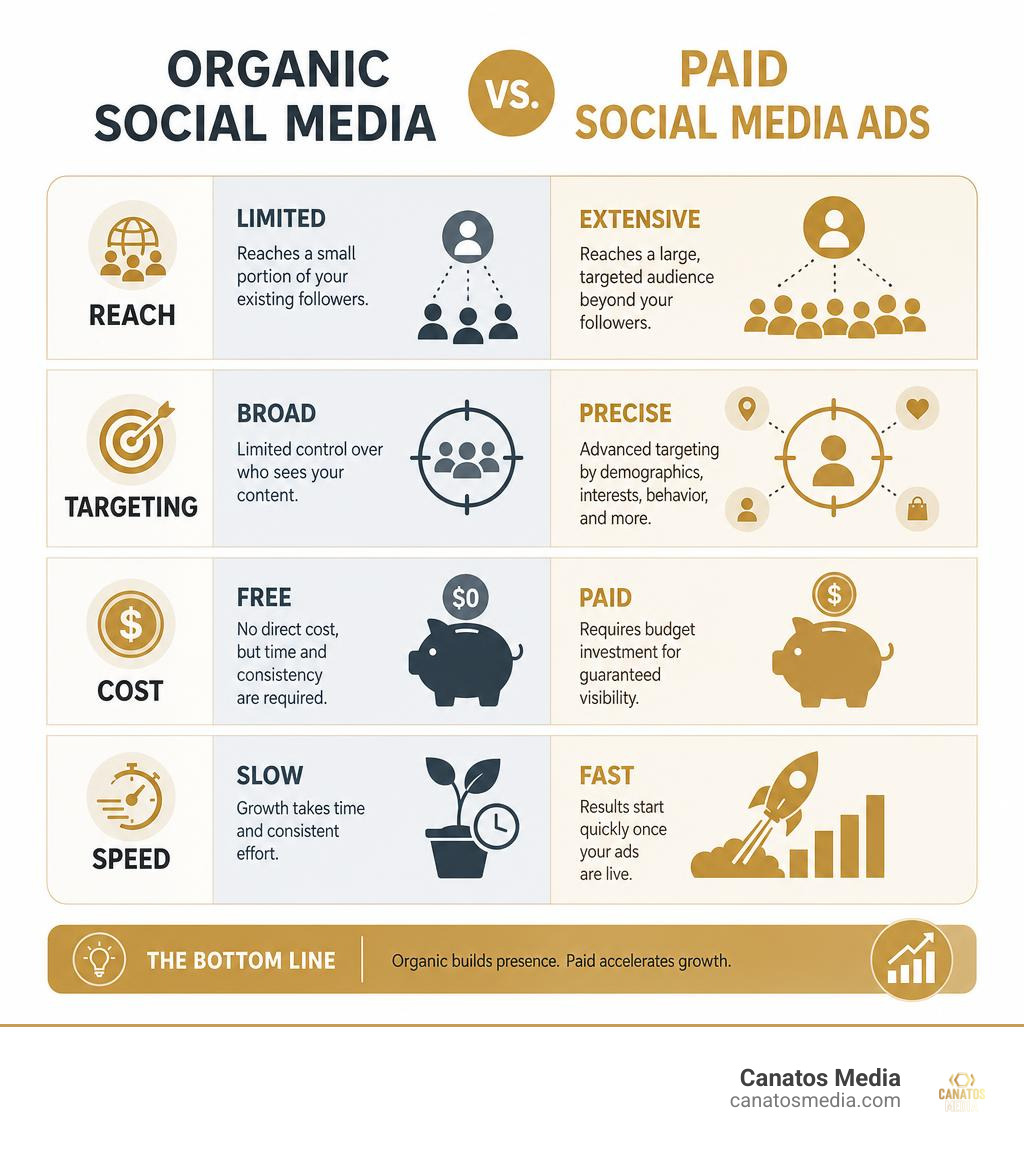
    How do they differ from organic? Organic reach is free but limited; paid ads guarantee visibility to specific audiences
    Top platforms Facebook, Instagram, YouTube, TikTok, LinkedIn
    Average cost $0.38–$5.26 per click depending on platform
    Who should use them? Any business that wants faster reach, leads, and sales

    Nearly 5.2 billion people use social media worldwide. And here’s the number that should stop you in your tracks: 80% of people make purchasing decisions based on what they see on social media.

    Yet most local business owners are either ignoring paid social entirely — or burning budget on ads that don’t convert.

    That gap is exactly what this guide closes.

    Social media advertising is now the second-largest digital ad market in the world, trailing only search advertising. Meta alone controls nearly 24% of all global digital ad spend. This isn’t a trend. It’s where attention lives, and where your customers are making buying decisions every single day.

    Whether you’re running a single location or managing multiple, this guide walks you through every key decision: which platforms to use, what formats work, how much to spend, and how to measure what’s actually working.

    I’m Nic Canobbio, founder of Canatos Media, and over the past two decades I’ve built and scaled social media ad strategies that have generated over 60 million views across platforms. I’ll share exactly what works — and what wastes your budget.

    Infographic comparing organic social media vs paid social media ads: reach, targeting, cost, and speed infographic

    What Are Social Media Ads and How Do They Work?

    To understand why paid social is such an absolute powerhouse for growth, we have to look at the fundamental shift from organic social media marketing to paid advertising.

    Organic social media is fantastic for nurturing the community you already have. It is your digital storefront, your brand’s personality, and your customer service desk. But let’s be completely honest: organic reach has plummeted across almost every major network over the last few years. If you post an update on your business page today, you are lucky if 2% to 5% of your followers actually see it in their feeds. Relying solely on organic reach to acquire new customers is like standing on a street corner whispering and hoping someone three blocks away hears you.

    Paid social media ads, on the other hand, are like handing you a megaphone with a laser-guided targeting system.

    When you run paid social campaigns, you bypass the restrictive organic algorithms entirely. You pay to place your content directly in front of the exact people who are most likely to buy from you. This is why we created our guide on Paid Social Media Advertising From Zero to Hero in One Hour—to show business owners that you don’t need to wait months for organic traction when you can launch highly targeted campaigns in an afternoon.

    The Mechanics of Paid Social: Targeting and Machine Learning

    The true magic of paid social lies in how these platforms find your customers. Unlike search engines, which rely on what someone is typing in at that exact second (search intent), social platforms rely on deep behavioral data and interest targeting.

    When you set up a campaign, you can define your target audience using three primary layers:

    1. Demographics: Age, gender, location, job titles, income, and education.
    2. Interests and Behaviors: What pages they like, what content they interact with, their shopping habits, and even the devices they use.
    3. Custom and Lookalike Audiences: You can upload your existing customer list, and the platform’s machine learning algorithm will find “lookalikes”—millions of other users who share identical behavioral traits with your best buyers.

    Once your campaign goes live, the platform’s machine learning engine takes over. The system enters a “learning phase” where it tests your ads on small segments of your target audience to see who clicks, watches, or converts. As it collects data, it optimizes delivery, showing your ads to the users most likely to take your desired action. If you don’t set this up correctly, however, you run the risk of overspending, which is why we always warn business owners to Stop Burning Cash on Bad Meta Ads by understanding how these algorithms function before launching.

    Every ad campaign is built on a specific campaign objective. Whether you want to build top-of-funnel brand awareness, drive traffic to a blog, capture leads via a native form, or secure direct e-commerce sales, choosing the right objective tells the algorithm exactly what to optimize for.

    The Top Platforms and Formats for Paid Social

    Not all social media platforms are created equal. Each network has its own unique user culture, primary demographics, and ad placements. To get the best return on your ad spend, you must match your product or service to the platform where your target audience naturally hangs out.

    Choosing the Right Platform for Your Social Media Ads

    Let’s look at the breakdown of the major players in 2026:

    Facebook

    • Active Users: Over 3.03 billion active users.
    • Key Demographics: Spans all age groups, but holds the strongest purchasing power among users aged 25–65+.
    • Why Use It: Facebook remains the undisputed king of local lead generation and e-commerce. Its targeting capabilities and sheer volume of historical user data are unmatched.

    Instagram

    • Active Users: At least 1.7 billion users.
    • Key Demographics: Highly popular among Millennials and Gen Z (ages 18–44).
    • Why Use It: Highly visual. If you sell lifestyle products, fashion, food, or aesthetic services, Instagram is your playground. It is also the home of Reels, which are incredibly effective for short-form video ads.

    YouTube

    • Active Users: Over 2.5 billion monthly active users.
    • Key Demographics: Broad appeal across all age groups, particularly strong with males and younger demographics who prefer video over text.
    • Why Use It: YouTube functions as the world’s second-largest search engine. Running video ads here allows you to capture users who are actively looking to learn, solve a problem, or be entertained.

    LinkedIn

    • Active Users: 1.15 billion users.
    • Key Demographics: Professionals, decision-makers, B2B buyers, and job seekers (ages 25–64).
    • Why Use It: If you are a B2B company, LinkedIn is essential. While it is notoriously expensive, it allows you to target users by specific job titles, industries, company sizes, and seniorities.

    TikTok

    • Active Users: 1.6 billion active monthly users.
    • Key Demographics: Dominated by Gen Z and younger Millennials (ages 13–34), though older demographics are growing rapidly.
    • Why Use It: TikTok is built on raw, authentic, and video content. If you can create ads that “don’t look like ads,” you can unlock massive, low-cost virality.

    Pinterest

    • Active Users: 553 million monthly users.
    • Key Demographics: Highly female-skewed (approx. 70%), with users actively planning future purchases (weddings, home decor, fashion, DIY).
    • Why Use It: Pinterest users have high commercial intent. They use the platform as a visual search engine to plan what they want to buy next.

    Snapchat

    • Active Users: 443 million daily active users.
    • Key Demographics: Heavily skewed toward Gen Z and younger audiences (ages 13–24).
    • Why Use It: Great for mobile-first, interactive campaigns, AR filters, and reaching a younger demographic at a lower ad cost.

    X (formerly Twitter)

    • Active Users: Around 611 million monthly active users.
    • Key Demographics: Highly educated, tech-literate, and male-skewed.
    • Why Use It: Excellent for real-time engagement, tech, finance, and news-related promotions.

    To build a truly bulletproof strategy, many businesses run a hybrid approach. If you want to see how to balance your strategy across different ecosystems, check out our guide on Meta Google Advertising. Additionally, mastering the back-end software is crucial to your success, so we highly recommend reading up on How to Navigate Meta Ad Manager Like a Pro to avoid costly setup mistakes.

    Ad Formats and Creative Specifications

    Once you have selected your platform, you need to choose the right ad format to showcase your offer. The primary formats include:

    • Photo Ads: A single, high-quality image paired with a compelling headline and caption. Best for clean, straightforward product showcases or quick local promotions.
    • Video Ads: Engaging video clips that tell a story or demonstrate a product. In 2026, short-form, vertical video (9:16 aspect ratio) is the highest-converting format across almost all networks.
    • Carousel Ads: These allow you to showcase up to 10 images or videos within a single ad, each with its own link. They are incredibly effective for showing multiple products, highlighting different features of a single product, or telling a step-by-step story. If you are developing your own campaigns, you can refer to the Instagram Carousel Ads | Developer Documentation for detailed technical specifications and API guidelines.
    • Story Ads: Full-screen vertical ads that appear between users’ organic stories. They offer an immersive experience with high conversion rates when paired with a clear swipe-up CTA.
    • Collection Ads: A primary video or image accompanied by four smaller product images in a grid layout, allowing users to browse and buy products directly within the social app.

    To make your life easier, you don’t always have to create ad creatives from scratch. You can leverage your top-performing organic posts and boost them to a wider target audience. For a deep dive into the technical side of how to do this, check out the official guide on how to Use Posts as Instagram Ads | Developer Documentation.

    Furthermore, if you want to drive direct, high-intent conversations with your prospects, you can set up campaigns that open directly into a chat. You can learn how to build these interactive experiences using the Ads that Click to Messenger | Developer Documentation to capture leads instantly in real-time.

    How Much Do Social Media Ads Cost in 2026?

    One of the most common questions we hear is: “How much should I expect to spend?”

    The honest answer is that social media advertising is highly accessible, allowing you to start with as little as $5 to $10 a day. However, your actual costs—measured primarily in Cost Per Click (CPC) and Cost Per Mille / Cost Per Thousand Impressions (CPM)—will vary wildly depending on your industry, target audience, season, and campaign objective.

    To give you a realistic picture of the paid social landscape in 2026, here is a comparison of average costs across the major networks:

    Platform Average CPC (Cost Per Click) Average CPM (Cost Per 1,000 Impressions) Primary Audience Focus
    Facebook $0.70 – $0.97 $7.19 – $12.50 Broad / All Demographics
    Instagram $0.20 – $3.56 $7.91 – $11.00 Visual / Millennials & Gen Z
    YouTube $3.21 $9.68 Video / Educational & Entertainment
    LinkedIn $5.26 $6.59 B2B / Professionals & Decision-Makers
    TikTok $1.00 $6.06 Short-Form Video / Gen Z & Millennials
    Pinterest $0.10 – $1.50 $2.00 – $5.00 Visual Search / Shopping & DIY
    Snapchat $0.57 (per swipe up) $2.19 Youth / Interactive Mobile
    X (Twitter) $0.38 $6.46 Tech, Finance, Real-Time News

    Note: These benchmarks represent median averages. If you are in a highly competitive industry like legal services, finance, or dental care, your CPCs will naturally skew higher. For a deep dive into industry-specific performance metrics, check out the comprehensive Facebook Ads Benchmarks 2025: NEW Data, Trends, & Insights for Your Industry | WordStream.

    Understanding Bidding Strategies and Budget Allocation

    Social media platforms run on an auction-based system. You are competing with thousands of other advertisers to get your ad in front of the same user. To win the auction without overpaying, you need to understand the platform’s bidding options:

    1. Lowest Cost / Maximize Conversions: The platform automatically bids to get you the most results possible for your budget. This is the best option for beginners.
    2. Cost Cap / Bid Cap: You set the maximum amount you are willing to pay for a click or a conversion. This keeps your costs predictable but can limit your reach if your cap is set too low.
    3. Target ROAS: The system adjusts bids to hit a specific return on ad spend. This is ideal for mature e-commerce brands with plenty of historical pixel data.

    budget allocation dashboard

    When allocating your budget, we recommend starting with a 70/30 split. Allocate 70% of your budget to prospecting campaigns (reaching new people who have never heard of you) and 30% to retargeting campaigns (reaching people who have visited your website, watched your videos, or interacted with your social pages).

    Best Practices for Running Successful Campaigns

    Launching a campaign is only 10% of the battle. The real work lies in optimization, testing, and scaling. To ensure your campaigns generate a positive return, you must treat your ads as an ongoing scientific experiment.

    How to Measure the ROI of Social Media Ads

    If you aren’t tracking your metrics, you are essentially throwing money into a black hole. To understand if your social media ads are actually working, you need to focus on the key performance indicators (KPIs) that align with your ultimate business goals:

    • Return on Ad Spend (ROAS): The total revenue generated divided by the total ad spend. If you spend $1,000 and make $5,000, your ROAS is 5x.
    • Cost Per Acquisition (CPA) / Cost Per Lead (CPL): How much it costs you to acquire a paying customer or a qualified lead.
    • Conversion Rate (CVR): The percentage of people who clicked your ad and completed your desired action on your landing page.
    • Click-Through Rate (CTR): The percentage of people who saw your ad and clicked it. A low CTR (under 1%) usually means your creative or targeting is missing the mark.

    To manage this data effectively, you need a structured approach. We keep our readers updated with our specialized resources in our Category: Ad Management and compile our best optimization strategies under our Tag: Paid Ads.

    Creative Strategies and Optimization Tips

    If you want your ads to convert in 2026, you must prioritize the quality and authenticity of your creative assets. Here are our proven strategies for running successful campaigns:

    • Embrace Cinematic Short-Form Video: Social feeds are faster and more crowded than ever. Standard static images rarely stop the scroll anymore. If you want to capture attention, you need engaging, high-production-value video assets. To see how this works in practice, read our analysis on How Cinematic Short Form Content Improves Meta Paid Ad Performance.
    • Scale and Adapt Your Creative: Don’t just create one video and hope for the best. You need to adapt your creative assets to fit different platforms and placements. Learn How to Scale Short Form Ad Creative Across Meta and Google Ads to maximize your production budget.
    • Optimize for Local Lead Generation: If you run a local brick-and-mortar business or service company, your video ads should be highly tailored to your local community. See our step-by-step guide on How to Optimize Short Form Video Ads for Local Lead Generation.
    • Leverage User-Generated Content (UGC): People trust other people far more than they trust brands. Running ads that look like organic organic reviews, unboxing videos, or customer testimonials can dramatically lower your acquisition costs.
    • Fight Creative Fatigue: In social media, ad creatives decay quickly. Because users scroll their feeds daily, they will quickly get tired of seeing the same ad over and over. Rotate your creative assets every 1 to 2 weeks to keep your frequency low and your conversion rates high.
    • Build a Systematic Follow-Up Process: No matter how incredible your ads are, they are only as good as your sales follow-up. For example, in our breakdown of The Gym Owner’s Guide to Paid Ads in 2026 – Two-Brain Business, we highlight that lead quality issues are almost always follow-up problems. If you don’t reach out to a new lead within 5 minutes of them submitting a form, your conversion rates will plummet.

    high-converting video ad storyboard

    Frequently Asked Questions About Paid Social

    Paid search (like Google Ads) is based on pull marketing. It captures users who are actively searching for a specific keyword with high intent (e.g., “plumber near me”). Paid social (like Meta Ads) is based on push marketing. It introduces your brand, product, or service to users based on their interests, behaviors, and demographics while they are browsing socially. Paid search is ideal for capturing immediate demand, while paid social is unmatched for building brand awareness, visual discovery, and generating demand where none existed before.

    How often should I refresh my ad creatives to avoid fatigue?

    As a general rule of thumb, you should refresh your ad creatives every 10 to 14 days for active, high-budget campaigns. If your target audience is smaller (such as a local geographic radius of 5 miles), your ads will reach the same people multiple times very quickly, meaning you may need to rotate creatives even faster to prevent your cost-per-click from rising.

    What is a good benchmark for social media ad ROI?

    While a “good” ROI depends heavily on your business model, profit margins, and industry, a standard benchmark for e-commerce is a 3x to 4x ROAS (Return on Ad Spend). For lead-generation businesses, a healthy benchmark is to ensure that your Customer Acquisition Cost (CAC) is at least 3 to 5 times lower than your Customer Lifetime Value (CLV).

    Conclusion

    Running successful social media ads in 2026 is no longer about simply hitting a “Boost Post” button and hoping for the best. It requires an integrated digital marketing strategy that seamlessly connects cinematic short-form video, hyper-precise audience targeting, and high-converting sales funnels.

    At Canatos Media, we specialize in helping brands build, run, and scale profitable paid media campaigns. From producing high-end, scroll-stopping video content to managing complex ad accounts across Meta and Google, we handle the heavy lifting so you can focus on running your business.

    Ready to stop burning cash and start driving measurable growth? Dive into our comprehensive Meta Ads Management Ultimate Guide to learn how we structure high-performing campaigns, or reach out to our team today to build a custom paid social strategy for your business.