1. Unified Brand Identity Across Multiple Locations
Running multiple locations means juggling dozens of moving parts. Each branch needs to feel like part of one cohesive brand while also speaking to its local market. At the same time, you’re competing for customer attention on social platforms where cinematic, high-quality content wins—and generic templated posts get buried.
The challenge: how do you maintain brand consistency across locations while simultaneously driving measurable leads from social media and paid advertising? This is where cinematic storytelling paired with integrated performance marketing becomes essential, not optional.
We’ve worked with dozens of multi-location brands, and the ones that grow fastest combine professional visual storytelling with data-driven advertising systems. They’re not choosing between “build brand awareness” and “generate leads”—they’re doing both, strategically.
Inconsistency kills trust. When customers see one location posting smartphone footage while another uses professional video, they question whether your brand is organized and trustworthy. Worse, they’re more likely to choose a competitor who looks polished across the board.
Multi-location brands face a real structural problem: each location may have different management, budgets, and creative resources. Without centralized guidelines and templates, brand identity fractures.
Here’s the solution: Cinematic brand storytelling creates a visual language that transcends individual locations. When you produce professional, narrative-driven video content—footage that tells a story about your brand values, your people, or your customer outcomes—that content becomes reusable across all locations. A well-crafted story about how your team delivers results feels equally authentic whether it’s posted from your downtown office or your suburban branch.
We help brands establish one unified visual identity by:
- Creating core cinematic templates and brand story assets that work across locations
- Providing location teams with approved content libraries they can customize locally
- Maintaining consistent color grading, pacing, and messaging in every video production
- Building in flexibility so local teams can add location-specific details without breaking brand cohesion
The practical takeaway: one strong cinematic brand story, produced once and deployed across all locations, costs far less than trying to manage separate creative for each branch—and it’s exponentially more powerful.
2. Cost-Effective Scalability Through Video-First Strategies
Budget is tight. Hiring creative teams in every location isn’t realistic. Paying agencies $10,000+ per video for each location is unsustainable.
This is where video-first thinking changes the economics. Instead of treating video as an expensive add-on, we build strategy around it. One high-quality video production becomes the foundation for weeks or months of social media content.
Here’s how we think about it: A single 90-second cinematic video can be broken into:
- 15-30 second social clips for Instagram Reels, TikTok, and YouTube Shorts
- 6-8 short testimonial or how-it-works snippets for carousel posts
- Background footage for website hero sections
- B-roll for paid advertising creatives
- Audio for podcast or email marketing
One production shoot gives you 8-12 weeks of content. Compare that to paying for new creative every week, or worse, posting low-quality user-generated content.
For multi-location brands, this scales beautifully. Produce content quarterly or monthly featuring different locations, team members, or customer stories. Each production serves the entire brand network.
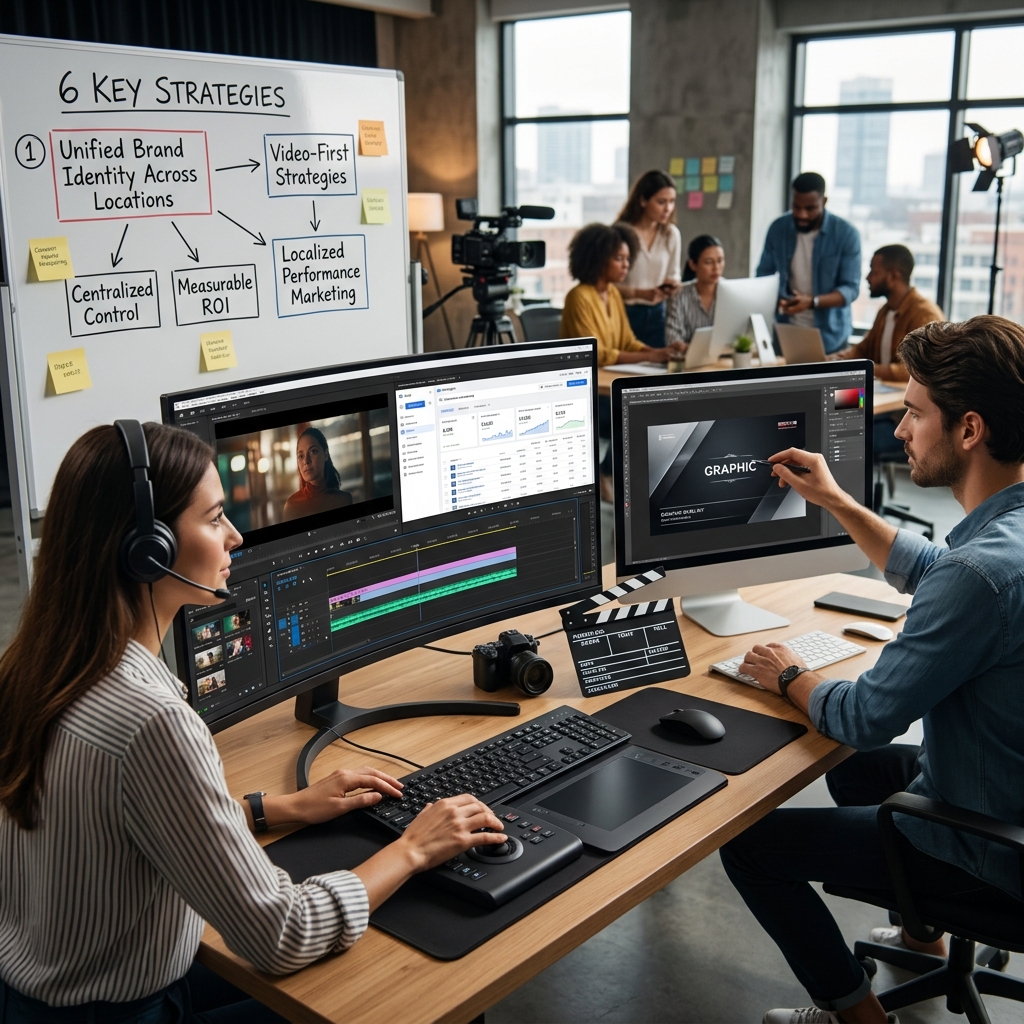
We also optimize where content is distributed. Rather than posting uniformly to every platform, we use data to identify which channels drive the highest-quality leads for your specific audience. This means your production budget gets laser-focused on what actually works—not spread thin across 10 platforms.
Action item: Audit your current content spend. If you’re paying for new creative more than twice a month, you’re overspending. Shift to a quarterly cinematic production model and watch your cost-per-piece drop by 60-70%.
3. Cinematic Content That Converts Social Followers Into Leads
Followers don’t pay your bills. Leads do.
We see brands with 50,000 social followers generating maybe 2-3 leads per month because their content doesn’t move people to action. They’re building an audience instead of a business.
Cinematic storytelling is specifically designed to move people emotionally and psychologically toward a decision. Unlike generic content, it works because it:
- Creates emotional connection through narrative (not just product features)
- Demonstrates outcome and transformation (what happens after they choose you)
- Builds perceived value so price becomes less of an objection
- Makes audiences remember you, not just scroll past you
The difference is tangible. A typical product demo video might get 5-8% click-through to your website. A cinematic story about a customer’s transformation or a problem you solve can drive 15-25% click-through because people actually want to know more.
Then we layer in strategic calls-to-action and landing page funnels. Content becomes the top of your lead funnel, not just awareness-building.
For multi-location brands, this is critical. Each location becomes part of a larger conversion system. A customer in Miami watches a story about how your service transformed a business, clicks through, and books a consultation at your Miami location. Another customer in Denver does the same thing from your Denver angle. One storytelling approach, many conversion points.
Cinematic website videos amplify this further by turning your website itself into a conversion tool—not just a directory.
4. Localized Performance Marketing With Centralized Control
This is where multi-location brands typically struggle: running Meta and Google ads across locations without completely fragmenting management.
Some brands give each location total control. Result: inconsistent messaging, wasted ad spend, duplicated efforts.
Other brands centralize everything. Result: ads that don’t resonate locally, location managers who feel disconnected from their marketing.
We design systems that split the difference. Here’s what that looks like:
Centralized strategy and creative: Core messaging, audience targeting strategy, and video creative come from the center. We build a unified approach.
Location-level execution and optimization: Each location gets a dedicated ad manager or dashboard access to run their campaigns within approved parameters. They can adjust budget, target local neighborhoods, and monitor results specific to their area.
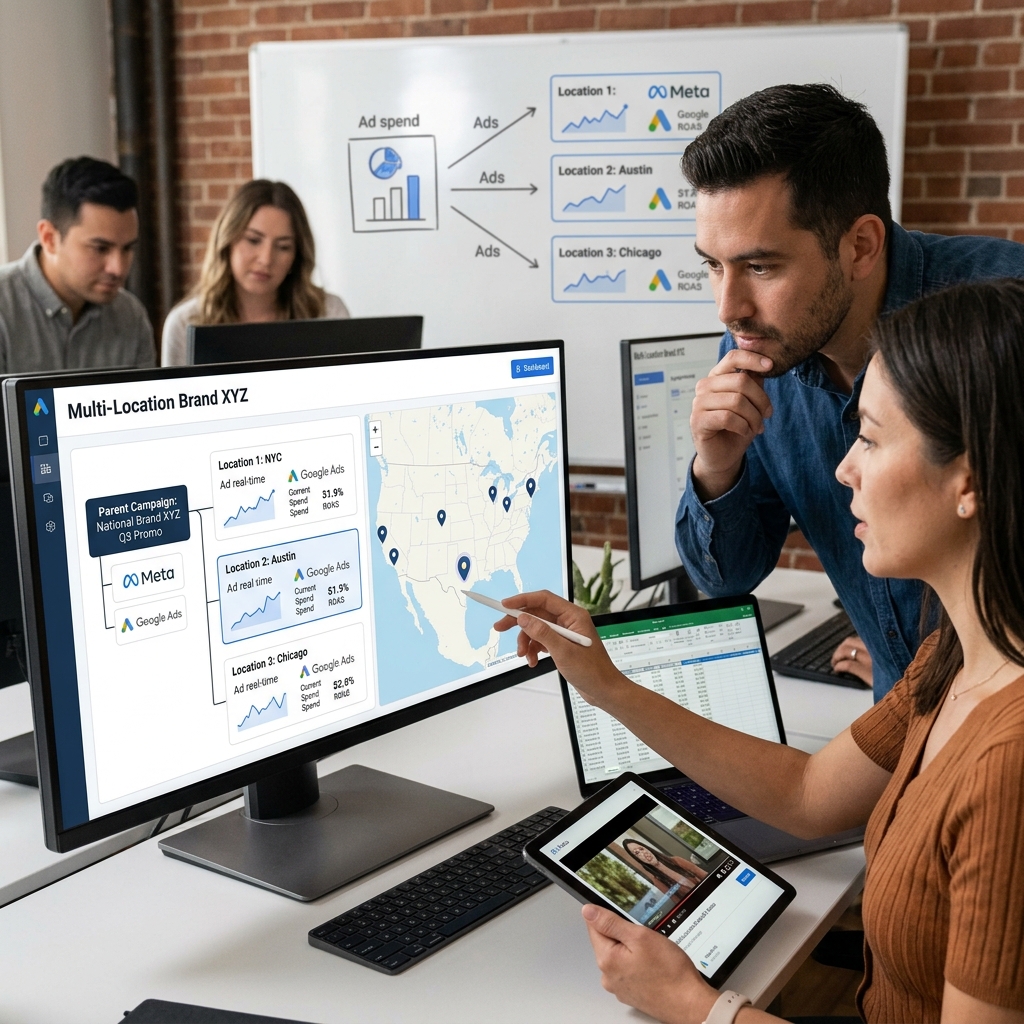
Unified reporting: All location data feeds into one dashboard so you see total brand performance and individual location performance in one place.
This approach lets you scale to 50 locations without 50 different marketing philosophies. A location manager in Atlanta isn’t guessing—they’re executing a proven system tailored to Atlanta’s market.
The technical piece matters too. We set up conversion tracking so you’re not just counting ad impressions. You’re tracking which locations get the most qualified leads, which ad angles drive the lowest cost-per-lead, and which audience segments actually become customers.
Next step: If you’re running location-based ads without centralized tracking, you’re likely overspending by 20-30% and don’t even know it. Set up conversion tracking by location immediately.
5. Building Trust and Credibility Through Professional Storytelling
Trust is everything for service-based and multi-location brands. If a customer doesn’t believe you’re legitimate, competent, and worth their money, they won’t convert—no matter how good your offer is.
Generic content signals low credibility. Smartphone video, templated designs, and repetitive messaging say “we didn’t invest in this for you.” Cinematic, professionally produced content sends the opposite signal: “we take our brand seriously, we invest in quality, and we’re stable enough to be here long-term.”
This perception directly impacts price negotiation. Brands that look polished can charge 15-25% more because customers perceive higher value and lower risk. They’re not comparing you on price alone—they’re buying confidence in your professionalism.
For multi-location brands, this effect compounds. When every location reflects the same professional standard, customers don’t wonder “which location is the best one?” All locations look equally credible and well-managed.
We build this through:
- Consistent visual quality across all content (same color grading, same pacing, same production value)
- Featuring your team and real stories, not stock footage (authenticity + professionalism combined)
- Professional website integration where video-first marketing becomes part of your entire customer experience, not just a social media tactic
- Testimonials and case studies told cinematically, not as text blocks
The result is trust that translates to longer sales cycles and higher customer lifetime value. People aren’t just buying from you once—they’re becoming advocates.
6. Measurable ROI From Integrated Social and Advertising Systems
At the end of the day, marketing spend is business spend. It needs to return money.
Many brands struggle to measure ROI because their marketing is fragmented. Social media is siloed from paid ads. Paid ads aren’t connected to sales. Website traffic isn’t tied back to specific content or campaigns.
We build integrated systems where every piece of content, every ad dollar, and every location feeds data back into one reporting dashboard.
Here’s what that means practically:
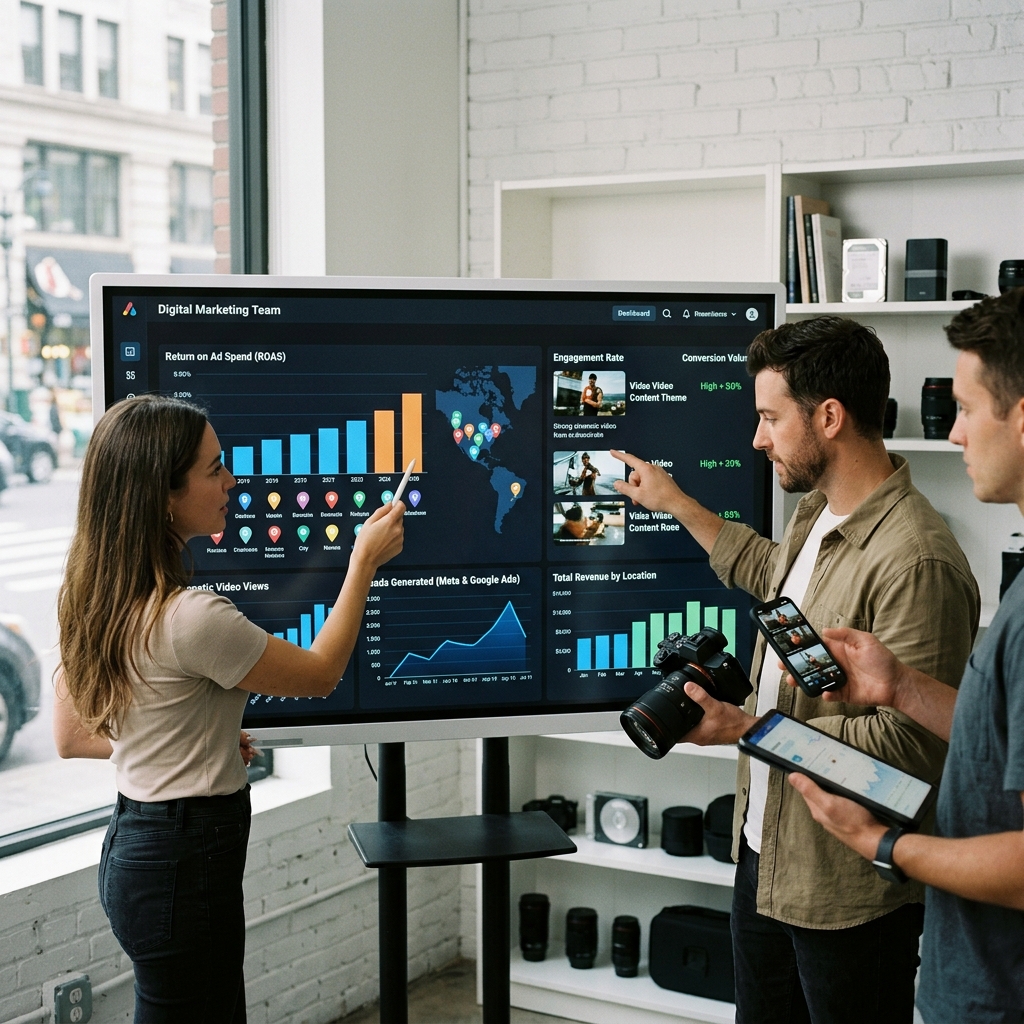
- Video content drops on social Monday morning. We track engagement and save the top-performing clips.
- Top clips get turned into paid ad creative by Thursday. We run them across Meta and Google with precise location and audience targeting.
- Clicks flow to custom landing pages built for each location or offer.
- Conversions (calls, form submissions, online bookings) get tracked back to the original content and ad that drove them.
- We see: “this cinematic customer story drove 32 leads at an $18 cost-per-lead across three locations.”
That’s not vanity metrics. That’s ROI.
For multi-location brands, this integration is transformative because it reveals which locations are responding to which messages, which content performs across all markets vs. which performs only locally, and where your ad spend is most efficient.
Most importantly, it proves the system works. When a location manager sees “we spent $4,000 on ads this month and generated 47 qualified leads at $85 each,” and those leads close at a typical rate, they understand their ROI instantly.
What to do now: Stop measuring marketing by impressions and followers. Start measuring by leads and customer acquisition cost. If you’re not tracking at least one conversion metric per location, you don’t actually know if your marketing is working.
—
Multi-location brands that grow fastest aren’t doing marketing the old way. They’re combining cinematic storytelling that builds trust and moves people to action with performance marketing systems that track every dollar and optimize relentlessly.
The brands that struggle are the ones trying to manage scattered social posts, inconsistent creative, and disconnected ad campaigns across multiple locations.
We help growth-focused business owners build the complete system: unified brand identity, scalable content production, conversion-focused storytelling, location-based ad execution with central oversight, and integrated reporting that shows exactly what’s working.
If your multi-location brand is ready to move beyond generic content and fragmented marketing, let’s talk about building a system that actually grows your business. That’s what we do.
Contact us today for a free consultation to see how we can help you grow your business.
Frequently Asked Questions (FAQ)
How do we help multi-location brands maintain consistent messaging while allowing local marketing customization?
We build centralized brand systems that give you unified visual and messaging standards across all locations, then layer in location-specific social media and paid advertising campaigns. Our approach means your brand story stays consistent in your cinematic content while we optimize ad targeting, messaging, and offers for each geographic market. This lets you speak to local customers without sacrificing the professional brand identity that makes you recognizable everywhere.
What’s included in our integrated digital marketing approach for franchises and service-based businesses?
We combine short-form video production, social media management, Meta and Google paid advertising, SEO optimization, and lead generation systems into one coordinated strategy. Rather than managing separate vendors for each channel, we handle everything from creating your cinematic content to running your ads to capturing and qualifying leads. This integration means your video content feeds directly into your social strategy, which powers your paid campaigns, which all drive toward the same conversion goals we’re tracking for you.
How do we measure the actual ROI of our video and marketing work?
We set up tracking systems that connect your video content, social media activity, paid ads, and website conversions into one reporting dashboard so you see exactly which efforts drive leads and sales. We don’t just report vanity metrics like views or likes – we show you cost per lead, conversion rates, and revenue attributed to our work. This accountability is built into our process from the start so we’re always optimizing toward your actual business goals.