
Why the Most Effective Instagram Ads Are Your Fastest Path to More Local Customers
The most effective Instagram ads in 2026 share a few things in common — and once you know what they are, you can start replicating them for your own business.
Here’s a quick breakdown of what works best, right now:
| Ad Format | Best For | Key Strength |
|---|---|---|
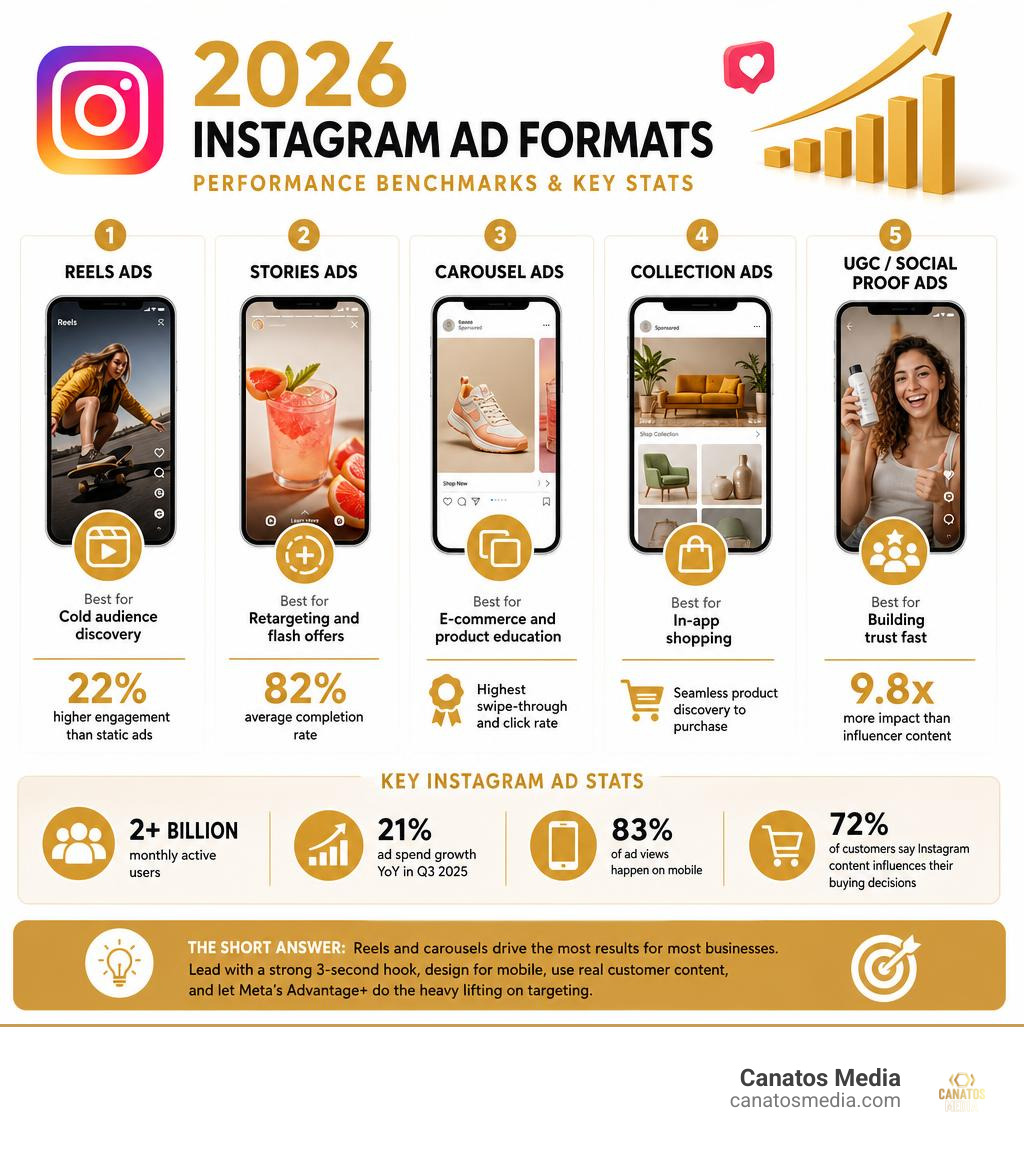
| Reels Ads | Cold audience discovery | 22% higher engagement than static ads |
| Stories Ads | Retargeting and flash offers | 82% average completion rate |
| Carousel Ads | E-commerce and product education | Highest swipe-through and click rate |
| Collection Ads | In-app shopping | Seamless product discovery to purchase |
| UGC / Social Proof Ads | Building trust fast | 9.8x more impact than influencer content |
The short answer: Reels and carousels drive the most results for most businesses. Lead with a strong 3-second hook, design for mobile, use real customer content, and let Meta’s Advantage+ do the heavy lifting on targeting.
Instagram now reaches over 2 billion monthly active users — and ad spend on the platform grew 21% year-over-year in Q3 2025. That growth isn’t slowing down. But more spend doesn’t mean better results. Most local businesses waste their budget on weak creative, wrong formats, and zero measurement strategy.
The competition for attention is real. A user scrolls past hundreds of posts every session. If your ad doesn’t stop them in the first three seconds, it’s invisible. And with 83% of all Instagram ad views happening on mobile, the stakes for getting your creative right have never been higher.
Up to 72% of customers say Instagram content directly influences their buying decisions. That’s not a small number — that’s most of your potential customers being shaped by what they see in their feed before they ever visit your website.
This guide breaks down exactly what separates forgettable ads from ones that drive real sales.
I’m Nic Canobbio, founder of Canatos Media — with over two decades in media production, live content, and paid social strategy, I’ve spent years studying and producing the most effective Instagram ads for brands that need real growth, not just vanity metrics. Let’s get into what actually works.
Decoding the Most Effective Instagram Ads Formats in 2026
To build a high-converting campaign, you must first understand where your ads live. Too many advertisers make the mistake of treating Instagram as a simple extension of their Facebook campaigns. As we discuss in our breakdown of Facebook Ads vs Instagram Ads (2026), user behavior, platform culture, and creative language are fundamentally different on these two networks.
While Facebook users are highly accustomed to clicking outbound links, Instagram users prefer to consume content and make discoveries directly inside the app. This means the most effective Instagram ads are designed to feel native to their specific placement.
Let’s look at the benchmarks for the primary placements on Instagram:
- Instagram Reels: The undisputed king of organic reach and low-cost attention. Reels ads feature a 30-40% lower Cost Per Thousand Impressions (CPM) compared to the standard feed because Meta aggressively subsidizes this inventory to keep users engaged.
- Instagram Stories: Ideal for direct response, quick promotions, and retargeting campaigns. Stories have an incredible 82% average completion rate when designed correctly.
- Instagram Feed: The traditional home of high-resolution imagery. While feed CPMs are higher ($10–$16 on average), they still command excellent conversion rates for high-intent buyers.
- Explore Page: A highly underutilized, high-Click-Through-Rate (CTR) placement. Users on the Explore page are actively looking to discover something new, making it the perfect spot for cold-traffic prospecting.
For local companies in Long Island and the Tri-State area, understanding how these placements interact is the key to running successful campaigns. Whether you are partnering with a top Long Island social media marketing company or building your campaigns in-house, matching your creative format to the user’s mindset is non-negotiable.
Why Reels and Stories Dominate the Most Effective Instagram Ads Landscape
If you want to build campaigns that convert in 2026, you must prioritize vertical video. Reels now absorb nearly 50% of the total time spent on Instagram. Because of this massive shift in user behavior, Reels ads lead engagement by 22% over static image ads. Furthermore, Instagram Stories are viewed daily by 70% of Gen Z users, making vertical formats the primary language of the platform.
To dominate this space, your creative needs to look like organic content. This is where we emphasize the shift from high-production commercial styles to authentic, vertical storytelling. In our guide on How to Create High-Impact Short Form Content That Converts on Facebook and Instagram Reels, we highlight that native-looking, phone-shot vertical video consistently outperforms polished corporate commercials.
When you design for Reels and Stories:
- Use a 9:16 vertical ratio (1080 x 1920 pixels) to occupy the user’s entire screen.
- Incorporate native platform signals, such as Instagram-style fonts, stickers, and interactive elements.
- Build your creative around trending audio or clear, voiceover-led hooks to ensure immediate engagement.
The Power of Carousels and Collection Ads for E-Commerce
While video is crucial, static and mixed-media formats still have a powerful role to play—specifically in e-commerce and product education. Carousels continue to outperform other formats for pure view counts on Instagram, regardless of account size. They allow you to showcase multiple angles of a product, tell a sequential story, or present a step-by-step tutorial that users can swipe through at their own pace.
Collection ads take this a step further by pairing a primary video or image with a grid of smaller product shots underneath. When a user taps the ad, they are taken to a fast-loading, immersive storefront within the Instagram app. This minimizes post-click friction and prevents drop-offs.
Here is how Carousel and Collection ads stack up in performance metrics:
| Metric | Carousel Ads | Collection Ads |
|---|---|---|
| Average Engagement Rate | 0.55% (Highest on Instagram) | 0.42% |
| Primary Advantage | Ideal for storytelling & multi-benefit education | Perfect for instant, in-app catalog browsing |
| Best Creative Combo | A video on card 1, followed by static detail cards | A lifestyle video header with clean product grids |
| Average ROAS Lift | 1.5x compared to single static images | Up to 1.8x when using creator-generated assets |
By leveraging these formats, local e-commerce brands in the Tri-State area can transform casual browsers into active buyers without forcing them to wait for a slow external website to load.
The Anatomy of a Scroll-Stopping Creative Strategy
The auction algorithm on Meta has changed. In 2026, targeting is no longer the main lever for ad performance. Meta’s AI is incredibly smart; it reads your video hooks, analyzes your visual frames, and decodes your captions to find your buyers. This means creative is 70% of your performance, while targeting is only 30%.
To win the auction and earn lower CPMs, you must build “scroll-stopping” creative. If you want to dive deeper into how Meta’s auction rewards engaging creative, check out our insights on how to Stop the Scroll and Start the Toll with Meta Paid Ads.
The absolute secret to a scroll-stopping ad is the first 3 seconds. This is your hook. If you fail to capture attention here, the rest of your video does not matter. You can use pattern interrupts to grab eyes instantly:
- Visual Interrupts: A split-screen comparison, a dramatic before-and-after contrast, or an unexpected motion in the first frame.
- Text Hooks: A bold, polarizing statement or a question that addresses a specific pain point (e.g., “Stop wasting money on paper notebooks”).
- ASMR / Audio Hooks: Satisfying sounds, like a product unboxing or a crisp voiceover, to draw users in immediately.
How to Design the Most Effective Instagram Ads for Mobile-First Audiences
With 83% of all Instagram ad views occurring on mobile devices, your creative must be designed mobile-first. This goes beyond just choosing the right aspect ratio. You must respect the platform’s layout and user habits.
First, you must design for sound-off viewing. Up to 80% of users scroll through their feeds with their phones muted. If your video relies entirely on spoken words without text support, your message is lost. Always include clear, dynamic captions or text overlays that explain the core benefit of your product.
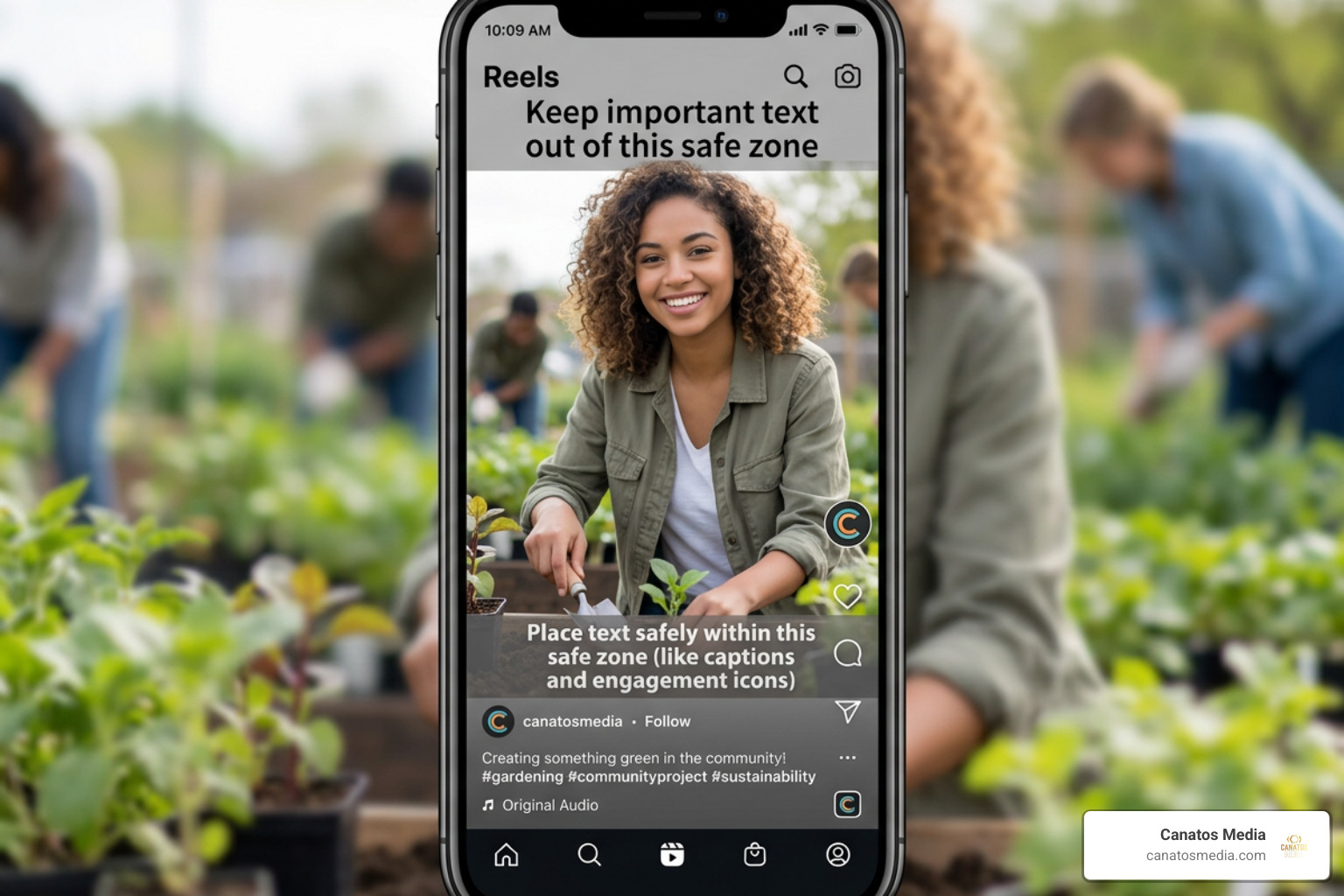
Second, you must respect ad safe zones. When running ads on Reels or Stories, Instagram overlays profile icons, usernames, captions, and Call-to-Action (CTA) buttons on the top and bottom of the screen. Keep your text, logos, and critical visual elements within the central 1080 x 1420 pixel safe zone to prevent them from being covered by the platform’s user interface.
Finally, consider the visual style. High-end, cinematic production can work beautifully when it feels authentic and narrative-driven. To see how this works in practice, read our guide on How Cinematic Short Form Content Improves Meta Paid Ad Performance. The goal is to balance professional visual quality with the raw, personal feel that Instagram users expect.
Leveraging UGC and Social Proof to Build Trust
People do not trust corporate promises; they trust other people. In fact, 83% of consumers trust reviews and recommendations from peers over traditional ads. Furthermore, users find User-Generated Content (UGC) to be 9.8 times more impactful than polished influencer content.
The most effective Instagram ads leverage this psychological trigger by placing real customer experiences at the center of the creative.
To successfully use UGC and social proof in your campaigns:
- Use “Lo-Fi” Phone Footage: Ask your customers or creators to film simple, authentic selfie-style videos explaining how your product solved their problem. Avoid overly polished scripts.
- Screenshot Real Reviews: Place a screenshot of a five-star review directly over a lifestyle photo of your product. This simple visual combination builds instant credibility.
- Focus on the “Before and After”: Show the real, unedited transition from a pain point to a solution.

For local service businesses in Long Island, showcasing real local testimonials in your ads is the fastest way to build community trust. If you want to explore advanced localized tactics, check out these Advanced Instagram Ad Strategies for Long Island Businesses to see how local social proof drives real-world bookings.
Structuring Campaigns for Maximum ROAS and Minimum Fatigue
You can have the most beautiful creative in the world, but if your campaign structure is messy, you will burn through your budget. To prevent this, you need to understand how to build campaigns that maximize your Return on Ad Spend (ROAS). If your current campaigns are showing high activity but flat revenue, you are likely falling into common structural traps. We highly recommend reviewing our guide to help you Stop Burning Cash on Bad Meta Ads.
To build a modern, high-performing campaign structure, follow these three rules:
- Implement the Meta Conversions API (CAPI): Relying solely on the standard browser pixel is a recipe for failure in 2026. Browser-based tracking can miss 20% to 40% of your conversions due to privacy updates and ad blockers. Setting up CAPI alongside your pixel ensures server-side tracking, capturing crucial platform actions like story link taps and direct message initiations.
- Embrace Broad Targeting: Stop micro-segmenting your audiences into tiny interest stacks. This limits Meta’s AI and drives up your CPMs. Instead, use broad targeting (audiences of 10 million+) and let the creative do the targeting. To learn how to transition your account to this modern workflow, read our comprehensive playbook on Instagram Ads in 2026: A Practical ROI Playbook.
- Use Advantage+ Creative: Enable Meta’s automated creative optimizations. This allows the algorithm to automatically adjust image brightness, add subtle background music to silent videos, and swap headlines based on what a specific user is most likely to engage with.
Creative Testing Frameworks and the 70/20/10 Rule
To keep your ad costs low and prevent creative fatigue (which typically starts when your ad frequency hits 5+), you must establish a structured creative testing framework. You cannot simply launch one ad and let it run for months. You need a system that regularly identifies new winning creatives.
We recommend allocating your budget using the 70/20/10 Rule:
- 70% of your budget goes to your Proven Winners. These are your stable, high-converting ads that drive consistent sales.
- 20% of your budget goes to Optimization Tests. Here, you test minor variations of your winning ads—such as testing three new hooks on your best-performing video.
- 10% of your budget goes to Experimental Swings. This is reserved for testing wild, completely new creative angles or formats that you have never tried before.
When running these tests, Meta’s algorithm requires approximately 50 optimization events per ad set per week to exit the learning phase. Keep your testing structured, isolate your variables, and give the algorithm enough budget and time (at least 7 to 10 days) to find statistically significant data.
For a detailed look at how to scale these test assets across different platforms, read our guide on How to Scale Short Form Ad Creative Across Meta and Google Ads.
Frequently Asked Questions about Instagram Advertising
Running paid social campaigns can feel overwhelming. To help you navigate the platform, we have compiled and answered the most common questions and strategic rules of thumb used by top digital agencies.
What is the 3-3-3 rule in marketing?
The 3-3-3 rule is a strategic framework designed to reduce campaign complexity and keep your messaging clear. It dictates that your marketing strategy should focus on:
- Three Core Messages: Do not try to explain ten different benefits in one ad. Focus on your three strongest selling points.
- Three Audience Segments: Define three distinct customer personas (e.g., the busy parent, the budget-conscious shopper, the high-end enthusiast).
- Three Primary Channels: Avoid spreading your budget across ten different social networks. Master three core channels (like Instagram, Google, and email) before expanding.
What is the 3-2-1 rule on Instagram?
The 3-2-1 rule is an organic engagement strategy that brands use to build community trust and boost their algorithmic reach. Every day, your brand should:
- Interact with 3 Accounts: Leave genuine comments on three relevant accounts in your industry or local area.
- Respond to 2 Comments: Reply to at least two comments left on your own posts to spark conversation.
- Ask 1 Question: Post one interactive element (like a poll sticker in Stories or a question in a caption) to encourage your audience to engage with you.
What are the most common mistakes to avoid in Instagram ads?
Even experienced media buyers make mistakes that drain their ad budgets. Here are the top four pitfalls to avoid:
- Over-Targeting: Creating highly narrow interest groups. This restricts the algorithm and increases your cost per click.
- Ignoring the Conversions API (CAPI): Relying solely on the Meta pixel, which results in lost data and poor attribution.
- Using Weak Hooks: Failing to capture attention in the first 1.5 to 3 seconds of your video ads.
- Allowing Creative Fatigue: Running the exact same image or video for weeks without refreshing the hook, copy, or visual format.
Conclusion
Building the most effective Instagram ads is not about having the largest production budget or finding a secret targeting hack. It is about understanding the platform’s culture, designing native vertical content, leveraging authentic human proof, and structuring your campaigns to let Meta’s AI do its job.
At Canatos Media, we specialize in connecting these pieces. We create cinematic, short-form videos that capture attention in the first second, and we back them up with technical Meta Ads management to ensure your creative translates directly into sales. Based right here in the Tri-State area and Long Island, we know exactly what it takes to help local businesses stop the scroll and start converting.
If you are ready to take full control of your advertising, read our Meta Ads Management Ultimate Guide to master the platform, or reach out to us today to start building campaigns that scale.