What Are SEO Services (and Do You Actually Need Them)?
SEO services are professional solutions that help your business rank higher in search results — driving more visitors, leads, and sales without paying for every click.
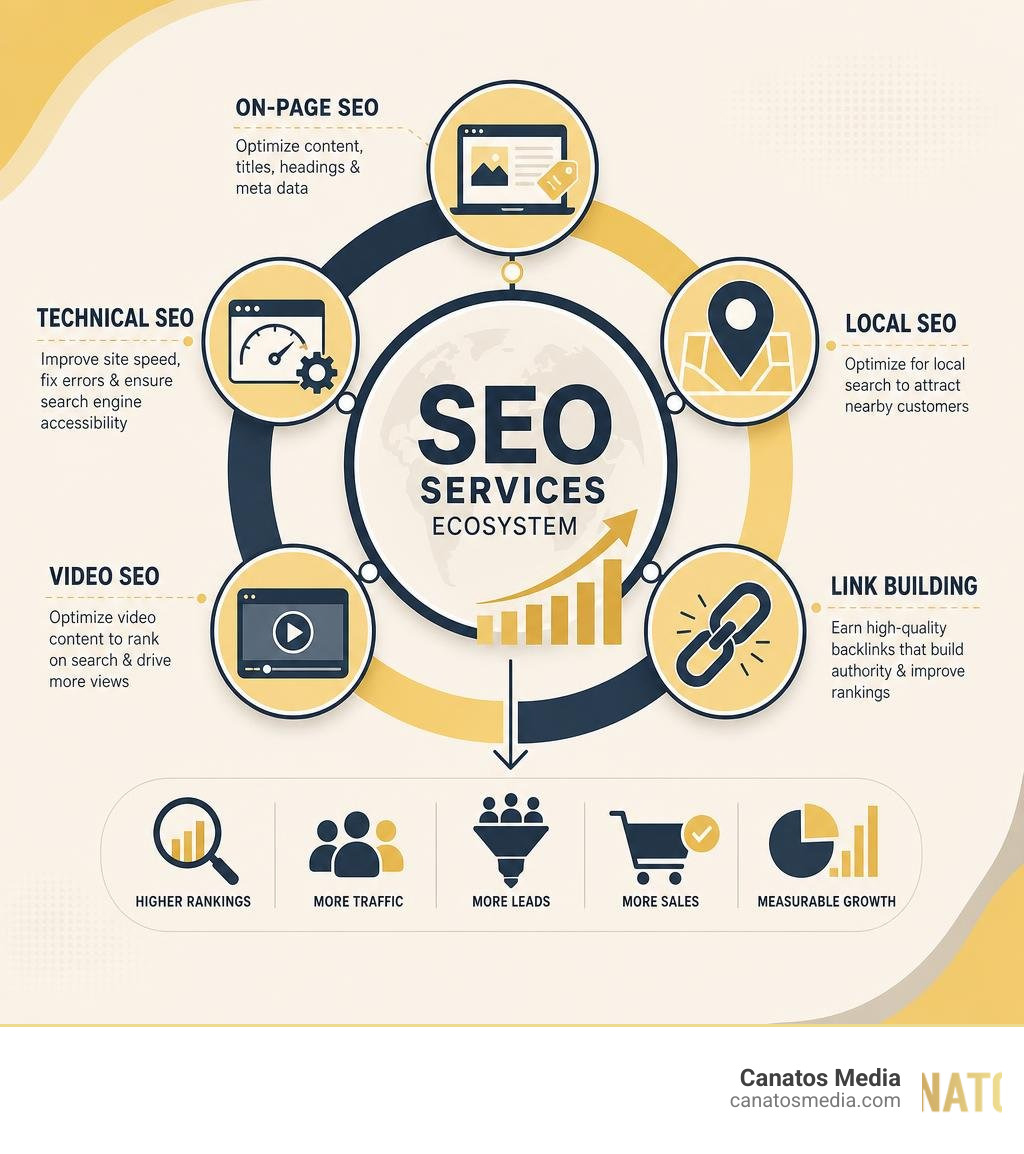
Here’s a quick breakdown of what they typically include:
- Keyword research — finding the exact terms your customers search for
- On-page optimization — improving titles, headings, meta descriptions, and content
- Technical SEO — fixing site speed, crawl errors, and mobile issues
- Link building — earning backlinks that signal authority to Google
- Content strategy — creating pages that match what buyers are actually looking for
- Local SEO — helping nearby customers find your business first
- Video SEO — optimizing YouTube content to rank on the world’s second-largest search engine
- Reporting and analytics — tracking rankings, traffic, and revenue outcomes
If you’re a local business trying to generate consistent leads online, the right SEO partner can be the difference between being found and being invisible.
Over 81% of US adults use YouTube, and Google processes billions of searches every single day. Yet most small and mid-sized businesses either skip SEO entirely or hand their budget to providers who never deliver real results. The cost of that mistake compounds quietly — while competitors climb the rankings, your business stays buried.
This guide cuts through the noise. You’ll learn what reliable SEO services actually look like, what separates good agencies from bad ones, and how video SEO on platforms like YouTube fits into a modern growth strategy.
I’m Nic Canobbio, founder of Canatos Media, and my experience producing content that has generated over 60 million views across social platforms has given me a front-row seat to how SEO services — done right — can transform a brand’s visibility and revenue. Let’s get into it.
Must-know seo services terms:
The Evolution of Modern SEO Services
Search engine optimization is no longer about stuffing keywords into white text at the bottom of a webpage. As we move through June 2026, search engines like Google have evolved into highly sophisticated, intent-driven answer engines. They analyze semantic relationships, evaluate user behavioral signals, and prioritize genuine user experience above all else. Google’s own SEO Starter Guide also emphasizes creating helpful, accessible content that search engines can understand and users can trust.
This evolution has fundamentally shifted user behavior. Searchers expect instant, highly accurate answers tailored to their specific device and location. With the rise of AI-powered search summaries and conversational queries, the technical hygiene of your website is put to the test daily.
If your site is slow, clunky, or difficult to navigate on a phone, search engines will simply ignore it. Ensuring your platform is perfectly optimized for handheld devices is no longer optional—it is the baseline for survival. To understand how to align your site with these modern standards, check out our guide on The Definitive Rules for Mobile SEO Success in 2026.
Traditional Website Optimization vs. YouTube SEO Services
While traditional website SEO and YouTube SEO share the same ultimate goal—maximizing search visibility—their underlying execution and ranking algorithms are entirely different.
Traditional website SEO focuses heavily on crawling text, indexing pages, mapping semantic entities, and evaluating domain authority through high-quality backlinks. When we optimize a website, we are working to satisfy Google’s complex web ranking systems by building topical authority and fixing technical infrastructure.
Video SEO, on the other hand, operates within a closed-loop platform ecosystem where user behavior is king. While text-based metadata matters, YouTube’s algorithm prioritizes signals such as:
- Watch time: The total cumulative minutes viewers spend watching your video.
- Audience retention: How long viewers stay tuned before dropping off.
- Click-through rate (CTR): The percentage of people who click your video after seeing the thumbnail.
- Session duration: Whether your video keeps users on the platform, even if they click onto another video afterward.
Because of these differences, a business cannot rely solely on classic web tactics to win on video platforms. If you run an online storefront, you must balance both worlds. Traditional search optimization brings buyers directly to your product pages, while video search builds trust and demonstrates products in action. To see why this balance is critical, read about Why Your Store Needs Ecommerce Website SEO to Survive.
Why YouTube is the Second-Largest Search Engine
Many marketers view YouTube purely as a social media network or an entertainment hub. In reality, it is the world’s second-largest search engine, processing over 3 billion searches every single month.

With over 2.6 billion active users—representing roughly one-quarter of the global population—YouTube has become the primary destination for “how-to” queries, product reviews, and educational content. When users want to see how a product works, learn a new skill, or compare services, they bypass traditional text search entirely in favor of video.
Every single day, users watch more than 1 billion hours of video content on the platform. This massive shift in user intent means that any modern marketing strategy that ignores video is leaving an enormous amount of traffic on the table. By optimizing your video content to rank for high-intent search terms, we can position your brand directly in front of buyers at the exact moment they are looking for visual answers.
How Specialized Agencies Optimize Video Content for Search
Optimizing video content for search engines requires a strategic blend of creative production and analytical data. It is not enough to simply upload a high-quality video and hope for the best; you must structure the file, metadata, and channel layout so that search algorithms can easily read, categorize, and recommend your content.
On-Page Video Optimization Strategies
On-page video optimization is where technical precision meets human psychology. To capture both search algorithms and human clicks, we focus heavily on the core elements of video metadata:
- Video Titles: Your title must contain your primary target keyword near the beginning, but it also needs to be written as a compelling hook that drives clicks.
- Descriptions: YouTube’s algorithm relies heavily on the first 200 characters of your description. We write keyword-rich, natural introductions, followed by detailed outlines, timestamp chapters, helpful links, and a clear call to action.
- Thumbnails: A custom, high-contrast thumbnail is the single most important factor for improving your click-through rate (CTR). It must visually communicate the video’s promise in less than a second, even on small mobile screens.
- Tags and Closed Captions: While tags have a smaller impact than they used to, they help categorize your content. Additionally, uploading custom, accurate closed-caption files (instead of relying on automated transcription) provides search engines with a clean text transcript to crawl for relevant keywords.
- Playlists: Grouping related videos into curated playlists encourages continuous watching, which directly boosts your channel’s overall session duration.

Competitor Analysis and Profile Optimization
Before we hit record on a video, we perform deep competitor reviews to identify content gaps in your niche. We analyze what your competitors are ranking for, where their videos fall short, and what search queries are underserved.
Once we identify those opportunities, we optimize your entire channel profile to convert new viewers into subscribers and leads. This includes designing a professional channel banner, writing a keyword-rich “About” section, setting up a compelling channel trailer for non-subscribers, and organizing your homepage layout to feature your highest-performing playlists.
For businesses operating in specific regions, this optimization can be tailored for local targeting. Whether you are targeting the tri-state area or building an international audience, aligning your channel profile with geographic search behavior ensures you attract the right kind of viewers to your business.
Integrating Paid Ads with Organic Video Marketing
While organic SEO is the ultimate long-term play for sustainable, compounding traffic, integrating paid advertising into your strategy can dramatically accelerate your results. When paid campaigns and organic efforts work together, they create a powerful digital marketing flywheel.
Maximizing ROI with YouTube Ads
Paid YouTube ad campaigns allow you to buy immediate visibility at the top of search results and suggested video feeds. This is incredibly useful for launching new products, targeting highly competitive keywords, or building early momentum for a brand-new channel.
By monitoring ad accounts closely and adjusting campaigns based on real-time performance data, we can ensure your ad spend goes toward highly targeted audiences. This active management helps prevent wasted budget and ensures your video ads drive measurable conversions, rather than just empty views.
To understand how these two approaches complement each other, let’s compare them side-by-side:
| Feature | Organic Video SEO | Paid YouTube Ads |
|---|---|---|
| Upfront Cost | Lower (requires time/production) | Higher (requires direct ad spend) |
| Time to Results | 3 to 6 months to build authority | Instantaneous upon campaign launch |
| Longevity | Permanent; continues to drive traffic | Temporary; stops when budget ends |
| Targeting Precision | Based on search intent and keywords | Highly specific demographics and interests |
| Primary Benefit | Compounding, trust-building authority | Rapid lead generation and brand awareness |
How to Choose the Best YouTube SEO Services for Your Business
Finding a reliable agency that delivers actual traffic and conversion growth requires looking past vanity metrics like views and subscriber counts. You need a partner who understands how to tie search visibility directly to your business’s bottom line.
When evaluating providers in the regional landscape, it is helpful to look for agencies that understand your specific geographic market. For instance, businesses looking for regional expertise in the New York and Long Island areas benefit greatly from working with a partner that understands local search behavior, regional demographics, and the competitive landscape of the tri-state area. A local partner can help you optimize your Google Business Profile, target location-specific keywords, and build regional authority that national agencies might overlook.
As you compare agencies and review pricing models, transparency is key. You should never feel locked into confusing, overpriced contracts that don’t show a clear path to return on investment. To protect your marketing budget, take a look at our practical advice on how to Stop Overpaying for Your Ecommerce SEO Packages and find Affordable SEO Services That Won’t Make Your Wallet Cry.
Additionally, if you operate an online store, make sure your provider has deep expertise in digital commerce. You can learn how to make the right choice by reading How to Pick an Ecommerce SEO Firm That Actually Delivers and exploring Why Every Store Needs an Ecommerce SEO Specialist.
Frequently Asked Questions About Video SEO
To help you better navigate video search, we have compiled answers to some of the most common questions businesses ask when exploring video SEO.
How is SEO for YouTube different from SEO for websites?
Website SEO focuses heavily on text optimization, site architecture, and external backlink profiles to rank pages on Google. YouTube SEO is primarily driven by viewer engagement and retention signals. While metadata (titles, descriptions, and tags) helps the algorithm categorize your video, the platform will only rank your content if viewers click on it (CTR) and watch it for a significant period (retention).
How long does it take to see results from video SEO?
If we are optimizing existing video content that already has baseline views and search demand, you can see initial visibility improvements in as little as 30 to 60 days. However, building sustainable, long-term organic growth, growing a loyal subscriber base, and dominating competitive search terms typically takes 3 to 6 months of consistent optimization and content publishing.
What are the most important ranking factors for YouTube videos?
The most critical ranking factors are click-through rate (CTR), audience retention, and total watch time. YouTube wants to keep users on its platform for as long as possible. If your videos consistently get clicked and keep people watching, the algorithm will reward you with higher search rankings and recommend your videos across the platform.
Conclusion
At Canatos Media, we believe that search engine optimization shouldn’t exist in a silo. True digital growth happens when your content, search strategy, and paid campaigns all work together as a single, unified system.
Whether we are creating cinematic short-form videos that capture attention on social feeds, managing your social media presence, running targeted Meta and Google ad campaigns, or building long-term search authority through on-page, local, and video SEO, our focus is always on driving measurable growth for your business.
We specialize in helping businesses across the tri-state area and Long Island bridge the gap between creative content and technical performance. If you are ready to stop guessing and start scaling your online presence with an integrated digital strategy, we are here to help.
Ready to take your search visibility to the next level? Explore our full range of digital marketing solutions and let’s build something great together. Visit the Canatos Media Services Page to get started today.
For more insights into search engine optimization, browse our dedicated SEO Search Engine Optimization Resource, check out our latest articles in our Category SEO Hub, or filter through our specialized topics in our Tag SEO Directory.