Author: canatosmedia

  • Why Combined Content and Advertising Agencies Outperform Single-Service Providers

    Why Combined Content and Advertising Agencies Outperform Single-Service Providers

    The Fragmented Agency Problem: Why Most Businesses Fail With Multiple Vendors

    Most growth-focused business owners start with a reasonable assumption: hire the best content creators, then hire the best advertisers. It makes sense on paper. In practice, it creates friction that drains budgets and slows results.

    When your video production team works separately from your advertising team, misalignment happens at every stage. The production house doesn’t know your advertising budget limits. The ad team doesn’t understand the production timeline. Neither group has skin in the lead-generation outcome. You’re managing two vendors with different priorities, different reporting systems, and different definitions of success.

    Consider a typical scenario: your production agency delivers four polished 30-second videos. Three weeks later. Your ad team reviews them and requests edits because the messaging doesn’t match the audience segments they planned to target. The videos get pushed back. Budget sits idle. Months slip by before anything runs.

    This isn’t about incompetence. It’s about structural misalignment. When content creation and paid advertising operate as separate functions, neither team bears responsibility for the full funnel. The content team optimizes for beauty. The ad team optimizes for clicks. Nobody optimizes for conversions that matter to your business.

    The cost of this fragmentation compounds over time. You’re paying premium rates to two agencies, managing twice the stakeholders, troubleshooting integration problems that shouldn’t exist, and watching campaign momentum die in handoff delays.

    How Disconnected Content and Advertising Teams Cost You Money

    The financial bleeding from fragmented teams happens in ways that don’t always show up in spreadsheets.

    Direct waste through rework. When advertising teams test underperforming videos, they often request changes that should have been built into the content from the start. Those revisions take weeks and cost thousands. A unified team would have anticipated these needs during production.

    Inefficient ad spend. Separated teams struggle to optimize the relationship between creative format and audience targeting. Your ad team might be reaching the right audience but with video formats that don’t match their platform preferences or viewing behavior. Your content team might have produced excellent material in the wrong dimensions or pacing for your primary ad channels.

    Slower iteration cycles. Testing and learning requires fast feedback loops. When you’re coordinating across two agencies, approvals take longer, updates move slower, and data insights from advertising performance rarely make it back to the content production team before the next project cycle begins.

    Platform misalignment. Meta’s algorithm favors certain video formats. Google Ads performs differently with different visual styles. TikTok engagement depends on specific editing techniques. A production team working without direct advertising input often creates content optimized for general appeal rather than platform-specific performance signals.

    Duplicate tools and overhead. You might be paying for project management tools, analytics platforms, and communication systems at both agencies. You’re also managing separate onboarding processes, brand guideline reviews, and approval workflows.

    A typical business with two agencies might spend 15-25% of their marketing budget on coordination overhead and rework. Consolidating that function often frees up budget to spend directly on performance.

    The Unified Approach: What Makes Integrated Agencies Different

    An integrated content and advertising agency operates with one core principle: content creation serves advertising performance, and advertising feedback shapes content strategy.

    This means the same team that produces your video also plans how it will be distributed, who it will reach, and what actions you want them to take afterward. They’re not handing off work at production completion. They’re handing off validated, platform-optimized creative that’s ready to perform.

    The alignment creates measurable advantages:

    Content built for conversion, not just views. Video is designed with your target audience, platform algorithms, and advertising objectives built into the creative strategy from day one.

    Faster testing and iteration. When your content and advertising teams are the same entity, feedback from ad performance gets built into the next production cycle immediately. Video that underperforms gets reshoots scheduled within days, not weeks.

    Consolidated reporting and accountability. One agency owns both the creative quality and the advertising performance. You get one set of metrics, one point of contact, and clear accountability for results.

    Consistent messaging across channels. Your brand story remains coherent whether someone encounters you on Instagram, TikTok, Google Ads, or Meta. Unified teams naturally maintain consistency because they’re working from one strategic brief.

    Optimized workflows. You’re not managing two separate processes; you’re moving through one integrated system from strategy through production through paid promotion.

    Our Cinematic Content Strategy Designed for Paid Advertising Success

    We approach every video project with advertising performance as a guiding constraint, not an afterthought.

    Our process starts with understanding your advertising objectives: which audience segments matter most, what actions you want them to take, and what budget you’re allocating to paid promotion. We map this information into the creative strategy before a single frame gets shot.

    This means our videos are built with:

    Multiple format options from a single shoot. We produce 30-second cuts, 15-second cuts, square formats, vertical formats, and native platform variations all in one production day. Rather than editing a single version and hoping it works everywhere, we’re creating platform-specific assets that perform better algorithmically.

    Platform-native editing and pacing. TikTok audiences favor quick cuts and pattern interrupts. YouTube audiences tolerate longer narratives. Meta audiences engage differently on Reels versus feed placements. We apply format-specific editing techniques to the same raw footage so each platform gets content optimized for its specific consumption patterns.

    Audience-specific storytelling. Different audience segments care about different benefits. A video targeting business owners might emphasize efficiency and ROI. The same product shown to new customers might emphasize ease of use. We structure narratives so advertising segmentation naturally corresponds to content variation.

    Performance-ready dimensions and specifications. Every video meets technical requirements for your primary advertising platforms before it ever gets exported. No surprises during upload. No reformatting delays.

    Seamless Workflow: From Production to Campaign Optimization

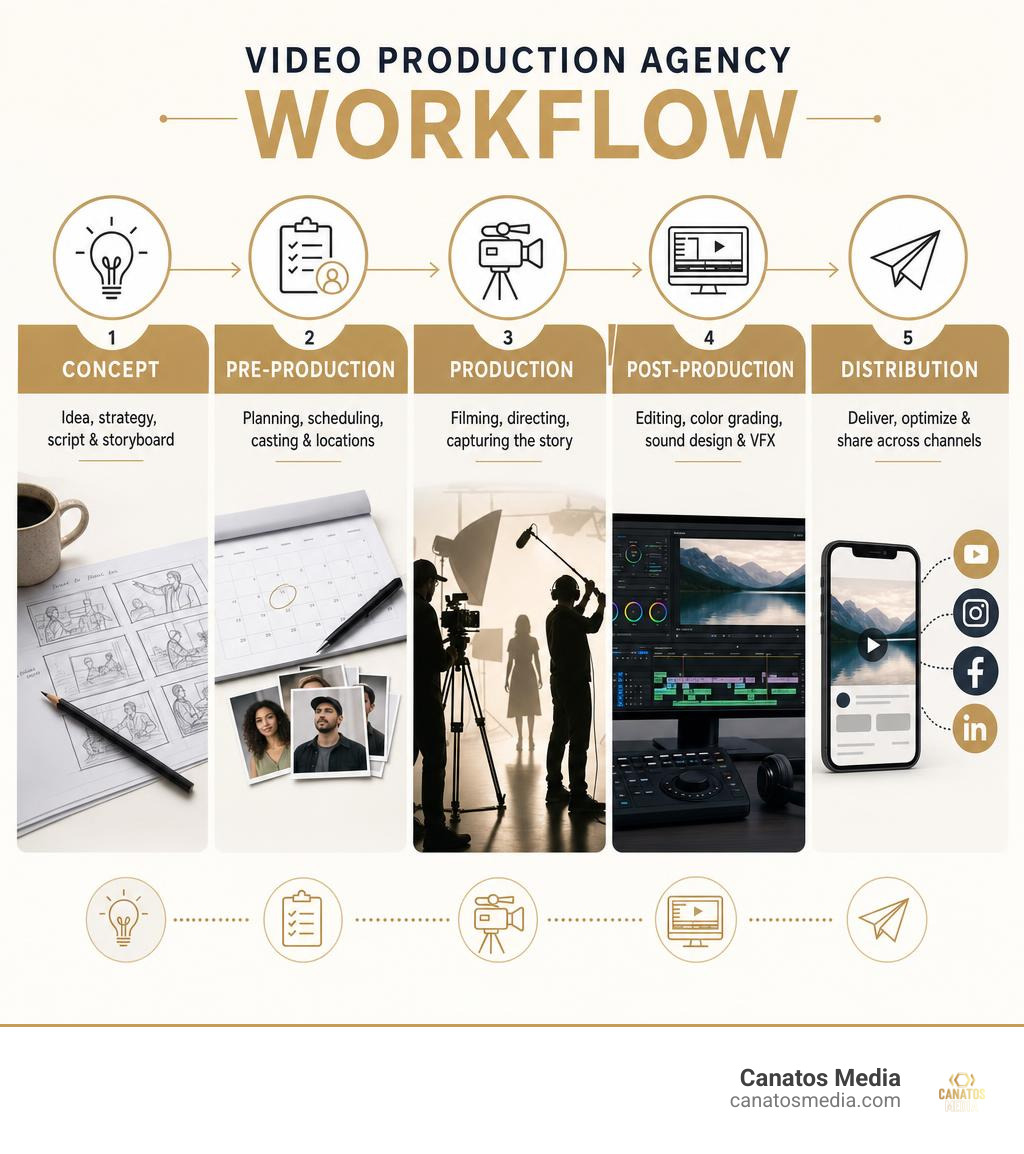
    The path from initial brief to live advertising happens through a coordinated system where each phase informs the next.

    Week 1-2: Strategy and planning. We define your advertising objectives, audience segments, platform strategy, and performance benchmarks. Content concepts get developed with these parameters as guardrails.

    Week 3-4: Production. Creative gets shot with multi-format output in mind. Raw footage gets organized by theme and message so editing can happen flexibly across multiple final versions.

    Week 5-6: Editing and optimization. Multiple cuts and formats come together. We’re testing variations that advertising data suggests will perform best: different hooks, different pacing, different closing frames.

    Week 7: Campaign setup and launch. Your videos upload directly into advertising accounts with proper audience segmentation and bid strategies already planned. We’re not starting fresh; we’re executing a strategy that was built into the creative.

    Ongoing: Performance monitoring and creative iteration. Ad performance data gets analyzed weekly. Underperforming videos get flagged for reshoots or repositioning. Strong performers get additional budget. This feedback loops directly back to the content team, not to a separate vendor.

    Lead Generation Through Coordinated Content and Promotion

    Lead generation happens when your content reaches the right person at the right moment with the right message. Fragmented teams struggle here because they’re not coordinating across all three variables.

    We build lead-generation systems by creating content that demonstrates value before the ask. A service-based business doesn’t need flashy video; they need video that shows how your process works and what results look like for real customers.

    Awareness content introduces your brand and demonstrates expertise through cinematic storytelling that stops the scroll.

    Consideration content shows your process, explains your differentiation, and builds confidence in your approach through case studies and customer testimonials.

    Decision content addresses objections, shows pricing transparency, and makes the next step obvious through clear calls-to-action.

    All three content types get promoted through coordinated advertising: awareness campaigns reach broad audiences with lower targeting, consideration campaigns retarget people who engaged with awareness content, and decision campaigns target warm audiences who’ve already shown interest. The content strategy and the advertising strategy are one unified system.

    For a multi-location service business, this might look like producing regional variations of core narrative content so each location can run locally-targeted campaigns with brand-consistent messaging. One production; multiple markets; coordinated ad spend. A fragmented approach would require separate production for each location or generic national content that doesn’t resonate locally.

    Measuring Results: How Integration Delivers Better ROI

    Integration changes what you can measure and how quickly you can improve based on data.

    With fragmented teams, you get siloed metrics: production agencies report on delivery speed and asset quality; advertising agencies report on clicks, impressions, and cost-per-click. Neither metric tells you what actually matters: leads, customers, and revenue generated from your video marketing investment.

    Integrated measurement connects the full funnel. We track which video variations, audience segments, platforms, and messaging approaches drive your highest-quality leads and lowest customer acquisition cost. Then we immediately feed that learning back into the next content production cycle.

    This creates a compounding advantage: every month your content gets slightly better at driving action because it’s optimized based on real performance data from the previous month.

    A typical integrated approach shows ROI improvement of 25-40% in the first three months as initial creative variations reveal which narratives and formats resonate with your specific audience. Fragmented approaches often plateau because feedback loops take too long and involve too many handoffs to act on insights quickly.

    Why Service-Based and Multi-Location Brands Need This Model

    Service-based businesses live or die on lead quality and conversion efficiency. You need video that builds confidence and demonstrates expertise, not entertainment content that generates vanity metrics.

    Our approach works particularly well for service businesses because we’re coordinating every video around your actual sales process. If your sales cycle involves consultation calls, we create content that qualifies prospects before they book. If your conversion depends on showing results, we prioritize case study and testimonial content that proves your capability.

    Multi-location brands face a different challenge: maintaining brand consistency while localizing for each market. Fragmented agencies force a choice between generic national content and expensive per-location production. We solve this through template-based production where core brand narrative gets localized through targeted advertising, voiceover variations, or location-specific footage additions, all coordinated around one unified strategy.

    For a plumbing company with five locations, this means one hero video about your process and values that introduces your brand, plus location-specific ads that show local service areas and customer testimonials. One core message; multiple market expressions; coordinated spend allocation.

    The Real Cost of Switching Between Agencies and Tools

    Consolidating from multiple agencies to one integrated partner involves real switching costs that deserve consideration. You’ll invest time in onboarding, rebuilding relationships, and potentially reworking some existing systems.

    But the cost of staying fragmented is higher. Every quarter you operate with separated teams, you’re absorbing inefficiency, managing duplicate processes, waiting for handoff delays, and missing opportunities to optimize based on performance data.

    The switching cost typically pays for itself within 60-90 days through eliminated rework, faster iteration cycles, and more efficient ad spend. Most of our clients report positive ROI on the consolidation decision within their first campaign cycle.

    How We Build Your Growth System From Content to Conversion

    We view your video marketing not as individual projects, but as a system that gets smarter and more efficient over time.

    Initial strategy work maps your specific audience segments, sales process, advertising objectives, and performance benchmarks. Content production happens with full visibility to all these constraints. Advertising strategy gets built during creative development, not after production completes. From your perspective, you’re managing one partner with one unified vision for your growth.

    As campaigns run, performance data gets analyzed and immediately informs the next production cycle. You’re not waiting for quarterly reviews or separate reporting. You’re seeing how creative variations perform within days and adjusting strategy accordingly.

    We measure success by your lead quality, customer acquisition cost, and revenue impact, not by vanity metrics like video views. Your growth becomes our accountability.

    The most effective approach is starting with one comprehensive campaign that moves through the full cycle: planning, production, advertising, optimization, and measurement. This proves the integrated model and establishes the feedback loops that compound over time.

    If you’re currently working with separated content and advertising vendors, it’s worth evaluating whether the coordination costs and delays are worth the price you’re paying. Most growth-focused businesses find that integration delivers better results, faster iteration, and clearer accountability for the same total investment.

    For further reading: End-to-end video marketing.

    Contact us today for a free consultation to see how we can help you grow your business.

    Frequently Asked Questions (FAQ)

    How does combining content production with advertising strategy actually save us money compared to hiring separate agencies?

    When we handle both content creation and paid advertising in-house, we eliminate the costly back-and-forth between disconnected teams and reduce revision cycles that waste your budget. Our content is built with advertising performance in mind from day one, meaning we’re not creating videos that look great but perform poorly on Meta or Google. You also avoid paying setup fees, onboarding costs, and the inevitable miscommunication that happens when different vendors don’t share the same metrics or goals.

    What’s the difference between how we approach video production versus traditional content agencies?

    We design every video specifically for paid advertising platforms and lead generation, not just for aesthetics or social virality. Our cinematic short-form content is structured to convert viewers into leads, which means we’re thinking about your landing pages, audience targeting, and sales funnel before we ever pick up a camera. Most traditional content agencies focus on creative storytelling without considering how the content will actually perform when promoted through paid channels.

    How do we measure whether our integrated approach is actually working for your business?

    We track the full journey from initial video view through lead capture and sales, so you see exactly which content pieces, ad placements, and audience segments generate your best results. Since we control both the creative and the advertising spend, we can test and optimize at every stage rather than guessing where the breakdown occurs between teams. Our reporting focuses on metrics that matter to your bottom line: cost per lead, conversion rates, and ROI on your total marketing investment.

  • Show, Don’t Just Tell: Crafting the Perfect Employer Brand Video

    Show, Don’t Just Tell: Crafting the Perfect Employer Brand Video

    What Is an Employer Branding Video (and Why It Changes Everything)

    An employer branding video is a short, engaging video that shows candidates what it’s really like to work at your company — not just what the job pays, but who your people are, what your culture feels like, and why someone would choose you over a competitor.

    Quick answer: Here’s what you need to know at a glance:

    Question Answer
    What is it? A video showcasing your company culture, values, and team — not a specific job opening
    Who is it for? Future candidates who want to feel your workplace before applying
    Why does it work? Viewers retain 95% of a video message vs. just 10% from text
    How long should it be? Under 90 seconds for social media; up to 2 minutes for YouTube or careers pages
    What performs best? Employee testimonials, day-in-the-life clips, behind-the-scenes footage
    Where should you post it? LinkedIn, TikTok, YouTube, Instagram, and your careers page

    Job seekers aren’t just scanning salaries anymore. Research shows that 77% of adults consider a company’s culture before applying — and a well-crafted video is the fastest way to show them yours.

    Think about it this way: a job posting tells candidates what the role is. An employer branding video shows them who you are. That difference is everything when you’re competing for top talent.

    The numbers back this up. Job postings with embedded video receive 800% more engagement than those without, and application rates jump by 34% when video is part of the listing. Static posts and text descriptions simply can’t compete with the emotional pull of a real person talking about why they love where they work.

    I’m Nic Canobbio, founder of Canatos Media, and with over two decades in media production — including scaling social content to more than 60 million views — I’ve seen how a strong employer branding video can transform how a company attracts talent. In this guide, I’ll walk you through exactly how to build one that works.

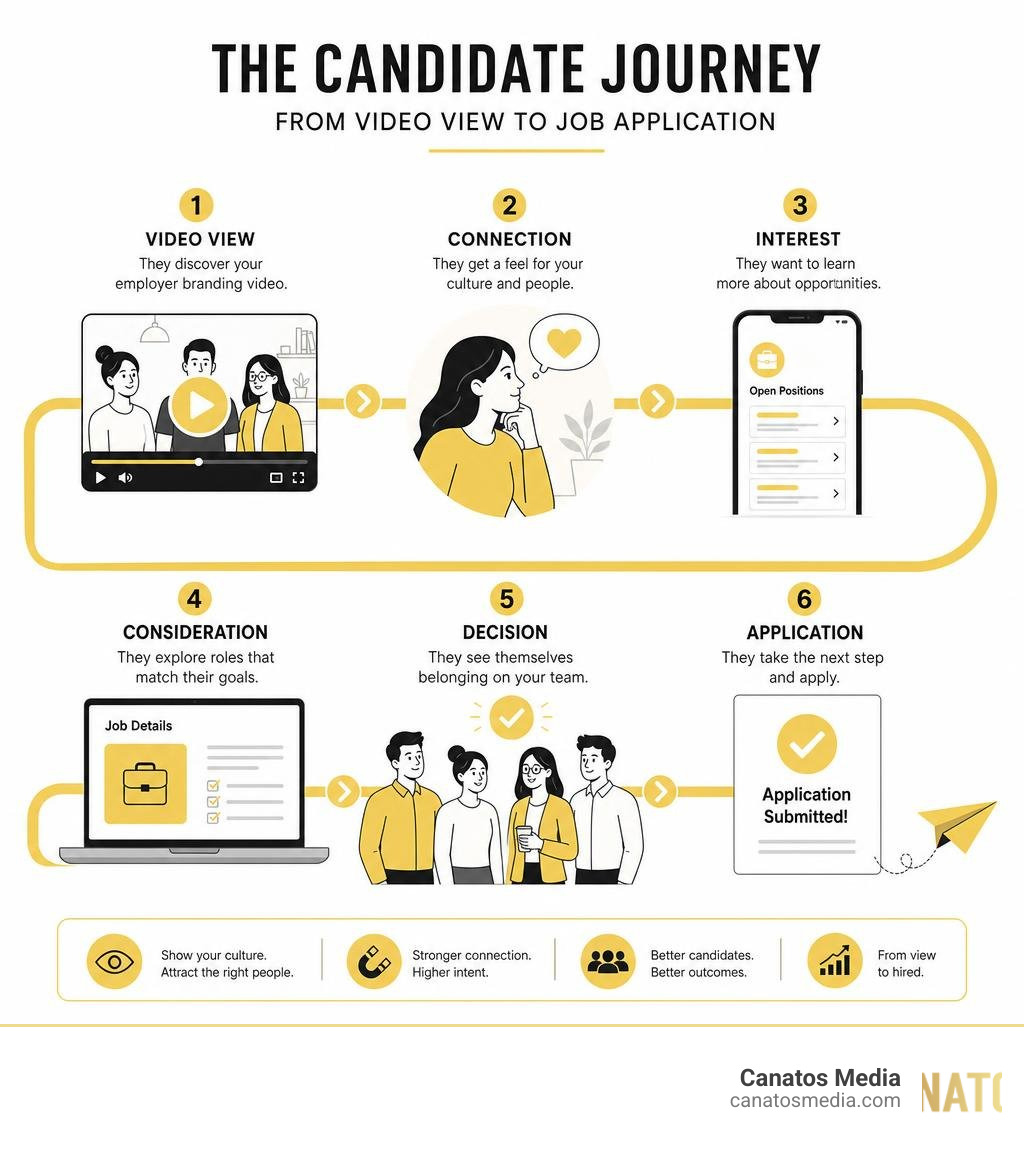
    Infographic showing candidate decision-making journey from video view to job application infographic

    Why Every Modern Recruitment Strategy Needs an Employer Branding Video

    In the hiring market of June 2026, talent acquisition is no longer a one-way street. Candidates are interviewing you just as much as you are interviewing them. An astounding 84% of job seekers say the reputation of a company as an employer is a key part of their decision-making process when applying for a job.

    If your digital presence consists entirely of dry, black-and-white text descriptions on job boards, you are missing out on the industry’s top tier of talent. To build an enduring, highly attractive employer reputation, you need to bring your company’s daily reality to life. For a deeper dive into how video fits into your broader marketing ecosystem, check out The Complete Guide to Video Marketing.

    job seeker watching a video on a smartphone

    The Difference Between a Recruitment Video and an Employer Branding Video

    It is common to hear HR professionals use “recruitment video” and “employer branding video” interchangeably, but they serve two distinct purposes in your talent acquisition funnel.

    A traditional recruitment video is tactical and short-term. It is typically tied to a specific job opening, listing the required skills, daily responsibilities, and immediate perks of a particular role. Its goal is transactional: Apply for this specific job right now.

    An employer branding video, on the other hand, is strategic and long-term. Instead of pitching a single role, it showcases your company’s overarching values, mission, work environment, and collective personality. It is designed to build a pipeline of passive candidates who think, “I don’t know what roles they have open right now, but I know I want to work there eventually.” For strategies on setting up this foundational narrative, read more about How to Create an Employer Branding Video That Attracts Top Talent.

    The Power of Video vs. Static Job Postings

    Let’s look at the hard facts. Humans are visual creatures. While reading a wall of text takes cognitive effort, watching a video is passive, engaging, and emotionally resonant. Viewers retain 95% of a message when delivered through video, compared to a meager 10% when reading it in text.

    Furthermore, search engines and social algorithms heavily favor video. Video content is 50 times more likely to rank on the first page of Google than traditional text-based content. If you are operating a business in the Tri-State area or right here on Long Island, local SEO visibility is paramount. Integrating high-quality video into your career pages and local listings ensures you stand out where candidates are actively looking.

    When you pair video with your job postings, the engagement metrics skyrocket. Job postings with video icons are viewed 12% more and receive a 34% greater application rate than postings without video. By showing real faces and authentic office dynamics, you also pre-screen candidates for culture fit, saving your HR team dozens of hours spent interviewing people who look great on paper but don’t align with your team’s energy. To understand why video is so effective at driving these actions, see Why Video Production is the Key to Modern Lead Generation for Service Businesses.

    Key Benefits and High-Performing Content Formats

    Implementing a video-first approach to your employer brand does more than just fill open seats; it drastically lowers your cost-per-hire and boosts overall brand awareness. When potential clients see how happy, engaged, and professional your employees are, their trust in your service increases as well. It’s a double-sided win. For a comprehensive look at how video elevates your entire brand presence, read How to Use Video to Boost Your Employer Brand.

    employees laughing during a behind-the-scenes shoot

    Top Video Formats: Testimonials, Day-in-the-Life, and Behind-the-Scenes

    Not all videos are created equal. To capture attention in 2026, you should utilize a mix of these high-performing formats:

    1. Employee Testimonials: These are the backbone of any employer brand. Instead of having your CEO read a scripted corporate speech, let your team speak from the heart. Highlight diverse roles and backgrounds to show that everyone has a voice. To see how top-tier brands structure these narratives, check out 10 Great Examples of Employer Branding Videos.
    2. Day-in-the-Life (DITL) Segments: Candidates want to see what their actual Tuesday morning will look like. A DITL video walks through an employee’s routine, from their morning coffee and team huddles to their actual workspace and collaboration sessions.
    3. Behind-the-Scenes (BTS) and Office Tours: Use humor or casual storytelling to showcase your physical workspace. If you have an open office layout, dynamic collaborative spaces, or beautiful local surroundings in the Tri-State area, show them off! You can find excellent inspiration on creative pacing and structure by studying how top-tier organizations structure their video campaigns.

    Leveraging Employee-Generated Content for Maximum Trust

    There is a major shift happening in how candidates consume media. Audiences have developed an incredibly sensitive “radar” for corporate insincerity. Overly polished, heavily scripted videos where employees look like they are reading under duress will actually push talent away.

    This is where employee-generated content (EGC) comes in. EGC can be categorized into two main types:

    • Low-Production EGC: Raw, authentic smartphone videos recorded directly by your employees. These work wonderfully for TikTok, Instagram Reels, and internal onboarding.
    • High-Production EGC: Professional videos shot by content specialists using high-end equipment, but structured around unscripted, genuine employee stories.

    By letting your team act as brand ambassadors, you build immense trust. A fantastic real-world example of this is seen in healthcare campaigns where authentic employee-led storytelling drove an average engagement rate of 9%—nearly triple the industry standard of 3.3%.

    For larger enterprises looking to scale this interactivity, tools like conversational widgets can make a huge impact by allowing candidates to engage directly with video content.

    How to Plan and Execute Your Video Strategy

    A great video doesn’t happen by accident. It requires careful planning, a clear understanding of your company’s core values, and a distribution strategy that meets candidates where they already spend their time. Whether you are a single-location business on Long Island or scaling across the Tri-State area, consistency is key. Learn how to maintain this standard at scale in Video-First Marketing for Franchises: How to Scale Brand Growth Across Locations.

    Best Practices for Producing Your First Employer Branding Video

    Before you hit record, keep these foundational best practices in mind:

    • Define Your Core Message First: What is the one thing you want candidates to feel? Is it your relentless drive for innovation, your warm and supportive family atmosphere, or your commitment to work-life balance? Start there.
    • Keep It Short: In the modern attention economy, less is more. Keep your primary brand videos under 90 seconds. You can always create shorter 15- to 30-second cutdowns for social media.
    • Design for Sound-Off Viewing: Up to 85% of social media videos are watched on mute. Always include clear, readable subtitles and dynamic on-screen text.
    • Focus on Truth Over Perfection: Let your employees speak naturally. Avoid scripts; instead, use open-ended prompts like, “Tell me about a time your team had your back when a project got tough.”
    • Leverage Local Expertise: If you are filming on Long Island or around New York, partnering with local production experts who understand the regional culture is invaluable. Working with a team that knows the local landscape ensures your regional storytelling feels authentic and right at home.

    For a deeper dive into structuring your production process, read How to Build a Video-First Employer Brand Strategy.

    Multi-Platform Distribution: LinkedIn, TikTok, and YouTube

    A masterpiece of a video is useless if no one sees it. You must tailor your distribution strategy to the unique culture of each platform:

    • LinkedIn: The gold standard for professional recruitment. Pair your video with a thoughtful, written post from your leadership team or the employees featured in the video. Keep the tone inspiring, professional, and value-driven.
    • TikTok & Instagram: This is where you showcase your raw personality. Focus on short-form, vertical videos, trending audio, and day-in-the-life challenges. Keep it fun, lighthearted, and highly visual.
    • YouTube: The perfect home for your longer-form, evergreen content. Optimize your video titles, descriptions, and tags for search so that candidates searching for your company name immediately find a high-quality window into your culture.

    To learn how to maximize your reach across all these channels, explore The Ultimate Guide to Video Marketing for Service Businesses in 2026.

    Measuring Success and Real-World Inspiration

    Like any marketing initiative, your employer branding campaigns must be backed by data. Tracking the right metrics allows you to refine your messaging, optimize your spend, and prove the direct return on investment (ROI) of your production efforts to company stakeholders. To see how we analyze and translate video views into tangible business growth, read How We Turn Video Views into Real Revenue for Service Businesses.

    Key Metrics to Track Video ROI

    To accurately measure the impact of your employer branding video, look beyond simple “view counts” and monitor these deep-funnel metrics:

    Metric What It Measures Why It Matters
    Retention / Watch Time How long viewers stay tuned in Tells you if your hook is working and if the content is engaging
    Click-Through Rate (CTR) The % of viewers who click your “Apply” or “Careers” link Measures immediate interest and the strength of your call-to-action
    Application Completion Rate The % of started applications that are actually submitted High video engagement should correlate with higher completion rates
    Cost-Per-Hire Total recruitment spend divided by number of hires Video-led strategies typically lower this by driving organic inbound talent

    For a comprehensive framework on analyzing your recruitment marketing data, see 5 Employer Branding Metrics You Should Be Tracking.

    Standout Examples: Google, Chipotle, and HubSpot

    When looking for creative inspiration, it helps to study the global brands that have mastered this medium:

    • Google: Google’s famous intern-focused videos successfully humanize a massive tech giant. By focusing on the nervous excitement of real, diverse interns on their first week, they show that even entry-level team members can make an impact.
    • Chipotle: Their popular “How I Chipotle” series focuses heavily on employee growth and personal journeys. By showcasing real crew members sharing their favorite custom food orders alongside their career advancement stories, they elevate fast-casual roles into highly attractive career paths.
    • HubSpot: Known for their incredibly transparent culture, HubSpot uses upbeat, employee-led office tours and candid discussions about flexible work arrangements to show exactly how they live their company values.

    To explore more award-winning creative strategies, check out The Best Employer Brand Videos to Inspire Your Strategy.

    Frequently Asked Questions

    How long should an employer brand video be?

    For social media platforms like LinkedIn, Instagram, and TikTok, aim for 30 to 90 seconds. For your dedicated careers page or YouTube channel, you can extend this to 2 minutes to allow for a deeper dive into employee stories. Always front-load your most exciting footage in the first 5 seconds to hook viewers before they scroll away.

    How do we ensure our videos feel authentic and not overly polished?

    The secret lies in unscripted storytelling. Avoid giving your employees pre-written scripts to memorize. Instead, conduct casual, conversational interviews using open-ended prompts. Film in your actual work environments with your real team, embracing natural laughs, spontaneous interactions, and minor imperfections.

    Should we produce our employer brand videos in-house or hire a professional agency?

    While basic, low-production employee-generated content is fantastic for daily social media updates, your primary brand video—the one that sits on your homepage and careers page—should be produced professionally. A professional agency ensures consistent brand guidelines, cinematic visual quality, crisp and clear audio, and a polished narrative structure that represents your business at its absolute best.

    Conclusion

    At the end of the day, attracting top talent isn’t about writing a flashier job description or listing more office perks. It’s about building a genuine connection. Candidates want to know that they will belong, grow, and do meaningful work with people they truly respect.

    At Canatos Media, we specialize in bringing these human stories to light. Based in the Tri-State area and serving businesses across Long Island, we create cinematic, short-form videos and execute integrated digital marketing strategies that connect your brand with the exact people you need to grow. We don’t just help you tell your story—we help you show it.

    Ready to transform your recruitment strategy and build a talent pipeline that drives real business growth? Why Video Production is the Key to Modern Lead Generation for Service Businesses is the perfect place to start. Let’s build something remarkable together.

  • Video Advertising Agencies for SMBs: Strategic Growth on a Sustainable Budget

    Video Advertising Agencies for SMBs: Strategic Growth on a Sustainable Budget

    Why SMBs Struggle With Traditional Video Marketing Approaches

    Most small and medium-sized businesses approach video marketing the same way: hire a production company for a polished brand film, post it once across channels, then wonder why engagement stalled. This works for companies with massive budgets and established audience bases. For growth-focused SMBs, it’s a financial dead-end.

    The real problem isn’t the production quality. It’s that traditional video marketing treats content as a one-time deliverable rather than a strategic asset designed to drive specific business outcomes. You end up with beautiful footage that doesn’t align with your sales funnel, doesn’t perform on the platforms where your customers actually spend time, and doesn’t scale across paid advertising channels.

    Many SMBs also assume they need to choose: either invest in cinematic quality or focus on conversion metrics. That false choice keeps them stuck cycling through cheap stock footage and generic templates that blend into the noise.

    The agencies that serve this space often lack integration. You might have a video production team that doesn’t understand paid advertising mechanics, or a performance marketing agency that treats video as an afterthought. Neither builds systems that compound over time.

    The Real Cost of Underestimating Video in Your Digital Strategy

    Video content now dominates platform algorithms. Meta, Google, and YouTube reward video engagement above static images and text. When you skip video or treat it as optional, you’re competing with one hand tied behind your back while your competitors capture attention and leads.

    The cost compounds quietly. Lower engagement rates mean higher cost-per-click on paid campaigns. Weaker organic reach means spending more on advertising to reach the same audience. Reduced trust signals (fewer views, shares, and comments) make conversion rates plummet. What starts as a modest underinvestment in video becomes a significant drag on your overall marketing ROI.

    Consider a service-based business like a dental practice or HVAC company with multiple locations. Without strategic video content, each location struggles to build local authority. Patient consultations feel generic. Referral momentum stalls. The business blames the market instead of recognizing that competitors with video-first strategies are capturing their share.

    The cost also appears in team bandwidth. Without purpose-built video systems, your internal marketing team wastes cycles trying to repurpose old footage, chase trends, or manage fragmented vendor relationships. That’s overhead that drains resources from actual growth work.

    What Sets Apart Video Agencies Built for Growth-Focused Businesses

    The best agencies for SMB growth combine three distinct capabilities: cinematic production that builds brand credibility, distribution strategy that reaches your specific audience, and conversion systems that turn viewers into leads.

    We look for alignment across several areas. First, your agency should understand the full customer journey, not just the production process. Where are your customers in their buying cycle? What objection or desire needs addressing at each stage? Video production without this context becomes expensive decoration.

    Second, the agency should specialize in short-form content optimization. A two-minute brand story has its place, but a 15-30 second asset built for Meta or TikTok ads with a clear call-to-action drives measurable results. Agencies that excel at SMB growth develop libraries of repurposable content that works across platforms.

    Third, look for integrated expertise. When your video producer understands paid advertising constraints and your paid advertising team understands cinematic storytelling, the strategy compounds. You get content that’s both beautiful and performance-driven.

    How We Combine Cinematic Quality with Conversion-Focused Systems

    At Canatos Media, we start every project by understanding your specific growth bottleneck. Are you struggling to book consultations? Build awareness in a new market? Reduce customer acquisition cost? The video strategy flows from that clarity.

    Our production process emphasizes cinematic storytelling with strategic editing. We don’t sacrifice visual quality, but every scene serves the conversion funnel. A product demonstration includes social proof elements. A customer testimonial emphasizes the transformation that matters most to prospects. A location showcase builds local credibility signals.

    We also build content systems, not one-off videos. For each project, we develop multiple formats from the same production: a 30-second paid ad, a 60-second social post, a 15-second carousel ad, and full-length supporting content. This efficiency means you get more return from each production dollar.

    The cinematic element matters more than many SMBs realize. Professional lighting, thoughtful composition, and smooth motion don’t just look better. They signal credibility and professionalism that builds trust with prospects who are evaluating you against competitors. Budget-conscious SMBs sometimes skip this, but the difference in conversion rates justifies the investment.

    Integrating Video Production with Paid Advertising and Social Management

    Video production exists to serve your broader marketing strategy. When your production and advertising teams operate separately, you lose leverage. The video gets made, then the advertising team scrambles to fit it into campaign structures. Timing gets misaligned. Budget constraints limit testing.

    We integrate production and advertising from project inception. Your advertising team provides constraints: platform-specific dimensions, audience insights, performance benchmarks from previous campaigns. Your production team builds creative that respects these requirements while maintaining cinematic quality. The result is content that performs.

    Social management adds another layer. Your video content needs consistent posting rhythm, community engagement, and platform-specific optimization to build momentum. We coordinate with your social calendar to ensure videos launch with supporting caption copy, community engagement strategy, and cross-platform amplification.

    For multi-location brands, this integration becomes critical. Scaling short-form ads effectively means producing location-specific variations that maintain brand consistency while speaking to local audiences. A coffee chain’s video about espresso quality plays differently in Seattle than in a suburban market. Integration ensures both locations get optimized creative without doubling production costs.

    Lead Generation Through Strategic Short-Form Content Distribution

    Short-form video wins on platforms because it’s digestible, shareable, and optimized for mobile viewing. But for SMBs, distribution matters more than virality. You need video reaching the specific people most likely to become customers.

    Strategic distribution starts with platform selection. TikTok works for youth-oriented brands but not for B2B services. LinkedIn performs well for professional services but struggles with product-focused content. Meta (Facebook and Instagram) offers precise targeting and strong conversion tracking. Google Ads captures high-intent search traffic. We build your distribution strategy based on where your audience actually engages.

    Converting social viewers into leads requires purposeful design. Every video needs a clear next step: a landing page link, a consultation booking button, a product page, or a lead magnet. The creative should prime viewers for that action. A video about common HVAC problems works best when it ends with a free inspection offer.

    Consistency across distribution channels builds familiarity and trust. When a prospect sees your brand on Facebook, recognizes the same style on Google Ads, and finds related content on your social feed, that repetition drives conversions. We maintain that consistency across platforms while adapting to each platform’s unique constraints.

    Building Your Video Strategy Across Meta and Google Platforms

    Meta and Google control most of the advertising attention for SMBs. Your video strategy needs to win on both.

    Meta platforms (Facebook and Instagram) excel at building audience awareness and engagement through lookalike audiences and detailed targeting. Video content performs best when it’s native to the platform, optimized for mobile, and builds emotional connection. We design Meta campaigns to reach cold audiences with awareness content, then retarget viewers with conversion-focused follow-ups.

    Google Ads captures different intent. Search ads with video extensions work when someone’s actively looking for your solution. YouTube placement reaches audiences watching related content. Google Shopping feeds product videos to high-intent browsers. We layer video across Google’s ecosystem to reach people at different consideration stages.

    The budget allocation between platforms depends on your business model. E-commerce might lean Google. Local service businesses often see better ROAS on Meta. Most balanced strategies use both.

    Measuring ROI: From Content Views to Qualified Leads

    Vanity metrics tempt every marketer. A viral video feels like success until you realize none of those viewers became customers. We measure what actually matters: quality leads and qualified conversions.

    This requires clear attribution setup. We track which videos drive clicks to your website, which clicks become lead form submissions, and which leads convert to customers. Without this chain of data, you’re flying blind.

    Different content serves different purposes. Awareness videos generate impressions and engagement; we measure these by views and engagement rate, but validate by tracking downstream conversion lift. Lead-focused videos should be measured primarily by cost per lead and lead-to-customer conversion rate. Branded conversion videos get evaluated on ROAS and customer acquisition cost.

    We establish baseline metrics before launching campaigns. If your current customer acquisition cost is 200 dollars, we set a specific improvement target. This frames every optimization decision around the business outcome that matters.

    Why Sustainable Video Advertising Requires Integrated Expertise

    Sustainable growth through video requires more than great production or great advertising expertise alone. It demands integration across the entire marketing operation.

    Production teams need to understand advertising mechanics so they build scalable creative. Advertising teams need to understand storytelling so they craft compelling narratives, not just optimized formats. Social management teams need to understand both so content reaches the right people at the right time. When these functions operate in silos, you lose leverage and consistency.

    We design our process around this integration. Your strategy team, production team, advertising team, and content management team work from the same brief. Goals align. Timelines sync. The output compounds because each function strengthens the others.

    This approach also builds efficiency. The same production shoot yields 10-15 variations. The same audience research informs both creative direction and advertising targeting. The same brand strategy guides everything from shot composition to call-to-action copy. That efficiency matters for SMBs managing budget constraints.

    Getting Started: Aligning Video Production with Your Growth Goals

    The first step isn’t scheduling a shoot. It’s clarity on your specific growth objective. Are you launching a new location? Building brand authority in a competitive market? Filling your consultation calendar? Reducing customer acquisition cost? Each goal demands different video strategy.

    Schedule a brief with your potential agency focused on understanding your business. How do customers currently find you? Where do you lose prospects in your funnel? What’s your current customer acquisition cost? What would meaningful improvement look like over the next six months?

    Then evaluate how the agency approaches these questions. Do they ask about your business and goals, or jump to production recommendations? Do they explain how video fits into your broader marketing? Can they articulate why their approach will work for your specific situation?

    We view every engagement as a partnership in sustainable growth. We invest time in understanding your business because the quality of our strategy depends on it. When you’re ready to move beyond generic video marketing toward integrated systems that drive measurable growth, we’re here to help you build that foundation.

    Contact us today for a free consultation to see how we can help you grow your business.

    Frequently Asked Questions (FAQ)

    How do you ensure our video content actually generates leads and sales, not just views?

    We build every video campaign around conversion mechanics from day one. Our process integrates cinematic storytelling with strategic distribution across Meta and Google platforms, paired with lead capture systems and retargeting sequences designed to move viewers into your sales pipeline. We track performance data throughout the funnel and adjust targeting, messaging, and creative based on what’s actually driving qualified leads for your business.

    What’s the difference between working with you versus hiring a traditional video production company and a separate digital marketing agency?

    We operate as a single integrated team, which means your video content, paid advertising strategy, and social media management are built to work together rather than operate in silos. Traditional agencies often hand off finished videos without understanding how they’ll perform in ads or how they fit into your broader lead generation system. We design everything from script to distribution specifically for conversion, eliminating the communication gaps and wasted budget that come from fragmented approaches.

    How does short-form video fit into a lead generation strategy for service-based businesses?

    Short-form video cuts through noise on social platforms where your potential customers already spend time, and we use it to establish credibility and address specific pain points your prospects face. We then connect this content to retargeting campaigns and lead magnets that capture contact information from engaged viewers. For service businesses especially, this approach builds trust quickly and creates a direct path from awareness to qualified inquiry.

  • Is a Social Media Content Creator Job Your Dream Career?

    Is a Social Media Content Creator Job Your Dream Career?

    Is a Social Media Content Creator Job Right for You in 2026?

    A social media content creator job is one of the fastest-growing career paths in digital media right now. Here’s what you need to know at a glance:

    What Details
    What you’ll do Film, edit, and publish short-form video and photo content for platforms like TikTok, Instagram, and YouTube
    What you’ll earn $40,000–$150,000+ per year depending on experience and role level
    Where you’ll work On-site, hybrid, or fully remote — 20% of current listings are fully remote
    Who’s hiring Entertainment, retail, beauty, tech, and agency brands across the U.S.
    How competitive is it 718 active U.S. job listings as of June 2026, with 43 new roles posted in the last 24 hours

    The demand is real and it’s growing fast. Whether you want a full-time brand role, a freelance contract, or a remote agency gig — there are more paths into this career than ever before.

    But knowing where to start and how to stand out is where most people get stuck.

    I’m Nic Canobbio, founder of Canatos Media, and I’ve spent over two decades in media production — creating content that has driven more than 60 million views across social platforms and building strategies that blend storytelling with AI-powered workflows. My hands-on experience in the social media content creator job space gives me a clear view of what employers actually want and what it takes to build a sustainable career in this field. In this guide, I’ll walk you through everything — from the job market to the skills, salaries, and strategies that will help you land the role.

    Overview of the social media content creator job ecosystem including platforms, skills, salary, and job types infographic

    The job market for social media creators has matured dramatically. What once felt like a scrappy, undefined gig has solidified into a highly structured, respected professional career path. As of June 2026, there are 718 active social media content creator job listings in the United States, with 43 fresh roles posted in just the last 24 hours.

    Brands have realized that traditional corporate advertising doesn’t connect with audiences the way it used to. Instead, they need a dedicated, creative engine to humanize their brand, translate internet culture, and build active digital communities.

    Whether you’re looking to work for an in-house brand, a creative agency, or build a freelance roster, the opportunities are abundant. If you search for open roles on platforms like LinkedIn, you’ll find hundreds of active listings, such as the 840 Social Media Content Creator jobs in United States – LinkedIn, showing that brands across every sector are actively recruiting.

    While the market is highly competitive, there is a distinct shortage of creators who understand how to balance raw creative intuition with business-driven performance metrics. If you can prove that your content doesn’t just look pretty but also moves the needle for brand engagement and conversions, you will be in high demand.

    Day-to-Day Realities of a Social Media Content Creator Job

    What does a social media content creator actually do all day? If you picture someone just lounging on a couch filming quick lip-sync videos, think again. The day-to-day reality of a social media content creator job is a , multi-disciplinary balancing act that requires both creative right-brain thinking and organized left-brain execution.

    On any given day, your schedule might look like this:

    • Morning Ideation & Scripting: Analyzing platform trends, auditing competitor channels, and writing tight, high-hook scripts.
    • Production: Setting up studio lighting, framing mobile or mirrorless camera shots, and filming multiple variations of hooks, calls-to-action, and b-roll.
    • Post-Production: Editing raw footage, adding native text overlays, choosing trending audio, and timing transitions perfectly to keep viewer retention high.
    • Optimization & Publishing: Writing engaging captions, optimizing hashtags, adjusting safe zones, and scheduling posts.
    • Analytics & Strategy: Reviewing watch-time metrics, engagement rates, and comment sections to figure out what worked and what needs to be iterated.

    To thrive in this environment, organization is key. You aren’t just making videos; you are managing a complex creative pipeline. For a deeper look at how to run this workflow smoothly, check out our guide on How to Master Social Content Management Like a Pro to understand how professional teams organize their content calendars and creative assets.

    Industry Variations: Beauty, Entertainment, and Retail

    The day-to-day responsibilities of a social media content creator job shift dramatically depending on the industry you choose to work in. Let’s look at how the role varies across three of the most popular sectors:

    1. The Beauty Industry

    In the beauty space, visual fidelity and aesthetic perfection are everything. Creators in this niche must have an expert eye for lighting, macro-photography, and color grading. You will spend your days filming high-definition texture shots, step-by-step application tutorials, and ASMR-style unboxings.

    The focus is heavily on product-centric storytelling, showcasing ingredient benefits, and matching the brand’s signature visual aesthetic. You must also be highly skilled at working with ring lights and studio backdrops to make skin and products look flawless on camera.

    2. The Entertainment Industry

    In entertainment marketing, speed and cultural relevance are your primary currencies. If you work for a TV network, a film studio, or a streaming platform, your job is to drive fandom engagement.

    This means combing through episodes, trailers, and behind-the-scenes footage to find scroll-stopping moments. You will write witty, platform-native copy, design text-on-image memes, and jump on real-time internet trends within hours of them going viral. It is a highly collaborative, fast-moving environment where you must live and breathe pop culture.

    3. The Retail Industry

    Retail content creators bridge the gap between digital content and physical experiences. If you work for a major retail brand, a lifestyle company, or a large physical destination, you will rarely be stuck behind a desk. You will be on-site, capturing the real-world energy of physical locations.

    A retail store walkthrough video shoot being captured on a mobile stabilizer

    This involves filming store walkthroughs, covering live events, showing off product styling in real-world settings, and interviewing shoppers. It is a highly active role that often requires working flexible hours, including weekends, to capture footage when foot traffic and event energy are at their peak.

    How to Stand Out and Land a Social Media Content Creator Job

    Because the entry barrier to making social media content is low, hiring managers are flooded with applications. To land a premium social media content creator job, you must prove you are a professional, not just an amateur hobbyist. Here is how to make your application impossible to ignore:

    1. Build a Video-First Portfolio: Ditch the traditional text-only resume. Your portfolio is your most important asset. It should live on a clean, modern website or a dedicated social handle. Include 3–5 high-performing short-form video case studies. Show the original hook, explain your creative strategy, and share the performance metrics (views, watch time, share rate).
    2. Highlight Multi-Format Versatility: Show that you can write witty copy, design clean graphic templates, shoot high-quality video, and edit on a tight deadline. Employers want a “one-person engine” who can take a concept from a blank page to a finished upload.
    3. Submit a Custom Creative Application: When applying to highly creative companies, don’t just send a generic cover letter. If you are applying to an entertainment brand, include a custom meme utilizing their IP. If you are applying to an agency, submit a 60-second vertical video explaining why you are the perfect fit.

    For example, when looking at creative application processes, you will see that forward-thinking employers often ask candidates to share their favorite current social media trends or submit custom creative assets to prove their cultural alignment.

    Core Skills and Technical Proficiencies Required in 2026

    To succeed as a professional content creator in 2026, passion isn’t enough. You need a robust technical toolkit. The modern creator is a hybrid professional who combines cinematic production standards with rapid, software-driven editing workflows.

    According to professional job listings, top-tier employers look for candidates who can seamlessly blend high-quality physical cinematography (using mobile and mirrorless systems) with expert-level post-production and AI automation.

    Here are the core technical proficiencies you need to master:

    • Camera & Lighting Mastery: Understanding frame composition, the rule of thirds, safe zones for vertical formats, and how to utilize natural light, ring lights, and three-point studio setups.
    • Audio Engineering: Capturing clean, crisp voiceovers using lavalier or shotgun microphones, and mixing background audio so it never overpowers the spoken word.
    • Industry-Standard Software: High proficiency in tools like Adobe Premiere Pro, Final Cut Pro, CapCut, Photoshop, and mobile editing apps.
    • Visual Branding: The ability to build and maintain branded style templates, select consistent typography, and design clean thumbnails.

    Mastering Short-Form Video Formats

    Short-form vertical video is the undisputed king of digital marketing. Platforms like TikTok, Instagram Reels, and YouTube Shorts drive the highest reach, engagement, and conversion rates across the web.

    But creating vertical masterpieces that actually convert requires a deep understanding of platform-native psychology. You cannot simply film a traditional horizontal ad, crop it to 9:16, and expect it to perform.

    Every platform has its own unique user behavior and algorithmic rules:

    • The 3-Second Hook: You must capture attention immediately. Whether it’s a visual pattern-interrupt, an intriguing question, or a bold on-screen text overlay, the first three seconds determine if a viewer stays or swipes.
    • Pacing and Rhythms: Modern vertical video editing is fast. You need to utilize jump cuts, zoom ins, sound effects, and text transitions to keep the viewer’s eyes moving and prevent drop-off.
    • Safe Zone Optimization: You must design your videos so that critical text, captions, and visual elements are not covered by platform user interfaces (like the mute button, profile icon, or description text).

    To learn how to design vertical videos that turn casual viewers into paying customers, read our guide on How to Create High-Impact Short-Form Content That Converts on Facebook and Instagram Reels. If you want to understand how to distribute these vertical assets effectively across platforms, check out our breakdown of Where to Post Your Vertical Masterpieces.

    The Rise of AI-First Workflows

    AI has completely revolutionized the creative workflow. In 2026, the most successful content creators aren’t running from artificial intelligence — they are embracing it as their ultimate creative partner to automate bottlenecks and scale production.

    A graphic displaying how AI tools integrate into the content creation workflow from scripting to editing infographic

    Professional creators use AI tools to:

    1. Accelerate Ideation: Utilizing generative models to brainstorm hundreds of hook variations, outline video scripts, and research emerging trends.
    2. Automate Editing Bottlenecks: Using tools like CapCut or Premiere Pro’s AI features to generate instant, highly accurate auto-captions, remove filler words (like “um” and “uh”), and automatically reframe horizontal footage into vertical formats.
    3. Enhance Production Quality: Leveraging AI tools to clean up background noise, extend video frames, and generate b-roll assets on the fly.

    By using AI to handle repetitive technical tasks, you free up your mental energy to focus on what matters most: high-level creative strategy and authentic storytelling. This hybrid approach is why professional agencies are able to produce high-volume, high-impact content much more efficiently than solo freelancers.

    To explore this dynamic further, read our article on Short-Form Content Strategy: Why Agencies Outperform Freelance Marketplaces and see how we scale production without sacrificing that crucial human touch in our guide on How We Scale Cinematic Short-Form Content Without Sacrificing Quality.

    Salary Ranges, Job Types, and Geographic Hotspots

    The financial landscape for a social media content creator job varies widely based on your location, your experience level, and the employment structure you choose. Because social media is a highly visible, revenue-generating function, companies are willing to pay top dollar for proven talent.

    If you are looking for open roles, check out the current active listings on Flexible Content Creator New York Remote Jobs – Indeed to see how compensation, benefits, and remote options are structured across different industries.

    Let’s break down the typical salary expectations across experience levels:

    • Entry-Level Creators (0-2 years experience): $40,000 – $60,000 per year (or $20 – $30 per hour for part-time/contract roles). These roles focus heavily on execution, asset creation, and basic editing under the direction of a senior strategist.
    • Mid-Level Creators (2-5 years experience): $65,000 – $95,000 per year. At this stage, you are expected to own the content pipeline, pitch creative strategies, shoot and edit independently, and analyze performance data.
    • Senior Creators / Directors (5+ years experience): $100,000 – $150,000+ per year. These high-paying roles require you to lead creative teams, manage agency partnerships, integrate organic content with paid ad strategies, and align social media goals with overall business revenue.

    U.S. Cities with the Highest Demand

    While remote work is highly popular, geographic location still plays a massive role in where the highest-paying, most prestigious jobs are located.

    The Tri-state area — specifically New York City and its surrounding regions like Long Island — remains one of the absolute biggest global hubs for media, fashion, retail, and advertising.

    • New York, NY: Accounts for 114 out of 718 (16%) of all active content creator job listings in the country. If you want to work with major global brands, high-profile agencies, or luxury retail, New York is the place to be. You can browse active local listings on 129 Social Media Content Creator jobs in New York – LinkedIn.
    • Long Island & Tri-State Suburbs: Many local businesses, auto groups, real estate firms, and boutique marketing agencies in Long Island are actively hiring in-house creators to build local brand awareness. If you want to work close to home, check out local job boards or search for local marketing roles on major platforms like LinkedIn and Indeed.

    A social media content creator editing viral short-form video on a laptop in a cozy NYC cafe

    Many of these local suburban roles offer hybrid schedules, allowing you to spend a couple of days shooting on-site on Long Island and the rest of the week editing from the comfort of your home.

    Comparing Job Types and Experience Levels

    To help you decide which employment path aligns best with your lifestyle and career goals, let’s compare the three primary job types available to social media creators:

    Feature Full-Time Brand Role Freelance / Contract Creative Agency Role
    Income Stability High (fixed salary + benefits) Variable (hourly or per-project rate) High (fixed salary + benefits)
    Creative Variety Low (focused on one brand) High (work with multiple clients) High (manage multiple client accounts)
    Schedule Flexibility Low (typically structured hours) High (you set your own hours) Moderate (agency deadlines & structures)
    Growth Potential Linear (advancing to Manager/Director) Unlimited (scale your own business) Rapid (exposure to diverse industries)
    Collaboration Work with internal marketing teams Work solo directly with business owners Work with professional designers, editors, and ad buyers

    If you are a small business owner looking to hire, or a creator wanting to see how professional agencies bridge the gap between organic creative work and paid advertising, check out our guide on Social Media Marketing Agency: Small Business Matches Made in Heaven.

    Frequently Asked Questions about Content Creation Careers

    What qualifications do I need for a social media content creator job?

    You do not need a specific college degree to land a social media content creator job. While a degree in marketing, communications, or film production can look great on a resume, hiring managers care infinitely more about your proven portfolio and your platform mastery.

    To prove you have what it takes, you should focus on developing a diverse, self-taught skill set:

    • Show, Don’t Tell: Create a personal social media account and use it as your sandbox. Experiment with different editing styles, hooks, and transitions, and show that you can organically grow an audience from scratch.
    • Master the Tools: Take free or low-cost courses to master Adobe Premiere, CapCut, and basic lighting setups.
    • Understand Distribution: Learn how to optimize your finished videos for different platforms. For a deep dive into where and how to upload your content for maximum reach, read our guide on Where to Post Your Vertical Masterpieces.

    Can I work fully remote as a social media content creator?

    Yes, but it depends heavily on the industry. Approximately 20% of active social media content creator job listings are fully remote. These remote roles are highly common in industries like SaaS (software as a service), B2B tech, and digital agencies where the content can be created using screen recordings, stock assets, user-generated content (UGC) networks, or remote interviews.

    However, if you work in retail, hospitality, entertainment, or local services, your role will naturally require a hybrid or on-site schedule. You cannot film a walkthrough of an amusement park, shoot product textures for a beauty brand, or cover a live event from your living room.

    If you prefer a hybrid lifestyle, look for roles that allow you to cluster your filming days together on-site, leaving you with quiet, uninterrupted remote days for editing and planning.

    How are AI tools changing the content creator role?

    AI is not replacing content creators; it is replacing creators who refuse to use AI. Artificial intelligence acts as a powerful force multiplier that allows a single creator to run like an entire production studio.

    By automating tedious tasks like generating captions, cutting out silences, and resizing video formats, AI tools allow you to focus on the high-level creative work that computers cannot replicate: authentic human connection, unique humor, and strategic storytelling.

    Conclusion: Is This Your Dream Career?

    A social media content creator job is an incredibly rewarding career path for anyone who loves blending visual storytelling with digital strategy. It is a , highly dynamic role where you get to shape brand narratives, experiment with cutting-edge creative technology, and see the real-time impact of your work.

    But to truly succeed and scale your career, you must remember that content does not exist in a vacuum. The most valuable creators are those who understand how organic content fits into a larger, integrated digital marketing strategy.

    At Canatos Media, we specialize in this exact intersection. We create cinematic short-form videos, manage end-to-end social media, run high-converting paid ads (Meta and Google), and provide SEO and website support for businesses across the Tri-state area and Long Island. Our unique strength lies in our integrated strategy: we connect beautiful creative content with precise targeting and conversion optimization to drive real, measurable business growth.

    If you are a business owner looking to take your digital presence to the next level without the headache of managing a content pipeline yourself, check out our All-in-One Social Content and Management services. Let us handle the strategy, the production, and the growth while you focus on running your business.

  • How Multi-Location Businesses Scale With Integrated Video Marketing Systems

    How Multi-Location Businesses Scale With Integrated Video Marketing Systems

    The Challenge Multi-Location Brands Face With Fragmented Marketing

    Multi-location and service-based businesses face a unique marketing problem: your growth depends on converting attention into leads across dozens of locations, often with inconsistent messaging and fragmented systems. At Canatos Media, we’ve built solutions specifically for brands operating at scale, combining cinematic short-form video production with integrated digital strategies that turn social engagement into measurable sales.

    When you operate multiple locations, your marketing efforts often become siloed. Each branch uses different platforms, different messaging, and sometimes different agencies. One location’s Instagram strategy doesn’t align with another’s Facebook approach. Your Google Ads campaigns run independently from your SEO efforts. The result is a scattered brand presence that dilutes your marketing spend and confuses your audience.

    This fragmentation costs you in three ways. First, you lose message consistency, which erodes brand recognition and trust. Second, you waste budget by duplicating efforts across locations instead of centralizing strategy. Third, you miss the compounding effect of integrated systems where video content fuels paid ads, organic search, and lead conversion simultaneously.

    The most successful multi-location brands we work with recognize that growth requires alignment. Your video content should power your social strategy, your social data should inform your paid advertising, and your entire system should funnel toward a single lead generation goal. Video ad campaigns for multi-location growth demand this cohesion to deliver results.

    What to do next: Audit your current marketing channels and identify where messaging diverges between locations. Note which platforms drive the most engagement but lack a clear path to leads.

    Why Generic Video Content Fails to Drive Business Growth

    Not all video content is created equal. Many businesses produce videos that look polished but feel disconnected from their actual business challenges. A generic testimonial video might get views, but it rarely converts viewers into qualified leads.

    The problem is deeper than production quality. Generic video content fails because it doesn’t tell a specific story about your business, your customers’ struggles, or why you solve their problems better than alternatives. It’s created for content’s sake, not for conversion.

    Effective video content for lead generation does three things simultaneously: it demonstrates your expertise, builds emotional connection with your audience, and creates urgency to take action. This requires cinematic storytelling that goes beyond talking heads or product demos. It means showing transformation, not just features.

    When we produce video for our clients, we start by understanding their customer’s journey. What objection stops them from buying? What proof would move them forward? How does a customer’s life actually change after working with you? These insights shape every frame, making content that drives measurable outcomes instead of vanity metrics.

    What to do next: Review your last five video posts. For each one, identify the specific business outcome it was designed to achieve. If you can’t name it, that’s likely why engagement didn’t convert to leads.

    Building Consistent Brand Narrative Across Multiple Locations

    Consistency doesn’t mean every location posts identical content. It means every piece of content reinforces the same core brand story, values, and positioning, regardless of which branch creates it.

    We approach this by developing a brand narrative framework that all locations follow. This framework includes your core value proposition, the transformation you deliver, and the tone of voice you use. Within that framework, each location can create locally relevant content that speaks to their specific market while staying true to the broader brand.

    For example, a multi-location home services company might have a core narrative about “solving home problems before they become emergencies.” One location might create content around seasonal maintenance (relevant to their climate), while another focuses on emergency response times (relevant to their competitive market). Both reinforce the same brand promise through different local angles.

    Cinematic quality amplifies this consistency. When all your video content shares a professional production standard and visual style, it reinforces brand recognition across channels and locations. This consistency builds trust faster than scattered, lower-quality content ever could.

    What to do next: Document your top three brand differentiators. These become the pillars for all content creation across locations, ensuring narrative consistency without limiting creativity.

    How Cinematic Short-Form Content Converts Social Traffic Into Leads

    Short-form video dominates social platforms because it holds attention in a crowded feed. But most brands stop there, creating entertaining content that doesn’t drive business results.

    Cinematic short-form content works differently. It captures attention through visual quality and storytelling, then uses that attention to move viewers closer to a buying decision. A 30-second video might show a transformation or solve a specific customer problem, with a clear call to action that drives toward your lead capture system.

    The structure matters. We typically build short-form video around this framework:

    • Hook within the first second (visual or narrative tension)
    • Problem identification (show your audience’s pain point)
    • Your solution in action (demonstrate results, not just claims)
    • Social proof or outcome (testimonial, metrics, or visual confirmation)
    • Clear next step (link in bio, website, booking calendar)

    This structure works across platforms because it respects how people consume content on Instagram, TikTok, YouTube Shorts, and Facebook. Each platform has different audience behaviors and technical requirements, but this narrative framework translates everywhere.

    When this content is supported by paid advertising, the conversion lift is dramatic. Social viewers who see cinematic content through paid placement tend to engage more and take action more readily than organic-only audiences.

    What to do next: Identify your three most common customer objections. Plan one short-form video that addresses each objection using the structure above.

    Our Full-Service Approach to Video-First Marketing Strategy

    Video production alone doesn’t scale a business. We’ve built a full-service model that treats video as the centerpiece of an integrated system, not an isolated deliverable.

    Here’s how it works. We start with strategy, not production. We understand your target customer, competitive landscape, and conversion goals. Then we create a video content roadmap that feeds into your social media calendar, informs your paid advertising strategy, and supports your organic search visibility.

    The production itself is cinematic because visual quality differentiates you in crowded social feeds and builds credibility with prospects. But that cinematic content only moves the needle if it’s distributed strategically, amplified through paid channels, supported by SEO optimization, and integrated into a lead capture system.

    Our approach includes social media management to ensure consistent posting and community engagement, paid advertising systems that target your ideal customers with your best-performing content, SEO optimization so your content ranks for high-intent search queries, and lead generation workflows that turn engagement into qualified prospects for your sales team.

    This integration is what separates commodity video production from growth-driving video marketing.

    What to do next: Map your current customer journey from awareness to lead capture. Identify where video content can strengthen each stage.

    Social Media Management That Amplifies Video Performance

    Posting video content inconsistently kills your reach. Algorithms reward accounts that post regularly with consistent quality, and your audience needs predictable content to stay engaged.

    We manage posting schedules that maintain consistent presence across platforms without overwhelming your team. This includes content calendar planning, caption optimization for engagement and searchability, community management, and performance monitoring.

    Beyond posting, we optimize content for each platform’s unique characteristics. A video that performs well on Instagram may need different cropping, caption length, or hashtag strategy on TikTok or YouTube. Platform-specific optimization dramatically improves reach and engagement.

    We also analyze performance data to identify which content resonates most with your audience. This data informs future video production choices, ensuring you’re creating more of what actually drives results.

    What to do next: Choose one platform where you want to strengthen presence. Commit to three new video posts this month with captions that drive specific actions.

    Organic reach alone doesn’t scale growth for most businesses. Paid advertising amplifies your best content, puts it in front of targeted audiences at the right moment, and drives measurable conversions.

    We build paid advertising systems around your video content because video ads outperform static creatives on Meta and Google platforms. A cinematic 15-second video of a customer success story, paired with precise audience targeting and clear conversion objectives, drives significantly better return than generic text ads.

    Our approach includes audience targeting based on your ideal customer profile, bid strategy optimization to maximize conversions within your budget, creative testing to identify top performers, and continuous monitoring to adjust spending based on performance data.

    The key difference is treating paid advertising as a system rather than isolated campaigns. Your top-performing social videos become ad creative. Ad performance data informs which stories to tell in future production. Customer response data shapes your video angles for subsequent shoots.

    What to do next: Identify your three highest-performing organic videos from the past six months. These are your candidates for paid amplification.

    SEO Optimization for Long-Term Organic Visibility

    While paid advertising drives immediate traffic, SEO builds long-term organic visibility that compounds over time. Video content plays a crucial role in SEO strategy because it increases time on page, improves engagement metrics, and provides additional indexing opportunities.

    We optimize your video content for search through strategic keyword placement in titles and descriptions, transcript optimization that gives search engines text to index, and structural markup that helps search engines understand your content. This ensures your cinematic videos rank for relevant search queries, driving qualified traffic to your website.

    Beyond video optimization, we integrate your video strategy with broader SEO efforts. Blog posts that discuss the problems your videos solve, landing pages that feature video testimonials, and resource pages that embed how-to videos all work together to build topical authority and improve rankings.

    What to do next: Research five high-intent keywords related to your core service. Create one piece of content (blog post, landing page, or video) optimized for each keyword.

    Lead Generation Systems Built Into Your Marketing Workflow

    Driving traffic and engagement is only half the challenge. The other half is converting that attention into qualified leads for your sales team.

    Our lead generation systems integrate across all your marketing channels. Website forms embedded after video content, landing pages optimized for specific customer segments, email capture sequences that nurture early-stage interest, and CRM integration that tracks leads through your pipeline.

    The most effective systems are invisible to the user. A prospect watches a compelling video, feels moved to learn more, and encounters a natural next step (a form, a booking calendar, a consultation request) that requires minimal friction. Behind the scenes, that lead is automatically logged and routed to your team.

    We build these systems to work across channels. A social media viewer becomes a website visitor who downloads a resource and joins your email list. A YouTube search viewer watches a testimonial and schedules a consultation. Each path is designed, not accidental.

    What to do next: List every way a prospect currently converts to a lead. Identify gaps where video content could smooth the path and reduce friction.

    Real Results Multi-Location Businesses Achieve With Our Process

    Businesses that implement integrated video marketing systems consistently see measurable improvements across key metrics. Most clients experience 40-60% increases in social engagement within the first quarter, 25-35% improvements in website traffic from organic search within six months, and 3-5x return on ad spend through paid video campaigns.

    The compounding effect arrives in month four or five. By that point, you have enough video content performing across channels that your social presence becomes self-reinforcing. Your best videos rank in search. Your paid amplification of top performers drives consistent leads. Your team has enough examples of what works that future content creation becomes more efficient.

    Multi-location brands especially benefit because the systems you build at one location scale to others. One location’s successful video story can be adapted for another market, your paid ad audiences can expand geographically, and your social templates work across all branches.

    What to do next: Set specific targets for engagement, traffic, and lead volume over the next six months. These become your benchmarks for measuring success.

    Getting Started With Your Video Marketing Transformation

    The best time to begin is now, with a clear first step rather than waiting for perfect conditions.

    Start by auditing your current video content and performance. What’s worked? What hasn’t? What opportunities exist on platforms where you’re not yet active? This foundation guides every decision that follows.

    Next, define your core video story. This becomes the narrative spine for all future content, ensuring consistency across locations and channels. Your story should answer: “What transformation do we deliver?” and “Why should prospects choose us?”

    From there, commit to a content production schedule that’s sustainable for your team. Whether that’s one cinematic video per month or one per week, consistency matters more than volume. Paired with social management, paid amplification, and lead capture systems, a modest amount of quality content drives outsized results.

    We’re here to guide this process. Our role is turning your brand story into video content that converts, distributing it strategically across channels, and building the systems that transform engagement into growth. Reach out to discuss how we can support your specific situation.

    Contact us today for a free consultation to see how we can help you grow your business.

    Frequently Asked Questions (FAQ)

    How do we ensure consistent brand messaging across multiple locations?

    We build a centralized content and messaging framework that guides all locations while allowing for local relevance. Our team creates brand guidelines and template-based video content that maintains your core narrative, then we manage deployment across each location’s channels through our social media management service. This approach keeps your brand voice unified while letting individual locations connect authentically with their communities.

    What makes our cinematic short-form videos different from standard social content?

    We prioritize production quality and strategic storytelling in every piece we create, rather than treating short-form content as a secondary channel. Our videos are shot with cinematic techniques, color graded professionally, and built specifically to stop scrolls and spark engagement. We then integrate these videos into paid advertising and organic strategies so they don’t just look good, they drive measurable conversions and lead generation for your business.

    How do we measure whether our video marketing is actually generating leads and sales?

    We establish tracking systems upfront by connecting our video content, paid ads, and social channels directly to your lead capture and CRM processes. We monitor performance across Meta and Google advertising, track which videos drive the highest-quality leads, and optimize our strategies based on conversion data rather than vanity metrics. This lets us show you exactly which campaigns are moving the needle for your revenue.

  • Master Your LinkedIn Paid Campaign Strategy Without the Headache

    Master Your LinkedIn Paid Campaign Strategy Without the Headache

    Why Your LinkedIn Paid Campaign Strategy Is Make or Break for B2B Growth

    A strong linkedin paid campaign strategy is the difference between burning budget on bot leads and actually filling your pipeline with decision-makers who can sign contracts.

    Here is a quick-start framework to get your LinkedIn ads working:

    1. Pick the right objective first — Awareness, Consideration, or Conversion — based on where your buyer is in their journey
    2. Target precisely — Use job title, seniority, company size, and company lists to reach real decision-makers
    3. Keep audiences under 100,000 — Smaller, tighter audiences reduce junk traffic and bot leads
    4. Turn off Audience Expansion and LinkedIn Audience Network — These defaults drain budget on irrelevant impressions
    5. Match your offer to the funnel stage — Cold audiences need value-first content (checklists, webinars), not demo requests
    6. Use Manual or Cost Cap bidding — Avoid letting LinkedIn’s Maximum Delivery inflate your CPMs unchecked
    7. Budget at least $5,000/month — LinkedIn reps advise against Lead Gen or Conversion campaigns below this threshold
    8. Measure pipeline quality, not just clicks — Track qualified lead rate, sales acceptance, and cost per opportunity

    LinkedIn has over 1 billion users, and four out of five of them drive business decisions. That is an enormous professional audience. But the platform’s defaults, its auction system, and its ad formats can work against you if you do not know what to watch for.

    Many advertisers have spent thousands of dollars — sometimes over $3,000 in a single campaign — and walked away with zero qualified leads. Not because LinkedIn does not work, but because the setup was wrong from the start.

    I am Nic Canobbio, founder of Canatos Media, and over two decades of building media strategies and high-stakes partnerships has shown me exactly where a linkedin paid campaign strategy succeeds or stalls. In this guide, I will walk you through the exact steps to run campaigns that actually convert.

    LinkedIn paid campaign strategy funnel stages and ad auction overview infographic - linkedin paid campaign strategy

    Building a Full-Funnel linkedin paid campaign strategy

    To succeed on LinkedIn in May 2026, you cannot simply “set and forget” a single ad. B2B buyers are more sophisticated than ever. They require multiple touchpoints before they trust a brand enough to share their contact information. A full-funnel approach ensures you are not just asking for a “marriage” on the first date.

    Full-funnel B2B marketing diagram showing Awareness, Consideration, and Conversion stages - linkedin paid campaign strategy

    A successful funnel moves a prospect through three distinct stages:

    • Awareness: You are introducing your brand to a cold audience. The goal here is reach and “brand recall.” You want them to recognize your name when they see it again.
    • Consideration: You are providing value. This is where you drive traffic to your website or encourage engagement with a video. You are proving you understand their pain points.
    • Conversion: This is the “ask.” Whether it is a Lead Gen Form for a whitepaper or a website conversion for a demo, you are collecting data to hand off to sales.

    For a deeper dive into how social ads work across platforms, check out our guide on Paid Social Media Advertising from Zero to Hero in One Hour.

    Comparing LinkedIn Ad Objectives

    Funnel Stage Recommended Objective Best Ad Formats Key Metric
    Awareness Brand Awareness Video Ads, Single Image Impressions / Reach
    Consideration Website Visits / Engagement Thought Leader Ads, Document Ads CTR / Video View Rate
    Conversion Lead Generation / Conversions Lead Gen Forms, Conversation Ads CPL / Conversion Rate

    Aligning Objectives with High-Ticket B2B Services

    When you are selling high-ticket services—like podcast marketing for executives or enterprise software—the “Conversion” objective can be a trap if used too early. High-consideration purchases require high-trust relationships.

    According to Ad set setup best practices | LinkedIn Help, selecting the right objective is the foundation of your ad set performance. If you target a Fortune 1000 CEO with a “Book a Demo” ad immediately, you will likely see high costs and low engagement. Instead, align your objective with the “temperature” of the audience. Use Awareness to highlight a common industry problem, then use Consideration to offer a solution-oriented case study.

    Selecting Ad Formats for Every Funnel Stage

    Choosing the right format is as important as the message itself. In 2026, LinkedIn offers a variety of “media-rich” options:

    • Sponsored Content (Single Image & Carousel): The bread and butter of the feed. Carousels are excellent for step-by-step walkthroughs or product comparisons.
    • Video Ads: One of LinkedIn’s fastest-growing formats. Keep them under 30 seconds for the best results, and always include captions, as many executives browse on mute.
    • Document Ads: A powerhouse for lead gen. Users can read your whitepaper or checklist directly in the feed.
    • Thought Leader Ads: These allow you to sponsor a post from a real person’s profile (like a CEO or subject matter expert). They feel more authentic and less like a “corporate” ad.
    • Connected TV (CTV): 84% of B2B marketers using CTV ads find them helpful for ROI. These are perfect for high-level brand storytelling at the top of the funnel.
    • Sponsored Messaging (Message & Conversation Ads): These land directly in the inbox. LinkedIn has a frequency cap: members usually only receive these once every 45 days.

    Precision Targeting for C-Suite and Fortune 1000 Executives

    The most powerful feature of LinkedIn is the data. You can target by job title, company size, and even specific company names. However, “with great power comes great responsibility”—or in this case, the risk of over-targeting.

    Executive-level targeting settings in LinkedIn Campaign Manager - linkedin paid campaign strategy

    To reach the C-suite in the tri-state area or Long Island, you need a balanced linkedin paid campaign strategy. Start with your Ideal Customer Profile (ICP). If you are looking for Fortune 1000 leaders, do not just rely on job titles. Many executives have “unique” titles that might not fit standard categories.

    Instead, use Matched Audiences. This allows you to upload a specific list of target companies (Account-Based Marketing) and then layer on seniority filters like “VP” or “C-level.” You can also leverage Predictive Audiences, which uses LinkedIn’s AI to find users similar to your existing high-value customers.

    As noted in Paid Advertising on LinkedIn: A Practitioner’s Guide (2026), the goal is not to make the audience as small as possible, but to make it as coherent as possible.

    Avoiding Bot Leads and Audience Expansion Pitfalls

    One of the most common ways beginners blow their budget is by leaving default settings toggled “on.”

    • Audience Expansion: This allows LinkedIn to show your ads to people “similar” to your target. In theory, it sounds great. In reality, it often pulls in low-quality leads and bots. Turn it off for niche B2B campaigns.
    • LinkedIn Audience Network (LAN): This sends your ads to third-party apps and websites. Unless you are running a massive brand awareness play, uncheck this box to keep your ads strictly on the LinkedIn platform.

    If you have ever seen “leads” with zero connections and weird job titles, you have likely fallen victim to these settings. Use Exclusion Lists to filter out competitors, current employees, and job seekers to ensure every dollar is spent on potential buyers.

    Lead Gen Forms vs. Website Conversions

    This is the age-old LinkedIn debate.

    Lead Gen Forms are incredibly low-friction. They auto-fill with the user’s LinkedIn data, making it easy for them to convert. However, because they are too easy, you might get lower-intent leads. Website Conversions require the user to leave LinkedIn and fill out a form on your site. This creates more “friction,” but the leads who finish the process are usually much higher quality.

    When should you use which?

    • Use Lead Gen Forms for “low-threat” offers like checklists, industry reports, or webinar sign-ups.
    • Use Website Conversions for high-intent actions like “Request a Quote” or “Schedule a Consultation.”

    For help setting up these complex tracking systems, take a look at our digital marketing services.

    Optimizing Performance and Scaling Results

    Once your campaign is live, the real work begins. LinkedIn’s “learning phase” typically lasts 10 to 14 days. During this time, the machine learning algorithm is figuring out who is most likely to engage with your ad. Avoid making major changes during this window, or you will reset the clock.

    Bidding and Budgeting Strategies

    To control costs, you need to move away from “Maximum Delivery” once you have baseline data.

    • Manual CPC (Cost Per Click): This gives you the most control. Start at about 1/3 of LinkedIn’s suggested bid. If you aren’t spending your daily budget, increase the bid by 15-20%.
    • Cost Cap: You set a target price per result, and LinkedIn tries to keep your average near that number.
    • Budgeting: Realistically, you need at least $5,000 per month for conversion-focused campaigns. While the daily minimum is $10, that won’t provide enough data to optimize a high-ticket B2B service.

    Scaling Your linkedin paid campaign strategy with Accelerate

    LinkedIn recently introduced Accelerate campaigns. These are AI-assisted setups that automate targeting and creative placement.

    • When to use Accelerate: If you have a small team or are new to the platform, Accelerate can get you live fast.
    • When to use Classic: If you are doing strict ABM, targeting a very narrow list of companies, or need granular control over exclusions, stick with “Classic” campaigns.

    Refining Your linkedin paid campaign strategy through A/B Testing

    Never run just one ad. We recommend rotating at least 3-4 creative variations.

    • Test your Hook: Try one headline that calls out a pain point and another that promises a specific result.
    • Test your Visuals: Compare a professional stock photo against a “Thought Leader” style image of your founder.
    • User-Generated Content (UGC): Screenshots of reviews or video testimonials often outperform polished corporate videos because they provide social proof.

    Frequently Asked Questions about LinkedIn Ads

    How much budget is realistically needed for LinkedIn ads?

    While you can start with a $10 daily minimum, a linkedin paid campaign strategy aimed at high-ticket lead generation usually requires $5,000+ per month. This allows the algorithm enough “signal” to find your buyers. LinkedIn clicks are expensive—often $5 to $15+—so a small budget will result in very few clicks and zero statistical significance.

    What are the most common mistakes beginners make?

    The “Big Three” mistakes are:

    1. Hyper-targeting: Making an audience so small (under 10,000) that the ad auction ignores you.
    2. Leaving “Audience Expansion” on: This dilutes your targeting with irrelevant users.
    3. Weak Offers: Asking for a demo from someone who has never heard of you. Offer a “valuable asset” first.

    How do you reach Fortune 1000 decision-makers without junk leads?

    The secret is a combination of Company Lists and Manual Bidding. By uploading the specific list of Fortune 1000 companies and using manual CPC, you ensure you aren’t overpaying for “junk” traffic from the Audience Network. Also, ensure you are excluding “Junior” and “Entry Level” seniorities.

    Conclusion

    Mastering a linkedin paid campaign strategy is not about having the biggest budget; it is about having the most precise strategy. By moving away from “set and forget” defaults and focusing on a full-funnel approach, you can turn LinkedIn into a predictable revenue generator for your B2B business.

    At Canatos Media, we specialize in an integrated strategy that connects cinematic video content with surgical targeting. Whether you are in the tri-state area or right here on Long Island, we help you bridge the gap between “clicks” and “contracts.”

    Ready to stop guessing and start growing? Elevate your business with our professional marketing services and let’s build a campaign that actually works for you.

  • How to Allocate Your Marketing Budget Between Video Production and Paid Advertising

    How to Allocate Your Marketing Budget Between Video Production and Paid Advertising

    The Challenge of Splitting Marketing Dollars Across Channels

    Every growth-focused business owner faces the same difficult question: How much should we spend on creating content versus promoting it? This tension sits at the heart of modern marketing. You have a finite budget, competing priorities, and no shortage of vendors telling you their channel deserves the lion’s share.

    The problem isn’t that you lack options. It’s that most budget frameworks treat video production and paid advertising as separate decisions rather than interconnected parts of a single system. When we work with multi-location or service-based brands, we almost always discover they’re either investing heavily in content that never reaches their audience, or spending aggressively on ads without quality assets to drive conversions.

    The businesses that grow fastest recognize something fundamental: these two investments amplify each other. Your budget allocation isn’t really about choosing between them. It’s about finding the right ratio that turns your content into a lead-generation engine.

    Why Most Businesses Struggle With Budget Distribution

    The struggle typically comes from one of three places. First, many business owners lack historical data. If you’re new to integrated video and paid media, you don’t yet know what your audience responds to or what your conversion costs actually are. You’re making educated guesses.

    Second, budget allocation gets politicized inside organizations. Your sales team wants more leads now, so they push for immediate paid ads. Your brand team wants better content to stand out from competitors. Both are right, and neither perspective fully captures the picture. This internal tension often leads to compromise budgets that satisfy no one and optimize nothing.

    Third, most agencies and consultants specialize in one channel. They naturally recommend their expertise. A video production company will emphasize content creation. A paid media manager will stress the importance of ad spend. Neither has incentive to show you the true trade-off.

    The result is scattered spending with no clear ROI model to guide future decisions.

    The Strategic Advantage of Combining Video Content With Paid Promotion

    Here’s what we’ve learned from working with dozens of brands: video content and paid media aren’t alternatives. They’re a system. Video gives paid advertising something worth promoting. Paid media ensures your content reaches people who can actually become customers.

    Consider a concrete example. A service-based brand might create a 30-second cinematic video showing their process and results. That video is compelling, but only to people who see it. Without paid promotion on Meta or Google, it sits on social platforms accumulating a few organic views. With strategic paid media pushing that content to your target audience, the same video generates qualified leads at a predictable cost.

    The reverse is equally true. Paid traffic without quality creative wastes money. A poorly produced or generic video gets low engagement, high cost-per-click, and few conversions, no matter how much you spend.

    When we structure this combination correctly, each dollar spent on production increases the efficiency of your paid media spend. Better creative means lower cost-per-acquisition. Better cost-per-acquisition means your paid budget goes further. Your content investment becomes an asset that compounds in value over time.

    How We Structure Budget Allocation for Maximum Lead Generation

    Our approach begins with understanding your baseline conversion metrics. Before recommending a split, we identify what it currently costs you to acquire a customer through existing channels, what your average customer value is, and how many leads you need monthly to hit revenue targets.

    From there, we work backward to determine necessary paid media spend. If you need 100 qualified leads monthly and your current cost-per-lead is $75 through paid ads, you need $7,500 in monthly ad spend. That’s your baseline amplification budget.

    Video production budget comes next. We typically recommend allocating 30-50% of your monthly paid media budget toward consistent content creation. If you’re spending $7,500 on ads, invest $2,250-$3,750 monthly in short-form video production, social content, and website assets. This ratio ensures you have fresh, high-quality creative feeding your paid campaigns rather than recycling tired assets.

    This isn’t a fixed formula for every business. A brand with an existing content library might skew spending heavier toward paid media initially. A startup building brand awareness from scratch might invest 60-70% in content upfront, then shift toward paid as assets accumulate.

    Video Production as Your Core Asset Investment

    Think of video production as infrastructure. You’re building assets that work continuously across multiple channels. A single well-produced short-form video can run on Instagram, TikTok, Facebook, Google, and your website. It can be repurposed into email content, testimonial videos, or product explainers. One production investment creates multiple working assets.

    We focus on cinematic short-form content because it performs. 15-60 second videos capture attention faster than longer formats and maintain engagement across platforms. More importantly, high production quality signals credibility. Audiences unconsciously trust polished, professional creative more than generic or amateurish content.

    Budget breakdown for video production typically looks like this: talent or spokesperson time (if needed), location or studio rental, equipment and crew, editing and color grading, and revisions. For service-based brands, we often recommend producing 2-4 new pieces of short-form content monthly. This keeps your social feeds fresh, gives paid media new assets to test, and signals active, current business to potential customers.

    The key is consistency. Sporadic, high-budget productions create occasional assets. Monthly investment in production creates a reliable content system that compounds over time.

    Paid advertising extends your reach beyond organic social followers and search visibility. Where organic reach has declined sharply across most platforms, paid media ensures your content reaches your target audience at scale.

    We structure paid media spending across two primary channels: Meta (Facebook and Instagram) for audience targeting and awareness building, and Google (Search and YouTube) for high-intent customers actively searching for solutions you provide. The split between these typically depends on your business model.

    Service-based brands often benefit from a 40/60 split toward Google (capturing demand that already exists) with Meta handling awareness and retargeting. Product companies might reverse this, using Meta heavily for discovery and Google for intent-driven traffic.

    Your monthly paid budget should reflect lead goals and proven cost-per-acquisition. Test campaigns reveal real performance data. Once you know it costs $85 to acquire a customer in your market, you can confidently scale spend knowing the financial outcome. This transforms paid media from expense to predictable investment.

    The Financial Reality: What ROI Looks Like Across Channels

    Video production ROI isn’t immediate. You invest upfront and realize returns over months as those assets work across channels. A $3,000 video production might take 4-6 months to justify itself through improved paid media performance. But by month 12, that single asset has often generated 10-30x its production cost in customer value.

    Paid media ROI is measurable immediately. You can turn on a campaign, track conversions within days, calculate cost-per-acquisition, and know whether you’re profitable. This creates a psychological preference for paid spend over production investment. But this short-term visibility masks a critical risk: without quality creative, your paid ROI deteriorates over time as audiences fatigue on generic ads.

    The combined model delivers both horizons. Your paid media generates immediate, measurable revenue. Your video investments build long-term asset value and improve paid media efficiency continuously. Together, they create a sustainable, scalable lead generation engine.

    For a business targeting $10,000 monthly revenue from marketing channels, we typically see:

    • $5,000-$7,000 allocated to paid media
    • $2,000-$3,000 allocated to production and content
    • $500-$1,000 reserved for testing and optimization

    This ratio generates 15-25 qualified leads monthly for most service-based brands, with cost-per-acquisition stabilizing around $300-$450 by month three.

    Benchmarking Your Spend Against Industry Standards

    Industry benchmarks provide helpful reference points, though your actual allocation depends on your specific situation. Across professional services, e-commerce, and local service industries, we see successful brands spending 5-15% of revenue on marketing. Within that envelope, the split between production and paid varies considerably.

    High-growth companies (40%+ annual growth) typically allocate 45-55% of marketing budget to paid media, with 35-45% toward content creation and production. Mature companies with strong brand recognition often skew heavier toward paid promotion with 60-70% allocation.

    Your conversion metrics matter more than industry averages. If your cost-per-acquisition is rising month-over-month, you need better creative (production investment). If you’re satisfied with creative but not reaching enough prospects, you need more paid spend. Let your own performance guide allocation more than external benchmarks.

    Building a Scalable Budget Framework That Grows With Your Business

    A scalable framework connects growth to budget increases. As your business scales, your marketing budget should grow proportionally. The key is establishing clear rules for that growth.

    We recommend this progression: Start with baseline spend ($3,000-$5,000 monthly) allocated 40/60 between production and paid. Track performance metrics for 90 days. Once you have solid conversion data, allocate all new budget increases using the same 40/60 ratio until you hit diminishing returns in a channel.

    If you grow to $10,000 monthly budget, keep $4,000 toward production and $6,000 toward paid. At $20,000 monthly, $8,000 production and $12,000 paid. This maintains the system’s integrity while allowing scale.

    As you mature, adjust ratios based on performance. Perhaps paid media ROI flattens at certain scale. Shift surplus into new content formats or expanded production. The framework flexes without losing structure.

    Common Allocation Mistakes and How to Avoid Them

    The most common mistake is underinvesting in production. Businesses allocate 80-90% to paid media with minimal production budget, then wonder why cost-per-acquisition keeps rising. Generic creative fatigues audiences. Fresh, quality creative maintains efficiency.

    Second mistake: unbalanced timing. Production and paid need to work together. Starting a paid campaign before you have video assets to promote is like building an engine without fuel. Conversely, producing quality content without promotion means no one sees it.

    Third mistake: not measuring creative performance. Which videos drive conversions? Which platforms generate your best leads? Without tracking, you can’t improve allocation. We recommend tagging all paid campaigns by video asset and reviewing performance weekly. After 4 weeks, pause underperforming creatives and increase spend on winners.

    Fourth mistake: treating budget allocation as one-time decision. Markets shift, audience preferences evolve, and your business grows. Your allocation needs regular review and adjustment.

    Measuring and Adjusting Your Budget Split for Continuous Improvement

    Establish clear KPIs for both production and paid channels. For production, track engagement rates, click-through rates, and which videos drive lowest cost-per-lead. For paid media, track cost-per-click, cost-per-lead, and cost-per-acquisition by campaign and creative asset.

    Review performance monthly. If paid media ROI is declining while creative fatigue is evident, increase production budget. If you’re acquiring leads efficiently but can’t scale further in current channels, test new paid platforms and audiences, requiring some budget reallocation.

    Most importantly, remain willing to test. Set aside 10-15% of your budget as experimental spend. Test new video formats, new audience segments, new platforms. Quarterly, review what worked and what didn’t. Let winning tests influence your allocation framework.

    We help our clients structure this measurement through integrated dashboards tracking production assets, paid performance, and customer acquisition cost across all channels. When data is visible and organized, allocation becomes strategic rather than reactive.

    Start by auditing your current spend. Where is your budget actually going? What’s it producing? If you’re not seeing clear connections between investment and results, your allocation framework needs rebuilding. The businesses that dominate their markets use production and paid media as an integrated system, not competing channels. That integration starts with thoughtful allocation and continuous measurement.

    For further reading: Paid ads guide.

    Contact us today for a free consultation to see how we can help you grow your business.

    Frequently Asked Questions (FAQ)

    How do we recommend splitting budget between video production and paid advertising?

    We typically advise our clients to allocate 40-50% toward video production as your core content asset and 50-60% toward paid media to amplify that content across Meta, Google, and other platforms. The exact split depends on your current content library and lead generation goals, but we’ve found this balance maximizes ROI by ensuring you have quality creative assets worth promoting. If you’re starting from scratch, we may recommend a heavier production investment upfront to build your content foundation.

    What kind of ROI can we expect from this budget allocation approach?

    Our clients generally see 3-5x return on their combined video and paid media spend within the first 90 days, though this varies based on your industry, competition level, and existing brand awareness. We track performance through lead volume, cost-per-lead, and conversion metrics rather than vanity numbers. The key is that cinematic video content consistently outperforms standard social media posts by 200-400% in engagement, which directly reduces your cost-per-lead on paid campaigns.

    How does our approach differ if we’re a service-based business versus e-commerce?

    For service-based brands like yours, we weight video production slightly higher because buyer trust and credibility matter more in the decision process, so we invest in storytelling that positions your expertise. With e-commerce, paid media budgets can be more aggressive since the conversion path is shorter and product-focused content is faster to produce. Either way, we build a scalable framework that adjusts as your business grows and your data tells us what’s working.

  • Building a Repeatable Social Media Funnel: From Reels to Booked Consultations

    Building a Repeatable Social Media Funnel: From Reels to Booked Consultations

    The Gap Between Views and Bookings: Why Most Brands Struggle

    Your Instagram Reel gets 15,000 views. Your TikTok video trends in your niche. But when you check your calendar, the consultation slots remain empty.

    This is the most common frustration we hear from growth-focused business owners. High view counts feel good until you realize they don’t translate to actual revenue. The problem isn’t that your content isn’t getting seen. It’s that your content isn’t structured to move people toward a specific action.

    Most brands treat social media like a broadcast channel rather than a sales system. They create entertaining or informative content, hope it resonates, and expect people to magically find their booking page. That’s not a funnel. That’s luck.

    A real social media funnel guides prospects through stages: awareness, consideration, and decision. Each piece of content has a job. Some attract strangers. Others build trust. The final stage converts interest into action. Without this structure, views pile up but bookings stall.

    Action step: Audit your last five best-performing posts. Did any include a clear next step or call-to-action that led to a booking?

    How Cinematic Content Changes the Conversion Game

    Cinematic content is different. It doesn’t just inform or entertain. It creates an emotional anchor that makes people remember your brand and trust your authority.

    When a video feels professionally produced, shot with quality lighting, sound design, and storytelling, viewers subconsciously perceive higher value. That perception matters. A service-based business owner featured in a cinematic brand story doesn’t look like everyone else in their niche. They look established, intentional, and worth booking.

    Beyond perception, cinematic content performs better at every funnel stage. In the awareness phase, it stops scrolls. During consideration, it builds confidence in your expertise. At decision time, it creates the psychological safety needed to schedule a consultation.

    The key is pairing that cinematic quality with funnel-specific messaging. A beautifully shot video that doesn’t align with where your prospect sits in their buyer journey won’t convert. But when you combine professional production quality with strategic message architecture, conversion rates climb significantly.

    Action step: Identify which funnel stage your current content primarily targets (awareness, consideration, or decision). Then create one piece of cinematic content for the stage you’ve been neglecting.

    Structuring Your Funnel: Awareness to Action Stages

    A repeatable social media funnel has three primary stages, and each requires different content and strategy.

    Awareness stage: Prospects don’t know you exist. Your content here answers questions, solves surface-level problems, and showcases expertise. Think educational short-form videos, behind-the-scenes reels, or clips highlighting common client challenges. The goal is reach and relevance, not conversion.

    Consideration stage: Prospects know about you and are comparing options. Content here shows your unique approach, demonstrates results, and addresses specific concerns. Case study videos, testimonials, and “here’s how we do it differently” content lives here. You’re building trust and differentiation.

    Decision stage: Prospects are ready to commit but need final reassurance. Content here emphasizes your booking process, shares transformation stories, and removes friction. Testimonial compilations, walk-through videos of your consultation, and clear CTAs belong in this zone.

    Most brands over-invest in awareness and skip decision. That’s why they accumulate viewers but not bookings. A balanced funnel dedicates roughly 60% of effort to awareness, 25% to consideration, and 15% to decision content. Adjust based on your sales cycle, but don’t ignore decision-stage content.

    Action step: Map your last month of social posts into these three stages. Identify which stage is underrepresented and plan three new pieces of content for that zone.

    Creating High-Intent Short-Form Content That Drives Bookings

    High-intent content speaks directly to prospects who are closest to making a decision. These viewers aren’t casually scrolling. They’re searching for solutions.

    The structure for high-intent reels follows a pattern: Problem identification (first 2 seconds), your specific approach (next 5 seconds), proof or result (next 3-5 seconds), clear next step (final 2 seconds).

    An example: A personal trainer creates a reel showing a common mistake they see in their consultation calls, demonstrates the correction, shows a client’s before-and-after, then ends with “Book your free form check at [link].” That’s high-intent. The viewer either recognizes the problem, sees the solution, and knows exactly what to do next.

    High-intent content doesn’t need viral reach. It needs precision. A reel with 2,000 views from your ideal customer profile who understands your offer outperforms a 50,000-view video that attracts unqualified viewers. Focus on clarity and relevance over vanity metrics.

    The best high-intent content directly references your offer. “If you’re ready to hire a fractional CFO” or “For service-based business owners scaling past $500K” immediately signals whether the content is for them. This filtering actually improves your booking rate because you’re speaking to the right people.

    Action step: Create one high-intent reel this week using the problem-approach-proof-CTA structure. Track how many consultation inquiries it generates over the next two weeks.

    Integrating Meta and Google Advertising Into Your Funnel

    Organic reach alone won’t sustain a repeatable funnel. Paid advertising accelerates results and creates consistency.

    Meta advertising (Facebook and Instagram) works best for awareness and consideration stage content. You can target by interest, behavior, and demographics to reach people likely to need your service. The advantage is creative flexibility and audience precision at a relatively low cost per impression.

    Google advertising targets people actively searching for solutions. Someone searching “hiring a social media manager near me” or “how to grow my service business online” is higher intent than someone casually scrolling. Google ads work best for decision-stage content and conversion-focused campaigns.

    In a balanced approach, use Meta to build awareness and warm audiences with your cinematic content. Simultaneously run Google ads targeting high-intent keywords that point directly to booking pages or lead capture forms. This dual strategy captures both discovered interest and active searching.

    Many brands underspend on advertising because they’re waiting for organic content to perform perfectly first. That’s backwards. Start with $300-500 monthly ad spend across Meta and Google, test messaging and audience segments, then scale what works. A repeatable funnel requires paid acceleration.

    Action step: Set up one Meta awareness campaign targeting your ideal customer profile and one Google search campaign targeting booking-related keywords. Start with $250 combined monthly budget.

    Building Automated Lead Capture Systems That Work

    Content brings traffic. Automated systems convert traffic into captured leads.

    An effective lead capture system uses a form, email sequence, and follow-up strategy. When someone clicks “Book a consultation” from a reel or ad, they land on a simple form asking for name, email, and a question like “What’s your biggest challenge right now?” This takes 30 seconds to complete.

    After submission, they receive an immediate email confirming their request and offering a booking link or next steps. A follow-up sequence of 2-3 emails over the next week keeps momentum, shares relevant case studies, and removes objections. This happens automatically.

    Without automation, a great piece of content converts one person at a time, only when you’re actively managing messages. With automation, every piece of content works 24/7, converting prospects while you sleep.

    The technology is simple: a landing page builder like Leadpages or Unbounce, email marketing software like ConvertKit or ActiveCampaign, and a scheduling tool like Calendly. Connect these three, and you have a basic system. As your volume grows, you can add workflows for follow-up, lead scoring, and dynamic email paths based on prospect behavior.

    Action step: Audit your current booking process. Does a prospect get an immediate response after submitting? If not, set up an automated email confirmation and one follow-up sequence within the next week.

    Using SEO to Feed Your Social Funnel With Qualified Traffic

    SEO and social media aren’t separate channels. They’re complementary.

    While social media brings rapid visibility and engagement, SEO feeds consistent, high-intent traffic to your website and content hub. A blog post optimized for keywords like “how to convert social media followers into leads” or “booking consultations best practices” captures people searching for exactly what you teach.

    This search traffic then discovers your lead capture form, books a consultation, or joins your email list. Unlike social media, where algorithmic changes affect reach overnight, SEO traffic compounds over months. One well-optimized article can deliver leads for years.

    The strategy is straightforward: identify keywords your ideal customers search for, create comprehensive content answering those searches, optimize that content for both search engines and readability, then promote it across your social channels. This creates a two-way flow: social drives engagement, search drives intent.

    We structure this by identifying keywords aligned with each funnel stage. Awareness-stage keywords like “how to book a consultation” are high volume but lower intent. Decision-stage keywords like “book a consultation with a fitness coach” are lower volume but far more likely to convert.

    Action step: Choose one keyword related to your service and create or optimize a piece of content targeting it. Include a clear lead capture element within that content.

    Tracking and Optimizing Your Funnel Performance

    A funnel without measurement is just guessing.

    Track these core metrics: traffic by stage (how many people entered awareness, consideration, decision), conversion rate by stage (what percentage moved from one stage to the next), cost per lead, and cost per consultation booked. These numbers reveal where your funnel leaks.

    If 10,000 people see your awareness content but only 200 click to consideration content, you have an awareness-to-consideration conversion problem. Maybe your CTAs are unclear or your messaging misses the mark. If 500 people reach decision content but only 20 book, your decision content isn’t compelling enough.

    Most brands discover these leaks only after months of wasted effort. Regular tracking catches problems in weeks.

    Use UTM parameters in your links to track which content drives which actions. Connect your analytics platform (Google Analytics, Metricool, or HubSpot) to your email system and CRM. This creates a complete view of how prospects move through your funnel.

    Set benchmarks. If your awareness-to-consideration conversion is 2%, optimize until it’s 3-4%. Small improvements at each stage compound into dramatically higher booking rates.

    Action step: Set up UTM parameters for your next three social posts. Track how many people click through to each stage of your funnel over the next 30 days.

    A viral reel is exciting. A reliable system is profitable.

    Viral content provides bursts of traffic but rarely builds repeatable revenue. A repeatable funnel runs on consistency: the same posting schedule, the same messaging frameworks, the same lead capture process, executed reliably week after week.

    Trends change weekly. Your core message, your ideal customer, and your offer don’t. While others chase trending sounds and formats, you’re building assets that compound. An audience built on consistent value and clear positioning sticks around through algorithm changes.

    This doesn’t mean ignoring trends entirely. Use trending formats when they align with your message. But don’t abandon your funnel strategy chasing virality. A consistent Tuesday morning reel that converts at 5% outperforms an inconsistent viral post that converts at 0.5%.

    Consistency also builds brand recognition. When your ideal customer sees your content three times a week, they begin associating you with solutions in your niche. That recognition shortens the consideration phase and increases booking rates.

    Action step: Commit to a posting schedule for the next 90 days: choose a frequency (daily, 3x weekly, or weekly) and stick to it, tracking how this consistency affects your booking rate.

    Our Approach to Building Your Repeatable Funnel

    We’ve built dozens of social media funnels that convert consistently. The process combines cinematic short-form content with strategic funnel architecture, paid advertising precision, and automated systems.

    We start by mapping your specific buyer journey: how long does your consideration phase last, what objections appear, what questions do prospects ask before booking. This informs content and messaging strategy. Next, we audit your current content and identify gaps by funnel stage.

    Then we produce cinematic content tailored to each stage. This isn’t just footage. It’s strategically designed video that moves prospects through your funnel. Simultaneously, we set up your lead capture infrastructure, email sequences, and ad strategy.

    Finally, we monitor performance, test new messaging and audience segments, and optimize. After 60-90 days of consistent execution, most clients see booking rates increase by 30-50%.

    If your social media generates views but not bookings, the gap isn’t your content quality. It’s your system. We help growth-focused business owners build systems that turn attention into revenue.

    Ready to build your repeatable funnel? Start with a clear funnel audit: identify your biggest leak (awareness, consideration, or decision stage), create one piece of content for that stage this week, and measure the impact. That single step often changes how you approach social media forever.

    For further reading: Convert viewers into leads.

    Contact us today for a free consultation to see how we can help you grow your business.

    Frequently Asked Questions (FAQ)

    How do we turn social media views into actual booked consultations?

    We build a structured funnel that moves viewers from awareness through multiple touchpoints before they’re ready to book. Our approach combines cinematic short-form content that captures attention, strategic paid advertising to reach high-intent audiences, and automated lead capture systems that make booking frictionless. Most brands skip steps in this journey, which is why they see views but no conversions.

    What makes short-form video content more effective for lead generation than traditional ads?

    We’ve found that cinematic, story-driven short-form content builds trust and keeps viewers engaged far longer than standard promotional ads. When we pair this content with clear calls-to-action and retargeting through Meta and Google, viewers already feel connected to your brand before they enter your lead capture system. The format itself aligns with how people actually consume content on social platforms in 2026.

    How do we measure whether our social media funnel is actually working?

    We track specific metrics across each stage of your funnel, from initial impression through booked consultation. Our reporting focuses on conversion rates at each touchpoint, cost per qualified lead, and ultimately cost per booking. This data guides our optimization decisions, so we’re constantly improving performance rather than just creating content and hoping it converts.
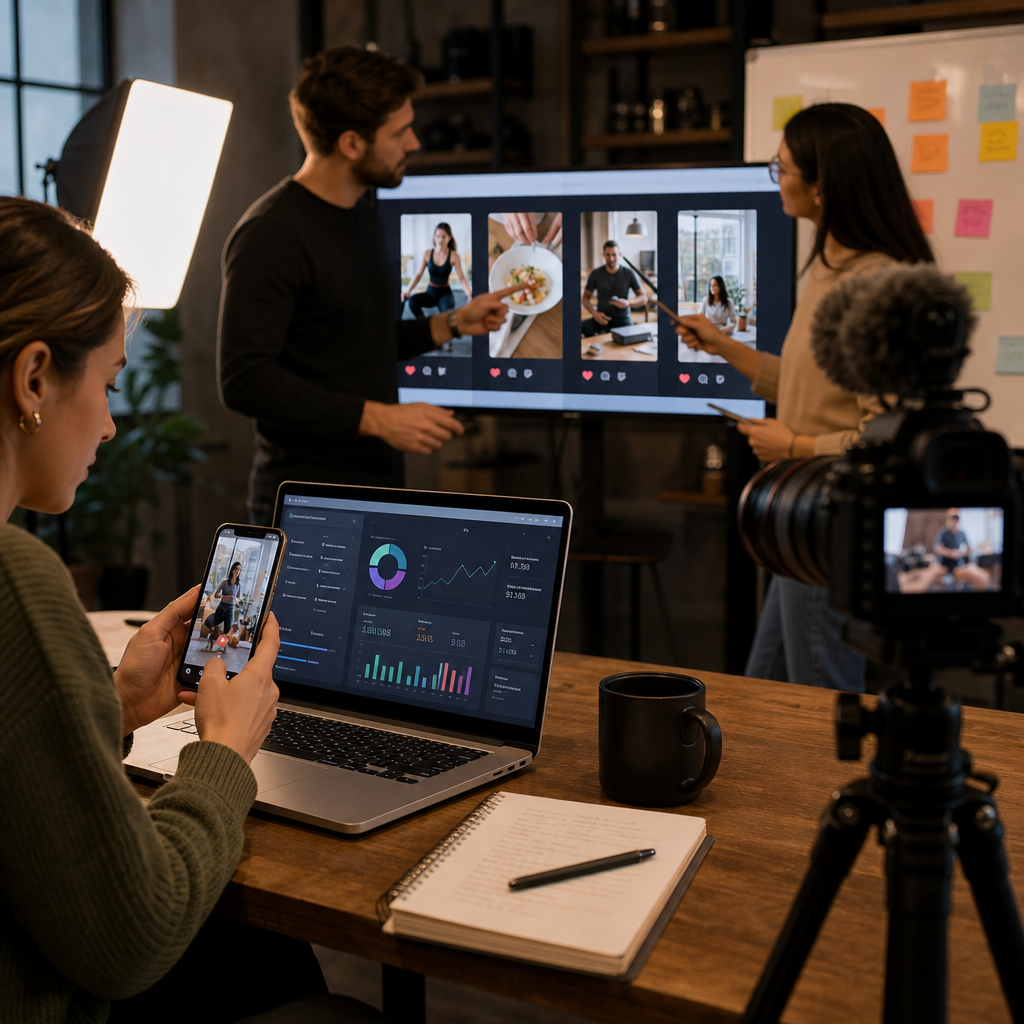
  • Local Growth Marketing: Finding the Right Creative and Ad Partner

    Local Growth Marketing: Finding the Right Creative and Ad Partner

    The Multi-Location Marketing Challenge: Why Standard Agencies Fall Short

    Running multiple locations or serving customers across different geographic areas feels like managing multiple businesses simultaneously. Each market has its own dynamics, competitor density, and customer behavior patterns. Yet most traditional agencies treat local growth like a checkbox they complete once, then move on.

    The problem runs deeper than inconsistent execution. Standard agencies typically operate in silos: a creative team makes content, a separate ad team runs campaigns, and social media gets managed by whoever has bandwidth. This fragmentation means your message shifts between channels, your creative doesn’t align with your ad strategy, and nobody’s accountable for actual lead volume or sales impact.

    Multi-location brands specifically struggle because they need consistency at scale. A dental practice with three clinics shouldn’t have three different brand voices or three separate customer journey strategies. Yet without the right partner, that’s exactly what happens. Each location gets generic advice, and you’re left cobbling together results from disconnected efforts.

    What we see work is the opposite approach: unified strategy, localized execution. One cohesive brand story that resonates with each market, supported by location-specific ad spend and creative variations that speak to local customer needs. This requires a partner who understands both the creative side and the performance side equally well.

    Why Creative Quality and Ad Performance Are Inseparable

    Many business owners still think of creative and advertising as separate functions. You hire someone to make a nice video, then you hire someone else to run ads. The reality is that exceptional creative without strategic ad deployment underperforms, and smart ad targeting can’t compensate for weak creative.

    The relationship works like this: high-quality visual content gives your ads permission to take up space in someone’s feed. People scroll past thousands of pieces of content daily. Cinematic production value, clear value propositions, and authentic storytelling are what stop the scroll. Once you have attention, strategic ad targeting and bid optimization determine whether that attention converts into a lead or sale.

    We’ve watched campaigns fail because creative was generic even though ad targeting was precise. We’ve also seen beautifully produced content underperform because it wasn’t aligned with the audience segment seeing it or the landing page experience didn’t match the promise in the ad.

    The strongest local growth marketing partners treat these as a single system. The creative is built with ad performance insights in mind: understanding which hooks work, which video lengths get watched, which calls-to-action drive conversions. The ad strategy, in turn, is informed by what the creative actually communicates. This integration is what separates campaigns that generate a few leads from campaigns that become predictable lead generation engines.

    What Integrated Local Marketing Actually Requires

    Building a true local growth marketing system means pulling together several pieces that most agencies keep separate.

    First, you need a unified brand strategy that defines how your company shows up across all channels and locations. This isn’t a logo and color palette. It’s a clear understanding of your unique value, your customer’s actual problems, and the story that makes people care enough to take action. For multi-location brands, this strategy should feel consistent whether someone discovers you on Instagram, Google, or through a local search result.

    Second, you need creative production capabilities specifically built for short-form content. Long-form brand videos are fine for websites, but local growth happens through short-form content on social platforms and search ads. This means a partner who shoots fast, tests often, and understands the nuances of what works on different platforms.

    Third, paid advertising expertise across both Meta and Google is essential. Meta platforms (Instagram and Facebook) excel at awareness and consideration; Google ads capture high-intent searches. Most local businesses need both, but few agencies optimize them together as a unified system.

    Fourth, you need lead capture infrastructure. Great content and targeted ads funnel traffic somewhere. That somewhere should be a landing page specifically designed to convert visitors into leads, connected to your CRM so follow-up happens automatically. This often gets overlooked, but it’s where the actual conversion happens.

    Finally, you need someone accountable for results. Not impressions or reach, but actual leads and sales attributed back to your marketing efforts. This requires clean data tracking, regular performance reporting, and willingness to adjust strategy based on what’s actually working.

    When these pieces work together, local growth becomes predictable and scalable.

    Short-Form Video as Your Local Growth Engine

    Video dominates how people consume information in 2026. But not in the way many business owners think. Most people aren’t watching ten-minute brand documentaries. They’re watching fifteen-second Instagram Reels, thirty-second TikTok clips, and six-second YouTube bumper ads while scrolling.

    Short-form video is particularly effective for local growth marketing because it’s designed to stop scrolling and generate immediate interest. A potential customer needs to understand your value proposition within the first three seconds. A local dentist might show a before-and-after transformation in under thirty seconds. A service company might demonstrate problem-solution in under twenty seconds.

    The production approach matters too. Generic stock footage with voiceovers doesn’t work. People respond to authentic, cinematic content that looks professional but feels real. This is where many brands stumble. They invest in polished national ads when what drives local growth is consistent, high-quality short-form content that can be produced regularly and tested rapidly.

    We recommend a monthly cadence of short-form video production that covers different angles of your value prop: customer testimonials, problem-solution demonstrations, behind-the-scenes glimpses, local event highlights, FAQs. This library of content then fuels both organic social posting and paid advertising campaigns. One piece of content might perform well organically on your Instagram feed, then get repurposed as paid ads targeting high-intent audiences.

    The efficiency here is significant. A single production day can generate twelve to twenty social-ready clips that feed your marketing for months. This is how you maintain consistent presence across locations without burning through budget on constant new productions.

    Building Lead Generation Systems That Work Across Locations

    For multi-location brands, centralized lead generation systems with local routing are game-changers. When someone clicks your ad or messages you on Instagram, they should be instantly connected to the right location, not sent to a generic contact form that disappears into the void.

    This requires integrating several components: your CRM or lead management software, your messaging platforms (Instagram DMs, Facebook Messenger, text), your location-specific phone numbers, and your team’s workflow. When done right, a lead generated in Location A gets routed to Location A’s team automatically. Follow-up is triggered instantly rather than waiting for someone to remember to check a shared email inbox.

    Most businesses leave lead generation fragmented because it seems complex to set up. The cost is high: leads get lost, follow-up is inconsistent, and you never get a clear picture of which marketing efforts actually drive business. The investment in integration pays for itself quickly through improved conversion rates and better data about what’s working.

    For each location, you should track:

    • Where leads come from (which ad, which keyword, which channel)
    • How quickly they’re contacted (response time correlates directly with conversion)
    • Whether they convert to customers (otherwise you don’t know if your marketing is actually working)
    • Customer lifetime value by source (helps you understand where to invest)

    When you have this data, you can make intelligent decisions about budget allocation, creative testing, and location-specific strategies.

    The Hidden Cost of Fragmented Marketing Tools

    Business owners often build their marketing stack piece by piece: a social media scheduling tool here, a Facebook Ads account there, Google Ads managed one way, SEO handled separately, website built on a different platform entirely. Over time, these tools create invisible costs that drain resources and results.

    The operational cost is real. Your team spends time moving data between systems, manually tracking performance, creating reports that should be automated. Someone’s managing your Instagram schedule in one tool, your Facebook ads in another, your website content in yet another. Nobody has a complete picture of what’s working.

    The performance cost is higher. When your ad strategy isn’t informed by your website analytics, you optimize for the wrong metrics. When your CRM doesn’t connect to your ads, you can’t attribute leads back to specific campaigns. When your social content isn’t aligned with your website messaging, the customer journey feels disjointed.

    We’ve found that businesses with integrated systems outperform fragmented ones consistently. Not because the individual tools are better, but because data flows smoothly, teams coordinate efficiently, and strategy adjusts quickly based on real performance data. Integration also matters when working with an end-to-end video marketing partner who needs visibility into your full performance picture to make informed recommendations.

    How We Connect Creative Content to Measurable Results

    The connection between what we create and what actually happens in your business comes down to three things: clear tracking, honest reporting, and constant optimization.

    We set up your tracking infrastructure first. That means proper UTM parameters on every ad, pixel implementation that actually works, and CRM integration that captures lead source data. Without this, you’re operating on assumptions rather than facts.

    From there, we establish a baseline. What’s your current cost per lead? Your lead-to-customer conversion rate? Your customer acquisition cost by channel? These numbers become the target we improve against.

    Our monthly reporting focuses on what matters to your business: leads generated, cost per lead, sales attributed to marketing, and ROI. We identify which pieces of content and which ad campaigns are actually driving results, then we double down on what works and adjust what doesn’t.

    The optimization happens weekly in most cases. Ad performance data updates daily. Video engagement metrics tell us which creative angles resonate most. We test new messaging, new audience segments, new landing page variations. Each test generates data that feeds the next iteration.

    This relentless focus on connection between creative and results is what separates effective marketing from activity that just keeps the lights on.

    Strategic Ad Optimization Beyond Platform Best Practices

    Running ads on Meta and Google requires understanding their algorithms and best practices. But competitive advantage comes from going beyond that baseline.

    Platform best practices get commoditized quickly. Everyone learns to set up audiences, everyone learns about lookalike campaigns, everyone knows about bid strategies. What separates strong performers is depth of strategic thinking about your specific business situation.

    For a multi-location service business, that might mean testing different geographic bid strategies: investing more heavily in high-conversion locations, testing expansion in underperforming areas, and adjusting creative based on local seasonality. For a retail brand, it might mean different messaging for new customer acquisition versus cart abandonment recovery.

    We also think strategically about creative rotation. Rather than setting ads and letting them run, we test new variations every two weeks. Fatigue is real: audiences get tired of seeing the same creative, performance declines. By rotating in fresh short-form content continuously, we maintain engagement and lower cost per result.

    Ad sequencing is another layer. Someone who clicks your ad but doesn’t convert gets shown a follow-up ad the next day with different messaging. Someone who visits your website but doesn’t request a lead magnet sees a targeted message about that specific offer. This isn’t advanced technology; it’s strategic thinking about customer journey.

    Scaling Local Success Without Scaling Your Headcount

    One of the biggest opportunities we see is helping multi-location brands scale their marketing without scaling their team proportionally.

    This works through a combination of systems, automation, and strategic outsourcing. Your in-house team focuses on strategy, customer communication, and what only they can do. Everything else gets systematized or handled by your marketing partner.

    Monthly content production, for instance, can be handled entirely by your creative partner. You collaborate on strategy and messaging, but the actual shooting, editing, and asset organization happens outside your office. Your team focuses on distributing that content and managing customer response.

    Lead routing and follow-up can be fully automated once set up properly. New leads flow into the right location’s queue, get initial outreach automatically, and trigger team notifications. Your people time gets spent on quality conversations, not administrative work.

    Paid advertising management, creative testing, and performance optimization all happen on your partner’s side. Your team receives weekly updates but doesn’t need to live in ad platforms themselves.

    The result is that growing from three locations to five locations doesn’t require hiring additional marketing staff. Your existing team can focus on improving conversion and customer experience while your partner handles scaling the lead generation machinery.

    Real Outcomes: Lead Generation and Sales Impact

    The best measurement of any marketing partnership is what actually happens in your business.

    We work with multi-location service businesses where our partnership has doubled lead volume while reducing cost per lead by thirty to forty percent. We work with retail brands where consistent short-form video content has become their most cost-effective customer acquisition channel. We work with companies where lead routing optimization has improved sales conversion rates because response time dropped from twelve hours to five minutes.

    These outcomes aren’t luck or one-time wins. They come from systematic work: setting up proper tracking, testing constantly, optimizing based on data, and maintaining consistent creative production. They come from understanding that marketing is a system, not random activities, and that every component needs to work in service of measurable business goals.

    If you’re managing multiple locations or serving customers across different areas, you likely recognize how difficult true integrated local growth marketing feels with standard agency approaches. The right partner eliminates that fragmentation. You get unified strategy, consistent creative quality, coordinated paid advertising, and accountability for actual results.

    The next step is clarity on your current situation. What’s your lead volume right now? Where are most leads coming from? How much are you paying per lead? Once you understand your baseline, you can decide whether a more integrated approach makes sense for your growth. We’re happy to discuss what local growth marketing could look like for your specific business.

    Contact us today for a free consultation to see how we can help you grow your business.

    Frequently Asked Questions (FAQ)

    How do we help multi-location businesses generate leads consistently across different markets?

    We build integrated systems that combine cinematic short-form video content with localized ad strategies, social media management, and lead capture workflows. Our approach ensures that each location gets customized messaging while maintaining your brand’s visual consistency, so you’re not juggling separate agencies or tools for different regions.

    What makes short-form video different from traditional advertising for local growth?

    We’ve found that short-form video stops the scroll and builds trust in seconds, which translates directly to higher engagement and lead quality compared to static ads. When we pair this content with strategic Meta and Google advertising, we’re not just getting views—we’re creating pathways that turn attention into qualified leads for your sales team.

    Why do you recommend combining creative production with advertising management instead of hiring separate agencies?

    When we own both the content creation and ad performance, we can optimize in real time based on what’s actually converting for your business. There’s no communication gap between the creative team and the people running your ads—we adjust messaging, angles, and targeting together based on lead data, which eliminates the waste that happens when these functions are separated.

  • Seeing is Believing: Why Audiovisual Production Companies are Your Secret Weapon

    Seeing is Believing: Why Audiovisual Production Companies are Your Secret Weapon

    Why Audiovisual Production Companies Are the Fastest Way to Grow Your Brand

    Audiovisual production companies are specialized agencies that handle the full process of creating video and audio content — from concept and scripting through filming, editing, and distribution — for businesses, brands, and organizations.

    Here’s a quick breakdown of what they do and why they matter:

    What They Do Why It Matters for Your Business
    Create branded video content Builds awareness and trust faster than text
    Manage full production workflow Saves you time, gear costs, and guesswork
    Deliver platform-ready formats Content works across social, web, and live events
    Combine strategy with storytelling Videos drive measurable leads and sales
    Scale content across locations Consistent brand voice everywhere you operate

    Right now, over 500 million hours of video are watched on YouTube every single day. And 86% of businesses are already using video as a marketing tool. If your brand isn’t showing up on screen, your competitors are — and they’re getting the attention you’re leaving behind.

    The global video production market was worth $13.7 billion in 2023 and is on track to nearly double by 2030. That growth isn’t happening by accident. It’s being driven by brands that figured out a simple truth: seeing is believing. Video builds credibility, explains your offer, and converts viewers into customers faster than almost any other format.

    I’m Nic Canobbio, founder of Canatos Media, and with over two decades in media production — including overseeing live production, launching a national podcast, and creating social content with over 60 million views — I’ve worked across every corner of the audiovisual production companies landscape. In the sections below, I’ll break down exactly how to find the right production partner, what to pay, and how to avoid the mistakes that waste time and budget.

    Video production ROI funnel infographic: Awareness to Conversion for modern brands infographic

    The Main Types of Audiovisual Production Companies and Their Services

    Not all audiovisual production companies do the same thing. Some are built for brand marketing. Others focus on live events, documentaries, commercials, or entertainment. Choosing the right type matters because the best partner for a polished product launch may be the wrong partner for a hybrid conference or a training library.

    Here are the main categories clients usually run into:

    1. Full-service production companies
    2. Boutique specialist studios
    3. Corporate video producers
    4. Commercial production companies
    5. Event and live-stream teams
    6. Documentary and narrative storytellers
    7. Immersive and emerging-tech specialists

    Full-service

    A full-service team handles strategy, creative development, pre-production, filming, editing, motion graphics, sound, and delivery. This is often the best fit if you want one partner to manage the whole process instead of juggling freelancers like you’re trying to direct traffic at rush hour.

    For brands that need video to support broader growth goals, this integrated model is especially useful. We see the biggest gains when production connects with targeting, publishing, and performance. If you want a deeper look at that approach, our guide to end-to-end video marketing breaks down how content turns into business results.

    Boutique

    Boutique studios usually specialize in a narrow lane such as animation, luxury brand films, social-first content, or post-production. They can be excellent when you already know exactly what you need and want highly focused expertise.

    The trade-off is that you may need to bring more strategy, coordination, or distribution planning yourself.

    Corporate

    Corporate production companies focus on business communication. Their work often includes:

    • Internal communications
    • Recruiting videos
    • Onboarding and training content
    • Executive messaging
    • Case studies and testimonials
    • Brand films
    • Investor or stakeholder communications

    These teams understand that the goal is not just “make it pretty.” The goal is clarity, consistency, and trust.

    Commercial

    Commercial production companies are built for ads and campaigns. They tend to work with tighter creative direction, stronger visual polish, and campaign deliverables for paid media, broadcast, streaming, and social placements.

    If you’re running Meta or Google campaigns, commercial thinking matters because the footage needs to perform, not just impress your cousin who “knows cameras.”

    Documentary and narrative

    These companies are strongest at human stories, interviews, field production, and emotion-driven structure. They are ideal for founder stories, mission-driven brands, customer stories, and mini-doc style campaigns.

    Choosing Audiovisual Production Companies for Corporate Growth

    For most businesses in the tri-state area and Long Island, the right production partner is the one that understands business outcomes, not just camera settings.

    If your goals are growth-focused, look for a company that can support:

    • Brand films that explain who you are
    • Training videos that reduce repeated manual teaching
    • Internal communications that keep teams aligned
    • Customer proof content that shortens sales cycles
    • Short-form clips for social and paid distribution
    • Lead generation content tied to landing pages and ads

    That last point is huge. A beautiful video with no conversion path is basically a very expensive screensaver. Our article on lead generation video production explains what to ask if your goal is pipeline, not applause.

    Event and Documentary Specialists

    Event-focused AV teams specialize in:

    • Live streaming
    • Hybrid meetings
    • Webcasting
    • Multi-camera capture
    • Audio reinforcement
    • Lighting and staging
    • Real-time switching
    • Recording for post-event content

    Documentary specialists bring a different superpower: story depth. They know how to capture unscripted moments, interviews, and real environments without making everything feel stiff and over-rehearsed.

    For brands that want authentic, high-trust content, documentary-style production often works beautifully alongside short-form video production. One long interview day can become a brand story, social clips, recruiting snippets, and paid ad creative if planned correctly.

    Today, the AV world is wider than ever. Traditional filming still matters, but technology is changing how content is planned, captured, and delivered.

    virtual production LED volume

    The biggest shifts we see in 2026 include:

    • AI-assisted scripting, editing, logging, and versioning
    • Virtual production with LED environments
    • Remote collaboration and review tools
    • 360-degree video and immersive content
    • High-resolution capture including 8K workflows
    • Spatial and interactive experiences for niche use cases

    That does not mean every brand needs cutting-edge gear for every project. Sometimes a single-camera interview and smart edit outperform a flashy tech demo. The point is fit, not novelty.

    AI is particularly useful when it helps teams move faster without making the work generic. It can support planning, rough cuts, captions, color workflow, and content adaptation. But human strategy, taste, and storytelling still matter. A lot.

    If you’re producing content at volume across teams or locations, this balance becomes critical. Our guide on scaling cinematic content covers how to maintain quality while increasing output.

    Specialized Skills in Modern Audiovisual Production Companies

    Some projects absolutely require specialized capabilities. Others don’t.

    Here are a few specializations worth paying extra for when the project truly calls for them:

    • Drone footage and aerial cinematography
    • Live streaming and webcasting
    • Animation and motion graphics
    • 3D or virtual production
    • Multi-camera event capture
    • Advanced sound design
    • Foreign language localization
    • 360-degree or immersive video

    The key question is simple: does the specialty improve the outcome, or just the mood board?

    For example:

    • Drone footage is valuable for real estate, destination, construction, campuses, and large facilities.
    • Live streaming expertise is essential for virtual and hybrid events because reliability matters more than cinematic bokeh.
    • Animation is ideal when your service is complex or difficult to film.
    • General production skills are enough for many testimonials, talking-head explainers, and social ads.

    When webcasting is part of the mix, we recommend looking carefully at technical redundancy, crew experience, and remote audience management. Our article on hiring a webcasting production company goes deeper on what separates a smooth live event from a public stress test.

    The Role of Geographic Location and Local Talent

    Location still matters, even in a remote-friendly world.

    For clients in the tri-state area and Long Island, working with a regional partner can simplify:

    • Travel and scheduling
    • Permit familiarity
    • Access to local crew and talent
    • Faster site visits and scout days
    • Lower logistics costs
    • Better understanding of local audiences and markets

    The tri-state area remains a major production hub because it offers talent, studios, locations, and deep freelance networks. If you need support staffing a project, local directories such as LOCAL TALENT / RESOURCES – South Jersey Film Office can help illustrate the depth of regional crew ecosystems. For businesses comparing nearby options, regional production pages like Video Production in NJ & New York – Twinlight Studios®, Long Island Video Production Company | New York, Long Island Video Production Company | Solvis Media LI NY, and local listings such as THE BEST 10 VIDEO/FILM PRODUCTION IN LONG ISLAND, NY show how geographically specific many searches really are.

    That said, location should not outweigh process. A nearby team with poor communication is still a headache, just a local one.

    For brands creating content across multiple branches or service areas, consistency matters more than proximity alone. That’s why we focus on systems that support scalable short-form production.

    Pricing Structures and Project Management Workflows

    Pricing is one of the biggest mysteries in this industry. Clients ask, “How much does a video cost?” and the honest answer is, “What kind of video, with how many people, at how many locations, for how many deliverables, by when?”

    Not annoying. Just true.

    Here is a simple framework:

    Project Type Typical Timeline Common Pricing Model Main Cost Factors
    Social short-form shoot 1-3 weeks Fixed package or retainer Shoot time, edit volume, revisions
    Corporate interview video 2-4 weeks Fixed project fee Crew size, location, graphics, audio
    Event coverage 1-3 weeks plus event day Day rate or package Cameras, streaming needs, operators
    Commercial campaign 4-8+ weeks Custom quote Creative development, talent, locations
    Training video series 3-8+ weeks Project fee or retainer Script volume, filming days, versions

    Most production companies use one or more of these pricing models:

    • Fixed-price packages for defined deliverables
    • Day rates for crew, gear, and production days
    • Monthly retainers for ongoing content
    • Custom bids for larger or more complex projects

    Retainers are increasingly common because many brands no longer need one heroic video per quarter. They need a reliable stream of content. If that sounds familiar, our piece on budget-friendly video production explains how to keep output high without letting cost drift upward.

    infographic of video project pricing factors and timelines infographic

    Factors Influencing Production Costs

    The biggest cost drivers are usually:

    • Creative development and scripting
    • Crew size and shoot duration
    • Talent or voiceover fees
    • Location permits or rentals
    • Equipment rentals or specialty gear
    • Set design, props, wardrobe, and styling
    • Motion graphics, VFX, or animation
    • Music licensing and sound mix
    • Number of edit versions
    • Revision rounds
    • Turnaround speed

    Specialized work costs more because the margin for failure is smaller. Live streaming is a good example. You are not just paying for cameras. You are paying for planning, switching, audio capture, internet stability, backup systems, and people who know what to do when something goes sideways.

    Concept to Delivery: The Management Chain

    A strong production company should be able to walk you through the process from start to finish. A typical workflow looks like this:

    1. Discovery and goal setting
    2. Creative development
    3. Scripting or storyboarding
    4. Production planning
    5. Filming or live capture
    6. Post-production
    7. Review and revisions
    8. Final delivery and distribution planning

    Good project management is what keeps this chain from breaking.

    In our experience, clients should expect:

    • A clear point of contact
    • Defined milestones
    • Production schedules
    • Shot lists or creative outlines
    • Transparent revision rounds
    • File delivery standards
    • Versioning for different platforms
    • Quality control before final handoff

    For live or hybrid productions, redundant systems matter too. Backup audio paths, extra recording routes, duplicate media capture, and contingency planning are not glamorous, but neither is apologizing to 500 attendees because the stream vanished.

    Distribution strategy should also be discussed before filming, not after. If the content will live on paid social, landing pages, internal portals, or event screens, those use cases affect framing, pacing, aspect ratio, and editing choices from day one.

    Evaluating Portfolios and Avoiding Common Challenges

    A slick reel is helpful, but it should not be the only thing you evaluate.

    professional editing suite with multiple monitors

    The average production company handles roughly 50 to 200 projects per year, and corporate plus commercial work makes up a large share of industry revenue. That means many portfolios are broad. Broad is fine. Relevant is better.

    What to Look for in a Portfolio

    When reviewing a production company’s work, look for four things:

    1. Visual style

    Does the work feel polished, intentional, and consistent? You are not just judging image quality. You are judging taste.

    2. Narrative depth

    Can they tell a story, or only assemble nice shots with dramatic music? Both have their place, but your project may need one more than the other.

    3. Technical execution

    Pay attention to:

    • Clean audio
    • Consistent lighting
    • Stable camera work
    • Natural color
    • Smooth editing
    • Appropriate graphics
    • Strong pacing

    If the audio is bad, viewers forgive exactly no one.

    4. Industry relevance

    A portfolio does not need to match your industry perfectly, but it should show understanding of similar objectives. A company that excels at music videos may not automatically be the best fit for compliance training. Likewise, a team that only shoots conference recaps may not be right for high-conversion ad creative.

    Also ask practical questions:

    • Have they handled projects at your scale?
    • Can they manage stakeholders and feedback?
    • Do they understand the platforms where the content will run?
    • Have they worked with multi-location brands?
    • Can they maintain brand consistency over time?

    If you need a model for this kind of integrated support, our page on end-to-end production for multi-location brands shows how strategy, production, and distribution can stay aligned.

    Avoiding Collaboration Pitfalls

    Most production problems are not caused by cameras. They are caused by unclear expectations.

    The most common issues we see are:

    • Vague goals
    • Late feedback
    • Too many decision-makers
    • Undefined revision limits
    • Scope creep
    • Missing rights or usage terms
    • Unrealistic timelines
    • No approval process

    Here is how to avoid them:

    Set clear objectives early

    Define what success looks like before creative begins. Is the video meant to educate, convert, recruit, train, or recap?

    Build structured feedback loops

    Choose who gives feedback, when, and in what format. Ten people emailing random opinions at midnight is not a workflow.

    Clarify intellectual property and usage

    Make sure your agreement covers footage ownership, licensing, music rights, talent releases, and where the final content can be used.

    Create sign-off stages

    Approve strategy, script, shoot plan, and edit milestones in sequence. This prevents major changes after production has already happened, which is the industry version of deciding to add a basement after the house is built.

    Frequently Asked Questions about Audiovisual Production

    How much do audiovisual production companies typically charge in 2026?

    In 2026, pricing usually falls into fixed packages, day rates, retainers, or custom bids. Small social content shoots may be quoted as simple packages, while commercial campaigns, live events, and multi-day productions are typically custom-scoped.

    Costs rise based on:

    • Number of shoot days
    • Crew size
    • Complexity
    • Talent
    • Locations
    • Equipment
    • Motion graphics or animation
    • Revision rounds
    • Speed of turnaround

    The best way to compare proposals is not just by total price, but by scope clarity. Ask what is included, what counts as a revision, who owns the assets, and how many deliverables you receive.

    How is AI changing the production process for businesses?

    AI is making production faster in areas like concept support, transcription, shot logging, captioning, rough editing, color assistance, content repurposing, and versioning. It can lower turnaround time and help teams create more formats from the same footage.

    But AI should support the process, not replace strategy and human storytelling. Overuse can make content feel generic, especially when every brand starts sounding like the same enthusiastic robot with perfect grammar.

    The winning approach is selective use: automate repetitive tasks, keep creative judgment human.

    What is the typical timeline for a professional video project?

    A straightforward brand or corporate project often takes 2 to 4 weeks. More involved campaign work can take 4 to 8 weeks or longer. Event work depends on the date of the event plus post-production needs. Ongoing retainers create the fastest turnaround over time because planning, approvals, and production systems are already in place.

    Timeline usually depends on:

    • Creative complexity
    • Scheduling
    • Stakeholder approvals
    • Number of filming locations
    • Edit versions needed
    • Whether animation, localization, or live components are involved

    Conclusion

    The best audiovisual production companies do more than make good-looking videos. They bring structure, specialized skill, creative direction, and business thinking to the entire process.

    That matters because content alone is not enough anymore. It has to connect to targeting, distribution, and conversion. In other words, the camera is not the strategy. It is the amplifier.

    At Canatos Media, we approach production that way: cinematic content tied to measurable growth. We help businesses connect story, platform, and performance so the final output does something useful in the real world – attract attention, generate leads, support sales, and keep brand messaging consistent across locations.

    If you want a partner that can connect production with paid media, social management, SEO, and website support, explore our End-to-End Video Production and Ads Management for Multi-Location Brands page. Because in 2026, the brands that grow fastest are not just being seen. They are being remembered.