Author: canatosmedia

  • Choosing the Right Monthly Video and Social Management Agency Model for Growth

    Choosing the Right Monthly Video and Social Management Agency Model for Growth

    The Gap Between Content Creation and Lead Generation

    Most brands create content and hope it drives results. They post videos on Instagram, share updates on Facebook, and expect phones to ring. The reality is messier: great content alone doesn’t convert viewers into customers. There’s a critical gap between what catches attention and what actually generates qualified leads.

    We see this constantly with multi-location and service-based brands. They invest thousands in video production, but the content sits isolated from their paid advertising strategy, their SEO efforts, and their lead capture systems. A beautiful 15-second video means nothing if it’s not part of a coordinated system designed to move prospects from awareness to action.

    The best-performing brands we work with treat video and social management as interconnected pieces. Your short-form content feeds your paid campaigns. Your social presence reinforces your SEO. Your consistent posting builds authority that makes lead generation more efficient. When these layers work together, your marketing compounds instead of scatters.

    Why Many Brands Struggle with DIY Video and Social Strategies

    Building content in-house sounds efficient until you map out the actual work. Someone on your team has to script, film, edit, post, respond to comments, manage ad spend, and analyze performance. That’s not one person’s job. It’s three jobs compressed into unrealistic timelines.

    We’ve watched business owners juggle video production while answering customer calls. We’ve seen social media managers burn out trying to learn paid advertising. Skill gaps multiply the problem: your editor might not understand what makes content perform on TikTok versus YouTube. Your ads person might not see why cinematic storytelling matters. Without alignment, you’re spending more and getting less.

    DIY also creates consistency gaps. When your team manages everything, posting schedules slip. Quality becomes uneven. Campaigns lose momentum. Meanwhile, your competitors who’ve outsourced this work are building momentum month after month with predictable posting, professional production, and coordinated strategy.

    The cost of staying DIY often exceeds the cost of hiring a capable partner. When you factor in salary, tools, training, and opportunity cost (the revenue you could generate if your team focused on core business), outsourcing becomes the financially smarter move.

    How Integrated Video Production and Management Works

    Integration means your video production strategy, social media posting schedule, paid advertising, and lead generation systems share the same objectives and data. Instead of silos, you have feedback loops.

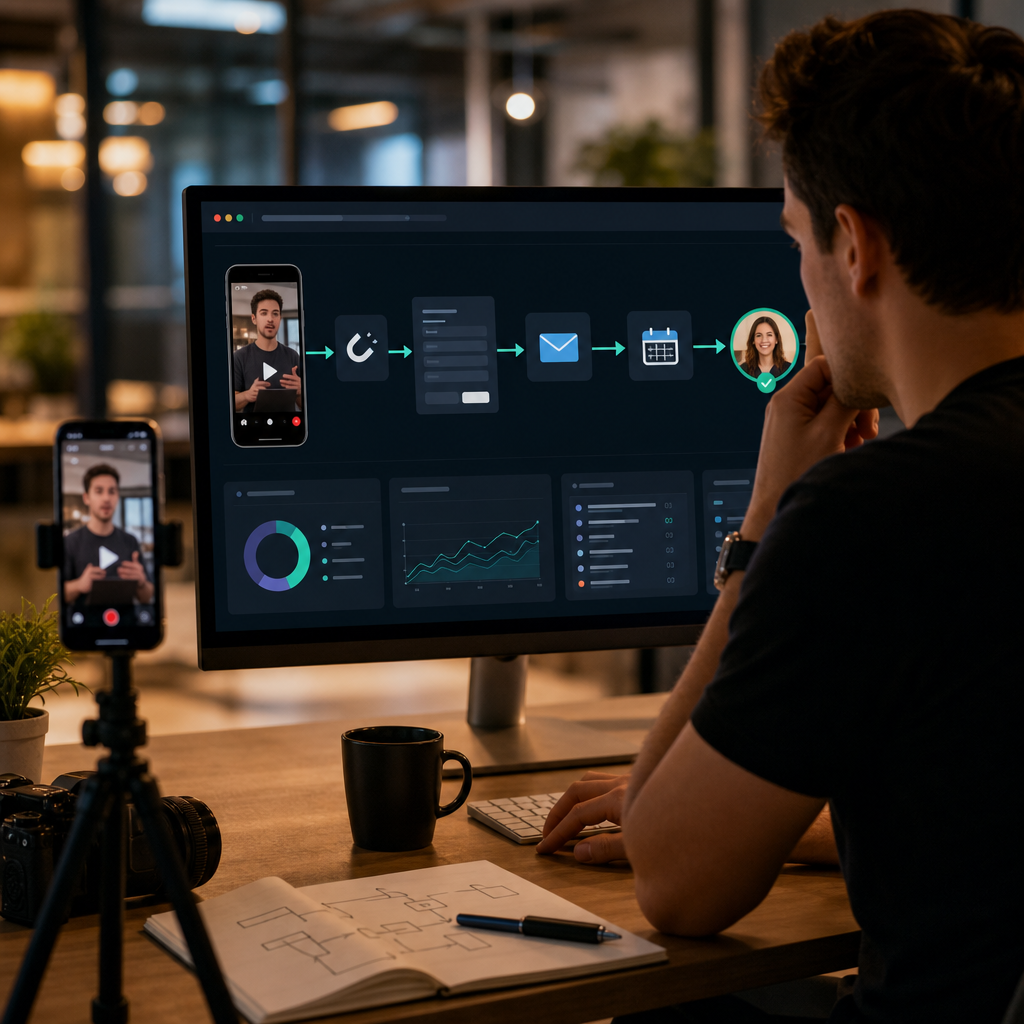
    Here’s the flow: We produce short-form video content tailored to your audience and platform. That content gets distributed across your organic social channels on a consistent schedule. Simultaneously, we repurpose and adapt the same content for paid campaigns on Meta and Google. The engagement data from both organic and paid informs what we produce next. Your social presence builds authority signals that strengthen your SEO. Meanwhile, the leads coming through your systems get tracked and fed back into campaign optimization.

    This integration reduces wasted effort and amplifies results. A single piece of cinematic content can serve five functions: organic reach, paid conversion, SEO signals, email nurture, and brand storytelling. When everything connects, your marketing budget works harder.

    Our Approach to Cinematic Short-Form Content Strategy

    We don’t treat short-form video as throwaway content. Every video we produce follows a narrative structure designed to hold attention, communicate value, and create desire for action.

    Cinematic quality means investing in production values that make your brand stand out. It means thoughtful lighting, intentional sound design, and editing that serves the story rather than distracting from it. But it’s not about making art films. It’s about making content that performs.

    We start by understanding your customer’s decision journey. What questions keep them awake at night? What objections do they voice before buying? What social proof resonates with them? We script content around these insights, then produce it with the production quality that commands attention in crowded feeds.

    The strategy layer ensures consistency. We don’t produce random videos. We develop a content calendar that addresses specific themes monthly, showcases different customer success stories, and creates narrative momentum. This consistency builds trust and keeps your brand top-of-mind as prospects move toward purchase decisions.

    Building Predictable Lead Generation Systems

    Predictable lead generation requires two things: a reliable flow of qualified traffic and a conversion system that captures that traffic efficiently.

    We build this by layering video content into a broader lead funnel. Your organic social content builds awareness and audience. Your paid video campaigns reach prospects at specific stages of their decision journey. Your website captures their information through strategically placed lead magnets and conversion points. Your email sequences nurture those leads until they’re ready to engage sales.

    The system only works when every element gets measured. We track which videos drive clicks. Which platforms deliver the lowest-cost leads. Which messaging resonates with different audience segments. That data informs monthly adjustments. A conversion rate that slips gets immediate attention. A platform that underperforms gets tested with different creative. Success isn’t luck. It’s systematic refinement.

    The Cost-Benefit of Full-Service Monthly Partnerships

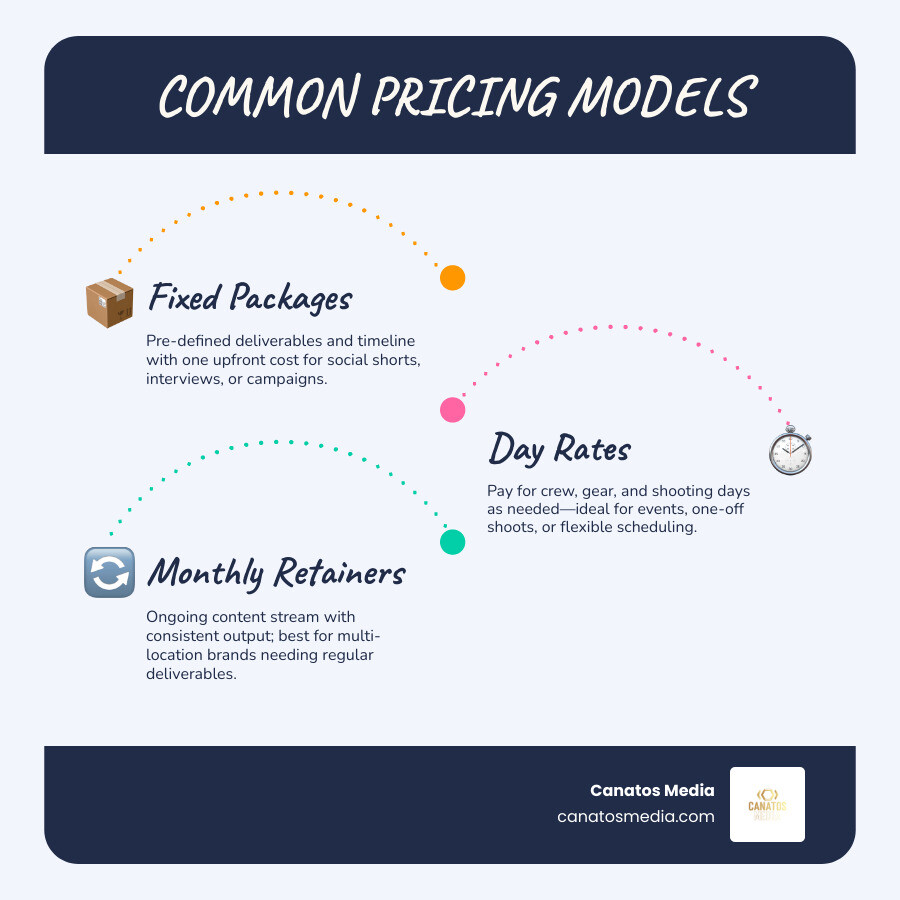
    Monthly retainers change the economics of video and social management. Instead of paying project rates for sporadic content, you pay a stable fee for consistent output and strategic optimization.

    This stability benefits both sides. You get reliable content production and management. We gain the time to truly understand your business, test strategies thoroughly, and compound results month over month. Annual contracts make sense when a partner knows your brand deeply.

    The all-in cost per lead drops significantly with monthly partnerships. When we produce 8-12 videos monthly instead of 2-3, production costs per piece decrease. When we manage ongoing paid campaigns instead of starting from scratch each time, we skip the learning curve. When we have months to optimize rather than weeks, we hit better conversion rates.

    For most multi-location and service-based brands, a full-service monthly retainer costs less than hiring a part-time employee while delivering more specialized expertise. Explore our flexible packages built to grow your brand and generate leads.

    Measuring Success: ROI Metrics That Matter

    Not all metrics deserve attention. Vanity metrics like views and likes feel good but don’t move the needle. Real ROI measurement focuses on business outcomes.

    Track these metrics consistently:

    • Cost per qualified lead (actual leads, not just clicks)
    • Lead-to-customer conversion rate
    • Customer acquisition cost compared to customer lifetime value
    • Video engagement rates segmented by platform and content type
    • Paid ad return on ad spend (ROAS)
    • Website traffic from social and organic channels
    • Email open and click rates for leads captured through video

    The data tells you what’s working. If one video format drives 3x more leads than another, you shift production toward that format. If a particular platform delivers leads at half the cost of competitors, you adjust budget allocation. Metrics-driven decisions beat gut feelings every time.

    How We Structure Our Monthly Video and Social Model

    Our monthly model includes video production, social media management, paid advertising oversight, and lead tracking.

    Typically, we produce 8-12 short-form videos monthly tailored to your platforms and audience. We handle scripting, shooting, editing, and revisions. Your social channels get managed with consistent posting schedules, community engagement, and growth strategies. We oversee your paid campaigns on Meta and Google, continuously testing creative variations and audience targeting. We track performance and deliver monthly reports showing leads, costs, and ROI.

    The mix adjusts based on your needs. A brand launching might need heavier production and paid spend. A mature brand might optimize more and produce less. Our all-in-one social content and management platform consolidates these services so you work with one team that understands both your creative direction and your business goals.

    Why Consistency and Quality Separate Winners from the Rest

    The brands dominating their markets share two traits: they publish consistently and they maintain quality standards.

    Consistency builds momentum. When you post weekly instead of randomly, algorithms favor you. Your audience develops habits around your content. Your team builds efficient production routines. Momentum compounds: month three outperforms month one because you’ve built an audience and refined your approach.

    Quality protects your brand. A single poorly produced video can undermine months of trust-building. Your customers notice when production values drop or messaging becomes inconsistent. Conversely, reliably excellent content signals professionalism and stability.

    The brands we work with commit to this discipline. They understand that a weekly two-minute video produced with care beats sporadic content made in haste. They see video and social not as occasional marketing tactics but as foundational business infrastructure.

    Getting Started with Your Transformation

    Start by auditing where you are. What videos are you producing now? Which platforms matter most for your audience? What’s your current lead volume and cost per lead? What’s consuming your team’s time without clear ROI?

    The next step is clarity about your growth targets. Do you want to double leads? Enter new markets? Build authority in your niche? Your targets shape the strategy. A brand aiming for premium positioning needs different content than one competing on volume.

    From there, you can explore whether a monthly video and social management partnership makes sense for your situation. We’re here to discuss your specific needs and show you what integrated video production and social management can deliver. Reach out, and let’s map out a path forward.

    Contact us today for a free consultation to see how we can help you grow your business.
    Frequently Asked Questions (FAQ)

    What’s included in your monthly video and social management partnership?

    We handle everything from cinematic short-form video production to ongoing social media management, paid advertising on Meta and Google, SEO optimization, and lead generation system setup. Our team produces content, manages your accounts, runs targeted ad campaigns, and tracks performance metrics to ensure we’re driving measurable results for your business each month.

    How do you ensure our video content actually converts to leads and sales?

    We build integrated systems that connect your video content directly to lead capture and nurturing workflows rather than treating content as standalone posts. Our approach combines high-quality cinematic storytelling with strategic ad targeting, landing page optimization, and tracking that measures exactly which content drives qualified leads and customers to your business.
    Why is a full-service monthly model better than hiring freelancers or doing it in-house?

    We provide continuity, accountability, and cross-functional expertise that scattered freelancers can’t match. When one team handles your video production, social strategy, paid ads, and SEO together, we see the complete picture of what’s working and adjust everything in concert. This integrated approach costs less than hiring multiple specialists and delivers faster, more predictable growth.

  • A – Z Guide to Live Production Services

    A – Z Guide to Live Production Services

    What Is Live Production — and Why It Matters in 2026

    Live production is the real-time process of capturing, switching, mixing, and delivering audio and video content to an audience — whether that audience is in a stadium, watching on TV, or streaming on their phone.

    Here’s a quick breakdown of what live production actually covers:

    Element What It Means
    Multi-camera switching Cutting between camera angles in real time
    Audio mixing Balancing sound from mics, music, and effects live
    Graphics & overlays Lower thirds, scoreboards, brand visuals
    Signal routing Getting the right feed to the right screen or platform
    Transmission Delivering the final output to broadcast, stream, or venue
    Communications Keeping crew connected via intercom systems

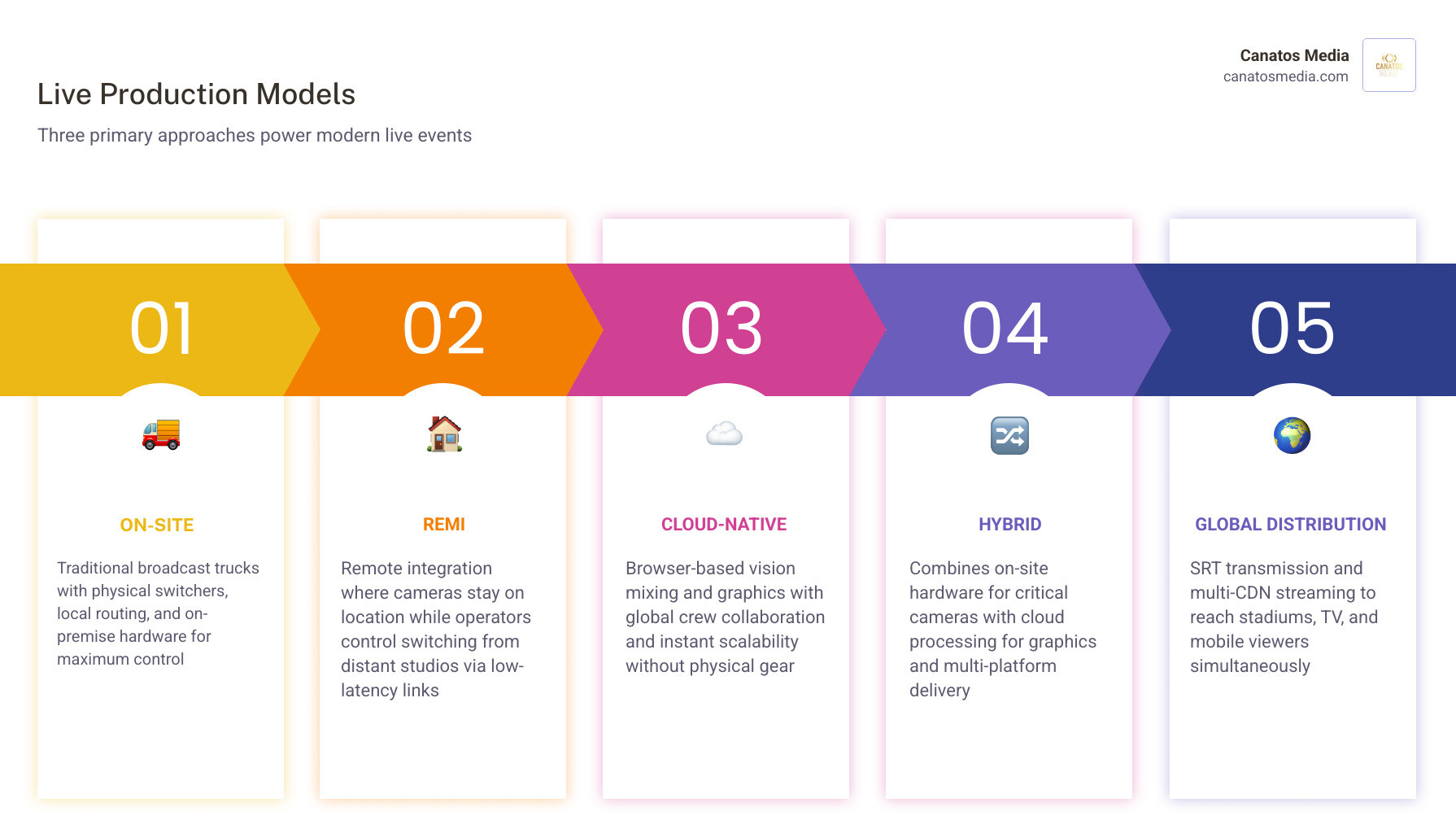
    Live production today spans everything from corporate town halls and sports broadcasts to K-Pop concerts and university esports events. It can happen on-site, remotely, or entirely in the cloud — and the line between those models is getting blurrier every year.

    The scale can be enormous. A single large concert can involve 60–70 crew members and over 20 partner companies working in sync. Miss one cue, and the whole show falls apart.

    I’m Nic Canobbio, founder of Canatos Media, and I’ve spent over two decades overseeing live production and content strategy — from national podcasts to social media content that has reached over 60 million views. In this guide, I’ll walk you through everything you need to know to understand, plan, or hire for a live production.

    Live production ecosystem infographic showing on-site, REMI, and cloud models with key components infographic

    Modern Live Production Workflows: On-Site, REMI, and Cloud Models

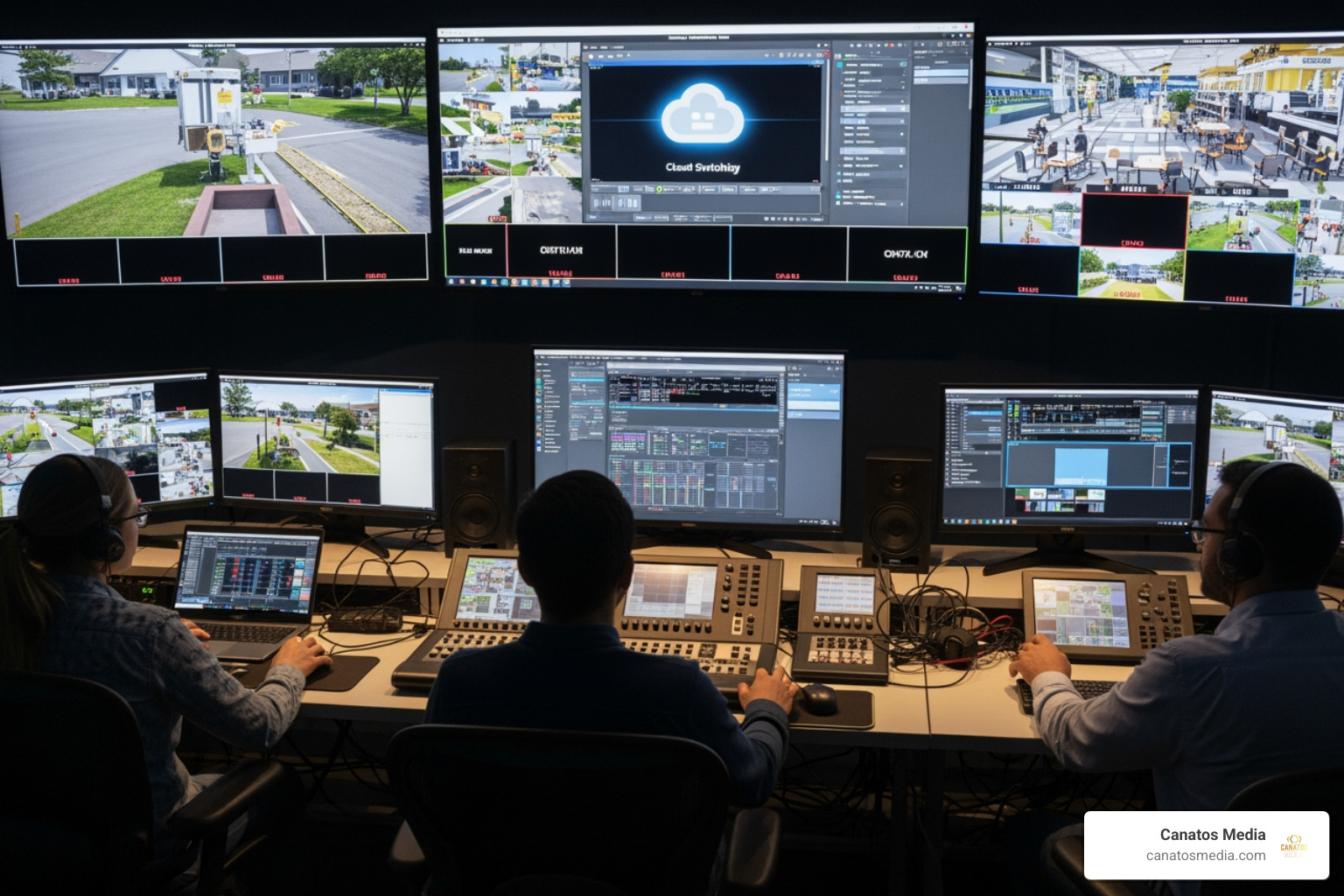
    remote production setup and cloud switching

    The landscape of live production in 2026 is defined by flexibility. Gone are the days when producing a high-quality live event meant parking a multi-million dollar broadcast truck outside a venue and running miles of heavy coaxial cable. Today, producers balance on-site hardware, remote production (REMI), and cloud-native environments to build workflows that fit their specific budget, scale, and distribution needs.

    Understanding how these models differ is the first step to executing a flawless broadcast. Whether you are planning a corporate town hall or a multi-venue conference, choosing the right framework will determine your technical requirements and your overall budget. For a deeper look at setting up web-based broadcasts, check out our resource on The Essential Guide to Hiring a Webcasting Production Company.

    On-Premises and Hybrid Infrastructure

    Traditional on-premises production relies heavily on physical hardware located directly at the venue. This setup utilizes physical production switchers, local SDI or IP routing (such as SMPTE ST 2110), and dedicated hardware for graphics, audio mixing, and engineering.

    For iconic regional venues in the tri-state area, such as the historic State Theatre New Jersey or the bustling stages supported by NJPAC Productions , on-site infrastructure remains a critical foundation. Having hardware on-site minimizes latency to near-zero, which is essential when feeding massive LED screens inside the venue where even a microsecond of delay between the performer’s mouth and the screen can break the illusion for the audience.

    However, modern on-premises setups are rarely isolated. Most operate as hybrid infrastructures, leveraging local processing for in-venue displays while sending clean video feeds to remote teams via IP networks for secondary broadcasts or localized streams.

    Cloud-Native Live Production Platforms

    On the other end of the spectrum lies cloud-native live production. Instead of shipping physical racks of gear to a venue, technical directors can now run an entire broadcast control room from a standard web browser.

    Platforms like Live Cloud Production | Grabyo have revolutionized this space by supporting up to 16 live HD video inputs and distributing those feeds to as many as 20 simultaneous endpoints at 60 frames per second. These browser-based control rooms handle everything from vision mixing and multi-track audio routing (supporting up to 64 channels) to instant replays and real-time graphics.

    Similarly, Chyron LIVE® – Cloud-Native Live Production Platform – Chyron offers an all-in-one cloud environment that allows remote distributed teams to collaborate seamlessly. It supports up to 12 remote guests and features customizable touchscreen interfaces, making it possible to produce a high-end broadcast with a lean, geographically dispersed crew. By removing the need for physical OB vans, cloud-native platforms democratize professional live video production for organizations of all sizes.

    Scaling Across Venues and Global Audiences

    When an event scales across multiple venues or targets a massive global audience, transmission reliability becomes the primary challenge. This is where Secure Reliable Transport (SRT) and advanced hardware codecs play a pivotal role.

    A prime example of scaling live production to extreme limits occurred during the 2025 Asia Tour Encore for the virtual group PLAVE. To keep over 35,000 in-person fans at the Gocheok Sky Dome perfectly synchronized with a global live stream and simultaneous live cinema broadcasts, the production team deployed 16 AJA BRIDGE LIVE units. You can read the technical breakdown in the article AJA gear powers PLAVE Asia Tour Encore . This specialized video infrastructure managed low-latency SRT-based 4K transmission, ensuring that the real-time motion-capture dancers and the virtual band avatars stayed in perfect sync across multiple continents.

    To help you decide which model fits your next project, here is a quick comparison of the three primary workflows:

    Production Model Primary Advantage Best Suited For Key Challenge
    On-Site (On-Premises) Near-zero latency, maximum control over local feeds Arena concerts, theatrical plays, local venue screens High shipping and travel costs, massive physical footprint
    REMI (Remote Integration) Centralized crew keeps travel costs low Multi-venue corporate events, regional sports Requires robust, high-bandwidth upload speeds at the venue
    Cloud-Native Highly scalable, pay-per-hour, browser-accessible Digital-first broadcasts, esports, multi-platform streams Dependent on public internet stability, requires cloud-trained operators

    Technical Integration: Audio, Video, Graphics, and Communications

    audio and video engineers at a live event

    A successful live broadcast is like a symphony; if the brass section is out of time with the strings, the performance is ruined. In live production, this means your video switchers, audio consoles, real-time graphics engines, and crew communication systems must function as a single, unified organism.

    When managing complex multi-location events, ensuring this technical integration is seamless is paramount. For brands operating across several regions, integrating these high-end visual tools with localized content strategies is key to maintaining brand consistency, as discussed in our guide on End-to-End Video Production and Ads Management for Multi-Location Brands.

    The Role of AI and Automation in Live Production

    Automation is no longer about replacing human operators; it is about freeing them to focus on creative storytelling. Modern live automation systems act as the invisible backbone of high-pressure broadcasts.

    Systems like Producer – LiveEdit add a powerful automation engine directly to the production workflow. By connecting to video switchers, PTZ cameras, media players, and lighting desks, it allows producers to lock their entire show to a unified timecode (supporting LTC, MTC, Art-Net, and OSC). During rehearsals, the system can automatically record multiple camera angles, allowing the director to instantly replay and compare takes to perfect the show’s timing before going live.

    On the cloud side, Live Producer X | Cloud Live Video Production | Grass Valley leverages Grass Valley’s AMPP platform to offer high-end visual control through an intuitive, hierarchical workflow. It simplifies complex tasks like picture-in-picture transitions, animated wipes, and multi-layered graphics, giving solo operators or remote crews the ability to execute network-grade shows with minimal manual overhead.

    Synchronizing Multi-Camera Feeds and Graphics

    The technical complexity of synchronization multiplies when virtual elements are introduced. In modern entertainment, virtual avatars, augmented reality (AR) overlays, and physical performers must coexist in the same visual space.

    Achieving this requires precise timecode alignment and real-time rendering engines. As highlighted in the behind-the-scenes look at virtual entertainment production, Maximizing Experiences While Supporting Talents’ Emotions: Interview with the Live Production Division | COVERedge , live production is not just about technical execution—it is about translating the artist’s emotional journey into visual metaphors. Whether using motion-capture suits to drive digital avatars or coordinating live violinists with dynamic LED backdrops, maintaining exact alignment between stage visuals and performers is essential to keep the audience fully immersed in the experience.

    As the technology driving live production evolves, so must the talent operating it. The industry is experiencing a massive shift toward software-defined workflows, requiring a new generation of professionals who are as comfortable with IP networking and cloud architecture as they are with traditional camera framing and audio mixing. To understand how these production trends fit into a broader business strategy, explore The Ultimate Guide to Video Marketing for Service Businesses in 2026.

    Educational Pathways and Certifications

    The most effective training programs bridge the gap between classroom theory and real-world pressure. Modern certifications focus heavily on hands-on control room operations, IP networking, and multi-camera event design.

    In the tri-state area, local institutions and community theaters play a vital role in fostering this talent. Organizations like the Music Mountain Theatre | Live Theatre | 1483 New Jersey 179 … provide practical, grassroots environments where aspiring technicians can learn the fundamentals of live audio engineering, theatrical lighting design, and stage management. These local stages serve as proving grounds, preparing crew members to step up to complex, high-stakes corporate and broadcast environments.

    Choosing the Right Live Production Partner

    For businesses looking to host an event, choosing a production partner can feel overwhelming. The right partner should offer a balance of cutting-edge technology, creative vision, and deep regional expertise.

    In the competitive New York and Long Island market, clients look for full-service capabilities that handle everything from concept to execution. When evaluating providers, it helps to look at established regional specialists. For instance, a premier Long Island Video Production Company or a dedicated Long Island Video Production Company | New York can offer tailored local insights and rapid deployment. Additionally, partnering with experienced Event Production Companies on Long Island NY ensures that your lighting, audio, rigging, and video logistics are managed by teams who understand the unique structural and regulatory requirements of local venues.

    At Canatos Media, we believe that live video shouldn’t exist in a vacuum. We specialize in taking the high-impact moments captured during your live events and turning them into a continuous stream of cinematic, short-form content that drives real business growth. If you are ready to elevate your brand’s digital presence, explore how you can Scale your brand with Canatos Media.

    Frequently Asked Questions about Live Production

    What is the difference between REMI and cloud-based live production?

    While both models allow production teams to work remotely, they utilize different technical infrastructures. REMI (Remote Integration Model) typically involves capturing video feeds on-site and transmitting them back to a physical, centralized broadcast studio or OB van where the actual switching and mixing occur on hardware. Cloud-based live production bypasses physical control rooms entirely; all video and audio feeds are sent directly to cloud servers, and the production team controls the entire broadcast via a standard web browser from any location with an internet connection.

    How does AI improve live event production workflows?

    AI is primarily used to automate repetitive, high-speed tasks during a live broadcast. This includes real-time automated captioning and multi-language localization, automated camera tracking for PTZ cameras, and AI-driven clip creation that can instantly recognize key moments (like a goal in a sports match or a dramatic peak in a speech) to generate instant replays and social media clips without human intervention.

    What should a business look for when hiring a live production company?

    A business should prioritize reliability, clear communication, and a strong portfolio of similar events. Key factors to consider include:

    • Redundancy: Do they have backup power, secondary internet lines, and fail-safes for critical equipment?
    • Scalability: Can they handle both in-person venue needs (like PA systems and LED walls) and digital streaming audiences simultaneously?
    • End-to-End Integration: Do they manage all disciplines (audio, video, lighting, and communications) under one cohesive team, or do they rely on uncoordinated subcontractors?

    Conclusion

    In 2026, live production is no longer just about broadcasting a single moment in time; it is about creating an immersive, multi-platform experience that continues to engage audiences long after the live stream ends. Whether you are leveraging hybrid on-site infrastructure in New Jersey, utilizing cloud-native switching via Grabyo or Chyron, or scaling a global broadcast with SRT transmission, the goal remains the same: delivering flawless, high-impact stories to your audience.

    At Canatos Media, we bridge the gap between live event energy and long-term digital growth. We don’t just help you capture the moment; we specialize in scaling that footage into high-performing, cinematic content that fuels your marketing funnel. To learn more about our philosophy on content creation, check out our insights on How We Scale Cinematic Short-Form Content Without Sacrificing Quality.

    If you are ready to build an integrated video strategy that connects high-end production with targeted ads and measurable business growth, explore our approach to End-to-End Video Marketing: How We Drive Real Results for Growing Businesses, or take the next step to Scale your brand with Canatos Media today.

  • How Cinematic Short-Form Ads Drive Measurable Leads Without Sacrificing Story

    How Cinematic Short-Form Ads Drive Measurable Leads Without Sacrificing Story

    The Lead Generation Problem with Generic Social Content

    Most brands treat social media ads like billboards. They post a product shot with a discount code, cross their fingers, and wonder why engagement stays flat while spending climbs. The problem isn’t that short-form video doesn’t work—it’s that forgettable, low-effort content floods the feed so relentlessly that viewers have learned to ignore it entirely.

    Generic content creates a vicious cycle. Your audience scrolls past because they’ve seen the same format a hundred times before. Your click-through rates drop. Your cost per lead rises. You end up cutting budgets or abandoning the channel altogether, which means you never get to see what actually resonates.

    What gets missed in this approach is that the most successful campaigns don’t separate lead generation from storytelling. They’re inseparable. When you lead with a compelling narrative instead of an immediate ask, you earn attention first. That attention becomes trust. Trust converts into action.

    The shift requires more than just swapping out static images for video. You need production quality that matches viewer expectations, messaging that speaks to real pain points, and a strategic framework that guides people from discovery to conversion without losing them in the journey.

    Why Storytelling Matters More Than Ever in Short-Form Ads

    Short attention spans are real, but they’re not what people think they are. Viewers don’t have short attention spans for content that hooks them immediately. They have low tolerance for irrelevant noise. A well-told story in six seconds outperforms a generic message in 30 seconds every time.

    The mechanics of effective short-form storytelling follow a clear pattern: establish context in the first second, create tension or curiosity, then resolve with your offer or call to action. A dental practice might open with “We see this problem three times a day,” show a patient’s expression of relief during treatment, then reveal their pain-free recovery plan. That’s story. That’s why it works.

    Storytelling also builds emotional connection, which directly impacts lead quality. Someone who clicks because they felt something is more likely to actually book a consultation or request information. They’re pre-qualified by emotion and relatability, not just curiosity about a price.

    We’ve found that the brands pulling the highest engagement and conversion rates aren’t the ones with the slickest production budgets. They’re the ones who figured out what their audience actually cares about and told that truth compellingly. A home services company’s story about how they solved a customer’s worst nightmare drives more leads than ten ads showing their team waving at the camera.

    The Strategic Advantage of Cinematic Production Quality

    There’s a meaningful difference between “video quality” and “cinematic quality.” Most video content looks like it was filmed on a phone in an office. Cinematic quality means intentional color grading, deliberate camera movement, professional lighting setups, and sound design that works as hard as the visuals.

    This matters for credibility and differentiation. When your ad looks cinematic, viewers make an unconscious assumption: this is a company that invests in excellence. That assumption converts. It also means your content won’t look dated in three months because you cut corners on production values.

    Cinematic production also solves a platform problem. Social feeds are visually chaotic. Low-quality video gets buried. Professional video stops the scroll. It commands attention through pure visual craft, giving your story the stage it deserves. Learn more about how cinematic short-form content improves platform performance.

    Another practical advantage: cinematic production scales. Once you’ve invested in a quality shoot with professional crew, lighting, and color grading, you can extract dozens of ad variations from the same content. Different crops, different music, different headlines—each tailored to specific audience segments or platforms. That multiplier effect on investment is what separates efficient ad spending from wasteful spending.

    Integrating Lead Capture Directly Into Your Story

    The moment your story ends, you lose momentum if the next step isn’t obvious and frictionless. This is where many campaigns fail. They tell a great story then point viewers to a generic landing page or ask them to “learn more.”

    We build lead capture into the narrative itself. Instead of treating the call to action as an afterthought, we design it as the natural resolution of the story. If your story establishes a problem and shows a solution, the CTA is the viewer deciding “I want that solution.” The button they click should feel like the obvious next step, not an interruption.

    This approach uses platform-native tools strategically. Meta lead forms work best when viewers stay within the app. Google forms let you segment traffic based on intent. SMS opt-ins can work if the story creates urgency. The format depends on your audience and offer, but the principle stays constant: the path to lead capture should be as smooth as the story itself.

    We also test messaging extensively. “Book a consultation” and “Schedule a free audit” produce different response rates even when they’re the same offer. The language has to match the tone and story you’ve established, or it creates cognitive friction that stops conversions.

    Our End-to-End Approach to Cinematic Ad Production

    We treat cinematic short-form ad production as a complete system, not isolated deliverables. The process starts with strategy: we identify your actual customer, understand their specific pain points, and determine what story will resonate most powerfully with them.

    From there, we move into creative development. We write scripts that hook within the first second and resolve with clear intent. We create storyboards that plan every shot, movement, and transition. This preparation means your actual shoot is efficient, focused, and produces exactly what the campaign needs.

    On set, we use professional lighting, camera equipment, and crew experienced in short-form production. We shoot cinematic elements—establishing shots, B-roll, character moments, detail work—that we can repurpose across multiple ad variants. We also capture behind-the-scenes and user-generated style content because variety in creative prevents ad fatigue.

    Post-production includes color grading that creates a distinct visual signature, sound design that reinforces emotion, and motion graphics that clarify your offer. Everything is optimized for the specific platforms where your ads will run, whether that’s vertical video for Instagram Stories or 16:9 for YouTube.

    We don’t hand off final files and disappear. We set up the ad accounts, segment audiences, configure targeting, and establish baseline metrics. Discover how we structure lead generation through video production systems.

    Optimizing Placement and Platform Strategy for Maximum ROI

    Not every platform suits every story, and not every audience segment responds to the same creative. We develop platform-specific strategies that acknowledge these differences without forcing you to remake content for each channel.

    Meta platforms (Facebook and Instagram) reward video with strong early engagement. Your cinematic short-form ad needs to earn attention within the first three seconds or it gets buried. Google Search and YouTube work differently—audiences are already in problem-solving mode, so your story can be more direct and solution-focused. TikTok and Instagram Reels favor entertainment and authenticity, so cinematic quality might be slightly less important than raw relatability.

    Audience segmentation is equally critical. Your message to a warm audience (people who’ve visited your site or engaged with previous content) can be more specific and assumptive. Cold audiences need broader storytelling that establishes credibility first. We build this tiering into the campaign structure so you’re not running the same ad to everyone.

    Budget allocation follows performance data. We start with balanced distribution across your target platforms, then systematically shift budget toward channels and segments that deliver the lowest cost per lead. This requires real-time monitoring and willingness to adjust, not a set-it-and-forget-it approach.

    Real Results: How Our Clients Convert Viewers Into Leads

    The metrics tell a consistent story. Brands running cinematic short-form ads see lower cost-per-click because quality creative gets better organic reach before ad spend even kicks in. They also see lower cost-per-lead because engaged viewers (the ones who stopped scrolling for your story) are more likely to convert than people who clicked out of idle curiosity.

    A multi-location home services company reduced their cost per qualified lead by 38% within 60 days by moving from static image ads to cinematic testimonial videos. Their story focused on customer relief after a major repair. The emotional hook meant their audience was pre-qualified by relevance before they ever submitted a form.

    A B2B professional services firm generated 47 qualified consultations in their first month of cinematic video ads by positioning their service as the solution to a specific, recurring client problem. The story showed that problem in context, explained why it was costly to ignore, then positioned their approach as the antidote. No sales pitch. Just narrative clarity.

    These results happen because cinematic storytelling attracts intent-driven viewers. Your ad isn’t generating random clicks. It’s generating qualified interest from people who recognize themselves in your story and want to know more.

    Building Consistent Brand Identity Across Your Ad Library

    As you accumulate cinematic ads over time, consistency becomes a competitive advantage. Your audience starts recognizing your brand by its visual language before they even read the headline. That recognition builds trust and accelerates conversion.

    Consistency doesn’t mean repetition. It means your color palette, camera movement style, music choices, and narrative voice remain recognizable even as the specific stories change. One ad might feature customer testimonials. Another might show your process. A third might address a specific objection. Each tells a different story, but each one is unmistakably yours.

    We develop brand guidelines for video production that specify these elements. What color grade do we apply? What camera movements feel native to your brand? What tone of voice works across scripts? These guidelines make it possible to produce new ads over time without losing the visual coherence that makes long-term campaigns effective.

    Consistency also simplifies testing and optimization. When your audience recognizes your brand by sight, they’re more willing to engage with multiple ads. You can test different messages, different CTAs, and different audience segments without worrying that each new creative will confuse your audience about who you are.

    Measuring What Matters: Attribution and Performance Tracking

    You can measure a lot of metrics: impressions, clicks, engagement rate, reach. Most of them don’t matter if they don’t connect to actual leads and sales. We focus on measurement that directly tracks conversion.

    Cost per lead is the foundational metric. If your cinematic ad campaign costs 40% less per lead than your previous approach, that’s real data showing improvement. We track this alongside lead quality metrics. Are the leads converting to customers? What’s the average deal value? A cheaper lead that never converts is worthless.

    We also measure time to conversion. Do leads from your cinematic video ads book a consultation faster than leads from other sources? Do they show up better prepared, with fewer basic questions? These behavioral indicators matter because they predict lifetime customer value.

    Platform analytics show what’s working within each channel. Which creative assets get the most engagement? Which messaging performs best with which audience segment? We use this data to inform what we shoot next. If testimonial stories outperform product-focused stories with your audience, we build more testimonials into the content calendar.

    Attribution modeling matters too, especially for longer sales cycles. A prospect might see your cinematic ad, not convert immediately, then return to your site a week later and finally book. Single-touch attribution would miss the ad’s role in that conversion. We set up tracking that captures the full path so you understand how your ads contribute to actual sales.

    Getting Started With Your Cinematic Ad Strategy

    The first step is honest assessment: are your current ads generating the quality and volume of leads you need? If the answer is no, the problem likely isn’t your ad budget. It’s creative quality, message clarity, or platform strategy. Cinematic short-form ads address all three.

    Start by identifying your best customer story. What transformation or outcome do your most satisfied customers experience? What problem were they facing before they found you? This becomes your first script. You don’t need perfect polish on attempt one. You need real story that resonates.

    From there, build a production timeline and budget that aligns with your growth goals. If leads are your primary constraint, invest in quality production. The return on that investment comes quickly when your creative is strong and your targeting is precise.

    We’re here to guide you through this process. We handle strategy development, production, platform setup, and ongoing optimization. Our goal is straightforward: generate measurable leads without sacrificing the storytelling that makes people care enough to convert.

    Ready to see how cinematic short-form ads perform for your specific business? Let’s discuss your current lead generation challenges and map out a concrete path forward.

    Contact us today for a free consultation to see how we can help you grow your business.
    Frequently Asked Questions (FAQ)

    How do we integrate lead capture into cinematic storytelling without interrupting the viewer experience?

    We build lead capture mechanics directly into the narrative flow of our ads rather than treating them as separate elements. Our team designs call-to-action moments that feel natural within the story itself, whether through product reveals, service demonstrations, or character-driven transitions. This approach keeps viewers engaged with your brand story while making conversion feel like the logical next step rather than a jarring interruption.

    What makes cinematic production quality actually drive more leads than standard short-form content?

    We’ve found that higher production values build trust and perceived brand authority, which directly impacts lead quality and conversion willingness. When your ad looks professionally crafted, potential customers are more likely to believe in your product or service and take the action you’re asking for. Beyond psychology, cinematic content also performs better in platform algorithms because it encourages longer watch times and higher engagement rates.

    How do we measure whether our cinematic ads are actually generating leads and not just views?

    We set up comprehensive attribution tracking across all platforms where your ads run, connecting video performance directly to lead submissions, form fills, and sales pipeline data. Our reporting shows you exactly which creative elements, placements, and audience segments drive the best-performing leads, so we can continuously optimize your investment toward the conversions that matter to your business.

  • The Definitive Guide to Tri State Marketing

    The Definitive Guide to Tri State Marketing

    What Tri State Marketing Really Means for the Foodservice Industry

    Tri state marketing — in the foodservice world — refers to the work of manufacturers’ representative firms that connect equipment brands with dealers, consultants, and operators across multi-state regions like New York, New Jersey, and Connecticut.

    Here’s a quick breakdown of what that looks like in practice:

    • Who they serve: Restaurants, healthcare facilities, schools, and hospitality businesses
    • What they do: Connect commercial equipment brands with buyers across a defined territory
    • Key players: Rep firms like Tri-State Marketing Associates act as an extension of the brands they represent
    • Why it matters: Without rep firms, manufacturers would struggle to maintain relationships and sales across large geographic areas

    One firm that defines this model is Tri-State Marketing Associates — founded in 1999 and headquartered in Ossining, New York. With 18 employees, over 130 years of combined industry experience, and $8.6M in annual revenue, they’ve built a reputation as a go-to resource for foodservice professionals across the Northeast.

    This guide breaks down how they operate, which brands and territories they cover, and what their growth trajectory reveals about the broader tri state marketing landscape.

    I’m Nic Canobbio, and through my work building strategic partnerships and media-driven growth at Canatos Media, I’ve seen how regional tri state marketing strategies can make or break a brand’s local presence. This guide draws on that experience alongside deep research into the foodservice rep model.

    Foodservice supply chain from manufacturer to operator via rep firm infographic infographic

    What is Tri State Marketing Associates?

    commercial foodservice equipment in a modern commercial kitchen

    At its core, Tri-State Marketing Associates is a premier manufacturers’ representative group dedicated to the commercial foodservice equipment and supplies industry. Instead of operating as a traditional, detached sales intermediary, the company functions as a direct, value-added extension of the manufacturing brands they represent.

    For commercial kitchen operators, selecting the right equipment is a high-stakes decision. A single purchasing error can lead to workflow bottlenecks, high energy bills, and expensive maintenance down the road. Tri-State Marketing Associates bridges this gap by providing foodservice professionals with the exact tools, hands-on knowledge, and support they need to make informed decisions.

    By operating closely within the local supply chain, they ensure that dealers, consultants, and end-user operators have immediate access to world-class equipment solutions. Their hands-on approach includes live equipment demonstrations, culinary consultations, and comprehensive product training, ensuring that high-end kitchen technology is fully understood and correctly utilized in the field.

    History and Evolution of the Rep Firm

    The story of Tri-State Marketing Associates began in 1999, when the firm was founded by industry veterans Lynne Schultz and Bart Gobioff. Recognizing a need for a more relational, service-oriented representative group in the New York metropolitan area, the founders set out to build a business grounded in deep product knowledge and strong regional relationships.

    Over the last two decades, the company has evolved from a localized rep firm into a regional powerhouse. Headquartered at 730 Old Kitchawan Rd N in Ossining, New York, the firm has expanded its footprint across multiple states, strategically establishing touchpoints in Westbury, NY, and Katonah, NY, to better serve their growing client base.

    A major milestone in their modern evolution occurred in 2024, when the firm officially joined the Manufacturers’ Agents Association for the Foodservice Industry (MAFSI). This membership solidified their status as a top-tier representative group, aligning them with national standards of excellence and giving them access to advanced industry resources. To learn more about their foundational values and current operations, you can visit the official homepage for Food Service Manufacturer Reps New York | Tri-State Marketing .

    Core Services in the Foodservice Industry

    To truly understand their impact, it helps to look at the specific ways Tri-State Marketing Associates supports the different segments of the foodservice supply chain:

    • Dealer Support: They provide commercial equipment dealers with up-to-date pricing, technical specifications, sales training, and promotional assets to help them sell represented brands effectively.
    • Consultant Support: Foodservice consultants designing commercial kitchens rely on the firm for highly accurate CAD drawings, Revit files, utility requirements, and innovative product applications.
    • Operator Initiatives: By working directly with operators—such as chefs, school nutrition directors, and healthcare foodservice managers—the firm helps end-users find tailored solutions for menu expansion, labor savings, and energy efficiency.
    • Brand Extension: For the manufacturers they represent, they act as a local sales and marketing department, executing targeted regional campaigns, attending local trade shows, and managing customer relationships.

    In many ways, their operational model mirrors what we do in the digital space. Just as a manufacturer relies on a local representative to connect their products with the right buyers, local businesses rely on specialized growth partners to navigate complex digital landscapes. If you are looking to scale your own business using modern marketing strategies, check out our guide on how to Stop Searching and Start Growing with the Best Local Marketing Companies.

    Territories and Brands Represented

    To manage a successful regional presence, a manufacturers’ representative must balance geographic accessibility with an elite portfolio of brands. Tri-State Marketing Associates has carefully curated a list of industry-leading manufacturers that cover virtually every major category in a commercial kitchen.

    Brand Primary Product Categories Key Applications & Industries Served
    Arctic Industries Walk-In Coolers & Freezers Restaurants, Cold Storage, Healthcare, Education
    EmberGlo Commercial Steamers & Charbroilers Quick-Service Restaurants, Diners, Specialty Kitchens
    Revent High-End Rack Ovens & Bakery Equipment Commercial Bakeries, Supermarkets, Artisanal Shops
    Winholt Material Handling, Racks, & Equipment Foodservice, Retail, Industrial Warehousing
    Vita-Mix Commercial Blenders & Beverage Prep Bars, Smoothies Shops, Coffee Houses, Restaurants
    Seating Concepts Commercial Furniture & Decor Dining Rooms, Food Courts, Corporate Cafeterias

    Diagram of foodservice representative sales channel flow

    Geographic Reach of Tri State Marketing

    The geographic coverage of Tri-State Marketing Associates is highly strategic, focusing on the dense and demanding markets of the Northeastern United States. Their primary territories include:

    • New York: Comprehensive coverage across the Metropolitan area, Long Island, Brooklyn, Queens, and Upstate New York.
    • New Jersey: Serving both Northern and Southern Jersey operators and dealers.
    • Pennsylvania: Focused coverage in Eastern Pennsylvania.
    • Delaware & New England: Expanding their reach to service the broader Northeast and Keystone territories.

    Managing such a diverse and geographic footprint requires clear channels of communication. Whether coordinating a walk-in freezer installation in Brooklyn or a bakery design in Philadelphia, their regional team remains highly accessible. For specific territory inquiries or regional support, you can reach out directly via the Contact | Tri-State Marketing page.

    Premier Brands and Product Categories

    The brands represented by Tri-State Marketing Associates are synonymous with durability and innovation. For example, Arctic Industries is a leader in custom walk-in coolers, offering polyurethane foam panels that deliver exceptional thermal efficiency. Meanwhile, Vita-Mix blenders are the undisputed gold standard for commercial beverage programs, relied upon daily by high-volume bars and coffee shops.

    By representing complementary product lines—spanning cooking, steam, refrigeration, holding, transport, and seating—they are able to offer complete, package-level solutions to their clients. This holistic approach is highly effective in business development.

    Whether you are selling high-end kitchen equipment or local services, success always comes down to solving the customer’s entire problem rather than just selling a single piece of the puzzle. For local businesses looking to apply these cohesive customer acquisition frameworks to their own models, we highly recommend exploring The Long Island Growth Guide: Customer Acquisition Strategies That Actually Work.

    The Team and Growth Metrics Driving Success

    Tri-State Marketing team collaborating on regional outreach

    The success of any representative firm relies entirely on the quality of its people and the strength of its relationships. Tri-State Marketing Associates has built a highly structured, multi-disciplinary team designed to support every phase of the sales and customer service cycle.

    Industry Expertise and Key Leadership

    The team boasts over 130 years of combined experience in the foodservice industry, giving them unparalleled insight into the operational challenges faced by modern kitchens.

    Key leadership and team members include:

    • Lynne Schultz & Bart Gobioff: Co-founders who established the firm’s relationship-first philosophy.
    • Marc Fugaro: Vice President, driving regional sales initiatives and strategic planning.
    • Judy Clinton: Managing crucial operational and customer support systems.

    The rest of the organization is rounded out by specialized roles, including dedicated Directors of Operator Initiatives, Outside Sales Associates, Inside Sales Support, Customer Service Representatives, and Social Media & Office Assistants. This specialized division of labor ensures that no client request falls through the cracks.

    To meet the individuals driving these regional operations and read their professional bios, visit the Our Team | Tri-State Marketing page, or view their professional corporate profiles through the Tri-State Marketing Associates Employee Directory .

    Modern Tri State Marketing Strategies and Growth Metrics

    As of July 2026, Tri-State Marketing Associates continues to showcase impressive growth, proving that their relationship-driven model—when paired with modern outreach—is highly resilient.

    Key performance and growth indicators for the firm include:

    • Employee Count: Currently employing 18 professionals, representing a healthy +6.5% year-over-year growth (+2 employees).
    • Annual Revenue: Generating an impressive $8.6M in annual sales revenue.
    • LinkedIn Presence: Reaching 917 followers, with a steady monthly growth of +2.5% and an outstanding yearly growth of +47.0%.
    • Website Traffic: Attracting 2,089 monthly visits, driven by a massive monthly traffic spike of +116.7% and a yearly growth rate of +60.7%.

    A major driver of this online and offline momentum is their active engagement with the local community through customer spotlight features. For example, their June Customer Spotlight highlighted the prestigious Country Club of New Canaan, showcasing how high-quality equipment elevates country club dining. Similarly, their May Customer Spotlight celebrated Bakers Grimm welcoming a state-of-the-art RATIONAL iCombi Pro into their bakery, while their March Customer Spotlight focused on the culinary creations at Pastabilities.

    By sharing these real-world success stories on social media and their blog, they build trust and demonstrate the tangible impact of their equipment. This is a prime example of how modern B2B businesses can use digital storytelling to drive real-world sales.

    If you want to build a highly engaged social media presence that converts local followers into loyal clients, check out our insights on finding a Social Media Marketing Agency Small Business Matches Made in Heaven.

    Additionally, if you are planning to scale your regional outreach through paid channels or high-quality video content, learning How to Select a Local Growth Marketing Partner for Creative and Ads is a crucial next step.

    Frequently Asked Questions About Tri-State Marketing

    What industries does Tri-State Marketing Associates serve?

    Tri-State Marketing Associates serves a wide range of commercial foodservice sectors. Their primary client base includes independent and chain restaurants, healthcare facilities (such as hospitals and assisted living communities), educational institutions (K-12 schools and university campuses), and hospitality venues (hotels, country clubs, and convention centers).

    Which brands does Tri-State Marketing represent?

    They represent some of the most respected brands in the commercial kitchen space, including Arctic Industries (walk-in refrigeration), EmberGlo (steamers and charbroilers), Revent (commercial ovens), Winholt (material handling and racks), Vita-Mix (high-performance commercial blenders), and Seating Concepts (commercial furniture and interior decor solutions).

    How can foodservice operators contact Tri-State Marketing?

    Foodservice operators, dealers, and consultants can easily get in touch with the firm. Their main headquarters is located at 730 Old Kitchawan Rd N, Ossining, NY 10562. You can reach their office by phone at (914) 941-1717 or submit an inquiry directly through the contact forms on their official website.

    Conclusion

    The success of Tri-State Marketing Associates demonstrates the power of a highly integrated regional strategy. By combining deep, hands-on industry expertise with consistent support for dealers, consultants, and operators, they have built a business that generates $8.6M in annual revenue and continues to expand its geographic and digital footprint.

    Whether you are distributing heavy commercial kitchen equipment or running a local service business in the tri-state area, the core principles of growth remain the same: you must build genuine relationships, establish a clear local presence, and use modern digital tools to tell your story.

    At Canatos Media, we help businesses across the tri-state area and Long Island turn their regional goals into reality. We create cinematic short-form videos, manage highly active social media channels, run targeted paid ad campaigns on Meta and Google, optimize websites for SEO, and provide ongoing technical support. Our integrated strategy is built to connect your content, targeting, and conversions for measurable, long-term growth.

    Ready to elevate your local marketing and start reaching more customers? Let’s build something great together. Connect with us at Canatos Media today.

  • 5 Best Local Lead Generation Strategies: Why Canatos Media Outperforms Common Thread Collective

    5 Best Local Lead Generation Strategies: Why Canatos Media Outperforms Common Thread Collective

    1. Cinematic Short-Form Video as Your Lead Magnet

    Local lead generation requires more than scattered tactics. Growth-focused business owners need a unified system that turns attention into qualified prospects and customers. The difference between agencies often comes down to whether they operate as separate departments or as an integrated machine built for conversion.

    Short-form video dominates how local audiences discover and evaluate service-based brands. Yet most agencies treat video as a standalone creative asset rather than a lead-generation tool designed for conversion.

    We produce cinematic short-form content that doesn’t just grab attention; it positions your brand as the premium choice while directly addressing your prospect’s pain point. When a plumbing company showcases a time-lapse repair with cinematic production quality, it signals professionalism. When a dental practice shows a patient’s genuine smile transformation with intentional color grading and sound design, trust builds immediately.

    The key difference is intent. Our video production focuses on converting viewers into qualified leads by embedding clear calls-to-action, benefit statements, and social proof directly into the creative. This isn’t vanity content; it’s a lead-generation asset.

    For multi-location brands, we create content templates that maintain cinematic quality while scaling across multiple locations, service types, and regional campaigns. A single shoot can produce 12-15 short-form assets optimized for different audience segments and platforms.

    What to do next: Audit your current video content. Does it showcase transformations or results? Does it include a specific next step for viewers? If not, repurposing existing footage through a lead-generation lens will immediately improve conversion rates.

    2. Integrated Social Media Management vs. Fragmented Services

    Many businesses hire separate teams for content creation, community management, paid ads, and strategy. Each team optimizes for their own metrics, creating disconnects. One team pushes brand awareness while another manages ad spend; neither owns lead conversion.

    We operate differently. Our social media management integrates directly with your paid advertising strategy and sales funnel. When we manage your Meta and Instagram presence, we’re not posting for engagement vanity metrics. We’re building authority, nurturing warm leads, and directly feeding qualified prospects into your sales system.

    This means your content calendar aligns with your ad campaigns. Your community responses reinforce messaging from paid creatives. Your bio links and call-to-action buttons point to lead capture forms connected to your CRM. Every element amplifies the others.

    Consider a HVAC company managing 8 service locations. Fragmented agencies might post the same content across all locations, missing regional relevance. We customize messaging by service area, align posting schedules with seasonal demand peaks, and ensure all responses include a location-specific booking link. The result is higher-quality leads arriving at the right service location at the right time.

    What to do next: Identify one breakdown in your current marketing chain. Does your social content connect to your paid ads? Do your ads funnel to a proper lead capture system? Fix that one link before adding new channels or increasing budget.

    3. Meta and Google Advertising Expertise for Qualified Leads

    Paid advertising budgets grow quickly when campaigns lack strategic direction. We’ve seen multi-location brands waste 40-60% of ad spend targeting the wrong audience or promoting the wrong message.

    Our Meta and Google advertising approach starts with audience clarity. Rather than broad demographic targeting, we build custom audiences based on buyer intent, service area, previous engagement, and competitor research. A personal injury attorney doesn’t benefit from impressions among people living in a different state. A roofing contractor wastes money showing ads to renters.

    We then match audience precision with message precision. Different audience segments receive different creative, different benefit claims, and different offers. A prospect researching emergency water damage gets different messaging than someone planning a basement remodel, even though both might be homeowners.

    Our approach to scaling short-form ad creative across both platforms ensures your cinematic videos perform equally well on Instagram Reels, TikTok Shop, and Google Performance Max campaigns. This unified approach reduces production costs while improving ROAS because the message remains consistent across platforms.

    We also build conversion tracking that measures what actually matters: phone calls booked, consultation requests, or qualified leads reaching your sales team. Vanity metrics like clicks disappear from our reporting.

    What to do next: Pull your last 30 days of ad spend and categorize it by audience segment. Where are you getting the lowest cost-per-lead? Double down there. Where are you bleeding budget? Pause or restructure those campaigns immediately.

    4. SEO Optimization That Actually Drives Local Traffic

    Local SEO generates leads that are cheaper and more qualified than paid advertising over time. But many agencies treat SEO as an afterthought, checking boxes with generic optimizations that don’t move the needle.

    We approach SEO with the same conversion focus as paid advertising. Your service area pages aren’t just optimized for local keywords; they’re designed to capture high-intent searches and guide prospects toward booking. Your content strategy targets questions your sales team actually hears from prospects.

    For multi-location brands, location-specific optimization is non-negotiable. Each service area gets dedicated keyword research, content, and citation building. A dental practice in three neighborhoods needs three distinct local SEO strategies, not one generic strategy applied three times.

    We also integrate SEO with your paid and social strategies. Keywords that drive traffic organically inform the messaging we use in ads. Content that ranks well informs the topics we cover in short-form video. The systems reinforce each other.

    What to do next: Search your primary service keyword plus your city name. How many competitor results appear in the top 5? If it’s fewer than two direct competitors, your opportunity for ranking is high. If it’s more than four, you’ll need sustained SEO effort or a paid strategy while building organic visibility.

    5. Lead Generation Systems Built Into Your Marketing Stack

    Attention without conversion is wasted budget. Many agencies drive traffic and leads but don’t own the systems that convert those leads into customers.

    We build lead generation systems that capture, score, and nurture prospects automatically. This means your website forms feed directly into your CRM. Prospects who download a guide automatically receive an email sequence. Warm leads get scored for sales readiness. Your sales team receives alerts for high-intent activity.

    For service-based businesses, we integrate calendar booking systems, SMS nurture sequences, and retargeting campaigns into one cohesive funnel. A prospect who visits your site, views your video, and leaves without converting gets a retargeting ad the next day. Another prospect who downloaded your guide gets a phone call from sales within 2 hours.

    This systematic approach increases lead-to-customer conversion by 25-40% because prospects move through a predictable journey rather than getting lost after initial contact.

    What to do next: Map your current prospect journey from first awareness to sale. Where do you lose prospects? Is it after they click an ad? After they reach your site? After the first sales call? Fix that bottleneck before expanding your top-of-funnel spending.

    6. Real-Time Performance Tracking and Optimization

    Data without action is just information. We track campaigns in real-time and optimize continuously rather than reviewing performance quarterly.

    Our dashboard shows you exactly which channels, campaigns, content types, and audience segments drive qualified leads and sales. We see when a Facebook audience segment stops performing and pause it before budget bleeds. We notice when a short-form video drives 3x higher conversion rates and immediately increase spend behind that creative.

    This isn’t set-and-forget advertising. Every week includes optimization cycles. Every month includes strategic reviews. Every quarter includes fundamental strategy adjustments based on what the market is showing us.

    What to do next: Set up conversion tracking for your three most important business metrics (phone calls, form submissions, or sales). If you can’t measure it, you can’t optimize it.

    7. Why Agency Cohesion Matters for Multi-Location Brands

    Most agencies operate as committees. Strategy works independently from creative. Creative works independently from paid ads. Paid ads work independently from social management. Each team optimizes for their own KPIs, creating friction and missed opportunities.

    We operate as a unified growth team. Your lead generation goal is shared across our video producers, social managers, paid specialists, and SEO strategists. When we build a campaign, every element serves the same objective.

    This cohesion matters most for multi-location brands managing complex regional strategies, varying service offerings, and multiple decision-makers. A coordinated approach ensures consistency while allowing regional customization. Your brand voice stays unified. Your conversion systems stay aligned. Your budget moves efficiently toward results.

    The difference between fragmented services and integrated systems shows most clearly in the bottom line: qualified leads and sales. When all your marketing channels push in the same direction with aligned messaging and unified conversion systems, leads flow more consistently, sales cycles shorten, and your marketing budget generates measurable ROI.

    We’ve built Canatos Media specifically to serve growth-focused business owners who need more than tactics scattered across different vendors. We deliver integrated video-first marketing that turns audience attention into qualified, trackable leads. If your current approach involves managing multiple agencies or handling pieces internally, consider consolidating with a partner built for conversion, not just traffic.

    Contact us today for a free consultation to see how we can help you grow your business.

    Frequently Asked Questions (FAQ)

    How does our video-first approach actually generate leads for local service businesses?

    We create cinematic short-form content that stops the scroll and compels action, then pair it with integrated Meta and Google advertising to reach qualified prospects in your service area. Our videos don’t just build brand awareness—we structure them as lead magnets that drive viewers directly into your sales funnel through optimized landing pages and lead capture systems. This combination of compelling visual storytelling and strategic paid placement consistently outperforms traditional social media posting because we’re converting attention into measurable inquiries from the right audience.

    What’s the difference between our agency model and working with multiple separate vendors?

    When you work with us, your video production, social media management, paid advertising, and SEO optimization all operate as one coordinated system rather than isolated services. We control the entire strategy, meaning your messaging stays consistent across platforms, your budget is allocated to what actually drives results, and we can rapidly optimize based on real-time performance data. With fragmented vendors, you’re managing different teams with different priorities, which creates gaps where leads fall through the cracks.

    How do we handle lead generation for multi-location brands specifically?

    We build scalable lead generation systems that maintain brand consistency while allowing location-specific targeting and messaging. Our approach uses localized video content, geo-targeted advertising, and location-based SEO optimization so each branch attracts qualified leads in their market. We then track performance by location so you see which strategies are driving the highest-quality leads for each service area.

  • To Degree or Not to Degree: Navigating Film and Video Production Programs

    To Degree or Not to Degree: Navigating Film and Video Production Programs

    Is a Film Degree Worth It in 2026?

    Film and video production sits at the intersection of art, technology, and business — and right now, it’s one of the most in-demand skill sets on the planet.

    Here’s a quick snapshot of what you need to know:

    • What it is: The process of creating moving image content, from scripted films to branded videos to live streams
    • Who it’s for: Aspiring directors, editors, camera operators, producers, and content creators across every industry
    • Degree options: B.A., B.S., B.F.A., Associate degrees, and professional certificates
    • Career outlook: Producers and directors earn a median of $79,692/year, with some markets like Washington state projecting 23.9% job growth through 2034
    • The big question: Whether formal education or a self-taught path better fits your goals — and that depends on where you want to work and what you want to make

    The digital revolution changed everything. Professional-quality cameras now fit in a backpack. Streaming platforms have created insatiable demand for content. And every organization — from Fortune 500 brands to local nonprofits — now uses video to communicate, sell, and connect.

    That’s opened up enormous opportunity. But it’s also made the question of how to break in more complicated than ever. Do you need a film school degree? A certificate? Or just a great reel and the right network?

    This guide breaks it all down.

    I’m Nic Canobbio, founder of Canatos Media, with over two decades of hands-on experience spanning live film and video production, national podcast development, and social content that has reached more than 60 million views. I’ll share what I’ve seen work — and what I’ve seen fail — so you can make a smarter decision about your path.

    Decision matrix comparing film school degree paths vs self-taught routes in video production infographic

    Know your film and video production terms:

    Defining the Medium in the Digital Age

    To understand whether a degree is right for you, we first need to define what film and video production actually means in July 2026. The terminology has shifted dramatically over the last decade, and the tools we use have completely transformed how we create.

    A modern hybrid mirrorless camera rig set up on a gimbal for cinematic shooting

    The Blurring Lines of Film and Video Production

    Historically, “film production” and “video production” were two entirely different worlds.

    Film production was an elite, expensive, and highly technical craft. It involved physical celluloid film stock, massive cameras, chemistry labs, and enormous crews. Video production, on the other hand, was associated with magnetic tape, television broadcasts, corporate training videos, and home movies. It was cheaper, faster, and visually distinct from the warm, textured “cinematic look” of celluloid.

    Today, digital cinema technology has completely shattered those boundaries.

    We now shoot Hollywood blockbusters, Netflix dramas, and local commercial campaigns on the exact same digital sensor technologies. High-definition digital video, advanced color science, and hybrid mirrorless cameras allow even small crews to capture breathtaking, cinematic imagery.

    Because of this digital convergence, the distinction between “film” and “video” is no longer about the medium we use to capture the image. Instead, it is about the intention behind the camera.

    • Film Production is focused on narrative depth, artistic expression, and cinematic storytelling. Every frame, cut, and sound is crafted to evoke a specific emotional response, whether it is for a feature-length film, a documentary, or a high-end music video.
    • Video Production is typically more functional, strategic, and direct. It encompasses everything from corporate communications and social media campaigns to event coverage and product explainers.

    If you want to dive deeper into how these commercial services work, check out our Beginner’s Guide to Video Production Services.

    The Power of Storytelling Across Modern Formats

    No matter the format — whether it is a 90-minute indie documentary, a 30-second TikTok ad, or a branded mini-doc — storytelling remains the absolute core of the industry.

    Every screen needs content, and audiences are smarter than ever. They can spot a lazy sales pitch from a mile away. That is why modern production techniques must elevate brand storytelling by treating commercial and branded content with the same artistic care as a narrative film.

    When we produce branded content, we are not just filming a product; we are capturing a human experience. We use lighting to set a mood, sound design to build tension, and editing pacing to create a satisfying narrative arc. By applying high-end cinematic techniques to everyday digital formats, we help brands build genuine authority and emotional connections with their audiences.

    Educational Pathways in Film and Video Production

    If you decide that a formal education is the right path for you, you will quickly realize that the options are vast. Academic institutions offer several different types of credentials, each with its own focus, balance of theory versus practice, and career preparation.

    A comparative diagram of educational pathways in film and video production

    Comparing Degrees: B.A., B.S., B.F.A., and Associate Programs

    When researching colleges, you will encounter four primary pathways. Understanding the structural differences between them is crucial to choosing a program that aligns with your personal learning style and career goals.

    Degree Type Primary Focus Best Suited For Key Advantages
    Bachelor of Arts (B.A.) Liberal arts, film theory, history, and analytical writing mixed with introductory production. Aspiring film critics, academics, screenwriters, and versatile media generalists. Highly flexible; easy to double-major; provides a broad, well-rounded education.
    Bachelor of Science (B.S.) Technical production, media technology, engineering, and the business/management side of the industry. Technical directors, camera technicians, sound engineers, and production managers. Strong focus on industry-standard software, equipment, and practical business skills.
    Bachelor of Fine Arts (B.F.A.) Intensive, hands-on, conservatory-style creative practice and portfolio development. Aspiring directors, cinematographers, editors, and hands-on creative specialists. Deep focus on creating a professional portfolio; high volume of collaborative production work.
    Associate of Science (A.S.) / Certificates Fast-paced technical training, set etiquette, and fundamental software skills. Independent filmmakers, crew technicians, and career-changers looking for fast entry. Affordable; highly practical; shorter time commitment (1 to 2 years).

    A B.F.A. or B.S. program is generally ideal if you want to be on set operating cameras, mixing sound, or editing footage on day one. A B.A. program is excellent if you want to understand the cultural impact of cinema, write scripts, and keep your career options broad. For those looking to gain immediate technical skills without the four-year commitment, an Associate of Science (A.S.) degree or a professional certificate program offers a direct pipeline to entry-level crew positions.

    Choosing the Right Concentration in Film and Video Production

    Within these degree programs, you will often be asked to choose a concentration or specialization. This allows you to tailor your coursework to the specific area of the industry you find most exciting.

    • Filmmaking / Directing: Focuses on narrative development, working with actors, visual style, and managing the creative team on set.
    • Live Production: Prepares you for the world of live television, sports broadcasting, concerts, and corporate event streaming.
    • Cinematography: Deepens your understanding of camera technology, lenses, lighting design, and the art of visual composition.
    • Motion Design and Animation: Focuses on title sequences, visual effects (VFX), 2D/3D graphics, and digital assets. To see how these skills apply to modern marketing, read our Animation Station: The Ultimate Guide to Digital Marketing Animation Videos.

    The Reality of Film School: Facilities, Equipment, and Workflows

    One of the strongest arguments for attending a formal program is the access it provides to professional infrastructure. Unless you have hundreds of thousands of dollars in capital, it is incredibly difficult to gain hands-on experience with industry-standard gear on your own.

    A professional post-production editing suite with color grading monitors and audio mixing boards

    Hands-On Facilities and Industry-Standard Gear

    Top-tier programs provide students with facilities that rival professional production companies. When evaluating schools, look closely at their physical resources:

    • Soundstages: Large, soundproofed spaces with overhead lighting grids, allowing you to build sets and control your shooting environment completely.
    • Cyc Walls (Cycloramas): Infinite green or white curved walls used for visual effects, green screen compositing, and commercial product shoots.
    • Post-Production Suites: Dedicated editing bays equipped with professional software (such as DaVinci Resolve, Avid Media Composer, and Adobe Premiere Pro), professional color-grading monitors, and surround-sound mixing capabilities.
    • Camera Packages: Access to high-end digital cinema cameras from brands like RED and ARRI, along with professional cinema lenses, wireless follow-focus systems, and advanced camera stabilization rigs (gimbals, Steadicams, and dollies).

    Learning on this gear is invaluable because it removes the intimidation factor when you transition to a professional set.

    Mastering the Three-Stage Production Workflow

    A great program doesn’t just teach you how to push buttons on a camera; it teaches you how to manage a highly structured professional workflow. Every successful project, regardless of budget, moves through three distinct phases.

    The three-stage film and video production workflow from pre-production to post-production

    1. Pre-Production: This is the planning phase. It includes concept development, scriptwriting, storyboarding, budgeting, casting, location scouting, and building shot lists. This phase is where the foundation of your project is built.
    2. Production (Principal Photography): This is the actual shoot. It involves setting up lights, capturing pristine audio, directing talent, and executing the shot list. It requires immense coordination, set etiquette, and safety standards.
    3. Post-Production: This is where the story is truly put together. It includes video editing, sound design, music composition, color grading, visual effects, and mastering the final files for distribution.

    To master these phases in detail, we highly recommend reading our guide, Lights, Camera, Action: A Deep Dive into the Three Stages of Film, as well as our breakdown of Music Video Production 101: From Script to Screen.

    Career Outlook: Salaries, Job Growth, and Major Employers

    Whether you choose the academic route or the self-taught path, you need to know what the job market actually looks like. The good news is that because video is now a fundamental requirement for every business, the career opportunities extend far beyond Hollywood. For broader national labor-market context, the U.S. Bureau of Labor Statistics maintains an overview for film and video editors and camera operators, including typical duties, work environments, and employment trends.

    Industry Job Roles and Projected Growth Rates

    The industry supports a wide variety of specialized roles. Here is a look at the median yearly incomes and projected job growth rates for key positions nationally:

    • Producers and Directors: Median yearly income of $79,692, with a projected national job growth rate of +4.76%.
    • Film and Video Editors: Median yearly income of $64,759, with a projected national job growth rate of +6.77%.
    • Camera Operators (Television, Video, and Film): Median yearly income of $63,230.
    • General Film and Video Crew / Editors: Median yearly income of $59,040.

    In major media hubs like the New York Tri-State area and Long Island, these numbers can skew significantly higher due to the concentration of commercial, television, and corporate production headquarters.

    To understand why businesses are willing to invest heavily in professional talent for these roles, read Don’t Wing It: Why Professional Production Services Video Matter.

    Who is Hiring Film and Video Graduates?

    When you graduate with a degree or build a competitive portfolio, where do you actually apply? The employer landscape is highly diverse:

    • Corporate Marketing Departments: From tech startups to financial institutions, internal marketing teams hire in-house video producers to create social media content, internal communications, and product videos.
    • Advertising and Digital Marketing Agencies: Agencies hire directors, editors, and motion designers to produce high-end commercial campaigns and social media ads for their clients.
    • Independent Production Companies: These studios handle everything from local commercials to feature-length documentaries and indie films.
    • Broadcast and News Stations: Local and national news networks require camera operators, technical directors, and fast-turnaround editors.

    For those looking to break into the local market or businesses looking to partner with professionals, understanding the local landscape is key. From boutique creative teams to established agencies in the New York Tri-State area and Long Island, there is a wealth of talent producing high-caliber work right in our backyard.

    To learn more about what to look for in a local partner, check out our guide on How to Find the Best Local Video Production Studio for Your Business.

    Frequently Asked Questions

    Do I need a degree to work in film and video production?

    The short answer is no. In the creative industries, your portfolio (your “showreel”) and your professional network are your most valuable assets. Employers and clients rarely ask to see a physical diploma; they want to see what you have actually made and hear from people who have worked with you on set.

    However, a degree program provides a structured environment to build that portfolio, fail safely, gain hands-on experience with equipment you couldn’t otherwise afford, and build a lifelong network of creative collaborators. If you are highly self-disciplined, you can absolutely build a successful career without a degree, but you will need to work twice as hard to build your own professional network.

    What is the average salary for film and video production professionals?

    As of 2026, the median income across the board sits between $59,000 and $80,000 per year, depending on your specialization. Editors earn a median of $64,759, while producers and directors earn a median of $79,692. It is important to note that many professionals in this industry work as freelancers, meaning their income can fluctuate based on the volume of projects they secure, their geographic location, and their level of experience.

    How are AI and emerging technologies changing the production workflow?

    AI and new technologies are rapidly reshaping our industry, but they are not replacing human creativity. Instead, they are automating tedious tasks.

    AI tools are now used to speed up pre-production by generating shot lists, organizing scripts, and automating transcribing or rough-cut assemblies in post-production. Drones have made sweeping aerial cinematography accessible to low-budget productions. Meanwhile, 3D VFX and virtual production environments (like LED volumes) allow filmmakers to shoot complex backgrounds without leaving the studio. These technologies are making production faster and more cost-effective, allowing creators to focus more of their energy on high-level storytelling.

    Conclusion

    The decision to pursue a formal degree or build your skills independently comes down to your personal learning style, financial situation, and long-term career goals.

    If you thrive in structured environments, want immediate access to top-tier equipment, and value a built-in network of peers and mentors, a film program can be an incredible launchpad. If you are entrepreneurial, eager to start working immediately, and prefer to learn by doing, the self-taught path with a focus on real-world client work might be your perfect match.

    At Canatos Media, we believe that the best education is a mix of both: mastering the fundamental rules of cinematic storytelling and immediately applying them to real-world, high-impact projects. We focus on building integrated strategies that connect beautiful, high-end video content with smart targeting and measurable business growth.

    Whether you are looking to launch your own career or need a strategic partner to elevate your brand’s visual content, we are here to help. Explore our Short-Form Video Production Services to see how we can bring your story to life.

  • Cinematic Video vs PPC: Which Drives More Sales for Your Business

    Cinematic Video vs PPC: Which Drives More Sales for Your Business

    Why Most Businesses Choose Between Video and PPC Instead of Combining Them

    The question arrives regularly in conversations with business owners: “Should we invest in video production or paid advertising?” Most respond by choosing one, treating them as opposing strategies. We see this pattern across service-based businesses, multi-location brands, and even e-commerce operations that could benefit from both.

    The real answer isn’t either-or. It’s what happens when you stop treating them as competitors and start using them as a unified system. Here’s what drives measurable results.

    Budget constraints force difficult choices. A service-based business with $15,000 monthly marketing spend faces real pressure to pick a lane: invest in creative assets or activate paid campaigns. When consultants or agencies don’t show the connection between these channels, the choice feels like a zero-sum game.

    There’s also a timing factor. PPC delivers fast signals. You can run ads today and see clicks and conversions within hours. Video production takes weeks. The speed difference creates a false perception that paid advertising is more reliable, so businesses double down on PPC while creative assets become an afterthought.

    What gets lost in this thinking is the compounding effect. Video isn’t just creative window dressing for ads. Quality visual content is the engine that makes your advertising dollar work harder. Without it, you’re paying more per click and converting at lower rates.

    The Hidden Costs of Running PPC Alone Without Supporting Visual Assets

    PPC platforms charge based on competition. When your ads lack compelling creative, you’re bidding against higher-quality competitors in the same auction. Generic ad copy and static images increase your cost per click significantly.

    Consider a HVAC service running Google Ads with only text and a logo. A competitor running the same keywords with cinematic video content showing technicians solving customer problems will naturally attract more engagement. The platform rewards engagement and quality scores, which means your competitor pays less per click despite bidding on identical terms.

    Beyond cost efficiency, conversion rates suffer. A prospect clicking a text ad lands on a page with no visual context of your service in action. They have to imagine what working with you looks like. Video-supported landing pages show transformation: before the service, during the process, and the satisfied result. This reduces friction and increases conversions by measurable percentages.

    The third hidden cost is brand positioning. Running PPC-only campaigns positions you as a utility option rather than a premium choice. Without cinematic storytelling, you compete on price. Competitors with visual brand narratives can charge more because they’ve established trust and desirability through quality content.

    How Cinematic Video Content Multiplies Your Advertising Budget Efficiency

    Cinematic video production, when executed strategically, increases the ROI of every advertising dollar you spend. Here’s why: platforms like Meta and Google prioritize ads with higher engagement metrics. Video content generates more engagement than static images or text.

    When your ads feature cinematic short-form content, they naturally accumulate more watches, shares, and comments. The platform’s algorithm interprets this engagement as a signal that your ad is valuable, which lowers your cost to reach additional people. You’re not paying more; you’re paying less while reaching more prospects.

    Video also extends the lifespan of your content investment. A 15-second cinematic video produced for Meta ads can be repurposed across Instagram, TikTok, and YouTube. The same production effort serves multiple channels. With static images, you typically need different versions for each platform.

    Perhaps most important: video builds emotional connection faster than any other format. A 10-second video showing a transformation or solving a problem creates immediate relatability. This emotional foundation makes your follow-up messaging more effective and your conversion rates higher.

    What Sets Cinematic Short-Form Content Apart from Generic Video Production

    Not all video production yields the same results. Generic video often means talking-head testimonials, product demonstrations filmed casually, or clips assembled quickly without intentional storytelling.

    Cinematic video production applies film production principles to short-form content: intentional shot composition, color grading, pacing, and narrative structure. The goal isn’t to entertain for entertainment’s sake. It’s to communicate your value proposition with visual clarity and emotional resonance.

    For a multi-location service business, cinematic production means showing real customer scenarios in a visually compelling way. Instead of a testimonial where a customer speaks about your service, cinematic production shows the service delivering results. The viewer experiences the transformation rather than hearing about it.

    The production quality itself signals professionalism. When prospects see polished, well-produced content, they unconsciously associate that quality with your business operations. It’s a perception advantage that directly impacts conversion likelihood.

    Our Integrated Approach: Video, Social Strategy, and Paid Advertising Working Together

    We build systems where each component reinforces the others. Video production creates the assets. Social strategy determines where and how those assets are distributed. Paid advertising accelerates reach and targets the right audiences.

    The sequence matters. We start by understanding your customer journey: how prospects discover you, what questions they have at each stage, and what convinces them to convert. Then we produce cinematic content that addresses each stage.

    Early-stage awareness content might show the problem your business solves. Mid-stage consideration content compares your approach to alternatives. Late-stage decision content addresses objections and showcases customer results. Each piece of content serves a strategic purpose in the paid campaigns we run.

    Social media management keeps your brand visible between paid campaigns. Organic content maintains audience relationships and feeds the algorithm with consistent activity, which amplifies your paid reach. It’s a multiplier effect that generic PPC campaigns alone cannot create.

    Real Results: How Video-First Strategies Outperform Traditional PPC Campaigns

    We’ve tracked the performance difference across dozens of service-based clients. Brands that combine cinematic video with paid advertising consistently see cost per acquisition (CPA) reductions of 30-50% compared to PPC-only campaigns.

    A dental practice running PPC without video support achieved a $45 cost per lead. When we introduced cinematic before-and-after content showing smile transformations and featured it in their paid campaigns, the same lead cost dropped to $28. The video didn’t change the offer. It changed how the offer was perceived.

    Lead quality improves alongside cost efficiency. Prospects who engage with cinematic content before converting are more qualified. They’ve seen your work, understood your process, and self-selected into your audience. This reduces follow-up effort and improves close rates.

    Another pattern we observe: video-first campaigns generate longer customer lifetime value. Clients acquired through cinematic storytelling become repeat customers more frequently than those from price-focused PPC campaigns. The initial emotional connection translates into lasting brand loyalty.

    Measuring Success: Leads and Sales from Integrated Video and Advertising Systems

    Measuring results requires tracking across both channels simultaneously. We monitor video engagement metrics (views, watch time, shares) and advertising metrics (clicks, cost per click, conversions) alongside business outcomes (leads generated, sales closed, revenue per customer).

    A common mistake is optimizing for the wrong metric. Some businesses focus only on views or cost per click without tracking whether those metrics lead to actual business results. We reverse this: we identify your target number of monthly leads or revenue goal, then work backward to determine what video engagement and ad spend requirements are needed.

    Attribution matters more with integrated campaigns. A prospect might watch your video content organically on social media, then click a paid ad weeks later after seeing a retargeting campaign. Which channel deserves credit? We use multi-touch attribution to understand the complete customer journey rather than assigning full credit to the final click.

    For service businesses especially, we track the full cycle: leads generated, leads qualified, opportunities closed, and customer lifetime value. Some months a particular video doesn’t generate the most direct conversions but significantly improves brand perception, making other channels more effective. The full picture reveals what’s truly working.

    Why Your Multi-Location or Service-Based Business Needs Both Video and Paid Strategy

    Multi-location businesses face a unique challenge: consistency across locations without rigidity. Cinematic video production establishes a unified brand voice across all locations. The videos show your service quality and customer experience standards, which every location should meet.

    Paid advertising for multi-location brands can then target local intent. The national cinematic video content serves every location, while local paid campaigns drive awareness in specific markets. This approach reduces production costs while maintaining local relevance.

    Service-based businesses particularly benefit from visual proof. Unlike product businesses where customers can easily see and understand what they’re buying, service businesses must show the customer experience and results. Video marketing for service businesses bridges this gap by making intangible services tangible through compelling visual narratives.

    The competitive landscape in service industries is increasingly visual. Competitors who haven’t invested in quality video content become harder to distinguish from. Cinematic video establishes market positioning that justifies premium pricing and attracts higher-quality customer inquiries.

    Building a Sustainable Lead Generation System With Cinematic Content

    Sustainable growth requires systems that compound over time. Each month you produce new cinematic content, your library of assets grows. This inventory becomes increasingly valuable for retargeting campaigns, testing variations, and reaching new audience segments.

    We structure content production around topics that matter to your customers. A pest control service produces cinematic videos about common infestations, prevention, and solutions. Each video serves multiple purposes: organic social reach, paid campaign asset, educational resource, and customer onboarding material.

    The lead generation system itself improves as it matures. Early months focus on building awareness and testing messaging. Mid-stage campaigns refine targeting based on which audience segments respond best to which content themes. Mature systems run highly efficient campaigns because we’ve eliminated ineffective messaging and focused spend on proven approaches.

    Systems require consistency. Monthly video production ensures your content pipeline never empties. When production becomes sporadic, campaign performance deteriorates. We recommend treating video production as a fixed monthly operating expense, similar to office rent, rather than a discretionary project.

    Getting Started With a Video-First Digital Marketing Strategy

    Start by auditing your current customer journey. Where do your best customers discover you? What content influences their decision to call or visit? What questions go unanswered that lose prospects to competitors?

    Use these answers to brief your video production partner on the exact scenarios and transformations your content should show. Specific direction produces better creative than generic “make professional videos” briefs.

    Begin with one core campaign combining three to five pieces of cinematic content. Test which content themes generate the highest engagement and lowest cost per conversion. Use those insights to inform your next production cycle.

    Allocate monthly budget for both production and distribution. Cinematic content requires paid promotion to reach audiences quickly. Organic reach alone limits growth velocity. We typically recommend a 60-40 split between production investment and paid distribution, though the exact ratio depends on your target audience size and competition level.

    The measurable difference compounds quickly. Most businesses notice improved conversion metrics within 30-60 days of launching integrated campaigns. Longer-term advantages in brand positioning and customer lifetime value emerge over quarters.

    If you’re ready to build a system that combines cinematic storytelling with strategic paid advertising and social media management, we can help you design the exact approach your business needs. Contact us to discuss your growth goals and current customer acquisition challenges.

    Contact us today for a free consultation to see how we can help you grow your business.

    Frequently Asked Questions (FAQ)

    Should we run cinematic video content or paid advertising first?

    We recommend starting with video content creation while running paid ads simultaneously, rather than choosing one or the other. Our experience shows that cinematic video assets dramatically improve your ad performance across Meta and Google, so running them in isolation wastes budget. We structure this by developing your core short-form content library first, then deploying those assets through paid channels to maximize reach and conversion.

    How do we know if a video-first strategy is actually working for lead generation?

    We track performance through specific metrics tied directly to your business goals: cost per lead, lead-to-sale conversion rate, and ROI on total ad spend including production costs. Our integrated approach includes conversion pixels, CRM tracking, and attribution reporting so you see exactly which video content and ad combinations drive qualified leads. We measure success by actual sales and revenue impact, not vanity metrics like views or engagement alone.

    What’s the difference between our cinematic video production and standard video content?

    We focus on brand storytelling that works across short-form platforms while maintaining production quality that elevates your market positioning. Our cinematic approach means professional cinematography, thoughtful pacing, and messaging strategy built for conversion, not just entertainment. We design every video specifically to perform in your advertising funnel and on social channels where your customers actually spend time.

  • Facebook Business Manager: Your Central Hub for Social Media Domination

    Facebook Business Manager: Your Central Hub for Social Media Domination

    Why Every Business Owner Needs Facebook Business Manager in 2026

    Facebook Business Manager is Meta’s free platform for managing all your business assets — pages, ad accounts, team access, and more — from one secure, centralized dashboard, completely separate from your personal Facebook profile.

    Quick answer: What does Facebook Business Manager do?

    Feature What It Does
    Asset Management Manage Pages, ad accounts, and Instagram profiles in one place
    Team Access Add employees and agencies with specific permission levels
    Ad Tools Create, run, and track paid campaigns across Meta platforms
    Security Keep business activities fully separate from personal accounts
    Partner Sharing Grant agencies access without sharing your personal login

    If you’re like most local business owners, you’re probably managing your Facebook Page through your personal account right now. Maybe a team member even has your login saved on their phone. It works — until it doesn’t.

    Accidental personal posts on your business page. Work notifications blowing up your personal feed at 11pm. A fake “business account” that Facebook’s bots could delete at any time. These are real risks that cost businesses time, money, and credibility every day.

    The good news? There’s a smarter way to run things.

    I’m Nic Canobbio, founder of Canatos Media, and after managing Facebook Business Manager accounts for brands generating tens of millions of social media views, I’ve seen how this platform separates businesses that scale from those that stay stuck. In the sections below, I’ll walk you through everything you need to get set up and running the right way.

    Facebook Business Manager ecosystem infographic showing pages, ad accounts, team roles, and partner access infographic

    Related content about facebook business manager:

    What is Facebook Business Manager and Why Your Business Needs It

    For years, many businesses managed their Facebook Pages by logging in through a personal profile or, worse, creating a pseudo “business profile” under a fake name (like “John’s Bakery Profile”). Today in July 2026, those outdated practices are not just inefficient — they are incredibly risky.

    First, let’s address the fake accounts. Meta enforces strict policies against pseudo business accounts. Their automated security bots constantly scan the network for fake profiles, and if they catch one, they will permanently delete it. If your business page is tied solely to a fake profile that gets shut down, you could lose access to your page, your custom audiences, and your ad history forever.

    Comparison workflow between personal account limitations vs Business Manager security

    Using a personal profile to manage business assets also creates massive security risks. When you share a personal login with employees or freelancers, you give them full keys to your digital kingdom. They can access your personal messages, photos, and payment methods.

    By switching to Facebook Business Manager, you eliminate these issues entirely. The platform acts as an isolated digital command center. It allows you to keep your personal profile completely separate from your business activities. Your team members log in with their own personal Facebook accounts, but they only see the business assets you explicitly grant them permission to view. They will never see your personal profile, and you will never see theirs.

    Transitioning to this setup is the first step toward professionalizing your digital footprint. To understand how this fits into your broader social media ecosystem, check out our guide on Meta Business Suite 101: Streamline Your Instagram and Facebook Presence.

    Key Benefits of Centralized Meta Asset Management

    Running a business in the Tri-State area or on Long Island means keeping up with a competitive market. Managing your digital assets shouldn’t slow you down. Centralizing your assets inside Facebook Business Manager provides three massive advantages:

    1. Granular Access Control and Team Collaboration

    You no longer have to pass passwords around on sticky notes. With Business Manager, you can assign specific roles (Admin, Employee, or Analyst) to team members. If you hire a new content creator, you can give them access to publish posts on your Page without letting them touch your credit card or edit your ad campaigns.

    Team permissions dashboard with admin and employee roles

    2. Seamless Agency Partnerships

    If you work with an agency for Social Media Management in Long Island or need expert Long Island Social Media Marketing, you don’t need to add individual agency employees to your account. Instead, you can add the agency as a “Partner” using their unique Business ID. This keeps your asset ownership secure while letting their team do what they do best.

    3. Professional Security and Privacy

    By keeping business notifications confined to the business dashboard, you protect your work-life balance. You won’t get interrupted by customer comments while trying to enjoy dinner with your family. Furthermore, Business Manager provides two-factor authentication requirements for all users, protecting your business from ad account hacks and unauthorized card charges. To explore how professional management can take the weight off your shoulders, read our A-Z Guide to Meta Ads Management Services.

    Step-by-Step Guide to Setting Up Your Account

    Setting up your command center is straightforward, but it must be done correctly to prevent ownership conflicts down the road.

    Account creation screen on business.facebook.com

    How to Create Your Facebook Business Manager Account

    To ensure a smooth onboarding process, make sure the business owner is the one who initiates this setup. Having an employee create the primary account under their personal login can lead to major headaches if they ever leave the company.

    Follow these steps to set up your account:

    1. Go to the Portal: Open your browser and navigate to business.facebook.com.
    2. Log In: Click Create Account and log in using your personal Facebook credentials. Don’t worry — this is only to verify your identity; your personal profile details will not be visible to others in the Business Manager.
    3. Enter Business Details: Input your official business name. This name should match your legal business entity, as Meta may require business verification documents later.
    4. Enter Your Contact Information: Input your name and your professional work email address. This email is where you will receive all asset notifications and security alerts.
    5. Complete Onboarding: Follow the remaining prompts to finish setting up your dashboard.

    Migrating Existing Pages and Ad Accounts to Facebook Business Manager

    Once your account is created, you need to bring your existing assets under this new umbrella.

    • Claiming an Existing Facebook Page: If you already own a page, go to Business Settings > Accounts > Pages. Click Add, select Add a Page, and enter your page’s name or URL. Because you are already the admin of that page, the request will approve instantly.
    • Requesting Access to a Page: If you are managing a page owned by someone else (like a local partner), select Request Access to a Page instead. This sends a request to the page owner to approve the connection.
    • Adding or Creating Ad Accounts: Go to Ad Accounts under the Accounts menu. You can claim an existing ad account or create a brand new one. That once you add an ad account to your Business Manager, it cannot be removed, so only add accounts that your business owns outright.

    For a deeper dive into managing these assets once they are migrated, take a look at our guide on How to Navigate Meta Ad Manager Like a Pro.

    Advanced Tools for Ad Creation, Tracking, and Mobile Management

    Once your assets are migrated into Facebook Business Manager, you gain access to Meta’s most advanced tools. In 2026, Meta has heavily integrated AI-enabled features to make advertising more efficient than ever before.

    Within the dashboard, you can build custom audiences, set up the Meta Pixel for website tracking, and deploy sophisticated campaigns. Meta’s automated targeting tools now handle much of the heavy lifting, analyzing user behavior to display your ads to the people most likely to convert.

    To make managing your presence easier on the go, Meta provides the Meta Business Suite app. This mobile tool is highly compatible with iOS and Android devices, allowing you to:

    • Schedule posts and stories for both Facebook and Instagram simultaneously.
    • Manage a unified inbox, responding to comments and direct messages in one place.
    • View real-time notifications and to-do lists so you never miss a lead.
    • Track key performance insights from your phone.

    Using these tools effectively requires understanding how to pair them with high-performing content. For example, learning How Cinematic Short-Form Content Improves Meta Paid Ad Performance can help you stand out in competitive markets like New York and the Tri-State area. If you are just starting out with paid campaigns, our resource on Mastering Meta Business Suite Ads Manager for Beginners is an excellent place to build your skills. You can also take advantage of free courses via Meta Blueprint to earn certifications and sharpen your marketing expertise.

    Frequently Asked Questions About Meta Business Tools

    Navigating Meta’s business ecosystem can sometimes feel overwhelming. Here are answers to the most common questions we hear from business owners.

    What is the difference between Meta Business Suite and Facebook Business Manager?

    While they sound similar, they serve different purposes. Facebook Business Manager is the backend settings panel used for managing permissions, billing, ad accounts, pixel data, and partner access. Meta Business Suite is the front-facing management tool designed for day-to-day operations like scheduling content, reading messages, and viewing basic analytics. Think of Business Manager as the engine under the hood, and Business Suite as the dashboard you look at while driving.

    Can I run ads without a Facebook Business Manager account?

    Technically, yes. You can run ads using a personal ad account or by simply hitting the “Boost Post” button on your page. However, doing this severely limits your capabilities. You miss out on advanced targeting options, custom pixel tracking, detailed audience insights, and professional reporting features. If you want to scale your marketing and avoid wasting budget, setting up a professional Business Manager account is essential. For more on this, read our guide on how to Stop Burning Cash on Bad Meta Ads.

    How do I safely add an external agency or partner to my assets?

    To add an agency safely, go to your Business Settings, click on Partners, and select Partner to share assets with. You will need to enter the agency’s unique Business ID.

    This secure handoff is standard practice for professional agencies and internal team roles alike. In fact, if you look at local job listings, such as Business Manager jobs in Long Island, NY or roles like the Strategic Channel Business Manager (Tri-State) , you will see that proficiency in managing these digital assets and permissions is a highly sought-after professional skill.

    Conclusion

    Setting up your Facebook Business Manager isn’t just about organizing your digital assets — it is about building a secure, scalable foundation for your business’s growth. By separating your personal life from your professional brand, securing your pages, and unlocking Meta’s advanced advertising tools, you set your business up for long-term success.

    At Canatos Media, we specialize in helping businesses across the Tri-State area and Long Island turn these tools into growth engines. We combine cinematic short-form video production, expert social media management, and highly targeted paid ad strategies to drive measurable results.

    If you are ready to stop guessing and start scaling your digital presence, we are here to help. Partner with us to build a comprehensive digital strategy that connects stunning content with high-converting ads. Explore our Meta & Google Advertising Services today to see how we can help you dominate your market.

  • Building Local Landing Pages and Funnels for Multi-Location Service Brands

    Building Local Landing Pages and Funnels for Multi-Location Service Brands

    Why Multi-Location Brands Struggle with Generic Landing Pages

    Multi-location service businesses face a fundamental problem: a single landing page cannot serve customers across different markets effectively. When a customer in Austin searches for plumbing services, they don’t want to see generic messaging or learn about your Denver office. They want proof that you operate locally, understand local problems, and can serve them quickly.

    Most multi-location brands default to a single homepage or a poorly configured location directory. This approach treats all markets as identical, which ignores critical differences in local competition, customer pain points, and search behavior. A dental practice in rural Montana operates in a completely different competitive landscape than one in suburban Chicago, yet both often use the same landing page copy.

    The result: lower click-through rates from local search results, higher bounce rates when visitors land on irrelevant pages, and qualified leads slipping to competitors who invested in location-specific messaging.

    The Cost of One-Size-Fits-All Web Strategies

    Running a generic web strategy across multiple locations creates both direct and hidden costs. On the surface, you’re spending advertising budget to send traffic to pages that don’t convert at location-specific rates. A $5 cost-per-click becomes a $50 customer acquisition cost when your landing page fails to establish local credibility.

    Beyond paid spend, you’re losing organic search visibility. Google’s algorithm prioritizes relevance and local intent matching. When someone in Phoenix searches “emergency AC repair near me,” a generic national page ranks lower than competitors with dedicated Phoenix landing pages that include local schema markup, local testimonials, and location-specific service details.

    There’s also the customer experience cost: visitors who land on pages without their location information leave immediately. These are warm leads, already interested enough to click, yet you’re sending them away. That compounds over time. If you’re running campaigns across five locations and each experiences a 20% higher bounce rate due to irrelevant landing pages, you’re effectively wasting one-fifth of your ad budget.

    How Location-Specific Pages Drive Higher Conversion Rates

    Location-specific landing pages work because they match user intent with immediate, relevant answers. When someone lands on a page that shows their city name, mentions local neighborhoods they recognize, includes testimonials from nearby customers, and displays your address with service hours, trust builds instantly.

    We’ve seen conversion rate improvements of 30-50% when service brands move from generic to location-targeted pages. A home services company might see 2% conversions on a generic “our services” page, but 3-4% on a page built specifically for each service area. That difference compounds quickly across five, ten, or twenty locations.

    Location-specific pages also support higher-intent actions. Instead of a vague “contact us” form, visitors see a location-relevant call-to-action: “Schedule a free inspection in Mesa,” or “Call our Charlotte team.” They know exactly who they’re contacting and how long service typically takes in their area. This specificity reduces friction and increases qualified lead volume.

    Search engines reward this relevance too. Pages optimized for local intent and keyword variations rank higher in local pack results and standard organic rankings. You’re not just converting better; you’re getting found more often.

    Our Approach to Building Location-Targeted Landing Pages

    We build location landing pages as a system, not as individual pages. Each location gets its own dedicated page with a consistent structure that allows for local customization without sacrificing brand cohesion.

    Our process starts with a master template that defines the core structure: hero section, service overview, local social proof, location-specific details, and clear conversion elements. Within this framework, we customize:

    • Headline and subheadline messaging (mentioning the city or neighborhood)
    • Local imagery and video testimonials from customers in that area
    • Service descriptions tailored to local market needs
    • Address, phone, hours, and service radius details
    • Local keyword variations in page copy and meta tags
    • Structured data markup to help Google understand your local relevance

    We also ensure technical consistency: consistent site architecture, proper linking between location pages and your main domain, and mobile optimization across all variations. This prevents your location pages from competing with each other or appearing as duplicate content.

    The result is a scalable system where adding a new location doesn’t require rebuilding from scratch; it’s a templated process that maintains brand consistency while delivering local relevance.

    Structuring Your Funnel for Local Search Intent

    Your funnel must account for different customer journey stages within each location. Someone searching “best plumber in Denver” is in a research phase. Someone searching “emergency plumber near me” is ready to buy right now.

    We structure location funnels in layers:

    Awareness pages target broad local searches with service overviews, area coverage maps, and general information. These pages rank well and funnel interested visitors deeper.

    Consideration pages address specific concerns: “How much does foundation repair cost in Denver?” or “What’s included in our spring HVAC inspection?” These pages capture visitors comparing options.

    Decision pages are your location-specific landing pages designed for immediate conversion. Service area map, customer testimonials from nearby, pricing or booking forms, and clear next steps.

    Each page type serves a purpose. Awareness pages build organic visibility and drive traffic. Consideration pages qualify visitors by answering their specific questions. Decision pages close the loop. Visitors may enter at any stage, but your site structure guides them toward local conversion actions.

    Creating Location-Specific Ad Campaigns That Feed Your Funnels

    Paid advertising becomes much more efficient when your landing pages match your ad targeting. When you run a Google Ads campaign for “plumber in Denver,” you send traffic to your Denver landing page, not your homepage or a generic services page.

    We build location-specific ad campaigns that align with your landing page strategy. Each location gets its own campaign (or ad group) with:

    • Location-targeted keywords and negative keywords
    • Ad copy mentioning the city or service area
    • Ad extensions showing the local address and phone number
    • Landing pages dedicated to that location

    This alignment reduces bounce rates because users see consistent messaging from click to landing. If your ad says “24-hour emergency plumbing in Nashville,” they land on a page specifically about Nashville emergency services with local numbers and testimonials. No surprise, no friction.

    We also use dynamic location insertion to scale this efficiently. Instead of manually creating dozens of ad variations, you set up templates that automatically populate location names and details. This scales well across ten, fifty, or even hundreds of locations while maintaining campaign quality.

    Connecting Social Media Traffic to Local Landing Pages

    Social media drives awareness and consideration, but it often sends traffic to the wrong pages. A video about your service goes viral in a specific region, yet you send everyone to your homepage.

    We connect social media campaigns directly to location landing pages by building social feeds based on geography. When you’re running a boosted post about your Henderson, Nevada location, the landing page destination is your Henderson landing page with local details, local social proof, and local conversion options.

    This works particularly well for social media ads. A video testimonial from a Dallas customer, amplified with Dallas-targeted ads, lands visitors on your Dallas page where they see Dallas testimonials and local details. The continuity increases conversion.

    We also use location-based audience targeting on Meta and Google to ensure social ads reach people in your service areas, then direct them to pages built for those areas. This prevents wasted reach and ensures budget goes toward qualified prospects.

    Measuring Performance Across Your Multi-Location Network

    With multiple location landing pages and campaigns, tracking performance requires a system. Without it, you can’t tell which locations drive profitable revenue and which need optimization.

    We set up location-level tracking across all your funnels:

    • UTM parameters tied to location landing pages so you can track conversions back to source
    • Location-specific conversion goals (calls, form submissions, bookings) within Google Analytics
    • Per-location campaign performance dashboards showing cost-per-lead and conversion rates
    • Monthly reporting comparing location-level performance against targets

    This data reveals patterns: Which locations convert highest? Which have the longest sales cycles? Which ad channels work best in each market? With this clarity, you optimize spend toward your best-performing locations and troubleshoot underperforming ones with targeted changes.

    We also track leading indicators like landing page bounce rate by location, average session duration, and traffic quality. These metrics often predict conversion problems before they appear in conversion data, allowing faster fixes.

    Tools and Systems We Use to Scale Geo-Targeted Funnels

    Building and managing location-based landing pages at scale requires the right tech stack. We use specialized tools to keep the process efficient:

    Landing page builders like Unbounce or Leadpages let us create location variations quickly while maintaining template consistency. Dynamic text replacement features automatically populate location names and details based on the visitor’s source or URL parameter.

    CRM systems like HubSpot or Pipedrive track leads from location-specific sources through the sales process. This connects marketing data (which landing page they came from) to sales outcomes (did they become a customer?).

    Analytics platforms give location-level visibility into user behavior and conversion performance. We configure Google Analytics 4 to track location-specific events and revenue attribution.

    Ad management platforms streamline multi-location campaign creation and optimization. Google Ads Editor and Meta’s campaign management tools let us deploy location campaigns consistently across many markets.

    We integrate these tools so data flows smoothly: leads captured on location landing pages sync to your CRM, Google Analytics tracks their behavior, ads platform reports on traffic source, and your team sees everything in one dashboard.

    Common Mistakes Multi-Location Brands Make with Landing Pages

    We see several patterns that sabotage multi-location landing page strategies. The first is creating location pages without local keyword research. You build a Denver page but optimize it for generic terms instead of Denver-specific searches. Result: the page ranks poorly because Google sees it as non-local content.

    Second is inconsistent local social proof. You show customer testimonials from different states, or no local testimonials at all. Visitors have no reason to trust you locally. Include testimonials, case studies, or photos from customers in the specific location whenever possible.

    Third is poor internal linking. Location pages sit isolated without links from your homepage, main services pages, or other location pages. This confuses search engines about your site structure and wastes link equity. We link location pages strategically from relevant hub pages and other location pages.

    Fourth is neglecting mobile optimization on location pages. Many brands optimize their homepage for mobile but overlook location pages. Since most local searches happen on mobile, this is a critical miss. Every location page must load fast and display perfectly on small screens.

    Finally, brands often fail to update location pages with current information. Address changes, new staff, updated service areas, or seasonal changes don’t get reflected. Stale pages lose trust and confuse customers. We recommend quarterly reviews of location page accuracy.

    Getting Started with Your Local Funnel Strategy

    Start by auditing your current location pages, if you have them. Document what exists, what’s missing, and where conversion opportunities live. Identify your top five service locations by revenue or growth potential.

    Next, map your ideal funnel for one location: What do awareness-stage customers search? What do decision-stage customers need to see? Build or redesign landing pages for these two-to-three key locations as pilots.

    Implement location-specific tracking so you understand current performance. Set up goals for calls, form submissions, or bookings by location. Run traffic to these pages for at least 30 days to gather baseline conversion data.

    Once you have a proven template and process, expand to additional locations. At Canatos Media, we help service brands build these systems end-to-end: designing location pages, structuring campaigns, and setting up analytics. We combine location landing pages with cinematic video content and integrated ad strategies to drive qualified leads at scale.

    If you’re managing multiple service areas and landing page performance feels scattered, we’d recommend starting with a location strategy audit. We can identify quick wins and outline a multi-month build plan that fits your budget and team capacity. Reach out if you’d like to discuss your specific situation.

    Contact us today for a free consultation to see how we can help you grow your business.
    Frequently Asked Questions (FAQ)

    Why do we recommend separate landing pages for each location instead of one generic page?

    We’ve found that customers searching for services in specific areas expect to see local details like their neighborhood, local testimonials, and area-specific offers. When we build individual landing pages for each location, we can match the search intent precisely, which dramatically improves conversion rates. A generic page dilutes this relevance and makes visitors uncertain whether your service actually serves their area, causing them to bounce to competitors.

    How do we connect our social media video content directly to local landing pages?

    We structure our video-to-funnel strategy by creating location-specific CTAs in your short-form content that direct viewers to the corresponding landing page for their area. Our paid advertising setup ensures that someone watching your cinematic brand video in Denver sees an ad that routes them to your Denver landing page, not a generic homepage. This continuity between creative and destination dramatically increases the likelihood of conversion because messaging remains consistent throughout their journey.

    What metrics do we track to measure if our local landing pages are actually working?

    We monitor conversion rates by location, cost per lead by service area, and which landing pages drive the highest-quality leads into your sales funnel. We also track how social traffic converts differently than paid search traffic for each location, which tells us where to allocate our production and advertising budget next. These insights help us continuously optimize which pages and locations deserve more investment.

  • How Cinematic Video and Paid Ads Drive Real Sales for Service Businesses

    How Cinematic Video and Paid Ads Drive Real Sales for Service Businesses

    Why Service Businesses Struggle to Convert Social Attention into Leads

    Service businesses often nail the attention part. A plumber, HVAC contractor, or cleaning service posts a before-and-after transformation video and watches engagement climb. Comments roll in. Shares happen. But then the phone doesn’t ring, and the inbox stays quiet.

    The gap exists because attention and trust are different currencies. A viral post proves people are watching, but it doesn’t prove they’re ready to buy or that they believe your business will solve their problem better than the next option. Service customers need to see the quality of your work, understand your process, and feel confident in your team before they commit. A 15-second scroll doesn’t do that.

    Most service businesses also lack a clear path from “saw your video” to “becoming a customer.” They post content on social media, hope someone clicks a link, and assume the website will close the deal. There’s no system. No nurture. No strategy connecting the initial impression to the actual conversion.

    The result is wasted content. You invest in production and publishing but miss the infrastructure that turns lookers into leads.

    The Problem with Disconnected Marketing Channels

    When your video content lives only on Instagram, your paid ads run independently on Google, and your website operates as a separate island, customers experience friction at every touchpoint. They see a compelling video about your service, click through to an ad on Google that looks like it’s from a different business, and land on a homepage that doesn’t reinforce what they just watched.

    This misalignment erodes trust faster than you think. Consistency across channels builds credibility. Inconsistency signals that you’re not serious or organized, which matters enormously for service businesses where people are inviting you into their homes or businesses.

    Another common mistake: running paid ads without a clear landing page experience. You drive traffic to a generic homepage or, worse, a Facebook link that doesn’t convert. The ad spend generates clicks, but the conversion rate stays flat because there’s no continuity between the promise in the ad and the experience on the landing page.

    We’ve seen service businesses spend thousands on ads only to abandon the leads because they don’t have a system to follow up. Without nurture sequences, lead qualification workflows, or a CRM connecting everything, leads evaporate. A potential customer fills out a form and hears nothing, so they call your competitor instead.

    How Cinematic Video Changes Customer Perception and Trust

    Cinematic video doesn’t mean expensive Hollywood production. It means intentional framing, purposeful pacing, and storytelling that shows your service in motion. When a customer watches a well-shot video of your team installing a system, solving a problem, or transforming a space, they’re watching a promise being kept in real-time.

    This visual proof carries weight that testimonials alone don’t achieve. Reading that you’re “professional and thorough” is one thing. Watching a five-minute cinematic breakdown of exactly how you approach a job is another. The viewer develops familiarity with your team, understands your process, and begins to imagine what working with you actually feels like.

    Short-form video content amplifies this effect. A 30-second clip showing a dramatic before-and-after with clean transitions and purposeful music communicates competence and attention to detail. It travels faster across social platforms, gets shared more often, and sits in someone’s consciousness longer than a static image or text description.

    Cinematic storytelling also gives you a competitive advantage in markets where most competitors are still using phone camera footage or generic stock videos. Quality stands out. Potential customers notice and interpret premium video production as a signal of a premium service.

    Our Integrated Approach: Video Plus Paid Advertising

    We treat video production and paid advertising as one system, not separate initiatives. Here’s how it works: you create cinematic short-form content that showcases your service in a way that builds trust and demonstrates expertise. Simultaneously, we run paid campaigns on Meta and Google that put that video content in front of people actively searching for or interested in your service type. The landing pages and follow-up sequences are designed to feel like a natural continuation of the video experience.

    This integration matters because it multiplies the effect of each channel. Your video content becomes raw material for paid ads, which means every production dollar works harder. A single piece of cinematic footage can be repurposed into six to eight different ad variations, each optimized for different audience segments and platforms.

    Your paid advertising budget then ensures your best content reaches the right people at the right time, rather than relying on organic reach alone. Meta ads put your video in front of homeowners who’ve shown interest in similar services. Google ads capture people actively typing “plumber near me” or “commercial cleaning services.” Video ads on both platforms consistently outperform static creative, which means your cost per lead drops when video is in the mix.

    Building Lead Generation Systems That Actually Work

    A lead generation system ties together video content, paid advertising, landing page design, and follow-up automation. Without this structure, you’re just hoping leads come in and randomly trying to close them.

    Start by identifying the specific transformation or problem you solve best. A home services business might focus on “transforming outdated HVAC systems into modern, efficient ones.” A cleaning service might zero in on “restoring commercial spaces to pristine condition.” This clarity lets you create focused video content and write ads that speak directly to that outcome.

    Next, design a landing page that echoes the video message. If your ad features a dramatic before-and-after transformation, the landing page should reinforce that same narrative with social proof, process explanation, and a clear call-to-action. For most service businesses, that CTA is a form requesting a free estimate, phone consultation, or inspection.

    The final layer is automation. When someone fills out a form, they should immediately receive a confirmation email with next steps, a video showing what to expect during a consultation, and a calendar link to book an appointment. For multi-location businesses, this routing should send the lead to the closest location automatically. The goal is to eliminate the gap between interest and follow-up, because most leads who don’t hear back within a few hours will call someone else.

    Meta Ads Strategy for Video-First Brands

    Meta (Facebook and Instagram) is where most service customers spend their daily time, which makes it ideal for building awareness and capturing intent-ready prospects. We structure Meta campaigns in layers. The top layer reaches broad audiences with awareness content, often 30-60 second videos showing your service in action. These establish familiarity and begin building the mental association between your brand and the solution.

    The middle layer targets people who’ve engaged with your awareness content, showing them more detailed videos that address specific concerns or showcase testimonials. These people have signaled interest, so your messaging can get more specific.

    The bottom layer targets people who’ve visited your website or landed on your lead form, reminding them to complete the process or offering a special incentive to book a consultation. Retargeting video ads consistently outperform static ads because movement and storytelling keep attention longer.

    For service businesses, we typically focus on conversion-oriented campaigns rather than pure brand awareness, because the audience is smaller and more qualified. The goal is to drive phone calls, form submissions, and consultations, not just likes and shares. This requires testing different video messaging, audience segments, and creative variations to find what drives the lowest cost per qualified lead.

    Google Advertising Optimization for Service Businesses

    Google Ads capture high-intent customers actively searching for your service type. A homeowner typing “emergency plumber” or a business manager searching “office cleaning services near me” is already past the awareness phase and looking for a solution today.

    For service businesses, we use a mix of search ads (text-based ads that appear in search results) and video ads (which appear on YouTube and across the Google Display Network). Search ads handle the immediate intent: someone searching “HVAC repair near me” sees your ad with clear pricing, availability, and a link to book. Video ads on YouTube and partner sites reach people earlier in their research, building familiarity before they start searching.

    The critical optimization lever is landing page alignment. A Google search ad must lead to a landing page that matches the search query and the ad copy. If someone searches “emergency plumbing service,” they should land on a page that prominently addresses emergencies and available appointment times, not a generic homepage. This match between intent, ad, and landing experience is what Google’s algorithm rewards with higher ad rankings and lower costs.

    For service businesses with seasonal demand, we adjust ad spend and messaging throughout the year. HVAC companies scale up heating ads in fall and cooling ads in summer. Landscaping businesses pause ads during winter and focus on spring projects when intent spikes. This seasonal approach prevents wasted ad spend and improves overall ROAS.

    How We Structure Campaigns for Multi-Location Brands

    Multi-location service businesses face a unique challenge: one campaign approach doesn’t work across all locations because demand, competition, and customer profiles vary geographically. We customize the strategy while maintaining brand consistency.

    At the core is a unified video library that showcases your service in a consistent style, but with location-specific variations. Imagine a cleaning company with 12 locations. We produce cinematic short-form content showing the cleaning process and results, then create location-specific versions where we feature local team members or local customer testimonials. The production quality and storytelling remain consistent, but each location’s audience sees themselves represented.

    Advertising then mirrors this approach. Each location gets its own Meta and Google campaign with geo-targeted budgets and messaging. A location in a competitive market might allocate more budget to paid ads, while a less competitive area focuses on organic social and organic search optimization. Lead routing automatically sends inquiries to the correct location, and each branch gets reporting showing which campaigns drive the most qualified leads.

    This structure also allows us to scale short-form video ads across Meta and Google Ads efficiently. One piece of cinematic content becomes dozens of variations, each optimized for a different location, audience, and platform. Multi-location brands see significantly higher ROAS because the same production investment drives leads across all branches.

    Measuring and Scaling What Works

    Data drives everything. We track which videos, ad variations, audience segments, and landing page layouts generate the lowest cost per qualified lead and the highest conversion rate from lead to customer. This measurement framework prevents waste and focuses budget on what’s working.

    For service businesses, the metrics that matter most are cost per lead, lead quality (how many leads become actual customers), and customer lifetime value. A lead that costs $15 but converts to a $3,000 project is far more valuable than a lead that costs $5 but never converts. We build dashboards showing these metrics in real-time so you can see which campaigns and channels are driving profitable growth.

    Scaling follows naturally once you’ve identified what works. If a particular video format, audience segment, or platform is delivering leads at a profitable cost, we increase budget to that channel. If another approach isn’t hitting targets, we either optimize it (different landing page, different audience, different creative) or pause it entirely. This disciplined approach prevents vanity metrics from distracting you and keeps focus on actual business results.

    Why Your Next Marketing Investment Should Include Video

    Video drives the conversion metrics that matter. Campaigns that include video content consistently achieve lower cost per acquisition, higher engagement rates, and better brand recall than text or static image campaigns. For service businesses specifically, video solves the trust gap by showing actual work and actual teams in motion.

    The investment in cinematic short-form video production pays dividends across multiple marketing channels. One production session generates assets for paid ads, organic social content, website hero sections, email marketing, and lead nurture sequences. This leverage means your content investment compounds over time.

    The combination of cinematic video and integrated paid advertising removes friction from the customer journey. Potential clients see a compelling video, click an ad that reinforces the same message, land on a page designed to convert, and move into a follow-up sequence that nurtures them toward a decision. Each touchpoint builds on the previous one, creating a coherent experience that builds trust and drives results.

    Your next marketing investment should allocate budget to video production, paid advertising integration, landing page optimization, and lead automation systems. This foundation turns social attention into qualified leads and leads into customers. If you’re ready to implement this approach and want a strategy tailored to your service business, we’re here to help you build a system that actually converts.

    Contact us today for a free consultation to see how we can help you grow your business.

    Frequently Asked Questions (FAQ)

    What makes cinematic video content more effective than standard social media clips for generating leads?

    We’ve found that cinematic video builds trust and perception in ways standard content simply can’t match. When potential customers see high-quality production value and authentic storytelling, they perceive your business as more professional and established. Our approach combines this elevated production with strategic placement across Meta and Google ads, so the visual impact reaches the right audience at the right moment in their buying journey.

    How do we connect video production with paid advertising to actually convert social attention into leads?

    We treat video and paid ads as a unified system rather than separate tactics. We produce cinematic short-form content specifically designed for your target audience, then run that content through Meta and Google advertising platforms with lead capture systems built into the funnel. This means every piece of visual content we create has a clear path from awareness to lead generation, with tracking and optimization at each stage.

    Why do multi-location service businesses see better results when they work with us compared to managing marketing in-house or through disconnected agencies?

    We handle the entire chain: content creation, social media strategy, paid ad management, SEO, and lead system design all work together under one approach. With multi-location brands, we customize campaigns for local relevance while maintaining brand consistency, and we measure performance across all channels so you know exactly which locations and strategies are driving real revenue.