Category: SEO

  • Step-by-Step Guide to SEO Basics

    Step-by-Step Guide to SEO Basics

    What Is Search Engine Optimization — And Why It Matters for Your Business

    Search engine optimization is the practice of improving your website so it shows up higher in search results — and attracts more of the right visitors, for free.

    Here’s a quick summary before we dive in:

    Question Quick Answer
    What is SEO? Improving your site so search engines rank it higher in results
    How does it work? Search engines crawl, index, and rank pages based on hundreds of signals
    Main types Technical, on-page, off-page, local
    How long does it take? Weeks to months — results build over time
    Why does it matter? Organic search drives 53% of all website traffic

    If you run a local business, the stakes are real. Google processes over 8.5 billion searches every day. Yet 91% of web pages get zero traffic from Google. The difference between those two groups is often SEO.

    The good news? You don’t need to be a tech expert. You just need to understand the basics — and take consistent action.

    This guide breaks it all down in plain language, step by step.

    I’m Nic Canobbio, founder of Canatos Media, and over two decades of building media brands and driving digital growth have shown me how search engine optimization can be the difference between a business that gets found and one that stays invisible. I’ll be walking you through everything you need to know to start showing up where your customers are already looking.

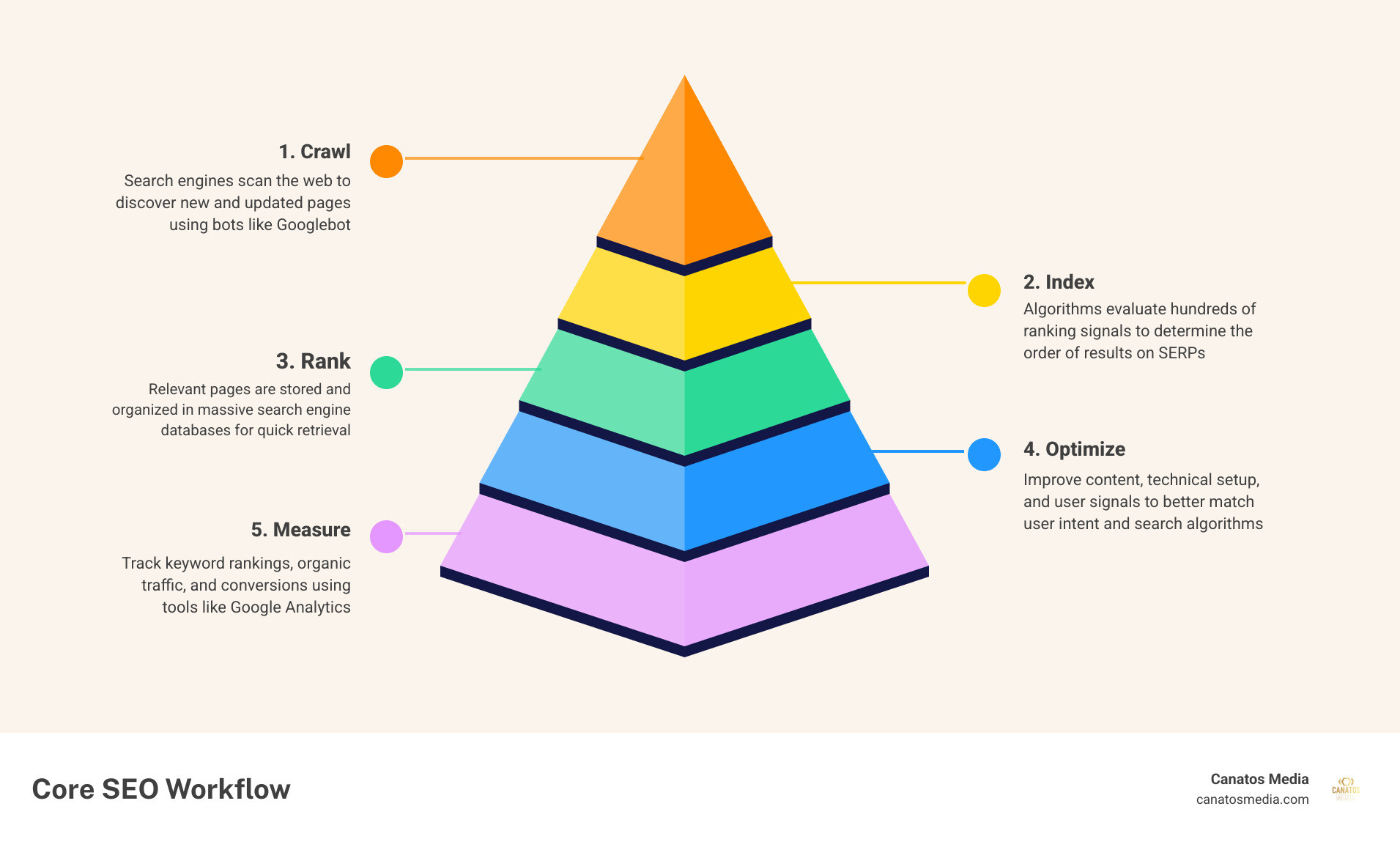
    Basic SEO workflow infographic: crawl, index, rank, optimize, measure infographic

    Demystifying Search Engine Optimization: How Search Works

    To understand What Is SEO – Search Engine Optimization? , we must first look at search through the eyes of the search engines. At its core, search is a matching game. A user types a query into a search box, expressing a specific need or “user intent.” The search engine’s job is to scan its massive library of web pages, find the most relevant, high-quality answers, and present them in order on the search engine results pages (SERPs).

    Modern search algorithms do not just look for matching letters; they try to understand the meaning behind the query. When someone searches for “best pizza nearby,” the algorithm knows they are likely hungry right now and want physical locations, not a recipe for pizza dough. This shift toward understanding context and intent is what guides organic rankings today.

    The History and Evolution of Search Engine Optimization

    The history of Search engine optimization is a story of continuous refinement. In the mid-1990s, early search directories like ALIWEB required website owners to manually submit their index files to be included. The search engines of that era relied on simple, easily manipulated factors like how many times a word appeared on a page. This led to “keyword stuffing,” where webmasters packed hidden text with repetitive terms to trick the system.

    Everything changed in 1998 when Google’s founders introduced the PageRank algorithm. Instead of just counting words, PageRank evaluated the quantity and quality of links pointing to a website. It treated these links as “votes” of confidence. Over the years, search engines have evolved from basic link analysis to sophisticated machine learning models. Today, search engines easily identify and penalize manipulative tactics, prioritizing genuine user value over technical shortcuts.

    How Search Engines Crawl, Index, and Rank Web Pages

    To earn a spot on the SERPs, your website must go through a three-step journey managed by search engines:

    1. Crawling: Search engines send out automated software programs, commonly referred to as “crawlers” or “bots” (such as Googlebot). These crawlers explore the web by following links from page to page.
    2. Indexing: When a crawler finds a page, it analyzes its content, code, images, and structure. It then stores this information in a massive database called the search index. If your page isn’t in this index, it cannot show up in search results.
    3. Ranking: When a user performs a search, the engine pulls the most relevant pages from its index and ranks them using hundreds of ranking signals, ranging from content depth to page speed.

    According to the official SEO Starter Guide: The Basics | Google Search Central | Documentation | Google for Developers , Google is fully automated. While you can suggest where crawlers should look, the vast majority of sites are discovered naturally through links from other websites. Following Google’s Search Essentials is the best way to ensure your site remains eligible for indexing and ranking.

    Helping Search Engines Find and Understand Your Content

    If you want search engines to rank your content, you must make it easy for them to find and read. According to Google’s Technical SEO Techniques and Strategies | Google Search Central | Documentation | Google for Developers , several foundational technical elements help manage how crawlers interact with your site:

    • XML Sitemaps: This is a map of your website designed specifically for search engines. It lists your most important pages, helping crawlers find and prioritize them.
    • Robots.txt: This text file tells search engine bots which pages or folders they are allowed to crawl and which ones they should ignore.
    • URL Structure: Clean, logical URLs (like canatosmedia.com/seo-search-engine-optimization/) are easier for both users and crawlers to understand than messy strings of numbers.
    • 301 Redirects: If you permanently move a page, a 301 redirect passes the ranking power of the old URL to the new one.
    • Canonical Tags: When you have similar or duplicate content across multiple pages, canonical tags tell search engines which version is the “master” page to index.

    The Core Pillars of Modern SEO

    Effective search engine optimization is not a single task; it is a combination of strategies. We can break these down into four core pillars: on-page optimization, off-page optimization, technical setup, and user experience.

    Core Pillars of Search Engine Optimization

    To build a sustainable digital presence, you must address both the visible and invisible parts of your website.

    For online retailers, we often discuss Why Your Store Needs Ecommerce Website SEO to Survive, because organic search acts as a consistent source of free customer acquisition. If you are struggling to manage this on your own, working with an Ecommerce SEO Specialist can help align these pillars effectively.

    • Keyword Research: Finding the exact phrases your target audience uses to search for your products or services.
    • High-Quality Content: Creating helpful, accurate content that answers the user’s search intent.
    • Meta Tags: Writing clear title tags and meta descriptions to entice users to click your link on the SERPs.
    • Backlink Profiles: Earning links from other reputable websites to build your domain authority and trust.

    Technical SEO, Mobile-First Design, and Accessibility

    Technical SEO ensures that your website is secure, fast, and easy to navigate. Because Google uses mobile-first indexing, it evaluates the mobile version of your website to determine your search rankings.

    Responsive mobile design displaying optimized viewport layout

    Responsive web design ensures your site looks and works perfectly on any screen size. Along with responsiveness, page speed is a key ranking factor. Google’s Core Web Vitals measure how quickly your page loads and how stable it is as it loads.

    Accessibility and SEO go hand-in-hand. When you optimize your site for users with disabilities—using descriptive alt text for images, clear heading hierarchies (H1 to H6), and accessible navigation—you also make it easier for search engine crawlers to understand your content.

    Local SEO and Regional Targeting

    If your business serves customers in a specific geographic area, local SEO is essential. For organizations looking to expand their local footprint, executing a targeted local strategy is the best way to earn visibility in the “Map Pack” and local search results.

    At Canatos Media, we specialize in helping businesses in the tri-state area and Long Island capture local search traffic. Optimizing your local presence is critical to getting more calls and driving foot traffic.

    By claiming and optimizing your Google Business Profile, building consistent local citations (your name, address, and phone number across the web), and targeting regional keywords, you can connect with customers in your immediate area. You can also explore our dedicated SEO (Search Engine Optimization) services to see how we help businesses win locally.

    SEO vs. PPC: Integrating Search into Digital Marketing

    A complete digital marketing strategy often combines organic search engine optimization and paid search (PPC). While both help you appear on the SERPs, they function differently:

    Feature Organic SEO Paid Search (PPC)
    Cost Free clicks (requires time/effort) Pay-per-click (direct ad spend)
    Speed Takes weeks or months to build Immediate visibility upon launch
    Sustainability Keeps driving traffic after you stop working Traffic stops when ad budget runs out
    Click-Through Rate Higher trust and organic clicks Lower CTR, but highly targeted
    Long-Term ROI High, compounding return over time Linear return dependent on ad spend

    Rather than choosing one over the other, the most successful businesses integrate both. PPC can drive immediate sales and test keyword conversions, while SEO builds a sustainable, long-term asset that lowers your average customer acquisition cost over time.

    The Future of Search: Generative AI, AEO, and GEO

    The search landscape is changing rapidly. With the rise of generative AI and large language models, search engines are shifting from displaying simple lists of links to providing direct, conversational answers.

    This evolution has introduced new optimization strategies:

    • Answer Engine Optimization (AEO): Optimizing your content to be sourced directly by AI answer engines like ChatGPT, Claude, and Google Gemini.
    • Generative Engine Optimization (GEO): Structuring your digital presence so generative search results cite your brand as the primary authority.

    To succeed in this new environment, brands must provide clear, machine-readable signals. This includes implementing schema markup, answering questions directly, and building strong brand authority.

    Additionally, search behavior is shifting toward rich media. Read our insights on How Video Content Drives Success in AI Search Results and AEO Optimization and explore how we approach AEO (AI Search Optimization) to keep your brand visible in AI-driven search environments.

    Measuring Success: Timelines, Metrics, and Tools

    To know if your search engine optimization efforts are working, you must track the right metrics over time. SEO is a long-term strategy, and changes can take weeks or months to show results.

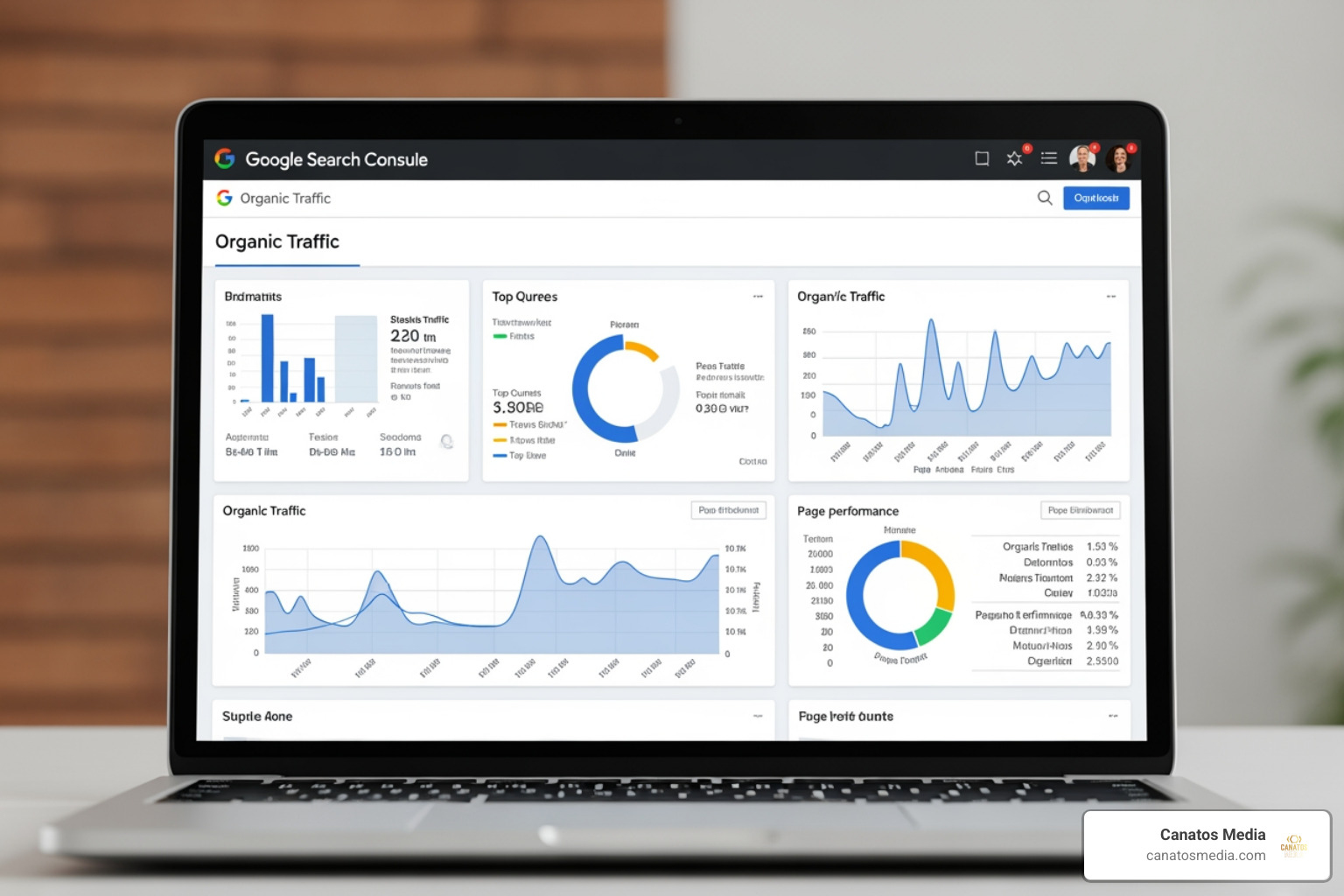
    Google Search Console dashboard displaying organic traffic performance

    To monitor your performance, we recommend using these key tools and tracking these essential metrics:

    • Google Search Console: The best tool for tracking organic impressions, click-through rates (CTR), and keyword rankings directly from Google.
    • Google Analytics: Essential for measuring what users do once they land on your site, including conversion rates, bounce rates, and organic session duration.
    • Keyword Rankings: Tracking whether your target keywords are moving up the search results pages.
    • Organic Traffic: Monitoring the overall growth of unpaid visitors coming to your website.

    Frequently Asked Questions About SEO Basics

    How long does it take to see results from SEO?

    Typically, it takes between 3 to 6 months to start seeing measurable improvements in rankings and traffic. This timeline depends on your website’s history, the competitiveness of your industry, and how consistently you publish high-quality content and build authority signals.

    Organic search refers to the natural listings on search engines that earn their place based on relevance and quality. Clicking these links is free. Paid search (PPC) involves paying to display ads at the top of the search results, where you pay a fee every time a user clicks your ad.

    Why is mobile optimization critical for search rankings?

    Google uses mobile-first indexing, meaning it primarily crawls and indexes the mobile version of your website. If your site is difficult to navigate, slow, or poorly formatted on mobile devices, your rankings will suffer on both mobile and desktop searches.

    Conclusion

    Mastering search engine optimization is one of the most effective ways to build a reliable source of traffic, leads, and sales for your business. By focusing on crawlability, high-quality content, strong user experience, and local visibility, you can build a digital presence that stands out.

    At Canatos Media, we believe the best results come from an integrated strategy. We connect high-end media creation, social media management, targeted paid ads, and technical web support to drive measurable growth.
    Ready to grow your online visibility? Explore our SEO (Search Engine Optimization) services, browse our resources under Tag: SEO and Category: SEO, and let’s build a strategy that gets your business found.

  • Why Every Service Brand Needs a Dedicated Social Ad Creative Studio

    Why Every Service Brand Needs a Dedicated Social Ad Creative Studio

    The Creative Crisis Facing Service Brands Today

    Service-based businesses face a unique challenge that product companies rarely encounter: your best marketing asset is the work your team does every day, yet most brands never capture it strategically.

    You’re running HVAC jobs, dental procedures, landscaping projects, or home renovations constantly. Each one could be powerful social proof. Instead, that visual gold sits in client properties and job sites, never converted into ads that work.

    Meanwhile, your competitors are flooding platforms with stock footage and templated graphics. The noise is deafening. Your audience scrolls past dozens of irrelevant ads before reaching anything authentic.

    The gap between what you’re capable of showing and what you’re actually showing is costing you leads. A dentist with 50 successful smile transformations per month has infinite creative assets. A roofing contractor completing 20 projects weekly has visual proof of quality that no testimonial can match. Yet most service brands default to phone-in content creation because they lack the systems to capture and repurpose their own work.

    This isn’t a creative problem. It’s a process problem. And it’s fixable.

    Why Generic Ad Content Costs You Leads

    When potential customers see templated ad creative, their trust meter drops immediately. They’ve learned to spot ads that could describe any business in any market. Generic messaging doesn’t stand out. It doesn’t prove you’re different from your local competitor charging half your price.

    Here’s what generic creative signals: you don’t believe your actual work is compelling enough to show. You’ve outsourced storytelling to someone who’s never seen a job site. You’re hoping clever copywriting compensates for weak visuals.

    Social platforms notice, too. Facebook, Instagram, and Google reward specificity. An ad showing a homeowner’s before-and-after renovation outperforms a stock image of a happy family in a kitchen 9 times out of 10. The algorithm favors authentic content because users engage with it longer. Higher engagement lowers your cost per click.

    Consider a HVAC company running identical ads across their service area. One shows a technician actually installing equipment in a real home. The other shows a smiling technician with a thumbs up against a blue background. Same copy. Same audience. The first one generates 40% more conversions because it proves the service works. It shows transformation.

    When your ads blend into the background, your cost per lead climbs. You’re competing on price instead of trust. The remedy isn’t working harder on ad copy. It’s showing your real work in ways that resonate.

    How Social Platforms Reward Authentic Visual Storytelling

    Platforms are increasingly pushing creators toward authenticity. Meta’s algorithm prioritizes video content that generates saves, shares, and comments. Google’s Performance Max campaigns reward novelty and variation in creative assets. TikTok’s algorithm is built on discovering content that feels genuine, even when it’s produced.

    What works isn’t perfection. It’s specificity combined with clarity. A short clip of a technician explaining why they chose a particular approach outperforms a 60-second product overview. Why? Because it demonstrates expertise and builds confidence in your process.

    This shift rewards service brands. Your work is inherently authentic. Clients care about seeing real results in real settings. They want to understand your process. A 15-second video of a plumber explaining a complex repair option is more valuable than any stock footage could be.

    The key is packaging your real work in ways platforms amplify. Shorter videos perform better than long ones. Clear before-and-afters beat ambiguous imagery. Specific results beat generic benefits.

    When your ads show actual client work with smart editing and clear messaging, platforms push them to more people automatically. Your cost per impression drops. Your reach expands. The math works in your favor because the content is built for how people actually consume information on these platforms.

    The Competitive Edge of In-House Creative Production

    Building a creative capability inside your organization gives you speed and consistency that outsourcing never delivers. When you need five new ad variations by Friday, you’re not emailing a freelancer hoping for turnaround. You’re pulling footage from this week’s jobs and turning it into ads in hours.

    This speed compounds over months. By mid-year, you’ve tested 50+ creative variations. By year-end, 200. You’ve learned what messaging resonates with homeowners in one service area versus another. You’ve discovered that before-and-afters perform better than process videos in your market. You’ve built institutional knowledge that informs every future campaign.

    In-house creative doesn’t mean hiring full-time videographers on your payroll. It means having processes and partnerships that let you capture and refine content from your own operations. A dedicated team that understands your brand, your customer journey, and your business goals operates differently than an external agency juggling 30 clients.

    The competitive advantage isn’t just faster turnaround. It’s smarter iteration. You see what works across your entire marketing ecosystem. You correlate creative changes with lead volume in real time. You adjust messaging based on customer feedback before launching the next campaign round.

    What Sets Our Social Ad Studio Apart

    We combine creative production with media strategy from day one. That means we’re not just making beautiful videos that win awards. We’re building ad creative specifically structured for platforms and designed to hit conversion metrics your business tracks.

    Here’s how we operate differently:

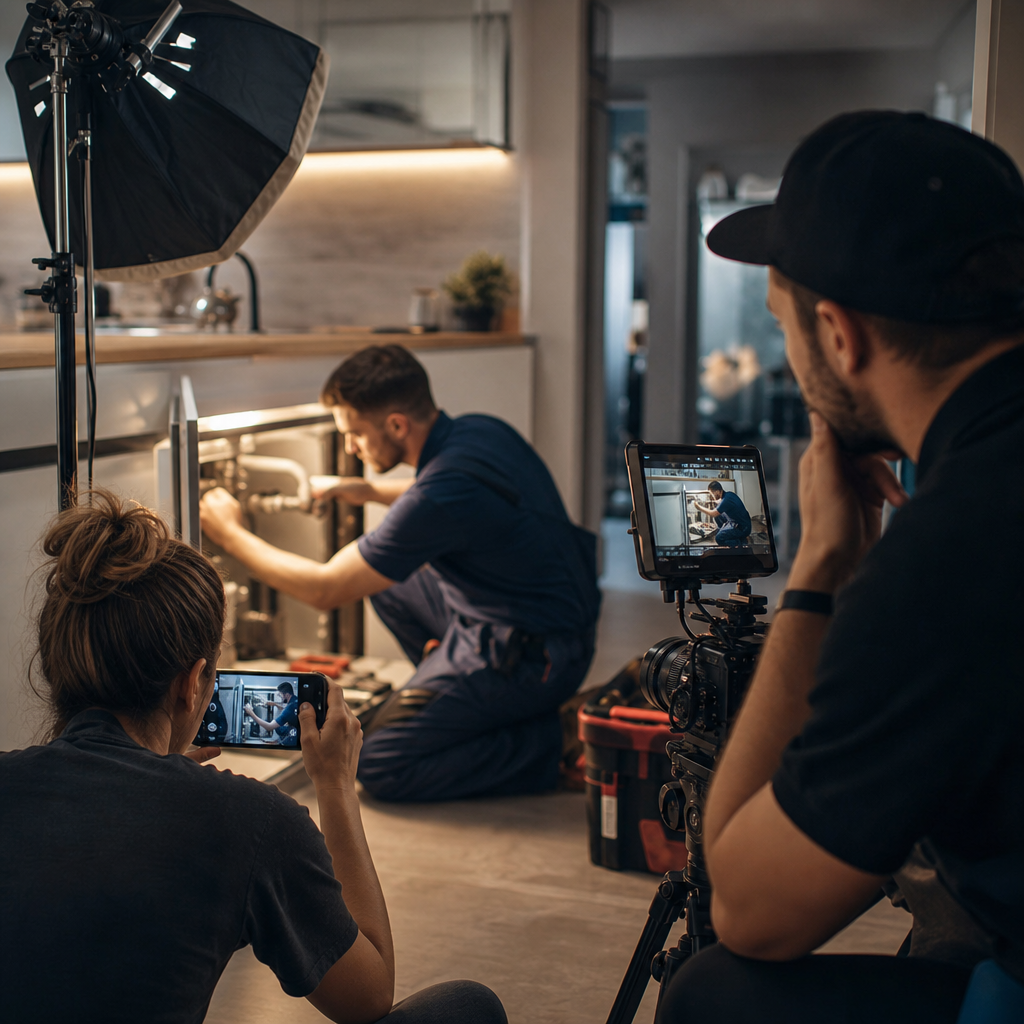
    Our team works directly with your service teams to capture real client work as it happens. We don’t ask you to recreate jobs for the camera. We embed into your operations, film genuine projects, and transform raw footage into platform-optimized ads. One shoot becomes 8-12 usable ad variations.

    We understand the full customer journey your leads experience, from first awareness through conversion. That shapes every creative decision. A video designed to build brand awareness uses different pacing and messaging than a video designed to overcome price objections. We build the right story for each stage.

    We iterate rapidly. Our studio produces 15-20 ad variations per month for scaling brands. We test across Meta, Google, and platform-specific formats. We measure performance against your actual lead and sales data. We optimize based on what’s working, not assumptions about what should work.

    We handle the technical requirements that most creative teams miss. Proper aspect ratios for different placements. Subtitles that drive engagement on muted videos. Platform-specific compression settings. Compliance with advertising policies. The details that separate ads that run smoothly from campaigns that get throttled.

    Building a Consistent Creative Pipeline for Scaling Brands

    Consistency beats perfection when it comes to social ad creative. Running four exceptional ads once every three months generates fewer leads than running solid ads weekly.

    We establish systems that make consistency automatic. We schedule regular capture days at your locations. We build templates for editing and delivery that cut production time without sacrificing quality. We create approval processes that keep campaigns moving without bottlenecks.

    For multi-location brands, this becomes critical. Each location has different aesthetics, team members, and client situations. Capturing this variety and turning it into a cohesive brand narrative requires process and discipline. When you have 10 locations, you need systems that scale. Ad hoc creative production becomes impossible.

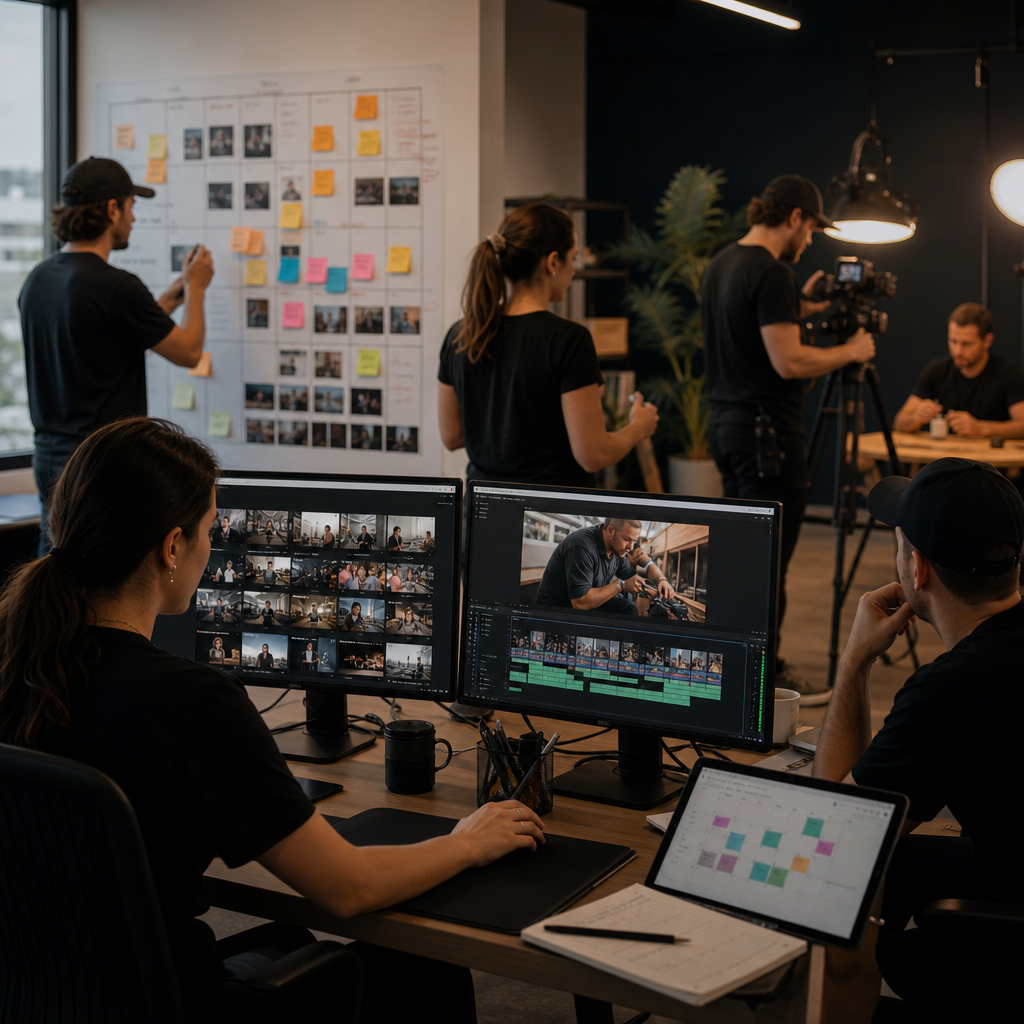
    Our approach is to map out what stories resonate across your business, then build a content calendar that ensures consistent creative delivery. One month focuses on new customer transformation stories. The next emphasizes your team’s expertise. The third highlights speed and reliability. This rhythm keeps your messaging fresh while maintaining brand coherence.

    A consistent creative pipeline also means your team gets trained in what works. Your operations staff learn what makes good footage for ads. Your sales team understands the creative assets available for objection handling. The entire organization becomes creative-aware, not just the marketing department.

    Transforming Raw Footage into High-Performing Ad Creative

    The gap between raw footage and high-performing ads is where expertise lives. Most service brands have thousands of hours of footage. Cameras on phones capture jobs constantly. Clients send videos of work. Yet this raw material rarely becomes usable ads because the technical and creative work feels daunting.

    We handle the entire transformation. That means reviewing hundreds of hours of footage, identifying the best moments, and building narratives around them. A 30-minute roof installation becomes a 15-second before-and-after that demonstrates transformation. A client testimonial becomes a structured case study ad with clear benefits highlighted.

    The editing process also optimizes for platform algorithms. We cut specifically for short attention spans. We add text overlays that work with sound off. We structure pacing to keep viewers watching through the critical conversion message. We test different hooks in the first 3 seconds because that’s where most viewers decide whether to watch or scroll.

    Sound design matters too. Most brands overlook audio in favor of visuals. We source or create audio that reinforces your message without distracting. Music selection signals professionalism and builds emotion appropriately for your audience.

    We also build variations for different audiences and campaign objectives. The ad that wins with homeowners considering upgrades differs from the ad targeting emergency service seekers. One emphasizes aesthetic transformation. The other emphasizes speed and reliability. Same project, two different stories.

    Measuring and Optimizing Creative Performance Across Platforms

    Data guides every creative decision we make. We don’t rely on vanity metrics like views or shares. We track what matters: cost per lead, cost per acquisition, lead quality, and downstream conversions.

    This measurement discipline reveals patterns. You might discover that videos under 12 seconds dramatically outperform longer formats in your market. Or that specific messaging resonates with commercial customers but falls flat with residential. Or that certain team members on camera increase conversion rates because clients connect with them.

    Once we identify what works, we build on it. If a particular pain point messaging converts 40% better than benefit messaging, we test variations on that pain point theme. If before-and-afters outperform testimonials, we shift production focus toward project transformations.

    We also measure creative fatigue. Every ad eventually stops working as effectively as it did initially. We track performance over time and know when to retire underperformers and test fresh creative. This prevents spending money on ads your audience has already seen.

    Platform-specific optimization matters too. What works beautifully on Instagram might not perform on Google. We test creative variations across platforms and allocate budget toward the best-performing combinations. This prevents the common mistake of running identical ads everywhere and wondering why some placements waste money.

    We provide transparent reporting that connects creative performance to your business outcomes. You see exactly which ads drove leads, at what cost, and whether those leads converted to clients. That clarity lets you make confident decisions about scaling creative production investment.

    Integrating Creative Studio Output with Paid Media Strategy

    Creative and media buying must work together. The best video in the world fails if it reaches the wrong audience. Conversely, perfect targeting wasted on weak creative never converts.

    Our studio works hand-in-glove with media strategy. We understand your target customer segments before we start production. We build different creative for different audience intentions. A homeowner actively searching for your service gets different messaging than someone in the awareness stage. That shapes every script we write.

    We also ensure creative aligns with your platform strategy. If you’re running multi-location brand growth campaigns, we produce location-specific creative that resonates locally while maintaining brand consistency nationally. If you’re expanding into new geographic markets, we create messaging that addresses market-specific objections.

    The feedback loop runs continuously. Media buying teams see which creative converts best. That intelligence informs what we shoot next. Production teams understand which customer objections drive creative strategy. Everyone operates from shared data instead of siloed assumptions.

    This integration also prevents waste. You’re not producing generic content and hoping it fits your paid strategy. You’re building ads specifically engineered for your most profitable customer segments and bidding strategies.

    Real Results: How Service Brands Scale with Better Creative

    A multi-location HVAC company working with us captured footage from jobs across their 12 locations. We produced 24 ads over four months, each featuring real customer transformations and team members from different areas. Their cost per lead dropped 35% within the first 90 days because the creative finally matched audience expectations.

    A plumbing service focused on commercial accounts was losing bids to larger national competitors. We built creative showcasing their team’s problem-solving expertise on complex commercial jobs. Specific footage of their work on building renovations and emergency situations proved they could handle sophisticated projects. Lead quality improved dramatically. They won contracts with facility management companies that previously didn’t take their calls.

    A dental practice drowning in competitor noise ran generic teeth-whitening promotions. We shifted to before-and-after transformations tied to their cosmetic dental process. Suddenly their ads stood out in scrolls. The visual proof of results converted browsers into appointment bookers. Their monthly ad spend stayed constant, but lead volume increased 50%.

    These aren’t isolated cases. Across service industries, brands that invest in authentic, platform-optimized creative outperform competitors running generic ads. The math is straightforward: better creative means lower cost per lead, which means more sustainable growth.

    Getting Started with a Dedicated Creative Studio Partnership

    The first step is assessing what you already have. Most service brands are already capturing footage. The question is whether it’s being used strategically. We typically start with a content audit, reviewing existing footage and identifying what’s already valuable.

    Next comes planning. We map out your customer journey, identify the stories that matter most, and build a production schedule that captures them without disrupting your operations. For service brands, this usually means scheduling shoot days that align with project timelines.

    Then we establish the workflow. We define approval processes, editing standards, platform-specific formatting, and reporting cadence. Clear processes scale. Ambiguous workflows create delays.

    From there, it’s consistent execution. We capture, edit, test, measure, and refine. Month one looks different from month six because we’re learning what works in your market.

    If you’re ready to transform your social advertising from generic to genuinely competitive, reach out. We’ll discuss your current creative situation and show you exactly how a dedicated social ad creative studio changes your lead generation economics. The investment pays for itself through improved ad performance and faster scaling.

    Contact us today for a free consultation to see how we can help you grow your business.

    Frequently Asked Questions (FAQ)

    How does our social ad creative studio differ from hiring freelance videographers?

    We maintain an in-house team that specializes in ad creative specifically, which means we understand conversion metrics, platform algorithms, and audience behavior in ways general videographers don’t. Our studio produces multiple variations of the same concept weekly, allowing us to test and optimize performance data in real-time rather than waiting weeks between project cycles.

    Can you work with footage we already have, or do we need to film everything from scratch?

    We absolutely transform existing raw footage and client-provided materials into high-performing ad creative. Many of our service brand clients have years of professional video content that we repurpose into short-form ads optimized for Meta and Google platforms, which accelerates your time to market and maximizes your existing investments.

    What’s the typical timeline from concept to having ads live on social platforms?

    Once we understand your target audience and campaign objectives, we typically produce initial ad variations within 7-10 business days. Our integrated approach means we’re building creative alongside your paid media strategy, so ads go live faster and with better alignment to your audience targeting and budget allocation.

  • Top 8 Multi-Channel Lead Generation Systems for Scalable Business Growth

    Top 8 Multi-Channel Lead Generation Systems for Scalable Business Growth

    1. Unified CRM Integration Across All Marketing Channels

    Most business owners treat lead generation like separate islands: social media ads over here, email marketing over there, SEO somewhere else entirely. The result is predictable: leads fall through the cracks, your sales team can’t track where prospects came from, and you’re spending more to acquire customers than you should.

    A true multi-channel lead generation system connects every touchpoint into one coherent machine. When video content drives attention, landing pages capture details, email nurtures prospects automatically, and your CRM tracks everything in real time, your cost per lead drops while your conversion rate climbs.

    We’ve built lead generation systems for growth-focused business owners managing multiple locations or service-based brands where visibility and consistency matter. Here are the eight foundational components that separate scalable systems from scattered marketing efforts.

    Your CRM should be the central nervous system of lead generation, not a dusty database. Every lead source—paid ads, website forms, email signups, social media inquiries—needs to feed automatically into one system so your team sees a complete view of each prospect.

    Without integration, your sales team wastes time manually entering data, and leads often slip through because no one owns follow-up. With proper CRM architecture, leads hit the system, triggers fire automatically, and your workflow begins without human intervention.

    What this looks like in practice:

    • A prospect submits a form on your website; their info appears in your CRM immediately
    • They’re tagged by lead source, campaign, and location (crucial for multi-location brands)
    • Assignment rules push them to the right salesperson based on geography or service type
    • Automated tasks remind the team to follow up within 24 hours

    The key is mapping all your marketing channels to one CRM with proper field structure. Hubspot, Pipedrive, and Salesforce all work well, but the setup matters more than the tool. We ensure your CRM schema reflects your actual sales process so data flows cleanly and your team trusts the system.

    Action item: Audit where leads currently live. If they’re in spreadsheets, email inboxes, or multiple disconnected platforms, that’s your first project.

    2. Video-Driven Landing Pages That Convert Social Traffic

    Video content captures attention on social media, but most businesses send that traffic to generic landing pages. The mismatch kills conversions. When a prospect watches an engaging video ad and lands on a static webpage with text and a form, they often bounce.

    High-performing landing pages match the energy and message of the video that drove the click. We build cinematic brand storytelling assets and pair them directly with optimized landing pages designed to convert the warm traffic that video creates. Video on the landing page itself reduces bounce rate and increases form submissions by clarifying what the prospect will experience.

    Consider a service-based brand running a video ad about their free consultation process. That video should appear on the landing page itself, with a clear CTA below it. The prospect sees proof and detail in motion, then decides whether to book a call. Friction drops, conversions rise.

    Landing page structure for video traffic:

    • Lead with the same video or a 30-second teaser
    • Remove navigation to avoid distraction
    • Use scarcity or urgency language tied to actual availability
    • Include social proof (testimonials, review counts, client logos)
    • One primary CTA (call, form, chat)

    We design landing pages with conversion metrics built in, so you see which variations, headlines, and CTAs perform best. Video-driven landing pages convert 20-40% higher than text-only alternatives.

    Action item: Identify your top-performing social video ad. Create a dedicated landing page that mirrors its narrative and energy.

    3. Automated Email Nurture Sequences for Lead Qualification

    Not every lead is ready to buy today. The ones who aren’t ready often go cold because your team’s working on prospects further down the funnel. Automated email sequences keep warm leads engaged without salespeople doing manual outreach.

    A well-designed nurture sequence typically spans 5-10 emails over 2-4 weeks, each one moving the prospect closer to a decision. The sequence itself qualifies leads by tracking which emails get opened, clicked, and responded to. If someone’s opening every email and clicking links, your sales team knows to prioritize them.

    Effective nurture sequences work because they educate without selling. An early email might address a common objection. A later one shares a case study. Another offers a free resource. By the time your salesperson calls, the prospect has absorbed real value and trusts the brand.

    Sequence elements that work:

    • Email 1: Immediate value (free guide, discount code, intro video)
    • Email 2-4: Educational content addressing prospect pain points
    • Email 5-7: Social proof and case studies
    • Email 8-10: Clear CTA to book a call, with urgency if appropriate

    Most businesses fail here because they either send too many emails (annoying people into unsubscribes) or too few (leads forget who you are). A rhythm of 2-3 emails per week for qualified leads works for most service-based brands.

    Action item: Write down your top five prospect objections, then create one email for each addressing that concern directly.

    4. Cross-Platform Analytics and Attribution Tracking

    You’re running Meta ads, Google Ads, social organic content, email campaigns, and SEO simultaneously. Without proper attribution, you don’t know which channel actually created the revenue. So you either overspend on the wrong channels or underfund winners.

    Attribution tracking shows you which touchpoints led to conversions. Did the lead come from a video ad, then click an organic social post, then open an email before booking a call? Good attribution gives you that full path. You’ll see that video is driving awareness, email is driving decisions, and organic social is reinforcing trust.

    This matters enormously for scaling. Once you know that a $500 spend on a specific ad campaign generates 10 qualified leads worth $5,000 in revenue, you can repeat that spend confidently. Without attribution, you’re flying blind.

    Tools like Google Analytics 4, Mixpanel, and native platform dashboards help, but the real work is in UTM parameters, proper conversion tracking, and CRM sync. We set up attribution systems so you see which channels drive not just clicks, but actual revenue.

    What to track:

    • First-touch attribution (which channel introduced the lead)
    • Multi-touch attribution (all touchpoints before conversion)
    • Cost per lead by channel
    • Lead quality by source (do Meta leads convert higher than Google leads?)
    • Customer lifetime value by acquisition channel

    Action item: Create a simple spreadsheet tracking leads by source for the next 30 days. Calculate cost per lead for each channel. You’ll immediately see where money is or isn’t working.

    5. Strategic Meta and Google Advertising Funnels

    Most businesses run Meta and Google ads reactively: “We need leads this month, so let’s run an ad.” Strategic advertising instead builds funnels that move cold prospects to warm to sales-ready over weeks or months.

    A proper funnel has awareness campaigns (reaching cold audiences with entertaining video content), consideration campaigns (targeting people who visited your site or watched your video), and conversion campaigns (targeting warm audiences ready to book or buy).

    We structure Meta ads management and Google campaigns to segment audiences and test different creatives. Video-based awareness campaigns introduce your brand. Retargeting campaigns remind people who’ve seen your content but haven’t converted. Final-click campaigns target people searching directly for your service or product.

    The efficiency gain is substantial. Instead of a single broad campaign reaching everyone with unclear results, you’re building sequential campaigns that nurture people progressively closer to a sale. This approach typically improves ROAS (return on ad spend) by 30-60% compared to scattered ad management.

    Funnel structure:

    • Awareness: Broad audiences, video-first creative, brand messaging
    • Consideration: Website visitors, video engagers, lookalike audiences
    • Conversion: Cart abandoners, high-engagement audiences, search intenders
    • Retention: Past customers, email subscribers, engaged followers

    Each layer has different KPIs. Awareness campaigns succeed on views and engagement, not immediate conversions. Conversion campaigns live and die on cost per lead or cost per sale.

    Action item: Map your current ad spend across these four funnel stages. If you’re only spending in one stage, that’s your scaling bottleneck.

    6. SEO-Optimized Content That Attracts High-Intent Leads

    Paid ads create immediate visibility but stop the moment you stop spending. SEO creates cumulative, long-term visibility that compounds over months and years. High-intent searchers (people actively looking for your solution) often convert higher than cold ad audiences because they’re already in buying mode.

    Content optimized for search intent addresses the specific questions your customers ask before they contact you. A service-based brand might rank for “how to [solve problem]” or “[problem] near me.” A product brand might rank for “[product type] comparison” or “best [product category].”

    We audit search intent across your industry, create content addressing high-intent keywords, and optimize pages technically so search engines rank them. This generates a steady stream of qualified leads that cost nothing per click once they convert to visits.

    Content strategy for lead generation:

    • Identify high-intent keywords (searches showing buying intent)
    • Create long-form content (1500+ words) addressing those queries
    • Optimize on-page elements (title, meta description, headers) for keywords
    • Build internal links between related content pieces
    • Update content regularly to maintain rankings

    SEO takes 3-6 months to show meaningful results, but that timeline justifies the investment because you’re building an asset that continues producing leads years later. A blog post that ranks for a valuable keyword can drive dozens of leads monthly indefinitely.

    Action item: Search your main service or product keyword on Google. Review the top 5 results. Could you create better, more detailed content? That’s your starting point.

    7. Social Media Management Connected to Sales Workflows

    Most social media management happens in isolation. Your team posts content, engages with comments, maybe generates some clicks. But those engaged followers rarely become structured leads because there’s no system converting social attention into sales conversations.

    Connected social media management treats every comment, DM, and link click as a potential lead worthy of follow-up. When someone engages heavily with your content, they’re signaling interest. That signal should trigger a response from your sales team or nurture sequence, not go unanswered.

    We manage social accounts with lead generation in mind. Every piece of content has a clear CTA. Comments on posts are responded to within hours, building relationship. DMs are monitored and answered promptly. High-engagement followers are invited to join email lists or book consultations.

    Social-to-sales handoff process:

    • Monitor engagement daily (comments, shares, saves)
    • Respond to genuine inquiries within 24 hours
    • Invite active followers to email list or webinar
    • Tag engaged followers in your CRM
    • Brief sales team weekly on hot social leads

    This turns social media from a brand-building expense into a lead generation channel. You’re still building brand presence, but now you’re actively converting attention into conversations.

    Action item: Review comments on your last 5 posts. Which commenters showed genuine interest? Reply to them personally and suggest a next step (email signup, free resource, consultation).

    8. Website Design and Optimization for Lead Capture

    Your website is where all channels funnel: paid ads, social media links, email CTAs, organic search results. If your website doesn’t convert visitors into leads efficiently, all other efforts underperform. A website optimized for lead capture has clear value messaging, reduced friction on forms, and multiple strategic CTAs.

    Most websites are built for brand impression, not conversion. They’re beautiful but unclear. Visitors don’t know what you do or how to take the next step. Optimized sites are equally professional but laser-focused on moving visitors toward a specific action: book a consultation, download a resource, join your email list.

    We design websites with lead capture built in from the ground up. Page load speed is fast (slow sites kill conversions). Navigation is minimal so visitors focus on the primary CTA. Forms are short and clearly explain the value they’ll receive in return. Page copy addresses specific customer pain points and shows how you solve them.

    Conversion-focused website elements:

    • Clear value proposition above the fold
    • Short contact forms (name, email, phone, 1-2 custom fields)
    • Multiple strategic CTAs throughout pages
    • Fast load times (under 3 seconds)
    • Social proof and testimonials on key pages
    • Clear explanation of next steps after form submission
    • Mobile optimization (50%+ of traffic is mobile)

    We also integrate your website with your CRM and email platform so leads flow automatically into your nurture sequences. There’s no manual data entry, no lost leads, no gaps in follow-up.

    Action item: Test your website on mobile. Can someone easily understand your value and submit a form without pinching and scrolling excessively? If not, that’s blocking conversions.

    Building a multi-channel lead generation system isn’t about adopting eight disconnected tools. It’s about creating one coherent machine where every piece amplifies the others. Video content drives awareness and traffic. Landing pages convert that traffic. Email nurtures prospects automatically. Your CRM tracks everything. Paid ads accelerate the cycle. SEO builds long-term visibility. Social media keeps audiences engaged. Your website captures leads at scale.

    When these systems work together, your cost per lead drops 30-50%, your sales team closes faster, and your business scales predictably. We specialize in building exactly this kind of integrated system for growth-focused business owners managing multi-location or service-based brands. Let’s discuss how to connect your marketing channels into one lead-generation engine that works.

    Contact us today for a free consultation to see how we can help you grow your business.

    Frequently Asked Questions (FAQ)

    How do we integrate video content into a multi-channel lead generation system?

    We create cinematic short-form videos specifically designed for your social platforms, then repurpose them across Meta and Google advertising campaigns while linking to optimized landing pages. Our video-driven approach captures attention in crowded feeds and drives qualified traffic directly into your lead capture systems, where automated nurture sequences begin qualifying prospects immediately.

    What’s the difference between lead generation strategy and a complete lead generation system?

    A strategy outlines your approach, but we build the actual system that executes it. We connect your CRM to all marketing channels, set up automated email workflows, implement cross-platform analytics, and ensure your website and social content work together as one unified engine. This means every lead we capture gets tracked, nurtured, and handed to your sales team at exactly the right moment.

    Can we track which marketing channel actually generates our sales?

    Yes. We implement cross-platform attribution tracking that shows us which combination of Meta ads, Google campaigns, SEO content, and social media actually drives conversions for your business. This data lets us continuously optimize our spending and content strategy so we’re not guessing about what works.

  • How to Choose the Right Video Marketing Partner for Your Local Service Business

    How to Choose the Right Video Marketing Partner for Your Local Service Business

    Why Local Service Brands Struggle With Video Content

    Local service businesses face a unique content challenge. Unlike product companies that can showcase items in isolation, you need to demonstrate expertise, build trust, and show real results. A plumber, HVAC contractor, dental practice, or home remodeler can’t just post a product photo and expect leads.

    The friction starts early. Most business owners know video performs better than static content, but creating it consistently requires skill, equipment, and time you don’t have. You’re already managing operations, staff, and customer relationships. Adding video production to that workload feels impossible.

    Then there’s the authenticity problem. Generic, over-produced videos don’t resonate with local audiences. People want to see real people, real projects, and real transformations. But creating that kind of content requires both creative vision and technical execution working together seamlessly.

    The result? Many service businesses either skip video entirely or produce low-quality content themselves that undermines their professional reputation.

    The Cost and Complexity of Traditional Video Agencies

    Traditional video production agencies operate on a project basis, not a partnership basis. You hire them for a one-off shoot, they deliver files, and the relationship ends. When you need more content next quarter, you start from scratch negotiating rates and timelines again.

    The financial model is built for big budgets. These agencies typically require retainers of $5,000 to $20,000+ per month minimum, with individual project costs running $3,000 to $15,000 or more. That investment makes sense for Fortune 500 brands with massive marketing budgets, but it’s a barrier for growth-focused business owners managing tighter margins.

    There’s also the execution gap. Traditional production houses excel at one-time cinematic projects but struggle with the ongoing content machine local businesses actually need. You end up with beautiful footage that doesn’t feed into a broader marketing strategy, so views don’t convert to leads.

    Finally, the timeline problem compounds the issue. From concept to final delivery, traditional agencies often take 4 to 8 weeks. In that time, market conditions shift, your marketing priorities change, and the content arrives when it’s no longer timely.

    What Sets Our Approach Apart From Standard Production Houses

    We built Canatos Media specifically for growth-focused service business owners who need consistent, high-quality content without the overhead of traditional agencies or the DIY struggle of doing it yourself.

    Our model flips the traditional approach on its head. Instead of project-based work with long gaps between content, we operate as an extension of your team. We handle short-form video production, social media management, paid advertising, and SEO optimization as an integrated system. Content isn’t an isolated asset; it’s fuel for a complete marketing engine.

    We maintain cinematic quality standards while working at speeds traditional agencies can’t match. Our in-house production team and streamlined workflows mean you get professional-grade videos in weeks, not months. We’re also transparent about pricing and built our services to fit growth-stage budgets, not just enterprise clients.

    The biggest difference is accountability. We don’t just hand off videos. We track how content performs, which pieces drive leads, and what messaging resonates with your audience. Then we optimize and iterate based on actual results.

    How We Integrate Video With Your Full Marketing System

    Video is most powerful when it’s part of a larger strategy, not a standalone tactic. We approach every project with the full funnel in mind.

    Short-form videos fuel social media growth and engagement. But they also need to connect to paid advertising, website presence, and lead capture systems. Here’s how we structure it:

    • Social content builds brand awareness and audience trust
    • Paid campaigns amplify that content to target audiences actively searching for your services
    • Landing pages and website content convert viewers into leads
    • SEO optimization ensures your brand appears when people search for solutions
    • Lead management systems track and nurture those inquiries into customers

    We manage all of these pieces, so messaging is consistent and each component reinforces the others. A video showcasing a transformed kitchen doesn’t just live on Instagram. We use it in ads, feature it on your website, optimize it for search, and structure your backend to capture and follow up with interested prospects.

    This integrated approach is why service businesses see 3-5x better results with us than they would investing in video alone.

    Short-Form Content That Actually Converts Leads

    Not all short-form content is created equal. The difference between a video that gets likes and a video that generates qualified leads often comes down to strategy and execution details.

    We focus on four content pillars for service businesses:

    Before and After Transformations: Show the problem state, walk through the process, and reveal the result. These establish credibility and demonstrate exactly what you deliver.

    Client Testimonials and Case Studies: Real customers talking about their experience build trust more effectively than any marketing message you could write. We film these professionally but keep them authentic.

    Educational Process Videos: Answer the questions prospects have. What goes into a proper foundation inspection? How does your remodeling timeline work? What should homeowners know about HVAC maintenance? Educational content positions you as an expert and keeps your brand top-of-mind.

    Behind-the-Scenes and Team Content: Local audiences connect with people. Show your team at work, introduce key staff, share company culture. This builds the personal relationships that drive referrals and repeat business.

    Each format serves a specific purpose in your marketing system. We create a content calendar that balances these types and ties them to your paid advertising and SEO strategy. The result is content that doesn’t just entertain; it qualifies and converts.

    Our Process For Building Your Video Content Engine

    We start with a strategy session where we understand your business, your customer journey, and your growth goals. Not every service business is the same, and we don’t use templates.

    From there, we build your content calendar and production roadmap. We identify which types of videos will serve your business best, how often you should publish, and how to integrate video into your paid and organic marketing efforts. We also establish baseline metrics so we can measure impact from day one.

    Production happens efficiently. Our team handles scripting, filming, editing, and optimization. We manage shoots on your timeline, minimize disruption to your operations, and deliver final content on schedule.

    Once content is live, we monitor performance continuously. We track metrics like views, engagement, click-through rates, and lead attribution. This data feeds back into optimization: we double down on what works, adjust what doesn’t, and refine the strategy quarterly based on real results.

    You’re never in the dark. We provide regular reports showing what’s working, how many leads are coming from video content, and recommendations for what’s next.

    Real Results: How We Drive Measurable Business Growth

    Results vary by industry and starting point, but we consistently see measurable business impact for our service business clients.

    One HVAC contractor client increased qualified leads by 67% over six months by combining cinematic before-and-after videos with targeted paid campaigns and improved website conversion. A home remodeler used testimonial video content to increase average project size by 18% because prospects entered conversations more confident in their vision. A dental practice cut new patient acquisition costs in half by building a video-based trust system that reduced decision friction.

    These results happen because video content is tied to actual business metrics, not vanity metrics. We’re optimizing for lead volume and quality, not just views or likes. That alignment between content strategy and business goals is what separates real growth from activity that feels productive but doesn’t move the needle.

    Why Cinematic Quality Matters for Service Brands

    High production value isn’t about ego or unnecessary expense. It’s about perception and trust.

    When someone is considering hiring you for a major purchase, they’re evaluating whether you’re professional, detail-oriented, and capable of delivering quality. Grainy, poorly lit, or amateurish video sends the wrong signal. It suggests those same qualities might be reflected in your actual work.

    Cinematic quality communicates craftsmanship. It tells prospects that you take pride in what you do and that you’re confident enough in your brand to invest in showing it well. For service businesses competing in mature markets with established competitors, that quality difference can be the deciding factor.

    We maintain cinematic standards across all content, from high-end project showcases to simpler social clips. Professional lighting, color grading, audio, and pacing are baseline, not premium add-ons.

    Ongoing Management and Optimization of Your Video Assets

    Video content doesn’t have a shelf life the way traditional advertising campaigns do. A well-produced video can drive leads for months or years if it’s properly distributed, repurposed, and optimized.

    We manage your video assets as an ongoing resource. That means:

    • Repurposing longer-form content into shorter clips for different platforms
    • Updating metadata and descriptions as search trends shift
    • Testing variations in paid campaigns to optimize performance
    • Retiring underperforming content and doubling down on winners
    • Building evergreen libraries so you always have relevant material to deploy

    This ongoing management is why we operate as a partnership, not a vendor. Your business evolves, markets shift, and seasons affect service demand. Your video strategy should evolve with those changes rather than remaining static.

    Getting Started With Your Video Strategy Today

    If you’re ready to move beyond generic content and build a video marketing system that actually drives leads, the first step is understanding where you are and where you want to be.

    We recommend scheduling a brief strategy call where we’ll discuss your business, your growth goals, and what’s holding you back right now. No hard sell, no obligation. We’ll give you honest feedback on your current approach and what we’d recommend.

    From there, we can outline a plan tailored to your budget and timeline. Most clients start with a pilot project to test the approach and see results before scaling up. That might be three months of content production and management, or it might be a larger engagement. The point is to start seeing measurable impact, then build from there.

    Visit https://canatosmedia.com to learn more about our services, or reach out directly to discuss your video strategy. We work with service businesses across industries, and we’ve built our process specifically to drive the kind of growth you’re looking for.

    For further reading: End-to-end video marketing partner.

    Contact us today for a free consultation to see how we can help you grow your business.

    Frequently Asked Questions (FAQ)

    What makes short-form video content different from traditional long-form production for local service businesses?

    We create videos designed for social media consumption where your customers actually spend time, rather than lengthy corporate videos that sit on websites. Our short-form approach combines cinematic quality with platform-specific optimization, so each 15-60 second piece drives engagement and captures attention in crowded feeds. This format directly converts into leads because we build clear calls-to-action and messaging that matches how service-based prospects actually discover and evaluate businesses online.

    How do you ensure video content actually generates leads rather than just views?

    We integrate every video we produce into your complete marketing system, connecting it with your paid advertising strategy, landing pages, and lead capture processes. Our team doesn’t just shoot and upload content; we analyze performance data, optimize based on what’s converting, and continuously refine your video strategy to align with your sales pipeline. This means every piece of content we create has a specific role in turning attention into qualified leads for your business.

    What’s included in your ongoing support after our initial video production is complete?

    We handle continuous management of your video assets through social media posting schedules, performance monitoring, paid media optimization, and regular strategy adjustments based on what’s working. Our team stays actively involved in your content’s performance rather than handing off a finished product, which means we’re constantly identifying new opportunities to improve your results and scale what’s successful.

  • Why Canatos Media Delivers Better Results Than Large Agencies for Local Businesses

    Why Canatos Media Delivers Better Results Than Large Agencies for Local Businesses

    The Problem With One-Size-Fits-All Creative Agencies

    Large creative agencies operate on a model that works best when they’re handling dozens of clients at scale. This structure creates an inherent conflict: the more clients they serve, the more they need to standardize their processes, templates, and creative approaches. A pizza chain, a dental practice, and an HVAC service company end up getting similar strategic frameworks because the agency’s profitability depends on efficiency, not differentiation.

    The result is predictable. Your brand gets beautiful content that could work for almost anyone. It lacks the specific insight into why your customers choose you, what problem you genuinely solve better than competitors, and how your team’s unique story creates trust. Generic content performs generically, which means your investment doesn’t compound over time.

    What we’ve learned working with growth-focused business owners is that the best marketing comes from understanding exactly how your business operates. A multi-location service brand has different customer acquisition challenges than a local specialty business. One-size-fits-all doesn’t account for these realities.

    Why Large Agencies Fall Short for Growing Businesses

    Scaling a business requires speed, flexibility, and strategic alignment. Large agencies often move slowly because they have approval hierarchies, account management layers, and creative teams stretched across multiple clients. When you need a campaign adjusted based on real performance data, you’re waiting for the next quarterly review or fighting for production slots.

    Growing businesses also face budget realities that enterprise-level agencies don’t accommodate well. They’re built to serve Fortune 500 budgets, not the smart mid-market owner who needs high-quality content production married to paid advertising spend that actually drives leads. The infrastructure overhead gets passed to clients in the form of higher rates and inflexible service packages.

    There’s another constraint: most large agencies separate video production from digital strategy. You get a beautiful cinematic piece, but the distribution, paid media amplification, and conversion optimization live in a different department or aren’t integrated at all. This fragmentation means your content doesn’t get the amplification it needs to generate leads consistently.

    We built our entire process around the opposite approach: tight collaboration between production, strategy, and performance marketing so every piece of content is built to convert.

    Our Approach to Cinematic Brand Storytelling

    Cinematic doesn’t mean expensive or slow. It means intentional. We start by understanding your customer’s actual decision journey. What information do they need before they trust you enough to call or fill out a form? Where are they most likely to encounter you online?

    From there, we build brand stories that show rather than tell. Instead of listing your qualifications, we show your team solving a real customer problem. Instead of explaining your service quality, we show it through production value, attention to detail, and authentic customer testimonials woven into compelling narrative.

    The cinematic approach we use serves a specific business purpose: it builds emotional connection and credibility faster than standard content. When a service-based business owner sees themselves in your brand story, they’re more likely to reach out. When customers feel like they understand your process and values, they become advocates.

    Each story we produce is tailored to your brand’s actual differentiation. We spend time understanding what makes your multi-location operation or specialized service genuinely different, then craft content that highlights that distinction.

    Next step: Schedule a brief call to map out the core stories worth telling for your brand.

    Integrated Digital Strategy Beyond Video Production

    Video is the centerpiece, but it’s not the whole strategy. We manage social media channels where your content lives, ensuring consistent posting schedules, community engagement, and audience growth. We handle Meta and Google advertising to amplify your best-performing content directly to people actively looking for what you offer.

    SEO optimization and AEO work (Answer Engine Optimization for AI platforms) ensure your brand content gets discovered when prospects search. Website design and support work keeps your digital foundation strong and conversion-focused. All of these functions operate as one system, not isolated services.

    This integration matters because growth compounds when every channel reinforces the others. A well-produced video about your service becomes a social asset, a paid media asset, a website hero piece, and a lead generation tool simultaneously. Instead of creating separate content for each channel, we maximize the return on every production by distributing it strategically across your entire digital presence.

    The alternative is fragment your budget across different vendors, each optimizing for their own metrics without visibility into overall business impact.

    How We Drive Measurable Lead Generation

    Content production without lead generation measurement is expensive content consumption. We build every strategy around your actual business goal: qualified leads and customer acquisition at a sustainable cost.

    Our approach starts with understanding your sales process. How long is your typical decision cycle? Do you sell primarily to existing customers, referrals, or cold prospects? Are you building brand awareness for future revenue or driving immediate appointments?

    From there, we design content and distribution to move people through your funnel. Top-of-funnel content builds awareness and trust. Mid-funnel content addresses common objections and comparison questions. Bottom-of-funnel content removes the final barriers to action. Video works particularly well here because people trust video credibility more than text alone.

    We track attribution across paid media, organic social, SEO, and direct channels so you see exactly which content and distribution methods generate your best-quality leads. This data-driven approach means we optimize continuously based on what’s actually working for your business, not what we think should work.

    The Advantage of Local, Personalized Service

    Working with a local partner means easier communication, faster turnarounds, and someone who understands your market’s specific dynamics. We’re not operating from a distant headquarters with limited insight into your industry or region.

    This matters most when strategy needs to adapt quickly. If a competitor launches a campaign or your market shifts, we adjust immediately. If you need a rush production for a seasonal opportunity, you’re not competing for priority across a hundred other clients. Your success is our success because we’re invested in your community and your long-term growth.

    We also maintain ongoing relationships rather than treating each project as transactional. We learn your business deeply over time, which means our recommendations improve and our execution becomes faster the longer we work together.

    Our Video-First Content Systems

    We’ve developed production and distribution systems that make high-quality video output consistent and sustainable at mid-market pricing. Instead of treating each video as a unique, expensive project, we’ve standardized our production workflow so we can deliver premium cinematic content without enterprise price tags.

    Our systems cover everything from pre-production strategy and scripting through post-production optimization and performance tracking. We batch-produce content when efficient, scale production up when opportunities grow, and always maintain the quality standard that differentiates your brand.

    The video-first framework also means everything we produce is optimized for short-form distribution first. Whether it’s YouTube Shorts, Instagram Reels, TikTok, or LinkedIn, your content gets produced and edited for the platforms where your audience actually spends time.

    Proven Results for Multi-Location and Service-Based Brands

    Multi-location businesses face a specific challenge: maintaining brand consistency while allowing local relevance. National chains solve this with templates. We solve it with a strategic framework that scales. Each location tells the core brand story while highlighting local team members, local customer testimonials, and location-specific service details.

    Service-based brands benefit from showing expertise in action. Dental practices, HVAC companies, construction firms, and professional services all see significantly higher lead quality when prospects watch video of the actual service being performed or the actual team member who will serve them.

    We’ve worked with brands that doubled their lead volume within six months by switching from generic content to a strategic video-first approach. Others have reduced customer acquisition cost by 40% by improving lead quality and conversion rates through better brand storytelling and landing page optimization.

    Why We Skip Generic Content for Authentic Brand Stories

    Authentic stories convert better because they’re specific. When your content acknowledges real customer challenges and shows your actual process for solving them, people see themselves in that story. Generic inspirational content about your industry gets scrolled past. Specific stories about how you solve a particular customer problem get saved and shared.

    This is why we spend significant time in the discovery phase understanding your business from the inside. We talk to your team, your customers, and your prospects. We identify the patterns in why people choose you. Then we translate those insights into content that feels earned rather than manufactured.

    Authenticity also builds trust faster with high-value prospects. When someone considering a significant purchase sees real customers and real processes, not actors and stock footage, their confidence in your brand increases measurably.

    How Our Clients Scale Without Massive Agency Budgets

    We’ve designed our service model specifically for growth-focused business owners who need high-quality marketing without enterprise-level costs. This means we’re strategic about where every dollar goes, prioritizing the channels and content formats that drive your specific business outcomes.

    We also build strategies that leverage your existing assets. Your team members become content stars. Your satisfied customers become case studies and testimonials. Your process becomes your competitive advantage communicated through video. This approach reduces dependency on expensive external talent or complex production logistics.

    Many of our clients start with a core video production and digital management package, then add paid advertising, SEO, or website optimization as revenue grows. This flexibility lets you scale investments as results prove themselves, rather than committing to large upfront agency retainers.

    Getting Started With Strategic Video Marketing

    The first step is understanding your specific situation. We recommend scheduling a brief strategic call to discuss your business model, current marketing efforts, and growth goals. From there, we outline a specific approach and investment level that matches your budget and timeline.

    Most growth-focused businesses benefit from starting with a core video production and social media strategy package, then adding paid media amplification once we’ve identified which content resonates most with your audience. This phased approach reduces risk and lets you see results before scaling investment.

    Our goal is to become your long-term video marketing and digital strategy partner. We invest time in understanding your business because sustainable growth comes from strategic alignment, not transactional service delivery.

    Ready to explore how cinematic brand storytelling and integrated digital strategy can drive measurable growth for your business? Get in touch with our team to discuss your specific situation.

    For further reading: Local digital agency comparison.

    Contact us today for a free consultation to see how we can help you grow your business.

    Frequently Asked Questions (FAQ)

    What makes our video production approach different from traditional marketing agencies?

    We combine cinematic storytelling with performance-driven strategy, meaning every video we create isn’t just visually compelling—it’s designed to convert viewers into leads. Rather than treating video as a standalone deliverable, we integrate it directly into your social media, paid advertising, and SEO efforts so your content works harder across all channels.

    How do we ensure our work drives actual business results for multi-location or service-based brands?

    We build lead generation systems tailored to your specific business model, tracking everything from video engagement to actual conversions. Our team manages your Meta and Google advertising campaigns alongside content creation, so we optimize based on real performance data instead of vanity metrics like views or likes.

    Can we support an existing website, or do we need to rebuild from scratch?

    We work with your current website setup and enhance it through SEO optimization and design improvements that complement your video content strategy. If upgrades make sense for your goals, we’ll recommend specific changes, but we never push unnecessary rebuilds—we focus on what actually moves your business forward.

  • Stop Hiding from Customers with These Local SEO Services and Tips

    Stop Hiding from Customers with These Local SEO Services and Tips

    Why Most Local Customers Can’t Find You Online (And How to Fix It)

    Local small business SEO is the process of optimizing your online presence so nearby customers can find you when they search on Google — and it’s one of the fastest ways to drive real foot traffic, phone calls, and sales without paying for ads.

    Here’s a quick breakdown of what it involves and why it works:

    What It Is What It Does
    Google Business Profile optimization Gets you visible in Google Maps and the Local Pack
    NAP consistency (Name, Address, Phone) Builds trust with Google across all directories
    Local keyword targeting Connects you with customers searching in your area
    Review generation and management Boosts rankings and converts searchers into buyers
    Local citations and directory listings Confirms your legitimacy to search engines
    Location-specific content Attracts high-intent local traffic to your website

    The numbers behind local search are hard to ignore. 46% of all Google searches have local intent. And 72% of consumers who do a local search visit a store within five miles. That means people aren’t just browsing — they’re ready to buy, and they’re looking for businesses like yours right now.

    The problem? Most small businesses are practically invisible when those searches happen.

    Forty-six percent of all Google searches have local intent — yet the majority of small business owners have no idea how to show up for them. A potential customer searches “plumber near me” or “best coffee shop open now” and the businesses that appear aren’t necessarily the best — they’re the ones that showed up online in the right way.

    That gap between a great local business and one that actually gets found is exactly what local SEO closes.

    I’m Nic Canobbio, and through my work building media strategies and content systems at Canatos Media — including campaigns that have driven over 60 million views across social platforms — I’ve seen how local small business SEO can transform a business’s visibility and lead flow when done right. Let’s walk through exactly how it works.

    infographic showing the local search ecosystem: search intent, Google Maps, Local Pack, reviews, citations, and conversions

    Local small business seo terms made easy:

    What is Local Small Business SEO and Why It Matters in 2026

    If you run a business in the Tri-State area or out on Long Island, your playing field is highly competitive but incredibly rewarding. Whether you are a boutique in Montauk, a family dentist in Nassau County, or an accountant in Hoboken, you aren’t trying to capture the attention of the entire world. You just need the people driving past your storefront or sitting on their couches three blocks away to find you.

    This is where local small business SEO differs fundamentally from traditional, national SEO. Traditional SEO focuses on ranking for broad, non-geographical keywords. For instance, a national flour brand wants to rank for “how to bake sourdough bread.” That is a massive, highly competitive keyword.

    In contrast, local SEO is all about local search intent and the proximity factor. If you own a bakery in Suffolk County, you want to rank for “fresh sourdough bread near me” or “bakery in Huntington.” The search engine uses the user’s real-time geographic location (via GPS, IP address, or cell towers) to serve up results that are physically close to them.

    comparing local and national search results

    To help you visualize this, we have broken down the core differences in the table below:

    Feature Traditional SEO Local SEO
    Target Audience National or global searchers Local, geographically defined searchers
    Primary Goal Drive website traffic and global brand awareness Drive foot traffic, phone calls, and local physical visits
    Key Ranking Factors Backlink profile, domain authority, broad content Proximity, Google Business Profile, local reviews, citations
    Primary Search Element Standard organic blue links Google Maps, the “Local 3-Pack,” localized organic results
    Competition Level Extremely high (competing with global giants) Moderate (competing only with businesses in your immediate area)

    If you want to dive deeper into how search engines evaluate websites on a broader scale, you can learn more about the fundamentals of local search to build a solid foundation.

    The Core Benefits of Local Small Business SEO

    Many small business owners we talk to on Long Island and across the Tri-State area feel overwhelmed by the thought of digital marketing. They worry they will have to spend thousands of dollars a month on paid ads just to stay relevant. But local SEO is actually the ultimate equalizer. Here is why:

    • Explosive Local Brand Awareness: When you rank in the top three map spots, every neighbor searching for your service sees your name first. It turns your business into a household name in your community.
    • Highly Cost-Effective Marketing: Unlike paid digital ads where the leads stop the second you turn off your budget, organic local search positions are long-lasting. Once you claim those top spots, they continue to drive free leads month after month.
    • Instant Trust and Credibility: When Google places your business in the coveted Map Pack, it acts as a stamp of approval. Combined with a steady stream of positive customer reviews, potential clients will trust you before they even pick up the phone.
    • Incredible Conversion Rates: People searching with local intent are highly motivated. They aren’t just researching; they are looking to buy today. In fact, 28% of local searches result in a purchase within 24 hours.
    • Drives Direct Foot Traffic: If you run a brick-and-mortar storefront, ranking highly on mobile map searches is the single best way to guide physical customers directly to your front door.

    If you are operating on a tight budget, you don’t have to break the bank to get started. You can discover affordable SEO services that won’t make your wallet cry and begin building your local authority step-by-step.

    Core Pillars of Local Search Dominance

    To win at local small business SEO, you have to understand how Google decides who gets the spotlight. When a user types in a query with local intent, Google deploys its local ranking algorithm. This algorithm is built upon three core pillars: Relevance, Distance, and Prominence.

    1. Relevance: How well does your business match what the user is searching for? If someone searches for “organic dry cleaners,” Google won’t show a standard laundromat unless its profile and website clearly state they offer organic services.
    2. Distance (Proximity): How far is your business from the searcher or the search location specified? While you cannot control where a searcher is standing, you can control how clearly you define your service areas.
    3. Prominence: How well-known or trusted is your business? Google measures this by looking at your reviews, your backlink profile, your local directory presence, and how active you are online.

    When these three pillars align, Google rewards your business by placing you in the Local Pack (also known as the Map Pack or the Local 3-Pack). This is the box of three featured local business listings that appears at the very top of Google’s search results, right beneath the map.

    Google Map Pack interface showcasing local business listings

    Because the Local Pack occupies the most valuable real estate on mobile and desktop screens, it captures roughly 75% of all local search clicks and calls. If you aren’t in those top three spots, you are essentially handing your local customers directly to your competitors.

    How Google Ranks Local Small Business SEO

    While we can’t control the physical distance between your shop and the searcher, we can absolutely maximize your Relevance and Prominence. Google’s local ranking algorithm relies heavily on specific off-page and on-page signals to determine your worthiness.

    First, your proximity signals must be crystal clear. This means your physical address must be verified, and your website must clearly outline the specific cities and neighborhoods you serve.

    Second, review velocity plays a massive role. It is not enough to have 100 great reviews from three years ago. Google wants to see a steady, natural influx of fresh, positive reviews. A business with 40 reviews—with five of them submitted in the last two weeks—will often outrank an older competitor with 150 stagnant reviews.

    Third, citation consistency is vital. If your business is listed as “Canatos Media” on Google, “Canatos Media LLC” on Yelp, and “Canatos Marketing” on the YellowPages, Google’s algorithm gets confused. That confusion dilutes your prominence score. Keeping your Name, Address, and Phone number (NAP) identical across the entire web is a non-negotiable rule.

    To make sure your technical and local foundations are built correctly, you can find reliable providers with our SEO services 101 guide to help navigate the complex landscape of search algorithms.

    Google Business Profile and Reputation Management

    Your Google Business Profile (GBP) is the single most important digital asset for local search. It is the control center for how your business appears on Google Maps and search results. If you haven’t claimed, verified, and fully optimized your GBP, you are invisible.

    To optimize your Google Business Profile for maximum impact:

    • Fill Out Every Single Field: Don’t skip anything. Enter your exact business name (no keyword stuffing!), category, business hours, holiday hours, local phone number, and a detailed, keyword-rich business description.
    • Select Accurate Categories: Your primary category is a massive ranking signal. Choose the most precise primary category possible (e.g., “Italian Restaurant” instead of just “Restaurant”), and use secondary categories to capture related services.
    • Upload High-Quality, Real Photos: Avoid stock photography. Upload real, high-resolution photos of your storefront, your team, your work, and your products. Keep adding new photos weekly to signal to Google that your business is active.
    • Leverage Google Posts: Think of Google Posts as free social media space directly on your search listing. Use them to share weekly updates, promotions, events, and helpful tips.
    • Build an Automated Review System: Don’t just hope customers leave reviews. Implement a system—using post-service SMS text messages, email follow-ups, or physical QR codes at your counter—to ask for reviews when customer satisfaction is highest.
    • Respond to Every Single Review: Always reply to reviews within 24 hours. Thank your positive reviewers, and address negative feedback professionally and constructively. Google notices your engagement, and so do prospective customers.

    For a deeper dive into managing your digital footprint and ensuring your business stays ahead of the curve, you can read how local businesses dominate search with smart reputation management.

    Actionable Strategies to Improve Local Search Visibility

    Now that you understand the rules of the game, let’s look at the actual strategies you can implement to push your business to the top of the local search results.

    First, let’s talk about local citation building. A citation is any online mention of your business’s Name, Address, and Phone number (NAP). These citations live on local directories, review platforms, and social media networks.

    To build local authority, you should submit your business to the core citation stack: Yelp, Apple Maps, Bing Places, Nextdoor, and your local Chamber of Commerce. For businesses on Long Island or in the Tri-State area, getting listed in regional business directories—like local business associations in Nassau or Suffolk County—sends incredibly strong geographical signals to Google.

    Second, mobile optimization is absolutely non-negotiable. Over 60% of local searches are performed on mobile devices while people are on the move. If your website takes more than three seconds to load, has tiny text, or lacks a prominent, clickable phone number, those mobile searchers will bounce immediately.

    Third, prepare for voice search. With smart assistants like Siri, Alexa, and Google Assistant integrated into daily life, people search conversationally. Instead of typing “dry cleaner Long Island,” they ask, “Hey Siri, where is the closest dry cleaner open right now?” Optimizing for natural, conversational language and answering direct questions on your website is key to capturing this growing traffic.

    On-Page Optimization and Local Small Business SEO

    Your website needs to be optimized so that Google can easily understand exactly what you do and where you do it. This starts with a smart local keyword strategy.

    Instead of targeting broad, highly competitive terms, weave localized keywords naturally into your page titles, headings, meta descriptions, and body copy. For example, instead of just targeting “interior designer,” use terms like “residential interior designer in Huntington NY” or “Suffolk County home decorator.”

    However, be careful to write for humans first. Cramming keywords like “best plumber in Nassau County” into every single paragraph looks spammy, ruins the user experience, and will actually get you penalized by Google.

    Next, you must implement structured data, specifically LocalBusiness schema markup. Schema is a piece of code you add to your website that acts like a translator for search engines. It tells Google’s spiders exactly what your business name is, your physical address, your phone number, your business hours, and your service areas.

    Implementing schema is incredibly powerful because it helps Google confidently understand your business details, making you much more likely to be featured in rich search results and AI-driven search overviews.

    To master this technical side of things, you can master Google search engine optimisation without losing your mind and read up on how to implement these changes, while also ensuring you learn the rules for mobile SEO success in 2026 to keep your mobile visitors happy.

    Creating High-Converting Location Landing Pages

    If your business serves multiple towns, counties, or neighborhoods across the Tri-State area, you shouldn’t try to cram all of those locations onto a single homepage. Instead, you need to create dedicated, high-converting location landing pages.

    A common mistake we see is creating “thin” location pages—pages that are identical except for the city name swapped out in the headline. Google hates duplicate content and will often ignore these pages entirely.

    To build high-converting location pages that actually rank:

    • Write Unique, Localized Content: Write at least 500 words of unique copy for each location page. Mention local landmarks, community events you sponsor, or specific projects you have completed in that specific neighborhood.
    • Embed a Custom Google Map: Embed a Google Map pointing directly to your verified physical location or service area radius for that specific branch.
    • Showcase Local Reviews and Testimonials: Feature reviews specifically from customers who live in that town. It builds instant, hyper-local trust.
    • Include Clear, Local Contact Details: Display the specific phone number, physical address (if applicable), and localized business hours for that branch.
    • Make the Call-to-Action (CTA) Prominent: Ensure there is a clear, easy-to-use contact form or a click-to-call button right at the top of the page.

    If you want to maximize the leads you capture from these pages, you should learn how to optimize local landing pages for high conversion lead capture in 2026 to turn those local searchers into paying clients.

    Frequently Asked Questions about Local SEO

    Navigating local search can spark a lot of questions. Here are some of the most common queries we hear from small business owners in our community.

    How long does it take to see results from local SEO?

    Local SEO is a compounding investment, not an overnight switch. If you are starting with a brand-new website and a fresh Google Business Profile, it typically takes 3 to 6 months of consistent optimization, citation building, and review generation to see significant ranking improvements.

    However, if you have an existing business with some history, optimizing your Google Business Profile and correcting NAP inconsistencies can often yield noticeable ranking boosts and increased phone calls within 30 to 90 days.

    Do service-area businesses need a physical address to rank?

    No, you do not need a public storefront to rank on Google Maps. If you are a plumber, electrician, or mobile dog groomer who travels to customers, you can set up your Google Business Profile as a Service-Area Business (SAB).

    During setup, you will verify your profile using your home address or office, but you can choose to hide your physical address from the public. You will then define your service radius by listing the specific cities, counties, or ZIP codes you serve.

    What are the most common local SEO mistakes to avoid?

    • Inconsistent NAP Data: Having different phone numbers, old addresses, or slightly different business names scattered across the web confuses Google and tanks your rankings.
    • Keyword Stuffing Your Business Name: Adding extra keywords to your Google Business Profile name (e.g., “John’s Plumbing – Best Plumber Long Island”) violates Google’s terms of service and can lead to an instant profile suspension.
    • Incentivizing Customer Reviews: Offering discounts, freebies, or gift cards in exchange for reviews is strictly prohibited by Google. If caught, Google will delete your reviews and may permanently ban your business profile.

    Conclusion

    Building a successful local business on Long Island or across the Tri-State area requires more than just offering great services—it requires being visible to the neighbors who are actively searching for you. Local small business SEO is the bridge that connects your hard work with the high-intent customers right down the street.

    At Canatos Media, we believe in an integrated digital marketing strategy that connects content, targeting, and conversions for measurable growth. We don’t just focus on keywords; we help you tell your story and build trust. From creating cinematic short-form videos that capture attention on social media to managing your paid ads, optimizing your website, and executing a flawless local SEO strategy, we handle the heavy lifting so you can focus on running your business.

    Ready to stop hiding from your customers and dominate your local market? Get started with our professional digital marketing services today, and let’s put your business on the map.

  • 7 Best Short-Form Video Conversion Strategies to Turn Views Into Appointments

    7 Best Short-Form Video Conversion Strategies to Turn Views Into Appointments

    1. Strategic Call-to-Action Placement in Video Content

    Short-form videos get views. That’s no longer the hard part. The challenge most business owners face is converting those views into actual appointment bookings and sales conversations.

    We see this pattern constantly: a service-based brand posts a well-produced 30-second video, it gets thousands of impressions, but the phone doesn’t ring and the appointment calendar stays empty. The missing piece isn’t video quality. It’s a deliberate conversion strategy built into every frame.

    This guide walks through seven proven tactics that turn casual viewers into qualified leads ready to book. These strategies work whether you’re running a dental practice, fitness studio, consulting firm, or multi-location service business.

    Your call-to-action matters far less if viewers never see it coming. The placement, timing, and format of your CTA determine whether someone actually takes the next step or scrolls past.

    We recommend placing your primary CTA between the 2-4 second mark in short-form content. This is after viewers have stopped scrolling and given you their attention, but before their thumb wanders back to the feed. A visual prompt (text overlay, button, or directional element) paired with a spoken request works better than either alone.

    Consider the difference:

    • Weak: A 30-second video about your service with a generic “Book Now” link in the caption
    • Strong: A 15-second demo showing actual results, with a text overlay at second 3 saying “Reserve Your Spot Below,” followed by a platform-native button the viewer can tap

    The second approach cuts through cognitive load. Viewers know exactly what to do and when to do it. For service-based brands, we’ve found that appointment-specific language (“Schedule your free consultation”) outperforms generic CTAs like “Learn More” by 40-60% in terms of click-through rates.

    Your action: Test three different CTA placements in your next video batch. Place one at 3 seconds, one at 10 seconds, and one at the end. Track which timestamp drives the most clicks on your platform analytics dashboard.

    2. Leveraging Platform-Native Lead Generation Tools

    Each platform has built-in conversion tools designed specifically to reduce friction between video view and lead capture. Using them correctly is often the difference between a viewed video and a booked appointment.

    Meta platforms (Facebook, Instagram) offer lead forms and direct booking integrations. These let viewers submit contact info or schedule time without leaving the app. Google has similar lead extensions for YouTube and Search. TikTok Shop and In-Feed Lead Forms work well for direct-response campaigns.

    The power of these tools is that they’re frictionless. A viewer watches your video, sees the CTA, and can book or submit their info in two taps. Compare that to sending someone to an external website, where they might bounce due to slow load times, unclear navigation, or form abandonment.

    When we use these native tools for our clients’ campaigns, we see 2-3x higher submission rates than campaigns driving to external landing pages. The conversion often happens while the viewer is still emotionally engaged with your video content.

    Here’s what maximizes effectiveness:

    • Pre-fill default information where possible (location, service type)
    • Keep form fields under three questions for cold audiences
    • Make the first field easy (typically just an email or phone number)
    • Set up automated responses confirming receipt and next steps
    • Connect submissions directly to your CRM or calendar system

    Your action: Audit which native lead tools your primary platform offers. Set up at least one form or booking integration this week, even as a pilot test with a single video.

    3. Creating Friction-Free Landing Page Experiences

    When your video CTA does drive someone to an external page, that landing page becomes your second chance at conversion. A slow, confusing, or mobile-unfriendly experience will tank your conversion rate regardless of how compelling your video was.

    Mobile optimization is non-negotiable. Over 90% of video viewers access content on phones. If your landing page takes 3+ seconds to load, has small text, or requires horizontal scrolling, you’ve lost the appointment.

    The best landing pages we’ve deployed for video-to-appointment campaigns follow this structure:

    1. Headline matching the video promise (instant relevance)
    2. 1-2 sentence social proof or outcome statement
    3. A single, prominent appointment booking button or form
    4. Optional: a brief FAQ or testimonial section below the fold

    We deliberately strip out navigation menus, additional product links, and sidebar content. The visitor’s only path forward is booking. This feels aggressive, but it’s exactly why it works. Every additional element is a reason to click away.

    Video viewers are warm, attention-rich prospects. They just watched something relevant to your business. A single-purpose landing page respects that momentum and channels it toward action.

    Your action: Pull up your current landing page on a mobile phone. Time the load speed, and check if the booking button is visible without scrolling. If either fails, redesign that page before launching your next video campaign.

    4. Building Urgency and Scarcity Into Your Videos

    Urgency and scarcity are often seen as manipulative sales tactics. Used ethically and authentically, they’re actually honest communication tools that accelerate decision-making.

    When someone watches your video, they’re not yet mentally prepared to make a decision. They’re curious and casually evaluating. Urgency messaging nudges them from passive interest into active choice.

    Scarcity works for appointment-based services because available time slots are genuinely limited. A dentist has only so many appointment slots. A fitness trainer can only take on a certain number of new clients per month. A consultant’s calendar fills up. These are real constraints, not fabricated ones.

    Video urgency can take several forms:

    • Limited-time offer (“Book this week and get 20% off your first service”)
    • Availability messaging (“Only 3 spots left this month”)
    • Seasonal messaging (“New client spots close on Friday”)
    • Deadline-focused (“Early bird consultation pricing ends soon”)

    The key is authenticity. Don’t claim scarcity that doesn’t exist. Viewers can sense dishonesty, and it erodes trust fast. But if you genuinely have limited appointments available, say so. Make it clear in your video and CTA.

    We’ve found that pairing urgency messaging with a specific deadline (not vague language like “soon”) increases conversion by 25-35%. “Book by Thursday” beats “book now” in our testing.

    Your action: Identify one genuine constraint in your appointment availability (limited slots, closing date for current pricing, seasonal capacity). Create a video highlighting that constraint with a specific deadline. Test it against your standard evergreen video to measure the lift.

    5. Implementing Retargeting Sequences for Warm Audiences

    Not every viewer converts immediately. Many watch your video, feel interested, then get distracted and move on. Retargeting sequences bring those warm prospects back in front of your message before they forget about you.

    Retargeting is most effective when it’s sequential. The first retargeting video should reference your initial video and move the prospect deeper. The second might address a common objection. The third can introduce a time-sensitive incentive. Each step progressively moves a prospect toward appointment booking.

    A typical sequence for a service business might look like:

    • Video 1 (initial): Problem + solution demo
    • Video 2 (retarget): Client success story or testimonial
    • Video 3 (retarget): Objection handling (“worried about cost?” or “not sure if it’s right for you?”)
    • Video 4 (retarget): Limited-time appointment offer

    This sequence works because each video assumes prior familiarity. You’re not starting from scratch with cold explanation. You’re building on interest that already exists.

    Platform algorithms actually favor this approach. When you structure campaigns around sequential messaging, your cost per result (appointment) typically drops as you move through the sequence because engagement quality improves.

    We recommend running retargeting sequences to video viewers for 30-60 days after initial view. Anyone who watched more than 50% of your first video is warm enough to show relevant follow-up content.

    Your action: Map out your next three retargeting videos right now. What problem does each solve or overcome? What’s the progression that moves someone closer to booking? Build this as a deliberate sequence, not random separate videos.

    6. Using Analytics to Optimize Your Video Performance

    Data-driven optimization separates video campaigns that generate appointments from ones that just rack up vanity metrics. You need to track the right metrics and act on what they reveal.

    Vanity metrics (views, likes, shares) feel good but don’t predict conversions. Actionable metrics are click-through rate (CTR) to your CTA, form submission rate, cost per lead, and ultimately cost per appointment booked.

    Start with these tracking fundamentals:

    • UTM parameters on every CTA link so you know which video drove which lead
    • Pixel tracking on your landing pages to measure conversion from click to submission
    • CRM integration that tags leads by video source and campaign
    • Calendar integration that tracks which leads actually booked and showed up

    The insight usually comes from comparing videos. You might find that videos under 20 seconds have 3x higher CTR than longer videos. Or that videos showing a specific before-and-after have 2x the conversion rate of educational content. These patterns tell you where to focus production effort.

    We typically run 2-4 week test phases with new video styles, measure performance, then scale what works. This iterative approach beats launching everything and hoping for the best.

    Your action: Set up proper tracking on your next three videos. Use consistent UTM parameters, enable pixel tracking on your landing page, and commit to reviewing performance weekly. Document what’s working and what isn’t.

    7. Developing Consistent Posting Schedules for Appointment Booking

    Consistency in posting multiplies the impact of every other strategy we’ve covered. Sporadic videos mean sporadic visibility and sporadic leads. Consistent posting builds audience habit, algorithm favorability, and steady appointment flow.

    The frequency that works depends on your platform and audience. On Instagram Reels, we see best results posting 3-5 times per week. On TikTok, 4-7 times per week. On YouTube Shorts, 1-2 times per week. LinkedIn performs well with 2-3 professional videos per week.

    The consistency matters more than the exact frequency. A business posting three times per week, every week, will outperform one posting once per week sporadically, even though the sporadic one posts more per month.

    A few benefits of consistent scheduling:

    • Audience learns when to expect new content from you
    • Algorithm prioritizes consistent creators with higher distribution
    • You build momentum where early videos boost later videos
    • Your team develops production efficiency and quality improves over time
    • Lead flow becomes more predictable and manageable

    We recommend planning content 4 weeks in advance. Batch-produce several videos at once, then schedule them across your posting calendar. This removes the daily pressure and ensures nothing falls through the cracks.

    Your action: Commit to a specific posting frequency for the next 90 days (pick one that’s sustainable). Block time on your calendar weekly for content planning or production. Schedule your next 8 videos right now using a platform like Meta Business Suite or a social calendar tool.

    Converting short-form video views into appointments requires treating each video as part of a deliberate system, not a standalone piece of content. Your CTA placement, landing page experience, retargeting sequences, and posting consistency all work together.

    This is where we at Canatos Media focus our work. We combine cinematic short-form video production with video lead generation strategy, paid advertising execution, and analytics optimization into one integrated system. Rather than managing video production separately from your conversion funnel, we build conversion into the video and the entire supporting system from day one.

    If your videos are getting views but not appointments, the gap isn’t usually video quality. It’s strategy. We help service-based and multi-location brands close that gap with an all-in-one marketing funnel that turns social media attention into booked appointments and measurable revenue growth.

    Contact us today for a free consultation to see how we can help you grow your business.

    Frequently Asked Questions (FAQ)

    How do we know if our short-form videos are actually converting viewers into appointments?

    We recommend tracking conversion metrics through platform analytics and UTM parameters on your landing pages to see which videos drive actual bookings. Our approach involves setting up conversion pixels on Meta and Google, then comparing view counts against appointment confirmations to calculate your true conversion rate. This data tells us which messaging, formats, and calls-to-action are actually moving prospects toward booking rather than just getting views.

    What’s the best way to structure a call-to-action in a short-form video when we only have 15-30 seconds?

    We’ve found that placing your CTA in the final 3-5 seconds works best, using both on-screen text and voiceover to direct viewers to book directly through platform tools or visit a specific landing page. The key is making the next step obvious and removing any confusion about where to go. We also test whether directing viewers to book instantly through native tools converts better than sending them to a landing page, since this varies by audience.

    How frequently should we be posting short-form content to see meaningful appointment bookings?

    We typically recommend posting 3-5 times per week across your primary platforms, though the exact frequency depends on your industry and how competitive your market is. Consistency matters more than volume, so we focus our clients on sustainable schedules they can maintain while ensuring each video actually promotes conversions rather than just filling the feed. We track booking patterns against posting frequency to find your optimal rhythm.

  • Scalable Video Production for Multi-Location Brands: Why Canatos Media Outperforms Limited Solutions

    Scalable Video Production for Multi-Location Brands: Why Canatos Media Outperforms Limited Solutions

    The Challenge Multi-Location Brands Face With Video Consistency

    Managing video content across multiple locations feels like herding cats. A franchise owner in Austin needs fresh promotional material. The Denver location wants something locally relevant. Meanwhile, headquarters demands brand consistency across every piece of content. Without a structured approach, you end up with disjointed videos that confuse your audience or, worse, no video content at all.

    The core issue: most multi-location brands treat video as an afterthought. They’ll film one corporate video and hope it resonates everywhere, or they let each location produce its own content without oversight, resulting in wildly inconsistent brand messaging. Neither approach works.

    When video campaigns for multi-location brands lack coordination, you lose two critical advantages. First, you dilute brand recognition because customers see conflicting visual identities. Second, you waste resources by duplicating production efforts instead of building systems that scale efficiently.

    The real cost appears in your bottom line: leads drop, customer confusion increases, and your marketing team spends more time coordinating than strategizing.

    Why Limited Video Platforms Fall Short for Growth

    Templates and DIY video platforms seem appealing. You get access to stock footage, some music, basic editing tools, and the promise of creating videos yourself. But this approach breaks down when you need consistent, professional-quality content across dozens of locations month after month.

    Here’s what happens in practice: someone on your marketing team becomes the “video person.” They learn the platform, create a few videos, then burnout sets in because production isn’t scalable without dedicated expertise. Meanwhile, your paid advertising budgets sit underutilized because you don’t have enough quality content to test different creative approaches.

    Limited platforms also ignore the bigger picture. They focus on video creation in isolation, disconnected from your social strategy, paid ads, SEO performance, and lead generation goals. You’ll produce a polished video, but then it sits on YouTube while your ad budget goes to text-based campaigns because you lack the systems to amplify visual content strategically.

    Growth-focused brands need more than editing software. They need production expertise, strategic distribution, performance tracking, and ongoing optimization all working together.

    Our Integrated Approach to Scalable Video Production

    We build video production systems specifically designed for multi-location and service-based brands. Rather than treating video as a standalone project, we weave it into your entire digital ecosystem from day one.

    Our process starts with your brand foundation. We define your cinematic voice, visual style, and messaging architecture so every location can produce consistent content without looking generic. This foundation becomes a playbook your team can follow while maintaining local relevance.

    From there, we handle production scaling in three ways:

    • In-house cinematic production for hero content and brand storytelling that sets the visual standard
    • Structured templates and guidance for local content your teams can confidently create
    • Strategic content batching so we produce months of material in focused shoots rather than managing piecemeal requests

    This approach means you’re not scrambling for content every month. You have a pipeline, clear guidelines, and production support that grows with your business.

    Short-Form Video That Drives Measurable Results

    Short-form video dominates attention across social platforms, but most brands use it ineffectively. They post random clips without considering platform dynamics, audience psychology, or conversion intent.

    We produce short-form content with specific purposes. Awareness videos hook viewers in the first two seconds and build brand familiarity. Consideration videos demonstrate your service or product in realistic scenarios. Decision videos remove objections and prompt action. Each format serves a strategic purpose in your customer journey.

    The metrics that matter aren’t vanity views. We track engagement rates, click-through rates, and most importantly, conversions tied back to lead generation and sales. A 100,000-view video that generates zero leads wastes your time. A 5,000-view video that produces ten qualified leads pays for itself immediately.

    By connecting short-form content directly to your business outcomes, we prove video ROI and build the case for sustained investment.

    Social Media Management Built Into Your Video Strategy

    Video content without distribution strategy is like building a product nobody knows exists. We integrate social media management directly into your video approach so content reaches the right audience at optimal times.

    Platform-specific optimization matters tremendously. Instagram Reels require different pacing than TikTok videos. LinkedIn videos perform better with captions and professional framing than they do without. YouTube Shorts need different hooks than YouTube long-form content. Our team knows these nuances and produces variations that perform across channels.

    We also handle community engagement and response management. When your video generates comments and messages, we respond promptly and professionally, building relationships that turn viewers into leads. Consistency in this area compounds over months, establishing your brand as responsive and trustworthy.

    Through integrated social management tied to your video content, you generate more reach and engagement from every piece you produce.

    Your strongest videos deserve paid amplification. Running ads without quality visual creative wastes budget on mediocre messaging. Running great creative without strategic media buying leaves money on the table.

    We handle both sides. Our video content is built to perform in paid environments because we understand how ads work. We know what thumbnail styles drive clicks, which opening frames stop scrolling, and how to structure calls-to-action that convert.

    Then we deploy that content across Meta and Google platforms with strategic audience targeting, bid management, and continuous optimization. We test different video angles against each other to identify top performers, then scale those winners while cutting underperformers quickly.

    This test-and-learn cycle means your advertising budget gets more efficient every month. You’re not guessing what works. You’re measuring, learning, and optimizing based on real data.

    SEO Optimization for Video-First Marketing

    Video deserves a place in your SEO strategy, not just on social platforms. We optimize your video content for search by ensuring it lives on your website with proper structure, transcripts, and metadata that search engines understand.

    Short-form content we produce for social gets repurposed and adapted for blog posts, landing pages, and educational content that ranks in search results. This multiplies the ROI of every production effort while building topical authority in your industry.

    When searchers look for solutions your brand offers, they find not just text but visual content that explains your offerings clearly. This improves click-through rates from search results and reduces bounce rates because visitors see exactly what they’re looking for.

    Lead Generation Systems Connected to Your Video Content

    Video content that doesn’t generate leads is entertainment, not marketing. We structure every video to drive specific actions aligned with your business goals.

    Awareness videos drive traffic to landing pages. Consideration videos direct viewers to consultations or product demos. Decision videos prompt trial sign-ups or purchases. Each video has a clear next step that pushes engaged viewers toward becoming leads or customers.

    We build lead capture mechanisms directly into your video strategy, whether through landing pages optimized for video traffic, email sequences triggered by video engagement, or retargeting campaigns that follow viewers across the web. The entire system works together to turn attention into measurable business results.

    How Our Cinematic Approach Sets Us Apart

    Our cinematic short-form video production means your content looks premium, not like something a junior marketer filmed on a phone. Lighting, sound design, color grading, pacing, and storytelling all receive professional attention.

    This quality matters more than most brands realize. Better-looking content builds trust. It signals that your brand is serious and professional. Customers subconsciously perceive higher-quality service from brands that invest in quality marketing.

    When your multi-location brand publishes content that rivals national brands in production value, you instantly compete on a different level. Local competitors with basic videos suddenly look less professional by comparison.

    Implementation and Support for Sustained Growth

    Starting a scalable video production system requires planning and coordination. We don’t just hand off a strategy and disappear. We work with your team through implementation, training, and ongoing optimization.

    We establish content calendars your team can follow. We document processes so new team members can adopt them quickly. We provide ongoing support and adjust tactics based on performance data and market changes.

    Your first 90 days focus on building foundation and proving initial ROI. Months 4-12 involve scaling what works and optimizing based on real results. Beyond that, we continue refining your video strategy to maintain competitive advantage.

    Why Multi-Location Brands Choose Our Complete Solution

    Multi-location brands need partners who understand their specific challenges: coordinating across teams, maintaining consistency, scaling production, and proving ROI across locations. We specialize in exactly this problem.

    Rather than juggling separate vendors for video production, social media, paid advertising, and SEO, you work with one team that understands how all these pieces connect. Your video content isn’t created in isolation. It’s built to perform on social, to rank in search, to convert through paid ads, and to generate qualified leads.

    This integrated approach eliminates gaps, reduces inefficiencies, and delivers results faster than managing separate specialists. You get accountability for overall outcomes, not just individual deliverables.

    If your multi-location brand needs scalable video production connected to measurable growth, we’re ready to build a system that works. Let’s discuss how we can turn your brand’s visual potential into consistent leads and sales across every location.

    Contact us today for a free consultation to see how we can help you grow your business.

    Frequently Asked Questions (FAQ)

    How do we handle video production consistency across multiple locations?

    We build a scalable production system tailored to your brand’s specific needs, whether you operate 5 locations or 50. Our team creates a content framework, visual guidelines, and streamlined workflows that allow us to produce cinematic short-form videos consistently while maintaining brand quality. We manage everything from scripting and filming to post-production, so your team doesn’t need to coordinate multiple vendors or worry about inconsistent messaging.

    What makes our approach different from just using a video platform or freelancer?

    We don’t just produce videos and hand them off. We integrate video production directly into a complete digital strategy that includes social media management, paid advertising, SEO optimization, and lead generation systems. This means every video we create is optimized for performance across your chosen channels, supported by paid promotion when it makes sense, and connected to measurable business outcomes like leads and sales.

    How quickly can we start producing videos for our locations?

    We typically begin with a strategy session and brand assessment to understand your growth goals and visual needs, followed by our production process tailored to your timeline. Most clients see their first batch of polished, platform-ready videos within 4-6 weeks, and we maintain ongoing production momentum through our managed service model so you have fresh content flowing consistently.

  • Building an Instagram Reels Lead Gen Funnel That Actually Converts in 2026

    Building an Instagram Reels Lead Gen Funnel That Actually Converts in 2026

    Why Most Brands Fail to Convert Instagram Reels Into Leads

    Instagram Reels have become a centerpiece of social strategy, but most brands treat them like entertainment-only content. The truth is harder: Reels can drive serious lead generation when they’re built intentionally within a complete funnel. We’ve helped dozens of service-based and multi-location businesses transform casual viewers into qualified leads through structured short-form video funnels. Here’s what separates the brands generating 50+ qualified leads monthly from those stuck with vanity metrics.

    The gap between views and conversions exists because Reels are designed to entertain, not to sell. A video with 100,000 views that doesn’t ask for anything will convert zero leads. Most brands publish Reels in isolation, hoping the algorithm will do the work, then wonder why engagement doesn’t translate to inquiries.

    The real problem is structural. Brands typically skip three critical steps:

    • No clear pathway from watching to clicking (viewers finish the Reel and scroll away)
    • Missing lead capture infrastructure (nowhere for interested people to actually convert)
    • Organic-only approach (relying on the algorithm alone without paid amplification)

    We often see brands with solid content but zero conversions because they haven’t connected the dots between entertainment and sales. A 15-second product demo that’s beautifully shot but has no call-to-action, no link, and no follow-up system is just a view counter. The Reels themselves need to be part of a larger funnel architecture, not standalone pieces.

    The Anatomy of a High-Converting Reels Funnel

    A working funnel has three distinct layers: awareness content that hooks viewers, consideration content that builds interest, and conversion content that pushes toward a specific action.

    Awareness Reels establish relevance quickly. These are problem-identification videos, quick how-tos, or behind-the-scenes content that makes someone stop scrolling. A dental practice might share a 15-second clip about why teeth staining happens, for example.

    Consideration Reels deepen the relationship. After watching that problem video, viewers see your practice’s approach to solutions, testimonials from past patients, or before-and-after transformations. These build trust and position your brand as credible.

    Conversion Reels are explicit invitations to act. They include clear CTAs: “Book your free consultation” with a linked button, “DM us to learn more,” or “Swipe up to start your audit.” These come after someone has seen your awareness and consideration content, so they’re more likely to respond.

    The funnel works because it respects the viewer’s journey. You’re not asking for a consultation in the first Reel they see. You’re earning the ask through progressive content that demonstrates value.

    Creating Thumb-Stopping Hook Content That Drives Engagement

    The first two seconds decide whether someone watches or scrolls. Your hook must address something specific your audience cares about right now.

    Common hooks that work:

    • Pattern interrupts (unexpected visuals, contrasting colors, sudden text overlays)
    • Curiosity gaps (“This one mistake is costing you $500/month”)
    • Direct relevance (“If you manage 3+ locations, watch this”)
    • Immediate utility (“Here’s the fastest way to…”)

    The best hooks we’ve seen connect a real pain point to a specific moment in someone’s day. A HVAC service posts: “Your AC just broke in July. Here’s what to do before you call anyone.” That speaks directly to urgency and immediate need.

    Hook duration matters too. Spend 1-2 seconds establishing relevance before moving into the body of the Reel. If viewers don’t connect with the first few frames, retention plummets and the algorithm deprioritizes your content.

    Test three hook variations per topic, measure which holds viewers longest, and double down on winners. Analyze which hooks generate the highest click-through rate to your lead capture system, not just view count.

    Structuring Your Reels for Maximum Click-Through Rates

    Once you’ve hooked attention, structure the rest for action.

    Start with the hook (0-2 seconds), move into the core value (2-12 seconds), and finish with a crystal-clear CTA (12-15 seconds). Don’t fill the middle with fluff. Every second should either demonstrate your expertise, build credibility, or address the problem you introduced.

    The CTA placement matters. Text overlays work well (“Tap the link in bio to book”), but button CTAs in the Reel itself (using linked stickers or links in the post) convert better because they reduce friction. Someone who’s already engaged doesn’t need to leave Instagram and hunt for your link.

    For service-based businesses, linking directly to a simple lead form or calendar booking page outperforms generic “DM us” CTAs. A physical therapy clinic linking to their appointment scheduler will convert 3-4x more leads than one asking for messages.

    Test your CTAs too. Try “Book now,” “Get started,” “Schedule your free consultation,” and measure which language drives the most clicks. Different audiences respond to different prompts.

    Integrating Paid Ads Into Your Reels Strategy

    Organic reach alone won’t scale lead generation consistently. We recommend pairing organic Reels with strategic paid amplification to reach colder audiences at scale.

    The best approach uses Reels as ad creative. You film content for your feed that can also function as ad creative, then test it with a small paid budget (typically $5-10 per day) to warm audiences. High-performing organic Reels become paid ad campaigns.

    Meta’s algorithm respects Reels as ad content, often giving paid Reels lower CPMs than traditional carousel or image ads. A Reel that’s already resonating organically will usually perform even better with paid distribution because it’s reaching more qualified viewers.

    Our Meta paid ads guide covers the technical setup, but the key insight is this: don’t create separate content for ads. Use your best organic Reels as paid campaigns. This ensures you’re scaling proven creative, not experimenting on the paid side.

    Start with lookalike audiences built from your existing customers, then expand to interest-based targeting around the problems your Reels solve. A home services company might target “people interested in home improvement” and “recent homeowners,” combined with lookalikes from past leads.

    Building Lead Capture Systems That Follow Your Content

    A click from a Reel is worthless without something to click toward.

    We set up simple lead capture pages that match the promise of the Reel. If your video said “Get your free 20-point audit,” the landing page should deliver exactly that without asking for five form fields. One-field forms (just email) often convert 2-3x higher than multi-field forms, though this varies by industry and offer.

    The capture flow usually looks like this:

    1. Viewer clicks the CTA in your Reel
    2. Simple form or booking page loads (matching the device they’re on)
    3. Automated confirmation email with next steps
    4. Lead notification to your team (so you can follow up quickly)

    Speed matters. If your capture page loads slowly, people bounce. Test on 4G mobile connections, not just WiFi, to catch lag issues most viewers experience.

    For service businesses, integrating a calendar booking system (Acuity Scheduling, Calendly, or similar) converts better than requiring a phone call. Someone engaged enough to click has already decided to explore; removing friction increases the completion rate.

    After capture, automate a follow-up sequence. An email confirming the lead, a text reminder if your system supports SMS, and a phone call within 24 hours gives you the best chance of conversion. Most leads grow cold after 48 hours without contact.

    Using Data and Analytics to Refine Your Funnel

    Raw data tells you where your funnel leaks. Track three metrics closely: watch time (what percentage of viewers make it to the end), click-through rate (CTR from the Reel itself to your capture page), and conversion rate (percentage of captures who become actual customers).

    If watch time is low, your hook or pacing isn’t working. If CTR is low, your CTA isn’t compelling enough. If conversion rate is low, your capture offer doesn’t match what viewers expected.

    Most brands ignore conversion rate entirely and focus only on views and likes. That’s backwards. A Reel with 50,000 views and 2% CTR driving 0.5% conversions from those captures is generating roughly 5 qualified leads. You need to know that number to understand whether your effort is working.

    Set up conversion tracking on your website and lead capture platform so you can see which Reels actually drive customers, not just clicks. Instagram’s conversion tracking (via the Meta Pixel) lets you connect Reel views to eventual purchases or service bookings.

    Review your metrics weekly. Which Reels have the highest watch time? Which CTAs convert best? Which audience segments become paying customers? Let data guide your content production priorities.

    How Cinematic Production Quality Increases Conversion Rates

    This is where many brands underestimate the impact of professionalism. A Reel shot on a smartphone with harsh lighting and shaky framing converts significantly fewer leads than one shot with intentional cinematography.

    High production quality signals credibility. A home remodeling company showing a polished before-and-after with proper lighting, color grading, and smooth transitions immediately establishes professionalism. A janky phone video raises doubt.

    We’ve tested identical Reel concepts filmed at different quality levels. The cinematic version consistently generates 30-50% more engagement and, more importantly, higher-quality leads. Better visuals attract more qualified prospects who trust your brand.

    You don’t need a Hollywood budget. Professional lighting, a tripod, basic color grading, and clean cuts elevate perception dramatically. Smartphone footage with these fundamentals applied outperforms expensive equipment used poorly.

    The production quality also affects how your brand is positioned against competitors. If your Reels look professional and theirs don’t, you’re already winning the trust game before your CTA appears.

    Scaling Your Winning Reels Across Multiple Accounts and Locations

    Once you’ve identified high-converting Reels, repurpose them across multiple brand accounts and location pages.

    A template-based approach works well here. If a particular hook structure, length, or CTA pattern consistently converts, create similar content for other locations or service lines using that same framework. The details change (location, specific offer, testimonial), but the structure scales.

    Multi-location brands especially benefit from this. A ten-location service business can film local variations of proven content, then launch them simultaneously across location pages and the main brand account. This creates frequency without requiring ten times the production effort.

    Regional variations also perform better than generic national campaigns. People respond more to content featuring their neighborhood, local testimonials, and location-specific CTAs. A dental network running the same Reel in every market will underperform compared to versions localized per market.

    Document your winning templates. Record the hooks that work, the Reel lengths that hold viewers, the CTAs that convert, and the offers that close. Use this as a production blueprint so every new Reel has better odds from day one.

    Common Mistakes That Kill Your Reels Performance

    The most expensive mistake is treating Reels as one-off content rather than part of a system. Publishing a great Reel with no lead capture page, no paid amplification, and no follow-up strategy generates vanity metrics and nothing else.

    Overly long CTAs kill performance too. If your last 3 seconds are pure talking head explaining your CTA, viewers often stop watching before they hear it. Overlay your CTA visually so viewers understand the action before the video ends.

    Inconsistent posting also hurts. The algorithm favors accounts with regular output. Posting sporadically (one Reel every three weeks) signals low activity. Aim for at least two Reels weekly to stay visible and give the algorithm fresh content to test.

    Many brands also fail to test their audience targeting. Running paid campaigns to “interests” rather than custom audiences built from your customer data means you’re reaching assumptions about who wants your service, not actual qualified people. Start with lookalikes and warm audiences first.

    Finally, ignoring mobile optimization tanks conversions. Reels are viewed on phones. If your capture page isn’t mobile-optimized, your form doesn’t fit the screen, or your CTA button is too small to tap, you’re losing 40-60% of potential conversions to friction alone.

    Building a converting Instagram Reels lead generation funnel takes intentionality across content, technical setup, and analytics. Start by auditing your current Reels for watch time and CTR, identify your best performers, then build paid and capture infrastructure around them. The funnel compounds over time: better Reels attract more interested viewers, better targeting reaches qualified people, better capture pages close more leads, and data refinement makes every piece stronger.

    We help brands like yours structure and scale Reels funnels that generate consistent, measurable leads. If you’re ready to move beyond vanity metrics and build a system that converts, let’s talk about what’s working for your specific business.

    Contact us today for a free consultation to see how we can help you grow your business.

    Frequently Asked Questions (FAQ)

    How long does it take to see results from an Instagram Reels lead generation funnel?

    We typically see our clients generating qualified leads within 2-4 weeks of launching a properly structured funnel, though the exact timeline depends on your industry, audience size, and how refined your targeting is. Results accelerate significantly once we collect enough performance data to optimize hook angles, call-to-action placement, and lead capture mechanisms. Our approach is designed to show measurable momentum quickly while building toward sustainable, scalable lead generation.

    What makes the difference between Reels that get views versus Reels that actually convert into leads?

    We’ve found that conversion comes down to three specific factors: your opening hook must stop the scroll within the first frame, your content structure needs to build curiosity or solve a problem clearly, and your lead capture system must be frictionless. Many brands create entertaining content that gets views but fails to guide viewers toward taking action. We design each Reel with the conversion destination in mind, whether that’s a landing page, contact form, or direct message sequence, rather than treating views as the end goal.

    Do we need to run paid ads to make Instagram Reels lead generation work?

    Organic Reels alone can generate leads if you have existing audience momentum and consistent posting discipline, but we recommend pairing organic content with strategic Meta advertising to accelerate results and target specific audience segments. Paid amplification allows us to test which Reels formats and messaging resonate strongest, then scale the winners across your target locations or service areas. The combination of organic discovery and paid reach is what we’ve found creates the most predictable lead flow for multi-location and service-based businesses.

  • Lead Generation Video Production: Converting Social Viewers into Qualified Leads

    Lead Generation Video Production: Converting Social Viewers into Qualified Leads

    Why Traditional Video Isn’t Driving Your Consultation Bookings

    Video content isn’t optional anymore. It’s the primary way your prospects discover, evaluate, and decide whether to contact you. But most video strategies miss the critical connection between what you produce and what actually converts viewers into consultation bookings. We’ve built our entire approach around closing that gap.

    Your team likely has plenty of video content out there. Brand reels, testimonials, product demos, company culture clips. They’re polished. They look professional. But they’re not generating the consultation calls you expected.

    The problem is simple: beautiful video without a conversion strategy is just entertainment. Traditional video production prioritizes storytelling and aesthetics without tying those elements to the specific actions you need prospects to take next. A stunning two-minute brand film might rack up thousands of views and zero qualified leads.

    We often see service-based businesses and multi-location brands invest heavily in production quality while leaving conversion mechanics on the table. The video performs well in the algorithm, but viewers don’t know what to do, where to book, or why they should act now rather than tomorrow. Friction kills leads.

    Your next step: audit your last five video posts. For each one, track how many people clicked your booking link or sent an inquiry. That gap between views and conversions is exactly what we’re solving.

    The Lead Generation Problem Most Agencies Miss

    Most video agencies separate content creation from conversion strategy. They hand you finished video, then your marketing team figures out how to use it. That handoff costs you leads.

    Lead generation requires video that works backward from your sales process. What does a qualified prospect actually need to see, hear, and feel before they’re ready to book a consultation with you? That insight determines every creative choice in production.

    We approach it differently. We start by understanding your ideal client profile, the specific objections they have, the trust signals that matter to them, and the precise call-to-action that moves them forward. Then we craft cinematic content that directly addresses those conversion points.

    When video is built with lead generation in mind from day one, you get higher-intent engagement, faster decision cycles, and more booked consultations per piece of content.

    How Strategic Video Content Captures Qualified Prospects

    Strategic lead generation video does three things simultaneously: it builds authority, it removes objections, and it creates urgency.

    Authority comes through cinematic quality and client success proof. When your video looks premium and features real client results, prospects perceive you as the established choice in your market. They’re more likely to trust your pricing and process.

    Objection removal is tactical. Identify the three to five biggest hesitations your leads have before booking (cost, time commitment, lack of experience, fear of wasting money) and address them directly in your content. A 45-second video showing your onboarding process removes the mystery. A client testimonial specifically addressing “Will this actually work for my situation?” converts skeptics.

    Urgency comes from clear CTAs and scarcity signals. “Book a free 20-minute strategy call this week” performs better than generic “learn more” buttons. Limited-time offers and time-specific messaging move fence-sitters.

    The result is video that doesn’t just inform or entertain. It qualifies prospects and moves them closer to a booking decision.

    Building Your Video Sales Funnel From Awareness to Action

    Your lead generation video strategy needs different content for different stages of prospect readiness.

    Awareness stage videos introduce your expertise without asking for commitment. These are short educational clips, industry insights, or quick wins that solve a small problem. You can run these broadly on social and search to reach people who don’t yet know you exist.

    Consideration stage content shows why your specific approach matters. Case studies, before-and-afters, client testimonials, and methodology breakdowns belong here. These videos target engaged audiences and warm leads who’ve already seen your awareness content.

    Decision stage content removes final objections. Pricing transparency videos, detailed process walkthroughs, and direct calls to action push qualified leads toward booking. These perform best when retargeted to people who’ve interacted with your previous content.

    Building this funnel means producing varied content consistently. We’ve found that businesses booking 20+ consultations per month typically run 8-12 pieces of video content weekly across multiple platforms and stages.

    Our Process: From Concept to Conversion-Focused Production

    We structure every project around conversion first, quality second.

    We start with strategy. You tell us about your ideal client, your sales process, and your lead goals. We map where video fits and what each piece needs to accomplish. A consultation booking system is completely different from a webinar registration or a product purchase, and the video approach changes accordingly.

    Then we design content specifically for those conversion points. Our team develops creative briefs that outline not just the visual story, but the psychological triggers and specific CTAs that drive action. Are you trying to build urgency? We emphasize limited availability. Trying to address skepticism? We feature third-party credibility and results.

    Production brings that strategy to life with cinematic quality. We focus on short-form formats that perform across platforms because that’s where your prospects spend time and where the algorithm favors engagement. Short-form video production allows us to create multiple conversion assets from single shooting days, maximizing your content volume and testing different approaches.

    Finally, we optimize each video for its platform and purpose. A YouTube thumbnail works differently than a TikTok frame. A LinkedIn CTAssociate is different from a Meta one. We handle all those details.

    Integrating Video With Your Digital Marketing Ecosystem

    Video that sits alone underperforms. Video integrated into your broader marketing system compounds.

    When we produce lead generation video, we’re simultaneously building it into your all-in-one marketing funnel. That means coordinating with your paid advertising, email sequences, landing pages, and sales follow-up.

    A prospect might see your awareness video on Instagram, get retargeted with consideration content on Google, land on a custom page with decision-stage video, and receive a series of emails containing clips from your process walkthroughs. Each touchpoint reinforces the previous one.

    We also optimize for SEO and audience algorithms. The same script and footage might become a YouTube video optimized for search intent, a series of carousel posts for LinkedIn, and short clips for TikTok discovery. One production creates assets across channels.

    This integrated approach turns casual viewers into consistently qualified prospects because they encounter your message across platforms in a logical sequence that moves them toward booking.

    Measuring ROI: Tracking Video Performance to Booked Calls

    You can’t optimize what you don’t measure. We implement tracking on every piece of video content we produce.

    We monitor views, engagement, and click-through rates, but those are starting points. The metrics that matter are lower-funnel ones: how many viewers clicked your booking link, how many landing page visits came from video traffic, and ultimately how many qualified consultations were booked from people who engaged with video.

    We use UTM parameters to track video sources through your booking system. We set up conversion pixels on your consultation confirmation pages. We often add simple surveys asking new callers how they found you, specifically asking about video content they remember seeing.

    Most of our clients discover that their highest-performing video pieces are driving 40-60% of their booked consultations within three months of consistent distribution. Once you identify which styles and topics convert best, you double down on that format.

    Monthly reporting shows exactly which videos are working and why, so we’re continuously improving both creative and strategy.

    Common Mistakes Brands Make With Lead Generation Video

    The biggest mistake is treating video like content instead of a conversion tool. You produce one video, post it once, and expect it to work. Lead generation video needs frequency and distribution strategy.

    Another common error is optimizing for views instead of conversions. A viral video that gets 100,000 views but zero bookings has failed its purpose. We always prioritize quality engagement and conversion over vanity metrics.

    Many businesses also underestimate the power of repetition. The same core message, presented slightly differently across multiple videos, actually converts better than constantly switching topics. Repetition builds authority and removes doubt.

    Finally, we see brands skip the CTA entirely or make it too soft. “Check our link in bio” is weaker than “Book your free 20-minute strategy call this week. Link in the comments.” Specificity drives action.

    Scaling Your Consultation Pipeline With Consistent Content

    Single videos don’t scale. Systems do.

    We typically recommend businesses aiming for consistent lead generation commit to producing 2-3 pieces of new video content per week. This sounds like a lot until you realize that with efficient production, one shooting day creates enough footage for 4-6 finished videos.

    Consistency serves two purposes. First, the platform algorithms favor regular publishers. Second, your prospects need repeated exposure before most will book. Publishing consistently means more of your audience sees your message multiple times.

    We’ve found that scaling consultation pipelines follows a predictable pattern. In month one, you establish the production system and baseline performance. Month two shows early results as content accumulates. By month three and four, you’re typically seeing 3-4x more booked consultations than you started with, assuming proper distribution and conversion optimization.

    The businesses that hit 30+ consultations per month maintain this consistency. They stop treating video as a project and start treating it as a standard business system.

    Getting Started With Your Lead Generation Video Strategy

    Start by documenting your current lead generation reality. How many consultations are you booking monthly? How long does the sales cycle take from first contact to signed client? What percentage of prospects who book actually move forward?

    Next, identify your top three objections prospects raise before booking. These become your primary content topics for the first quarter.

    Then choose your primary distribution platform. If your ideal clients are on LinkedIn, focus there first. If they’re on Instagram or TikTok, prioritize those platforms. Consistency on one platform beats scattered presence across many.

    Finally, commit to a small production test. Produce 4-6 pieces of lead-generation focused video content, distribute them strategically over two months, and measure which content drives booking interest. Let data guide your next investments.

    Lead generation video isn’t a nice-to-have. It’s become the primary way prospects evaluate whether to book with you. Building it with conversion strategy, cinematic quality, and integrated distribution turns it from a content expense into your highest-ROI marketing channel.

    Contact us today for a free consultation to see how we can help you grow your business.

    Frequently Asked Questions (FAQ)

    How do we ensure video content actually converts viewers into qualified leads?

    We build conversion mechanics directly into our video production process, starting with strategic calls-to-action tailored to your specific service offerings. Our team integrates these videos with landing pages, contact forms, and lead capture systems during the production phase, rather than treating video as standalone content. We then track which video elements and messaging drive the highest-quality inquiries, allowing us to refine future content based on actual consultation bookings rather than vanity metrics.

    What’s the difference between our lead generation videos and standard short-form content?

    Our videos are designed with your sales funnel in mind from the first frame, incorporating specific pain points your prospects face and positioning your solution as the clear answer. We combine cinematic production quality with data-driven messaging strategies, then connect that content to your broader digital ecosystem including paid advertising, email sequences, and website optimization. Standard short-form content prioritizes views and engagement, but we prioritize qualified inquiries that convert into consultations and revenue.

    How long does it typically take to see measurable results from a lead generation video strategy?

    We usually begin tracking meaningful metrics within 4 to 6 weeks once videos are deployed across your channels and integrated with our advertising and optimization efforts. However, the timeline depends heavily on your sales cycle length and how quickly we can gather enough lead data to identify winning patterns and scale what works. We recommend committing to at least 3 months of consistent content and measurement before making major strategy adjustments.