Blog

  • Affordable SEO Services That Won’t Make Your Wallet Cry

    Affordable SEO Services That Won’t Make Your Wallet Cry

    Why Choosing the Right Cheap SEO Service Can Make or Break Your Business

    A cheap SEO service sounds like a smart move when you’re running a local business on a tight budget — but the difference between “affordable” and “dangerously cheap” can cost you thousands.

    Here’s a quick breakdown to help you decide fast:

    Option Monthly Cost Risk Level Best For
    Ultra-cheap agency Under $300 High Avoid
    DIY SEO $0 + your time Low Motivated owners
    AI-powered tools $20–$50 Low Tech-comfortable owners
    One-time projects $500–$2,000 (once) Low Specific fixes
    Legitimate agency $500–$3,000+ Low Hands-off growth

    The hard truth? A $99/month SEO package buys less than 45 minutes of real work from a professional. At average US consultant rates of $100–$150/hour, the math simply doesn’t add up.

    72% of people use Google to find local businesses. If you’re invisible there, you’re losing customers every single day — to competitors who showed up and you didn’t.

    This guide cuts through the noise. It explains what budget SEO actually gets you, what to avoid, and how to get real results without getting burned.

    I’m Nic Canobbio, founder of Canatos Media, and after two decades navigating media strategy, content production, and digital growth for brands across sports, media, and e-commerce, I’ve seen how the wrong cheap SEO service can quietly destroy online visibility that took years to build. That experience is exactly why I put this guide together — so you can make a smarter call from the start.
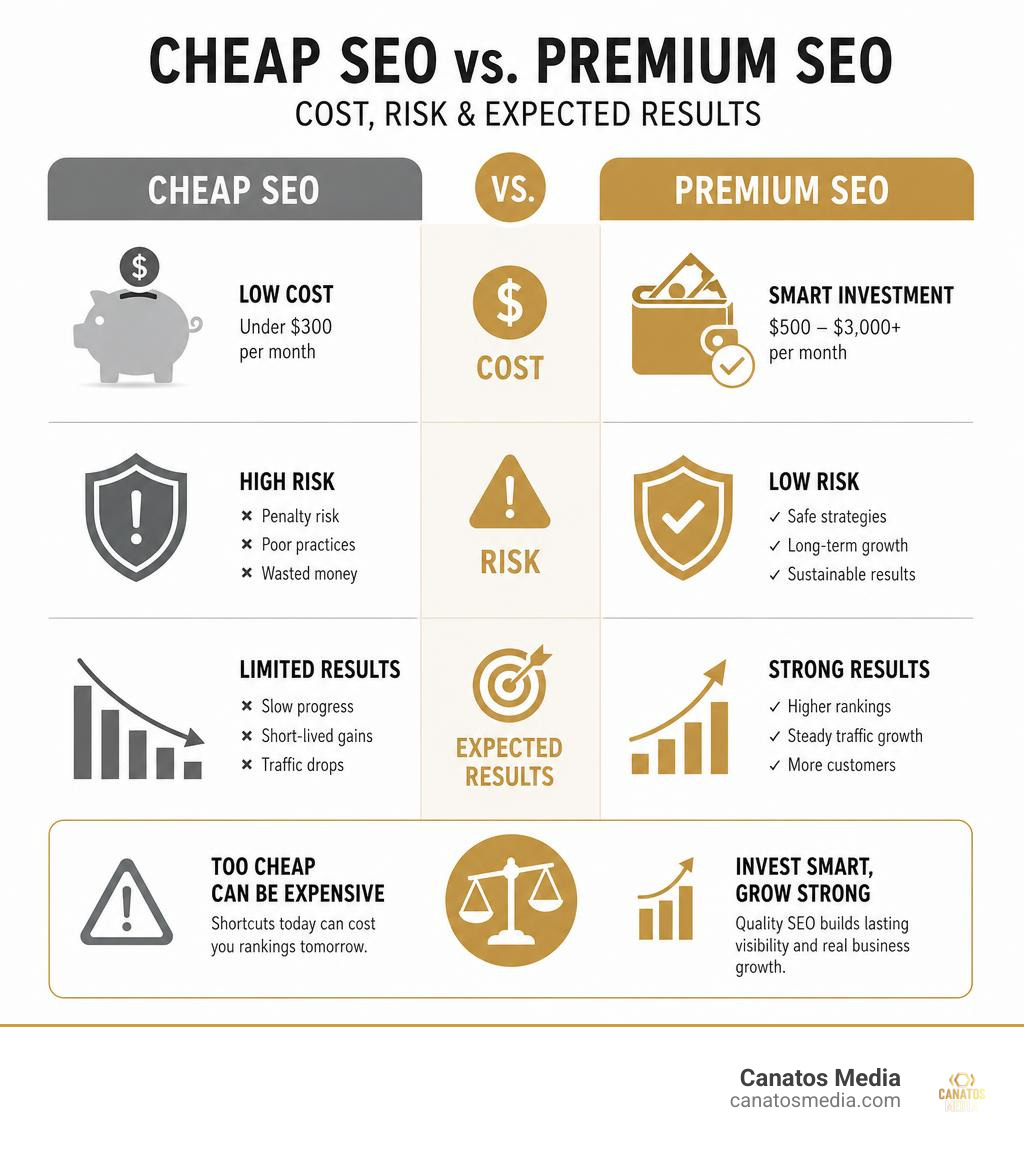
    infographic comparing cheap vs premium SEO tiers cost risk and expected results infographic

    Cheap seo service terms simplified:

    What is a Cheap SEO Service and What Does It Actually Cost?

    When we talk about search engine optimization, “cheap” is a highly relative term. To a venture-backed tech startup, a $3,000 monthly retainer is pocket change. But for a family-owned pizzeria in Nassau County or an HVAC specialist in North Jersey, that kind of monthly spend is a massive financial hurdle.

    An affordable or cheap SEO service typically refers to budget-conscious optimization strategies designed for small businesses. These services focus on the core essentials—like local visibility, basic technical health, and foundational keyword optimization—rather than massive, multi-channel corporate campaigns.
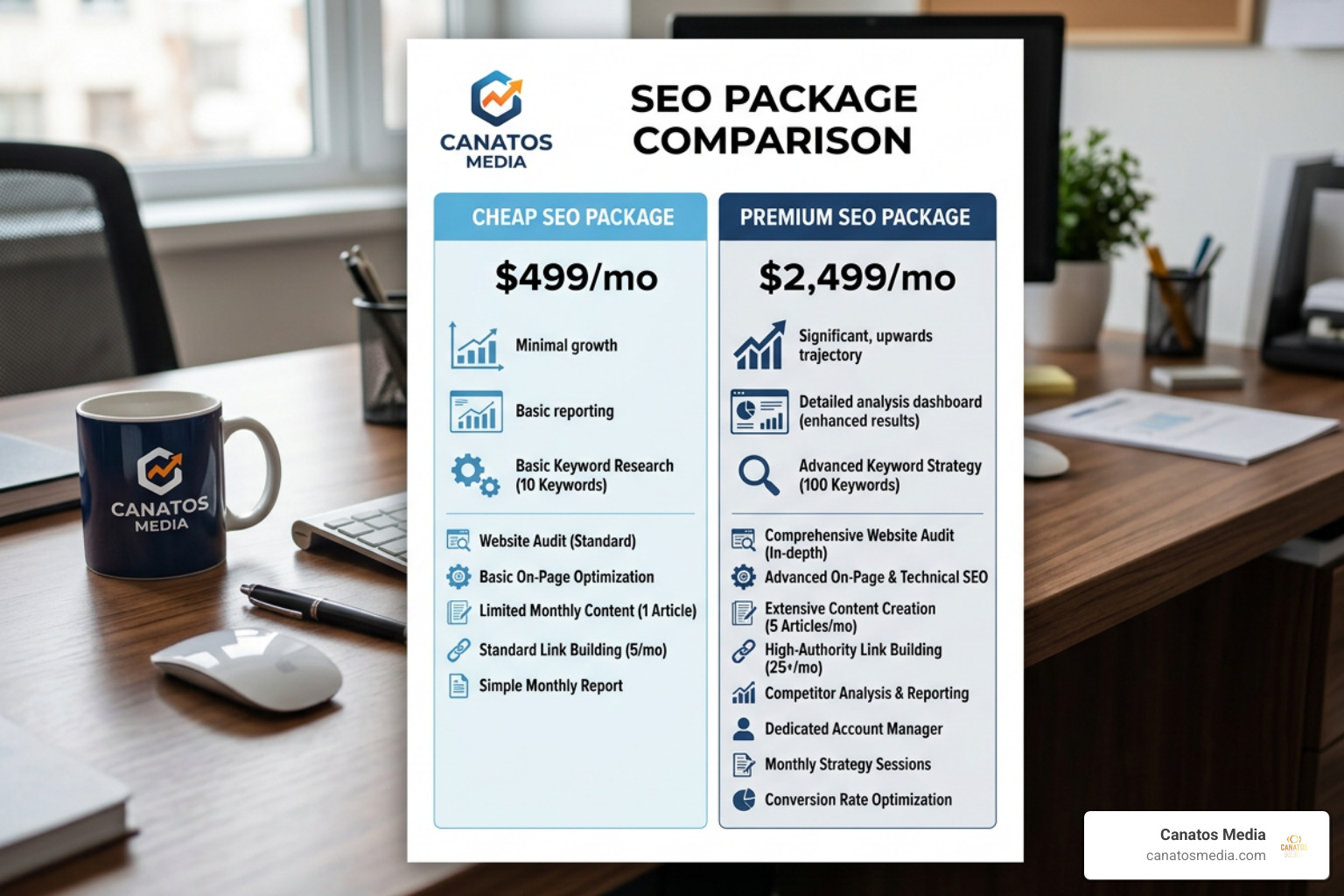
    pricing tiers visual showing difference between cheap and premium SEO packages

    To understand where your money goes, we have to look at how agencies and consultants price their labor. According to industry data, the vast majority of reputable SEO agencies (35%) price their hourly services between $100 and $149 per hour. Only a tiny fraction—about 4.3%—charge under $25 per hour.

    This means that if you are paying a rock-bottom rate, you are either getting very few minutes of actual human attention, or your campaign is being outsourced to low-cost, untrained labor using automated software.

    To get a clearer picture of the landscape in May 2026, let’s look at the standard pricing models:

    • Hourly Consulting: Typically $100–$150/hour in the US.
    • Monthly Retainers: Range from $500 to $3,000+ per month for legitimate small business campaigns.
    • One-Time Projects: Fixed-price “sprints” ranging from $1,000 to $5,000 to fix specific technical or content issues.

    To dive deeper into how search engines evaluate your site, you can read our comprehensive guide on SEO search engine optimization.

    The Reality of a $99/Month Cheap SEO Service

    We have all seen the advertisements: “Rank #1 on Google for only $99/month! No contracts! Guaranteed results!”

    It sounds incredibly tempting. But let’s look at the basic math. If the average US consultant charges $100 to $150 per hour, a $99 monthly fee buys you less than 45 minutes of real, strategic work per month. No human being can research your competitors, write high-quality content, fix technical code, and build authoritative backlinks in 45 minutes.

    So, what are these ultra-cheap providers actually doing?

    To survive on such razor-thin margins, these companies rely entirely on automation and high-volume spam tactics. They use automated software to blast low-quality, spun content across the web. They buy bulk link packages, such as those offering to buy 200 backlinks fast, and point them at your site.

    While this might trigger a temporary, artificial spike in your rankings, it is a direct violation of Google’s Spam Policies for Search. Once Google’s algorithms catch on—which they inevitably do—your site will be hit with a manual action or an algorithmic penalty.

    Getting hit by a Google penalty can completely erase your organic traffic overnight. Worse yet, recovering from a penalty is incredibly difficult. It typically requires hiring a senior team to conduct a deep audit, manually disavow thousands of toxic links, and rebuild your content from scratch. This recovery process can easily cost between $5,000 and $15,000. In short, trying to save a few hundred dollars with an ultra-cheap provider can cost you ten times more to fix down the road.

    What Realistic Budgets Buy in May 2026

    If $99/month is a recipe for disaster, what can you actually get with a realistic, modest budget?

    If you can allocate $500 to $1,500 per month, you enter the zone of legitimate, high-impact SEO. At this level, a professional provider can focus on the high-yield tasks that move the needle for local businesses.

    • Local SEO & Map Pack Optimization: Optimizing your Google Business Profile, managing local directory citations, and targeting geo-specific keywords (e.g., “Long Island plumber”). This is highly effective because 72% of people use Google to find local information.
    • Foundational Technical Audits: Ensuring your website is fast, secure, mobile-friendly, and easily crawlable by search engine bots.
    • On-Page Optimization: Writing clear title tags, meta descriptions, and header structures for your core service pages.
    • Targeted Keyword Research: Finding high-intent, low-competition search terms that your actual customers are typing into their search bars.

    To understand how Google processes these optimizations, you can explore Google’s Guide on How Search Works.

    Red Flags and Scams to Avoid When Shopping for Affordable SEO

    When you are shopping for a budget-friendly provider, you need to protect your business from predatory agencies. Because SEO can feel like a “black box” to many business owners, it is easy for unscrupulous sellers to hide behind technical jargon.

    warning signs and red flags of cheap SEO scams infographic

    Here are the five most common red flags that indicate an SEO service is a scam:

    1. “Guaranteed” Page 1 Rankings: Google’s search algorithms are proprietary and change constantly. Google explicitly states in its official documentation: “No one can guarantee a #1 ranking on Google.” If an agency promises you guaranteed rankings, walk away.
    2. “Proprietary” Technology and Secret Methods: Legitimate SEO relies on clear, public best practices: fast site speed, great user experience, high-quality content, and authoritative links. If a provider claims they have a “secret formula” or “proprietary software” that they cannot explain to you, they are likely using black-hat automation.
    3. Mismatched Billing and Agency Names: Pay close attention to your invoices. If you sign up with “Elite SEO Experts” but your credit card statement shows a charge from an unrelated, generic holding company, it is a sign of a high-volume, low-accountability operation.
    4. Generic Reports with No Specific Actions: Beware of monthly reports that consist solely of automated ranking charts with no explanation of what work was actually completed. A real provider will give you a clear work log showing exactly what pages they optimized, what content they wrote, and what technical fixes they deployed.
    5. Gmail Addresses for Professional Communication: If the “agency” is communicating with you via a free Gmail address (e.g., bestseoguy101@gmail.com), they lack the basic infrastructure of a professional business.

    For a deeper dive into selecting a trustworthy partner who respects your budget, read our guide on how to pick an ecommerce SEO firm that actually delivers.

    What SEO Tasks Are Realistically Achievable on a Budget?

    You do not need a multi-million dollar budget to see real growth in your organic traffic. By focusing on a few high-impact, low-cost tasks, you can achieve significant ranking improvements.

    If you are working with limited funds, prioritize these highly achievable tasks:

    • Claim and Complete Your Google Business Profile: This is completely free and is the single most important factor for local search visibility. Ensure your business name, address, and phone number (NAP) are 100% accurate and consistent with your website.
    • Build Dedicated Service Pages: Instead of listing all your services on one generic “Services” page, build dedicated, high-quality pages for each individual offering. If you are a contractor, have separate pages for “Roofing Repair,” “Siding Installation,” and “Window Replacement.” This makes it much easier for Google to understand what your pages are about.
    • Collect Customer Reviews Religiously: Google loves active, highly rated businesses. Implement a system to ask every satisfied customer for a Google review. A business with 50 recent, detailed reviews will almost always outrank a competitor with only 5 old reviews.
    • Optimize Your Site Speed: Page speed is a direct ranking factor. You can use free tools like Google PageSpeed Insights to identify issues. Often, simply compressing heavy images and choosing a clean, lightweight website theme can shave seconds off your load time.
    • Consistent Directory Citations: Ensure your business is listed correctly on major directories like Yelp, YellowPages, and local Chamber of Commerce sites to build foundational trust.

    To understand why these structural setups are so critical for businesses trying to sell online, see our article on why your store needs ecommerce website seo to survive.

    Cheap SEO Services vs. DIY, AI Tools, and One-Time Projects

    Small business owners in the tri-state area have more choices than ever when it comes to managing their search visibility. You do not have to choose between a costly monthly retainer and a risky ultra-cheap agency.

    Let’s look at how cheap monthly services compare to the modern alternatives:

    Leveraging AI Tools for Technical Setup

    The rise of AI has completely changed the economics of SEO. Today, AI-powered tools costing just $20 to $50 per month can automatically handle complex technical setups that agencies used to charge $1,500/month to manage.

    AI tools are incredibly efficient at:

    • Generating Structured Data (Schema Markup): Helping search engines understand your business type, reviews, and event schedules.
    • Automating Technical Maintenance: Generating XML sitemaps, managing SSL certificates, and identifying broken links or crawl errors.
    • Optimizing Core Web Vitals: Automatically minifying code and optimizing assets to ensure rapid mobile loading times.

    By combining cheap AI tools for technical optimization with your own human insight for local content creation, you can build a highly effective, low-cost SEO engine.

    The “Sprint” Strategy: Buying One-Time Projects

    One of the best alternatives to renting an agency’s time month-after-month is the “sprint” strategy. Instead of signing a long-term contract, you buy specific, high-value assets that you own permanently.

    For example, you can hire a professional to perform a one-time technical audit and fix your site speed for a flat fee of $1,000. Once that work is done, it is a permanent asset that continues to benefit your business for years without any ongoing monthly fees. You can then allocate your budget to creating high-quality video content to drive engagement.

    To learn how to integrate video with your broader digital presence, check out the ultimate guide to video marketing for service businesses in 2026.

    For further guidance on navigating these options, you can review Google’s Advice on Hiring an SEO.

    How to Choose a Legitimate, Budget-Friendly SEO Provider

    If you decide to hire a provider to handle your campaign, you must vet them carefully. A legitimate, affordable agency will focus on transparency, realistic expectations, and clear communication.

    When evaluating potential partners, look for these key indicators:

    • Tailored, Not Out-of-the-Box Strategies: Avoid agencies that offer the exact same package to a local plumber, a dentist, and a national e-commerce store. Your strategy should be customized to your specific industry and local market.
    • Real Case Studies with Verifiable Data: Ask to see case studies showing traffic and conversion growth for real clients. Legitimate agencies will gladly show you anonymized data proving their methods work.
    • Commercial Reporting: Avoid agencies that only send you complex keyword ranking reports. Look for providers who report on metrics that actually impact your bottom line: organic phone calls, form submissions, and sales.

    For more foundational tips on structuring your business’s outreach, you can refer to the SBA Guide on Marketing a Small Business.

    Finding a Local Cheap SEO Service That Delivers

    If you run a business in the tri-state area or Long Island, hiring a local provider gives you a massive competitive advantage. A local provider understands the specific geographic nuances of your market. They know the difference between Nassau and Suffolk counties, they understand the local commuting patterns, and they know how to write content that resonates with tri-state residents.

    When looking for local expertise, check out vetted local directories and regional listings such as the best SEO companies for small business in Atlanta 2026 on Semrush or the best SEO companies in Georgia rankings on GoodFirms to benchmark what professional regional agencies look like.

    By focusing on local search visibility and partnering with a team that understands your specific community, you can ensure your budget is spent on strategies that actually drive foot traffic and local leads.

    To understand how to optimize your site specifically for local searches, consult Google’s Guide to Improving Local SEO Rankings.

    Frequently Asked Questions about Affordable SEO

    How long does it take to see results from budget SEO?

    Generally, it takes 3 to 6 months to start seeing noticeable gains in organic traffic and rankings. Technical fixes (like improving site speed or fixing broken links) can sometimes show positive movement in 4 to 8 weeks, while highly competitive keywords can take 6 to 12 months of consistent effort.

    Can cheap SEO services cause Google penalties?

    Yes. Ultra-cheap services (typically under $300/month) often rely on high-volume automated link building and keyword stuffing. These black-hat tactics violate Google’s guidelines and can result in manual actions or algorithmic penalties that completely remove your site from search results.

    Is DIY SEO better than hiring a cheap agency?

    Yes, if you have the time to invest. If your budget is under $300/month, you are far better off doing the work yourself or using AI tools. You can learn the basics through Google’s official SEO Starter Guide and focus on claiming your Google Business Profile and writing clear, helpful content for your customers.

    Conclusion

    At Canatos Media, we believe that you do not need to risk your business’s online reputation with shady, ultra-cheap SEO packages to get real results. True digital growth happens when your content, your targeting, and your technical optimization work together in harmony.

    Whether you need cinematic short-form video to engage your audience, targeted paid ads to drive immediate leads, or a clean, search-optimized website that converts visitors into customers, we build integrated strategies tailored to your exact budget.

    Ready to grow your business without making your wallet cry? Let’s build a strategy that works for you. Grow your business with Canatos Media services today.

  • Scalable Short-Form Creative Packages That Drive Meta and Google Ad Performance

    Scalable Short-Form Creative Packages That Drive Meta and Google Ad Performance

    Why Growth-Focused Businesses Struggle With Ad Creative Consistency

    Running paid campaigns across Meta and Google requires a steady stream of fresh creative. Yet most growing businesses face a real bottleneck: they either produce inconsistent content that dilutes their brand message, or they stretch limited budgets trying to keep up with platform demands.

    The core problem is timing and resource allocation. When you’re managing multiple locations or service lines, maintaining visual consistency while scaling feels nearly impossible. Your team might excel at running ads, but producing 10-15 pieces of quality video content monthly strains both budget and bandwidth. Many business owners end up recycling the same 3-4 videos until performance tanks, or they pause campaigns while waiting weeks for new creative.

    This inconsistency compounds across channels. What performs on Instagram Reels differs from YouTube Shorts or Google Performance Max. Without a systematic approach to creative production, you’re essentially guessing which format works best for each platform, losing money on underoptimized assets in the process.

    Your immediate action: Audit your current ad library. Count how many unique videos you’ve run in the last 90 days across Meta and Google. If the number is below 12, you’re likely leaving performance gains on the table.

    The Hidden Cost of Inconsistent Visual Content Across Platforms

    When your ad creative lacks consistency in messaging, style, or volume, you pay a real price in platform performance and budget efficiency. Meta’s algorithm learns from engagement and conversion signals; when you’re constantly serving dramatically different creative styles, the algorithm takes longer to find your audience sweet spot. Google’s Performance Max campaigns struggle similarly when creative assets don’t align with audience intent patterns.

    Beyond algorithmic costs, inconsistent creative fragments your brand perception. A prospect might see a polished cinematic video one week, then a rough testimonial the next. That unpredictability erodes trust and makes your business appear less established than competitors who maintain visual clarity.

    There’s also the production chaos cost. Without a scalable package structure, you’re likely either:

    • Rushing creative through production, cutting corners on quality
    • Waiting for perfectly executed pieces, missing seasonal campaign windows
    • Overproducing for one quarter, then going quiet the next

    Each scenario damages either your brand perception or your campaign velocity. Most growth-focused brands spend 20-30% more on ads than necessary because their creative doesn’t optimize properly across platforms before spending tapers off.

    What to do next: Calculate your monthly ad spend and multiply by 0.25. That’s roughly the budget leak from suboptimal creative performance. This number justifies investing in a structured creative system.

    How Scalable Creative Packages Solve Multi-Channel Ad Demands

    Scalable short-form creative packages solve this by establishing a predictable production rhythm tied directly to your advertising goals. Rather than scrambling for content, you receive a set number of finished videos monthly, pre-formatted for Meta and Google’s requirements and optimized for both algorithm learning and viewer psychology.

    Our packages work because they separate creative production from campaign management. You outsource the production bottleneck while keeping full control over targeting, bidding, and account strategy. This removes the resource constraint that forces most brands into the inconsistency trap.

    The structure also enables platform-specific optimization. Your Meta creative runs at 9:16 aspect ratio with captions embedded. Your Google Shorts ads are formatted for discovery. Performance Max gets a 1:1 square variant. All pieces share your brand voice, but each lives in its ideal native format.

    For multi-location brands, this approach scales naturally. One creative shoot can yield 8-12 platform-ready videos suited to different service lines or locations. A pest control company filming one day produces videos showcasing termite treatments, mosquito solutions, and preventive maintenance, each optimized for different audience segments and platforms.

    The predictability also transforms how you plan campaigns. Instead of asking “Do we have creative?”, you’re asking “Which audience should we target with this asset?” You move from creative scarcity to creative abundance, shifting your energy to strategy and optimization.

    Our Approach to Building Standardized Yet Flexible Ad Creative

    We design our creative packages around the insight that high-performing ads share fundamental structural patterns, but these patterns can adapt to your specific brand voice and positioning. Every video we produce follows a proven framework: hook within 1-2 seconds, clear value statement by second 3, proof or demonstration mid-video, and a specific call-to-action at the end.

    Within that structure, flexibility is critical. A service-based brand’s creative plays differently than a local retail brand’s. We develop creative briefs that capture your unique selling angle, then produce variations exploring different angles: problem-focused, transformation-focused, authority-focused, social-proof-focused.

    Our process begins with strategic alignment, not just production. We ask: What’s your current conversion bottleneck? Are prospects not clicking, or are they clicking but not converting? Are you reaching the right audience, or is targeting the issue? This shapes whether we emphasize awareness-stage content (educational, trend-based) or conversion-stage content (testimonials, detailed solutions).

    We then establish a production rhythm. Most packages deliver 4-6 finished videos every 4 weeks, which provides enough frequency for platform algorithm learning while maintaining brand consistency. Each video is shot with your specific messaging in mind, but we also explore format variations: quick tutorial vs. narrative storytelling vs. customer-spotlight vs. behind-the-scenes.

    Every asset comes platform-ready with captions, proper aspect ratios, and metadata optimization for Meta and Google discovery.

    Streamlining Production Without Sacrificing Quality or Brand Voice

    The biggest fear most business owners have with outsourced creative is losing brand voice. Your brand isn’t just your logo or color palette; it’s your distinct perspective on your industry. Generic creative kills conversion regardless of production quality.

    We prevent this through deep brand collaboration before shooting. We conduct interviews, review your best-performing past content, and sit through actual customer conversations. We learn what makes your brand different from competitors, not just in features but in philosophy and approach. This feeds directly into scripts and creative direction.

    Our short-form video production process emphasizes efficiency without cutting corners. A single shoot day typically yields 4-6 finished videos because we’re using proven shot lists, we’re filming multiple angles and variations, and our post-production workflow is standardized. This isn’t assembly-line thinking; it’s professionalism at scale.

    We also build iteration into our packages. Your first month of creative might reveal opportunities: maybe testimonial-style videos outperform educational content, or maybe a particular tone resonates stronger. We use that data to refine subsequent deliveries, making your package increasingly effective as we work together.

    This iterative approach means your creative investment compounds. Month 3 of a package is producing stronger results than Month 1, not because we’re producing better, but because we’re producing smarter based on performance data.

    Measuring Performance Across Meta and Google With Unified Creative Systems

    One major advantage of standardized creative packages is measurement clarity. When every video follows the same structural framework, you can isolate what’s actually driving performance. Is it the message, the format, the audience, or the platform? With wildly inconsistent creative, these variables blur together.

    We track every asset through your Meta and Google accounts, tagging each video with its creative angle and production date. This creates a searchable library where you can see: “Which platform and angle combo gave us our lowest CAC last month?” or “How did our Q1 creative perform compared to Q2?”

    This data then informs future creative decisions. If product-demo-style videos consistently outperform narrative-style on Google Performance Max, we weight future production toward that format. If conversion-stage testimonials beat awareness-stage educational content, we shift the mix.

    Most importantly, unified creative systems let you actually attribute results back to creative investment. Too many brands know they spent $5,000 on a video production but can’t connect it to actual leads or revenue. Scalable packages eliminate that gap by producing enough asset volume that performance signals become statistically meaningful, not noise.

    Action item: Set up UTM parameters or custom creative tagging in your ad accounts now. When you transition to a scalable package, this infrastructure lets you immediately see which creative angles drive performance.

    Integrating Short-Form Content Into Your Paid Advertising Strategy

    Short-form content powers paid advertising today because it respects how people actually consume video on mobile. A 30-second short-form ad gets watched; a 2-minute corporate video doesn’t, even with big budgets behind it.

    Our approach integrates short-form creative into your broader paid strategy across three layers:

    First, awareness-stage content: Trend-based, educational, or entertainment-focused videos that hook cold audiences. These aren’t selling; they’re proving relevance and building initial trust. A financial advisor creates a 15-second video on common retirement mistakes. A home services company demonstrates a quick maintenance tip.

    Second, consideration-stage content: Problem-solution videos, detailed product demonstrations, customer success stories. By the time prospects see this content, they’ve already engaged with your brand or landed on a page. These videos answer the specific questions that move them toward a decision.

    Third, decision-stage content: Testimonials, detailed ROI breakdowns, limited-time offers. This content targets people already in your conversion funnel or returning visitors. It removes final objections.

    A scalable creative package produces content suited to all three stages. Your monthly deliverables might include 2 awareness-stage variations, 2 consideration-stage videos, and 2 decision-stage pieces. This gives your paid strategy depth and flexibility that single-asset approaches can’t match.

    The key is distributing this across both Meta (Facebook, Instagram, Threads) and Google platforms strategically. Meta excels at building awareness through algorithmic reach; Google excels at capturing high-intent searchers. Your creative needs reflect those platform strengths.

    Real-World Results From Service-Based and Multi-Location Brands

    We’ve worked with dental practices, HVAC contractors, estate planning firms, and multi-location fitness businesses. The pattern we see consistently: brands that shift from ad-hoc creative to scalable packages see 25-40% improvement in cost-per-lead within the first 90 days, simply from having enough creative volume for proper platform optimization.

    One multi-location pest control company was producing maybe 2-3 videos quarterly, then wondering why their CPL stayed flat. They shifted to a monthly package delivering 6 finished videos. Within two months, they had enough data to see that location-specific videos (one store location handling a client’s termite problem) outperformed generic company videos by 3x. They doubled down on that angle. Within 6 months, their CPL dropped from $47 to $31, and they scaled their ad spend 2.5x because their creative efficiency made more budget profitable.

    A service-based brand (estate planning) discovered their best-performing creative wasn’t polished testimonials; it was founder-led educational content about common estate planning mistakes. That insight came only after producing enough volume to see clear patterns. Once they knew what worked, they weighted production heavily toward that format, and their conversion rate improved 35%.

    Our case studies show more detailed examples, but the common thread is clear: scalable creative packages don’t just solve the production bottleneck; they create the volume necessary for data-driven optimization.

    Choosing Package Tiers That Match Your Growth Stage

    We offer packages scaled to business size and growth ambition. Early-stage brands typically start with 4 videos monthly, pre-formatted for Meta and Google, plus strategic consultation on where to deploy them. This tier costs less but requires your team to handle some strategy and audience management.

    Growth-stage brands often choose 6-8 videos monthly plus ongoing creative strategy consultation. This tier includes audience insights and platform-specific recommendations based on performance data. You’re outsourcing production and getting strategic guidance on creative direction and platform allocation.

    Scaling brands typically want 10-12 videos monthly plus full integration with their ads team. This tier includes creative strategy aligned with your current campaign performance, A/B testing frameworks, and monthly optimization meetings. You’re outsourcing production entirely while maintaining strategic alignment.

    There’s no “right” tier universally; it depends on your ad spend, growth goals, and internal bandwidth. A business spending $10,000 monthly on ads often finds a 6-video package optimal; it’s enough to iterate and optimize without overkill. A business spending $50,000+ monthly might need 10+ videos to feed their scale while maintaining creative freshness.

    Quick assessment: If your monthly ad spend divided by 2,000 is greater than your monthly video production capacity (including editing and optimization), a scalable package makes financial sense.

    Getting Started With Your First Scalable Creative Package

    Starting with a scalable package begins with a discovery conversation. We discuss your current advertising challenges, your brand positioning, your audience, and your conversion bottlenecks. This feeds directly into how we design your package and what creative angles we prioritize for Month 1.

    We also establish clear success metrics upfront. We’re not measuring “creative quality” or “production value.” We’re measuring leads generated, cost-per-lead, conversion rate, and platform performance. You’ll know exactly which package tier is working because the data will tell you.

    Your first month includes a strategic onboarding phase where we learn your brand deeply, finalize your creative brief, and produce your initial video batch. Months two and beyond hit a steady rhythm: you receive finished, platform-optimized videos on a predictable schedule, you deploy them into your campaigns, and we iterate based on performance.

    The transition from ad-hoc creative to scalable production isn’t complicated, but it does require committing to a system. Most growth-focused business owners find this trade-off obvious once they calculate the cost of inconsistent creative: higher platform costs, slower algorithm learning, and missed seasonal opportunities.

    If your team is stretched thin producing content while managing everything else, or if your CPL isn’t dropping despite good targeting strategy, a scalable creative package is the logical next step. We’re here to handle the production while you focus on strategy and growth.

    Contact us today for a free consultation to see how we can help you grow your business.

    Frequently Asked Questions (FAQ)

    What’s included in our scalable creative packages?

    We build each package around your platform needs, typically including 4-8 short-form videos per month optimized specifically for Meta and Google ads. Our packages cover scripting, filming, editing, platform-specific formatting, and performance-ready file delivery. We also integrate A/B testing variations so you can test different messaging angles without additional production costs.

    How do we maintain brand consistency when producing videos at scale?

    We develop a creative framework during our initial strategy phase that locks in your visual style, messaging pillars, and brand voice. This framework becomes our production standard, allowing us to batch-produce content efficiently while ensuring every video feels authentically yours. We handle revisions in-house rather than sending work back and forth, which keeps turnaround fast and quality consistent.

    Can we integrate these videos into both Meta and Google advertising simultaneously?

    Yes, that’s exactly how we structure our approach. We produce assets with both platforms’ technical requirements in mind from the start, then optimize each video for Meta’s algorithm and Google’s display specs separately. This means you’re not paying for multiple rounds of editing, and your creative strategy stays unified even though the formats differ slightly between platforms.

  • A No-Nonsense Comparison of Local Digital Marketing Agencies

    A No-Nonsense Comparison of Local Digital Marketing Agencies

    A No-Nonsense Comparison of Local Digital Marketing Agencies

    Why Most Local Businesses Struggle to Get Found Online

    If you’ve ever typed digital marketing near me into Google, you already know the frustration: a wall of agencies, consultants, and freelancers all claiming to be the best — with no easy way to tell them apart.

    Here’s a quick answer to help you cut through the noise:

    The fastest way to find a good local digital marketing provider:

    1. Search Google for agencies in your city and check their reviews on Google, Clutch, or UpCity
    2. Look for agencies that specialize in businesses like yours (industry + service type)
    3. Ask for case studies with real numbers — leads, rankings, or ROI
    4. Confirm they offer the core services you need: SEO, paid ads, social media, or web design
    5. Schedule a free strategy call before committing to anything

    Here’s the reality: 70% of consumers research a business online before ever visiting or calling. If your business isn’t showing up in local search results, a competitor is getting that customer instead.

    The good news? You don’t need a massive budget or a national agency to fix it. Local digital marketing providers — the ones who know your market, your competitors, and your community — often deliver faster, more targeted results than big-name remote firms.

    But not all local agencies are created equal. Some are full-service growth partners. Others resell generic packages with little customization. Knowing the difference is what this guide is about.

    I’m Nic Canobbio, founder of Canatos Media, and I’ve spent over two decades working at the intersection of media production, content strategy, and business development — including building digital and paid media campaigns that have driven tens of millions of content views and tangible revenue results, which gives me a grounded perspective on what actually works in digital marketing near me searches. In the comparison below, I’ll break down what separates the best local providers from the rest, so you can make a confident decision.

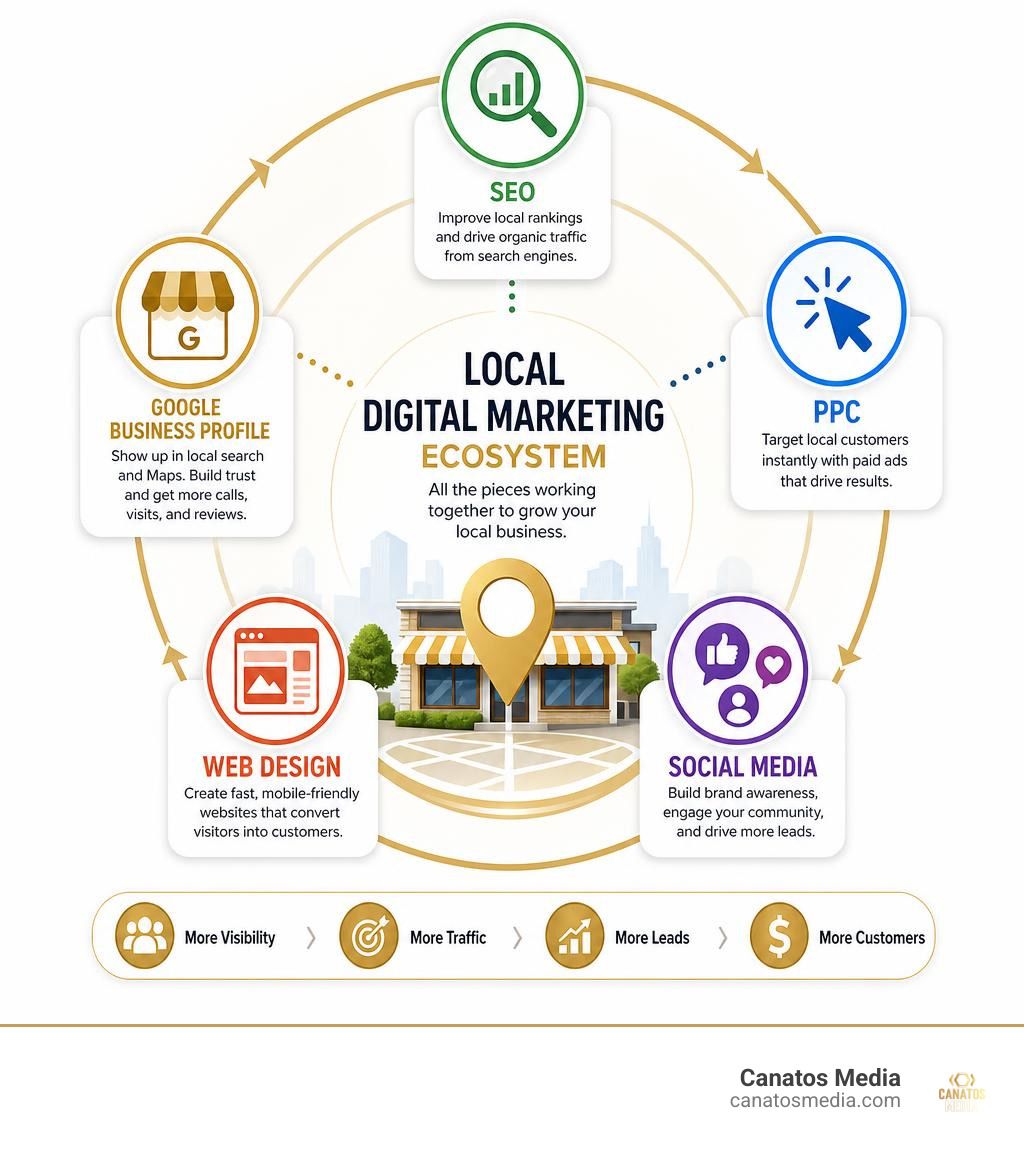
    Local digital marketing ecosystem showing SEO, PPC, social media, web design, and Google Business Profile infographic

    Digital marketing near me word guide:

    Why Search for “Digital Marketing Near Me” Over National Agencies?

    When you run a business in the Tri-State area or on Long Island, your target audience isn’t a generic demographic profile spread across the country. Your audience consists of real people living in specific neighborhoods, commuting on the LIRR, or looking for services across New York, New Jersey, and Connecticut.

    National agencies might have massive teams, but they lack the regional pulse. They don’t understand the difference between targeting customers in Nassau County versus Suffolk County, nor do they understand the hyper-local competitive landscape of the NYC metro area. Searching for a digital marketing near me partner ensures you work with professionals who actually understand your market dynamics.

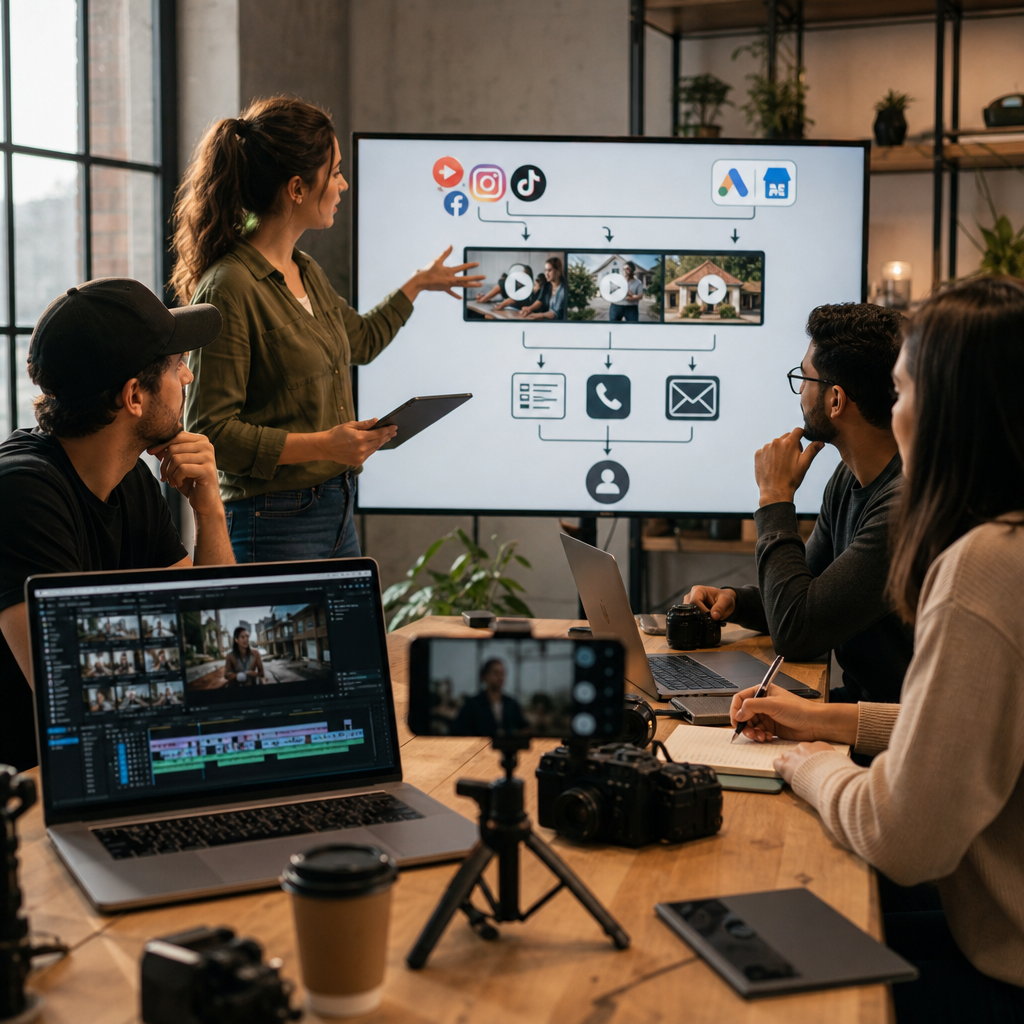
    Local agency collaboration and strategy meeting

    Choosing a regional expert means your campaigns are built with local nuances in mind. If you are looking to build a brand that stands out in a crowded regional market, you need a partner featured on The Best Creative Digital Agency Shortlist for 2026 who understands how to blend local relevance with world-class creative execution.

    The Benefits of Hiring a Digital Marketing Near Me Provider

    The most immediate benefit of hiring a local agency is their hands-on approach to local search signals. A nearby agency can physically visit your location to capture high-quality, authentic photo and video assets, which are critical for building community trust.

    Furthermore, local agencies excel at managing your local search footprint. This includes building accurate local citations and optimizing your Google Business Profile (GBP). According to industry data, local businesses that optimize their Google Business Profile see up to 70% more website visits and 35% more direction requests.

    A local agency ensures your business is properly categorized, your service areas are accurately mapped, and your customer reviews are managed effectively to build authority. For a step-by-step understanding of how to manage your business listing, you can consult the Google Business Profile Help Center.

    How Local Agencies Differ from Remote or National Firms

    The difference between a local agency and a remote national firm comes down to communication, execution, and tailored strategies.

    • Communication: With a local agency, you aren’t just another ticket in a project management queue. You can pick up the phone, speak to someone in your time zone, or even meet for a coffee in Manhattan or Garden City to discuss your quarterly goals.
    • Regional Insights: A remote agency in another state won’t know that a winter storm in the Tri-State area requires a sudden shift in your home services ad copy, or that local events are prime opportunities for real-time social media campaigns.
    • Tailored Strategies: National firms often rely on rigid, pre-packaged templates. Local agencies build custom strategies designed to compete specifically against the businesses down the street from you.

    For a deeper dive into how local businesses can leverage these dynamics to outcompete national brands, check out HubSpot’s Local Marketing Guide.

    Comparing the Core Services of Local Marketing Providers

    To get the most out of your marketing investment, it helps to understand the primary levers local agencies pull to drive growth. The best local agencies don’t just offer one isolated service; they integrate multiple channels to build a cohesive customer acquisition system.

    To understand the full scope of what these teams handle daily, read The Ultimate Breakdown of What a Creative Digital Marketing Agency Actually Does.

    Here is a quick comparison of the three most common service pillars:

    Marketing Pillar Primary Goal Best For Typical Timeline for Results
    Local SEO Long-term organic visibility in search engines and map packs. Sustainable lead generation, local search dominance, and authority building. 3 to 6 months
    Paid Ads (PPC) Immediate traffic, leads, and phone calls from high-intent searchers. Scaling quickly, promoting seasonal offers, and filling immediate booking gaps. 1 to 15 days
    Social Media / Video Community engagement, brand awareness, and visual trust-building. Educating customers, humanizing your brand, and retargeting warm audiences. 1 to 3 months

    Local SEO and Google Business Profile Optimization

    Local SEO is the art and science of making sure your business shows up when someone searches for your services in your specific town or neighborhood. The holy grail of local SEO is the “Map Pack” — the top three local business listings that appear alongside a map at the top of Google search results.

    To win a spot in the Map Pack, a local agency will focus on:

    1. Google Business Profile Optimization: Ensuring your business name, address, and phone number (NAP) are 100% consistent across the web.
    2. Local Citation Building: Listing your business in prominent regional directories, including localized platforms like Yelp’s Long Island Business Directory.
    3. On-Page Local SEO: Creating dedicated location landing pages on your website targeting specific towns across NY, NJ, or CT.

    For a detailed look at the ranking signals Google uses to determine local placement, read Google’s Official Local Search Ranking Guide.

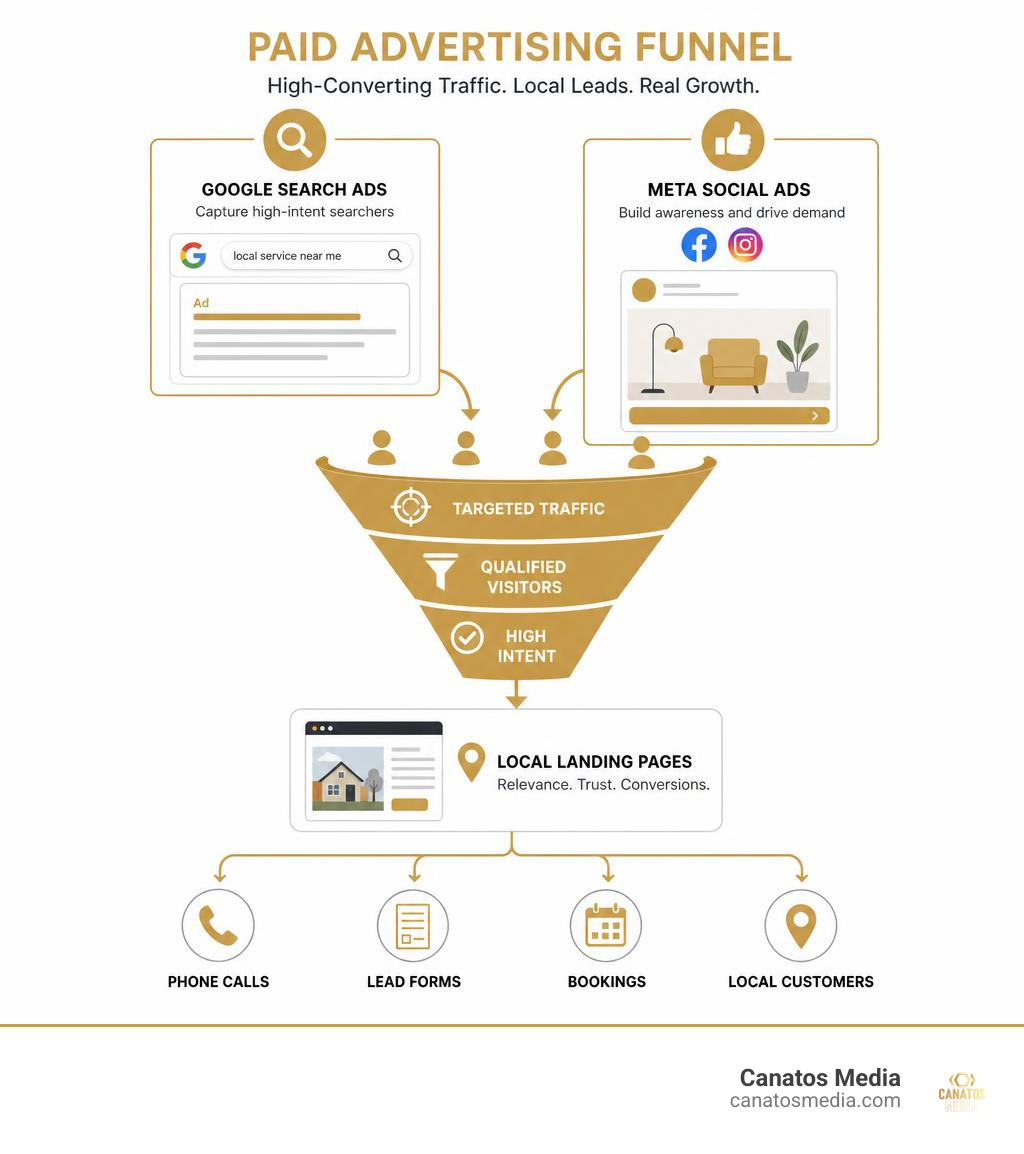
    While SEO builds long-term equity, paid search and paid social ads are your fastest path to generating immediate leads. By combining Google Ads (which captures high-intent searchers actively looking for your service) with Meta Ads (which builds visual demand on Facebook and Instagram), you create a highly efficient lead-generation system.

    Paid advertising funnel showing Google Search Ads and Meta Social Ads driving high-converting traffic to local landing pages

    When properly managed, businesses using targeted local SEO and paid ads report a 40-60% lower cost per lead compared to non-optimized campaigns.

    To build a high-performing paid campaign, you need to structure your ad accounts correctly, write compelling local copy, and design conversion-focused landing pages. You can master the fundamentals using our Step-by-Step Guide to Paid Ads.

    Additionally, to avoid common budget pitfalls and maximize your return on ad spend, explore our comprehensive resources on Meta Google Advertising, learn how to navigate platforms like a professional with the Meta Ads Management Ultimate Guide, or discover how to self-optimize using our tutorial on How to Navigate Meta Ad Manager Like a Pro.

    Social Media and Video Marketing

    In 2026, social media is no longer just about posting occasional updates. It is a visual search engine and a trust-building platform. Modern consumers want to see the faces behind your business, watch behind-the-scenes footage of your work, and consume engaging, short-form video content on platforms like Instagram Reels and TikTok.

    Working with an agency that can produce high-quality, cinematic video content gives you a massive unfair advantage. It allows you to build real, human connections with your local audience before they ever pick up the phone.

    To build an effective organic and paid social presence, check out The Complete Guide to Social Media Management. If you want to dive deeper into video creative, read our guides on How to Create High-Impact Short-Form Content That Converts on Facebook and Instagram Reels and The Ultimate Guide to Video Marketing for Service Businesses in 2026.

    How to Evaluate and Choose a Digital Marketing Near Me Agency

    Selecting the right partner can feel overwhelming, but keeping a few key criteria in mind will save you thousands of dollars and months of wasted effort.

    First, look for structural alignment. Agencies operate under various business models — some sell pre-packaged hourly services, while others build custom, outcome-based growth engines. To find the right fit for your business goals, read about the 6 Best Agency Models for Monthly Video and Social Ads in 2026.

    Agency vetting checklist and selection process

    When evaluating local providers in the Tri-State area, look for established firms with deep roots in the region who understand the local market dynamics. If you require sophisticated website development alongside your marketing, choosing a partner that integrates web design with active SEO and paid advertising can help ensure your digital foundation is rock solid.

    Key Questions to Ask a Digital Marketing Near Me Agency

    Before signing any contract, schedule a discovery call and ask these direct questions to separate the true growth partners from the sales-heavy agencies:

    1. “How do you track and measure campaign success?” (Red flag: They only talk about “impressions” or “clicks.” Green flag: They talk about leads, phone calls, cost per acquisition, and booked revenue.)
    2. “Do we own our ad accounts and website assets if we part ways?” (Red flag: They host your website on a proprietary platform or refuse to give you admin access to your Google Ads or Meta accounts.)
    3. “Who will be managing my account on a day-to-day basis?” (Ensure you have a dedicated account manager and regular, transparent reporting meetings.)
    4. “Can you show me a case study of a business similar to mine in the NY/NJ/CT area?” (An agency should readily provide localized examples of their success.)

    For more advice on vetting marketing vendors, check out Search Engine Land’s Guide to Hiring an SEO Agency.

    Cost, Timelines, and Measuring ROI

    A major concern for any business owner is understanding the financial commitment and when they will see a return on their investment.

    • The Timeline: Paid search campaigns can start generating phone calls within days of launch. SEO, on the other hand, is a compounding asset. SEO campaigns for local service businesses typically show measurable ranking improvements within 60-90 days and meaningful traffic gains in 3-6 months.
    • The ROI: Marketing should never be viewed as an expense; it is an investment. Companies combining SEO, PPC, and conversion-focused websites experience an average ROI of 500% on monthly marketing investments. For example, a monthly local marketing investment of $5,000 can realistically scale to return $30,000 in tracked, closed local business once the compounding systems are fully optimized.

    Frequently Asked Questions about Local Digital Marketing

    How much does local digital marketing cost?

    Local digital marketing costs vary based on your competitive landscape, target geographic area, and growth goals. In the Tri-State area and Long Island, professional local marketing retainer services typically start around $800 to $1,500 per month for basic local SEO and Google Business Profile management.

    For integrated campaigns that combine custom web design, active search engine optimization, paid advertising management, and ongoing video content creation, monthly investments usually range from $3,000 to $7,500+. Additionally, most agencies recommend a minimum starting ad budget of $500 per month to gather enough initial data to optimize your paid campaigns effectively. To understand industry-standard paid ad costs, consult WordStream’s Local Advertising Benchmarks.

    How long does it take to see results from local SEO?

    For most local businesses in competitive markets like New York or New Jersey, you will begin to see measurable movement in search keyword rankings within 60 to 90 days. Meaningful increases in organic website traffic, phone calls, and lead form submissions typically build momentum between months 3 and 6.

    Because search engines prioritize websites with established authority, consistent content, and clean technical structures, local SEO is a long-term strategy that continues to deliver low-cost leads long after your initial optimization. For more on how search engine algorithms process local business authority over time, read Google Search Central on SEO Timelines.

    What industries benefit most from local digital marketing?

    Any business that relies on customers within a specific geographic radius benefits heavily from local digital marketing. However, the industries that see the highest and most immediate return on investment include:

    • Home Services: HVAC, plumbing, roofing, electrical, landscaping, and cleaning companies. These businesses rely on high-intent local searches (e.g., “emergency plumber near me”) to book immediate, high-ticket jobs.
    • Professional Services: Law firms, accounting practices, real estate agencies, and insurance brokers.
    • Healthcare & Medical: Dental practices, medical clinics, physical therapists, and local chiropractors.

    Conclusion

    Finding the right partner when searching for digital marketing near me doesn’t have to be a gamble. By choosing a local team that understands the unique pulse of the Tri-State area and Long Island, you ensure your marketing budget is spent on strategies that actually drive local foot traffic, phone calls, and booked jobs.

    At Canatos Media, we don’t believe in generic, one-size-fits-all marketing packages. We partner with local businesses to build custom, integrated growth engines. We combine high-end, cinematic short-form video production with aggressive local SEO, paid Meta and Google ad campaigns, and website support to turn attention into real, measurable revenue.

    Ready to stop chasing vanity metrics and start scaling your business with a clear, cohesive digital strategy? Let’s talk.

    Book a strategy call with Canatos Media today to unlock your local growth potential.

  • Why Video Production is the Key to Modern Lead Generation for Service Businesses

    Why Video Production is the Key to Modern Lead Generation for Service Businesses

    The Lead Generation Problem: Why Traditional Marketing Isn’t Working

    Video Production Lead Generation for Service Businesses

    Most service business owners we speak with are stuck in the same cycle: they’re spending money on ads, getting traffic, but watching leads dry up. The issue isn’t your budget or your offer. It’s that potential customers don’t trust text and static images the way they used to.

    Traditional marketing assumes people will read long-form copy, compare features, and make rational purchasing decisions. In 2026, that’s not how buying works. Prospects want to see proof that your service actually works. They want to know what it feels like to work with you. They need confidence built through visual storytelling, not promises.

    When you rely only on paid search or generic display ads, you’re competing on price and keyword placement. When you build your lead generation around video content, you’re competing on trust and results. The difference shows up directly in your conversion rates.

    Here’s what we’ve observed: businesses that incorporate video into their marketing funnel see 2-3x higher engagement rates than those using static content alone. More importantly, video prospects are more qualified. They’ve already experienced your brand narrative and decided they want to learn more, so they’re further along in their buying journey.

    Action step: Audit your current lead sources for the next week. Track which ones produce the most qualified leads, not just the most leads. You’ll likely notice video-based touchpoints perform differently.

    How Video Content Changes the Buyer’s Journey

    Video doesn’t just make your marketing prettier. It fundamentally changes how prospects move through your sales funnel.

    In the awareness stage, video gives potential customers a reason to stop scrolling. They might not even know they have a problem yet, but a well-crafted video showing real transformation can catch their attention where text never would.

    At the consideration stage, video lets prospects experience your team and your process without booking a call. A prospect can watch how you handle a client situation, hear your approach explained by the founder, or see the actual results you deliver. This answers dozens of unspoken questions before anyone reaches out.

    By the decision stage, video testimonials and case studies provide the social proof people need to commit. Video from real customers carries more weight than a written review because authenticity is harder to fake on camera.

    The critical shift: prospects who consume video content about your business before reaching out tend to have higher close rates. They’re pre-qualified by their own decision to watch. They’ve chosen to invest their time in understanding your offer, which signals genuine interest.

    We’ve also noticed that video extends the conversation timeline in your favor. A prospect might watch a short-form video, then days later remember your brand and click a link to learn more. That’s multiple touchpoints without multiple ad spends.

    Action step: Map your current customer journey and identify where video would save the most questions. Usually, it’s right after someone clicks an ad but before they book a consultation.

    The Difference Between Generic Video and Cinematic Storytelling

    Not all video is equal. A shaky phone recording of your team might feel authentic, but it won’t inspire confidence in high-ticket services. On the flip side, overly produced corporate videos feel disconnected from reality.

    Cinematic storytelling sits in the middle: professional production quality combined with authentic human moments. It means showing real team members and real clients within a narrative that illustrates your value. The production quality says “we take this seriously.” The story says “we understand your situation.”

    When we produce video content for service businesses, we focus on transformation, not features. Instead of listing what you do, we show what changes for clients after working with you. That could be a home services business showcasing a before-and-after renovation with the client explaining how it improved their daily life. Or a consulting firm showing how a confused founder moved to confident leadership.

    The cinematic approach also means investing in shot composition, color grading, and sound design. Details matter because they build trust. A video with poor audio makes viewers question everything else, even if your service is excellent. A video with intentional framing and color palette feels premium and thought-through.

    Generic video feels like a box to check. Cinematic storytelling feels like a reason to choose your business.

    Action step: Watch three videos from businesses in your industry. Note which ones actually make you feel something versus which ones you could ignore. That’s the gap you need to close.

    Short-Form Video: The Format That Actually Converts

    Long-form video has its place for brand building, but short-form is where lead generation happens. We focus on short-form video production because it aligns with how people actually consume content on social platforms.

    Thirty to ninety seconds is the window where you capture attention, tell a story, and create a reason for someone to take the next step. Longer videos work on YouTube when someone is intentionally seeking knowledge. Short-form works everywhere else because it respects the viewer’s time while still conveying value.

    The format also allows you to test messaging quickly. You can produce variations of the same concept, measure which versions get higher engagement and click-through rates, then double down on what works. That rapid feedback loop is impossible with traditional content production.

    Short-form videos also perform exceptionally well in paid advertising. When someone sees an ad that looks like native content rather than a commercial, they’re more likely to watch it. A short-form video on Instagram Reels or TikTok styled as content feels native and gets better performance than a traditional ad angle.

    For service businesses specifically, short-form excels at showing results, highlighting team expertise, answering common questions, and building familiarity. You can post 3-4 times per week without feeling like you’re overwhelming your audience, and each piece is an opportunity to trigger someone’s decision to reach out.

    Action step: Choose one result your clients value most and brainstorm five different 60-second angles that showcase it. Variety keeps your audience engaged while reinforcing the same core message.

    Integrating Video with Paid Advertising for Maximum ROI

    Video content gains power when you distribute it intentionally through paid channels. A great video that no one sees generates zero leads.

    We combine video production with Meta and Google advertising to ensure the right people see your message at the right moment. A lead magnet video on Facebook might introduce a prospect to your approach. A follow-up video on Google ads could retarget them as they research further. A short testimonial video in a campaign might close someone on the fence.

    The integration works because paid advertising gives you precision targeting that organic reach can’t match. You can show video specifically to people searching for your service type, living in your area, or matching your ideal customer profile. The video does the trust-building work while the ad placement does the targeting work.

    We’ve also found that video ads generate higher click-through rates than static ads at similar or lower cost. The cost per view might be higher, but the cost per qualified lead is typically lower because video drives better engagement and higher-intent clicks.

    One practical approach: use short, hook-heavy video in awareness-stage ads to build familiarity. Use longer, explanation-focused video in consideration-stage retargeting. Use testimonial video in decision-stage campaigns. Each format and length serves a specific moment in the funnel.

    Action step: Identify your three highest-converting ad campaigns from the past year. Redesign one using video content and measure the difference in cost-per-lead and conversion rate after two weeks of data.

    Building a Complete Lead Generation System Around Video

    Video is most effective when it’s part of a coordinated system, not a standalone tactic. We help our clients build what we call an all-in-one marketing funnel that uses video as the centerpiece.

    This system includes landing pages that feature video prominently, email sequences that incorporate video clips, lead magnets delivered as video content, and retargeting campaigns that show different video assets based on where the prospect is in the journey. Everything works together.

    The system also requires social media management that distributes video strategically across platforms. Instagram Reels demand a different edit than YouTube Shorts or LinkedIn videos. A platform-specific approach means your video content actually performs well wherever it appears.

    Lead capture is another critical component. Many businesses produce great video but fail to connect views to lead form submissions. We use calls-to-action within videos, strategic landing page placement, and email integration to turn viewers into captured leads that enter your sales pipeline.

    Finally, the system includes measurement and optimization. You’re tracking which videos drive the most qualified leads, which platforms produce the best engagement, and which messaging resonates with your audience. That data guides what you produce next.

    Action step: List every place your prospects might encounter your brand online. For each touchpoint, decide what video content would belong there and in what format.

    How We Combine Video Production with Social Media Strategy

    Video production and social media management need to work together or neither reaches full potential.

    Our approach starts with understanding your social media goals and audience. We don’t just produce beautiful videos and hope they perform well. We produce videos specifically designed to stop scrolls, encourage shares, and drive actions within each platform’s algorithm.

    Then we implement a consistent posting schedule that keeps your audience familiar with your brand. Consistency matters more than perfection. A business posting one solid video weekly outperforms a competitor posting once monthly, even if that monthly video is technically better produced.

    We also manage the social channel itself, responding to comments, engaging with prospects’ content, and building community. Video brings people to your page, but interaction keeps them there. An unanswered comment under a video that gets 10,000 views is a missed opportunity.

    The combination approach also allows for real-time optimization. If a particular video style or topic gets extraordinary response, we can adjust our content calendar to produce more of it. If a platform shift happens, we adapt the format to match.

    Action step: Choose one social platform where your ideal customers spend time. Commit to one week of daily monitoring and engagement, then expand your timeline if you’re seeing positive responses.

    Measuring Video Performance: From Views to Actual Sales

    Views are vanity metrics. Sales are reality. We build measurement systems that connect video engagement all the way back to revenue.

    This requires tracking multiple layers. First, we measure video performance metrics: views, watch time, engagement rate, shares, and click-through rate on any calls-to-action. These tell us if the content is working as content.

    Second, we track how those views convert to lead form submissions, email signups, or website visits. A video might get 5,000 views but only 12 of those viewers become leads. Knowing that ratio is essential.

    Third, we connect those leads to your sales pipeline. Which leads from video content are actually scheduling calls? Which are becoming paying customers? What’s the average deal size from a video-sourced lead compared to your other channels? This is where video’s real value emerges.

    We typically see video-sourced leads have higher close rates than other channels, which often makes them the most profitable leads even if the raw volume seems lower.

    The measurement also guides your next production decisions. If testimonial videos convert at twice the rate of educational videos, you know where to invest your production budget.

    Action step: Set up conversion tracking for one video campaign this week. Choose one key action (form submission, call scheduled, purchase completed) and measure the complete path from video view to that outcome.

    The Multi-Location Advantage: Scaling Video Across Your Business

    For businesses with multiple locations or service areas, video production creates a scalability challenge. Filming custom content in 10 different locations sounds expensive.

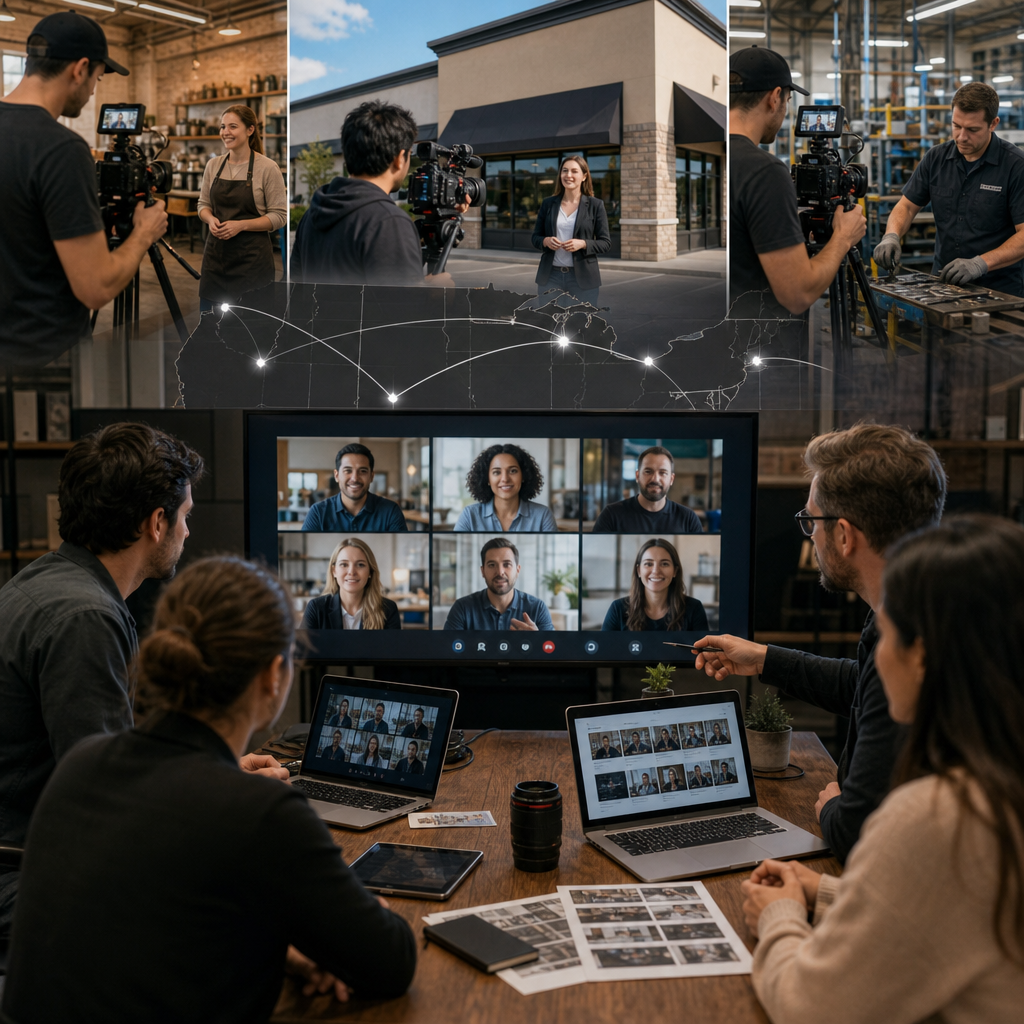
    We’ve developed approaches that solve this. Foundational videos about your overall approach, team expertise, and core processes are produced once and work everywhere. Location-specific videos about local results, team members at each branch, and localized market knowledge are produced in batches when our production crew visits each location.

    This hybrid approach cuts production costs significantly while maintaining the appearance of locally-relevant content. A prospect in Denver sees videos featuring Denver team members and Denver clients, but they’re also seeing the same core narrative as prospects in Austin.

    The system also allows for variations on the same core content. One video shoot produces multiple short-form clips, each emphasizing different angles for different audience segments. A 90-minute shoot might yield 12-15 videos for distribution across social, email, and paid advertising.

    For multi-location service businesses, this approach typically produces leads across your entire footprint while feeling locally authentic.

    Action step: If you operate multiple locations, identify your three most-filmed locations and plan a production visit within the next two months. Allocate a half-day at each location.

    Getting Started with a Video-First Marketing Approach

    The transition to video-first marketing doesn’t require overhauling everything immediately. Start with one core video that represents your approach, share it strategically, and measure the response.

    Most service businesses benefit from beginning with what we’d call a “why choose us” video. This is 90 seconds of your founder or lead team explaining your philosophy and what makes your approach different. It’s not a sales pitch. It’s a values alignment piece that shows prospects who you are before they talk to your sales team.

    After that, add one video per week focused on different angles: client results, team expertise, process explanations, common questions answered, or social proof. Build a small library over eight weeks and see how your lead generation shifts.

    Invest in professional production quality, but not in unlimited complexity. You need good lighting, clear audio, and intentional composition. You don’t need multiple cameras, drone shots, or graphic animations unless they directly serve your message.

    Partner with a team that understands both production and marketing strategy. The most beautiful video that doesn’t convert is a wasted expense. The most strategically sound video that looks amateur won’t get views. You need both.

    We’re ready to help you build a video production strategy that fills your pipeline with qualified leads. Let’s start with understanding your current bottleneck and building a realistic plan to address it.

    Contact us today for a free consultation to see how we can help you grow your business.

    Frequently Asked Questions (FAQ)

    How do we turn video views into actual leads and sales?

    We combine cinematic short-form video content with integrated paid advertising and lead capture systems. Our approach starts with creating compelling visual storytelling that stops the scroll, then we strategically place that content in front of your target audience through Meta and Google advertising while simultaneously optimizing your website and social channels to convert viewers into qualified leads. We measure every step of this journey, tracking which videos generate the highest-quality leads so we can continuously improve your results.

    What makes your video production different from generic content creation?

    We specialize in cinematic storytelling rather than generic promotional videos. Our productions use professional cinematography, intentional messaging, and brand narratives that resonate with your ideal customers, which produces significantly higher engagement and conversion rates than standard content. We also tailor every video to fit short-form platforms where service business audiences actually spend their time, ensuring your investment drives real business outcomes instead of vanity metrics.

    Can we scale video marketing across multiple locations?

    Yes, and that’s one of our core strengths with multi-location brands. We develop video templates and messaging frameworks that maintain consistent brand identity across all your locations while allowing for local customization. This lets us produce high-quality cinematic content at scale without the typical cost of shooting custom videos for every single location, making video marketing economically viable for larger service-based networks.

  • Mastering Meta Business Suite Ads Manager for Beginners

    Mastering Meta Business Suite Ads Manager for Beginners

    Why Meta Business Suite Ads Manager Confuses So Many Business Owners (And How to Fix That)

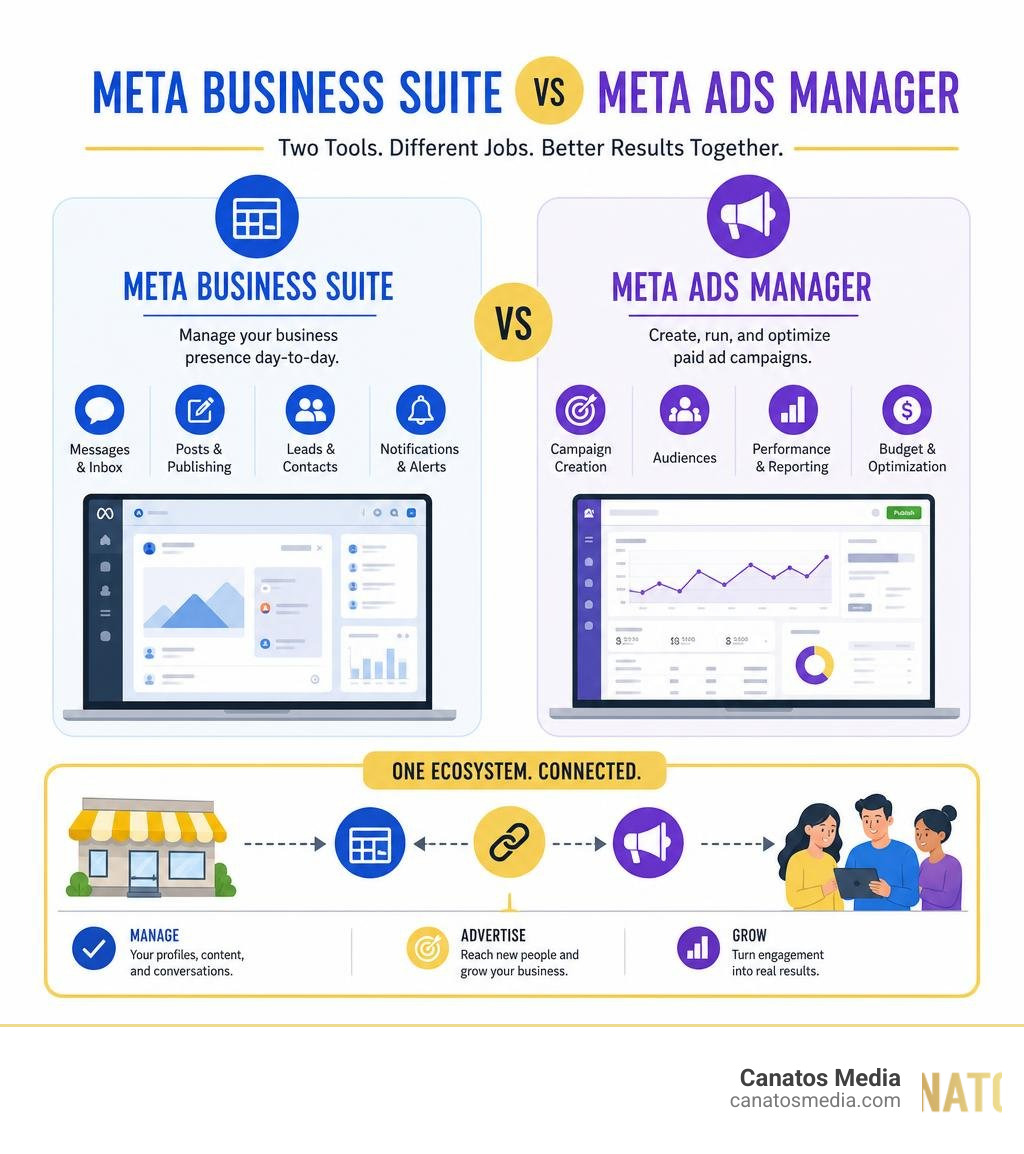
    If you’ve ever logged into Facebook trying to run an ad and ended up lost between tabs, you’re not alone. The Meta Business Suite Ads Manager ecosystem is actually two separate tools that work together — and most beginners don’t realize that until they’ve wasted hours clicking in circles.

    Here’s a quick breakdown of what each tool does:

    Tool Primary Purpose
    Meta Business Suite Manage your Facebook Page and Instagram account — posts, messages, leads, and notifications
    Meta Ads Manager Create, run, and optimize paid ad campaigns across Facebook, Instagram, Messenger, and more

    The simple version:

    • Use Meta Business Suite to manage your business presence day-to-day
    • Use Meta Ads Manager when you want to spend money to reach new customers

    Both live inside the same Meta ecosystem. Both can be accessed from your Facebook Page. But they do very different jobs — and mixing them up costs time and money.

    I’m Nic Canobbio, founder of Canatos Media, and after producing content that’s reached over 60 million views and managing paid media strategies across multiple platforms, I’ve seen how mastering the Meta Business Suite Ads Manager combination can transform a local business’s ability to generate leads and drive real growth. In this guide, I’ll walk you through everything you need to know — from setup to optimization — in plain language.

    Meta Business Suite vs Meta Ads Manager ecosystem comparison infographic infographic

    Meta business suite ads manager terms to remember:

    What is the Meta Business Suite Ads Manager Ecosystem?

    To understand how to grow your brand in the Tri-State area or out on Long Island, you have to understand the layout of Meta’s digital landscape. Many local businesses get caught in an endless loop because both portals appear inside Facebook and both deal with business activities.

    Let’s clarify: Meta Business Suite is your centralized control room for organic business assets. It was built specifically for page managers to handle day-to-day operations across Facebook and Instagram. Through Meta for Business (formerly Facebook for Business), you can view notifications, respond to direct messages, schedule organic posts, and look at high-level engagement analytics.

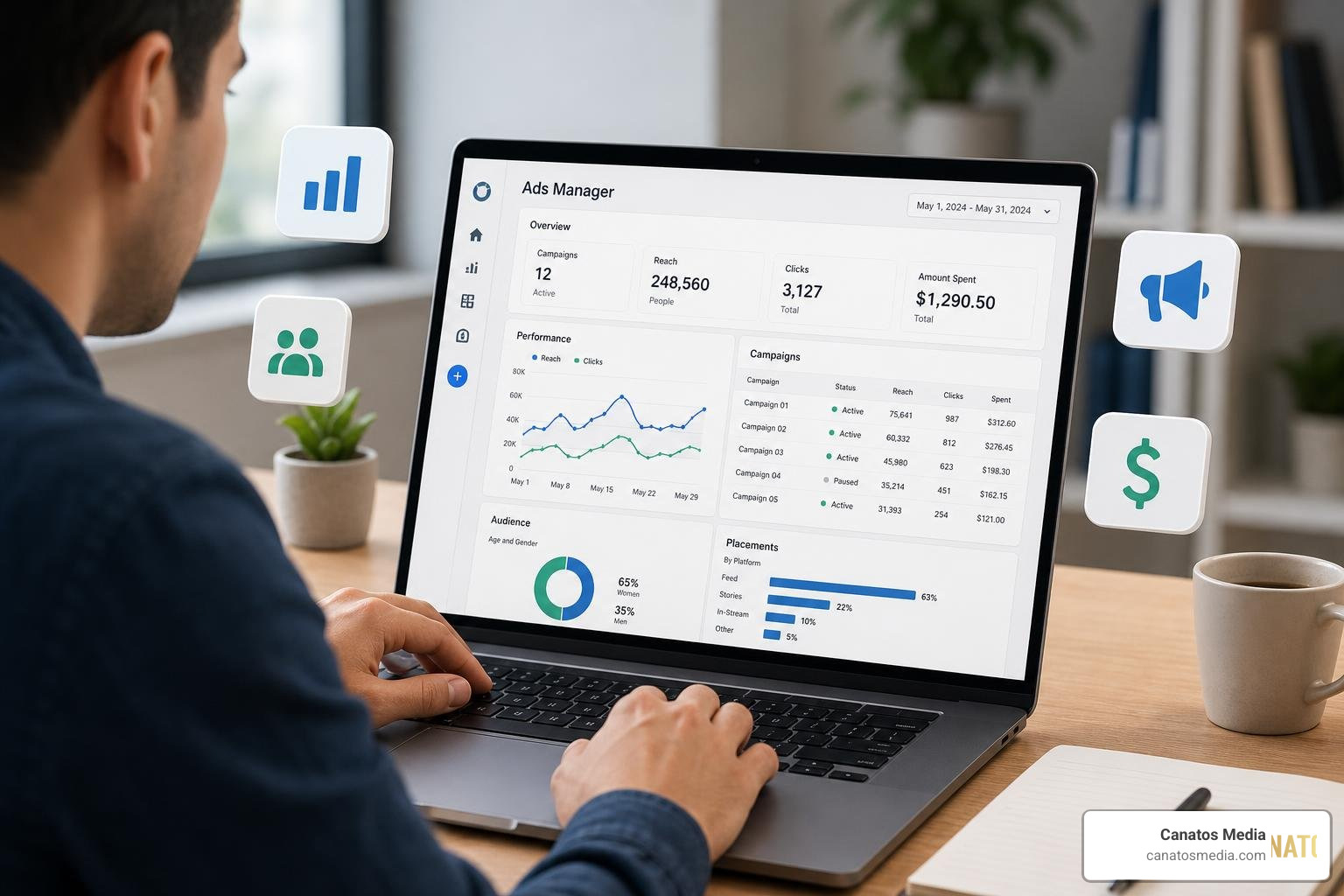
    On the flip side, Meta Ads Manager is a highly specialized, technical powerhouse built solely for performance advertising. It replaced older tools like Power Editor to give advertisers granular control over targeting, budgeting, placements, and complex split-testing.

    Feature Meta Business Suite Meta Ads Manager
    Primary Goal Asset management & organic growth Paid customer acquisition & ROI
    Key Activities Posting, scheduling, customer messaging Campaign creation, audience building, bidding
    Ad Capabilities “Boost” posts (basic targeting) Advanced campaign structures, custom audiences
    Reporting Depth Basic page likes, reach, and post engagement Conversion tracking, ROAS, cost-per-click, placement breakdowns

    While Meta Business Suite offers light, simplified advertising options (like boosting a post to get quick local visibility), relying on it for your main advertising campaigns is a fast way to burn through your marketing budget. For a truly professional, structured campaign, you need to transition into the dedicated Ads Manager platform. You can learn more about how these interact in our guide on Facebook Ads Manager vs Meta Business Suite 2026.

    Core Capabilities of Meta Business Suite

    For day-to-day social media management, Meta Business Suite is an incredibly powerful, free platform. It saves business owners on Long Island and throughout the Tri-State area from having to pay for expensive third-party scheduling tools.

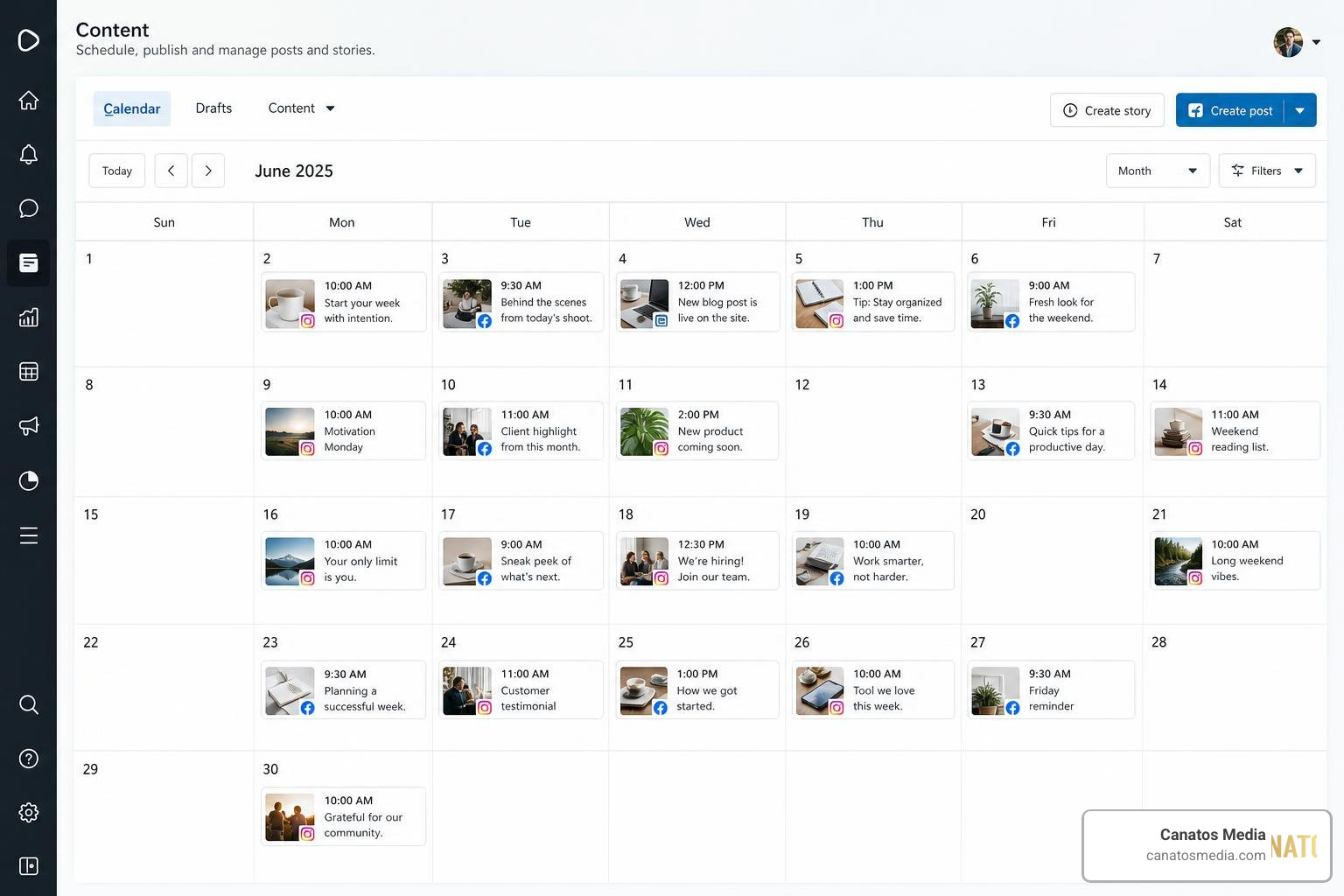
    Meta Business Suite content scheduler calendar view

    If you are just getting started, you can watch How To Set Up A Meta Business Account in 2026 – YouTube to get your business accounts linked up properly.

    To access Meta Business Suite, make sure you are logged into your personal Facebook account, then switch your profile to your Facebook Page. On the left-side menu of your desktop screen, you will see the shortcut to Meta Business Suite.

    Once inside, the navigation menu on the left side is your gateway to everything. The most critical button here is All Tools. Clicking this expands a directory where you can jump straight into advanced settings like Business Settings, Events Manager (for tracking your website pixel), Audiences, and even Ads Manager.

    If you manage multiple local brands, you can easily switch between different business accounts and Facebook Pages using the dropdown menu in the top-left corner of the Business Suite dashboard.

    Managing Organic Assets and Engagement

    The magic of Meta Business Suite lies in how it streamlines community management.

    • Unified Inbox: Instead of opening separate apps, you can read and reply to messages and comments from Facebook, Instagram, and Messenger in one single screen. You can even connect WhatsApp Business to keep all client inquiries organized.
    • Post and Reel Scheduling: You can draft a post or upload a vertical video for a Reel, write your captions, add local hashtags, and schedule them to go live at different times on Facebook and Instagram to match when your specific audiences are most active.
    • Lead Center: When you run lead generation forms, you don’t have to open Ads Manager to find your prospects. Meta Business Suite has a built-in Lead Center where you can view, download, and organize incoming leads.
    • Stories: Share behind-the-scenes moments of your business by scheduling Stories across both platforms simultaneously.

    Deep Dive into Meta Ads Manager

    When you are ready to transition from simple social posts to generating measurable conversions, it’s time to step into Meta Ads Manager. This is the exact tool we use at Canatos Media to build high-converting paid social campaigns. To explore this in-depth, check out our Step-by-Step Guide to Paid Ads.

    Ads Manager campaign creation workflow hierarchy

    To access the platform directly, you can visit Meta for Business (formerly Facebook for Business).

    Ads Manager is built on a rigid, three-tier campaign hierarchy:

    1. Campaign Level: This is where you define your ultimate business objective. Meta asks you: What is the goal of this campaign? You can choose from Awareness, Traffic, Engagement, Leads, App Promotion, or Sales. This is also where you can toggle on Advantage Campaign Budget (which automatically distributes your budget across your ad sets).
    2. Ad Set Level: This is where the logistics happen. You define who sees your ads (targeting), where they see them (placements), and how much you want to spend. This is where you build custom audiences, lookalike audiences, or target specific geographic locations like Nassau and Suffolk counties.
    3. Ad Level: This is the creative layer. It’s what your potential customers actually see on their feeds. Here, you upload your images or cinematic short-form videos, write your primary ad copy, design headlines, and select your call-to-action (CTA) buttons.

    By keeping these three levels organized, you can easily run A/B split tests to see if a certain video creative performs better than a static image, or if a warm lookalike audience converts at a lower cost than broad demographic targeting.

    Setting Up Campaigns in Meta Business Suite Ads Manager

    To set up a campaign that won’t drain your bank account, you must align your campaign objective with your actual business goal. If you want phone calls or form fills, do not choose “Traffic” — choose “Leads.” If you choose Traffic, Meta’s algorithm will optimize for people who like to click links but rarely buy or sign up. Choosing the wrong objective is one of the primary reasons businesses struggle; learn more about how to Stop Burning Cash on Bad Meta Ads.

    Once your objective is set, you will configure your targeting. You can target users based on:

    • Demographics: Age, gender, relationship status, education, and job titles.
    • Interests and Behaviors: What pages they like, what products they buy, and what devices they use.
    • Custom Audiences: Uploading your customer email list, targeting past website visitors via the Meta Pixel, or retargeting users who watched 50% of your Instagram Reels.

    For a deeper look at setting up your pixel and managing these assets, read our Meta Ads Management Ultimate Guide.

    Leveraging AI and Automation Features

    In 2026, Meta’s advertising platform relies heavily on artificial intelligence. Marketers who learn to collaborate with these AI features get far better results than those who try to manually control every variable.

    • Advantage+ Campaigns: These are Meta’s highly automated campaign setups. Advantage+ Shopping Campaigns, for example, are designed specifically for e-commerce brands. They automate creative combinations, placements, and audience expansion, using machine learning to find the buyers most likely to convert.
    • Dynamic Creative: Instead of building ten different ads manually, you can upload up to ten images/videos, five text options, and five headlines. Meta’s AI will mix and match these assets to serve the best-performing combination to each individual user.
    • Automation Rules: Think of these as your campaign safety net. You can set up rules that say: “If the Cost Per Lead goes above $25, pause the ad set automatically,” or “If an ad set generates a Return on Ad Spend (ROAS) greater than 3.0 over the last 3 days, increase the daily budget by 15%.”
    • The Learning Phase: Whenever you launch a new ad set, Meta enters the “Learning Phase.” This is when the algorithm is gathering data to figure out who is most likely to click or convert. During this time, performance can fluctuate. Making large edits (like changing budgets by more than 20% or editing ad creative) restarts this phase, so it’s critical to let your ads run uninterrupted until they exit the learning phase.

    Reporting, Troubleshooting, and Mobile Functionality

    Launching your campaigns is only half the battle; tracking performance and fixing technical hurdles is where the real work begins.

    Desktop vs. Mobile Ads Manager App

    While we always recommend building your campaigns on a desktop computer for maximum control, the mobile app is an excellent companion tool for checking in on the go.

    The mobile app has earned a solid reputation among business owners, boasting over 10 million downloads and a 4.4 rating on Meta Ads Manager on Google Play and a 4.6 rating on the Apple App Store. You can download the iOS version via Meta Ads Manager 4+.

    • What you can do on mobile: Monitor real-time campaign performance, pause underperforming ads, adjust daily budgets, receive instant alerts when a campaign budget is spent, and quickly switch between different ad accounts.
    • What you should do on desktop: Build complex campaign structures, set up custom conversion tracking, run detailed audience research, export custom reports, and manage pixel integrations.

    Troubleshooting Common UI Frustrations

    Meta’s interface is notorious for updates that can leave users feeling lost. Here are a few common issues and how to solve them:

    • “Why is everything greyed out?” If you can’t click the “Edit” button or create a new campaign, it’s almost always a permissions issue. You need to make sure you have “Admin” or “Advertiser” access to the specific ad account.
    • Missing Ad Accounts: If your business page is showing up but your ad account is missing, check the dropdown menu in the top-left corner of Ads Manager. You may have your personal ad account selected instead of your business ad account.
    • Two-Factor Authentication (2FA): Meta now strictly requires 2FA for all business managers. If you or your team members don’t have this enabled, Meta may restrict your ability to edit ads or access Page settings.
    • Onboarding Team Members Safely: When granting access to employees or agencies, always follow the principle of least privilege. Assign them as an “Advertiser” or “Analyst” rather than giving away full “Admin” control. For step-by-step instructions on secure setup, refer to the Meta Ads Add User Access | OpsBlu Docs.

    Frequently Asked Questions about Meta Advertising

    What is the difference between Meta Business Suite and Ads Manager?

    Meta Business Suite is built for organic page management (scheduling posts, responding to customer messages, and viewing page growth). Meta Ads Manager is a dedicated platform built for paid advertising campaigns (audience targeting, budget bidding, and conversion tracking).

    Why can’t I see my ad account or edit campaigns?

    This usually happens because you have the wrong ad account selected in the top-left dropdown, or you do not have the proper user permissions assigned to your Meta Business account. Go to your Business Settings to verify your access level.

    What is the learning phase in Meta ads and why does it matter?

    The learning phase is the period when Meta’s algorithm is actively delivering your ads to find the best audience. During this time, performance may be unstable. Avoid making significant changes to your budget, targeting, or creative during this phase to keep the algorithm from resetting.

    Conclusion

    Navigating the meta business suite ads manager ecosystem doesn’t have to feel like a chore. By using Meta Business Suite to keep your community engaged and using Ads Manager to run structured, conversion-focused paid campaigns, you can build a highly effective digital marketing funnel.

    For local businesses in the Tri-State area and Long Island, standing out online requires a cohesive approach. At Canatos Media, we specialize in an integrated strategy that connects high-end, cinematic short-form video content with precise targeting and conversion optimization. Whether you need hands-on social media management, technical paid ad support, or strategic direction, we are here to help your business grow.

    Ready to take your digital marketing to the next level? Explore our Meta Google Advertising Services and let’s build a strategy that drives real, measurable results for your business.

  • How We Streamline Video Production Across Multiple Business Locations

    How We Streamline Video Production Across Multiple Business Locations

    The Challenge of Managing Video Content Across Your Locations

    Managing video production across multiple locations creates real friction: inconsistent branding, duplicated efforts, scheduling chaos, and inflated costs. When you’re running a service-based business or franchise with locations spread across different cities or regions, the logistics of capturing quality video content becomes exponentially harder.

    We’ve worked with dozens of multi-location brands who thought they needed separate production teams at each site. They were overspending, getting inconsistent results, and struggling to maintain a cohesive brand narrative. There’s a better way, and we’ll walk you through our approach to turning distributed locations into a streamlined content machine.

    Multi-location brands face a specific problem traditional agencies overlook. You need video content that maintains cinematic quality and consistent branding while reflecting the unique character of each location. This means you can’t simply create one hero video and repurpose it everywhere.

    Here’s what typically breaks down:

    • Coordinating crews across multiple cities becomes a scheduling and cost nightmare
    • Each location may produce content independently, resulting in wildly different styles and quality
    • You end up managing dozens of raw video files with no clear organizational system
    • Local teams often lack guidance on what content actually drives leads and sales
    • Recreating setup and lighting at each location wastes time and money

    The real cost isn’t just in production days and crew rates. It’s in the opportunity cost of missed content, slow turnaround times, and the friction between central brand standards and local autonomy.

    Why Traditional Video Approaches Fail Multi-Location Brands

    Generic video production agencies treat multi-location shoots like they treat single-location shoots, just repeated. They show up, film, and hand over footage. This approach ignores the unique operational realities of distributed businesses.

    Traditional agencies also separate video production from your broader marketing strategy. You get videos that look nice but don’t integrate with your paid advertising, social media calendar, or lead generation systems. For a multi-location brand, this misalignment becomes painfully expensive because each location might be running disconnected marketing efforts.

    Another trap: agencies focus on “quantity” for multi-location work, assuming you want more footage to justify the complexity. What you actually need is strategic, purposeful content that can be repurposed and adapted across locations without losing impact.

    We approach multi-location video fundamentally differently. We build a repeatable framework that maintains quality and brand consistency while allowing each location to tell its own story within a cohesive system.

    Our Standardized Framework for Consistent Cinematic Quality

    Our framework centers on three components: a standardized shot list, documented production protocols, and a centralized creative direction system.

    The shot list is our foundation. Before any camera rolls, we define the exact shots, angles, and scenes that need to happen at each location. This isn’t limiting—it’s enabling. It means your production team knows precisely what to capture, eliminating ambiguity and reducing shooting time by 30-40%.

    We document production protocols for lighting, audio, camera settings, and composition. This ensures that whether we’re filming in Denver or Dallas, a wide shot of your main entrance looks professional and consistent. Protocols also speed up setup significantly because crews aren’t making creative decisions on the fly.

    Creative direction stays centralized but flexible. We establish your brand’s visual language—color grading, pacing, music style—and apply it consistently across all location footage. Local teams understand the guardrails, so they can capture location-specific moments while maintaining the overall brand voice.

    What to do next: Map out three to five hero shots that define your brand visually, then document how those shots should be executed at any location.

    Planning and Logistics: How We Reduce Shoot Time and Costs

    Smart planning is where multi-location video production becomes cost-effective. We consolidate shooting schedules by clustering nearby locations into single production trips, reducing travel time and crew overhead.

    Before a shoot day, we handle location scouting remotely using photos and video calls. This prevents surprises on arrival and allows us to pre-identify the best angles, lighting challenges, and backup options. Crews show up ready to execute, not explore.

    We also build in time buffers strategically. Rather than padding every shoot day generously, we identify which locations need extra time (a busy street requiring multiple takes, complex lighting situations) and schedule accordingly. This keeps efficient shoots tight while protecting the schedule where it matters.

    Scheduling software synchronized with your local teams ensures no conflicts and clear communication. When locations know exactly when crews are arriving, they can prepare the space and have key staff available.

    Typical results: reducing per-location shoot days from two or three down to one, cutting travel costs by 35-50% through strategic clustering, and compressing total production timelines by 40%.

    Building Your Reusable Asset Library Across Locations

    Raw video footage is only valuable if you can find and use it. We build a centralized asset library organized by location, content type, and scene. This structure lets you quickly locate “storefront footage from the Portland location” or “customer testimonial from March.”

    Every file gets tagged with metadata: location name, shoot date, shot type, talent names, and usage rights. This makes the library searchable and audit-able. Your in-house team can pull assets months later without hunting through folders.

    The library also tracks which assets have been used where. You avoid accidentally posting the same clips in overlapping markets and maintain awareness of which location footage is overused versus underutilized.

    Beyond organization, we identify which shots are truly reusable across locations. A confident team member speaking to camera? That works nationally. Footage of your unique service delivery at each location? That’s location-specific. This clarity prevents both waste and missed opportunities.

    Building the library during initial shoots requires minimal extra effort, but the payoff compounds as your content library grows and becomes an operational asset.

    Managing Your Brand Story with Distributed Teams

    A consistent brand story doesn’t mean every location says the same thing. It means your narrative framework, values, and messaging tone remain cohesive while each location illustrates those themes with its own examples.

    We work with you to establish core narrative pillars: your promise to customers, how you solve their specific problem, proof points, and calls to action. Each location then creates content expressing these pillars through local context.

    For example, a multi-location home service brand might center on “expert technicians who respect your home.” The Denver location shoots content showing their team’s professionalism and attention to detail. The Phoenix location shoots different homes and team members but conveys the same brand promise. Both stories strengthen the overall narrative.

    We document this narrative framework and share it with local teams, ensuring they understand the “why” behind content requests, not just the “what.” This alignment reduces revision cycles and improves local buy-in.

    Actionable guidance: Define three to five non-negotiable brand story elements, then brainstorm how each location can express them authentically.

    Turning Location-Specific Content Into Social Media Momentum

    Short-form video thrives on authentic, location-relevant content. We repurpose multi-location footage into platform-specific clips for Instagram Reels, TikTok, and YouTube Shorts while maintaining your brand consistency.

    A five-minute shoot might yield 15-20 short-form videos tailored to different platforms and audiences. A customer testimonial shot in Chicago becomes promotional content, educational content, and proof-point content depending on how it’s edited and captioned.

    We coordinate posting schedules so each location’s content appears consistently on its relevant social channels. A multi-location franchise might post Monday mornings from the flagship location, Wednesday evenings from the secondary location, ensuring steady content flow without overwhelming followers.

    Location-specific hashtags and targeting mean followers in Denver see content from the Denver team, building local community and relevance. We track which content resonates in each market, informing future shoot priorities.

    Your social media becomes a distributed storytelling platform rather than a centralized broadcast channel. Engagement typically increases because followers see people and places they recognize.

    Integration With Your Paid Advertising and SEO Strategy

    Video content only drives real business growth when it integrates with your paid advertising and SEO efforts. We coordinate multi-location video production with your broader digital strategy from the start.

    Short-form video footage becomes assets for Meta and Google advertising campaigns. A 15-second testimonial clip becomes a Facebook ad testing different audiences. A location walkaround becomes a local Google Ads video asset.

    For SEO, we structure multi-location video on your website strategically. Location-specific pages include video from that location, which improves local search relevance and engagement metrics. We optimize video titles, descriptions, and captions for location-based search terms.

    We also synchronize video release schedules with paid advertising pushes. Launching new video content alongside a paid campaign means your ads direct traffic to fresh content, improving conversion rates and time-on-page signals.

    This integrated approach means your video production investment serves multiple marketing functions simultaneously: social credibility, paid ad performance, and search visibility.

    Scaling Video Production Without Scaling Your Budget

    Most brands assume scaling video means proportionally higher costs. With our framework, it doesn’t.

    Once protocols and shot lists are documented, onboarding new locations requires minimal setup. A new site follows the established framework, uses the same lighting and camera settings, and captures the same foundational shots. There’s no reinvention.

    Your asset library becomes more valuable as it grows. Ten locations mean 10x more content available for repurposing, paid ads, social posts, and website use. The cost per usable asset actually decreases.

    We also build in automation where possible. Templated captions, standardized color grading, and pre-built short-form editing templates mean your team can produce final content faster using the raw footage we’ve already shot.

    Progressive scaling looks like this: months one through three focus on perfecting the process with 2-3 locations. Months four through six expand to 4-6 locations using proven systems. By month 12, adding a new location requires a fraction of the initial effort.

    Next step: Inventory which of your current locations have consistent production needs, and start with those as your pilot group.

    Real Results: Measuring ROI From Multi-Location Video Campaigns

    We measure multi-location video success across several dimensions: content production efficiency, social engagement, advertising performance, and lead generation.

    Our clients typically see 40-60% reduction in cost per location after the first production cycle because protocols eliminate rework and shooting time decreases. A second production round is even more efficient because teams understand the system.

    Social media engagement increases by 200-300% when content is consistent, location-relevant, and produced with cinematic quality. Short-form video from multi-location shoots consistently outperforms static images and generic stock footage.

    Check our case studies to see how multi-location brands have translated video content into measurable lead generation and customer acquisition cost improvements.

    Paid advertising performance improves because you’re running ads with authentic, location-specific footage rather than generic creative. Video ads from your framework typically generate 25-35% lower cost per lead than text or image ads.

    The long-term advantage is even more substantial. Your asset library becomes an operational advantage—six months of footage means constant content availability without continuous new production. This shifts video from a periodic campaign expense to a scalable, repeatable system.

    Start by documenting your current content needs across locations, then reach out to discuss how we can build a production framework tailored to your specific business model and geographic spread.

    Contact us today for a free consultation to see how we can help you grow your business.

    Frequently Asked Questions (FAQ)

    How do we handle video production schedules when our locations are spread across different regions?

    We coordinate all shoot logistics through our centralized planning system, which maps out equipment, crew, and timing across your locations simultaneously. This approach lets us batch shoots efficiently—we’ll often film content for multiple branches in one trip, then repurpose and customize that footage for each location’s specific audience. Our team manages all the on-site coordination so your managers focus on running their branches rather than production details.

    What makes our video framework actually work for multi-location brands?

    We’ve built a standardized template system that maintains your cinematic quality and brand consistency while allowing location-specific customization. Each shoot follows the same technical specifications, lighting setups, and narrative structure, which means content from any location integrates seamlessly into your social media feeds and paid campaigns. This consistency is what drives the ROI—audiences recognize your brand voice whether they’re watching content from your flagship location or a satellite office.

    Can we really scale video production across locations without proportionally increasing costs?

    Yes, because we front-load the planning and systematize the execution. Once we establish your framework, each additional location requires less setup time and creative overhead than the first. We build reusable asset libraries, standardized graphics packages, and templated editing workflows that compress production timelines and reduce expenses per video as you expand to new locations.

  • How to Measure Short-Form Video ROI and Prove Content Value

    How to Measure Short-Form Video ROI and Prove Content Value

    Why Most Brands Struggle to Track Short-Form Video Results

    Short-form video has become essential for modern marketing, yet most brands treat it like a guessing game. You publish content, watch the view count climb, and hope something converts. The truth is that without proper measurement systems, you’re flying blind. We’ve helped dozens of growth-focused business owners connect their video content to actual revenue, and the difference between those who measure correctly and those who don’t is striking.

    This guide walks you through the systems we use to track short-form video ROI so you can prove your content’s real value to your business.

    The challenge isn’t a lack of data. Platforms like TikTok, Instagram Reels, and YouTube Shorts provide detailed analytics on views, engagement, and even click-throughs. The problem is that these metrics live in isolation. A video gets 50,000 views and 2,500 likes, but those numbers tell you almost nothing about whether anyone actually bought something or requested your services.

    Most brands default to vanity metrics because they’re easy to see and feel good to report. Views, shares, and follower growth get attention in team meetings, but they’re directional at best. What you actually need is a line of sight from content creation to customer acquisition. Without it, you can’t justify continuing to invest in video production, and you certainly can’t optimize your spending.

    The disconnect happens because short-form platforms weren’t designed for conversion tracking. They’re built for engagement and watch time, not lead capture. That’s where intentional system design comes in.

    The Real Problem: Attribution Without Proper Systems

    Attribution is the core issue. When someone watches your TikTok, leaves the app, and later visits your website three days later through a Google search, which channel gets credit for that conversation? Without the right infrastructure in place, you’ll never know.

    We see this constantly: a business owner invests in producing high-quality short-form content, distributes it across channels, and then can’t connect any leads back to those videos. They blame the content when the real problem is a missing middle layer. The content might be excellent, but without tracking setup, it’s invisible to your reporting system.

    The fix requires connecting three things: your short-form content distribution, your website traffic, and your lead capture process. Each needs to feed data into a central reporting system. Skip any one of these and your ROI calculation becomes speculation.

    Key Metrics That Actually Matter for Short-Form Content

    Not all metrics deserve your attention. Here’s what we focus on:

    Click-Through Rate (CTR). This measures how many people who saw your video actually clicked a link to your website or landing page. A video with 10,000 views and 200 clicks has a 2% CTR, which is a solid starting point for short-form content.

    Traffic Source Attribution. When someone clicks from your Reels link to your website, you need to know they came from that specific video or series of videos. This requires UTM parameters or pixel tracking.

    Landing Page Conversion Rate. The percentage of people who clicked through and then completed your desired action (filled out a form, booked a call, made a purchase) tells you whether your video attracted the right audience.

    Cost Per Lead. Divide your content production and distribution costs by the number of leads generated. This is the metric that matters most for ROI.

    Video Watch-Through Rate. People should be watching at least 50% of your video. Anything lower suggests your hook, pacing, or message isn’t resonating. This helps you refine future content.

    Setting Up Tracking Before You Produce Your First Video

    Your measurement system must be in place before your first video goes live. Adding it later creates data gaps and makes historical analysis unreliable.

    Start by creating a dedicated landing page or link that directs viewers to your offer. This could be your website homepage, a specific service page, a booking calendar, or a lead capture form. Don’t send people to your generic homepage and hope they figure out where to go. That’s where traffic leaks out.

    Next, ensure your website has a tracking pixel installed (typically Facebook Pixel or Google Analytics 4). This code sits on every page of your site and records when someone visits, what they do, and whether they convert. Without this, you have no way to know if clicks from your video content resulted in any business activity.

    Finally, set up your CRM or lead management system to capture platform source information. When someone fills out a form or books a call, that system should have a field indicating they came from social media, email, paid ads, or organic search. Manual data entry defeats the purpose, so automate this if possible.

    How We Connect Content Views to Actual Lead Generation

    Our approach links each piece of content to lead data through a combination of UTM parameters, pixel tracking, and CRM integration. When we create a short-form video for one of our clients, we don’t just upload it. We design the entire path from view to conversion.

    For example, if we’re producing content for a multi-location service business, each video gets a unique UTM parameter. When someone clicks the link in that video, they arrive at a landing page with a form. That form connects to the client’s CRM, which logs the source as “video content” or more specifically “Instagram Reels Jan 2026.” Now there’s a direct thread.

    We then run a weekly report that shows exactly how many leads came from video content, what those leads cost to acquire, and what percentage converted to customers. The client sees the full picture, not just platform vanity metrics.

    Building Your ROI Measurement Framework

    Your framework should answer these five questions:

    1. How much did we spend on video production and distribution this month?
    2. How many total leads did we generate from all sources?
    3. How many of those leads specifically came from short-form video content?
    4. What was our cost per video lead?
    5. What percentage of video leads converted to paying customers?

    Structure this in a spreadsheet or marketing dashboard that updates weekly. You need weekly visibility, not monthly, because content performance trends emerge quickly with short-form formats.

    Include columns for: video title, publish date, platform, total views, clicks, CTR, leads generated, cost per lead, and customer conversion rate. This granular data lets you spot which content performs best and which types underperform.

    The Role of UTM Parameters and Pixel Tracking

    UTM parameters are simple URL tags that tell your analytics platform exactly which campaign, content piece, and platform sent each visitor. They look like this: ?utm_source=instagram&utm_medium=reels&utm_campaign=march_collection.

    Every link in your short-form video should include these parameters. Without them, Google Analytics and other tools treat clicks from different videos the same way, making it impossible to attribute specific leads to specific content.

    Pixel tracking (through Facebook Pixel, Google Analytics 4, or similar) captures behavior at a deeper level. It records when someone watches your video (if they’re on a webpage), when they visit your site, what pages they view, and what actions they take. This creates a behavioral map that UTM parameters alone can’t provide.

    Use both together: UTM parameters for initial attribution, pixels for detailed engagement tracking.

    Integrating Short-Form Data With Your Overall Marketing Dashboard

    Your short-form video results shouldn’t live in isolation. They need to integrate with your overall marketing performance data alongside paid ads, email campaigns, and organic search results. This gives you a complete picture of which channels drive the most cost-effective leads.

    If you’re already running Facebook ads or Google ads, these platforms have their own conversion tracking. Make sure your short-form video tracking uses the same conversion definitions so everything is comparable. “Lead” should mean the same thing whether it came from a paid ad or organic video content.

    We recommend centralizing everything in a single dashboard where the business owner can see performance across all channels in real time. This might be a Google Data Studio dashboard, a platform-native analytics tool, or a custom reporting system. The key is one source of truth.

    Common Mistakes That Hide Your True Video ROI

    Mistake one: sending video viewers to your homepage instead of a dedicated landing page. This makes it nearly impossible to track behavior and creates friction for the viewer.

    Mistake two: not setting up CRM fields for traffic source. Even if someone fills out a form, if you don’t capture that they came from video content, the data is lost.

    Mistake three: confusing video engagement metrics with conversion metrics. A video with high watch time looks successful, but if viewers never click through or convert, it’s not doing the job.

    Mistake four: ignoring production costs in ROI calculations. A video that costs $3,000 to produce but generates $2,500 in revenue has negative ROI, even if engagement looks strong.

    Mistake five: measuring ROI too early. Short-form video often has a longer conversion cycle than people expect. Give your content at least 4-6 weeks of performance data before drawing conclusions.

    Calculating Cost Per Lead From Your Video Content

    Here’s the practical calculation:

    Total Video Investment (this month) = $X Total Leads from Video Content (this month) = Y Cost Per Lead = X divided by Y

    Your video investment includes production, editing, graphics, music licenses, and any paid distribution or ads amplifying the content. Don’t undercount. If an employee spends 8 hours editing a video at $50/hour, that’s $400 in production cost.

    Let’s say you spend $5,000 producing and distributing short-form videos in a month and generate 40 leads from that content. Your cost per video lead is $125. If your average customer lifetime value is $2,000, that’s a 16x return on investment.

    That’s strong, but the math only works if you’re actually tracking and capturing that lead data correctly.

    What ROI Targets Should You Set for Short-Form Video

    Your target depends on your industry, customer lifetime value, and sales cycle. A service business with a $10,000 average customer value can afford a much higher cost per lead than an e-commerce business with a $50 average order.

    A realistic starting target is a 3:1 return on video investment. For every dollar spent on production and distribution, you generate three dollars in revenue (either immediately or within the first six months). This is achievable for most businesses once tracking is set up properly.

    More aggressive targets might aim for 5:1 or 10:1, but these typically come after you’ve optimized content performance, refined your landing pages, and built audience segments. Early on, focus on getting your measurement system working accurately before chasing aggressive numbers.

    Getting Started With Your Video Performance Baseline

    Begin by establishing a baseline. Produce one piece of high-quality short-form content, set up all tracking properly, and let it perform for at least four weeks. Document every metric listed above. This baseline becomes your reference point for optimization.

    During this period, resist the urge to judge performance too quickly. One video rarely drives significant ROI. The system works because you’re producing content consistently and each piece contributes to a larger lead flow. Think of your short-form video strategy as a portfolio of content, not individual bets.

    After your baseline period, start A/B testing. Different hooks, call-to-action phrasing, video length, or distribution timing might move the needle. Small improvements across many videos compound into significant ROI gains.

    Our all-in-one marketing funnel integrates short-form video production, distribution, landing pages, and lead tracking into one cohesive system. It removes the complexity of connecting all these pieces manually, which is where most measurement systems break down.

    The short-form video landscape rewards brands that combine creative excellence with measurement discipline. Start by getting your tracking right, measure consistently, and refine based on real data. That’s how you move from wondering whether video works to proving exactly how much revenue it generates.

    Contact us today for a free consultation to see how we can help you grow your business.

    Frequently Asked Questions (FAQ)

    How do we help you connect short-form video views to actual leads and sales?

    We build integrated tracking systems that connect your video content directly to lead generation. Our approach combines UTM parameters, pixel tracking, and CRM integration so you can see exactly which videos drive inquiries and conversions. Without these systems in place before you produce content, you’ll struggle to prove ROI even if your videos perform well.

    What metrics should we be tracking to measure short-form video ROI?

    We focus on metrics that connect to your bottom line: view-through rates, click-through rates to landing pages, cost per lead from each video, and conversion rates from video traffic. Vanity metrics like total views or likes won’t tell you if your content actually drives business growth. We recommend tracking these across your Meta, Google, and website data in one unified dashboard so patterns become obvious.

    Why do most brands fail to measure their video content performance?

    We’ve found that brands typically lack proper attribution systems before investing in content production. Without UTM parameters, pixel tracking, and CRM integration set up in advance, you can’t connect video views to leads. Additionally, many teams track data in separate platforms instead of consolidating everything into one measurement framework, making it impossible to see the real ROI story.

  • Website Design and Cinematic Video Production: A Unified Approach to Brand Growth

    Website Design and Cinematic Video Production: A Unified Approach to Brand Growth

    Why Your Website Needs Cinematic Video Integration

    Your website is often the first real interaction a prospect has with your brand. Yet most businesses treat their website as a separate entity from their video content, social media, and broader marketing strategy. They optimize one channel at a time, hoping the pieces eventually fit together. They rarely do.

    At Canatos Media, we’ve seen firsthand how this fragmentation costs businesses leads, credibility, and conversion momentum. When your website design, video content, and overall brand narrative work together instead of in silos, something different happens: visitors don’t just browse. They stay longer, trust faster, and convert at measurable rates.

    This article walks through why that unified approach matters, how to build it, and the specific results we’ve helped our clients achieve.

    Video changes how people engage with your website. It’s not about adding a play button for decoration. Cinematic video serves a functional purpose: it communicates your value proposition, shows your expertise in action, and builds emotional connection faster than text or static images alone.

    When someone lands on your website, they have seconds to decide whether you’re worth their time. A well-produced cinematic video positioned strategically on your homepage or service pages compresses months of relationship-building into minutes. The prospect sees your brand in motion, understands what you do, and grasps why you’re different before they scroll.

    Beyond the homepage, video reduces friction throughout the buyer’s journey. A service-based business might embed a client testimonial video on their pricing page. An e-commerce brand might showcase their product manufacturing process. A B2B software company might feature a quick explainer video on their features section. In each case, the video answers the question the visitor is asking at that exact moment.

    Search engines reward this behavior too. Pages with embedded video tend to rank better and keep visitors on the page longer, which signals relevance to Google and other search algorithms.

    Action item: Audit your top five landing pages. Note which ones have no video content. Those are your immediate candidates for integration.

    The Problem with Disconnected Design and Video Strategies

    Most businesses operate with separate teams or vendors handling website design and video production. The designer builds the site with one aesthetic in mind. The videographer produces content with a different visual language. The result feels disjointed, even when each piece is high-quality on its own.

    We’ve observed several common patterns in how this fragmentation shows up:

    • Video color grading doesn’t match the website’s color palette
    • The video style (cinematic, animated, testimonial) clashes with the overall design tone
    • The website layout forces video to feel awkwardly inserted rather than integrated
    • Brand messaging differs between video copy and website copy
    • Video and web strategy target different audience segments or conversion goals

    This inconsistency erodes trust. Your prospect sees beautiful cinematic video, then lands on a website that feels like it was designed by a different company. They notice the disconnect, consciously or not, and it introduces friction into their decision-making process.

    Beyond aesthetic concerns, disconnected strategies waste budget. You might invest heavily in short-form video production for social media, but that video content never makes it to your website where it could drive conversions. Or your website design looks premium, but your video quality doesn’t match that investment level, making the whole package feel untrustworthy.

    Action item: Compare your website’s visual style with your most recent video content. Do the colors, pacing, typography, and overall tone feel like they belong to the same brand?

    How We Unify Website Design with Cinematic Production

    Our approach starts before we build or produce anything. We develop a unified visual and strategic framework that guides both the website design and the video production process simultaneously. This framework includes:

    Color palette and visual language: We establish a consistent color scheme, typography system, and design aesthetic that both the website designer and video production team follow. This extends to motion design elements, transitions, and how we frame people and products on camera.

    Brand narrative structure: We define the key messages, emotional beats, and visual storytelling approach that will flow through both mediums. Your website tells a story with page hierarchy and content flow. Your cinematic videos tell a story with pacing, music, and cinematography. When these align, they reinforce each other.

    Audience segments and conversion goals: Rather than treating website and video as separate channels, we map out which videos serve which audience at which stage of the buyer journey. A decision-maker needs different content than an awareness-stage prospect. Your website and video strategy should reflect that distinction consistently.

    Technical integration planning: We determine where video lives on your site, how it performs, and what happens after someone watches it. Does the video button link to a contact form? Does it auto-play on mobile or require a click? These technical decisions affect both user experience and conversion rates.

    Once this framework is locked, the design and production work becomes aligned execution rather than parallel guessing.

    Creating Visual Consistency Across Your Digital Properties

    Visual consistency extends beyond your website and video content into every digital touchpoint: social media, email, paid advertising, and beyond. When a prospect sees your brand on Instagram, clicks through to your website, and watches your video, they should experience the same visual identity throughout.

    This consistency builds what we call “brand recognition momentum.” Each touchpoint reinforces the others. The more consistently someone sees your visual language, the faster they recognize you, remember you, and trust you.

    Practically, this means:

    • Using the same font families across website and video motion graphics
    • Maintaining consistent aspect ratios and framing when showing products or team members
    • Applying the same color palette to video graphics, website backgrounds, and CTA buttons
    • Ensuring your brand’s personality (premium, approachable, cutting-edge, etc.) comes through in both visual design and video tone

    We often find that multi-location or service-based brands struggle with this because each location or team might have created their own promotional materials. A unified video-first website design gives you a standardized foundation that ensures every piece of branded content feels intentional and cohesive.

    Action item: Create a simple brand asset document that captures your primary colors, fonts, and logo usage. Share it with anyone creating content for your brand, whether in-house or through vendors.

    Turning Website Visitors into Qualified Leads with Video

    Video on your website serves conversion purposes if it’s positioned and structured strategically. Not all video placement is equal.

    A homepage video that builds emotional connection and establishes credibility works differently than a service explainer video that answers technical questions. A client testimonial video builds social proof. A founder story video builds founder-based authority. Each serves a conversion purpose at different moments in the buyer journey.

    We structure video on your website with conversion funnels in mind:

    Awareness and trust building: Cinematic brand videos, founder stories, and company culture videos positioned on your homepage or “about” page help visitors understand who you are and why they should trust you.

    Consideration and education: Product demos, service explanations, and process videos help prospects understand exactly what you offer and how it works.

    Decision and social proof: Client testimonial videos and case study videos help prospects feel confident about making a purchase or scheduling a call.

    Each video type answers a different question the visitor is asking. When properly positioned, that video becomes the reason they convert from visitor to lead.

    We also optimize video for form completion. A lead generation form that appears after someone watches a relevant video has higher completion rates than an out-of-context form. The video primes them emotionally and educationally for the ask.

    Our Integrated Approach to Website and Video Development

    Here’s how we structure the work:

    We start by understanding your current digital presence, target audience, and conversion goals. We interview your sales team about common prospect objections. We audit your current website and any existing video content. This discovery phase informs everything that follows.

    Next, we develop a unified strategy document that outlines the website architecture, video types needed, messaging hierarchy, and how these pieces connect. We create a visual direction that guides both the design and production work.

    The website design phase and video production phase happen in parallel, not sequentially. Our designers and video producers collaborate regularly to ensure alignment. When the website designer makes decisions about layout and color, the video producer understands those choices and reflects them in the cinematic work.

    Once both are built, we integrate video into your website technically and strategically. We optimize page load speeds so video doesn’t slow your site. We set up analytics tracking so you can measure which videos drive the most engaged visits and conversions. We ensure video is mobile-responsive and accessible.

    Throughout this process, we’re also building out your broader digital marketing infrastructure: social media management, paid advertising strategy, and search optimization. Your website and video become the centerpiece of a coordinated digital presence.

    Real Results: How Unified Strategies Drive Measurable Growth

    Our clients see measurable outcomes when website design and cinematic video work together.

    Service-based businesses typically see increases in qualified lead volume within the first 60 days. One HVAC service company increased their contact form submissions by 34% after integrating cinematic service videos on their homepage and service pages. The video let prospects see the team in action and understand the quality of work before deciding to call.

    E-commerce and product-based businesses see improvements in average order value and repeat purchase rates. One client’s product videos showing real-world usage and materials increased their average cart value by 18% because prospects felt more confident about their purchase decision.

    Multi-location service brands see faster scaling because they have a unified visual and narrative framework they can apply across locations. Rather than each location developing its own messaging, they use the core website and video strategy as a template, saving months of work and ensuring consistency.

    Beyond conversion metrics, clients report faster sales cycles and higher close rates. Prospects who’ve watched relevant video content are more informed and committed before they have a conversation with your sales team.

    You can explore how this looks in practice in our case studies, which detail specific results and the strategies behind them.

    Getting Started with Video-First Website Design

    Start by answering these questions for your business:

    1. What’s your biggest bottleneck right now? Is it website traffic, conversion rate from traffic, or something else?
    2. What are your top three visitor questions that your current website doesn’t answer quickly enough?
    3. What video content exists within your organization that you’re not currently using on your website?
    4. What’s your timeline for needing measurable improvement?

    Your answers clarify where to focus first. If your website gets traffic but doesn’t convert well, your priority is videos that address prospect objections and build trust. If your website gets minimal traffic, your priority is social-first video content that brings people to your site.

    We recommend starting with one strategic video integrated into your highest-traffic pages, measuring the impact, then scaling from there. This lets you see the conversion impact before investing in a full website redesign.

    The key is beginning with a unified perspective rather than treating video and web design as separate projects. That mindset shift alone changes the outcomes you’ll see.

    Common Questions About Integrating Video into Your Website

    How much does adding video to my website cost? It depends on the scope. Integrating existing video costs far less than producing new cinematic content. We work with businesses at different budget levels and recommend starting with a strategic video or two rather than overhauling everything at once.

    Will video slow down my website? Not if it’s properly optimized. We host video files on CDN infrastructure that ensures fast delivery regardless of visitor location. We also offer adaptive bitrate streaming so video quality adjusts based on connection speed.

    What type of video performs best on websites? It depends on your goal and audience. Founder or team videos build trust quickly. Product demos or service explainers answer questions. Client testimonials build social proof. We recommend a mix that covers different stages of the buyer journey.

    Can I use social media video on my website? Usually, but we often find that social-first video (short, fast-paced) performs differently on websites than purpose-built web video. Social video is designed for the Facebook or TikTok algorithm. Website video is designed for conversion. They serve different functions, though sometimes one piece can work for both.

    How do I measure if website video is actually working? Through analytics. We set up tracking that shows you how many people watch each video, how long they watch, whether they take action afterward, and which videos correlate with the highest conversion rates. This data guides what type of video you produce next.

    Start exploring how cinematic website videos can transform your digital presence. The combination of thoughtful design and high-quality visual storytelling creates momentum that individual channels alone simply cannot achieve.

    Contact us today for a free consultation to see how we can help you grow your business.

    Frequently Asked Questions (FAQ)

    How do we integrate video into website design to improve lead generation?

    We embed strategic short-form video content throughout your website to capture attention and guide visitors toward conversion points. Our approach positions video on key pages like homepages, service pages, and landing pages to increase engagement time and communicate your value proposition faster than text alone. We pair this with optimized call-to-action elements that connect video engagement directly to our lead capture systems.

    What’s the difference between creating cinematic video for social media versus for your website?

    While both use cinematic production quality, we tailor each for its platform’s unique behavior. Our social videos are shorter, hook viewers immediately, and drive traffic to your website. On your website, we create longer-form content that builds trust, demonstrates expertise, and supports the visitor’s decision-making journey through your sales funnel.

    How do we ensure visual consistency between our video production and website design?

    We develop your brand’s visual language upfront, including color palettes, typography, motion styles, and storytelling approaches that apply across both mediums. Our team works collaboratively so your website design and video production follow the same aesthetic standards, creating a cohesive experience that reinforces brand recognition at every touchpoint.

  • Stop Scrolling and Start Selling: The Secrets of Most Effective Instagram Ads

    Stop Scrolling and Start Selling: The Secrets of Most Effective Instagram Ads

    Why the Most Effective Instagram Ads Are Your Fastest Path to More Local Customers

    The most effective Instagram ads in 2026 share a few things in common — and once you know what they are, you can start replicating them for your own business.

    Here’s a quick breakdown of what works best, right now:

    Ad Format Best For Key Strength
    Reels Ads Cold audience discovery 22% higher engagement than static ads
    Stories Ads Retargeting and flash offers 82% average completion rate
    Carousel Ads E-commerce and product education Highest swipe-through and click rate
    Collection Ads In-app shopping Seamless product discovery to purchase
    UGC / Social Proof Ads Building trust fast 9.8x more impact than influencer content

    The short answer: Reels and carousels drive the most results for most businesses. Lead with a strong 3-second hook, design for mobile, use real customer content, and let Meta’s Advantage+ do the heavy lifting on targeting.

    Instagram now reaches over 2 billion monthly active users — and ad spend on the platform grew 21% year-over-year in Q3 2025. That growth isn’t slowing down. But more spend doesn’t mean better results. Most local businesses waste their budget on weak creative, wrong formats, and zero measurement strategy.

    The competition for attention is real. A user scrolls past hundreds of posts every session. If your ad doesn’t stop them in the first three seconds, it’s invisible. And with 83% of all Instagram ad views happening on mobile, the stakes for getting your creative right have never been higher.

    Up to 72% of customers say Instagram content directly influences their buying decisions. That’s not a small number — that’s most of your potential customers being shaped by what they see in their feed before they ever visit your website.

    This guide breaks down exactly what separates forgettable ads from ones that drive real sales.

    I’m Nic Canobbio, founder of Canatos Media — with over two decades in media production, live content, and paid social strategy, I’ve spent years studying and producing the most effective Instagram ads for brands that need real growth, not just vanity metrics. Let’s get into what actually works.

    2026 Instagram ad formats, performance benchmarks, and key stats infographic infographic

    Decoding the Most Effective Instagram Ads Formats in 2026

    To build a high-converting campaign, you must first understand where your ads live. Too many advertisers make the mistake of treating Instagram as a simple extension of their Facebook campaigns. As we discuss in our breakdown of Facebook Ads vs Instagram Ads (2026), user behavior, platform culture, and creative language are fundamentally different on these two networks.

    While Facebook users are highly accustomed to clicking outbound links, Instagram users prefer to consume content and make discoveries directly inside the app. This means the most effective Instagram ads are designed to feel native to their specific placement.

    Let’s look at the benchmarks for the primary placements on Instagram:

    • Instagram Reels: The undisputed king of organic reach and low-cost attention. Reels ads feature a 30-40% lower Cost Per Thousand Impressions (CPM) compared to the standard feed because Meta aggressively subsidizes this inventory to keep users engaged.
    • Instagram Stories: Ideal for direct response, quick promotions, and retargeting campaigns. Stories have an incredible 82% average completion rate when designed correctly.
    • Instagram Feed: The traditional home of high-resolution imagery. While feed CPMs are higher ($10–$16 on average), they still command excellent conversion rates for high-intent buyers.
    • Explore Page: A highly underutilized, high-Click-Through-Rate (CTR) placement. Users on the Explore page are actively looking to discover something new, making it the perfect spot for cold-traffic prospecting.

    For local companies in Long Island and the Tri-State area, understanding how these placements interact is the key to running successful campaigns. Whether you are partnering with a top Long Island social media marketing company or building your campaigns in-house, matching your creative format to the user’s mindset is non-negotiable.

    Why Reels and Stories Dominate the Most Effective Instagram Ads Landscape

    If you want to build campaigns that convert in 2026, you must prioritize vertical video. Reels now absorb nearly 50% of the total time spent on Instagram. Because of this massive shift in user behavior, Reels ads lead engagement by 22% over static image ads. Furthermore, Instagram Stories are viewed daily by 70% of Gen Z users, making vertical formats the primary language of the platform.

    To dominate this space, your creative needs to look like organic content. This is where we emphasize the shift from high-production commercial styles to authentic, vertical storytelling. In our guide on How to Create High-Impact Short Form Content That Converts on Facebook and Instagram Reels, we highlight that native-looking, phone-shot vertical video consistently outperforms polished corporate commercials.

    When you design for Reels and Stories:

    1. Use a 9:16 vertical ratio (1080 x 1920 pixels) to occupy the user’s entire screen.
    2. Incorporate native platform signals, such as Instagram-style fonts, stickers, and interactive elements.
    3. Build your creative around trending audio or clear, voiceover-led hooks to ensure immediate engagement.

    The Power of Carousels and Collection Ads for E-Commerce

    While video is crucial, static and mixed-media formats still have a powerful role to play—specifically in e-commerce and product education. Carousels continue to outperform other formats for pure view counts on Instagram, regardless of account size. They allow you to showcase multiple angles of a product, tell a sequential story, or present a step-by-step tutorial that users can swipe through at their own pace.

    Collection ads take this a step further by pairing a primary video or image with a grid of smaller product shots underneath. When a user taps the ad, they are taken to a fast-loading, immersive storefront within the Instagram app. This minimizes post-click friction and prevents drop-offs.

    Here is how Carousel and Collection ads stack up in performance metrics:

    Metric Carousel Ads Collection Ads
    Average Engagement Rate 0.55% (Highest on Instagram) 0.42%
    Primary Advantage Ideal for storytelling & multi-benefit education Perfect for instant, in-app catalog browsing
    Best Creative Combo A video on card 1, followed by static detail cards A lifestyle video header with clean product grids
    Average ROAS Lift 1.5x compared to single static images Up to 1.8x when using creator-generated assets

    By leveraging these formats, local e-commerce brands in the Tri-State area can transform casual browsers into active buyers without forcing them to wait for a slow external website to load.

    The Anatomy of a Scroll-Stopping Creative Strategy

    The auction algorithm on Meta has changed. In 2026, targeting is no longer the main lever for ad performance. Meta’s AI is incredibly smart; it reads your video hooks, analyzes your visual frames, and decodes your captions to find your buyers. This means creative is 70% of your performance, while targeting is only 30%.

    To win the auction and earn lower CPMs, you must build “scroll-stopping” creative. If you want to dive deeper into how Meta’s auction rewards engaging creative, check out our insights on how to Stop the Scroll and Start the Toll with Meta Paid Ads.

    The absolute secret to a scroll-stopping ad is the first 3 seconds. This is your hook. If you fail to capture attention here, the rest of your video does not matter. You can use pattern interrupts to grab eyes instantly:

    • Visual Interrupts: A split-screen comparison, a dramatic before-and-after contrast, or an unexpected motion in the first frame.
    • Text Hooks: A bold, polarizing statement or a question that addresses a specific pain point (e.g., “Stop wasting money on paper notebooks”).
    • ASMR / Audio Hooks: Satisfying sounds, like a product unboxing or a crisp voiceover, to draw users in immediately.

    How to Design the Most Effective Instagram Ads for Mobile-First Audiences

    With 83% of all Instagram ad views occurring on mobile devices, your creative must be designed mobile-first. This goes beyond just choosing the right aspect ratio. You must respect the platform’s layout and user habits.

    First, you must design for sound-off viewing. Up to 80% of users scroll through their feeds with their phones muted. If your video relies entirely on spoken words without text support, your message is lost. Always include clear, dynamic captions or text overlays that explain the core benefit of your product.

    Second, you must respect ad safe zones. When running ads on Reels or Stories, Instagram overlays profile icons, usernames, captions, and Call-to-Action (CTA) buttons on the top and bottom of the screen. Keep your text, logos, and critical visual elements within the central 1080 x 1420 pixel safe zone to prevent them from being covered by the platform’s user interface.

    Diagram showing Instagram Reels safe zones for text and logo placement

    Finally, consider the visual style. High-end, cinematic production can work beautifully when it feels authentic and narrative-driven. To see how this works in practice, read our guide on How Cinematic Short Form Content Improves Meta Paid Ad Performance. The goal is to balance professional visual quality with the raw, personal feel that Instagram users expect.

    Leveraging UGC and Social Proof to Build Trust

    People do not trust corporate promises; they trust other people. In fact, 83% of consumers trust reviews and recommendations from peers over traditional ads. Furthermore, users find User-Generated Content (UGC) to be 9.8 times more impactful than polished influencer content.

    The most effective Instagram ads leverage this psychological trigger by placing real customer experiences at the center of the creative.

    To successfully use UGC and social proof in your campaigns:

    • Use “Lo-Fi” Phone Footage: Ask your customers or creators to film simple, authentic selfie-style videos explaining how your product solved their problem. Avoid overly polished scripts.
    • Screenshot Real Reviews: Place a screenshot of a five-star review directly over a lifestyle photo of your product. This simple visual combination builds instant credibility.
    • Focus on the “Before and After”: Show the real, unedited transition from a pain point to a solution.

    Example of an authentic, high-converting user-generated content (UGC) ad layout

    For local service businesses in Long Island, showcasing real local testimonials in your ads is the fastest way to build community trust. If you want to explore advanced localized tactics, check out these Advanced Instagram Ad Strategies for Long Island Businesses to see how local social proof drives real-world bookings.

    Structuring Campaigns for Maximum ROAS and Minimum Fatigue

    You can have the most beautiful creative in the world, but if your campaign structure is messy, you will burn through your budget. To prevent this, you need to understand how to build campaigns that maximize your Return on Ad Spend (ROAS). If your current campaigns are showing high activity but flat revenue, you are likely falling into common structural traps. We highly recommend reviewing our guide to help you Stop Burning Cash on Bad Meta Ads.

    To build a modern, high-performing campaign structure, follow these three rules:

    1. Implement the Meta Conversions API (CAPI): Relying solely on the standard browser pixel is a recipe for failure in 2026. Browser-based tracking can miss 20% to 40% of your conversions due to privacy updates and ad blockers. Setting up CAPI alongside your pixel ensures server-side tracking, capturing crucial platform actions like story link taps and direct message initiations.
    2. Embrace Broad Targeting: Stop micro-segmenting your audiences into tiny interest stacks. This limits Meta’s AI and drives up your CPMs. Instead, use broad targeting (audiences of 10 million+) and let the creative do the targeting. To learn how to transition your account to this modern workflow, read our comprehensive playbook on Instagram Ads in 2026: A Practical ROI Playbook.
    3. Use Advantage+ Creative: Enable Meta’s automated creative optimizations. This allows the algorithm to automatically adjust image brightness, add subtle background music to silent videos, and swap headlines based on what a specific user is most likely to engage with.

    Creative Testing Frameworks and the 70/20/10 Rule

    To keep your ad costs low and prevent creative fatigue (which typically starts when your ad frequency hits 5+), you must establish a structured creative testing framework. You cannot simply launch one ad and let it run for months. You need a system that regularly identifies new winning creatives.

    We recommend allocating your budget using the 70/20/10 Rule:

    • 70% of your budget goes to your Proven Winners. These are your stable, high-converting ads that drive consistent sales.
    • 20% of your budget goes to Optimization Tests. Here, you test minor variations of your winning ads—such as testing three new hooks on your best-performing video.
    • 10% of your budget goes to Experimental Swings. This is reserved for testing wild, completely new creative angles or formats that you have never tried before.

    When running these tests, Meta’s algorithm requires approximately 50 optimization events per ad set per week to exit the learning phase. Keep your testing structured, isolate your variables, and give the algorithm enough budget and time (at least 7 to 10 days) to find statistically significant data.

    For a detailed look at how to scale these test assets across different platforms, read our guide on How to Scale Short Form Ad Creative Across Meta and Google Ads.

    Frequently Asked Questions about Instagram Advertising

    Running paid social campaigns can feel overwhelming. To help you navigate the platform, we have compiled and answered the most common questions and strategic rules of thumb used by top digital agencies.

    What is the 3-3-3 rule in marketing?

    The 3-3-3 rule is a strategic framework designed to reduce campaign complexity and keep your messaging clear. It dictates that your marketing strategy should focus on:

    • Three Core Messages: Do not try to explain ten different benefits in one ad. Focus on your three strongest selling points.
    • Three Audience Segments: Define three distinct customer personas (e.g., the busy parent, the budget-conscious shopper, the high-end enthusiast).
    • Three Primary Channels: Avoid spreading your budget across ten different social networks. Master three core channels (like Instagram, Google, and email) before expanding.

    What is the 3-2-1 rule on Instagram?

    The 3-2-1 rule is an organic engagement strategy that brands use to build community trust and boost their algorithmic reach. Every day, your brand should:

    • Interact with 3 Accounts: Leave genuine comments on three relevant accounts in your industry or local area.
    • Respond to 2 Comments: Reply to at least two comments left on your own posts to spark conversation.
    • Ask 1 Question: Post one interactive element (like a poll sticker in Stories or a question in a caption) to encourage your audience to engage with you.

    What are the most common mistakes to avoid in Instagram ads?

    Even experienced media buyers make mistakes that drain their ad budgets. Here are the top four pitfalls to avoid:

    1. Over-Targeting: Creating highly narrow interest groups. This restricts the algorithm and increases your cost per click.
    2. Ignoring the Conversions API (CAPI): Relying solely on the Meta pixel, which results in lost data and poor attribution.
    3. Using Weak Hooks: Failing to capture attention in the first 1.5 to 3 seconds of your video ads.
    4. Allowing Creative Fatigue: Running the exact same image or video for weeks without refreshing the hook, copy, or visual format.

    Conclusion

    Building the most effective Instagram ads is not about having the largest production budget or finding a secret targeting hack. It is about understanding the platform’s culture, designing native vertical content, leveraging authentic human proof, and structuring your campaigns to let Meta’s AI do its job.

    At Canatos Media, we specialize in connecting these pieces. We create cinematic, short-form videos that capture attention in the first second, and we back them up with technical Meta Ads management to ensure your creative translates directly into sales. Based right here in the Tri-State area and Long Island, we know exactly what it takes to help local businesses stop the scroll and start converting.

    If you are ready to take full control of your advertising, read our Meta Ads Management Ultimate Guide to master the platform, or reach out to us today to start building campaigns that scale.

  • Video-First Marketing for Franchises: How to Scale Brand Growth Across Locations

    Video-First Marketing for Franchises: How to Scale Brand Growth Across Locations

    Why Franchises Struggle With Consistent Brand Messaging Across Locations

    Franchise owners face a unique challenge: maintaining a cohesive brand identity while managing multiple locations, each with its own audience, competitive landscape, and growth objectives. The stakes are high. A disjointed brand message across locations confuses customers, dilutes marketing spend, and makes it nearly impossible to scale growth predictably.

    This is where video-first marketing becomes essential.

    We’ve worked with multi-location and franchise brands that discovered a critical truth: short-form video content, paired with integrated digital systems, transforms how franchises acquire customers and build brand recognition. Rather than treating each location as an isolated marketing unit, a coordinated video and digital strategy positions your entire franchise network for sustainable growth.

    Franchise systems inherently create friction around brand consistency. You have a corporate vision, but you also have franchisees with varying resources, priorities, and local market knowledge. Some locations are fully staffed with marketing support; others are run lean by an owner juggling operations and customer service.

    The result is fragmented marketing. Location A launches one social media campaign while Location B uses outdated messaging. Some franchisees invest in digital advertising; others skip it entirely. Customers in different markets see conflicting brand narratives, and the corporation struggles to measure what’s actually working across the network.

    Add budget constraints into the equation, and many franchises default to static graphics or repurposed old videos. These assets feel generic and don’t capture attention in crowded social feeds. Prospects scroll past without engaging, and franchisees become frustrated because their local marketing isn’t generating leads.

    The core problem: franchises lack a scalable system that delivers consistent, high-quality content while allowing for local customization.

    The Competitive Advantage of Video-First Marketing for Multi-Location Brands

    Video content outperforms every other content format on social platforms. Posts with video generate 1200% more shares than text and images combined, and video drives higher click-through rates on paid campaigns. For franchises, this advantage compounds across your network.

    When you build your franchise marketing around short-form video, you create a unified content engine that every location can leverage. A single cinematic video shoot produces content assets that work across Instagram Reels, TikTok, YouTube Shorts, and Meta platforms. Each location gets professional, on-brand content without duplicating production costs.

    This matters because franchisees typically lack in-house production capability. They’re not equipped to shoot, edit, and optimize video on their own. By providing professionally produced, location-branded content as part of your franchise marketing system, you remove the friction and empower every location to compete effectively in their local market.

    Beyond content itself, video builds trust faster than any other medium. Prospects see your team, your facility, your service delivery in motion. They understand what they’re getting before they call or visit. This compression of the sales cycle directly impacts customer acquisition costs and conversion rates.

    How Cinematic Short-Form Content Drives Franchise Customer Acquisition

    Short-form video works because it respects attention spans while delivering narrative impact. A 15-to-30-second cinematic clip can showcase your service, build emotional connection, and drive a specific action—all within the thumb-stop window of a mobile feed.

    For franchises, this translates to location-specific customer acquisition. A dental franchise might produce videos showing the patient experience at individual locations. A home services franchise creates shorts highlighting before-and-after transformations in real neighborhood contexts. A fitness franchise films member testimonials and class highlights with local coaches and community members.

    The cinematic approach matters. Polished production, intentional music and sound design, and strategic pacing create content that feels premium and trustworthy. Your brand doesn’t compete on being relatable or DIY; it competes on delivering a clear, professional promise of what customers will experience.

    Each video should ladder back to a clear business objective: appointment bookings, lead form submissions, phone calls, or in-location visits. A franchise owner in Seattle and another in Austin both need content that converts viewers into actual customers, not just impressions.

    What to do next: Map your top 3-5 customer actions you want to drive (consultation bookings, membership signups, service inquiries), then brief your content team on short-form video concepts that speak directly to each action.

    Building Integrated Digital Systems That Connect Video to Sales

    Video is only as valuable as the system that converts viewers into customers.

    We design franchise digital systems where video sits at the center of a coordinated funnel. When a prospect sees your short-form content on Instagram, they don’t just watch and leave. A strategic CTA (call-to-action) directs them to a landing page, a lead form, a booking calendar, or your website. That interaction is tracked, segmented, and fed into follow-up sequences that nurture them toward a sale.

    This requires integration across multiple platforms: social media accounts, your website, email systems, and your CRM. A franchise owner in Denver shouldn’t have to manually input leads from different sources. The system captures everything, attributes it to the right location, and provides clarity on what’s driving revenue.

    For franchises, this integration also enables corporate visibility. You can see which locations are generating leads, which content performs best in which markets, and where marketing budget should shift. Franchisees get dashboards showing their own performance, creating transparency and accountability.

    A professional approach uses a branded landing page for each location, fed by video ads and organic social promotion. The landing page is optimized for conversion (fast load, clear CTA, minimal friction), and every submission feeds into a lead management workflow that your team works immediately.

    Social Media Management and Paid Advertising for Franchise Growth

    Social media management for franchises requires both centralized strategy and localized execution.

    At the corporate level, you maintain brand voice, posting cadence, and content calendar guidelines. Each location manages its own community, responds to local comments, and handles customer service inquiries. Centralized production provides the video assets; local teams distribute them strategically.

    Paid advertising amplifies this reach. A franchise network benefits from running location-specific paid campaigns on Meta and Google. You can target prospects by geography, interest, and behavior, directing them to the nearest franchisee. A home repair franchise in a multi-state network can run hyperlocal Google ads in Dallas, Denver, and Detroit simultaneously, with creative and landing pages tailored to each market.

    The budget efficiency is significant. Rather than franchisees managing small individual ad spends, a coordinated approach pools resources where it matters most. You identify which locations have the highest customer acquisition cost and redirect budget to higher-performing areas or test new creative.

    Video performs exceptionally well in paid formats. A 15-second cinematic video clip turns into a scroll-stopping ad that drives direct response. Paired with a clear landing page and tracked conversion, you get measurable ROI that justifies ongoing investment.

    Scaling Video Production While Maintaining Brand Consistency

    Many franchise owners worry that scaling video production means losing quality or control. The opposite is true if you build the right system.

    We produce video content in batches. Rather than shooting one location at a time, we might film three to five franchise locations in a single production sprint. This reduces per-location costs, ensures consistent visual style (same equipment, same crew, same color grading), and accelerates your content timeline.

    The key is building modular video templates. Your core brand footage (cinematic establishment shots, service demonstrations, testimonial structures) gets produced once with professional quality. Then, location-specific elements (local team members, neighborhood details, specific offerings) get inserted into that framework.

    For example, a tax preparation franchise produces a core “how we help” video once. Then each location gets a 30-second custom intro with their local team and a geo-specific CTA. The cost per location is a fraction of producing unique content from scratch, but the quality and consistency remain premium.

    This approach also solves the franchisee capability problem. Your franchisees don’t need in-house production skills. They provide access to their location, their team, and customer testimonials. We handle the rest, delivering finished assets ready to deploy.

    Lead Generation Workflows That Convert Social Engagement Into Customers

    Not every video viewer becomes a customer. Your system needs to capture interest at multiple stages and nurture prospects through a defined workflow.

    A typical franchise lead workflow looks like this: A prospect watches your video on Instagram and clicks the link to your location’s landing page. They fill out a contact form with their name, number, and service interest. That lead immediately triggers a sequence: an automated text or email acknowledgment, a calendar invite to book a consultation, and an assignment to your local team for follow-up within 24 hours.

    The workflow should account for different prospect types. Someone watching a video about financing might need different messaging than someone inquiring about basic services. Segmentation in your email and CRM systems ensures each prospect receives relevant follow-up content and offers.

    For franchises, location-based lead routing is essential. When a prospect in Phoenix completes your form, the lead automatically goes to your Phoenix franchisee, not some generic inbox. Franchisees see leads immediately and can act while interest is warm.

    We also layer in retargeting. Prospects who watch your video but don’t convert see follow-up ads over the next week, reminding them to take action. A simple frequency of three to five ads, spaced strategically, reminds fence-sitters without feeling aggressive.

    Actionable step: Audit your current lead flow from social engagement to customer conversation. Identify bottlenecks where prospects drop off and fix them systematically.

    SEO and AEO Optimization for Franchise Online Visibility

    Prospects searching for your service locally need to find you. This is where SEO and AEO (Answer Engine Optimization) become critical for franchise networks.

    At the corporate level, you own domain authority and brand authority. Your main domain ranks for competitive national keywords. At the location level, you build individual location pages with geo-specific keywords, local testimonials, and service details. A pizza franchise in Chicago owns the page for “Chicago pizza delivery,” complete with local reviews and operational details.

    Videos significantly boost SEO. Google prioritizes pages with embedded video, and video sitemaps improve crawlability. When you produce short-form video content, embed clips on your location pages and create transcripts. This signals to search engines that your content is substantive and relevant.

    AEO optimization prepares your content for AI-powered search results. Answer Engine Optimization focuses on structured data, clear question-and-answer formatting, and direct, concise answers. When an AI searches for “best dental practice in Miami,” having clear, well-structured content about your Miami location increases the chance you appear in AI-generated summaries.

    For franchises, this strategy compounds. Fifty locations with optimized local pages, each ranking for geo-specific keywords, creates a network effect. Together, they generate consistent organic traffic that franchisees don’t have to pay for.

    Measuring Video Campaign Performance Across Your Franchise Network

    Measurement is where many franchise marketing programs fall apart. Without clear metrics, it’s impossible to know what’s working and where to invest next.

    We track metrics at three levels: content performance, campaign performance, and revenue impact.

    Content performance tells you which videos your audience engages with. How many views? What’s the average watch time? How many clicks to your landing page? This informs what creative concepts resonate in different markets.

    Campaign performance measures the effectiveness of paid spend. Cost per click, cost per lead form submission, and cost per qualified lead show whether your ad spend is efficient. If one location’s video ads cost $8 per lead and another’s costs $22, you investigate why and optimize accordingly.

    Revenue impact is the ultimate metric: how many of your video-generated leads convert to paying customers? What’s the average customer value per location? Is the marketing ROI positive? For a franchise system, this clarity allows corporate to set clear expectations for franchisees and guide investment decisions.

    We implement dashboards that franchisees can access in real time. They see their own lead volume, ad spend, and ROI. This transparency builds confidence and encourages franchisees to invest in the system because they see the direct return.

    Why Our Video-First Approach Delivers Results for Franchise Owners

    We built our video-first approach specifically for multi-location brands because we recognized that franchises need solutions that are both scalable and locally relevant. A franchise owner can’t afford generic content anymore, and they can’t afford to manage complex in-house production either.

    Our process combines cinematic production quality with strategic distribution and lead conversion systems. We don’t just make pretty videos; we engineer content that drives measurable customer acquisition for each location in your network.

    We manage the complexity so franchisees can focus on operations and customer service. We handle video production, social media management, paid advertising strategy, and lead conversion optimization. Your franchisees get professional, location-branded content and clear visibility into marketing performance.

    The result is consistent, professional brand presence across your entire franchise network. New franchisees launch with proven content and systems already in place. Established locations see lead volume and quality improve predictably. And corporate gains the visibility and control necessary to scale confidently.

    If your franchise is ready to compete with unified branding and professional video marketing, we’re here to build the system that makes it work across every location. Reach out to discuss how we tailor our video-first approach to your specific franchise model and growth objectives.

    Contact us today for a free consultation to see how we can help you grow your business.

    Frequently Asked Questions (FAQ)

    How do we maintain consistent brand messaging across multiple franchise locations?

    We build centralized content systems that provide each location with pre-approved video assets, templates, and messaging frameworks. Our team creates cinematic brand videos that establish your core identity, then we empower local franchises with social media management tools and guidelines that let them customize content while staying on-brand. This approach keeps your franchise network unified visually and strategically while allowing local flexibility where it matters most.

    What’s the timeline for seeing lead generation results from video marketing?

    We typically see our franchise clients gain meaningful engagement within 4-6 weeks of launching integrated video campaigns across their locations. However, converting that engagement into qualified leads depends on the strength of your underlying systems – which is why we pair video production with lead generation workflows, paid advertising optimization, and sales funnel setup. Most clients see measurable sales impact within 3-4 months once all components are working together.

    Can we scale video production without losing quality across our entire franchise network?

    Yes – we’ve designed our process specifically for this challenge. We produce high-quality cinematic hero content centrally, then create templates and guidelines that local teams use to generate supporting short-form videos consistently. Our production systems, combined with our social media management support, let us maintain cinematic quality while scaling efficiently across as many locations as you operate.