Why Is Meta Ads Management Crucial for Businesses in 2026?
The digital advertising landscape has undergone a massive transformation. In June 2026, simply pressing the “Boost Post” button on Facebook or Instagram is no longer a viable strategy; it is a guaranteed way to burn through your marketing budget. Navigating paid social media now requires a highly sophisticated, professional approach to achieve a positive return on ad spend (ROAS).
Meta’s ecosystem remains an absolute powerhouse for global and local reach. The numbers speak for themselves:
- Meta platforms reach over 3.6 billion monthly active users, with more than 77% of all internet users active on at least one of its platforms (Facebook, Instagram, Messenger, or WhatsApp).
- Facebook alone boasts over 2.9 billion active users and remains one of the most powerful digital advertising platforms within Meta, offering businesses unmatched reach, precise targeting, and high engagement.
- Instagram has more than 2 billion active users, with Reels and video content experiencing explosive watch-time growth of over 30% recently.
Despite this massive audience, capturing attention has never been more difficult. In 2026, Meta’s ad delivery system relies heavily on advanced machine learning algorithms (such as the Andromeda AI engine) and automated campaign structures. At the same time, privacy regulations and browser-side tracking limitations (stemming from iOS 14.5 and the ongoing phase-out of third-party cookies) have made traditional tracking methods obsolete.
Without professional management, businesses struggle with “creative fatigue,” incorrect campaign objectives, and broken tracking systems that miss up to 50% of conversions. Professional Meta Ads management ensures that your campaigns are built on a solid data foundation, utilizing server-side tracking and dynamic, high-converting creative assets. This systematic approach prevents wasted ad spend, allowing optimized, AI-powered Meta campaigns to regularly achieve a ROAS in the healthy 3x to 5x range.
What Are Meta Ads Management Services and How Do They Work?
At its core, professional Meta Ads management is the end-to-end administration, optimization, and creative development of paid advertising campaigns across Meta’s entire suite of applications. This includes:
- Facebook: Feeds, Stories, Reels, Right Column, Marketplace, and In-Stream Video.
- Instagram: Feed, Stories, Explore, Reels, and Shop.
- Messenger: Sponsored messages and inbox ads.
- WhatsApp: Click-to-WhatsApp ads that initiate direct conversations.
- Audience Network: Digital ad placements on external mobile apps and websites.
Professional management services do not just involve “running ads.” They encompass a continuous engineering loop divided into four core components:
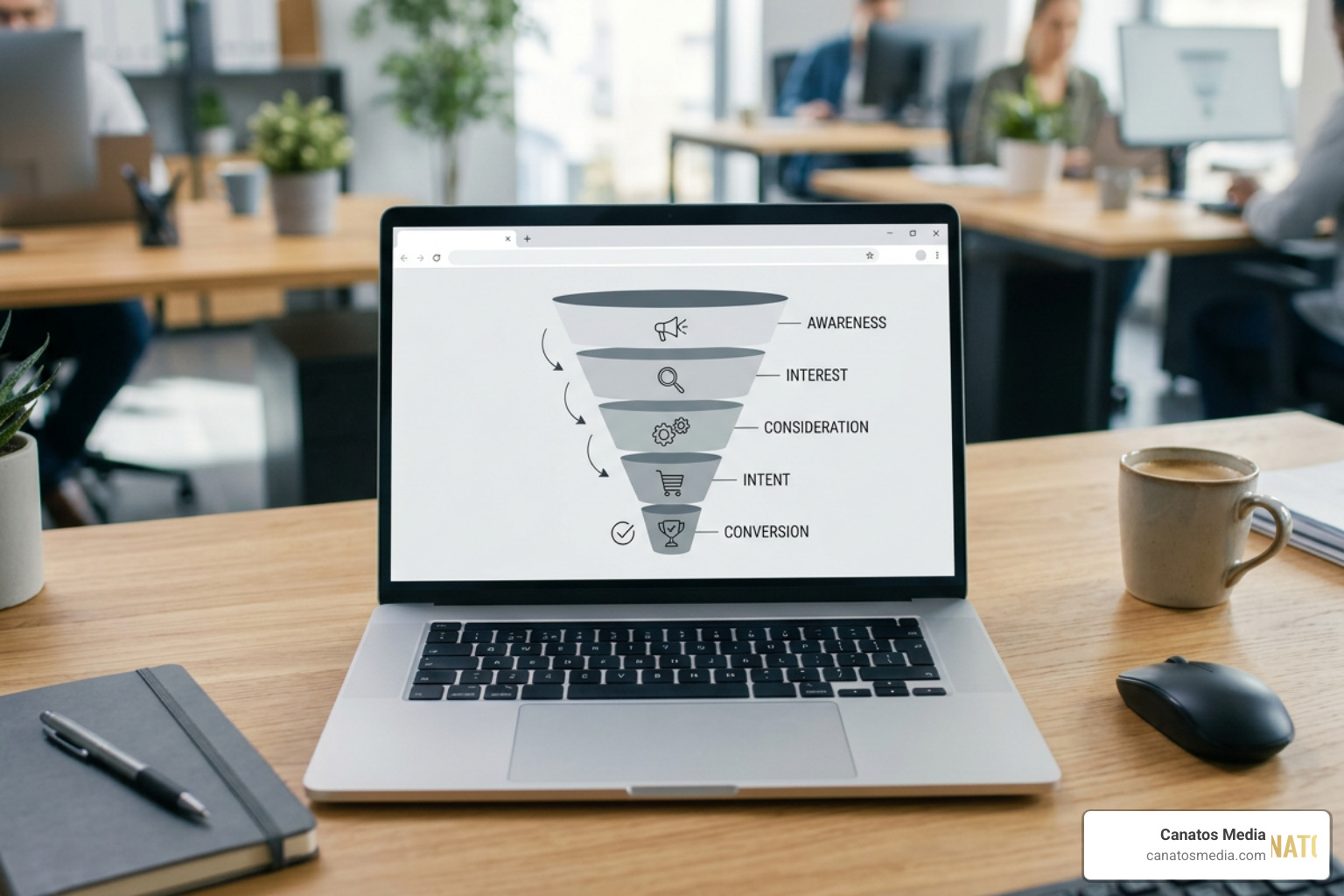
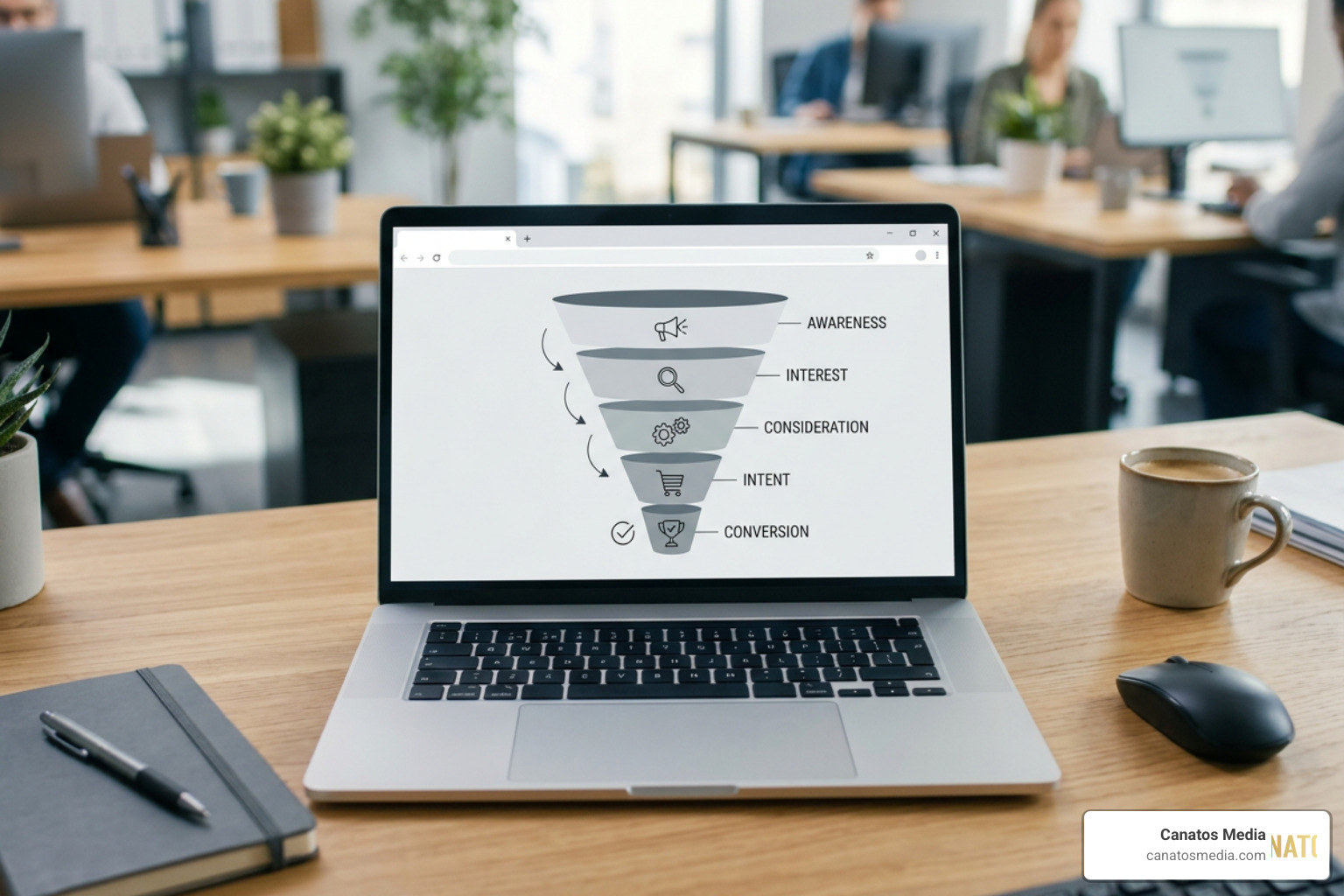
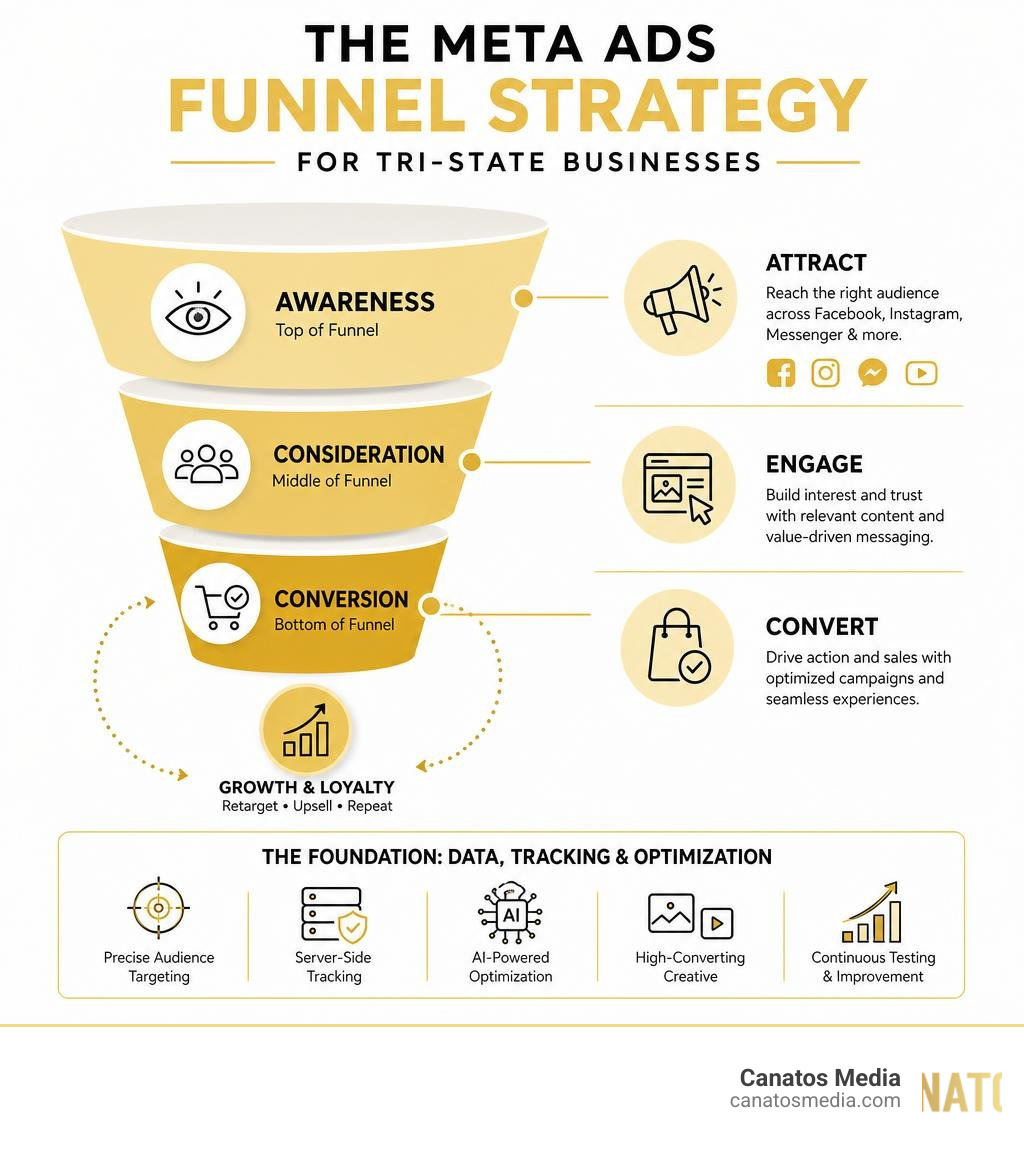
- Strategic Planning & Funnel Architecture: Mapping out the customer journey. We design full-funnel strategies that move users from cold awareness (prospecting) to mid-funnel consideration (engagement/lead generation) to bottom-funnel conversion (sales/retargeting).
- Creative Production & Copywriting: Building visual assets—specifically cinematic short-form videos, user-generated content (UGC), and high-impact carousels—paired with persuasive, brand-aligned copy.
- Media Buying & Algorithmic Optimization: Setting up campaigns within the ad auction, configuring bidding strategies (such as Cost Cap or Value Optimization), and letting Meta’s AI optimize delivery.
- Tracking & Data Infrastructure: Installing and maintaining the technical tools required to feed accurate data back to Meta’s algorithm.
These campaigns are managed using two primary platforms: Meta Business Suite and Meta Ads Manager. While Meta Business Suite acts as a centralized dashboard for organic content and basic business operations, Meta Ads Manager is the heavy-duty workspace where media buyers build, test, and scale campaigns.
To understand how these platforms operate, you can read our guides on Mastering Meta Business Suite Ads Manager for Beginners and How to Navigate Meta Ad Manager Like a Pro. For the official platform documentation, you can explore the Marketing Tools and Advertising Solutions on Facebook and … – Meta resource page.
What Are the Different Meta Ads Management Options Available to Businesses?
When deciding how to manage your Meta advertising, you have four primary paths. Each option has distinct trade-offs regarding cost, time commitment, creative capability, and scalability.

| Management Option | Typical Monthly Cost | Time Commitment | Creative Production | Best Suited For |
|---|---|---|---|---|
| DIY (Self-Service) | $0 (Only ad spend) | Very High (15-25 hrs/week) | Limited (Canva templates, basic photos) | Startups spending under $1,500/month |
| Freelance Specialists | $500 – $2,000/month | Low | Variable (Often requires you to provide assets) | Small businesses with simple lead-gen needs |
| AI-Powered Automation | $200 – $1,200/month | Low | None (Relies on existing assets) | E-commerce brands looking for basic optimization |
| Professional Agency | $2,000 – $15,000+ (or % of spend) | None | High (Cinematic video, UGC, design) | Businesses spending $3,000+/month seeking scale |
1. DIY Self-Management
Managing campaigns yourself is highly cost-effective for businesses in their infancy. However, it requires a steep learning curve. Business owners often find themselves spending 15 to 25 hours a week troubleshooting technical issues, writing copy, and analyzing data, which pulls them away from running their actual business.
2. Freelance Specialists
Hiring a freelance media buyer can bridge the gap between DIY and an agency. Freelancers are often highly skilled in technical setup and bid management. However, they rarely have the resources to handle high-end creative production, meaning you will still need to supply them with videos, images, and copy.
3. AI-Powered Automation Tools
AI tools offer a middle ground by automating bid adjustments, audience expansion, and basic budget allocation. While excellent for technical efficiency, these tools cannot build a cohesive brand strategy, write emotionally resonant copy, or produce cinematic video content.
4. Professional Digital Marketing Agencies
A full-service agency provides an integrated, “done-for-you” solution. Agencies handle everything from technical tracking and media buying to high-end creative production and strategic positioning.
When Should You Transition to an Agency?
If your monthly ad spend exceeds $1,500 to $3,000, transitioning to professional management is highly recommended. Below this spend level, the data volume is often too low for Meta’s algorithm to exit its “learning phase” efficiently, and errors in targeting or tracking can quickly drain your budget.
At Canatos Media, we provide an integrated agency solution specifically tailored for businesses in the Tri-State area and Long Island. We don’t just push buttons in Ads Manager; we align your high-end cinematic short-form video content with advanced paid social strategies to build a sustainable customer acquisition engine. You can explore our full range of services in our Category Ad Management section.
How Do Professional Agencies Optimize Targeting and Ad Creatives?
In 2026, the old way of laser-targeting specific interests—such as trying to target “32-year-old females in Long Island who love green smoothies and yoga”—is dead. Hyper-targeting restricts Meta’s machine learning, driving up cost-per-thousand-impressions (CPMs) and preventing campaigns from scaling.
Today, professional agencies rely on algorithmic targeting through tools like Advantage+ Audience and Andromeda AI. We feed Meta’s algorithm a broad audience, and the machine uses real-time behavioral signals to find the exact users most likely to convert.
Because targeting has become automated, your ad creative is now your primary targeting tool. The visual hook, the messaging, and the aesthetic style of your ad determine who stops scrolling and who gets bypassed.

To optimize ad creatives, professional agencies focus on:
- Cinematic Short-Form Video & UGC: Highly polished, cinematic short-form video combined with authentic, user-generated content (UGC) style ads outperform traditional corporate commercials. They feel native to platforms like Instagram Reels and TikTok, capturing attention without feeling like an aggressive sales pitch. To see how we execute this, read How Cinematic Short Form Content Improves Meta Paid Ad Performance and learn How to Scale Short Form Ad Creative Across Meta and Google Ads.
- The 3-Second Hook: The first three seconds of a video ad determine 50% of its success. Agencies test multiple “hooks” (both visual and text-based) to see what stops the scroll.
- Structured A/B Testing: We use a systematic testing framework. Instead of guessing, we launch “concepts” (a single creative idea) with three distinct variations (different hooks, background music, or call-to-actions). We set strict financial cut-offs: if an asset does not hit our target key performance indicators (KPIs) within a set budget, we cut it and scale the winners.
For a deeper look at how these creative and structural elements work together in modern campaigns, you can watch The COMPLETE Meta Tutorial (Meta Ads, Meta Business … – YouTube .
How Do Agencies Handle Tracking, Budgeting, and Compliance?
Behind every beautiful ad creative lies a complex technical infrastructure. Professional agencies manage three critical pillars to ensure your campaigns run smoothly: tracking, budget optimization, and policy compliance.
1. Server-Side Tracking (Conversions API)
Ever since Apple introduced iOS 14.5, browser-based tracking (the traditional Meta Pixel) has lost its reliability, frequently missing 30% to 50% of conversion events. To combat this, agencies implement the Meta Conversions API (CAPI).
CAPI creates a direct, server-to-server connection between your website and Meta. This ensures accurate attribution, improves your Event Match Quality, and feeds clean data back to Meta’s AI. This technical upgrade alone can drop your cost-per-result by 15% to 40%. If you are still relying solely on the browser pixel, you are likely wasting a significant portion of your budget. Learn how to fix this in our guide on how to Stop Burning Cash on Bad Meta Ads.
2. Budget Optimization Strategies
Agencies utilize two primary budgeting methods depending on the campaign’s maturity:
- Campaign Budget Optimization (CBO): Meta automatically distributes your budget across different ad sets in real time, favoring the highest-performing audiences.
- Ad Set Budget Optimization (ABO): The budget is locked at the ad set level, which is ideal for controlled A/B testing of specific audiences or creative concepts.
When scaling budgets, agencies avoid making massive, sudden budget increases. Raising a budget by more than 20% to 30% at once can trigger a “learning phase reset,” forcing Meta’s algorithm to restart its optimization process from scratch. We scale budgets incrementally every week to maintain stable performance.
3. Compliance and Advertising Standards
Meta enforces strict Advertising Standards to protect its users. Getting your ad account flagged or disabled can paralyze your business. Agencies ensure strict compliance by avoiding prohibited content (such as deceptive claims, low-quality landing pages, or clickbait) and navigating restricted categories (like housing, employment, finance, or social issues) which require special ad category declarations and age targeting restrictions.
How Much Do Meta Ads Management Services Cost in 2026?
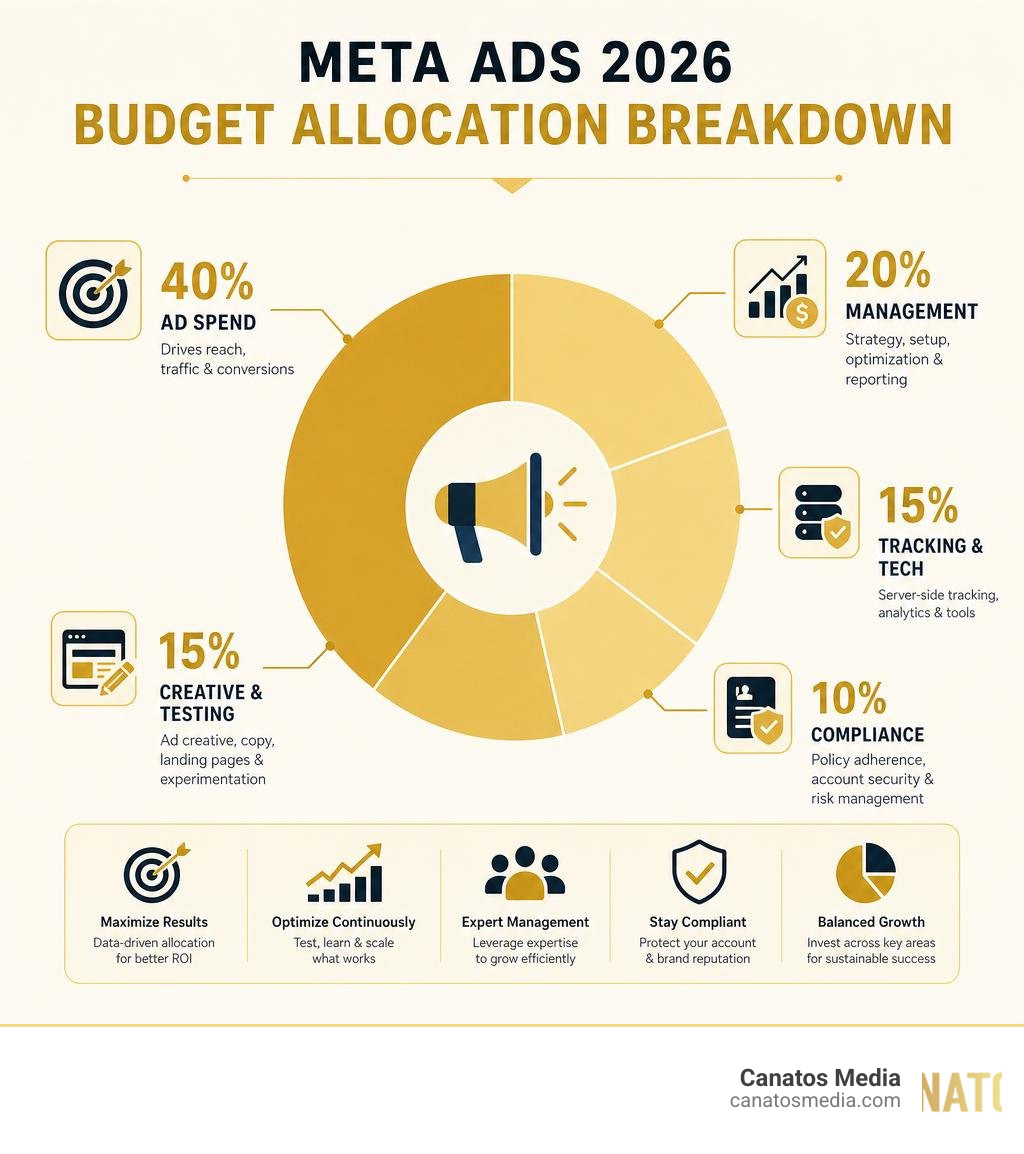
Understanding the total cost of Meta advertising requires looking at both platform costs (what you pay Meta to show your ads) and management costs (what you pay an agency or tool to run them).
2. Platform Benchmarks (June 2026)
- Median Cost Per Click (CPC): $1.12 (up roughly 8% year-over-year)
- Average Cost Per Thousand Impressions (CPM): $12.50
- Cost Per Lead (CPL): Ranges from $25 in e-commerce to $180+ in highly competitive B2B or financial services.
2. Agency Pricing Models
Agencies generally charge using one of three structures:
- Flat Monthly Fee: A predictable monthly retainer (typically starting around $1,500 to $5,000+ depending on scope). We strongly advocate for flat fees because they eliminate the conflict of interest inherent in other models; we want to focus on growing your revenue, not just inflating your ad spend.
- Percentage of Ad Spend: The agency charges a fee (usually 15% to 25%) of your total monthly ad budget, often with a minimum base fee of $2,000.
- Performance-Based / Hybrid: A lower base fee combined with a percentage of generated revenue or leads (typically 10% to 20% of the return).
3. Hidden Costs to Keep in Mind
When planning your budget, platform spend and management fees are only part of the equation. You must also account for:
- Creative Production: High-quality video and design assets can cost between $1,000 and $8,000+ per month if sourced externally.
- Software Subscriptions: Third-party tracking, attribution tools, and creative software can add $200 to $1,200/month.
- Testing Budgets: You should allocate 20% to 40% of your initial budget purely to testing hooks, angles, and audiences.
For a comprehensive breakdown of budgeting and pricing structures, read our Meta Ads Management Ultimate Guide.
How Do Meta Ads Integrate With Your Broader Digital Marketing Strategy?
Meta Ads do not operate in a vacuum. To maximize your return on investment, paid social must be integrated into a holistic, multi-channel digital marketing strategy.
The Synergy Between Meta and Google Ads
One of the most powerful digital marketing combinations is pairing Meta Ads with Google Ads.
- Meta Ads Create Demand: Social media is a discovery engine. Users scrolling through Instagram Reels aren’t actively shopping; your creative interrupts their scroll and introduces a desire or solution they didn’t know they needed.
- Google Ads Capture Demand: Once a user is introduced to your brand on Meta, they often open a new tab and search for your business or product on Google. If you do not have search ads or strong SEO in place, your competitors will capture that high-intent traffic.
We call this the “handshake” between paid social and paid search. You can read more about this powerful combination in our guide on Meta Google Advertising.
Integrating with SEO, Content, and Email Marketing
An integrated strategy connects all digital touchpoints:
- SEO & Content: High-performing organic blog posts and website content provide excellent landing pages for your Meta campaigns. Conversely, data from your paid ads can reveal which headlines and topics get the highest click-through rates, guiding your organic content strategy.
- Email Marketing: Meta lead generation campaigns are highly effective for building your email list. Once a user opts in, automated email sequences can nurture those leads, driving down your overall customer acquisition cost (CAC).
To see how these channels work together step-by-step, review our Step-by-Step Guide to Paid Ads and explore The Ultimate Guide to Social Media Ads.
What Are the Most Frequently Asked Questions About Meta Ads Management?
What is the minimum budget required to start with Meta Ads?
While Meta technically allows you to run ads for as little as $1 per day per ad set, a practical budget for businesses looking to grow is at least $30 to $50 per day ($900 to $1,500 per month) for testing, and $50 to $150+ per day for active sales or lead generation campaigns.
Accounts spending under $30 per day often experience 40% to 60% higher costs per result. This happens because the budget is too small to generate the volume of conversion data (ideally 50 conversions per week per ad set) that Meta’s algorithm needs to optimize and exit the learning phase.
How long does it take to see results from professional Meta Ads management?
We recommend evaluating Meta campaigns on a 90-day optimization timeline:
- Weeks 1–2 (Onboarding & Setup): Installing the Conversions API, auditing past data, and producing initial creative assets.
- Weeks 3–4 (Testing & Learning): Launching initial campaigns. Actionable data begins to accumulate as the algorithm tests different creative hooks and audiences.
- Weeks 5–8 (Optimization): Turning off underperforming creatives, scaling winning ad sets, and refining the retargeting funnel.
- Weeks 9–12 (Iterative Scaling): Consistently growing the budget on winning concepts while maintaining a stable ROAS.
Why is my Meta ad account getting rejected, and how do I fix it?
Ad rejections typically occur due to violations of Meta’s Advertising Standards. Common culprits include:
- Deceptive or Exaggerated Claims: Promising unrealistic results (e.g., “lose 10 pounds in 3 days” or “double your income overnight”).
- Low-Quality Landing Pages: Your ad must match the destination page. If your landing page is slow, broken, or covered in pop-up ads, Meta will reject the ad.
- Personal Attributes: You cannot imply that you know a user’s personal characteristics (e.g., “Are you struggling with debt?” or “As a 40-year-old woman…”).
If your ad is rejected, do not delete it. Go to the Account Quality dashboard in Meta Business Suite, review the specific policy violation, edit the ad to comply, or request a manual review if you believe the automated rejection was an error.
How Can You Get Started With Meta Ads Management Today?
Choosing the right Meta ads management option comes down to your current stage of business growth:
- If you are spending under $1,500/month, start with a DIY approach or basic AI tools while focusing heavily on capturing authentic, raw smartphone video content.
- If you are spending over $3,000/month and want to scale without spending dozens of hours managing campaigns, hiring a professional agency is the most effective path forward.
At Canatos Media, we serve businesses across the Tri-State area and Long Island by providing a fully integrated marketing solution. We don’t believe in isolated strategies. We combine cinematic short-form video production, expert paid media management (Meta and Google), SEO, and website support to build cohesive, high-converting acquisition funnels.
Ready to stop guessing and start scaling? Book a discovery call with Canatos Media today to see how we can turn your social presence into a powerful revenue engine.